Blessed Stefan Wyszyński
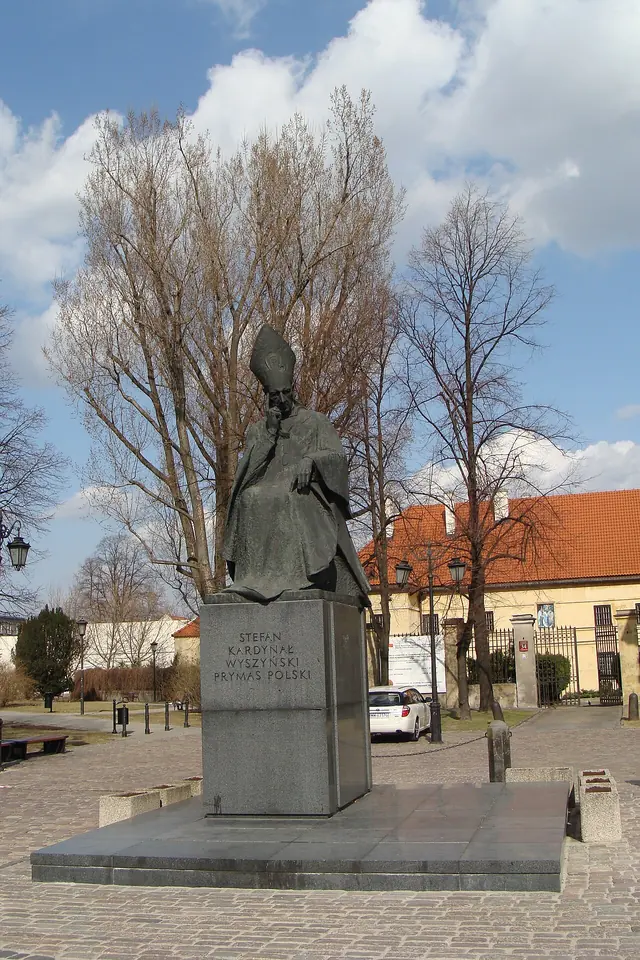
Blessed Stefan Wyszyński (1901 to 1981), Cardinal Wyszyński, was the Primate of Poland from 1948 until his death, who led the Church through the Communist years, spent three years as a prisoner of the regime (1953 to 1956), and prepared his nation for the millennium of its baptism in 1966, earning the title Primate of the Millennium. He was beatified in Warsaw on September 12, 2021. He is Blessed, not yet a canonized saint, and his memorial is May 28.
Blessed Stefan Wyszyński led the Catholic Church in Poland for thirty-three years, through Stalinism, prison and the long gray decades of Communist rule, until the year a Polish pope stood in St. Peter's Square. Poles call him the Primate of the Millennium. When he died in 1981, St. John Paul II said, as the Cardinal Stefan Wyszyński University recalls, "God gives such a father, shepherd and primate once in a thousand years." The Church beatified him in Warsaw on September 12, 2021, so we honor him as Blessed, and we keep his memorial on May 28.
On the day of the beatification, Pope Francis, celebrating Mass in Budapest, spoke of him at the Angelus:
Cardinal Wyszyński, the Primate of Poland, who was arrested and imprisoned, was always a courageous pastor according to the heart of Christ and a herald of freedom and human dignity.

Who was Stefan Wyszyński?
He was born on August 3, 1901, in Zuzela on the Bug River, in the part of Poland then ruled by Russia, the son of the village organist. His mother died when he was nine. The university that bears his name says he "transferred his love for his mother to the Mother of God," and that he chose to say his first Mass, on August 5, 1924, at the shrine of Our Lady of Częstochowa at Jasna Góra rather than at home, "to always have a mother, a mother who does not die."
He was ordained on August 3, 1924, at Włocławek, earned a doctorate in canon law at the Catholic University of Lublin, and threw himself into Catholic social teaching, working with the Christian trade unions and editing a journal for priests. During the war he served as chaplain to the Home Army and to the institute for the blind at Laski, near Warsaw, where he worked alongside Mother Elżbieta Róża Czacka, who was beatified with him.
"You will love"
During the Warsaw Uprising of 1944, Cardinal Semeraro told the crowd at the beatification, Father Wyszyński picked up a half-burned scrap of paper that the wind had carried to Laski from the burning capital. On it were the words "You will love." He took it to the chapel and showed the sisters: "This is the holiest appeal of fighting Warsaw to us and the entire world. An appeal and a testament: You will love." Semeraro said he lived his whole ministry in answer to it.

Primate of Poland
In 1946 Pius XII made him bishop of Lublin, and in November 1948, at only 47, he was appointed archbishop of Gniezno and Warsaw and Primate of Poland. He did not want the post. He wrote to the pope that the times required "a man who is fully and perfectly a man of God, ready for any sacrifice." The university's biography notes that over time he became exactly that. His episcopal motto was Soli Deo, "To God Alone."
Non possumus and prison
In February 1953 the Communist state decreed that it would control appointments to church offices. The bishops' reply, which the Primate made his own, was Non possumus, "We cannot": "We are not allowed to put the things of God on Caesar's altars." Pius XII had named him a cardinal that January. On September 25, 1953, he was arrested at night and held for three years in a series of places: Rywałd, the monastery at Stoczek in Warmia, Prudnik, and finally the convent of the Nazareth sisters at Komańcza in the Carpathian hills. At Stoczek, on December 8, 1953, he made a personal act of consecration to the Virgin Mary. Semeraro recalled one of his sayings from those years: "Whoever hates, has already lost."

The Jasna Góra Vows and the Great Novena
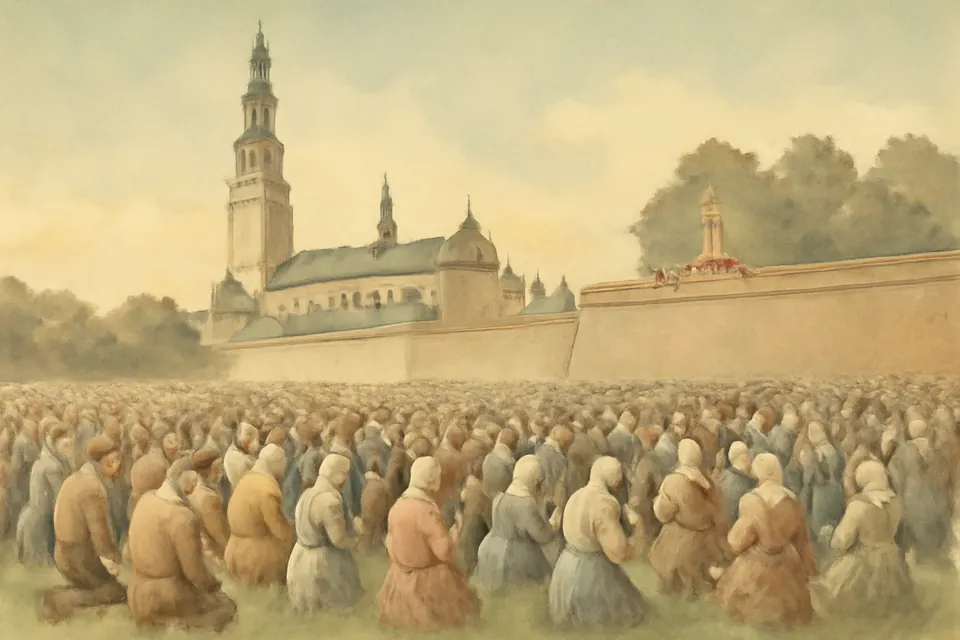
At Komańcza, in the spring of 1956, he wrote the text of the Jasna Góra Vows of the Nation, renewing the vows King John Casimir had made to the Mother of God three hundred years earlier. On August 26, 1956, about a million pilgrims made those vows at Jasna Góra while their Primate was still a prisoner. In prison he also drew up the Great Novena, nine years of prayer and teaching that led to the celebration of the millennium of Poland's baptism in 1966. He was released in October 1956.


The Polish pope
Wyszyński helped secure the appointment of Karol Wojtyła as archbishop of Kraków in 1964, and he lived to see him elected pope in 1978. John Paul II wrote to his countrymen a few days later that "this Polish pope... would not be on Peter's chair were it not for your faith which did not retreat before prison and suffering." In 1965 Wyszyński also signed the Polish bishops' letter of reconciliation to the German bishops, which began the long work of Polish-German reconciliation.

His death and beatification
He died of cancer on May 28, 1981, two weeks after John Paul II was shot in St. Peter's Square. His funeral in Warsaw on May 31 was, in the university's words, "a great religious and patriotic manifestation."
His cause for beatification opened in May 1989. Pope Francis declared his heroic virtues in December 2017. In October 2019 he approved a miracle, the approved healing in 1989 of a 19-year-old woman from thyroid cancer after a community of sisters prayed through the cardinal. The beatification was set for June 2020, postponed by the pandemic, and celebrated on September 12, 2021, at the Temple of Divine Providence in Warsaw, by Cardinal Marcello Semeraro for the pope. The healed woman, Sister Nulla, carried his relics to the altar. His memorial was set for May 28.
Praying with Blessed Stefan Wyszyński
As a Blessed, he may be honored publicly where the Church allows, especially in Poland, and every Catholic may ask his prayers privately. We have not found a prayer for his intercession in English with a source we can verify, so we offer none under his name. Let us take his own short rule as our prayer: Soli Deo, to God alone. And let us ask Blessed Stefan Wyszyński to pray for Poland, for the persecuted Church, for prisoners of conscience, and for all of us who are tempted to hate: "Whoever hates, has already lost."
You may also want to read about Our Lady of Częstochowa, whose shrine was the center of his life, and St. Maximilian Kolbe, another Polish priest who answered hatred with love.
Frequently asked questions
Is Stefan Wyszyński a saint?
Not yet. He was beatified on September 12, 2021, in Warsaw, so the Church calls him Blessed Stefan Wyszyński. Canonization, which would make him a saint, would require a second miracle attributed to his intercession and approved after the beatification.
What miracle led to Cardinal Wyszyński's beatification?
The healing of a 19-year-old woman from thyroid cancer in 1989, after a community of Polish sisters prayed for her through the cardinal's intercession. Pope Francis approved the miracle in October 2019. The woman, now Sister Nulla, carried his relics to the altar at the beatification Mass.
When is the feast of Blessed Stefan Wyszyński?
May 28, the day he died in 1981. The memorial was announced at the beatification Mass and is kept in Poland.
Why is he called the Primate of the Millennium?
Because he led the Church in Poland through a nine-year program of prayer and renewal, the Great Novena, that prepared the whole country for the thousandth anniversary of Poland's baptism in 966, celebrated in 1966. He began planning it while he was a prisoner.
Why was Cardinal Wyszyński imprisoned?
In 1953 the Communist government issued a decree giving the state control over church appointments. Wyszyński and the bishops answered "Non possumus," we cannot. He was arrested in September 1953 and held until October 1956 at Rywałd, Stoczek, Prudnik and Komańcza.
What was his motto?
Soli Deo, which means "To God Alone."
Sources
- Cardinal Stefan Wyszyński University in Warsaw: Patron of the University. His childhood and his mother's death in 1910, first Mass at Jasna Góra, ordination August 3, 1924, Lublin 1946, Primate 1948, Non possumus, imprisonment 1953 to 1956, the Jasna Góra Vows and Great Novena, his death, the cause opened in 1989, heroic virtues 2017, miracle 2019
- Polish Bishops' Conference: Card. Semeraro's homily at the beatification (September 12, 2021). The burned scrap of paper ("You will love"), "Whoever hates, has already lost," Soli Deo
- Angelus News (CNA): Cardinal Wyszynski and Mother Czacka beatified in Poland. Pope Francis's Angelus words, Sister Nulla, the memorial on May 28
- National Catholic Register: Cardinal Wyszynski, Poland's Primate of the Millennium, to be Beatified in September (2021). The 1989 cure of a 19-year-old woman with thyroid cancer