St. Nicholas of Myra
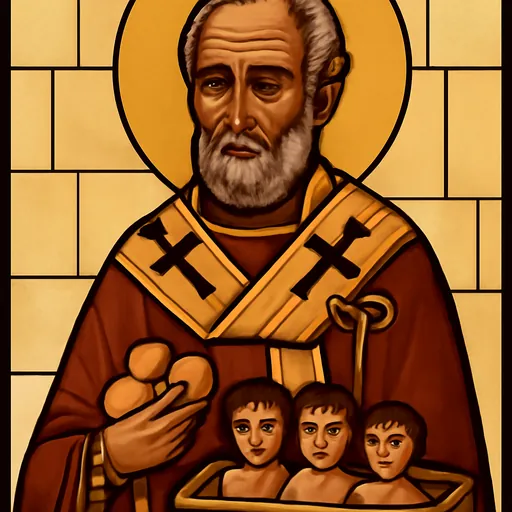
St. Nicholas was a 4th-century bishop of Myra, in present-day Turkey, remembered for secret generosity to the poor. His feast day is December 6. Stories of his gift-giving grew into the European tradition of Sinterklaas and, in America, Santa Claus. He is the patron saint of children, sailors and merchants.
Who was St. Nicholas?
Nicholas was born around the year 270 in Patara, a port town in Lycia on the southern coast of what is now Turkey. Tradition says his parents were wealthy Christians who died when he was young, leaving him a large inheritance. He resolved to use it for the poor.
He became bishop of the nearby city of Myra. He lived through the last great Roman persecution of Christians under Emperor Diocletian, and early accounts say he was imprisoned for his faith before Constantine ended the persecution. He died in Myra on December 6, around the year 343.
Very little about Nicholas can be proven from documents written in his own lifetime. Most of what we know comes from accounts written a century or more after his death. Even so, devotion to him spread faster and wider than to almost any other saint, first across the Greek-speaking East and then through all of Europe.
The miracles and legends of St. Nicholas
Nicholas is called "the Wonderworker" in the Eastern churches because so many miracle stories gathered around his name. All of the stories below are traditional: they come from his legend, not from formal Church investigation.
Three bags of gold
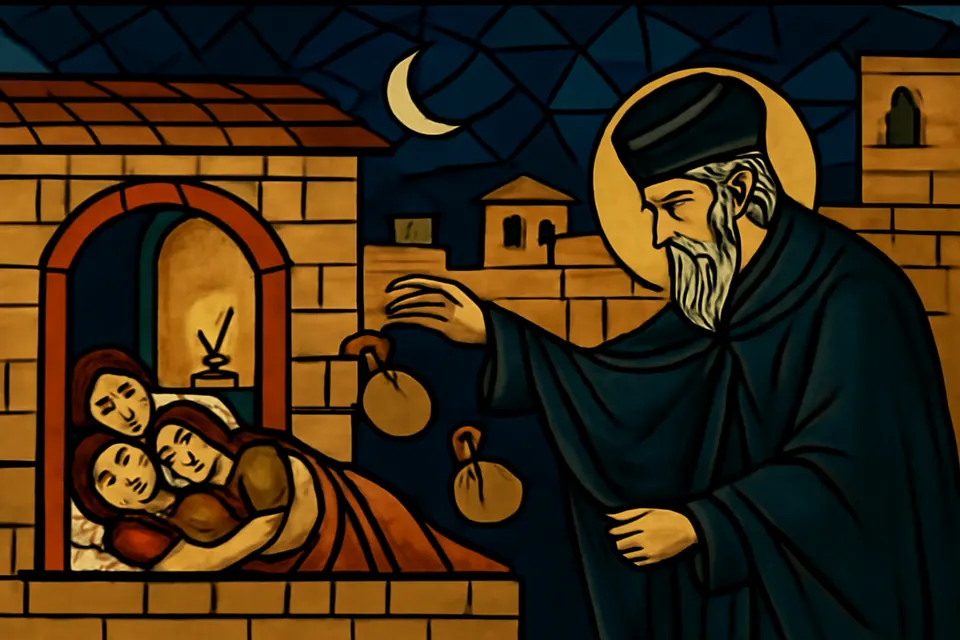
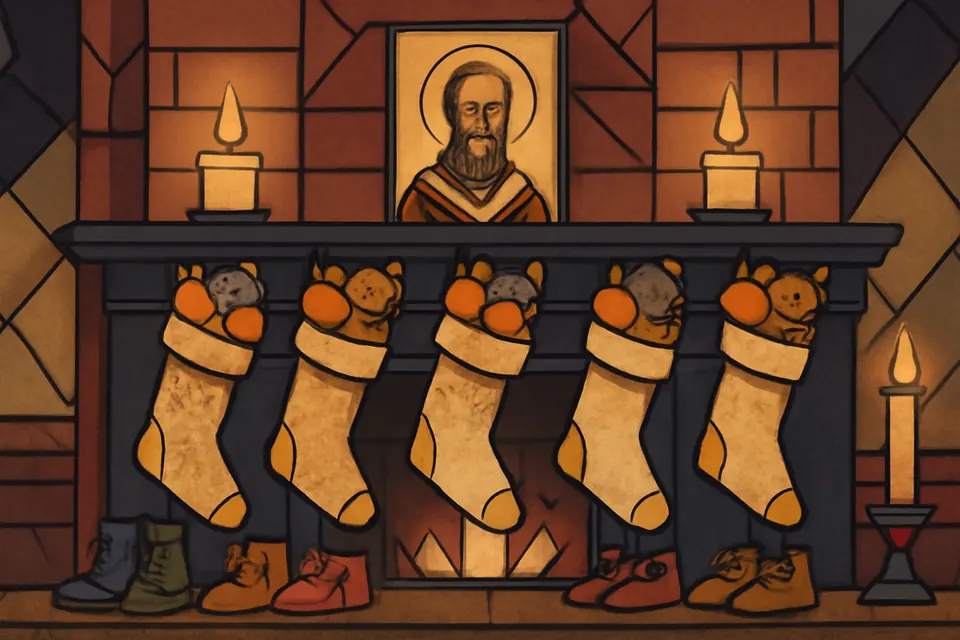
The best-known story tells of a poor man with three daughters and no money for their dowries. Without dowries they couldn't marry and faced being sold into slavery or prostitution. On three nights Nicholas secretly tossed a bag of gold through the family's window, one for each daughter. On the third night the father caught him and Nicholas asked him to tell no one. In some versions the gold lands in stockings drying by the fire, which is one origin of the Christmas stocking.
Saving three innocent men
An early account, the Praxis de stratelatis, tells how Nicholas stopped the execution of three innocent men in Myra by grabbing the executioner's sword. The same story says three imperial officers later called on him in prayer when they were falsely condemned, and Nicholas appeared to Emperor Constantine in a dream to win their release.
Calming the storm
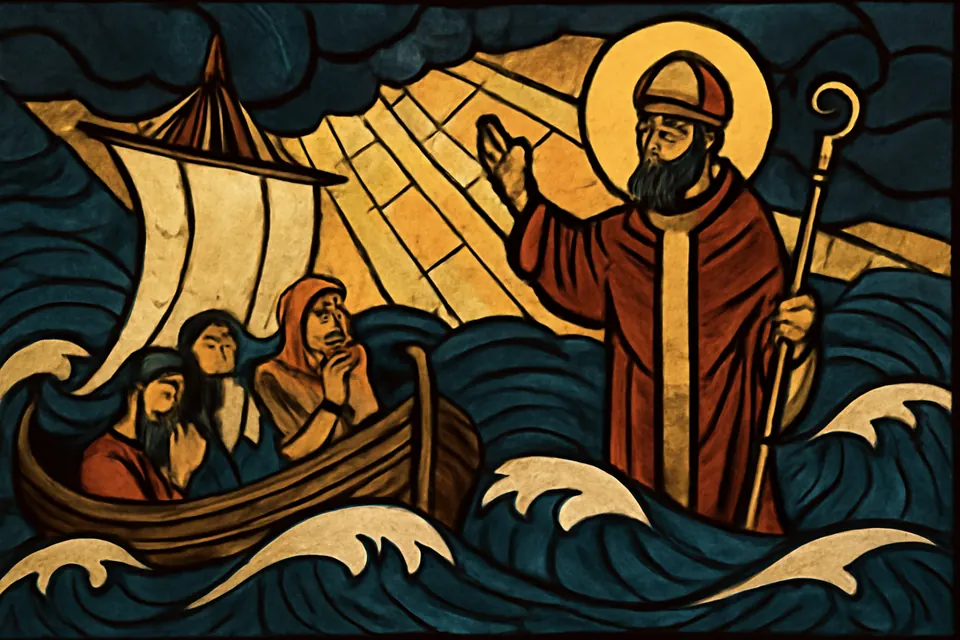
Sailors caught in a storm off Lycia are said to have prayed to Nicholas. He appeared on deck, helped with the rigging and calmed the sea. This is why he became the patron saint of sailors, and why many Greek and Italian port churches are dedicated to him.
The three boys
A much later medieval legend tells of three boys murdered by an innkeeper during a famine. Nicholas discovered the crime and raised them back to life. It made him the patron of children and students, and explains why he is often painted beside three children in a tub.
The Council of Nicaea
Nicholas is traditionally listed among the bishops at the Council of Nicaea in 325. A popular story says he struck the heretic Arius there. The oldest lists of the council's bishops don't include his name, and the slap appears only in much later sources, so most historians treat it as legend.
The myrrh of St. Nicholas
The Basilica of San Nicola in Bari reports that a clear liquid, called the manna or myrrh of St. Nicholas, gathers in his tomb. It is collected each year on May 9, the feast of the arrival of his relics in Bari, and given to pilgrims in small bottles. This is a reported phenomenon tended by the basilica, not a formally declared miracle.
Relics in Bari
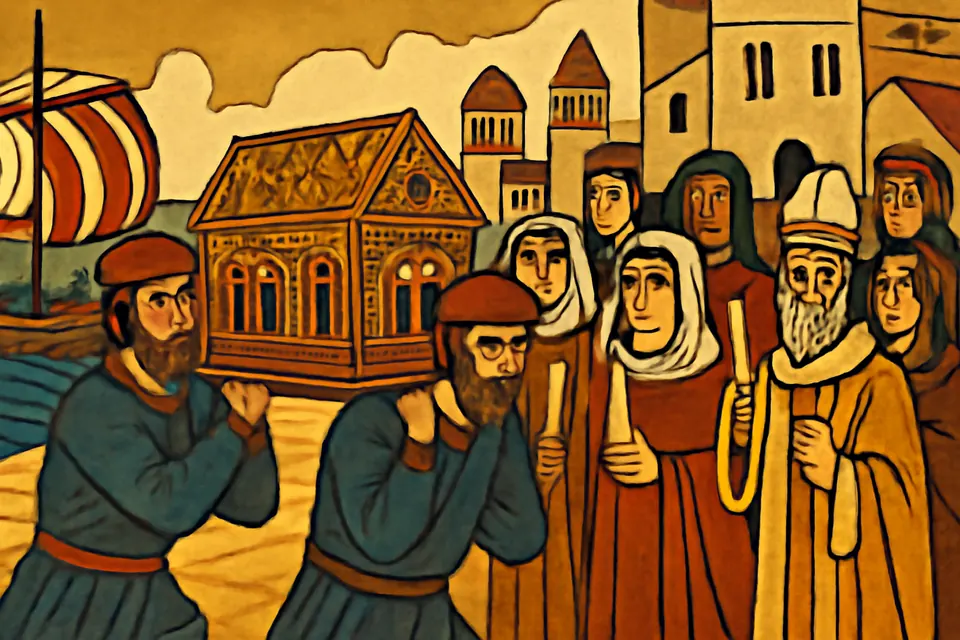
In 1087, as Seljuk Turks overran Asia Minor, sailors from Bari in southern Italy took most of Nicholas's bones from his tomb in Myra and brought them home. The Basilica of San Nicola was built to house them, and Bari has been the center of his devotion in the West ever since. Venice says its sailors took the remaining fragments a few years later. Because Bari is one of the few places in the Catholic world where Orthodox Christians regularly come on pilgrimage, the basilica has long been a meeting point between the two churches.
From St. Nicholas to Santa Claus
By the Middle Ages, St. Nicholas Day was a festival for children across Europe, marked with small gifts left in shoes. In the Netherlands, Sinterklaas still arrives each year in bishop's robes. Dutch settlers carried the custom to New Amsterdam. In the 1800s, American writers and artists turned him into the jolly Santa Claus and moved his visit to Christmas Eve. Many families still keep December 6 with chocolate coins and oranges, reminders of the gold he gave away.
How St. Nicholas is honored
- Feast day: December 6 in the Catholic, Orthodox and Anglican calendars.
- Translation of relics: May 9, especially in Bari and in the Orthodox churches.
- Customs: shoes or stockings set out on the evening of December 5, small gifts, and charity done in secret in his name.
Prayer to St. Nicholas
The Eastern churches sing this short hymn, the troparion of St. Nicholas, on his feast:
The truth of things hath revealed thee to thy flock as a rule of faith, an icon of meekness, and a teacher of temperance;
for this cause thou hast achieved the heights by humility, riches by poverty.
O Father and Hierarch Nicholas, intercede with Christ God that our souls be saved.
Catholics often ask for his intercession in their own words, especially for children, for travelers at sea and for the poor.
Symbols of St. Nicholas in art
In Western art Nicholas usually wears a bishop's miter and cope and holds three gold balls or purses. Eastern icons show him as an older bishop with a short white beard, wearing an omophorion, a stole marked with crosses, and holding the Gospels. An anchor or ship points to his patronage of sailors.
Frequently asked questions
Is St. Nicholas the same as Santa Claus?
Santa Claus grew out of St. Nicholas. Dutch settlers brought their Sinterklaas customs to New Amsterdam (New York), and 19th-century American writers and illustrators turned him into the Santa Claus known today. The historical Nicholas was a bishop, not a toymaker from the North Pole.
When is St. Nicholas Day?
December 6, the traditional date of his death. Many families in Europe and America put out shoes or stockings on the evening of December 5 to find small gifts the next morning.
Where is St. Nicholas buried?
Most of his relics are in the Basilica of San Nicola in Bari, Italy. Sailors from Bari carried them from Myra in 1087. Venice also claims a portion of his relics.
What is St. Nicholas the patron saint of?
Children, sailors, merchants, students, pawnbrokers and unmarried women, along with cities and countries including Bari, Russia and Greece.
Why is St. Nicholas shown with three gold balls?
The balls stand for the three bags of gold he is said to have secretly given a poor father so his three daughters would have dowries. Pawnbrokers later adopted three gold balls as their sign.
Sources
- Catholic Encyclopedia (1911): St. Nicholas of Myra
- Basilica di San Nicola, Bari (official site)
- St. Nicholas Center, history and traditions
- Butler's Lives of the Saints, December 6
- Roman Martyrology, December 6