Buenos Aires Eucharistic miracle
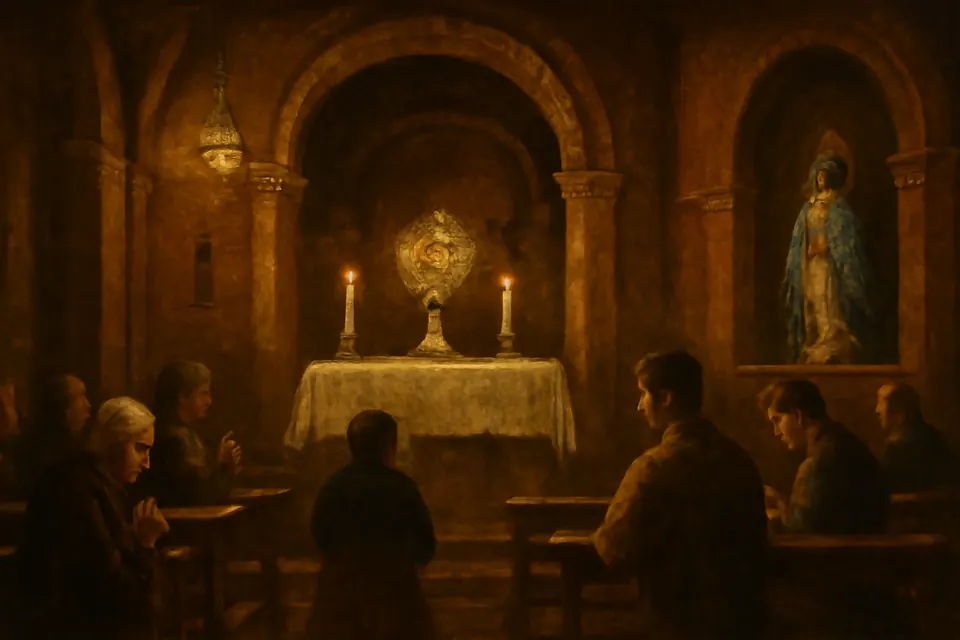
The Buenos Aires Eucharistic miracle is the name given to events at the parish of Santa María in Buenos Aires, above all a consecrated Host that, in August 1996, was placed in water and later appeared as bloodlike tissue. A pathologist later described a sample as human heart muscle. The Church has not formally approved it as a miracle; it remains reported.
On a busy avenue in Buenos Aires, between the neighborhoods of Almagro and Caballito, stands a red-brick church with a tall bell tower: the parish of Santa María. Its doors open at eight in the morning and close at nine at night, and someone is almost always kneeling inside before the Blessed Sacrament. The parish is known around the world for what Catholics call the Buenos Aires Eucharistic miracle. Its own pastor prefers a humbler word. "We don't call it a miracle," Fr. Alberto Vari told Crux in 2019. "We describe it as a 'sign.'"
Here is what happened, what was found, what has been questioned, and where the Church stands.
Status: reported. The Archdiocese of Buenos Aires has never declared these events a miracle, and no formal judgment of their supernatural character has been made. Many accounts online say otherwise; they are mistaken.
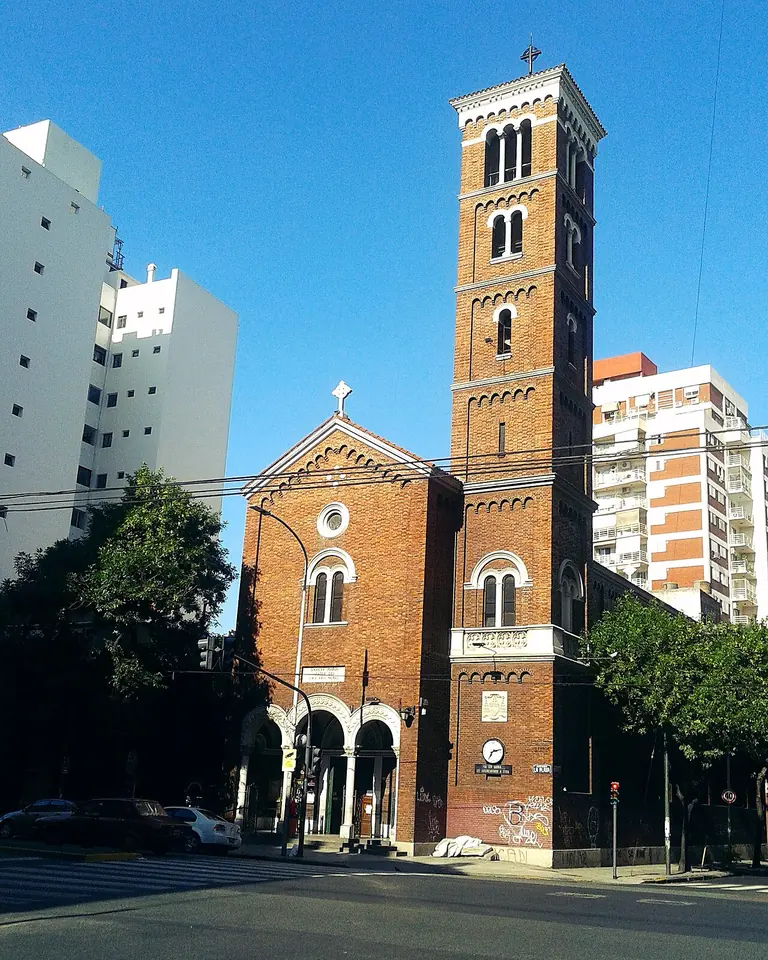
Three signs at one parish: 1992, 1994 and 1996
May 1992
The first event, as the parish tells it, came in the spring of 1992. After Mass a priest found two small pieces of a consecrated Host left on the altar. Following the Church's practice for a Host that cannot be consumed, he placed them in a chalice of water to dissolve and set the chalice in the tabernacle. A week later, on May 8, the feast of Our Lady of Luján, patroness of Argentina, he checked the chalice and found the water had turned deep red. An informal analysis at the time suggested blood, and little more was done. This is the material the parish still keeps, and calls the "1992 sign."
July 1994
Two years later, in July 1994, a Eucharistic minister distributing Communion at Mass said he saw a drop of blood fall inside a chalice. This is the least documented of the three events.
August 1996
The event that made Santa María famous came in August 1996. Accounts differ on the date: Crux and CNA place it on August 15, the Assumption, while the Polish priest Mieczysław Piotrowski, followed by Fr. Robert Spitzer, gives Sunday, August 18. A parishioner told the priest, Fr. Alejandro Pezet, that she had found a consecrated Host discarded on a candleholder at the back of the church. It was too soiled to consume, so he did what the Church asks: he placed it in a container of water in the tabernacle so that it would dissolve, after which the water is poured into the sacrarium.

When he opened the tabernacle on August 26, Spitzer writes, the Host had not dissolved. It appeared instead as a piece of bloody tissue, larger than the Host had been. Kelly Kearse, summarizing the published accounts, puts the change at about eleven days after the Host was placed in water.

Bishop Bergoglio's part
In 1996 Jorge Mario Bergoglio, the future Pope Francis, was one of the auxiliary bishops of Buenos Aires. The Vatican's biography records that John Paul II named him auxiliary in 1992 and that he succeeded Cardinal Quarracino as archbishop in 1998. Fr. Pezet reported what he had found to him. According to the account published by Piotrowski and summarized by Spitzer, Bergoglio asked that the Host be professionally photographed, which was done on September 6, 1996, and that it be kept in the tabernacle without publicity.
Three years later the tissue still had not decayed, and Bergoglio, now archbishop, asked for a scientific examination. On October 5, 1999, in the presence of his representatives, Ricardo Castañón Gómez took a sample. Kearse describes Castañón as a clinical psychologist who specialized in brain chemistry; Spitzer calls him a scientist and physician.
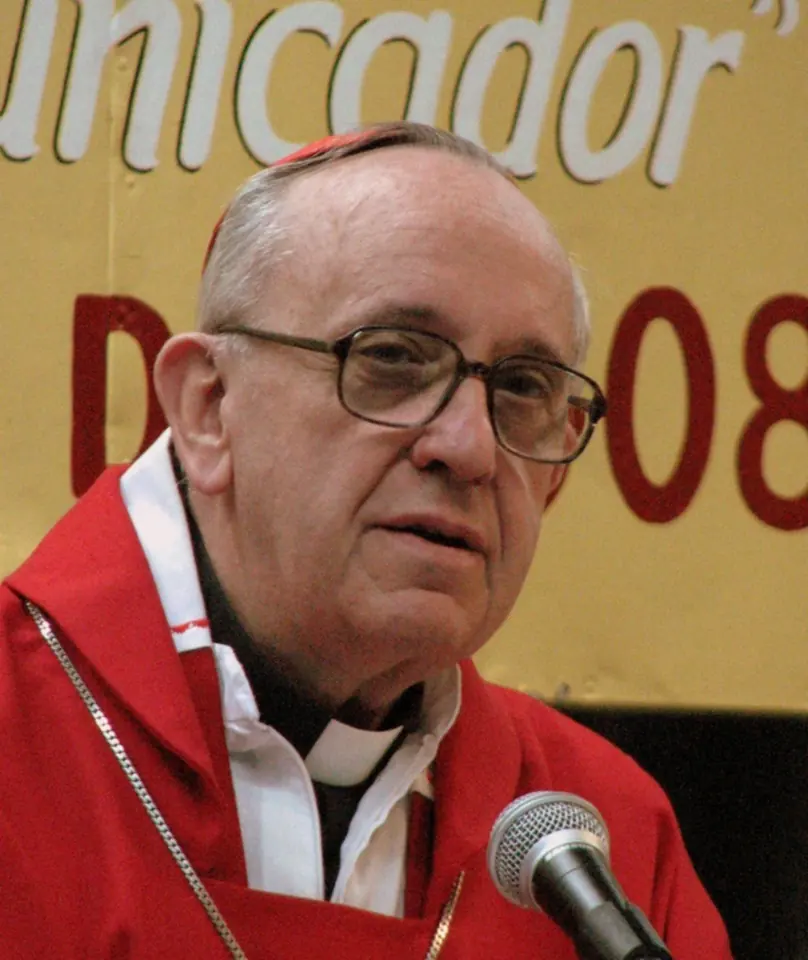
Bergoglio spoke of the events with reserve. Crux reports that, asked his opinion while he was still in Buenos Aires, he replied, "The Lord passed and left his mark," and that in a homily he described them as "Mary opening a space for us to encounter her son Jesus." Neither as archbishop nor later as pope did he issue a decree declaring a miracle.
The scientific studies
Samples were sent to several laboratories and experts between 1999 and 2005, and the accounts of who studied what are not fully consistent.
- Castañón's own analysis, according to CNA, reported human DNA and blood.
- Dr. Robert Lawrence, an American tissue specialist, reported in 2000 human skin and white blood cells in the samples, and in 2003 concluded the tissue came from an inflamed heart (CNA).
- Dr. Frederick Zugibe of Columbia University, a forensic pathologist and specialist in the heart, was asked by Castañón in 2005 to examine slides without being told their source. As quoted by Spitzer, he testified: "The analyzed material is a fragment of the heart muscle found in the wall of the left ventricle close to the valves." He found the muscle inflamed and full of white blood cells, which he said "indicates that the heart was alive at the time the sample was taken," and "as if the owner had been beaten severely about the chest."
Crux tells the story somewhat differently: it says the sample Castañón sent to laboratories in San Francisco, Sydney and New York came from the 1992 sign, and that the first two reports said only that it "could be" human tissue. These differences are one reason careful readers ask for the original reports.
For Fr. Spitzer, writing for the Magis Center in 2020, the presence of living white blood cells rules out a cadaver as a source and points to a supernatural origin. He counts Buenos Aires, with Tixtla and Sokółka, among the three great Eucharistic miracles of our time to be studied by science.
The questions Catholic scientists have raised
Other Catholic scientists have asked for more caution, and it is right to hear them. In November 2024 Dr. Kelly Kearse, an immunologist trained at Johns Hopkins who teaches at Knoxville Catholic High School and has served as a Eucharistic minister for many years, published a review with Frank Ligaj in the Journal of Forensic Science and Research. On Buenos Aires they raised several points:
- The experts were chosen to find heart tissue. Most were pathologists and cardiologists, "indicating that the assumption had likely been made that this was human (cardiac) tissue." Microbiologists and specialists in fungi were not consulted.
- The test was not fully blind. No control slides prepared the same way were mixed in, and although Zugibe was not told what the sample was, Kearse notes that the camera crew present might have suggested it was not from "an ordinary John Doe."
- The DNA results are often overstated. Speakers and books say human DNA was found that could not be read, hinting at a divine origin. The laboratory report says that "a very low concentration of human DNA was recovered" and that the sample "contained high molecular weight (good quality) DNA of non-human origin." Kearse explains that a trace of human DNA is what one expects from people handling a sample without gloves, and that bacteria, fungi and the wheat of the Host itself all carry DNA.
Kearse also ran a control experiment of his own. He treated unconsecrated wafers the way the reported Hosts had been treated, left in a dusty corner and then kept in water for a week or more, and about 15 percent formed a red, gelatinous substance like the one in the photographs. Under the microscope it was fungus and bacteria. As Stacy Trasancos, a Catholic chemist, wrote in reporting his work, his purpose "is not to disprove miracles and not to question the Real Presence of Christ in the Eucharist." Kearse put it this way: "True faith should welcome evaluation at the scientific level, in as detailed and transparent of a manner as possible."
None of this proves the events at Santa María were natural. It means the scientific case has not been settled, and the authors propose a standard protocol, including genetic tests to show whether the blood and tissue come from a single source, that could settle it.
What the Church asks of us
The Church has a careful process for judging events like these, and it is slow on purpose. Under the norms issued by the Dicastery for the Doctrine of the Faith in May 2024, a bishop examines a reported supernatural phenomenon and submits his judgment to the Dicastery, and as a rule neither the bishop nor the Dicastery will declare a phenomenon to be of supernatural origin, even when devotion is approved. In the case of Buenos Aires, no such judgment has been made. That leaves us free to pray at Santa María with gratitude, and asks us not to call it more than the Church has called it.

More importantly, our faith in the Eucharist has never rested on signs like this one. The Catechism teaches that in the Most Blessed Sacrament the body and blood of Our Lord, together with His soul and divinity, are "truly, really, and substantially contained," and that this presence "cannot be apprehended by the senses ... but only by faith." Fr. Vari said it well: "I don't know if Christ is still present in the sign, but I know he's present in the Eucharist, that he becomes present at every Mass, and that's unexplainable enough."
Santa María today and St. Carlo Acutis
The parish has kept its focus where its pastors wanted it, on adoration and the poor. Crux describes a soup kitchen twice a week alongside nearly constant adoration, and a side chapel inscribed with Bergoglio's words about Mary opening a space for us to meet her Son.
Buenos Aires is one of the cases in the Eucharistic miracles exhibition designed by St. Carlo Acutis as a teenager, which has carried the story to thousands of parishes. On May 8, 2021, the 29th anniversary of the first sign, Santa María received a first-class relic of Carlo, then Blessed. "It's no small thing," the pastor, Fr. Alberto Sorace, said that day, "that this Eucharistic sign happened on the feast day of the Virgin of Luján."

Buenos Aires among the Eucharistic miracles
Buenos Aires belongs to a family of modern cases in which a Host fell or was found, was placed in water, and was later reported to show blood or tissue: Tixtla in Mexico (2006), Sokółka in Poland (2008) and Legnica in Poland (2013). The bishop of Legnica declared in 2016 that its Host bears the hallmarks of a Eucharistic miracle, and a bishop of Chilpancingo-Chilapa called Tixtla a miracle in 2013, though his successor reopened the inquiry; Sokółka, like Buenos Aires, remains reported. The older cases, such as Lanciano and Bolsena-Orvieto, come to us through centuries of veneration. For all of them, with the status of each, see our guide to Eucharistic miracles, and for the Church's methods, how the Church investigates miracles.
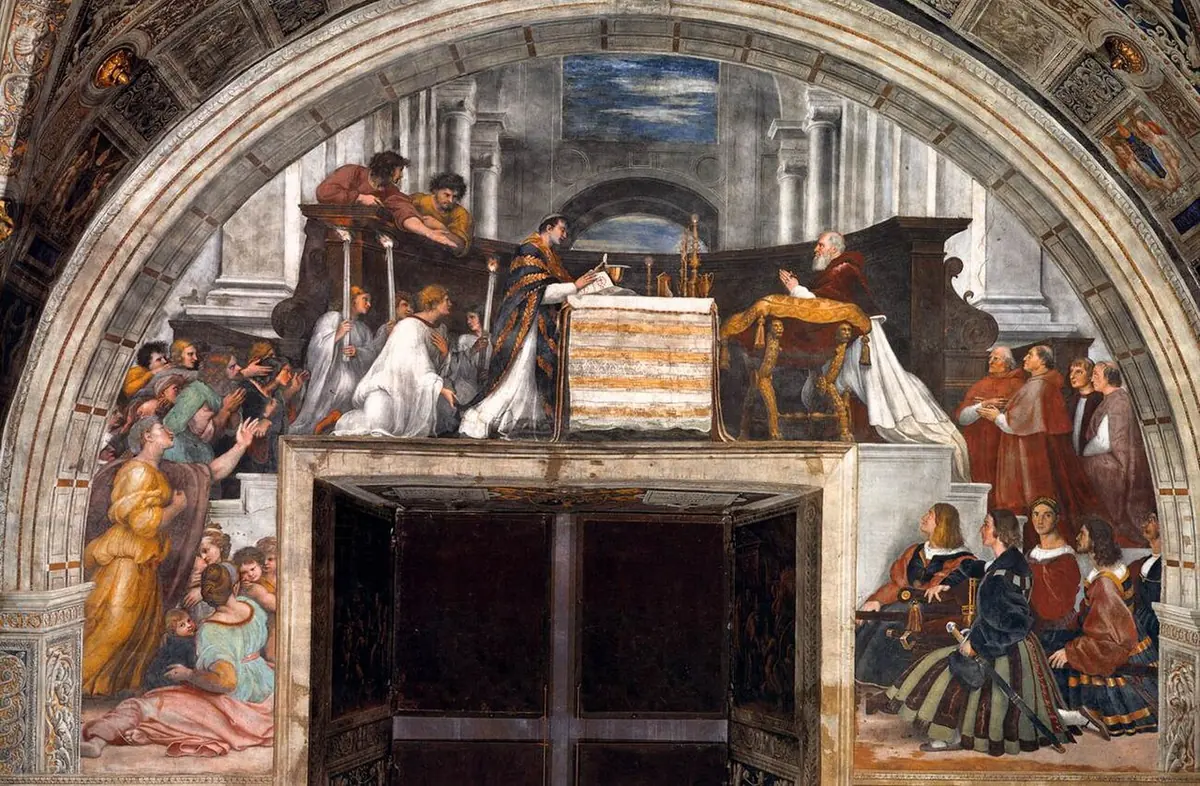
Whatever the final verdict on Santa María, the same Lord waits in the tabernacle of every parish. Let us go and adore Him there, and ask Our Lady of Luján to open a space for us, too, to meet her Son.
Frequently asked questions
What is the Buenos Aires Eucharistic miracle?
It is a series of reported signs at the parish of Santa María in Buenos Aires. In May 1992 pieces of a Host left in water turned red; in July 1994 a Eucharistic minister said he saw a drop of blood in a chalice; and in August 1996 a Host found discarded in the church was placed in water and days later appeared as a piece of bloodlike tissue. The 1996 Host is the one most studied.
Is the Buenos Aires Eucharistic miracle approved by the Church?
No. The Archdiocese of Buenos Aires has never declared it a miracle, and the parish itself calls it a "sign." In 2019 the pastor told Crux, "We don't call it a miracle." Catholics may pray at the parish and honor what happened there, but the Church has made no formal judgment that it is supernatural.
What was Pope Francis's role in the Buenos Aires Eucharistic miracle?
In 1996 Jorge Mario Bergoglio was an auxiliary bishop of Buenos Aires. According to the accounts that followed, the parish priest informed him, and he asked that the Host be professionally photographed. In 1999, by then archbishop, he asked for it to be scientifically examined. Crux reports that, asked his opinion, he said, "The Lord passed and left his mark." He never issued a decree declaring it a miracle.
What did Dr. Frederick Zugibe find?
Zugibe, a forensic pathologist and heart specialist in New York, examined slides from the sample without being told its source. As quoted by Fr. Robert Spitzer, he described "a fragment of the heart muscle found in the wall of the left ventricle close to the valves," inflamed and full of white blood cells, which he took as a sign that the heart had been alive and under severe stress.
What are the criticisms of the scientific studies?
In 2024 the Catholic immunologist Kelly Kearse and Frank Ligaj reviewed the case in the Journal of Forensic Science and Research. They noted that the experts chosen were pathologists and cardiologists who were likely to see heart tissue, that no control slides were mixed in, and that the DNA report found only "a very low concentration of human DNA," typical of contamination from handling, alongside good-quality DNA of non-human origin. They call for standard tests, not a verdict against the miracle.
Where is the Buenos Aires Eucharistic miracle kept?
At the parish of Santa María on Avenida La Plata, between the Almagro and Caballito neighborhoods of Buenos Aires. Crux reported in 2019 that the material from 1994 and 1996 had evaporated, while the "sign" of 1992 is kept in a small glass case in the tabernacle and shown during Eucharistic adoration a few times a month.
Sources
- Inés San Martín, Future pope once called host-turned-to-blood a 'mark of the Lord' (Crux, July 21, 2019)
- Giselle Vargas, Argentine Parish Where Eucharistic Miracles Occurred Receives Relic of Blessed Carlo Acutis (CNA / National Catholic Register, May 12, 2021)
- Robert J. Spitzer, S.J., Contemporary Eucharistic Miracles (Magis Center, September 2020)
- Kelly Kearse and Frank Ligaj, Scientific Analysis of Eucharistic Miracles: Importance of a Standardization in Evaluation, Journal of Forensic Science and Research 8 (2024)
- Stacy Trasancos, Exaggerations and eucharistic miracles (East Tennessee Catholic, from Crisis Magazine, January 23, 2025)
- Vatican: Biography of the Holy Father Francis
- Vatican News: Vatican releases new norms on alleged supernatural phenomena (May 17, 2024)
- Catechism of the Catholic Church, nos. 1373–1381 (The presence of Christ by the power of his word and the Holy Spirit)