St. Joseph, Spouse of Mary and Guardian of the Redeemer
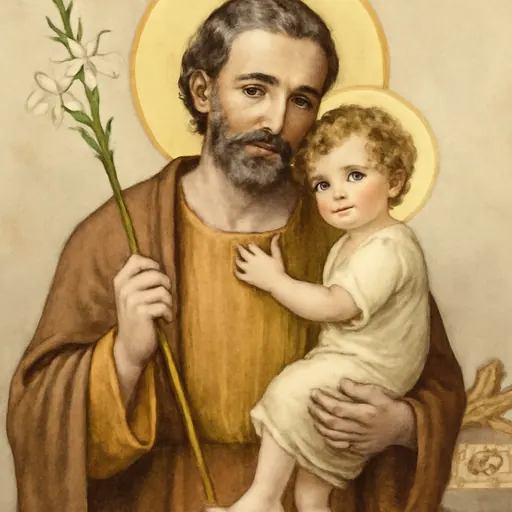
St. Joseph was the husband of the Virgin Mary and the foster father of Jesus, a just man and a carpenter of Nazareth descended from King David. The Gospels of Matthew and Luke are the only historical sources for his life. Catholics honor him as Patron of the Universal Church, of fathers, of workers and of a happy death. His feast day is March 19, and St. Joseph the Worker is kept on May 1.
Who was St. Joseph?
Joseph was the husband of Mary and the man who raised Jesus as his son in Nazareth. Christians call him the foster father, or legal father, of Jesus, because the Gospels teach that Jesus was conceived by the Holy Spirit and not by Joseph. He was a descendant of King David, and his trade was that of a tekton, the Greek word translated "carpenter," which covers a builder or craftsman in wood and stone.
Everything we know for certain about him comes from the first two chapters of the Gospels of Matthew and Luke, plus a passing remark elsewhere, when the people of Nazareth ask about Jesus, "Is not this the carpenter's son?" (Matthew 13:55). He never speaks a word in the Gospels. (Bible quotations on this page are from the Douay-Rheims version, except those taken from papal documents.) Pope Francis, in his letter Patris corde, says Matthew and Luke "tell us very little, yet enough for us to appreciate what sort of father he was."

Devotion to Joseph grew slowly, then very fast. The early Church honored martyrs first, and Joseph was not one. His feast spread in the West in the late Middle Ages, entered the Roman calendar under Sixtus IV (1471–1484), and grew through the work of St. Teresa of Ávila and others. In the 19th and 20th centuries popes gave him title after title: Patron of the Universal Church, Patron of Workers and Guardian of the Redeemer. Patris corde notes that "after Mary, the Mother of God, no saint is mentioned more frequently in the papal magisterium than Joseph."
St. Joseph in the Gospels
The betrothal and the first dream
Matthew tells the story from Joseph's side. Mary was betrothed to him, a binding engagement under Jewish law, when she was found to be with child before they lived together. Joseph, "being a just man," decided to divorce her quietly rather than expose her to shame (Matthew 1:19). Then an angel spoke to him in a dream. In the words Patris corde quotes:
Do not be afraid to take Mary as your wife, for the child conceived in her is from the Holy Spirit. She will bear a son, and you are to name him Jesus, for he will save his people from their sins.
"When Joseph awoke from sleep, he did as the angel of the Lord commanded him" (Matthew 1:24). By naming the child, Joseph made Jesus his legal son and an heir of David's line.


Bethlehem
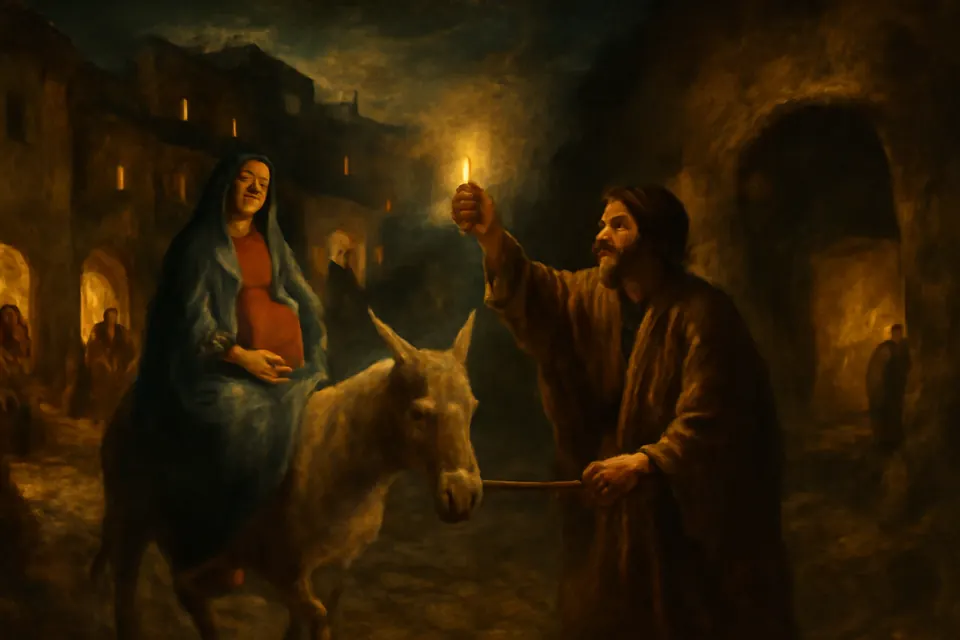
Luke gives the reason for the journey: a Roman census required Joseph to register in Bethlehem, "because he was of the house and family of David" (Luke 2:4). Mary came with him and gave birth there, laying the baby in a manger "because there was no room for them in the inn." Joseph was present when the shepherds came, and Matthew adds the visit of the Magi.
Forty days later Joseph and Mary presented Jesus in the Temple in Jerusalem. They offered "a pair of turtledoves, or two young pigeons," the offering the Law of Moses allowed for families who could not afford a lamb. Joseph heard the old man Simeon's prophecy over the child.
Egypt and Nazareth
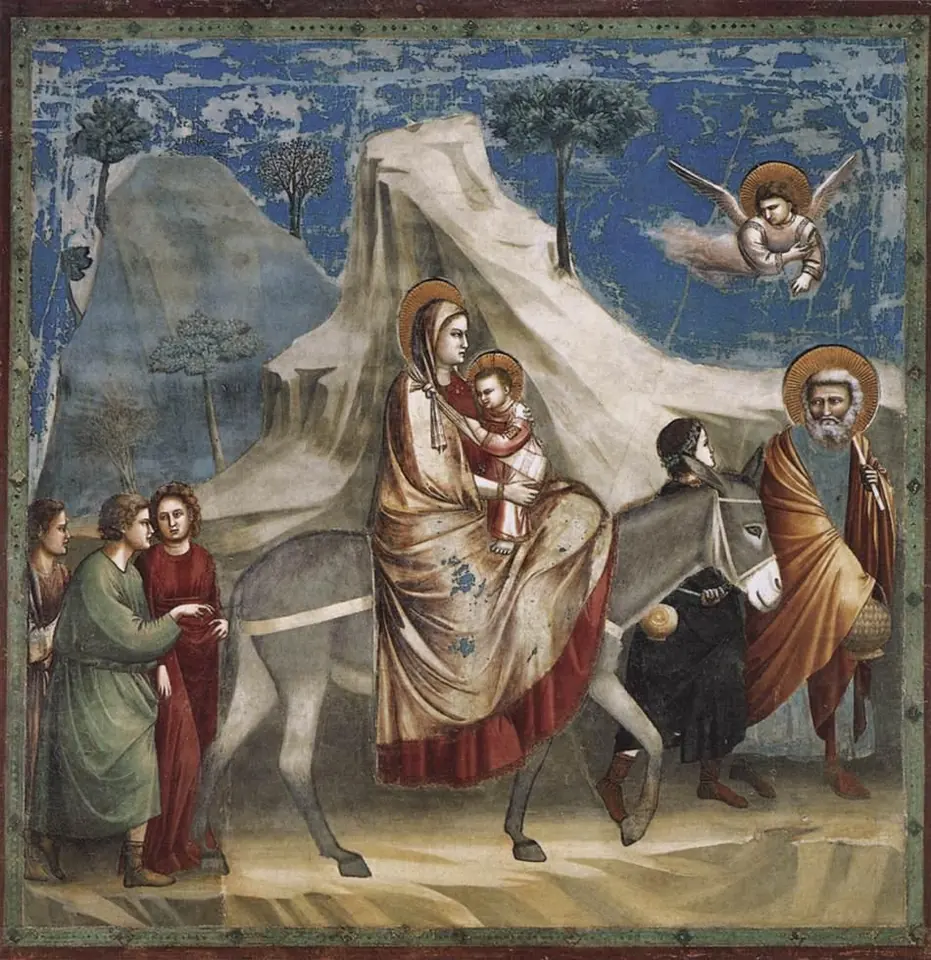
In a second dream an angel warned Joseph to take the child and his mother and flee to Egypt, because King Herod meant to kill him. Joseph left by night. He stayed in Egypt until Herod's death, when a third dream told him to return. A fourth warned him away from Judea, where Herod's son ruled, and he settled in Nazareth in Galilee. All four dreams are in Matthew 1 and 2.

The boy in the Temple
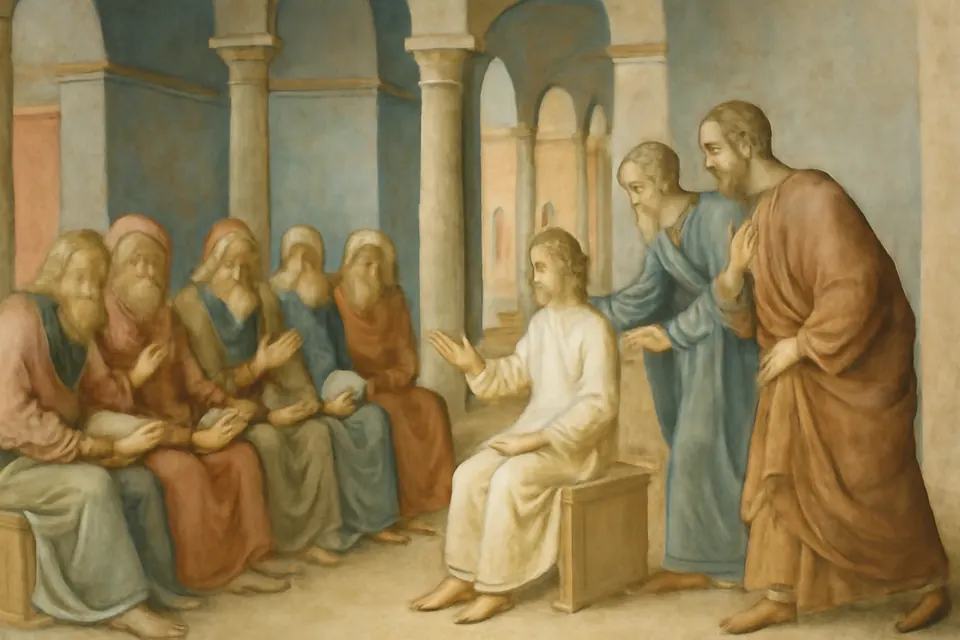
The last scene with Joseph comes when Jesus was twelve. The family went up to Jerusalem for Passover, and on the way home Joseph and Mary found that Jesus was missing. After three days they found him in the Temple, sitting among the teachers. Mary said to him, in the Douay-Rheims version, "thy father and I have sought thee sorrowing" (Luke 2:48). Jesus answered that he must be in his Father's house, and then went home with them to Nazareth "and was subject to them."
The silent years
After that Joseph disappears from the story. When Jesus begins to preach, his mother and his relatives appear, but Joseph does not, and from the cross Jesus entrusts Mary to the disciple John. From this Christians have long concluded that Joseph died before Jesus' public ministry, at Nazareth. Where he was buried is unknown.
Apocrypha and legends about St. Joseph
Because the Gospels say so little, early Christians filled the gaps with stories. None of them is Scripture, and the Church has never accepted them as history, but they shaped the way artists painted Joseph for more than a thousand years. This encyclopedia labels them traditional.
The rod and the dove
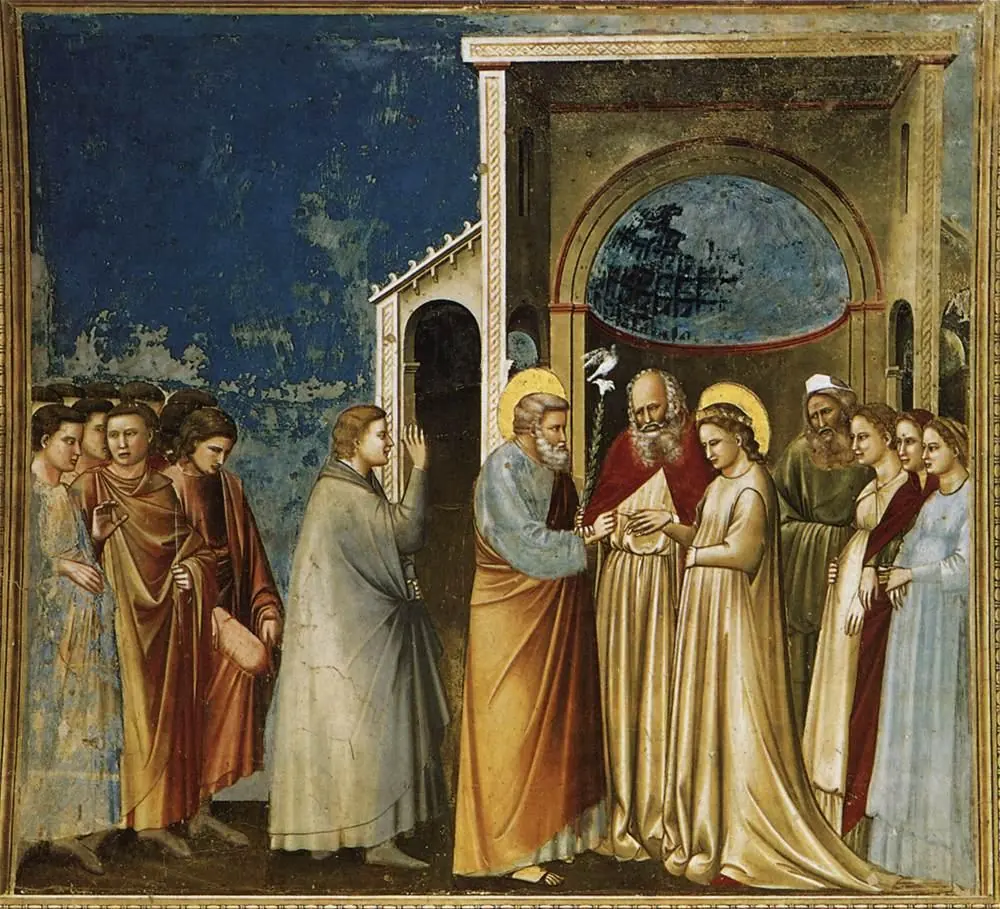
The Protoevangelium of James, written around the middle of the 2nd century, says that Mary was raised in the Temple. When she was twelve, the high priest was told by an angel to "assemble the widowers of the people, and let them bring each his rod." The priest prayed over the rods, and when Joseph took his rod back last, "a dove came out of the rod, and flew upon Joseph's head." Joseph objected, "I have children, and I am an old man, and she is a young girl," but agreed to take Mary into his keeping.
Later medieval retellings, including the Golden Legend, make the rod burst into flower, like Aaron's rod in the Book of Numbers. That flowering staff became Joseph's best-known attribute.

The older widower
The Protoevangelium explains "the brothers of the Lord" in the Gospels as Joseph's sons from a first marriage. A later Egyptian text, the History of Joseph the Carpenter, says he lived to the age of 111. The Catholic Encyclopedia calls these stories "void of authority." St. Jerome rejected them in the 4th century and held that Joseph, like Mary, was a virgin, and that the "brothers" were cousins. Catholic teaching today follows Jerome on the brothers, while art kept the old man for centuries. After the Council of Trent, painters such as Murillo began to show a younger, stronger Joseph, a man able to protect his family.
The miracles of St. Joseph
The four dreams are part of the Gospel itself, and Christians receive them as Scripture, not as later reports. Miracles told after the Gospels are sorted here by this encyclopedia's labels:
- The flowering rod and the dove: traditional, from the Protoevangelium of James and medieval legend.
- St. Teresa of Ávila's recovery: reported. In her Life, Teresa says she turned to Joseph during a long illness that had left her paralyzed, and recovered. In the David Lewis translation she writes, "I cannot call to mind that I have ever asked him at any time for anything which he has not granted."
- The appearance at Cotignac, France (1660): reported. A young shepherd named Gaspard Ricard said that on June 7, 1660, a tall man appeared to him on Mount Bessillon, told him he was Joseph, and showed him where to find water under a heavy rock. A spring still flows there, and a sanctuary was built on the spot.
- The Loretto staircase in Santa Fe, New Mexico: traditional. According to the story told by the Sisters of Loretto, their new chapel, finished in 1878, had no stairs to its choir loft. The sisters made a novena to St. Joseph, and a carpenter arrived, built a spiral staircase with no central support, and left without being paid. The sisters believed he was St. Joseph. Historians have proposed a French carpenter of the area as the builder.
- Healings at Saint Joseph's Oratory in Montreal: reported. Thousands of cures were attributed to Joseph's intercession through the prayers of St. André Bessette, the doorkeeper who founded the Oratory. The Church examined some healings for André's own canonization, as miracles through André's intercession.
The death of St. Joseph and a happy death
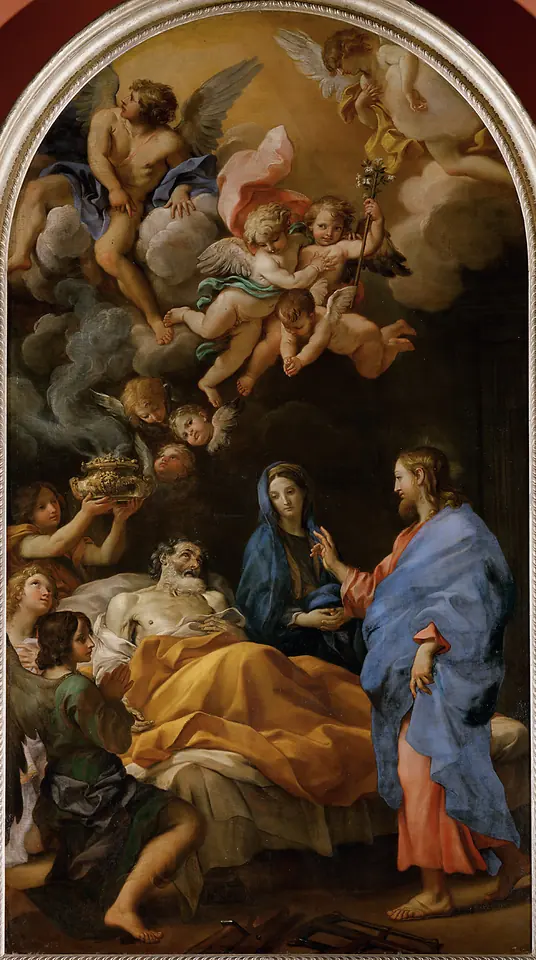
No one knows how Joseph died, but Christian tradition imagined the scene with love. Jesus and Mary stand at his bedside, and Joseph dies in their arms, the death every Christian might hope for. For that reason Catholics call him the patron of a happy death, a title the Catechism of the Catholic Church (1014) mentions when it encourages believers to ask Joseph to pray for them at the hour of death.

Why St. Joseph is the patron saint of the Church, fathers and workers
The Universal Church. On December 8, 1870, Pius IX declared Joseph Patron of the Catholic Church in the decree Quemadmodum Deus, issued while the First Vatican Council was suspended and Rome had just been lost to the Italian army. Leo XIII explained the title in Quamquam pluries (1889). Just as Joseph "ministered to all the needs of the family at Nazareth and girt it about with his protection," Leo wrote, he "should now cover with the cloak of his heavenly patronage and defend the Church of Jesus Christ."
Fathers and families. Joseph was the head of the Holy Family. Leo XIII wrote that "fathers of families find in Joseph the best personification of paternal solicitude and vigilance."
Workers and carpenters. Joseph earned the family's living with his hands. In 1955 Pius XII created the feast of St. Joseph the Worker on May 1, the day many countries keep as a workers' holiday, to give Catholic workers their own patron.
Refugees. He took his family into exile in Egypt. In 2021 the Vatican added "Patron of exiles" to his litany.
Canada. French missionaries placed New France under Joseph's protection in the 17th century, and he is the principal patron of Canada.
Home sellers. This one is popular devotion only, described below. Our patron saints page lists every patronage on the site.
Symbols of St. Joseph in art
You can usually recognize Joseph by what he carries:
- A flowering staff or a lily: from the legend of the rod that blossomed. The lily also stands for his chastity.
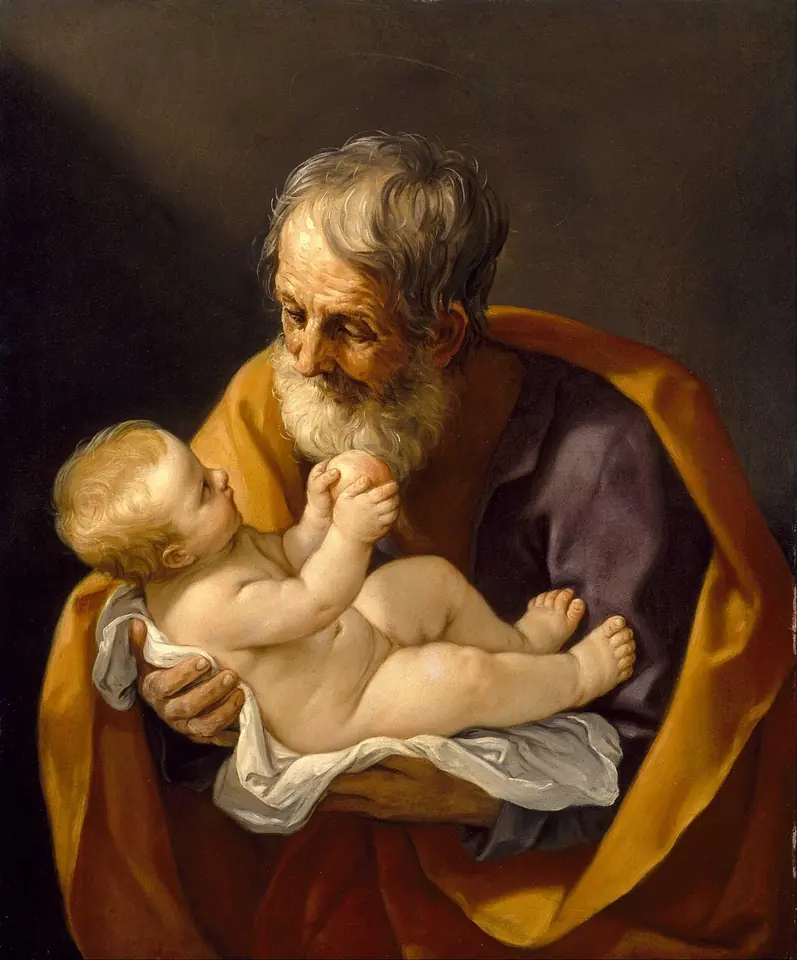
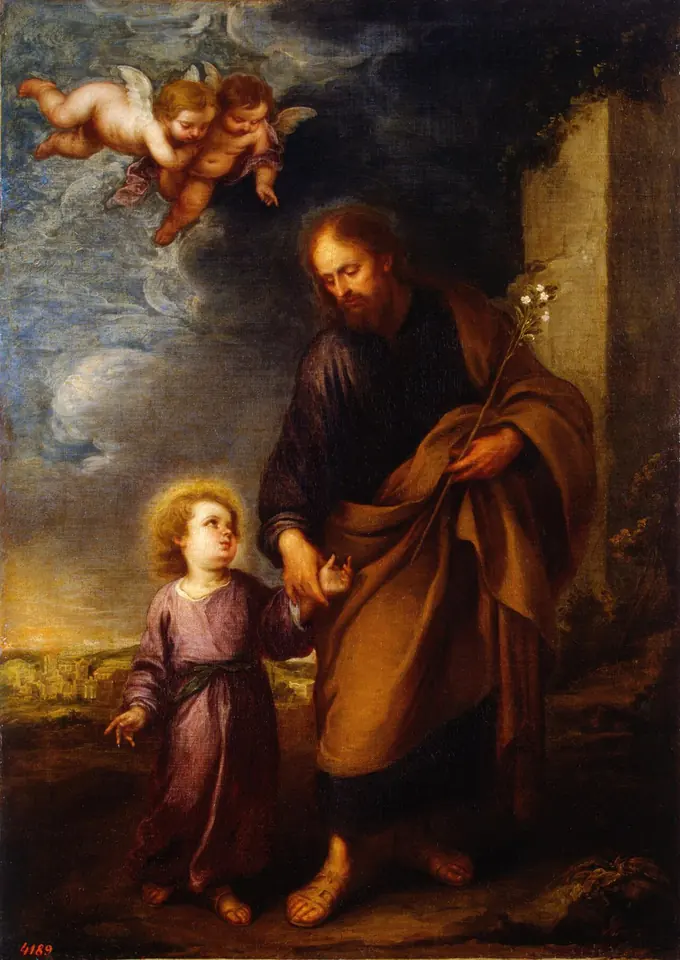
- The Child Jesus in his arms: the most common way of showing him since the 17th century, as in the paintings by Reni and Murillo on this page.
- Carpenter's tools: a saw, plane, square, hammer or ax, for his trade.
- Two turtledoves in a basket: the offering at the Presentation in the Temple.
- A donkey: in scenes of the Nativity and the Flight into Egypt.


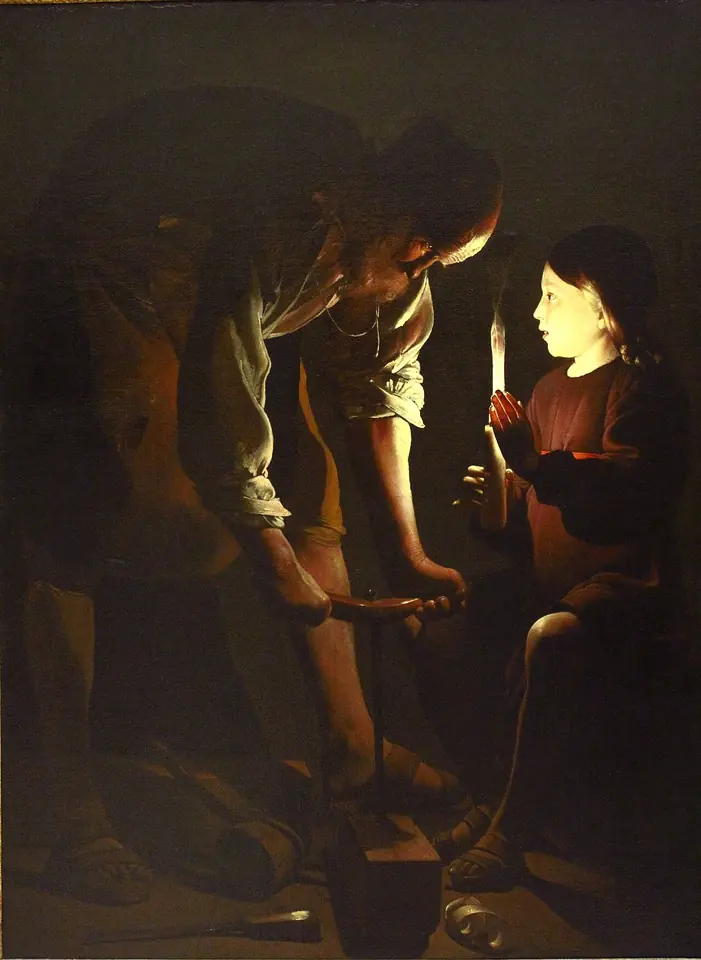
Western art shows two different Josephs. In medieval painting he is usually old and gray, sometimes sitting apart, half-asleep, at the edge of the Nativity, as if to make it clear that he is not the child's father. From the 16th century, encouraged by St. Teresa's devotion and Catholic Reformation preachers, he becomes a younger, active protector and a loving father. Georges de La Tour's painting in the Louvre shows him at work by candlelight while the boy Jesus holds the light, the beam he bores foreshadowing the cross.

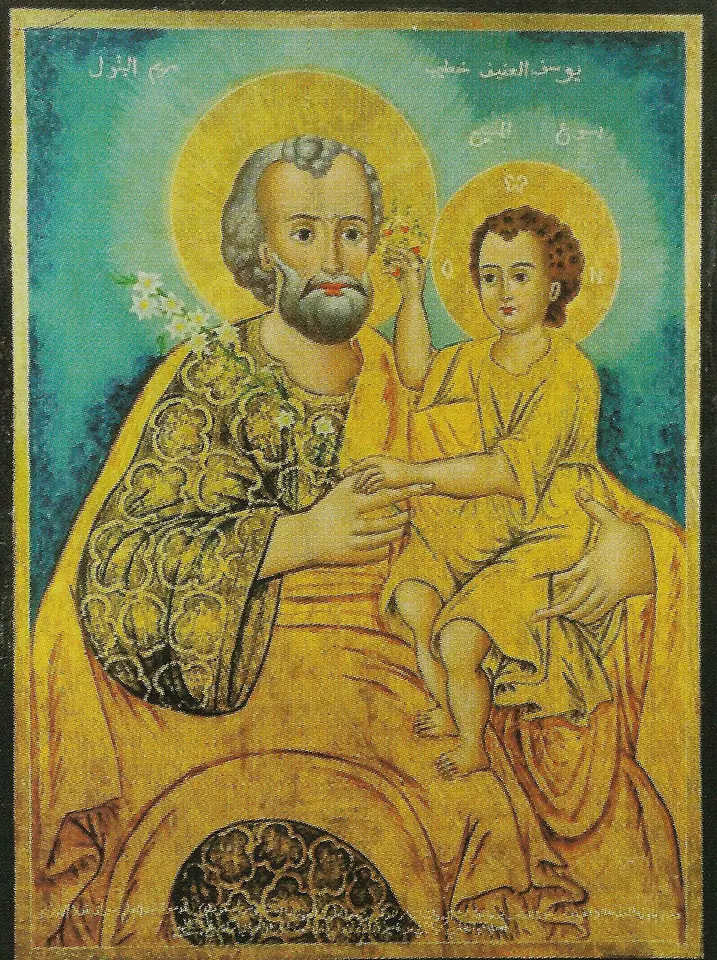
Eastern icons show Joseph mostly in scenes of the Nativity, where he sits in a corner looking troubled while an old shepherd, often read as the devil, tempts him with doubt. Standing icons of Joseph alone are less common in the Byzantine tradition but appear among Arab Christians and in modern Catholic churches.

Murillo's Joseph is a strong, dark-haired man walking hand in hand with the boy Jesus, a type that became very popular in Spain and Latin America.

St. Joseph's feast day and customs
Joseph's main feast is March 19, a solemnity in the Catholic Church, usually falling in Lent. May 1 is St. Joseph the Worker. March is traditionally his month, and Wednesday is the day of the week dedicated to him. You can find his neighbors on the calendar, including St. Patrick on March 17, on our feast days page.
In 1962 John XXIII added Joseph's name to the Roman Canon of the Mass, and in 2013 the Vatican added it to the other main Eucharistic Prayers. Pope Francis declared a Year of St. Joseph from December 8, 2020, to December 8, 2021, for the 150th anniversary of his proclamation as Patron of the Church, and published Patris corde to open it.
St. Joseph's Table
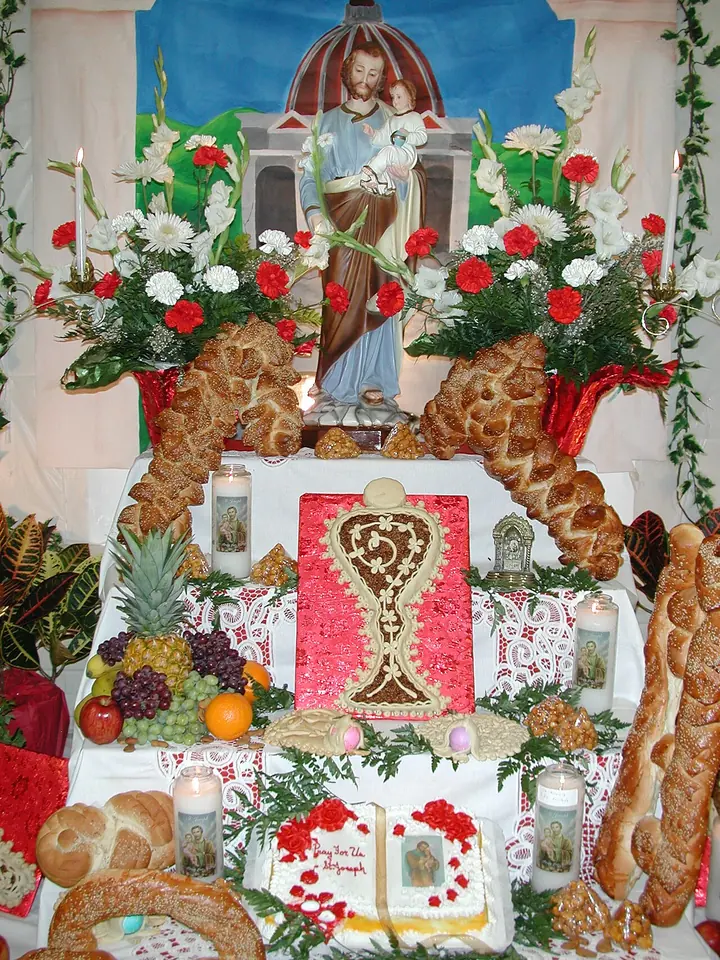
In Sicily and in Sicilian communities abroad, families and parishes build a Tavola di San Giuseppe, a St. Joseph's Table or altar, for March 19. Tradition says that during a medieval drought and famine, Sicilians prayed to Joseph for rain and promised to honor him with a feast if they were saved. The rains came, and fava beans were the crop that saved them. The story is traditional.
A typical table has three tiers, for the Trinity, with a statue of Joseph at the top. It is covered with flowers, breads baked in the shape of his staff and carpenter's tools, breadcrumbs for sawdust, cookies, zeppole pastries and fava beans, but no meat, since the feast falls in Lent. The food is blessed and then given to the poor. In New Orleans, where Sicilian immigrants brought the custom in the 19th century, children dressed as the Holy Family knock at doors in a reenactment called Tupa Tupa before being welcomed to the table.


The St. Joseph statue and selling a house
A popular custom, especially in the United States, is to bury a small statue of St. Joseph in the yard of a house that is for sale. Practices vary: some bury it upside down, some near the "for sale" sign, some facing the house or facing away. People pray for Joseph's help, and after the sale they dig up the statue and give it a place of honor in their new home. Stores sell "St. Joseph home-sale kits" with a plastic statue and a prayer card.
The origin is unclear. One common story traces it to St. Teresa of Ávila, whose nuns are said to have buried medals of Joseph while praying for land for their convents, but there is no early record of this. The custom is folk practice, not Church teaching. Many Catholics see it as a form of prayer, an act of trust made visible; priests often warn that treating the statue as a charm that works by itself would be superstition. The Church has never endorsed the practice or prescribed a prayer for it.
The sleeping St. Joseph
Statues of Joseph lying asleep, recalling his dreams, have become popular since Pope Francis told families in Manila in 2015 that he keeps one on his desk and slips notes with his worries under it, asking Joseph to dream about them.

Saint Joseph's Oratory in Montreal
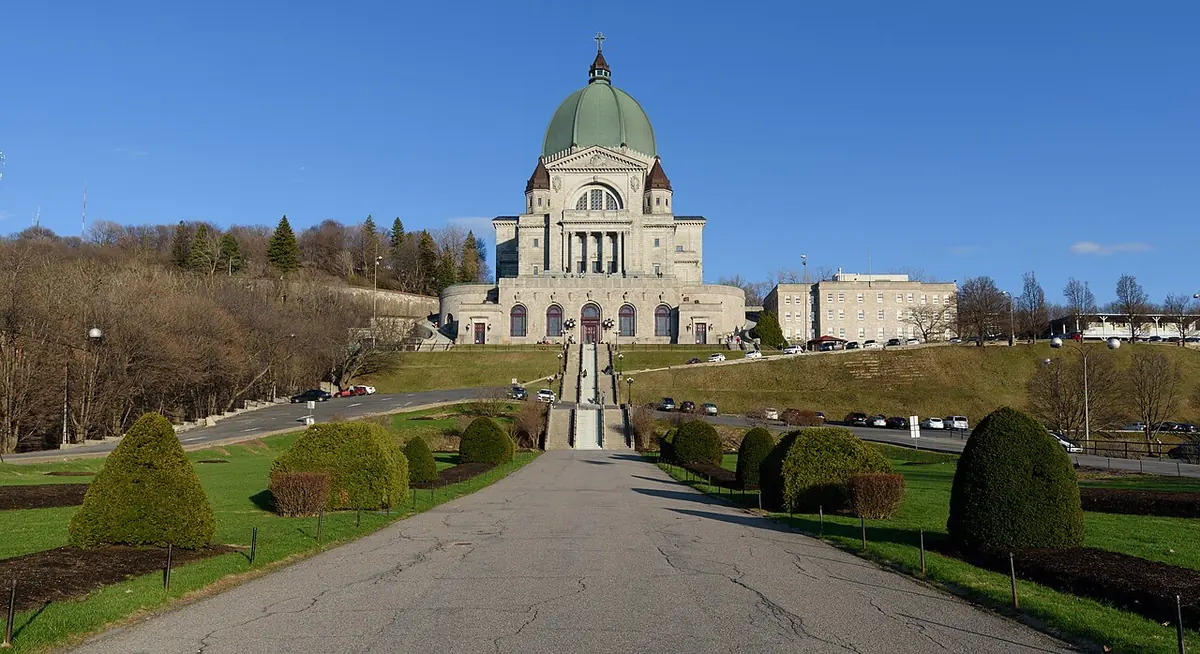
The largest church dedicated to Joseph anywhere, and the largest church in Canada, is Saint Joseph's Oratory on Mount Royal in Montreal. It began as a small chapel built in 1904 by Brother André Bessette, a doorkeeper of the Congregation of Holy Cross, who sent the sick to pray to Joseph. Some pilgrims still climb the central stairway to the basilica on their knees.

Prayers to St. Joseph
Prayer to St. Joseph by Leo XIII ("To you, O blessed Joseph")
Pope Leo XIII sent this prayer with his encyclical Quamquam pluries on August 15, 1889, and asked that it be added to the Rosary throughout October every year. The Vatican's English text reads:
To thee, O blessed Joseph, we have recourse in our affliction, and having implored the help of thy thrice holy Spouse, we now, with hearts filled with confidence, earnestly beg thee also to take us under thy protection. By that charity wherewith thou wert united to the Immaculate Virgin Mother of God, and by that fatherly love with which thou didst cherish the Child Jesus, we beseech thee and we humbly pray that thou wilt look down with gracious eye upon that inheritance which Jesus Christ purchased by His blood, and wilt succor us in our need by thy power and strength.
Defend, O most watchful guardian of the Holy Family, the chosen off-spring of Jesus Christ. Keep from us, O most loving Father, all blight of error and corruption. Aid us from on high, most valiant defender, in this conflict with the powers of darkness. And even as of old thou didst rescue the Child Jesus from the peril of His life, so now defend God's Holy Church from the snares of the enemy and from all adversity. Shield us ever under thy patronage, that, following thine example and strengthened by thy help, we may live a holy life, die a happy death, and attain to everlasting bliss in Heaven. Amen.
Many prayer books print a modern version beginning "To you, O blessed Joseph."
Pope Francis' prayer from Patris corde
Pope Francis closed Patris corde (2020) with this prayer:
Hail, Guardian of the Redeemer,
Spouse of the Blessed Virgin Mary.
To you God entrusted his only Son;
in you Mary placed her trust;
with you Christ became man.
Blessed Joseph, to us too,
show yourself a father
and guide us in the path of life.
Obtain for us grace, mercy and courage,
and defend us from every evil. Amen.
In a footnote to the same letter, Francis says that for over forty years he has prayed every day a prayer to Joseph from a 19th-century French prayer book of the Sisters of Jesus and Mary. It begins, "Glorious Patriarch Saint Joseph, whose power makes the impossible possible, come to my aid in these times of anguish and difficulty."
The Memorare to St. Joseph
Modeled on the Memorare to the Virgin Mary, this short prayer appears in many Catholic prayer books. Its author and date are unknown, and several versions circulate. The common form, as EWTN prints it, begins:
Remember, O most chaste spouse of the Virgin Mary, that never was it known that anyone who implored your help and sought your intercession were left unassisted. Full of confidence in your power I fly unto you and beg your protection.
The Litany of St. Joseph
Pius X approved the Litany of St. Joseph for public use in 1909. It calls on Joseph under titles such as "Head of the Holy Family," "Pillar of families," "Patron of the dying" and "Terror of demons." On May 1, 2021, the Congregation for Divine Worship added seven new invocations drawn from papal teaching: Guardian of the Redeemer, Servant of Christ, Minister of salvation, Support in difficulties, Patron of exiles, Patron of the afflicted and Patron of the poor.
Novenas to St. Joseph
There is no single official St. Joseph novena. Catholics commonly pray for nine days before his feast, from March 10 to 18, or before May 1, often repeating one of the prayers above each day. Leo XIII encouraged Catholics to dedicate the whole month of March to Joseph and to hold a triduum of prayer in each parish before his feast.
Ite ad Joseph: "Go to Joseph"
The phrase comes from Genesis 41:55. During the famine in Egypt, the hungry people cried to Pharaoh for bread, and he told them, "Go to Joseph; what he says to you, do." The Church Fathers saw the patriarch Joseph, son of Jacob, as a figure of Joseph of Nazareth: both were dreamers, both went down to Egypt, both kept bread for others. Leo XIII drew the comparison in Quamquam pluries, and Pope Francis cites "Go to Joseph" in Patris corde as a sign of the people's trust in him.
Frequently asked questions
When is St. Joseph's feast day?
March 19, a solemnity in the Catholic Church. A second feast, St. Joseph the Worker, falls on May 1; Pius XII added it in 1955. Orthodox Christians remember Joseph on the Sunday after Christmas.
What is St. Joseph the patron saint of?
Pius IX declared him Patron of the Universal Church in 1870. He is also patron of fathers and families, of workers and carpenters, of a happy death (because tradition says he died with Jesus and Mary beside him), of refugees and exiles, and of countries including Canada. In popular devotion he is also the saint people ask for help in selling a house.
Does burying a St. Joseph statue help sell a house?
It is a folk custom, not Church teaching. People bury a small statue of Joseph in the yard of a house they want to sell, often upside down, pray for his help, then dig the statue up after the sale and give it a place of honor in the new home. Many Catholics treat it as a way of praying; priests often warn against treating the statue as a lucky charm. The Church has never endorsed it.
What is the most famous prayer to St. Joseph?
The prayer beginning "To you, O blessed Joseph," written by Pope Leo XIII and sent with his encyclical Quamquam pluries in 1889, to be said after the Rosary during October. The Memorare to St. Joseph and the Litany of St. Joseph, approved by Pius X in 1909, are also widely prayed.
Is there a St. Joseph novena?
There are many, and no single official text. The most common custom is to pray for nine days from March 10 to 18, ending on the eve of his feast, often using an existing prayer such as Leo XIII's. Leo XIII himself recommended dedicating March to St. Joseph and holding a triduum, three days of prayer, before his feast.
Was St. Joseph an old man?
The Gospels don't say. The image of an elderly widower comes from the Protoevangelium of James, a 2nd-century writing not accepted as Scripture, which also gives him children from an earlier marriage. St. Jerome rejected that story, and since the 16th century many Western artists have painted Joseph as a young or middle-aged man.
How did St. Joseph die?
No one knows. He appears in the Gospels for the last time when Jesus is twelve, and he is absent during Jesus' ministry and at the cross, so Christians have long assumed he died before then. Tradition pictures his death at Nazareth with Jesus and Mary beside him, which is why he is the patron of a happy death.
What does "Ite ad Joseph" mean?
It is Latin for "Go to Joseph." In Genesis 41:55, Pharaoh tells the starving Egyptians to go to Joseph, the son of Jacob, for bread. Catholics apply the words to St. Joseph of Nazareth, and Pope Francis cites the phrase in Patris corde as an expression of "popular trust in Saint Joseph."
Sources
- Leo XIII, Quamquam pluries (1889), with the Prayer to Saint Joseph (Vatican)
- Francis, Apostolic Letter Patris corde (2020) (Vatican)
- John Paul II, Apostolic Exhortation Redemptoris Custos (1989) (Vatican)
- Congregation for Divine Worship: Letter to the Presidents of the Bishops' Conferences on the new invocations in the Litany of Saint Joseph (May 1, 2021)
- Congregation for Divine Worship: Decree on the name of St. Joseph in Eucharistic Prayers II, III and IV (May 1, 2013)
- Catholic Encyclopedia (1910): St. Joseph
- Protoevangelium of James (Ante-Nicene Fathers translation, New Advent)
- The Life of St. Teresa of Jesus, trans. David Lewis (Project Gutenberg)
- EWTN: Memorare to St. Joseph
- National Catholic Register: Come to the (St. Joseph) Table: Feasts Overflow With Food and Faith (2024)
- National Catholic Register: Saint Joseph's Little-Known Appearance in France
- Indianapolis Business Journal: Some call on tradition of burying St. Joseph statue to help sell homes (2006)
- Saint Joseph's Oratory of Mount Royal (official site)
- The Gospels of Matthew (chapters 1–2, 13:55) and Luke (chapters 1–2)