The Blessed Virgin Mary, Mother of Jesus

The Blessed Virgin Mary was a young Jewish woman of Nazareth, betrothed to Joseph, who became the mother of Jesus. Christians honor her as the first disciple of her Son, and Catholic and Orthodox Christians honor her as Mother of God (Theotokos), ever-virgin and above all the saints. Her main feast in the Catholic calendar is the Solemnity of Mary, Mother of God, on January 1.
Who is the Blessed Virgin Mary?
Mary of Nazareth was a young Jewish woman of Galilee, engaged to a carpenter named Joseph, when the Gospels say the angel Gabriel announced that she would bear a son by the power of the Holy Spirit. She is the mother of Jesus.
Christians of every tradition honor her, but in different ways. The Catholic and Orthodox Churches call her the Mother of God, ever-virgin, all-holy, and ask her prayers more than those of any other saint. Protestant churches honor her as the mother of the Lord and a model of faith, and confess with the ancient creeds that Christ was "born of the Virgin Mary." Islam honors her as well: a whole chapter of the Qur'an, the nineteenth, bears her name, Maryam.


Mary in Scripture
The New Testament says little about Mary, but she appears at the turning points of the Gospel. Quotations are from the New American Bible on the Vatican's website.
Her family and early life
The Gospels do not name Mary's parents. A 2nd-century writing, the Protoevangelium of James, calls them Joachim and Anne and tells of Mary's presentation in the Temple as a little girl. It was never counted as Scripture, but the names of St. Joachim and St. Anne and the feast of her Presentation (November 21) come from this traditional source.
The Annunciation
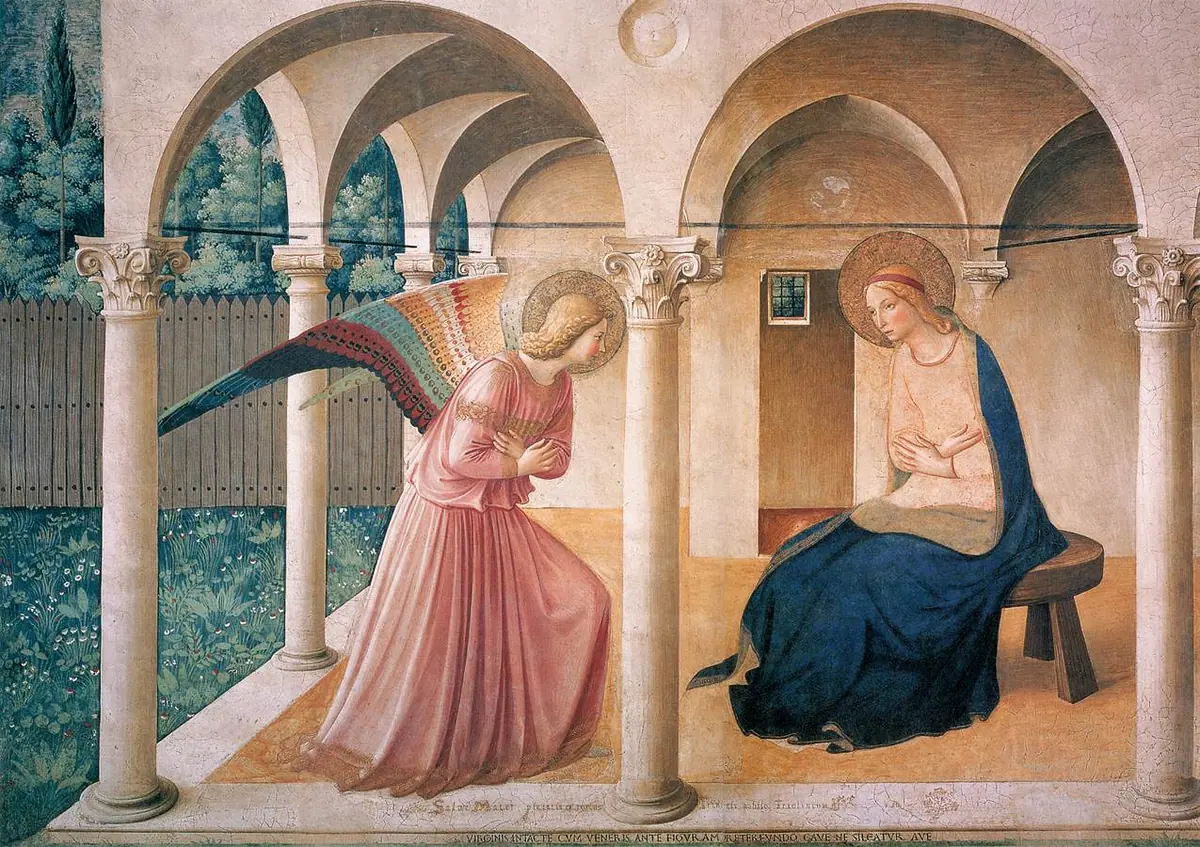
Luke's Gospel says that in the sixth month of Elizabeth's pregnancy, "the angel Gabriel was sent from God to a town of Galilee called Nazareth, to a virgin betrothed to a man named Joseph, of the house of David, and the virgin's name was Mary." The angel greets her, "Hail, favored one! The Lord is with you" (Luke 1:28). When she asks how she can conceive, "since I have no relations with a man," Gabriel answers that the Holy Spirit will come upon her. Mary replies: "Behold, I am the handmaid of the Lord. May it be done to me according to your word" (Luke 1:38).
Her consent, often called her fiat from the Latin "let it be done," is the center of Christian reflection on Mary. The Catechism of the Catholic Church quotes St. Irenaeus: "Being obedient she became the cause of salvation for herself and for the whole human race."

The Visitation and the Magnificat
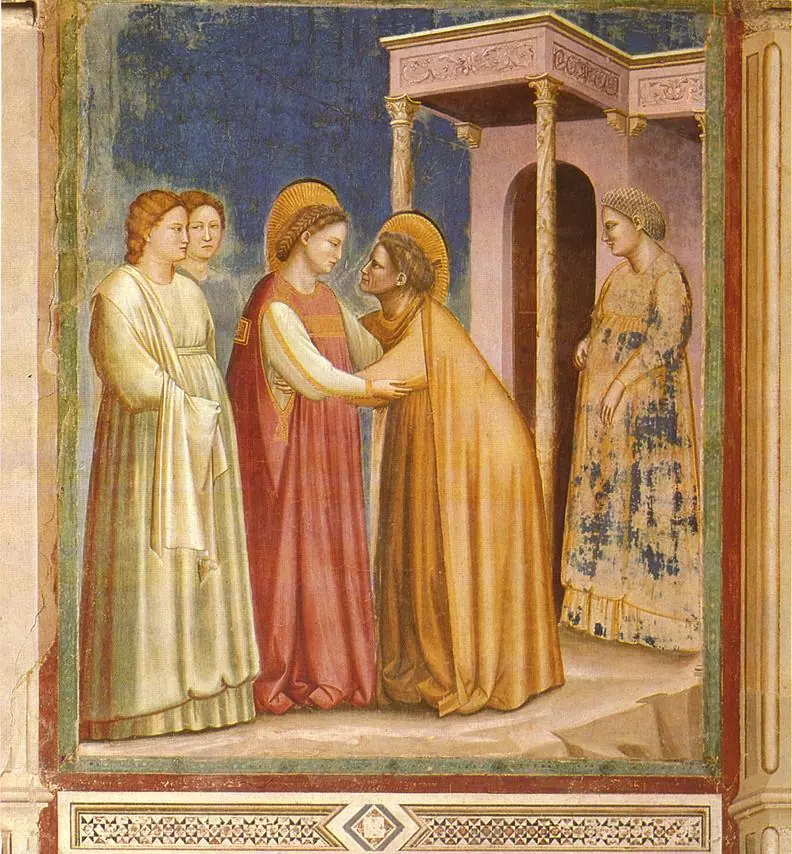
Mary then went "in haste" to the hill country of Judah to visit her kinswoman Elizabeth, pregnant with John the Baptist. Elizabeth, "filled with the holy Spirit," cried out: "Most blessed are you among women, and blessed is the fruit of your womb. And how does this happen to me, that the mother of my Lord should come to me?" (Luke 1:42–43). Mary answered with the song called the Magnificat: "My soul proclaims the greatness of the Lord; my spirit rejoices in God my savior. For he has looked upon his handmaid's lowliness; behold, from now on will all ages call me blessed" (Luke 1:46–48).

The birth and childhood of Jesus
Luke adds to the story of Jesus' birth a line about Mary's inner life: "And Mary kept all these things, reflecting on them in her heart" (Luke 2:19). When she and Joseph presented the child in the Temple, the old man Simeon told her, "and you yourself a sword will pierce" (Luke 2:35), the origin of her title Our Lady of Sorrows.
The wedding at Cana
In John's Gospel, Mary is at a wedding in Cana of Galilee when the wine runs out. She tells Jesus, "They have no wine." He answers, "Woman, how does your concern affect me? My hour has not yet come." She turns to the servants: "Do whatever he tells you" (John 2:3–5). Jesus changes water into wine, the first of his signs. Her words to the servants are the last she speaks in the Gospels.


At the foot of the Cross
John alone records that "standing by the cross of Jesus were his mother and his mother's sister, Mary the wife of Clopas, and Mary of Magdala." Seeing his mother and the disciple he loved, Jesus said, "Woman, behold, your son," and to the disciple, "Behold, your mother." "And from that hour the disciple took her into his home" (John 19:25–27). Christian tradition identifies that disciple as St. John the Apostle, and Catholic teaching reads the scene as Jesus giving Mary as mother to all his disciples.


With the apostles at Pentecost
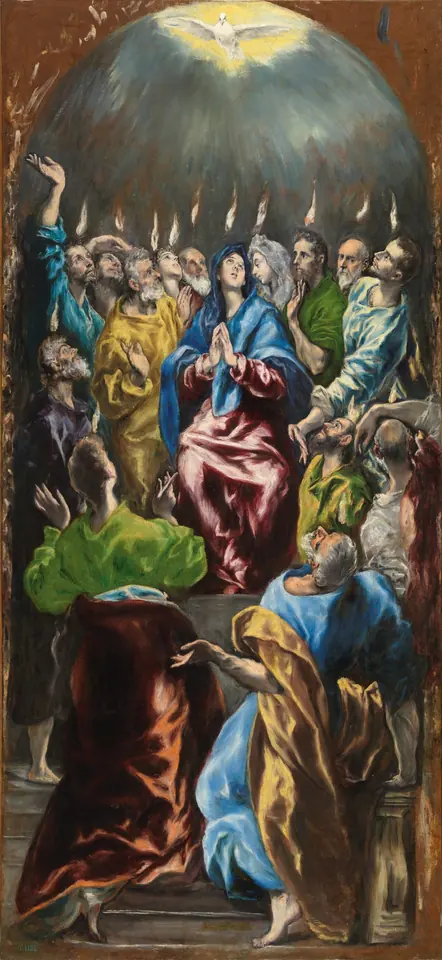
After the Ascension, the apostles returned to the upper room in Jerusalem. "All these devoted themselves with one accord to prayer, together with some women, and Mary the mother of Jesus, and his brothers" (Acts 1:14). It is the last time Scripture names her. Christian art places her at the center of the room at Pentecost.

The woman clothed with the sun
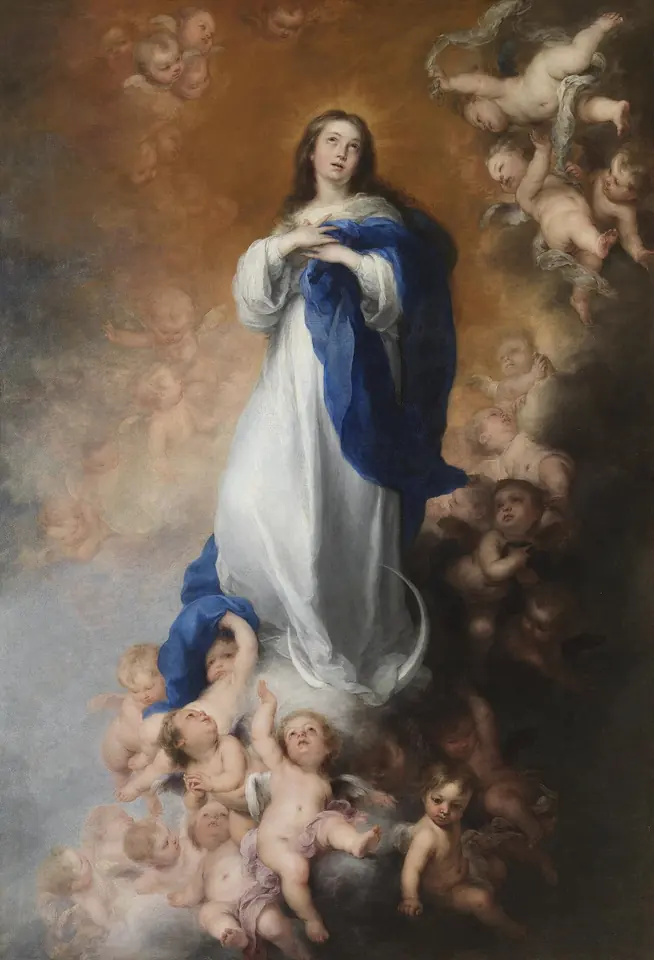
Revelation 12 describes "a great sign" in the sky: "a woman clothed with the sun, with the moon under her feet, and on her head a crown of twelve stars," who gives birth to a male child as a dragon waits to devour him. Many interpreters read the woman as Israel or the Church. Catholic tradition also reads her as Mary, the mother of the Messiah, and Pius XII in Munificentissimus Deus noted that medieval theologians saw the Assumption signified in "that woman clothed with the sun whom John the Apostle contemplated on the Island of Patmos." The image gave painters the stars, sun and moon that surround Mary in pictures of the Immaculate Conception and of Our Lady of Guadalupe.
The four Marian dogmas
A dogma, in Catholic teaching, is a truth the Church holds as divinely revealed. Four concern Mary.
Mother of God (Theotokos), 431
In the early 5th century Nestorius, archbishop of Constantinople, objected to calling Mary Theotokos, "God-bearer," and preferred "Mother of Christ." St. Cyril of Alexandria argued that because Jesus is one person, truly God and truly man, his mother is truly the mother of God. The Council of Ephesus met on June 22, 431, approved Cyril's teaching and deposed Nestorius. The first of Cyril's anathemas, read at the council, says: "If anyone will not confess that the Emmanuel is very God, and that therefore the Holy Virgin is the Mother of God (Θεοτόκος), inasmuch as in the flesh she bore the Word of God made flesh... let him be anathema."
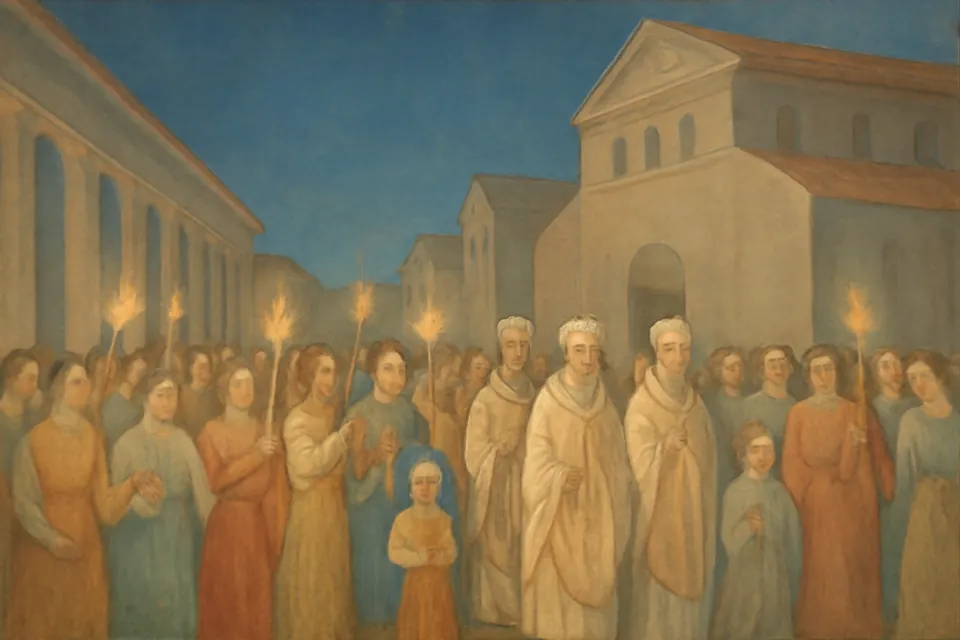
The Catholic Encyclopedia records that when the verdict was announced that evening, the people of Ephesus "escorted the fathers to their houses with torches and incense." The title is about Christ before it is about Mary: it says who her Son is.
Perpetual virginity
The Church teaches that Mary conceived Jesus as a virgin and remained a virgin all her life. The Second Council of Constantinople (553) calls her "the holy, glorious, and ever-virgin Mary, the Mother of God," and the Lateran Council of 649 taught her virginity before, during and after the birth. The Catechism says Christ's birth "did not diminish his mother's virginal integrity but sanctified it," so the liturgy calls her Aeiparthenos, "Ever-virgin."
The Gospels mention "brothers" and "sisters" of Jesus (Mark 6:3). Catholic and Orthodox teaching holds that these were close relatives, not other children of Mary; the Catechism notes that James and Joseph, named among the "brothers," are called the sons of "the other Mary." Many Protestants read the passages as referring to children born to Mary and Joseph after Jesus.


The Immaculate Conception, 1854
The Immaculate Conception concerns Mary's own conception in her mother's womb, not the conception of Jesus. On December 8, 1854, Pope Pius IX defined in the bull Ineffabilis Deus that "the most Blessed Virgin Mary was, from the first moment of her conception, by a singular grace and privilege of almighty God and by virtue of the merits of Jesus Christ, Saviour of the human race, preserved immune from all stain of original sin" (as quoted in the Catechism, no. 491). The Catechism stresses that this holiness "comes wholly from Christ": Mary was redeemed "in a more exalted fashion."
The Orthodox Church honors Mary as Panagia, "all-holy," and without sin, but it does not accept the 1854 definition, which rests on the Western theology of original sin. Four years after the definition, the apparitions at Lourdes gave the doctrine a popular voice. See the Immaculate Conception.

The Assumption, 1950
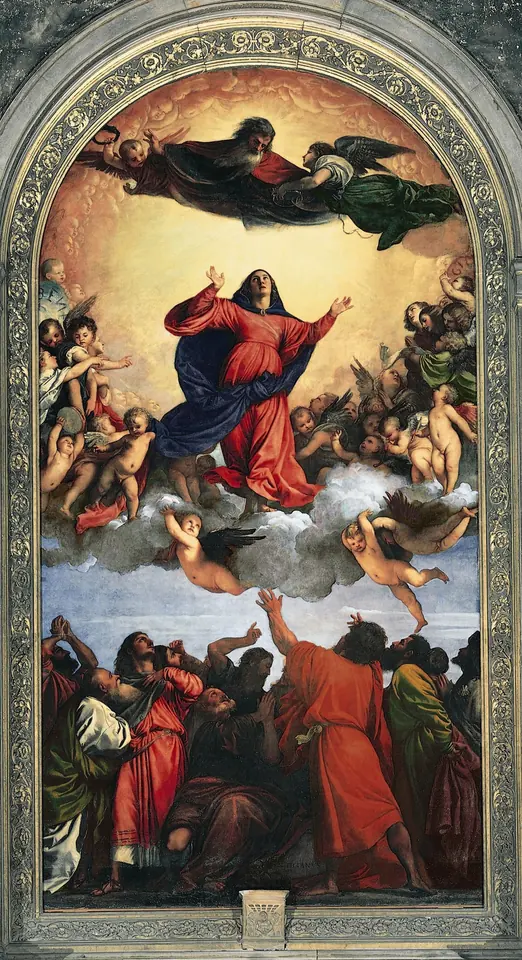
On November 1, 1950, Pius XII defined in Munificentissimus Deus: "we pronounce, declare, and define it to be a divinely revealed dogma: that the Immaculate Mother of God, the ever Virgin Mary, having completed the course of her earthly life, was assumed body and soul into heavenly glory." The definition does not say whether Mary died first. The Catechism calls the Assumption "a singular participation in her Son's Resurrection and an anticipation of the resurrection of other Christians."
The Orthodox Church celebrates the same mystery on August 15 as the Dormition, the "falling asleep" of the Mother of God. The Orthodox account, drawn from ancient tradition, says the apostles gathered at her deathbed in Jerusalem and buried her at Gethsemane, and that when Thomas arrived on the third day and the tomb was opened, her body was gone. The Catholic Encyclopedia notes that this story first appears in apocryphal writings of the 4th or 5th century; it is traditional.

How Catholics and Orthodox honor Mary
Hyperdulia, not worship
Catholic theology distinguishes three kinds of honor. Latria, adoration, belongs to God alone. Dulia is the honor given to the saints. Mary receives hyperdulia, a higher veneration than other saints because of her unique role. The Second Vatican Council taught that devotion to Mary, "although it is altogether singular, differs essentially from the cult of adoration which is offered to the Incarnate Word, as well to the Father and the Holy Spirit" (Lumen Gentium 66). The Council also warned preachers to avoid "all gross exaggerations" and anything "which could lead separated brethren or any other into error" (Lumen Gentium 67). Catholics and Orthodox ask her prayers as they would ask any fellow believer's.
The oldest prayer to Mary
The Sub tuum praesidium is the oldest known prayer addressed to Mary. A Greek copy survives on a papyrus in the John Rylands Library in Manchester, usually dated to the 3rd century, though some scholars date it later. The Compendium of the Catechism gives it in English:
We fly to thy protection, O holy Mother of God. Despise not our petitions in our necessities, but deliver us always from all dangers O glorious and blessed Virgin.


The Hail Mary
The Hail Mary joins Gabriel's greeting and Elizabeth's blessing to a petition added by the Church. The Catholic Encyclopedia traces it as a common devotion to about 1050; the petition "Holy Mary, Mother of God" spread in the 15th and 16th centuries, helped by the catechism of St. Peter Canisius, and the full form became official in the Roman Breviary of 1568. This is the text in the Compendium of the Catechism:
Hail, Mary, full of grace, the Lord is with thee. Blessed art thou among women and blessed is the fruit of thy womb, Jesus. Holy Mary, Mother of God, pray for us sinners, now and at the hour of our death. Amen.
The Rosary
The Rosary is a chain of prayers counted on beads: decades of ten Hail Marys, each begun with an Our Father and ended with a Glory Be, while the person praying meditates on events in the lives of Jesus and Mary. Tradition says Mary gave it to St. Dominic, but the Catholic Encyclopedia traces that story to the Dominican preacher Alan de la Roche around 1470; the devotion grew from lay people saying 150 Hail Marys in place of the monks' 150 psalms. For centuries it had fifteen mysteries, in three sets: joyful, sorrowful and glorious. In 2002 John Paul II added five "mysteries of light," from Jesus' baptism to the Last Supper, in Rosarium Virginis Mariae. The Rosary's own feast is Our Lady of the Rosary on October 7.
The Angelus
The Angelus is a short devotion to the Incarnation said morning, noon and evening, traditionally when a church bell rings. It takes its name from its first words in Latin, Angelus Domini. The Catholic Encyclopedia says the custom of three Hail Marys at the evening bell had spread across Europe by the early 14th century. The Compendium gives it this way:
V. The Angel of the Lord declared unto Mary. R. And she conceived of the Holy Spirit.
Hail, Mary, full of grace, the Lord is with thee. Blessed art thou among women, and blessed is the fruit of thy womb, Jesus. Holy Mary, Mother of God, pray for us sinners, now and at the hour of our death. Amen.
V. Behold the handmaid of the Lord. R. Be it done unto me according to thy word. Hail Mary.
V. And the Word was made flesh. R. And dwelt among us. Hail Mary.
V. Pray for us, O holy Mother of God. R. That we may be made worthy of the promises of Christ. Let us pray; Pour forth, we beseech thee, O Lord, thy grace into our hearts; that we, to whom the Incarnation of Christ, thy Son, was made known by the message of an angel, may by his Passion and Cross be brought to the glory of his Resurrection. Through the same Christ, our Lord. Amen.
The Pope leads it from a window over St. Peter's Square every Sunday at noon.


The Akathist hymn
In the Byzantine churches the great hymn to Mary is the Akathist, a long poem of praise, each stanza ringing with greetings that begin "Rejoice." Its name means "not sitting," because the congregation stands while it is sung. The Orthodox Church in America connects it with the deliverance of Constantinople from a siege in the 620s, when Patriarch Sergius carried an icon of the Mother of God and her robe in procession around the walls. It is sung in full on the fifth Saturday of Great Lent, the Saturday of the Akathist, and in parts on other days.


How Protestants view Mary
The 16th-century Reformers did not abandon Mary. They kept the creeds that confess Christ "born of the Virgin Mary," and Martin Luther's Smalcald Articles (1537) speak of "the pure, holy [and always] Virgin Mary." What they rejected was prayer to her and to the other saints. The Lutheran Augsburg Confession (1530) honors the memory of the saints as examples, "that we may follow their faith and good works," but says that "the Scripture teaches not the invocation of saints or to ask help of saints, since it sets before us the one Christ as the Mediator."
Most Protestant churches today, evangelical churches especially, honor Mary as the mother of the Lord and a model of humble faith, often pointing to her fiat and her Magnificat. They do not pray to her, and they do not accept the Immaculate Conception or the Assumption as doctrines, finding no basis for them in Scripture. Many hold that Mary and Joseph had other children after Jesus. Anglican and Lutheran calendars keep feasts of Mary, including the Annunciation and August 15.
Titles, apparitions and images of Mary
Christians have given Mary hundreds of titles. The Litany of Loreto, approved by the Church in 1587, gathers many of them: Mother of Christ, Mother most pure, Seat of Wisdom, Mystical Rose, Tower of Ivory, House of Gold, Ark of the Covenant, Gate of Heaven, Morning Star, Health of the Sick, Refuge of Sinners, Comforter of the Afflicted, Help of Christians and Queen of Heaven. Other titles come from places where Christians believe she appeared or from famous images.
The Church distinguishes Scripture and public revelation from "private" revelations. The Catechism teaches that these "do not belong, however, to the deposit of faith"; their role is "to help live more fully by it in a certain period of history." When a bishop approves an apparition, he declares it worthy of belief, but no Catholic is required to believe it. Every apparition below is reported in this sense, and the major ones have been formally approved by the Church.


- Our Lady of Guadalupe: appearances to St. Juan Diego near Mexico City in 1531, and the image on his cloak.
- Our Lady of the Miraculous Medal: visions to St. Catherine Labouré in Paris in 1830, and the medal they inspired.
- Our Lady of La Salette: an appearance to two shepherd children in the French Alps in 1846.
- Our Lady of Lourdes: eighteen appearances to St. Bernadette Soubirous in 1858, where the Lady called herself "the Immaculate Conception."
- Our Lady of Knock: a silent apparition at a village church in County Mayo, Ireland, in 1879.
- Our Lady of Fátima: appearances to three shepherd children in Portugal in 1917.
- Our Lady of Mount Carmel: patroness of the Carmelite order and the brown scapular.
- Our Lady of Perpetual Help and Our Lady of Częstochowa: two famous icons, in Rome and in Poland.
- Our Lady of Loreto: the Holy House at Loreto, Italy, honored as the house of Nazareth.
- Our Lady of Sorrows, Our Lady of the Rosary and the Immaculate Conception: titles drawn from her life, her prayer and her dogmas.
Mary is honored as patroness of countless nations, among them the United States under the title of the Immaculate Conception and the Americas as Our Lady of Guadalupe. See all the patron saints.
Symbols of the Virgin Mary in art
These signs help identify Mary and the scene in a painting, a window or an icon:
- Blue mantle: in Western art since the Middle Ages, usually over a red or white dress. Blue became her color in churches and vestments.
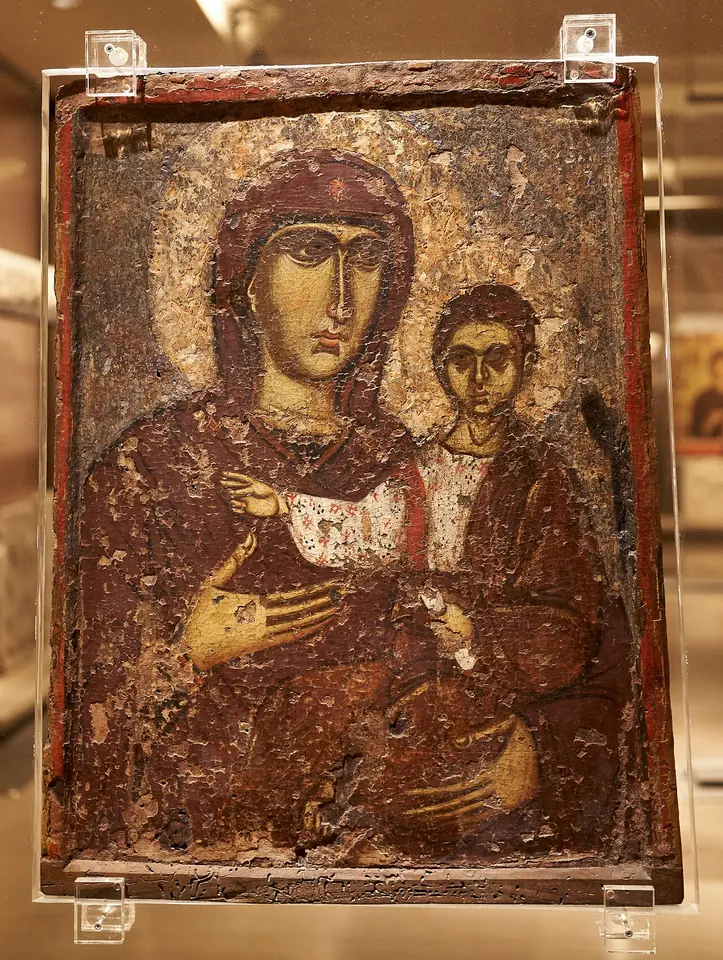
- Maphorion with three stars: in Eastern icons, a dark red-purple veil and cloak, with a star on her forehead and on each shoulder, often explained as her virginity before, during and after Christ's birth.
- Crown of twelve stars and crescent moon: from Revelation 12, the mark of the Immaculate Conception, as in Murillo's painting above.
- White lily: purity. Gabriel often carries lilies in Annunciation scenes, or they stand in a vase beside Mary.
- A heart pierced by a sword, or seven swords: Simeon's prophecy and Our Lady of Sorrows.
- A crown: her title Queen of Heaven.
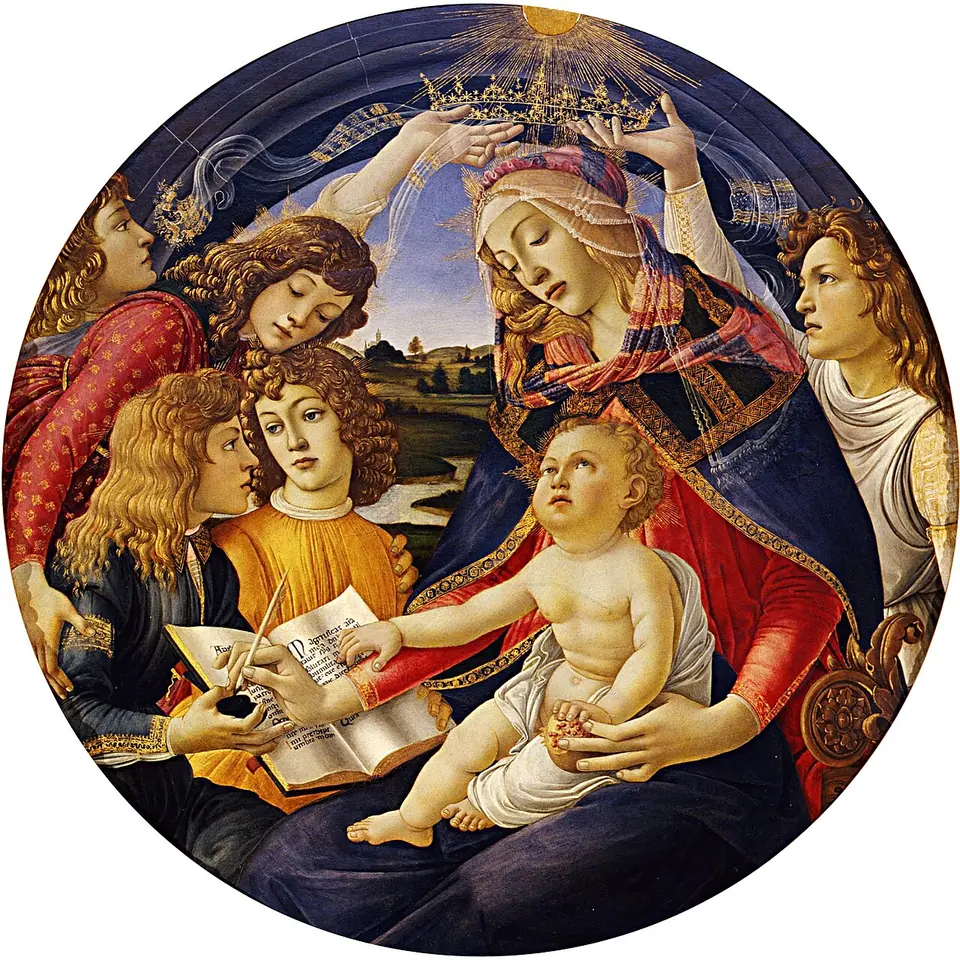
- A book: often open in Annunciation scenes, for her meditation on Scripture; Botticelli shows her writing the Magnificat.

Icon types
Eastern icons of the Mother of God follow set types, and many Western images descend from them.
- Hodegetria, "she who shows the way": Mary holds the Child on one arm and points to him with her other hand. Tradition attributes the original to St. Luke. Our Lady of Częstochowa belongs to this family.
- Eleusa, "tenderness" or "mercy": the Child presses his cheek against his mother's, as in the Virgin of Vladimir.
- Platytera or the Sign: Mary with arms raised in prayer and the Child in a circle on her breast.
- Enthroned (Kyriotissa): Mary on a throne with the Child on her lap, the type behind Duccio's Rucellai Madonna.

The Pietà
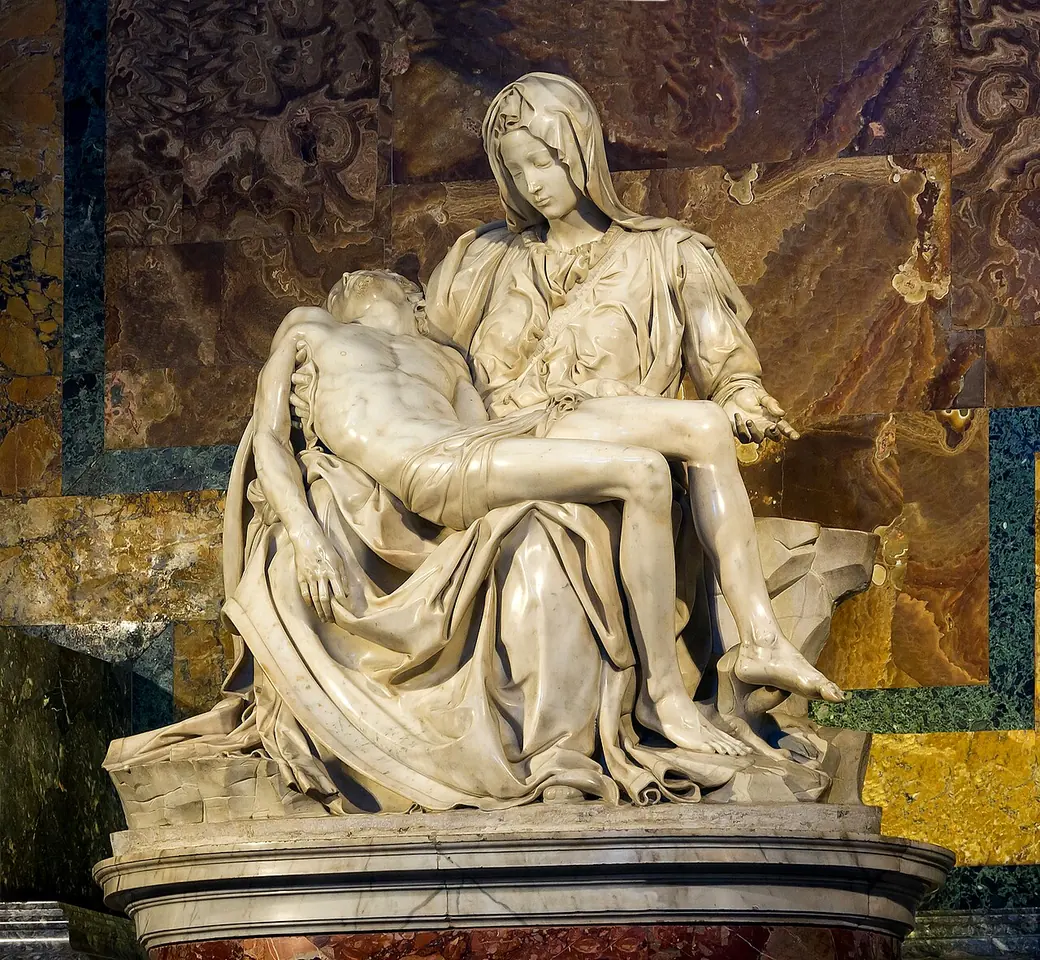
The Pietà (Italian for "pity" or "compassion") shows Mary holding the body of Jesus taken down from the Cross. It is not a scene in the Gospels but a devotional image that spread from German lands in the 14th century. Michelangelo's marble Pietà in St. Peter's Basilica, carved in 1498–1499 when he was in his early twenties, gives Mary a young, calm face, and it is the only work he signed: his name is carved on the sash across her breast.

The House of Mary at Ephesus
Where Mary spent her last years is not recorded. The older tradition, kept by the Orthodox Church and found in the Catholic Encyclopedia, places her death in Jerusalem, where her tomb is still shown in a church in the Kidron Valley near Gethsemane. Another tradition says she went to Ephesus with John, who, by early testimony, lived and died there. The Catholic Encyclopedia (1909) judged that the Ephesus tradition "rests on no ancient testimony."
In the early 19th century a bedridden German nun, Blessed Anne Catherine Emmerich, described in visions a stone house near Ephesus where Mary had lived. Following the published account, a French priest found a ruined chapel there in 1881, and in 1891 Lazarist priests from Smyrna led by Fr. Henri Jung rediscovered it. They learned that Christians of the nearby village of Şirince had long honored the ruin as a place of the Virgin. Meryem Ana Evi, "the House of Mother Mary," draws Muslim visitors too.
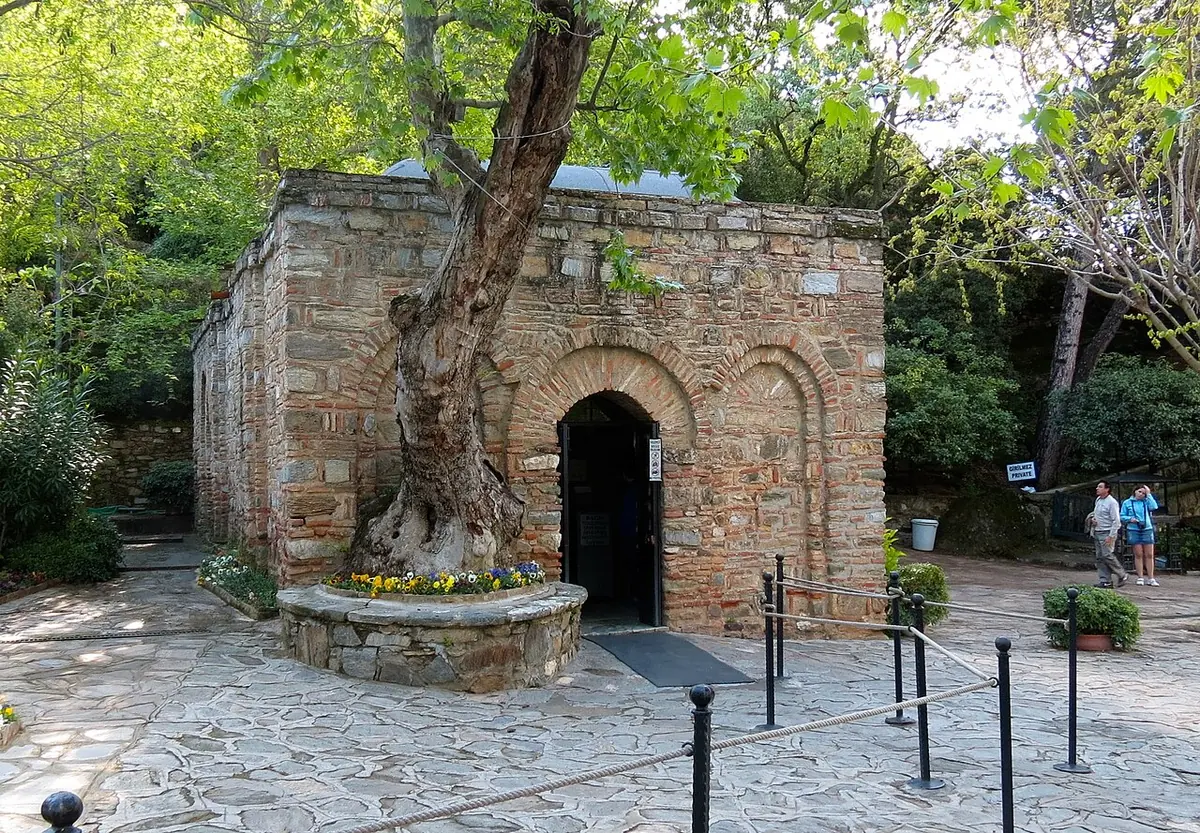

The Church has never ruled on whether Mary lived there, but three popes have prayed at the house: Paul VI in 1967, John Paul II in 1979 and Benedict XVI in 2006. In his homily there, Benedict XVI recalled that Mary's divine motherhood was "solemnly confessed and proclaimed in Ephesus at the Ecumenical Council of 431." The tradition of Mary at Ephesus is traditional, not a matter of doctrine.

Feast days of the Blessed Virgin Mary
The year opens with Mary. January 1, the octave day of Christmas, is the Solemnity of Mary, the Holy Mother of God, and the Catholic Encyclopedia notes that it was the oldest feast of Our Lady at Rome. The other solemnities are the Annunciation on March 25, nine months before Christmas, the Assumption on August 15 and the Immaculate Conception on December 8. Her Nativity is September 8.
The calendar adds more than a dozen feasts and memorials, listed in the box at the top of this page, from the Visitation (May 31) to Our Lady of Sorrows (September 15). Saturday is traditionally Mary's day, and May and October are her months.
The Orthodox Church counts four Marian feasts among its Twelve Great Feasts: her Nativity (September 8), her Entry into the Temple (November 21), the Annunciation (March 25) and the Dormition (August 15), which is preceded by a two-week fast. Browse every date on the feast day calendar.
Prayers to the Blessed Virgin Mary
Besides the Hail Mary, the Angelus and the Sub tuum praesidium above, the prayer Catholics most often add to the Rosary is the Salve Regina. This is the text in the Compendium of the Catechism (United Kingdom version):
Hail, Holy Queen, Mother of Mercy, Hail our life, our sweetness and our hope! To thee do we cry, poor banished children of Eve. To thee do we send up our sighs, mourning and weeping in this valley of tears! Turn, then, most gracious Advocate, thine eyes of mercy toward us, and after this, our exile, show unto us the blessed fruit of thy womb, Jesus. O clement, O loving, O sweet Virgin Mary.
Orthodox Christians pray the Akathist and the short hymn "It is truly meet," and Christians of every tradition sing Mary's own prayer, the Magnificat, which the Church prays every evening at Vespers.
Frequently asked questions
Who was the Virgin Mary?
The mother of Jesus. The Gospels present her as a young woman of Nazareth in Galilee, betrothed to Joseph, to whom the angel Gabriel announced that she would conceive a son by the Holy Spirit. She appears at Jesus' birth, at the wedding at Cana, at the foot of the Cross and with the apostles before Pentecost.
What are the four Marian dogmas?
That Mary is the Mother of God (Theotokos), affirmed at the Council of Ephesus in 431; that she remained a virgin before, during and after Jesus' birth; that she was conceived without original sin (the Immaculate Conception, defined by Pius IX in 1854); and that she was taken up body and soul into heavenly glory (the Assumption, defined by Pius XII in 1950).
Do Catholics worship Mary?
Catholic teaching says no. The Church distinguishes adoration (latria), which belongs to God alone, from the honor given to saints (dulia). Mary receives a higher honor called hyperdulia, which the Second Vatican Council says "differs essentially from the cult of adoration" given to God. Catholics ask her to pray for them, as they would ask a fellow believer.
What is Mary's feast day?
She has many. In the Catholic calendar the Solemnity of Mary, Mother of God, is January 1, and the other solemnities are the Annunciation (March 25), the Assumption (August 15) and the Immaculate Conception (December 8). Her birthday is kept on September 8 in both East and West.
What is the Hail Mary prayer?
The best-known Marian prayer. Its first half joins the angel Gabriel's greeting and Elizabeth's words from Luke 1; the second half asks, "Holy Mary, Mother of God, pray for us sinners, now and at the hour of our death." The full form became official in the Roman Breviary of 1568.
What do Protestants believe about Mary?
Protestants honor Mary as the mother of Jesus and a model of faith, and confess with the creeds that Jesus was "born of the Virgin Mary." Most do not pray to her or to other saints, and most do not accept the Immaculate Conception or the Assumption, which they do not find taught in Scripture.
Where did Mary die?
Scripture does not say. The older tradition, kept by the Orthodox Church, places her death and burial in Jerusalem, at a tomb in the Kidron Valley near Gethsemane. A later tradition places her last years in Ephesus with the apostle John. Catholic teaching defines that she was assumed body and soul into heaven, without defining whether she died first.
Why is Mary shown in blue?
Western painters from the Middle Ages on usually dressed her in a blue mantle over a red or white dress, and blue became her color in church art and vestments. Eastern icons give her a dark red-purple outer garment, the maphorion, marked with three stars.
Sources
- Catechism of the Catholic Church, nos. 484–507: Conceived by the power of the Holy Spirit and born of the Virgin Mary
- Catechism of the Catholic Church, nos. 963–975: Mary, Mother of Christ, Mother of the Church
- Catechism of the Catholic Church, nos. 65–67: Christ Jesus, the fullness of revelation (private revelations)
- Second Vatican Council, Lumen Gentium (1964), chapter 8
- Pius XII, Munificentissimus Deus (November 1, 1950)
- Compendium of the Catechism of the Catholic Church (2005), appendix of common prayers
- John Paul II, Rosarium Virginis Mariae (October 16, 2002)
- Benedict XVI, Homily at the Shrine of Meryem Ana Evi, Ephesus (November 29, 2006)
- New American Bible (Vatican website): Luke 1
- New American Bible (Vatican website): Luke 2
- New American Bible (Vatican website): John 2
- New American Bible (Vatican website): John 19
- New American Bible (Vatican website): Acts 1
- New American Bible (Vatican website): Revelation 12
- Council of Ephesus (431): Third Letter of Cyril to Nestorius and the twelve anathematisms (New Advent)
- Second Council of Constantinople (553), anathematisms (New Advent)
- Catholic Encyclopedia (1909): Council of Ephesus
- Catholic Encyclopedia (1907): Assumption of Mary
- Catholic Encyclopedia (1909): Dulia
- Catholic Encyclopedia (1910): Hail Mary
- Catholic Encyclopedia (1907): Angelus
- Catholic Encyclopedia (1912): The Rosary
- Catholic Encyclopedia (1910): Litany of Loreto
- Orthodox Church in America: The Dormition of our Most Holy Lady the Mother of God and Ever-Virgin Mary
- Orthodox Church in America: 5th Saturday of Great Lent, of the Akathist to the Theotokos
- The Augsburg Confession (1530), Article XXI: Of the Worship of the Saints (Book of Concord)
- The Smalcald Articles (1537), Part I (Book of Concord)
- Via Peregrina: House of the Virgin Mary, Ephesus
- Pius IX, Ineffabilis Deus (December 8, 1854), as quoted in the Catechism, no. 491