St. Patrick, Apostle of Ireland
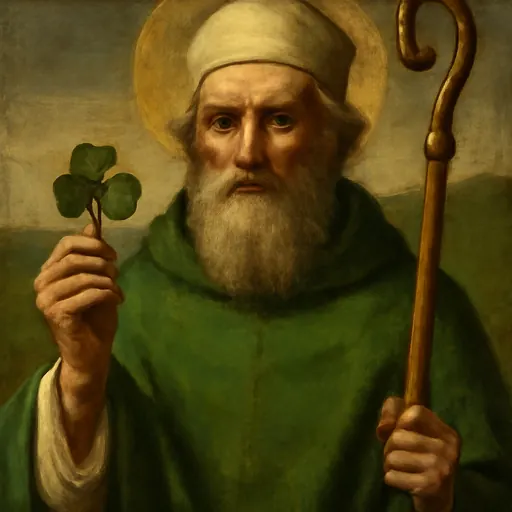
St. Patrick was a 5th-century Christian from Roman Britain who was kidnapped as a teenager, enslaved in Ireland for six years, escaped, and later returned as a bishop to preach the Gospel there. He is the patron saint of Ireland, and his two surviving letters, the Confessio and the Letter to Coroticus, are the oldest documents of Irish history. His feast day is March 17, the traditional date of his death.
Who was St. Patrick?
Patrick is one of the few early saints we can hear in his own voice. Two short Latin texts written by him survive: the Confessio, an account of his life and calling written near its end, and the Letter to Coroticus, an angry open letter to a British warlord whose men had killed and enslaved newly baptized Irish Christians. Everything else told about him, from the snakes to the shamrock, comes from later writers. This entry quotes Patrick from the English translation by Pádraig McCarthy published on the Royal Irish Academy's St. Patrick's Confessio website.
The Confessio opens plainly:
My name is Patrick. I am a sinner, a simple country person, and the least of all believers. I am looked down upon by many.
He was a Roman Briton, born in the late 4th or early 5th century. His father, Calpornius, was a deacon and a town councilor, and his grandfather, Potitus, was a priest. The family lived near a place Patrick calls Bannavem Taburniae, which no one has been able to locate. Scholars have proposed sites from the Severn estuary to the Solway Firth.

He never gives dates, and the Irish annals disagree. The traditional date for his mission is 432, and the annals record his death in both 461 and 493. Most historians place his work somewhere in the second half of the 5th century. He was not the very first bishop in Ireland: a chronicle by Prosper of Aquitaine records that Pope Celestine sent a bishop named Palladius "to the Irish believing in Christ" in 431. Patrick's achievement was to carry the Gospel to the pagan north and west, to places where, he wrote, "there is nobody else there."
The life of St. Patrick
Captured at sixteen
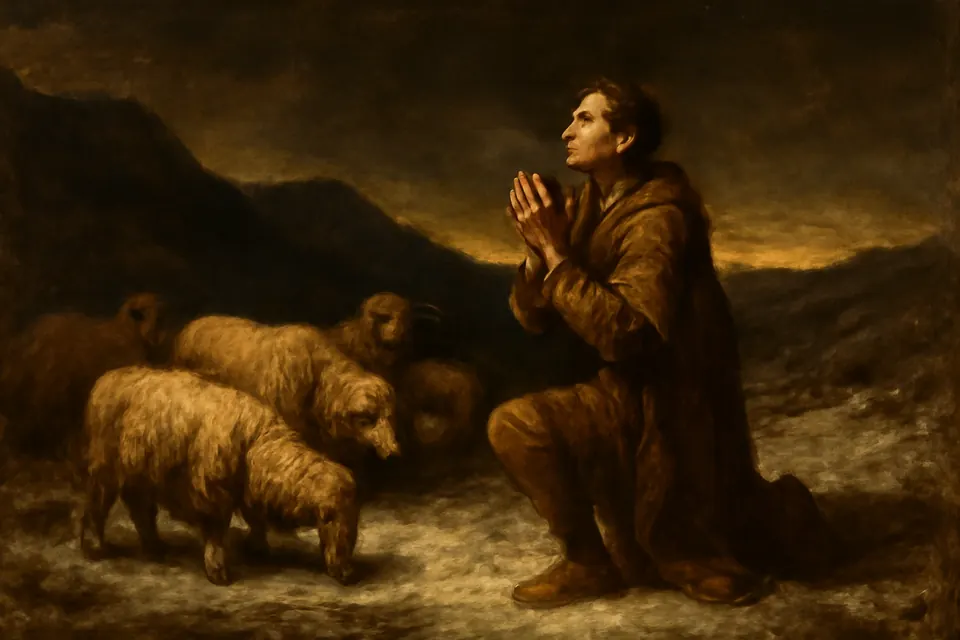
Irish raiders attacked his family's estate when he was "about sixteen," Patrick writes, and carried him off "along with thousands of others." He admits that he did not then know God, although he had been raised in a Christian home, and he reads the disaster as a judgment on a lax faith. In Ireland he was sold as a slave and put to work herding sheep. Later tradition places his captivity on Slemish mountain in County Antrim, while his own text mentions only "the wood of Voclut, near the western sea," which suggests County Mayo.
Captivity turned him to prayer. In one of the most quoted passages of the Confessio, he writes:
After I arrived in Ireland, I tended sheep every day, and I prayed frequently during the day. More and more the love of God increased, and my sense of awe before God. Faith grew, and my spirit was moved, so that in one day I would pray up to one hundred times, and at night perhaps the same. I even remained in the woods and on the mountain, and I would rise to pray before dawn in snow and ice and rain.
Escape
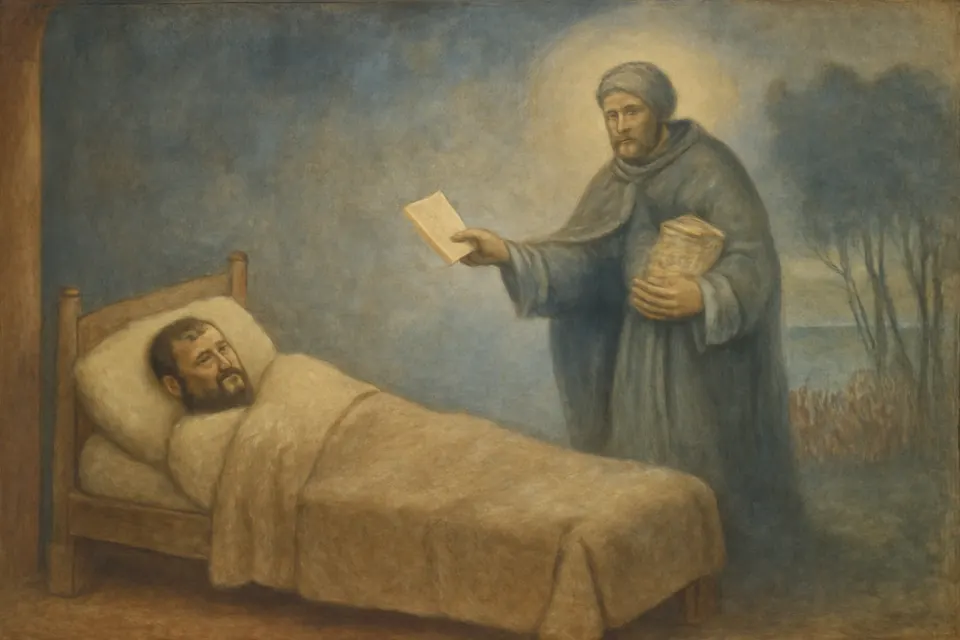
After six years a voice spoke to him in his sleep: "You have fasted well. Very soon you will return to your native country." A little later it said, "Look – your ship is ready." The ship was not nearby, he adds, "but a good two hundred miles away." He walked away from his master and found a ship about to sail. The captain at first refused him, then called him back.
The crew landed after three days and wandered for twenty-eight days through an empty country. When food ran out, the captain challenged him: "You tell us that your God is great and all-powerful – why can't you pray for us?" Patrick told them to turn to God, and a herd of pigs appeared on the road. Patrick tells this as a plain answer to prayer; this encyclopedia files it as reported, since the only witness is his own account.
The voice of the Irish
Back home in Britain, his family begged him never to leave again. Then came the dream that decided his life. He saw "a man whose name was Victoricus coming as it were from Ireland with so many letters they could not be counted." The letter he was handed began with "the voice of the Irish people," and he seemed to hear the people by the wood of Voclut calling out together:
We beg you, holy boy, to come and walk again among us.
"This touched my heart deeply," he writes, "and I could not read any further."
He studied for the priesthood, possibly in Gaul, though he never says where. Later lives connect him with St. Germanus of Auxerre, and the Catholic Encyclopedia follows them, but Patrick himself mentions only that he once hoped to visit "the brothers" in Gaul. He returned to Ireland as a bishop and stayed for the rest of his life.
Bishop in Ireland
The Confessio is short on events and long on gratitude, but it gives glimpses of the mission. He baptized thousands and ordained clergy "everywhere." He paid gifts to kings and to the "judges" of the districts he passed through, in order to travel safely. Once he and his companions were seized and "bound in iron," and freed on the fourteenth day. He was proud that converts' children took vows of celibacy:
The sons and daughters of the leaders of the Irish are seen to be monks and virgins of Christ!
He also had enemies in the Church. Some of his "superiors" in Britain brought up against him a sin he had confessed thirty years before, while still a youth, and questioned his fitness to be a bishop. The Confessio is partly his defense. He insists he took no payment for baptisms or ordinations, and he returned the ornaments that pious women laid on the altar so that no one could accuse him of greed.
The Letter to Coroticus
The second document is a cry of anger. Soldiers of a British king named Coroticus, nominally Christian, raided Ireland and killed a group of Patrick's converts on the day after their baptism, "the anointing was still to be seen clearly on their foreheads when they were cruelly slain and sacrificed by the sword." Others were carried off to be sold. Patrick sent a priest to ask for the captives back, and the soldiers "scoffed at them."
So he wrote to be read aloud before the soldiers. He calls them "allies of the apostate Scots and Picts" and tells Christians not to eat with them or take their alms until they free the prisoners. He also tells of his own status: "I live as an alien among non-Roman peoples, an exile on account of the love of God."
Death
Patrick ends the Confessio simply: "This is my confession before I die." Where and when he died is not recorded in his writings. The Irish tradition, already set down in the 7th century, says he died at Saul in County Down, on March 17, and was buried nearby at Downpatrick.
History and legend: the 7th-century lives
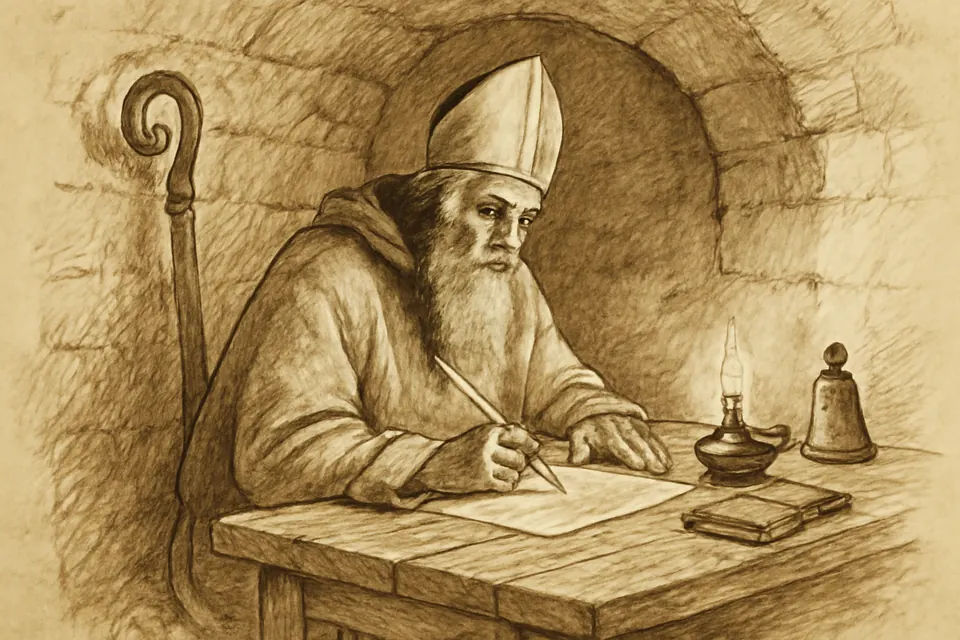
About two hundred years after Patrick's death, two churchmen wrote the first lives of him, both preserved in the 9th-century Book of Armagh. Muirchú wrote a continuous life, and Tírechán compiled notes on the churches Patrick was said to have founded. Both wrote partly to support the claim of Armagh to be Ireland's chief church, and both turn Patrick into a wonder-worker who contends with druids and kings. Later Irish lives, such as the Tripartite Life and the Middle Irish homily in the Leabhar Breac, expand the stories further.
The Easter fire at Slane
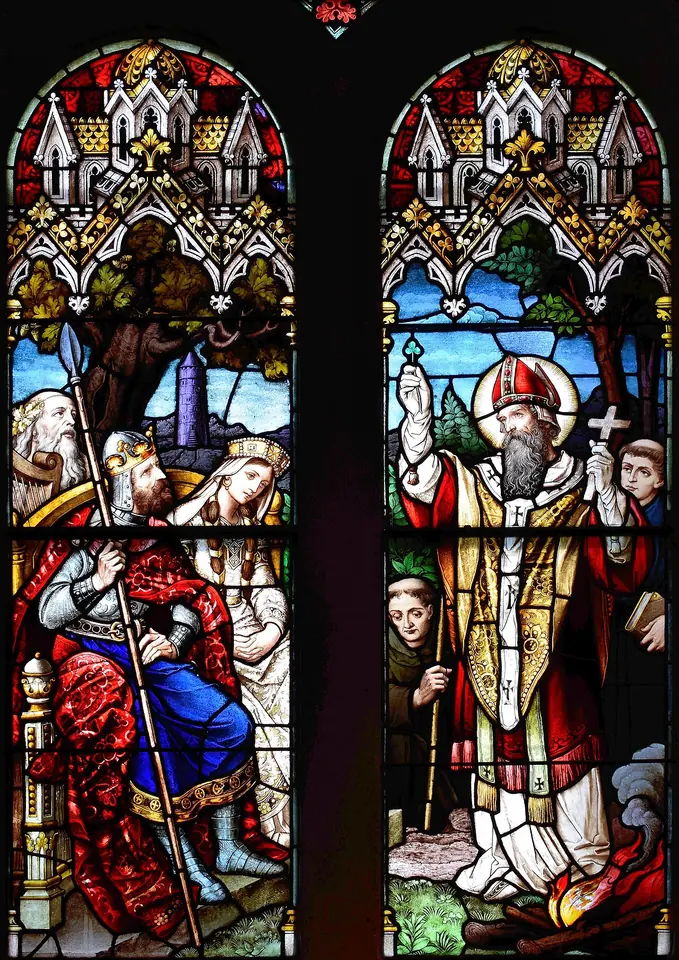
The most famous story comes from Muirchú. On Easter Eve Patrick lit the Paschal fire on a hill near Slane, in sight of Tara, at a time when the high king Lóegaire had forbidden any fire to be lit before the royal fire at Tara. The king's druids warned that unless that fire was put out that same night, it would never be put out in Ireland. Lóegaire rode out to kill Patrick but ended by allowing him to preach. In the stories that follow, Patrick defeats the druids in contests of miracles. The episode is traditional, and it is the reason a statue of Patrick stands on the Hill of Slane today.

The deer's cry
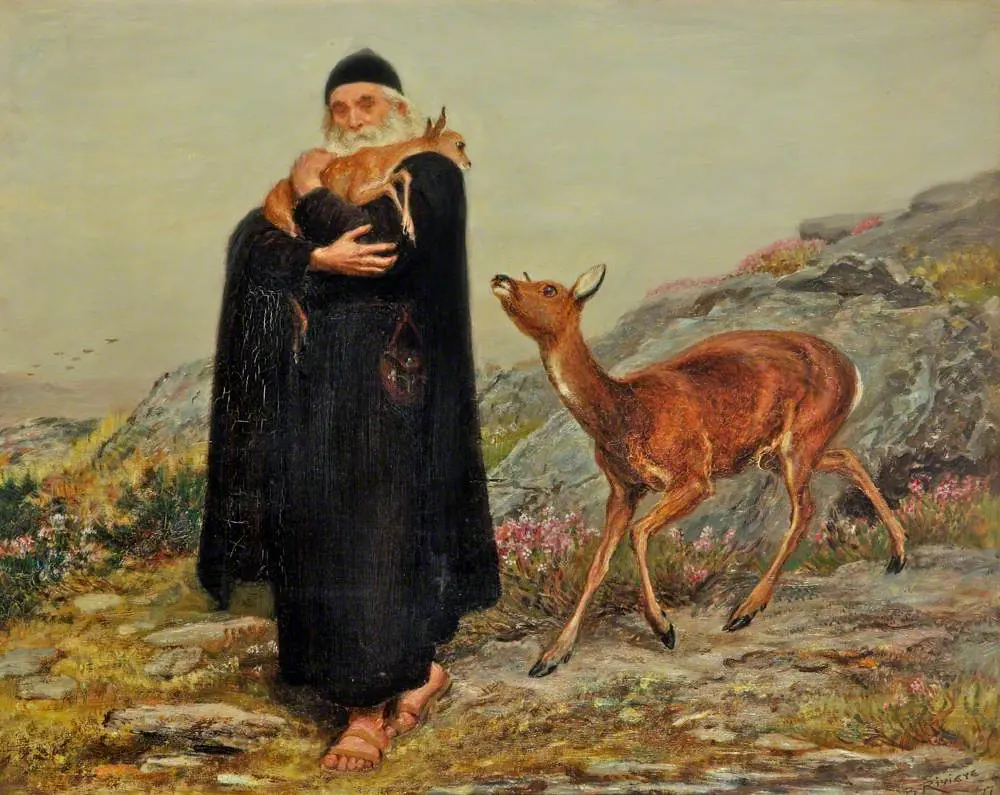
The Leabhar Breac homily adds that Lóegaire laid ambushes on every road to Tara. Patrick and eight companions passed through them unseen "in the shape of eight deer and behind them one fawn," the boy Benén carrying Patrick's book satchel. The prayer known as "The Deer's Cry," or St. Patrick's Breastplate, takes its name from this story.
The King of Cashel
At Cashel, the homily says, Patrick baptized Óengus, King of Munster. During the ceremony the spike at the foot of Patrick's crozier went through the king's foot. Óengus said nothing, and when Patrick asked why, he answered that he "thought that it was a rite of religion." The story is traditional.

The miracles of St. Patrick
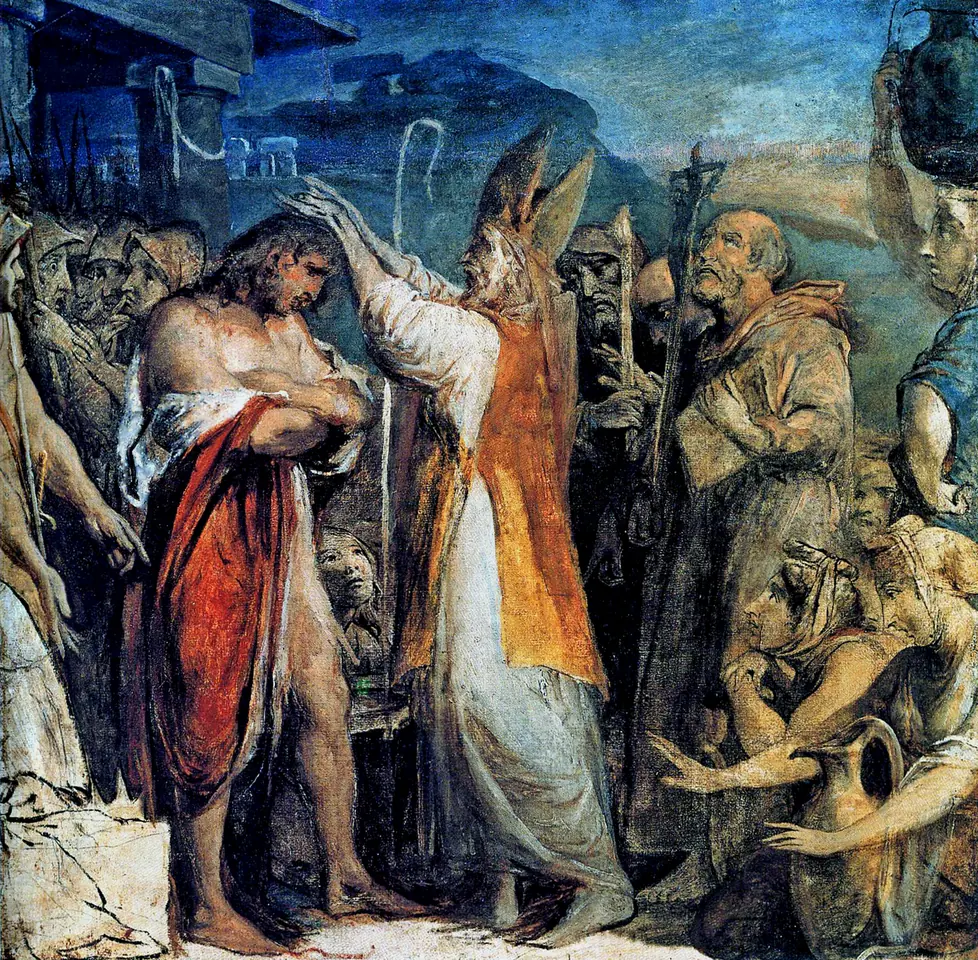
Patrick claimed no miracles for himself, except answers to prayer and dreams he believed came from God. Everything else belongs to the later lives. Sorted by the labels this encyclopedia uses:
- The voice that told him his ship was ready; the herd of pigs in the wilderness: reported. They come from his own Confessio.
- Freedom from his captors on the fourteenth day: reported, from the Confessio.
- The Paschal fire at Slane, the contests with the druids, the deer's disguise: traditional, from Muirchú and the later lives.
- Forty days of fasting on Croagh Patrick, where he drove off demons in the shape of black birds: traditional, from Tírechán and the later lives.
- Driving the snakes out of Ireland: traditional, and late. Ireland had no snakes after the Ice Age, and Bede, in the 8th century, says that snakes brought from Britain died as soon as they breathed Irish air, with no mention of Patrick. The story that Patrick banished them was added by later biographers, among them Jocelyn of Furness, around 1200.
- Healings and favors through his intercession: reported. Irish Catholics have told of them for centuries, but no modern investigation has examined them.

Why St. Patrick is the patron saint of Ireland
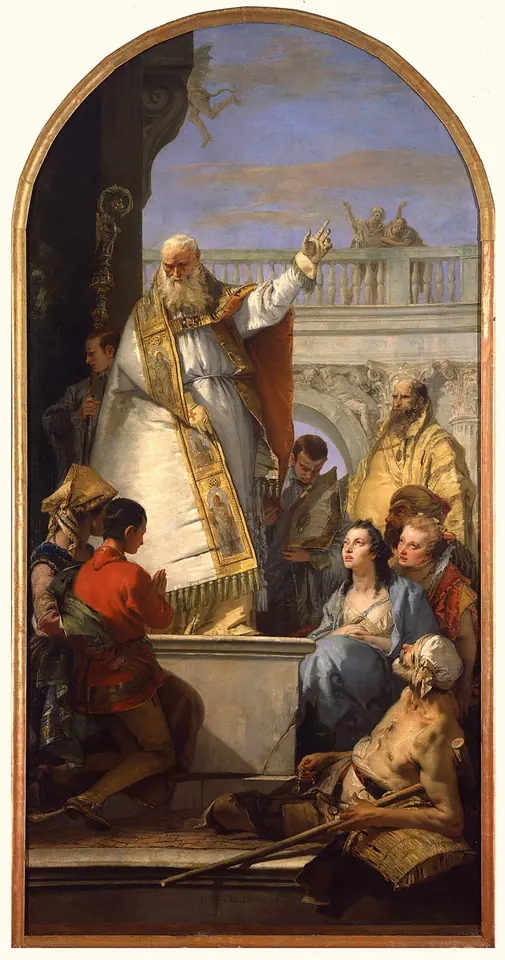
No one formally named Patrick Ireland's patron. By the 7th century Armagh already honored him as the apostle of the whole island, and the tradition was settled long before Rome kept any list of patrons. The Church in Ireland honors him as principal patron, with St. Brigid and St. Columba beside him.
Irish missionaries carried him abroad. He became patron of Nigeria, where Irish priests and sisters built up much of the Catholic Church in the 20th century, and of countless parishes and cathedrals founded by Irish emigrants in the United States, Canada and Australia. See the full list on our patron saints page.
Symbols of St. Patrick in art
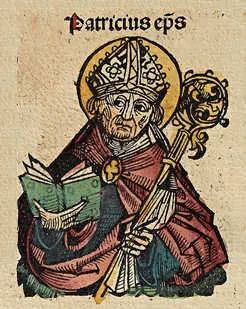
Patrick is almost always shown as a bishop, with miter and crozier, often older and bearded. To tell him from other bishops, look for:
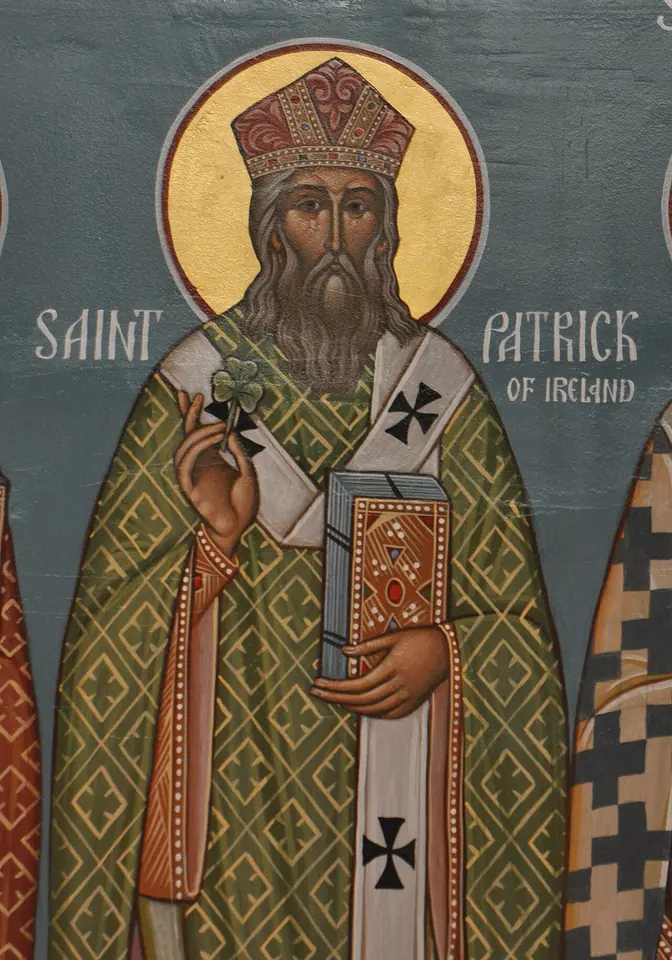
- A shamrock: the three-leaved plant, usually held up in one hand. It refers to the legend that he used it to explain the Trinity, a story first written down in 1726. Before then, Irish people already wore shamrock on his day; the English traveler Thomas Dineley described the custom in 1681.
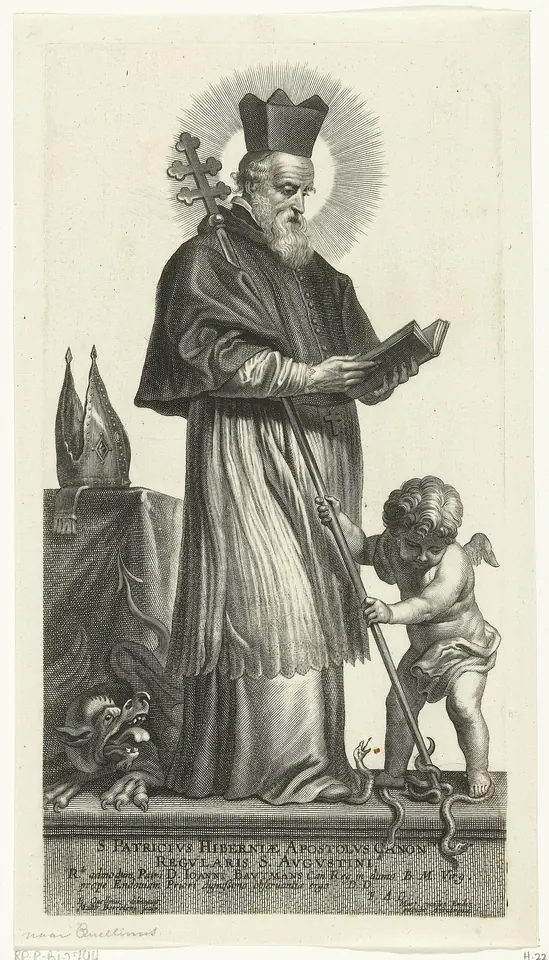
- Snakes: at his feet, often being driven into the sea or crushed under his crozier, from the snake legend.
- Green vestments: a modern convention. Older paintings, such as Tiepolo's, dress him in the colors of any bishop. Blue was long linked with Patrick and the Order of St. Patrick, and green became Ireland's color only in the 18th and 19th centuries.
- Fire: a flame or bonfire, for the Easter fire at Slane.
- A book: for the Gospel he preached, and sometimes his own writings.
- A fawn or deer: for "The Deer's Cry" legend, as in Briton Rivière's painting.

A 17th-century Flemish engraving by Mattheus Borrekens puts several attributes together: a book in his hands, a miter set aside, a crozier held by an angel and snakes on the ground.

The Eastern Orthodox Church also counts Patrick among its saints, as a bishop of the undivided Church before 1054. Orthodox icons show him in the manner of other early bishops: gray-bearded, frontal, in a white stole marked with black crosses, blessing with one hand and holding the Gospels. Some modern icons add a shamrock.

Places of St. Patrick
Croagh Patrick
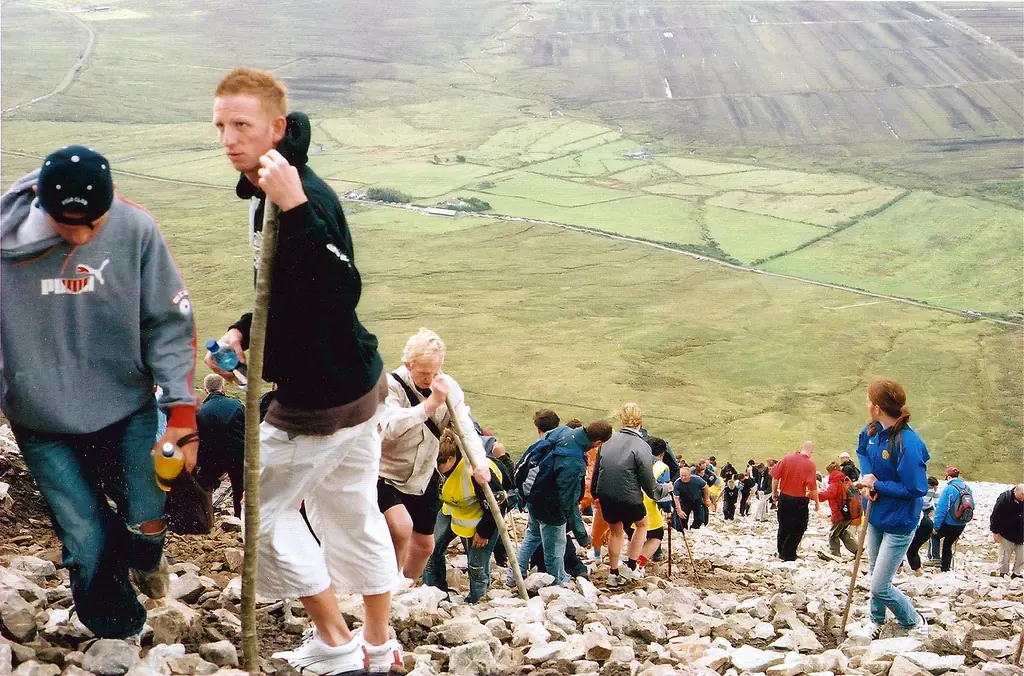
Croagh Patrick, a cone-shaped mountain above Clew Bay in County Mayo, is Ireland's holy mountain. Tírechán says Patrick fasted for forty days on its summit, as Moses did on Sinai. The Leabhar Breac homily adds that devils in the shape of black birds filled the mountain until Patrick rang his bell and they fled into the sea.
Pilgrims have climbed it for at least a thousand years. On Reek Sunday, the last Sunday of July, thousands make the climb up the steep, loose stone path, some of them barefoot, for Mass at the chapel on the summit.

St. Patrick's Purgatory, Lough Derg
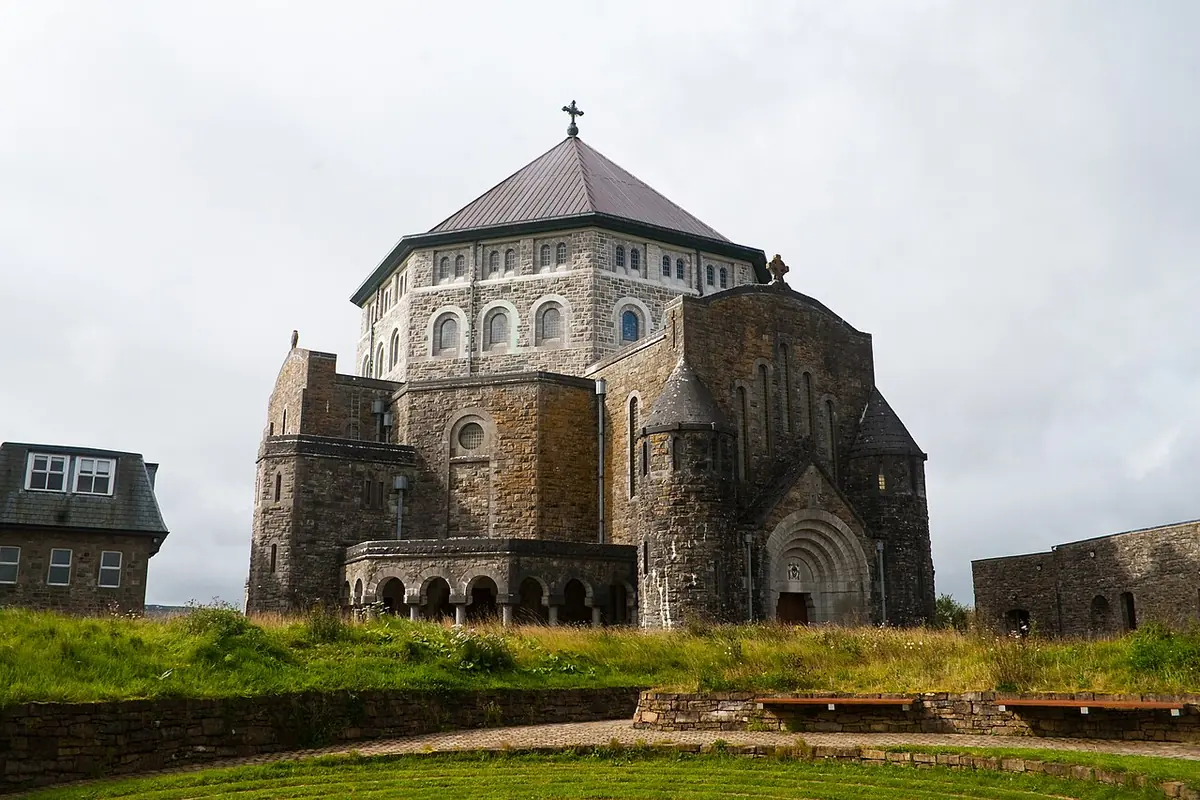
On Station Island in Lough Derg, County Donegal, medieval tradition placed a cave where Christ showed Patrick an entrance to purgatory. The Latin Treatise on the Purgatory of St. Patrick, written in England in the late 12th century, made the place famous across Europe, and pilgrims came from as far as Hungary and Spain. The cave was closed long ago, but the pilgrimage continues. The Three Day Pilgrimage, held each summer, keeps the old pattern of prayer, fasting and vigil: pilgrims go barefoot, eat one simple meal a day and keep an all-night vigil in the basilica.

Downpatrick and Saul
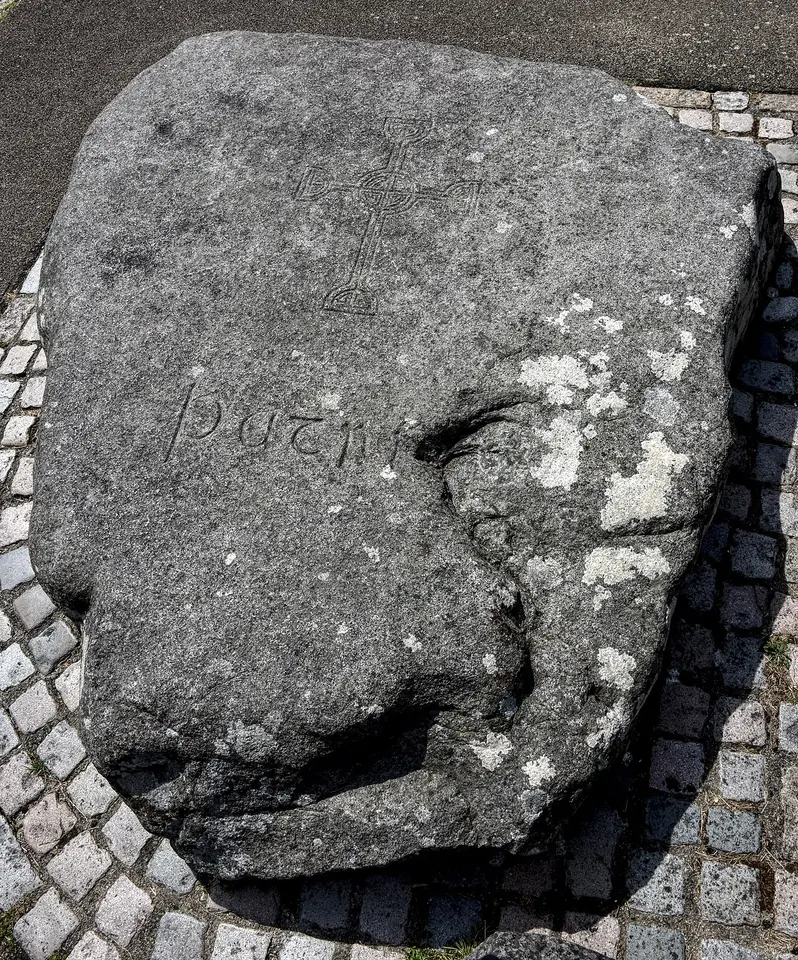
Tradition says Patrick's first church in Ireland was a barn at Saul, County Down, given by a local chief named Díchu, and that he died there. He was buried at Downpatrick, a few miles away. Muirchú tells that two untamed oxen were yoked to the cart that carried his body and were allowed to go where they would; where they stopped, he was buried. A medieval rhyme says three saints lie in one grave at Down: Patrick, Brigid and Columba. The Anglo-Norman lord John de Courcy claimed to have found their bodies there in the 12th century.
The grave in the churchyard of Down Cathedral is marked by a large granite boulder from the Mourne Mountains, laid in 1900 partly to stop pilgrims from carrying away the soil. No one can say whether Patrick lies exactly beneath it.

Armagh, which Patrick is said to have founded, has two cathedrals named for him, one Catholic and one Church of Ireland. Both claim his heritage.
St. Patrick's Day
Patrick's feast is March 17, which Irish tradition holds was the day he died. The Irish kept it from the early Middle Ages. It entered the universal calendar of the Catholic Church in the 17th century, through the efforts of the Irish Franciscan Luke Wadding. In Ireland it is a holy day and a public holiday; elsewhere it is an optional memorial. His neighbors on the calendar, including St. Joseph on March 19, are on our feast days page.
For centuries the day was mainly religious in Ireland. Because it falls in Lent, the Church often relaxed the Lenten fast for the feast, which helped give the day its festive side.
The first parades were in America
Parades are an American invention. The earliest recorded St. Patrick's Day procession took place on March 17, 1601, in the Spanish colony of St. Augustine, Florida, organized by its Irish vicar, Ricardo Artur. In Boston, the Charitable Irish Society, founded by Irish Protestants, held its first gathering on March 17, 1737. In New York, Irish soldiers serving in the British army marched on March 17, 1762, and the New York parade, which grew from such marches, is now one of the largest in the world.
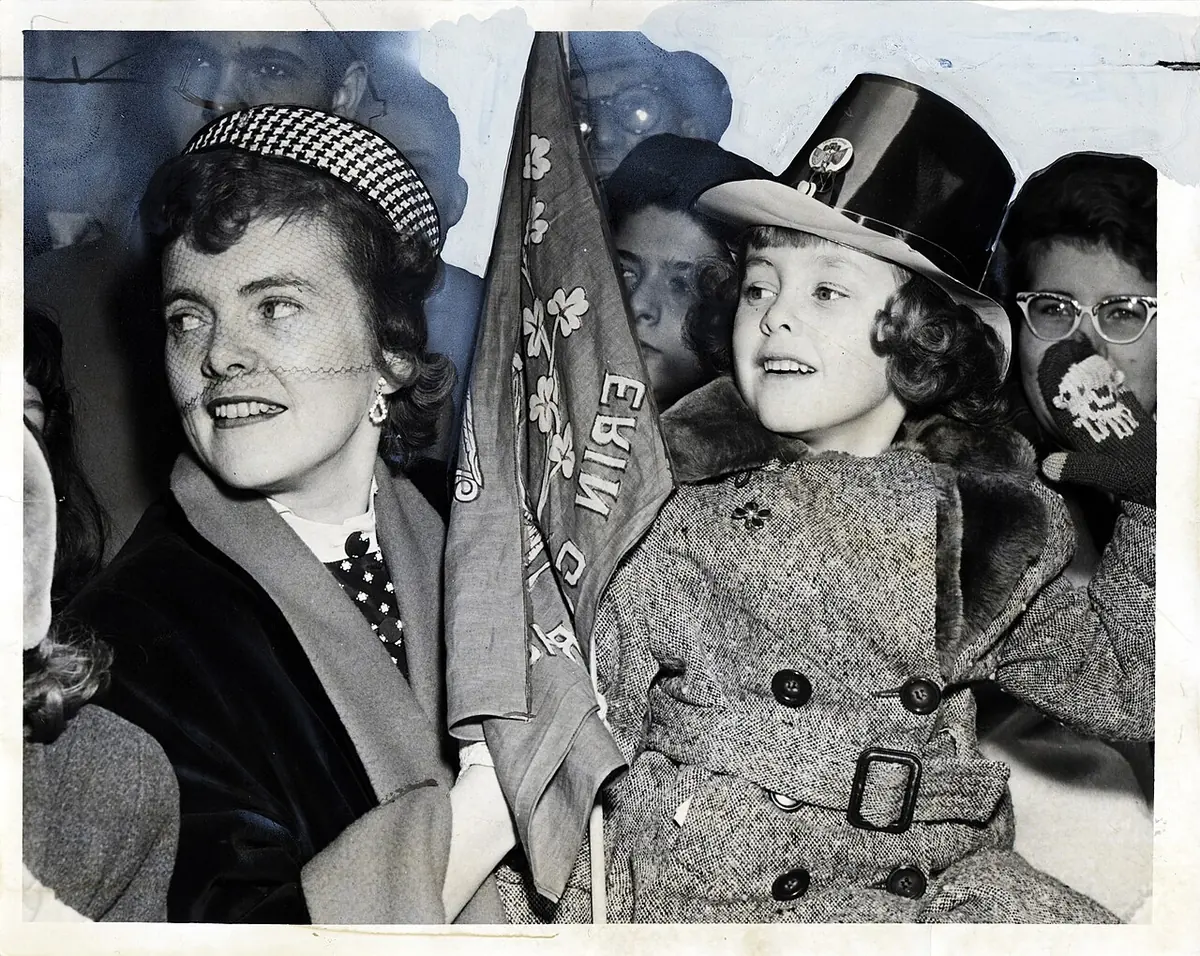

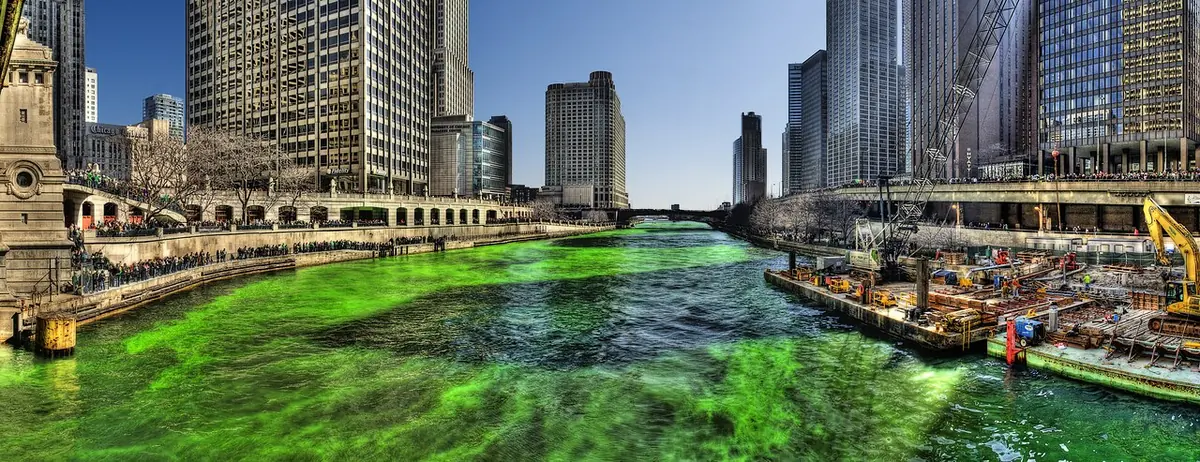
Irish immigrants in the 19th century made the parades a show of pride in the face of prejudice, and the customs spread back to Ireland. Corned beef and cabbage, green beer and the green Chicago River are American additions. Chicago first dyed its river green in 1962, after city workers found that the dye they used to trace sewage leaks turned the water a brilliant green.

St. Patrick's Breastplate and other prayers
The Breastplate (the Lorica)
The prayer most connected with Patrick is the Old Irish hymn called St. Patrick's Breastplate, the Lorica (Latin for "breastplate") or "The Deer's Cry." The oldest copies are in the 11th-century Liber Hymnorum, whose preface says Patrick sang it when Lóegaire's ambushes were set against him on the way to Tara. Its language belongs to about the 7th or 8th century, so most scholars think it was written after Patrick's death, by someone who knew his spirit well. It is a traditional attribution. The Catholic Encyclopedia of 1911 accepted it as genuine, as many Irish Catholics still do.
Kuno Meyer's translation, in Selections from Ancient Irish Poetry (1911), opens:
I arise to-day
Through a mighty strength, the invocation of the Trinity,
Through belief in the threeness,
Through confession of the oneness
Of the Creator of Creation.
Its best-known lines come near the end:
Christ with me, Christ before me, Christ behind me,
Christ in me, Christ beneath me, Christ above me,
Christ on my right, Christ on my left,
Christ when I lie down, Christ when I sit down, Christ when I arise.
Many English-speaking churches sing it as the hymn "I bind unto myself today," a free version by Cecil Frances Alexander. In the medieval Irish lives, Patrick is said to have promised that whoever sang his hymn on the day of death would reach heaven.
The Collect for St. Patrick's Day
The Catholic Mass of March 17 opens with this prayer, from the English translation of the Roman Missal (2011):
O God, who chose the Bishop Saint Patrick to preach your glory to the peoples of Ireland, grant, through his merits and intercession, that those who glory in the name of Christian may never cease to proclaim your wondrous deeds to all. Through our Lord Jesus Christ, your Son, who lives and reigns with you in the unity of the Holy Spirit, God, for ever and ever.
Catholics also ask St. Patrick to pray for Ireland, for Irish emigrants and their families, and for missionaries. Many pray the Breastplate itself in the morning, as a prayer for protection through the day.
In his own words
Patrick's Latin is rough, and he knew it. "I did not learn as others did," he writes, and he calls himself "a sinner without learning." Yet the Confessio is full of Scripture, and its picture of Christ is drawn with care. Near the end he contrasts the sun that the pagan Irish worshiped with the one he served:
We, however, believe in and adore the true sun, that is, Christ, who will never perish.
He asked readers of his confession not to credit him with anything he had done, but to "judge and believe in all truth that it was a gift of God."
Frequently asked questions
What is St. Patrick the patron saint of?
Ireland above all, where he is the principal patron alongside St. Brigid and St. Columba. He is also patron of Nigeria, where Irish missionaries founded much of the Catholic Church, and of many dioceses and parishes founded by Irish emigrants, including St. Patrick's Cathedral in New York.
When is St. Patrick's feast day, and why March 17?
March 17. Irish tradition, recorded in the annals and the early lives, holds that he died on that date. It is an optional memorial in the General Roman Calendar and a solemnity in Ireland. When March 17 falls in Holy Week, the Church in Ireland moves the liturgical celebration to another day.
Did St. Patrick really drive the snakes out of Ireland?
No. Ireland had no snakes after the last Ice Age, and the Venerable Bede, writing in the 8th century, already noted that snakes could not live there, without connecting it to Patrick. The story that Patrick banished them first appears in Latin lives written centuries after his death. It is traditional and is often read as a picture of his victory over paganism.
Did St. Patrick use the shamrock to explain the Trinity?
Patrick's own writings never mention it. The earliest written account of the story is in the botanist Caleb Threlkeld's book of Irish plants, published in 1726, which reports it as something the Irish say. Patrick does write about the Trinity at length, so the legend fits his teaching even if the scene itself is late tradition.
What is St. Patrick's Breastplate?
A long Old Irish prayer for protection, also called the Lorica or "The Deer's Cry," which begins "I arise today" in Kuno Meyer's translation. Medieval Irish tradition credited it to Patrick, but its language points to a date around the 7th or 8th century, after his death. It is still one of the best-loved Irish prayers.
Where is St. Patrick buried?
Tradition places his grave at Downpatrick, County Down, in the churchyard of Down Cathedral, where a granite boulder marked "Patric" was placed in 1900. Medieval tradition says St. Brigid and St. Columba lie there with him. The exact spot cannot be proven.
Was St. Patrick Irish?
No. He was a Roman Briton, from a Christian family; his father Calpornius was a deacon and his grandfather Potitus a priest. He came to Ireland first as a captive and then, years later, by choice as a missionary bishop.
Where did St. Patrick's Day parades start?
In America, not Ireland. The earliest recorded procession was in the Spanish colony of St. Augustine, Florida, in 1601. Irish soldiers in the British army marched in New York City on March 17, 1762, and New York's parade grew from there. In Boston, the Charitable Irish Society held its first St. Patrick's Day gathering in 1737.
Sources
- St. Patrick's Confessio (Royal Irish Academy): Confession, English translation by Pádraig McCarthy
- St. Patrick's Confessio (Royal Irish Academy): Letter to the soldiers of Coroticus, English translation
- Catholic Encyclopedia (1911): St. Patrick
- Kuno Meyer, Selections from Ancient Irish Poetry (1911): The Deer's Cry (Project Gutenberg)
- On the Life of St. Patrick, Middle Irish homily from the Leabhar Breac, trans. Whitley Stokes (CELT, University College Cork)
- Lough Derg: Sanctuary of Saint Patrick (official site)
- Down and Dromore (Church of Ireland): Down Cathedral
- HISTORY: St. Patrick's Day: Origin, Meaning and Background
- The Roman Missal (English translation, 2011): Collect for St. Patrick, March 17
- Muirchú, Life of Patrick, and Tírechán, Collectanea (Book of Armagh, 7th century)