Tilma of Guadalupe

The Tilma of Guadalupe is the cloak of St. Juan Diego, woven of coarse plant fiber, that has carried the image of Our Lady of Guadalupe since December 1531. It hangs above the main altar of the Basilica of Guadalupe in Mexico City. The faithful venerate it as the sign Our Lady gave Bishop Zumárraga; its origin has been studied and debated for nearly three centuries.
What is the tilma of Guadalupe?
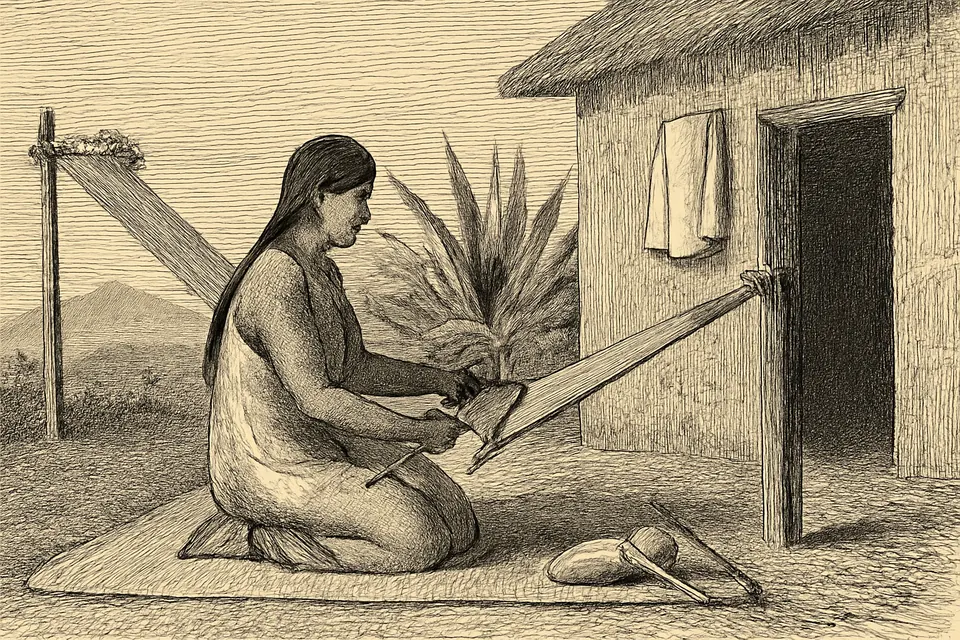
The tilma of Guadalupe is the outer cloak of St. Juan Diego, a Nahua convert who lived near Mexico City in the early 1500s. A tilma (from the Nahuatl tilmatli) was the cloak an Indigenous man wore knotted at one shoulder or at the neck. Poorer people wore the rough kind called ayatl, which Spanish speakers turned into ayate. That is the word the Basilica of Guadalupe still uses for it: el ayate de Juan Diego.
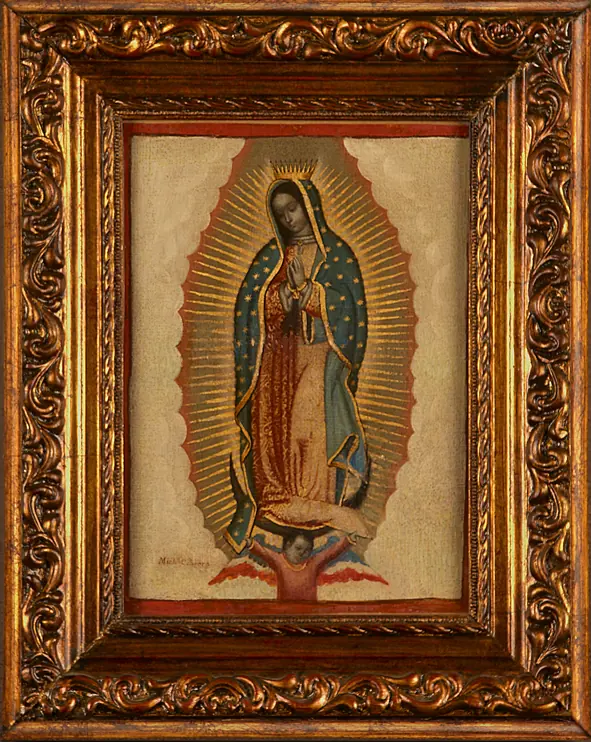
On this cloak is the image of the Virgin Mary that the faithful know and love as Our Lady of Guadalupe: a young woman with folded hands and lowered eyes, a blue-green mantle scattered with stars, rays of light around her, a crescent moon and an angel at her feet. Tradition holds that it appeared on December 12, 1531, when Juan Diego opened his cloak before Bishop Juan de Zumárraga and the roses he was carrying fell to the floor. The cloak has been kept at Tepeyac ever since, and pilgrims come by the millions to see it.
This page is about the cloth itself: what it's made of, where the story of it comes from, how it is shown today, and what painters, scientists and skeptics have said after looking at it closely. For the apparitions, the symbols in the image and the December 12 feast, see our full entry on Our Lady of Guadalupe.
What the tilma is made of: maguey, palm or something else?
Everyone agrees on the basics. The tilma is a coarse, open weave of plant fiber, made of two lengths of cloth sewn together with a seam that runs up the middle of the image and passes just beside the Virgin's face. Beyond that, the sources disagree.
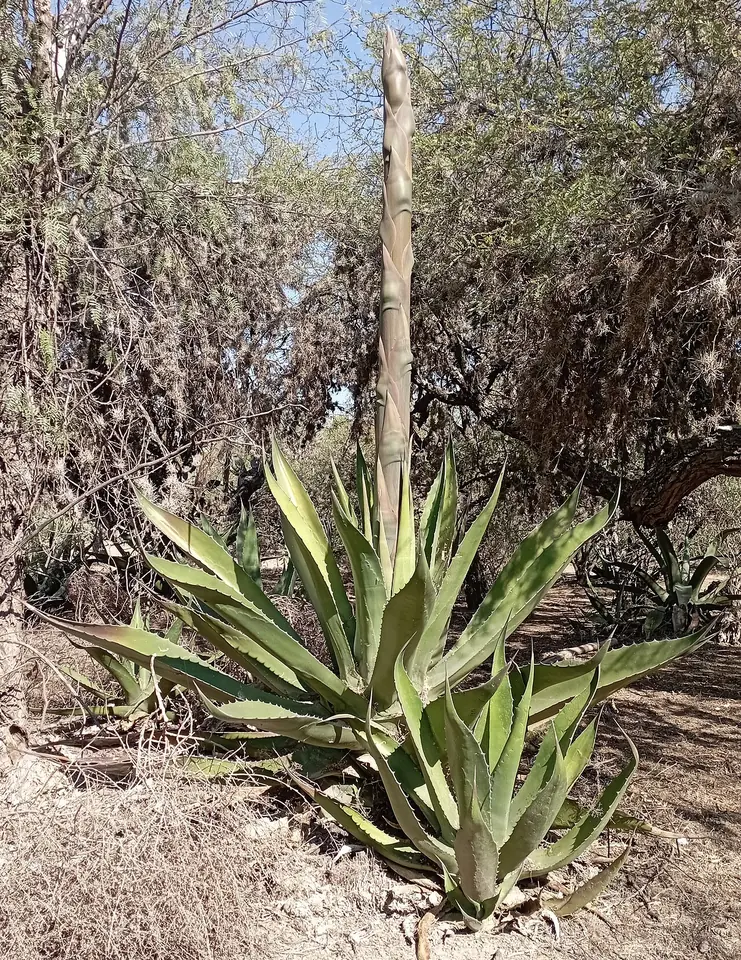
The maguey (agave) view. Most writers say the cloak is woven from agave fiber, which in Mexico is called ixtle (from Nahuatl ichtli). Ayates of maguey fiber were the ordinary clothing of the poor in 16th-century central Mexico. Philip Callahan, who photographed the image in infrared in 1979, called it "the agave tilma."
The palm view. Miguel Cabrera, the painter who examined the cloth in 1751, disagreed. In his book Maravilla americana (1756) he wrote that the cloth was a coarse weave of threads called pita, "which the Indians drew from certain palms native to this country." He knew that others thought it was maguey and rejected the idea, because the maguey ayates the Indigenous people of his day still wore were "much too coarse," and this one was not. He also reported something he found more striking than the fiber: though the cloth looks rough, it felt to his hand "very like fine silk."
The linen-and-hemp view. In 2002 the Mexican magazine Proceso reported a private examination made in 1982 by the art restorer José Sol Rosales, who looked at the cloth under a stereomicroscope. As Joe Nickell summarized the report in Skeptical Briefs, Rosales thought the fabric seemed to be a mix of linen with hemp or cactus fiber.

So the honest answer is that the fiber is debated. The common identification is agave, but no fiber analysis has been published in a form that settles it. Cabrera himself thought the question beside the point: palm or maguey, he wrote, either one was "the most unsuitable" surface a human artist could have chosen.
The 1531 account in the Nican Mopohua
The fullest account of how the image came to be on the cloak is the Nican Mopohua, named for its first words in Nahuatl, "Here is told." It describes the four apparitions to Juan Diego on Tepeyac Hill in December 1531, the bishop's request for a sign, the roses gathered on the frosty hilltop, and the moment in the bishop's house:
And then he held out his white tilma, in the hollow of which he had placed the flowers.
And just as all the different precious flowers fell to the floor, then and there the beloved Image of the Perfect Virgin Holy Mary, Mother of God, became the sign...
The text goes on to say that the bishop untied the tilma from Juan Diego's neck and placed it in his private chapel, and later in the first small church at Tepeyac. (The English here is the translation published on the Basilica's own website.)

When it was written, and by whom. The Nican Mopohua first appeared in print in 1649, in a small Nahuatl book called Huei tlamahuiçoltica ("By a great miracle"), published by Luis Laso de la Vega, the priest in charge of the shrine, at the press of Juan Ruyz in Mexico City. The Basilica attributes the text to Antonio Valeriano (died 1605), the best-known Nahua scholar of the Franciscan College of Santa Cruz in Tlatelolco, and dates it to around 1556, citing the historian Miguel León-Portilla. Other historians, notably Stafford Poole, argue that it was composed in the 17th century under Laso de la Vega. Both positions are set out in our Guadalupe entry. What isn't in dispute is that the cloak itself was being venerated at Tepeyac by the 1550s.
How the tilma is displayed in the Basilica
For most of its history the tilma hung above the high altar of the church at the foot of Tepeyac, first in a small chapel, then in the church of 1622, and from 1709 in the building now called the old basilica. A photograph from around 1900 shows it there in its frame.

On May 18, 1923, according to the Archdiocese of Mexico, the photographer Manuel Ramos took the first photograph of the image directly, without its protective glass, while the frame was being changed after the bombing of 1921. His photographs became the official images of the Virgin circulated in the 1920s and 1930s.
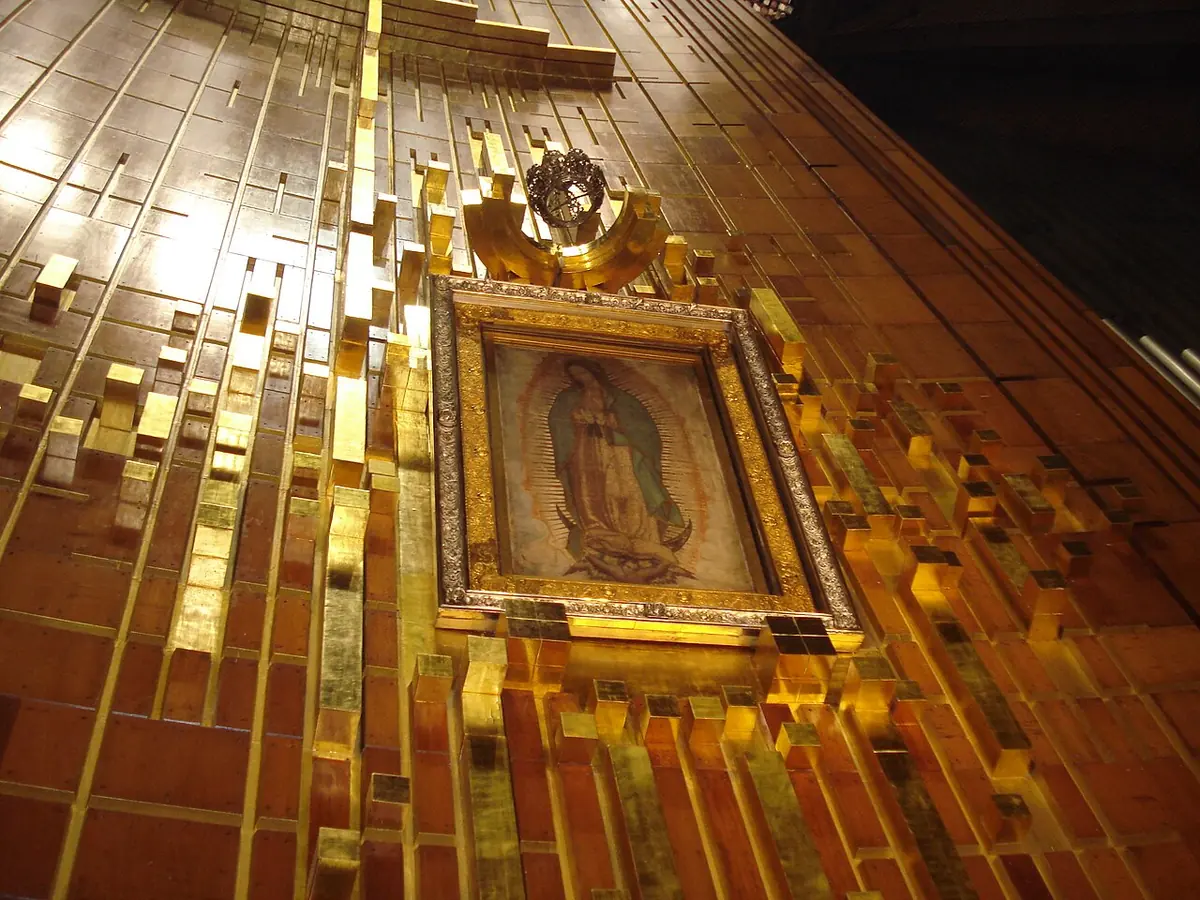
When the old church was sinking into the soft lakebed soil, a new round basilica was built beside it, and the image was carried into it on October 12, 1976. There it hangs high on the wall behind the main altar, in a frame set against panels of gold. During Mass it is visible from the whole church.

The basilica's designers also solved an old problem: how to let millions of people see the image up close without stopping the liturgy. Below and behind the altar is a passage where moving walkways carry visitors past beneath the tilma. You step on, look up at the cloak a few yards above you, and are carried along to make room for the next person. On December 12 the line can stretch out across the plaza.
The 1751 inspection by Miguel Cabrera
The first close professional study of the tilma was an art inspection. On April 30, 1751, at the request of the abbot and canons of the shrine, the painter Miguel Cabrera and a group of fellow master painters examined the image. One of them, Juan Patricio Morlete Ruiz, later wrote that he was an eyewitness that day. Cabrera published their findings in 1756 as Maravilla americana, "American marvel," dedicated to Archbishop Manuel Rubio y Salinas.
Cabrera's main observations:
- No sizing. The cloth had no aparejo, the ground or primer every painter of his day laid down before painting, without which the colors should soak through the open weave.
- Four techniques on one surface. He believed the head and hands were in oil, the tunic and the angel with its clouds in tempera, the mantle in aguazo (a watercolor technique on cloth), and the field behind the rays in a worked tempera. He knew of no painter who had ever combined all four.
- The cloth's survival. He marveled that the ayate had lasted more than 225 years in Mexico City, a city built on a lake and ringed by salt flats, whose damp, salt-laden air he said crumbled buildings, while finer canvases rotted.
He concluded that the painting was sobrenatural, supernatural. His study is a painter's judgment, made with the eye and hand, not with instruments, and it was written by a devout man for the archbishop. Still, it is the earliest detailed description of the cloth by people who had touched it, and later researchers on every side quote it.

Philip Callahan's infrared study, 1979
In 1979 Philip Serna Callahan, a biophysicist at the University of Florida and a specialist in infrared photography, photographed the tilma in infrared with Jody Brant Smith. His report was published in 1981 by CARA (the Center for Applied Research in the Apostolate) as The Tilma Under Infra-Red Radiation.
Callahan's findings cut two ways, and both are worth keeping.
What he could not explain. He found no underdrawing and no sizing or varnish on the original figure. He wrote that "the original figure, including the rose robe, blue mantle, hands and face ... is inexplicable" by infrared techniques, and that the colors had kept their brightness without fading or cracking. He also noticed that the face looks flat and disappointing up close, but at six or seven feet the rough weave and the pigment blend into an olive skin tone, an effect he compared to bird feathers and butterfly scales.
What he said was added by human hands. Callahan was just as clear that parts of the image were later additions. In his reading, the moon and the tassel were added first, and later the gold and black decorations, the angel, a fold of the robe, the sunburst, the stars and the background, "probably during the seventeenth century." Some of these additions were flaking.
Skeptics take the same photographs further. Joe Nickell points to infrared evidence that the hands were modified, sketch-like lines in a fold of the robe, heavy pigment on the highlights of the face, and cracking along the seam as signs of an ordinary painting. Defenders of the tradition reply that Callahan's additions don't touch the core figure, and some argue the additions were made very early, by Indigenous painters, to strengthen the image's meaning for Nahua viewers.
Claims about the eyes and the stars
Two popular claims about the tilma have spread far beyond Mexico. They are claims, not findings the Church endorses, and each has serious critics.
Figures in the eyes. The usual account says that in 1929 Alfonso Marcué, photographer of the old basilica, noticed what looked like a bearded man in the Virgin's right eye, and that the draftsman José Carlos Salinas Chávez saw it again in 1951. Beginning in 1979 the Peruvian engineer José Aste Tönsmann scanned photographs of the eyes at high magnification. In 2001 he told a conference in Rome that he had found "at least 13 people" in the eyes, which he identifies as Juan Diego, Bishop Zumárraga, an interpreter and others present in 1531. Critics answer that the eyes are tiny marks on a coarse, open weave, and that enlarging them invites the mind to find faces in random marks. Nickell and the forensic analyst John Fischer argued that the figures are the mind finding images, inkblot-like, in random shapes.
Stars on the mantle. In the 1980s Juan Homero Hernández Illescas and Fr. Mario Rojas Sánchez argued that the stars on the mantle reproduce the constellations over the Valley of Mexico on the morning of December 12, 1531. Not every Catholic researcher agrees. In 2014, at the Guadalupan studies college of the Universidad Intercontinental in Mexico City, the engineer Eugenio Urrutia Albisua used planetarium software to test the book. He reported that the mantle lacks many of the brightest stars of the constellations claimed, leaves out Aldebaran and Venus, and pairs constellations such as Scorpius and Taurus that could not be in the sky together at the proposed hour.
The 1921 bomb and other dangers
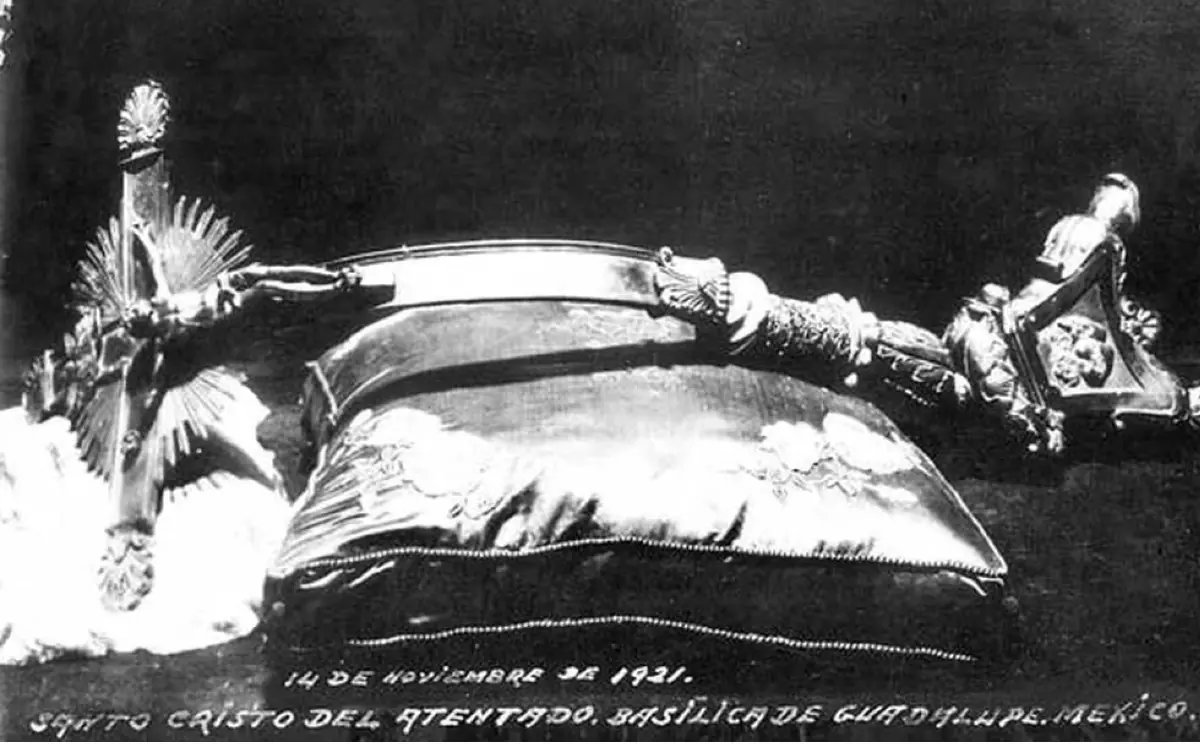
On the morning of November 14, 1921, during the anti-Catholic conflict that followed the Mexican Revolution, Luciano Pérez Carpio, an employee of the president's private office, left a bomb of dynamite hidden in a flower arrangement on the altar beneath the image in the old basilica. According to the Archdiocese of Mexico, it went off at about 10:30. It damaged the altar steps and the brass candlesticks and threw a crucifix of iron and bronze, weighing more than 50 pounds, to the floor, bent backward. The image was unharmed, and the glass over it did not even break. This is a reported event: the attack is well documented, and the faithful see the image's escape as providential.
An earlier accident is less famous. Around 1784, silversmiths working on the frame knocked over a vessel of agua fuerte, nitric acid, which ran down the cloth beside the face. The account was not written down until 1820, in sworn testimony kept in the basilica's archive. The witness José Manuel de la Riva, who arrived minutes after the spill, later said the acid left a stain on the left side "without spoiling the painting of the image, nor eating the ayate." The historian Arturo Rocha Cortés notes that nitric acid stains plant fiber yellow rather than dissolving it, which fits what can still be seen.
Nearly 500 years of survival
The tilma has now lasted close to five centuries. For much of that time it hung in the damp, salty air of the old lakebed, and, as the acid story shows, devotees were sometimes allowed close enough to kiss it. Plant-fiber ayates are often said to last only a few decades, and Cabrera already treated the cloth's survival as part of the wonder in 1751. Skeptics answer that a well-kept textile can last much longer than everyday clothing worn in the fields. Either way, the survival of this particular cloak, through an acid spill and a bomb, is a fact anyone can see at Tepeyac.
Is the tilma officially a miracle?
The Church venerates the image, and the cloak with it, as a holy object, the sign that Our Lady gave to Bishop Zumárraga, as the Church's long tradition holds. The Church has approved the devotion, and popes have honored it in nearly every way available. In the 18th century Pope Benedict XIV granted the feast its own Mass and Office. Leo XIII had the image solemnly crowned in 1895. John Paul II prayed before it on his first trip abroad in 1979 and canonized Juan Diego at the basilica in 2002.
But the Church has never issued a decree declaring that the image itself is of supernatural origin, the way it formally approves a healing for a canonization (see how the Church investigates miracles). Like all apparitions, Guadalupe belongs to private revelation, which the faithful may accept but are not obliged to believe. So on this site the image on the tilma is labeled traditional: a miracle held by tradition and by the faith of millions, honored by popes, and still argued over by historians and scientists.
For the cloak's place among the other famous relics of Christianity, see relics and incorruptible saints. The feast of Our Lady of Guadalupe is December 12, and St. Juan Diego's is December 9; both are on our feast-day calendar.
Frequently asked questions
What is the tilma of Guadalupe made of?
Coarse plant fiber of the kind the Nahua wove into everyday cloaks called ayatl, or ayate. Most writers say agave (maguey) fiber, also called ixtle, and the infrared researcher Philip Callahan called it an "agave tilma." The painter Miguel Cabrera, who handled it in 1751, disagreed and said it was woven from palm fiber, because maguey ayates were much coarser. A restorer's examination reported in 2002 described it as a mix of linen with hemp or cactus fiber. No published fiber analysis has settled the question.
Can you see the tilma of Juan Diego in person?
Yes. The tilma hangs in a frame above and behind the main altar of the Basilica of Our Lady of Guadalupe at Tepeyac, in the north of Mexico City. Visitors can view it from the nave or walk down to the passage behind the altar, where moving walkways carry them beneath it so the line keeps flowing.
Has the Church declared the tilma image a miracle?
Not by any formal decree. Popes have honored the image in the strongest ways the Church has, with a feast and its own Mass, the canonical coronation of 1895, and the canonization of Juan Diego in 2002. But no Church document defines the image's origin as supernatural, and, as with all private revelation, the faithful are not required to believe it. Many of the faithful, together with many bishops and popes, regard it as miraculous.
Are there really images in the eyes of Our Lady of Guadalupe?
That is a claim, not an established fact. Since 1929 several people have reported a bearded man reflected in the eyes, and the engineer José Aste Tönsmann says digital enlargement shows at least 13 figures. Critics such as Joe Nickell answer that magnifying a coarse painted weave lets the eye find faces in random shapes, much as people see figures in inkblots.
Do the stars on the mantle match the sky of December 12, 1531?
Juan Homero Hernández Illescas and Fr. Mario Rojas Sánchez argued that they do. In 2014 the engineer Eugenio Urrutia Albisua, speaking at a Guadalupan studies college in Mexico City, disputed the claim, showing that the mantle leaves out major stars of the constellations named and that some of the paired constellations could not be in the sky together at the proposed hour.
What happened to the tilma in the 1921 bombing?
On November 14, 1921, a bomb hidden in flowers on the altar beneath the image exploded in the old basilica. It damaged the altar steps and bent a heavy iron and bronze crucifix backward, but the image and even its glass were unharmed. The bent crucifix is displayed in the new basilica.
Sources
- Miguel Cabrera, Maravilla americana (Mexico: Colegio de San Ildefonso, 1756), Internet Archive
- Basílica de Guadalupe: Documentos históricos (on the Nican Mopohua and Huei tlamahuiçoltica)
- Basílica de Guadalupe: El Relato (the Nican Mopohua in Nahuatl with English and other translations)
- Philip Callahan's infrared conclusions, quoted from A Handbook on Guadalupe (The Miracle Hunter)
- Joe Nickell, "'Miraculous' Image of Guadalupe," Skeptical Briefs 12.2 (June 2002)
- Zenit: Science Sees What Mary Saw from Juan Diego's Tilma (2001), via Catholic Education Resource Center
- Universidad Intercontinental, Colegio de Estudios Guadalupanos: Eugenio Urrutia on the stars in the mantle (May 17, 2014)
- Arturo Rocha Cortés, Crestomatías guadalupanas no. 9: Aguafuerte sobre la tilma (Universidad Intercontinental)
- EWTN News: Mexican archdiocese shares first photo ever taken of image of Our Lady of Guadalupe