St. Juan Diego Cuauhtlatoatzin

St. Juan Diego Cuauhtlatoatzin was an Indigenous Mexican convert who, according to the Guadalupe tradition, saw the Virgin Mary on Tepeyac Hill in December 1531 and carried her image to the bishop on his cloak. He spent his last years as a hermit beside her chapel and died in 1548. Pope John Paul II canonized him in 2002 as the first Indigenous saint of the Americas. His feast day is December 9.
Who was St. Juan Diego?
St. Juan Diego is the man to whom, according to Mexican Catholic tradition, the Virgin Mary appeared on Tepeyac Hill in December 1531, leaving her image on his cloak. That image is the one venerated today as Our Lady of Guadalupe, and the full story of the four apparitions and the tilma is told on her page. This page is about the man himself: what is known of his life, why some historians doubted he ever lived, and how he became, in Pope John Paul II's words, "the first indigenous Saint of the American Continent."
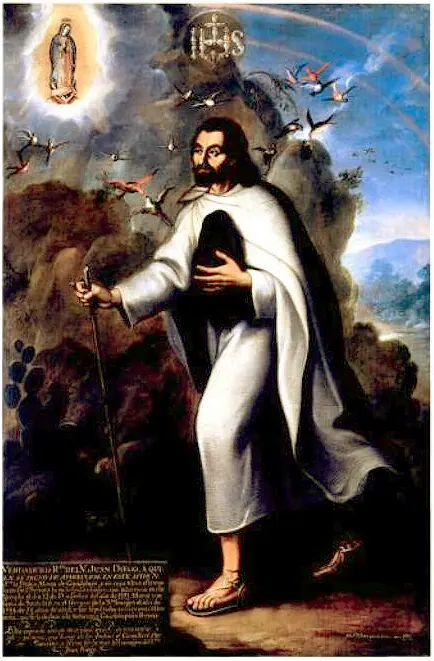

Little about him can be checked against documents from his own lifetime. The Vatican's biography admits that "little is known about the life of Juan Diego before his conversion," and draws on tradition and the Nican Mopohua, the Nahuatl account printed in 1649.
His life
Cuauhtlatoatzin, "the talking eagle"
The Vatican biography says he was born in 1474 in Cuauhtitlán, today part of the Mexico City area, with the name Cuauhtlatoatzin, which it translates as "the talking eagle." It calls him a member of the Chichimeca people. He would have been about 45 when the Spanish arrived in 1519.
Baptism
When he was about fifty, the biography says, a Franciscan named Peter of Ghent (Pedro de Gante), one of the first friars in New Spain, baptized him. He took the Christian names Juan Diego.

Tepeyac, December 1531
On December 9, 1531, on his way to Mass, Juan Diego saw a Lady on Tepeyac Hill who asked for a church there. When Bishop Juan de Zumárraga wanted a sign, she sent Juan Diego to pick roses on the winter hilltop, and when he opened his cloak (the tilma) before the bishop, her image was on the cloth. This is the Guadalupe tradition as the Nican Mopohua tells it.


Hermit beside the chapel
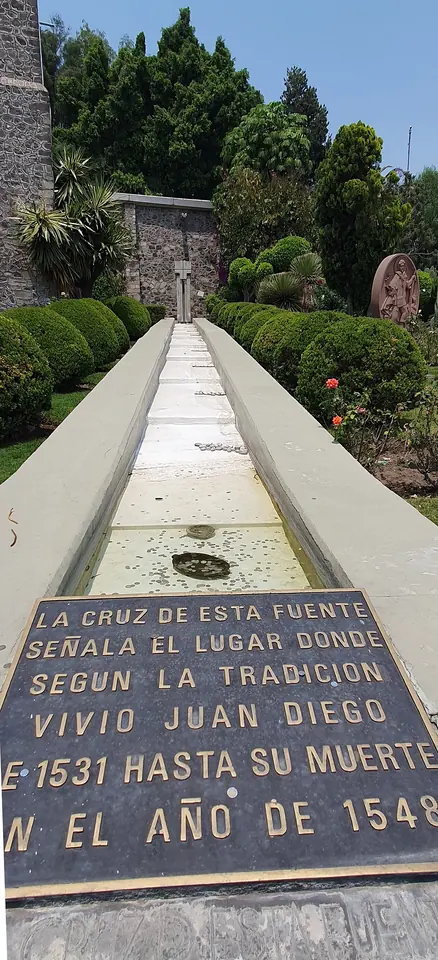
What the tradition says about his later life is simple. "With the Bishop's permission," the Vatican biography says, "Juan Diego lived the rest of his life as a hermit in a small hut near the chapel where the miraculous image was placed for veneration. Here he cared for the church and the first pilgrims." He died in 1548 and was buried in that first chapel. The place where his hut is thought to have stood is marked today in the gardens of the Capilla de Indios, beside the basilica.

Did Juan Diego exist? The debate before 2002
Doubts about Juan Diego are as old as doubts about the apparitions. No surviving letter of Bishop Zumárraga mentions him, and the historian Stafford Poole, a Vincentian priest, writes that there is "no incontrovertible evidence of the apparitions before 1648." If the story first appeared in print more than a century after 1531, critics asked, how could the Church be sure its main character was a real man and not a figure of devotion?
The question became urgent when John Paul II beatified Juan Diego at the basilica on May 6, 1990. According to the National Catholic Register, the longtime abbot of the basilica, Guillermo Schulenburg, first raised his objections that same year, and by 1997 they had effectively frozen the cause. The Congregation for the Causes of Saints asked for more proof of Juan Diego's existence and character.
At the request of Cardinal Norberto Rivera of Mexico City, a historical commission spent 18 months searching archives in Mexico, Spain and Rome. On October 28, 1998, it presented what the Register called "three significant, previously forgotten documents":
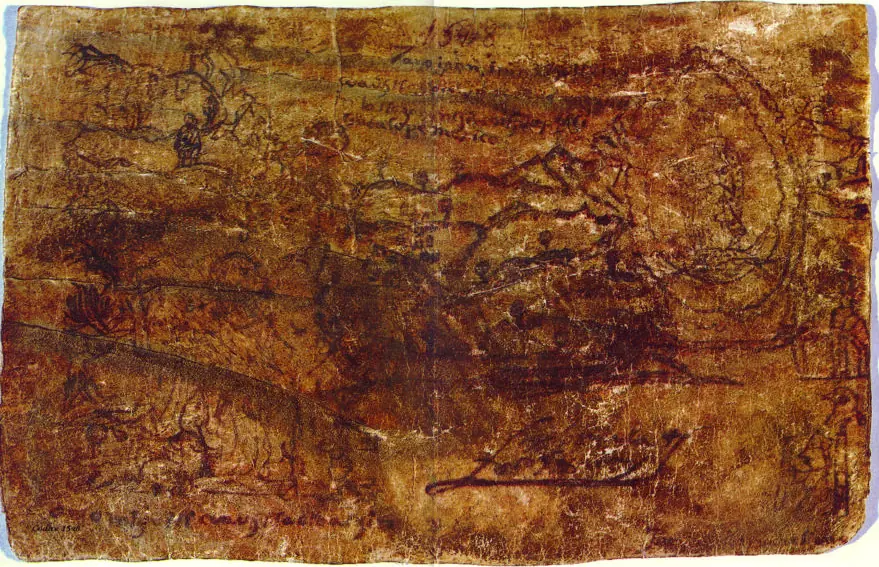
- The Codex Escalada, a drawing on deerskin found in Spain, which shows an apparition and records the death of Juan Diego, under his Nahuatl name, in 1548. Its supporters date it to the 16th century; critics question its age.
- A written record of the oral tradition of the Totonac people of Veracruz.
- The testimony of Sister Ana de Cristo, a Spanish nun who passed through Mexico in 1619 on her way to the Philippines, describing how Bishop Zumárraga came to believe after receiving the tilma of "a local Indian named Juan Diego."

In December 1999 the Mexico City paper Reforma reported a new letter from Schulenburg and two former basilica officials to the Vatican, repeating that no records proved Juan Diego's existence. The Mexican bishops dismissed it, and the canonization went ahead. Historians still disagree, and the Church does not ask Catholics to treat the apparition accounts as articles of faith.
The miracles of St. Juan Diego
Juan Diego's beatification in 1990 did not require a miracle, because his cult was judged ancient. Canonization did.
- Approved: the healing of Juan José Barragán Silva in May 1990. Zenit, as quoted by Aleteia, reports that the young man, who used drugs, stabbed himself and threw himself head first from a balcony in Mexico City in front of his mother, during the days of the beatification. As he fell, she prayed: "Give me a proof... save this son of mine! And you, my Mother, listen to Juan Diego." Doctors expected him to die or be permanently disabled. Within days he was well, and the Church's medical examiners called the cure scientifically unexplained. It was the miracle accepted for the canonization of July 31, 2002.
- Traditional: the healing of his uncle Juan Bernardino, which the Nican Mopohua reports on December 12, 1531.
- Traditional: the image on the tilma itself, which Catholics regard as miraculous. It belongs to the story of Our Lady of Guadalupe.
Why St. Juan Diego is a patron of Indigenous peoples
Juan Diego has no formal patronage, but he is honored as a patron of Indigenous peoples throughout the Americas. In his canonization homily, John Paul II said that Juan Diego accepted the Christian message "without forgoing his indigenous identity" and called on Mexico to support the Indigenous peoples "in their legitimate aspirations." See more patron saints by cause.
Symbols of St. Juan Diego in art
Juan Diego is nearly always shown with his tilma, the coarse cloak tied at one shoulder, held open to show the image of Guadalupe. Roses spill from it or lie at his feet, recalling the sign given to the bishop. He wears plain white cotton and sandals, the dress of a Nahua commoner. Colonial painters such as Miguel Cabrera gave him a short beard and a staff, as a hermit. Modern statues often show him before Bishop Zumárraga as the roses fall.


If you see a man holding a cloak with the image of Guadalupe on it, it is Juan Diego.
Feast day and where he is honored
The Church keeps the optional memorial of St. Juan Diego on December 9, the anniversary of the first apparition. In Mexico it opens the days leading to the great Guadalupe pilgrimage of December 12. See the feast day calendar.

His shrine is the Sanctuary of Our Lady of Guadalupe at Tepeyac, where he was buried in the first chapel.
Prayer to St. Juan Diego
The best-known prayer to him is the one Pope John Paul II prayed at the end of his canonization homily on July 31, 2002. These are its opening and closing lines, from the Vatican's English text:
Blessed Juan Diego, a good, Christian Indian, whom simple people have always considered a saint! We ask you to accompany the Church on her pilgrimage in Mexico, so that she may be more evangelizing and more missionary each day.
Beloved Juan Diego, "the talking eagle"! Show us the way that leads to the "Dark Virgin" of Tepeyac, that she may receive us in the depths of her heart, for she is the loving, compassionate Mother who guides us to the true God. Amen.
Frequently asked questions
When is St. Juan Diego's feast day?
December 9, the date given for the first apparition of Our Lady of Guadalupe in 1531. Our Lady of Guadalupe's own feast follows three days later, on December 12.
What miracle made Juan Diego a saint?
The healing of Juan José Barragán Silva, a young man who fell head first from a balcony in Mexico City in May 1990, during the week of Juan Diego's beatification. His mother prayed to Juan Diego. Doctors expected him to die or be left severely disabled, but he recovered fully. The Church judged the cure medically unexplained and approved it as the miracle for the 2002 canonization.
Did Juan Diego really exist?
Catholics believe he did, and the Church accepted his historical existence after a special historical commission reported in 1998. Some historians and a former abbot of the Guadalupe basilica argued that no reliable document mentions him before the 1640s. The debate did not stop the canonization.
What is St. Juan Diego the patron saint of?
He has no formal patronage from Rome, but Catholics in Mexico and across the Americas honor him as a patron of Indigenous peoples. Pope John Paul II called him "the first indigenous Saint of the American Continent."
Sources
- Vatican: Juan Diego Cuauhtlatoatzin (1474-1548), biography
- Vatican: John Paul II, Homily at the Canonization of Juan Diego Cuauhtlatoatzin, July 31, 2002
- National Catholic Register: Mexico Faithful Aren't Buying the Latest Dig at Juan Diego (December 19, 1999)
- Aleteia: How a drug addict's life was miraculously saved by St. Juan Diego
- Stafford Poole, "Guadalupe, Virgin of," Encyclopedia of Latin American History and Culture (Encyclopedia.com)
- Liturgy Office of England and Wales: Universal Calendar, December
- Readings in Classical Nahuatl: Nican Mopohua: Thus It Is Told (UC San Diego)