Seraphim
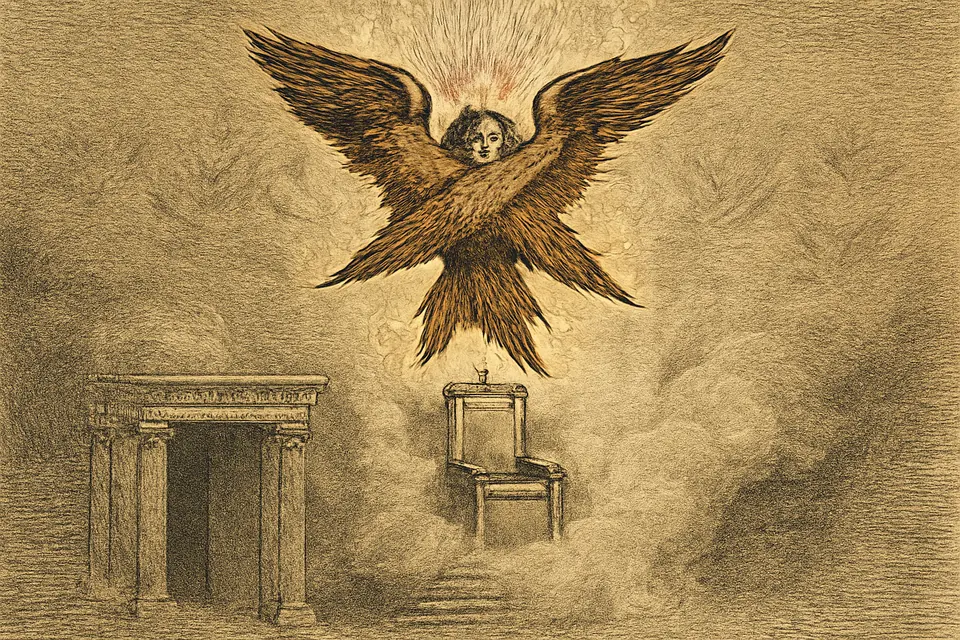
The seraphim are the highest choir of angels, the six-winged spirits the prophet Isaiah saw around the throne of God crying "Holy, holy, holy, the Lord God of hosts" (Isaiah 6:3). Their name means "burning ones," and tradition sees them as aflame with love for God. A seraph appeared to St. Francis of Assisi before he received the stigmata in 1224.
At every Mass, just before the Eucharistic Prayer, the whole church sings the words of the seraphim: "Holy, Holy, Holy Lord God of hosts." We borrow their song because we have nothing better to offer. The seraphim are the angels who burn closest to God, and the Church has loved them since Isaiah first saw them in the Temple more than seven centuries before Christ.
Isaiah's vision of the seraphim
Scripture mentions the seraphim in only one passage, and it is one of the great scenes of the Old Testament. In the year King Ozias died, about 740 BC, the young Isaiah was in the Temple in Jerusalem when the veil between heaven and earth fell away. In the Douay-Rheims:
In the year that king Ozias died, I saw the Lord sitting upon a throne high and elevated: and his train filled the temple. Upon it stood the seraphims: the one had six wings, and the other had six wings: with two they covered his face, and with two they covered his feet, and with two they flew. And they cried one to another, and said: Holy, holy, holy, the Lord God of hosts, all the earth is full of his glory. And the lintels of the doors were moved at the voice of him that cried, and the house was filled with smoke.
And I said: Woe is me, because I have held my peace; because I am a man of unclean lips, and I dwell in the midst of a people that hath unclean lips, and I have seen with my eyes the King the Lord of hosts. And one of the seraphims flew to me, and in his hand was a live coal, which he had taken with the tongs off the altar. And he touched my mouth, and said: Behold this hath touched thy lips, and thy iniquities shall be taken away, and thy sin shall be cleansed. (Isaiah 6:1-7)
Then the Lord asked, "Whom shall I send? and who shall go for us?" and Isaiah, cleansed, answered, "Lo, here am I, send me" (Isaiah 6:8). The seraph's coal turned a frightened man into a prophet.

The meaning of the name
The Hebrew root saraph means "to burn." The same word describes the "fiery serpents" that bit the Israelites in the desert (Numbers 21:6), which shows how strongly it suggests fire. Pseudo-Dionysius, writing about the year 500, said that "the holy designation of the Seraphim denotes either that they are kindling or burning."
He went on to describe them as ever moving around God with "constancy, and warmth, and keenness," giving new life to the spirits below them and "rekindling them to the same heat," purifying "through fire," and shedding a light that "can never be concealed or consumed." The seraphim do not only burn; they set others on fire.
Why six wings?
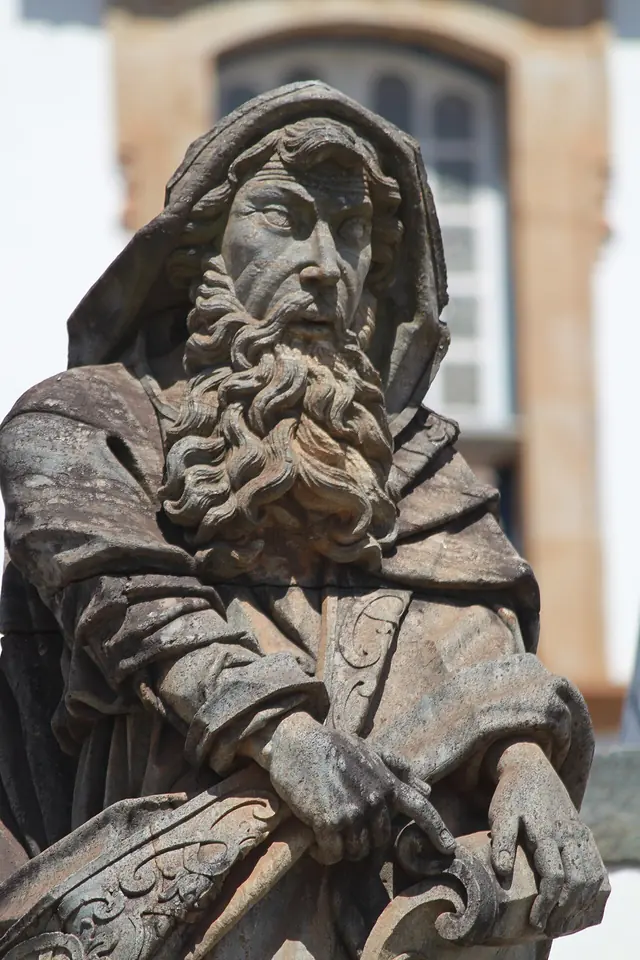
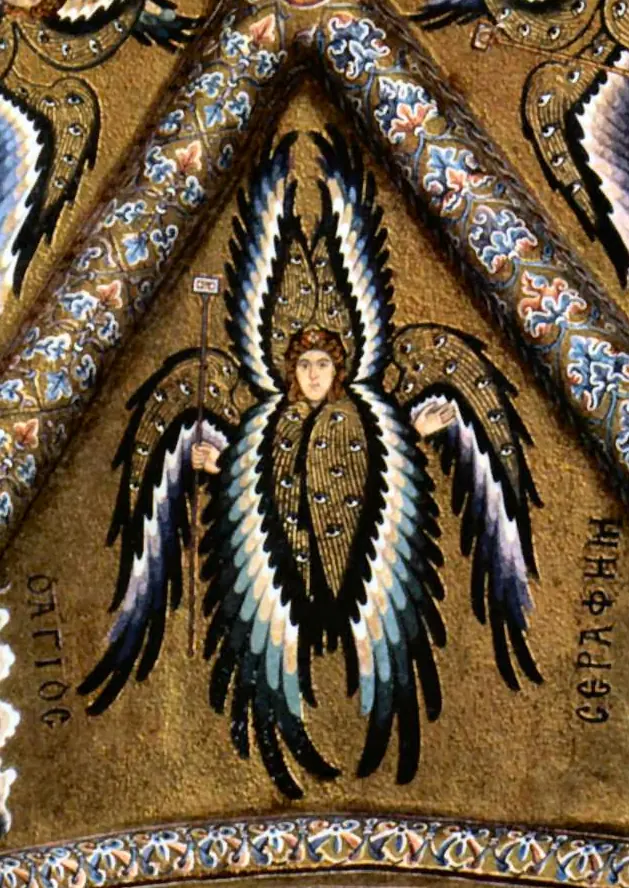
Isaiah tells us exactly what the six wings do, and the Church's teachers have read a lesson in each pair. With two the seraphim cover their faces, because even the highest creature cannot look on the full glory of God. With two they cover their feet, a sign of humility and modesty before the Holy One. With two they fly, always ready to go where God sends them. Reverence, humility, readiness: this is the seraphim's whole life, and it can be ours too.
The highest choir of angels
In the order of the nine choirs of angels handed down by Dionysius and St. Gregory the Great, the seraphim stand first, above the cherubim and the thrones. They are, Dionysius says, "established immediately around God."
St. Thomas Aquinas explains why. Every angel loves God, but the name seraphim speaks of an "excess of charity, expressed by the word ardor or fire." He finds three things in fire and applies each to them. Fire moves upward without stopping, "which signifies that they are borne inflexibly towards God." Its heat penetrates and spreads, rousing those below "to a like fervor, and cleansing them wholly by their heat." And fire gives light, so "these angels have in themselves an inextinguishable light, and that they also perfectly enlighten others."
Why should love outrank knowledge, so that the seraphim stand above the cherubim, whose name means "fulness of knowledge"? Because in this life love unites us to God more closely than understanding can. We may know God only a little, and still love him with everything.
The seraphim in the Church's worship
The seraphim's cry has been part of Christian worship from the start. St. John heard it again in heaven, where four living creatures, "each of them six wings," cry day and night, "Holy, holy, holy, Lord God Almighty, who was, and who is, and who is to come" (Apocalypse 4:8). The Church took the song into the Mass as the Sanctus, and the great hymn Te Deum sings that the cherubim and seraphim cry out without ceasing, Holy, holy, holy, Lord God of Sabaoth.
Dionysius gave a whole chapter of The Celestial Hierarchy to the question of why Isaiah "is said to have been purified by the Seraphim." He weighs two answers. Perhaps a lower angel was called a seraph because he cleansed with fire. Or perhaps the angel gave the credit to God and to the seraphim, because God's light and fire pass first to the highest choir and through it, rank by rank, down to us. Either way, the cleansing came from God's own fire.
"Seraphic" St. Francis and the stigmata
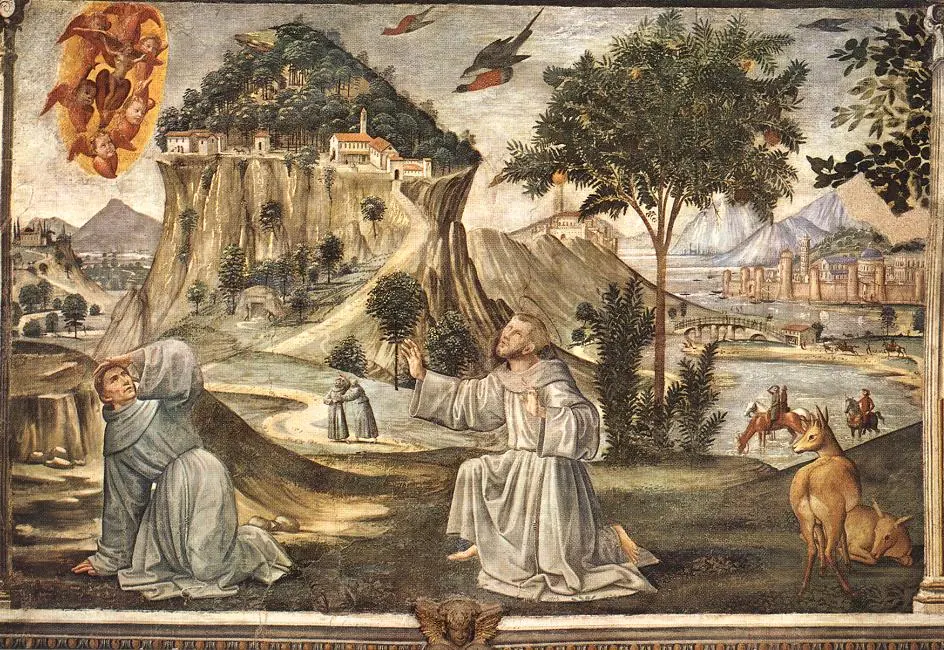
The seraphim came closest to earth in the life of St. Francis of Assisi. In late summer 1224, Francis went up Mount La Verna in Tuscany to keep a fast in honor of St. Michael. St. Bonaventure, in his Life of St. Francis, written in the 1260s from the testimony of the friars, tells what happened, in E. Gurney Salter's 1904 translation:
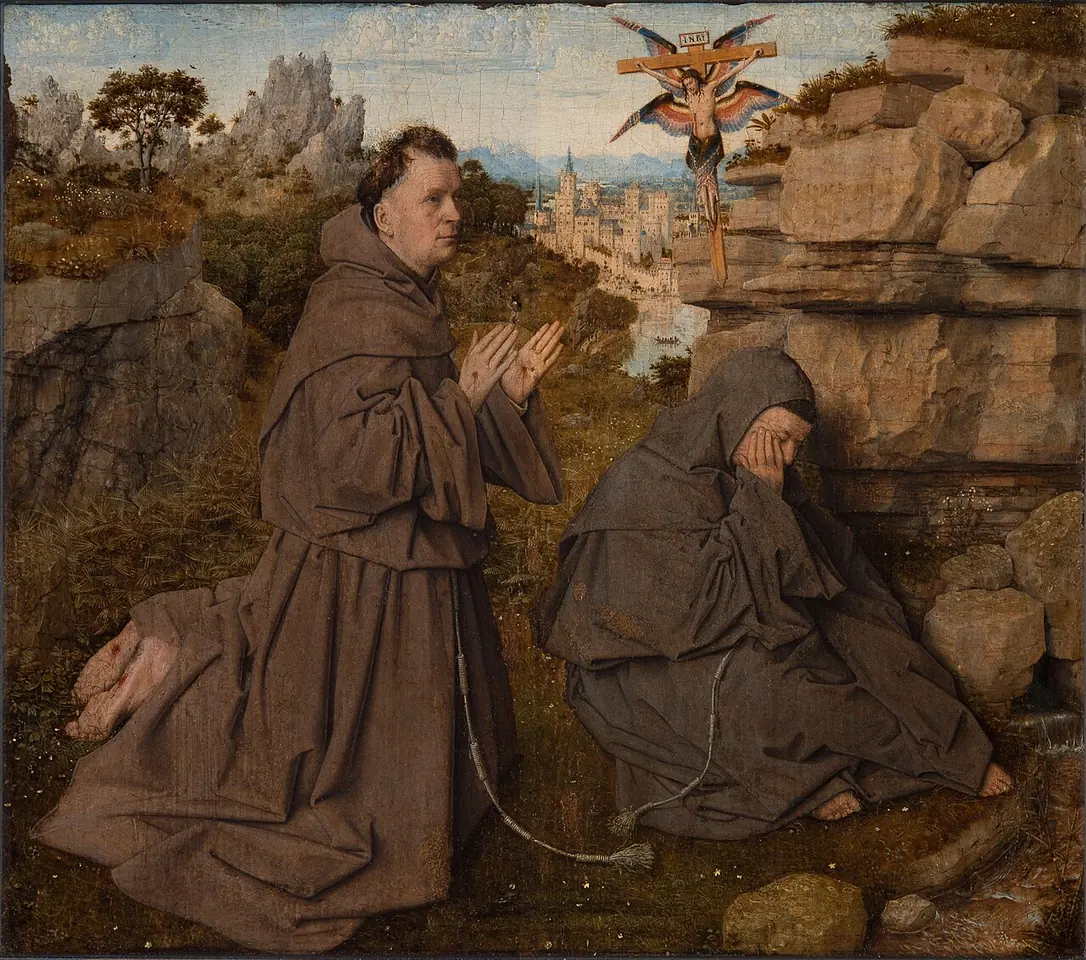
on a certain morning about the Feast of the Exaltation of Holy Cross, while he was praying on the side of the mountain, he beheld a Seraph having six wings, flaming and resplendent, coming down from the heights of heaven. When in his flight most swift he had reached the space of air nigh the man of God, there appeared betwixt the wings the Figure of a Man crucified, having his hands and feet stretched forth in the shape of a Cross, and fastened unto a Cross.
Francis was filled with joy and sorrow at once, Bonaventure writes, and understood that he "was to be wholly transformed into the likeness of Christ Crucified, not by martyrdom of body, but by enkindling of heart." When the vision ended, the marks of the nails appeared in his hands and feet, and a wound in his side.
The stigmata of St. Francis are a reported miracle, the best attested of all the wonders in his life. His companions saw the wounds, Brother Elias announced them to the order at Francis's death in 1226, and the Franciscan family keeps the feast of the Stigmata of St. Francis on September 17. Ever since, Francis has been called the Seraphic Father, and the Franciscans the Seraphic Order.
St. Bonaventure, the Seraphic Doctor
In 1259, as minister general of the Franciscans, Bonaventure himself climbed La Verna to pray where the seraph had appeared. There he wrote his little masterpiece, The Soul's Journey into God. He took the six wings of the seraph as six steps of the soul's ascent: from God's traces in the created world, through his image in our own minds, up to God himself, and at last to union with him through love of Christ crucified. For his teaching and his burning love, the Church calls him the Seraphic Doctor.

St. Teresa's angel of fire
Another saint left a famous account of a burning angel. St. Teresa of Ávila described in her Life how an angel pierced her heart with a golden spear tipped with fire, leaving her "all on fire with a great love of God." She wrote that his face was burning, "as if he were one of the highest angels, who seem to be all of fire: they must be those whom we call cherubim."
Her own manuscript says cherubim. Her confessor, Domingo Báñez, suggested "seraphim" in the margin, and most early editions printed it that way. Whichever choir he came from, the Carmelites remember the event as the transverberation of St. Teresa's heart, and the image of the fiery angel has made it one of the best-known mystical experiences in the Church.
How to pray with the seraphim
We will not see a seraph in this life, but we can share their work. Every Sanctus is a chance to join them consciously, remembering that we sing with them, not merely about them. The traditional Roman Mass kept Isaiah's coal in a prayer said before the Gospel, the Munda cor meum, which asks almighty God to cleanse the heart and lips of the one who reads, as he cleansed the lips of the prophet (qui labia Isaiae prophetae calculo mundasti ignito). We can make that prayer our own whenever we open the Scriptures. And when our love for God grows cold, we can ask the seraphim, whose very name is fire, to pray that it be rekindled.
For the other choirs and the archangels, see our angels hub.
Holy seraphim, burning with love before the throne of God, pray for us, that we may love him as you do.
Frequently asked questions
What are seraphim?
Seraphim are the highest of the nine choirs of angels. Scripture mentions them only in Isaiah 6, where they stand above the throne of God, each with six wings, crying "Holy, holy, holy." Tradition sees them as the angels most on fire with love for God.
What does seraphim mean?
The Hebrew root saraph means to burn. Pseudo-Dionysius wrote that the name "denotes either that they are kindling or burning." Seraphim is the Hebrew plural; one is a seraph.
Why do seraphim have six wings?
Isaiah says that "with two they covered his face, and with two they covered his feet, and with two they flew" (Isaiah 6:2). The Fathers read the covered face as reverence before God's glory, the covered feet as humility, and the flight as readiness to serve.
Is a seraph higher than a cherub?
Yes, in the order taught by Pseudo-Dionysius and St. Thomas Aquinas. The seraphim are first and the cherubim second, because love unites us to God even more closely than knowledge.
What is the connection between seraphim and St. Francis?
In September 1224 on Mount La Verna, St. Francis saw a six-winged seraph with the figure of the crucified Christ between its wings, and afterward the marks of the nails appeared in his hands and feet. That is why Francis is called the Seraphic Father and his order the Seraphic Order.
Sources
- Isaias 6, Douay-Rheims Bible (drbo.org)
- Dionysius the Areopagite, The Celestial Hierarchy, tr. John Parker (1899), chapters 7 and 13
- St. Thomas Aquinas, Summa Theologiae I, q. 108, a. 5 (the names of the orders)
- St. Bonaventure, The Life of St. Francis of Assisi, tr. E. Gurney Salter (1904), chapter 13
- St. Teresa of Jesus, The Life of St. Teresa, tr. David Lewis, chapter 29 and note 14 (Project Gutenberg)