St. Bonaventure
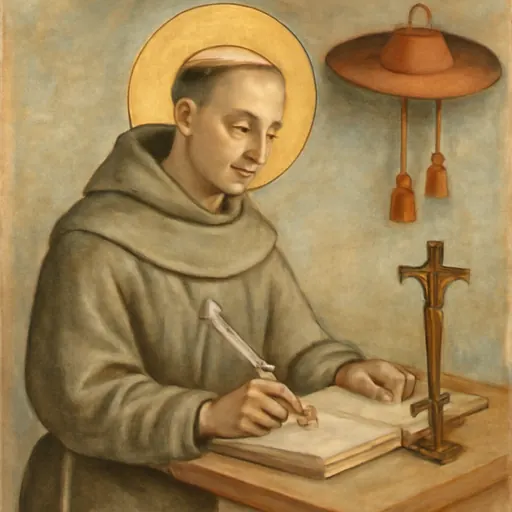
St. Bonaventure (about 1217–1274) was an Italian Franciscan friar, theologian and bishop, born Giovanni di Fidanza at Bagnoregio. He taught at the University of Paris alongside St. Thomas Aquinas, led the Franciscan order as Minister General for 17 years, wrote the official life of St. Francis and The Soul's Journey into God, and died as a cardinal at the Council of Lyon. He is a Doctor of the Church, called the Seraphic Doctor, and his feast day is July 15.
Who was St. Bonaventure?
Bonaventure was a Franciscan friar from central Italy who became one of the two great theologians of the 13th century, beside his colleague St. Thomas Aquinas. He taught at the University of Paris, then spent 17 years governing the Franciscans at a time when quarrels over poverty threatened to split the order. He wrote the life of St. Francis of Assisi that the friars adopted as the official one, and a short book on prayer, The Soul's Journey into God, that has been read by contemplatives ever since. Pope Gregory X made him a cardinal in 1273, and he died the next year at the Council of Lyon.
Pope Benedict XVI, who wrote his own early academic work on Bonaventure, called him "a man of action and contemplation, of profound piety and prudent government." The Church honors him as a Doctor of the Church with the title the Seraphic Doctor.

The life of St. Bonaventure
A boy saved by St. Francis
He was born Giovanni di Fidanza at Bagnoregio, a hill town near Viterbo, north of Rome. The Catholic Encyclopedia gives the year as 1221; Benedict XVI thought 1217 more likely. His father was a physician. The Catholic Encyclopedia records his parents' names, Giovanni di Fidanza and Maria Ritella, and almost nothing else about his youth.
One event he never forgot. As a child he fell gravely ill, and according to Benedict XVI even his father gave up hope. His mother prayed to Francis of Assisi, who had recently been canonized, and the boy recovered. Bonaventure wrote of it in the prologue of his life of Francis, in E. Gurney Salter's 1904 translation:
For I, who remember as though it happened but yesterday how I was snatched from the jaws of death, while yet a child, by his invocation and merits, should fear to be convicted of the sin of ingratitude did I refrain from publishing his praises.

A later story says Francis himself held the sick baby and exclaimed "O buona ventura!" ("O good fortune!"), which gave the boy his religious name. It is traditional. The Catholic Encyclopedia calls the story "highly improbable" and traces it to a late 15th-century legend; the name Bonaventure was already in use before him.


Paris
Giovanni went to Paris to study, earned his master of arts, and around 1243 joined the Franciscans there, taking the name Bonaventure. He later explained that he loved Francis's order because it resembled the early Church: "The Church began with simple fishermen, and was subsequently enriched by very distinguished and wise teachers; the religion of Blessed Francis was not established by the prudence of men but by Christ."
He studied theology under the Franciscan master Alexander of Hales and began to teach. In those years the secular professors at Paris tried to drive the friars, both Franciscans and Dominicans, out of the university. Bonaventure answered them in writing. When Pope Alexander IV settled the dispute, Bonaventure and Thomas Aquinas received the degree of doctor together on October 23, 1257.


Minister General of the Franciscans
On February 2, 1257, before he was 40, the friars elected him Minister General. The order had more than 30,000 members, Benedict XVI noted, with missions as far away as Peking, and it was divided. The "Spirituals" wanted the strictest poverty and some followed the prophecies of Joachim of Fiore, who foretold a coming age of the Holy Spirit; others wanted the rule relaxed. Bonaventure struck at both extremes. In 1260 the general chapter at Narbonne adopted his constitutions for the order, and he spent years visiting the provinces.
He refused the archbishopric of York in 1265. At the chapter of Pisa in 1263, the Catholic Encyclopedia records, he asked that a bell be rung at nightfall in honor of the Annunciation, a custom from which the Angelus prayer seems to have grown. He was a friend of King Louis IX of France, and he helped settle the papal election at Viterbo, which had dragged on for nearly three years. On his advice the cardinals chose Gregory X in 1271.

The Legenda Maior
The chapter of Narbonne asked him to write a new life of St. Francis to replace the many versions in circulation, each claimed by a different party. He gathered documents and interviewed friars who had known Francis. The chapter of Pisa approved his Legenda Maior in 1263, and in 1266 the chapter of Paris ordered the older lives destroyed. That decree has been criticized ever since; the Catholic Encyclopedia defends it as an attempt "to wipe out the old quarrels and start afresh." Benedict XVI summed up its portrait of Francis as an alter Christus, "another Christ."
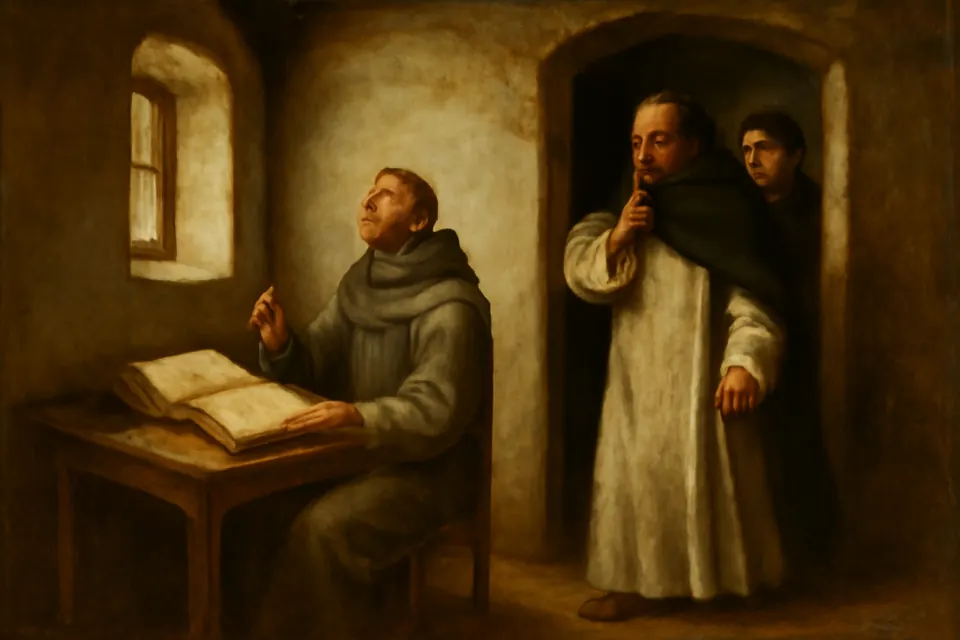
A well-known story, which the Catholic Encyclopedia repeats, says Thomas Aquinas once came to Bonaventure's cell while he was writing the life, found him in ecstasy, and withdrew saying, "Let us leave a saint to work for a saint." The story is traditional.
Cardinal, and death at Lyon
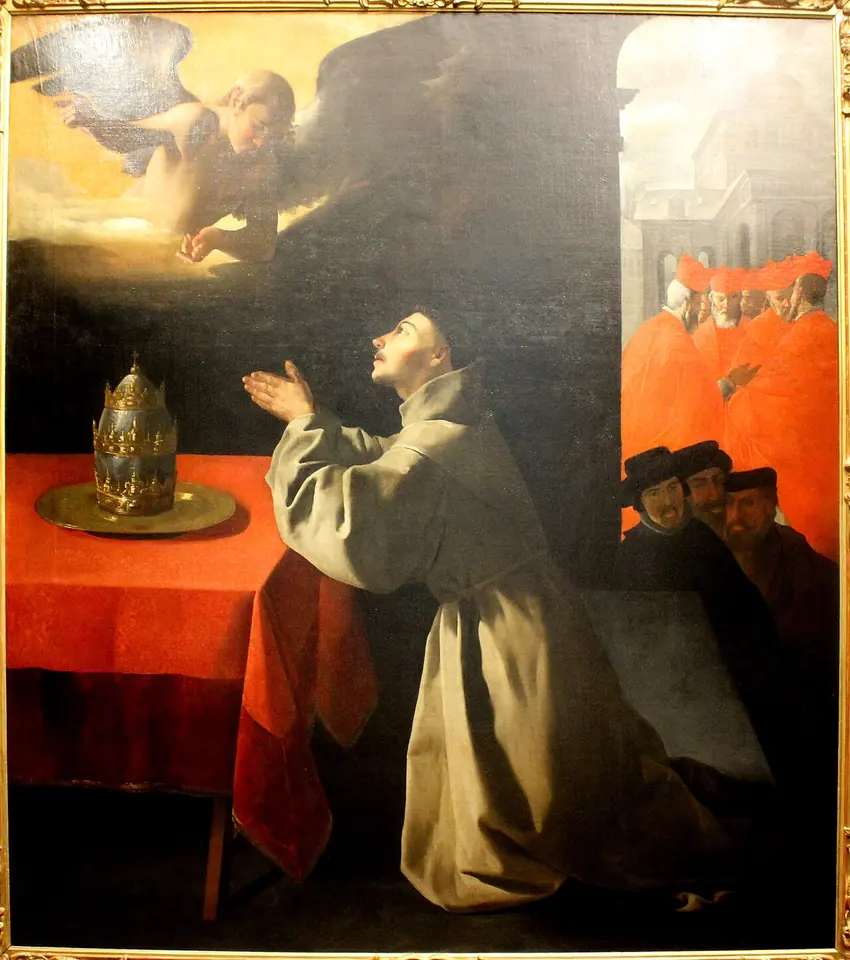
Gregory X named him Cardinal-Bishop of Albano on June 23, 1273. A popular story says the papal envoys found him washing dishes at a friary near Florence and that he asked them to hang the red hat on a tree until his hands were free. It is traditional, recorded by the Catholic Encyclopedia as "it is said."
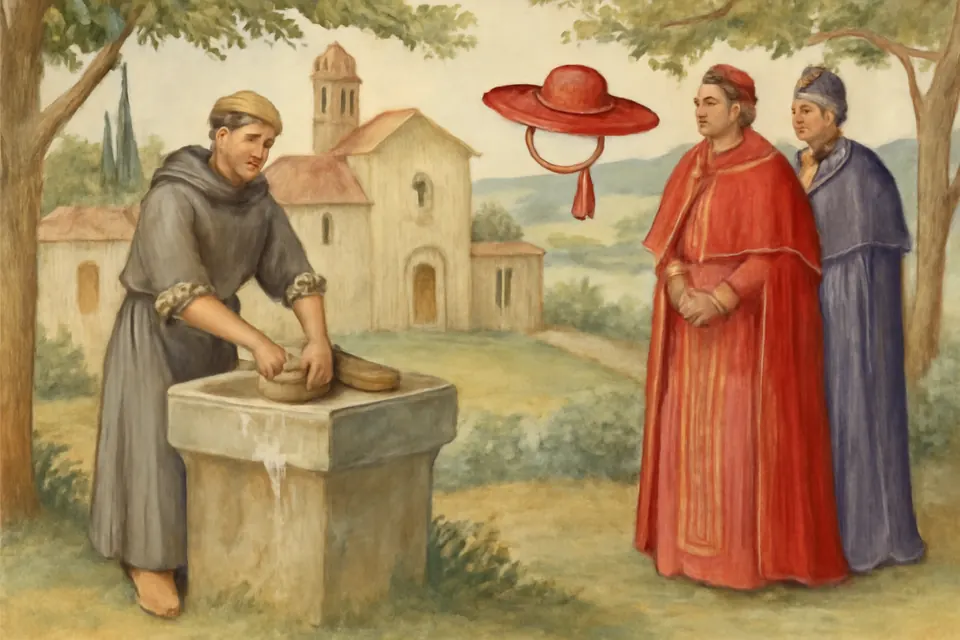
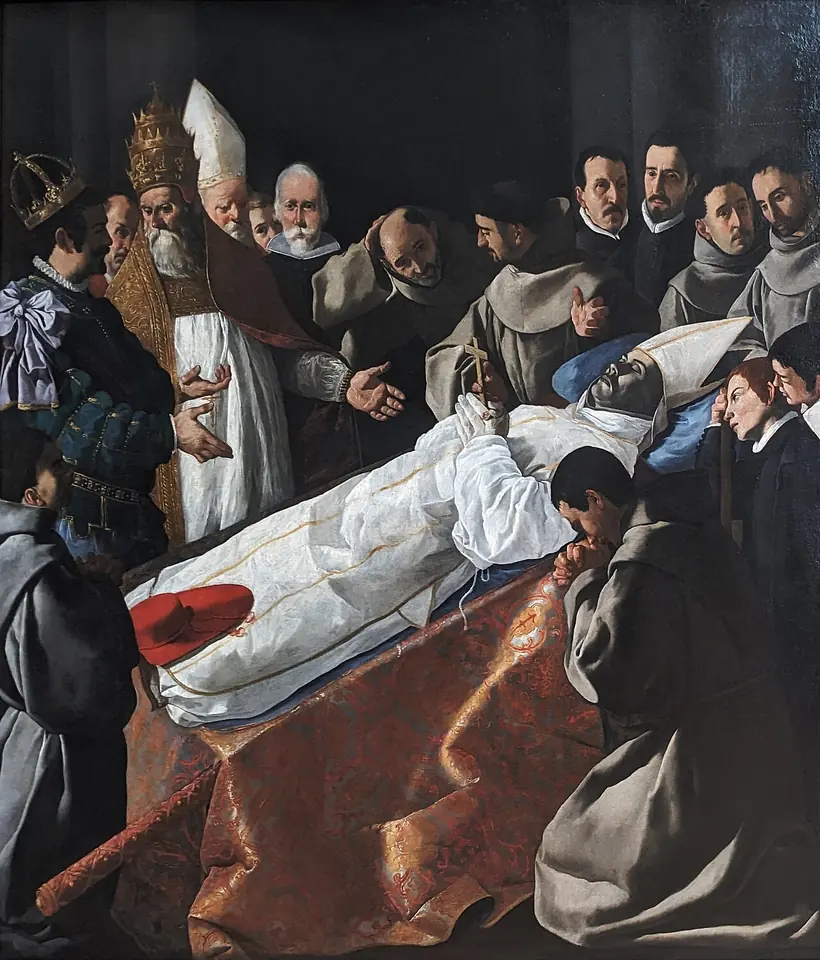
The pope then put him in charge of preparing the Second Council of Lyon, which met to reunite the Latin and Greek churches. Bonaventure preached to the council fathers twice and worked with the Greek delegates. The union was proclaimed on July 6, 1274. Nine days later, on Sunday, July 15, Bonaventure died, while the council was still in session. The cause is unknown; his secretary's chronicle says he was poisoned. He was buried that evening in the Franciscan church at Lyon, with the pope, the King of Aragon and the council in attendance.


The miracles of St. Bonaventure
Bonaventure was canonized in 1482, but no individual miracle from his cause is widely cited today.
- Reported: his own healing as a child through St. Francis's intercession, which he tells in the Legenda Maior.
- Reported: when his remains were moved in 1434 to the new Franciscan church at Lyon, his head was found well preserved, "the tongue being as red as in life," according to the Catholic Encyclopedia. The people of Lyon took him as their patron, and the event gave new life to his cause.
- Traditional: the "O buona ventura" story and the stories of Thomas Aquinas at his door and the hat on the tree.
The Soul's Journey into God
In 1259 Bonaventure went to La Verna, the mountain in Tuscany where Francis had received the stigmata in a vision of a six-winged seraph. There he wrote the Itinerarium mentis in Deum, translated as The Soul's Journey into God or The Mind's Road to God. In the prologue he explains that while he meditated there, he thought of "the vision of the winged Seraph in the form of a Crucifix" and saw in it the way to God.
The six wings became six steps: from God's traces in the created world, through his image in the soul, to God himself, and finally to union with him through the crucified Christ. Bonaventure insists that the created world speaks of God. In the translation Benedict XVI used in his 2010 catechesis:
He who is not brightened by such splendours of created things is blind; he who does not awake at such clamours is deaf; he who does not praise God on account of all these effects is mute; he who does not turn towards the First Principle on account of such indications is stupid.
The last chapter turns from study to love. Benedict XVI quoted it, in the Vatican's English text of his audience of March 10, 2010:
question grace, not instruction; desire, not intellect; the cry of prayer, not pursuit of study; the spouse, not the teacher; God, not man; darkness, not clarity; not light, but the fire that inflames all and transports to God with fullest unction and burning affection
Benedict explained the difference from his friend Thomas: for Thomas the final goal of human life is to see God, for Bonaventure "to love God, to encounter him and to be united in his and our love." Bonaventure's other major works are the Commentary on the Sentences, written when he was about 27, the Breviloquium, On the Reduction of the Arts to Theology, and the unfinished Collations on the Six Days.
Why St. Bonaventure is the patron of Bagnoregio and Lyon
His birthplace, Bagnoregio, keeps his memory and his largest relic, and Dante made the town's name famous: in the Paradiso he has the saint introduce himself as "Bonaventure of Bagnoregio." Lyon chose him as a patron after the 1434 discovery of his preserved head. Catholic Culture also lists him as a patron against bowel disorders and of St. Bonaventure University in New York; no source explains the bowel patronage. See all the patron saints.
Symbols of St. Bonaventure in art
Painters usually show Bonaventure as a clean-shaven Franciscan in a gray or brown habit. Look for:
- A cardinal's red hat: worn, lying at his feet, or hanging on a tree branch, from the story of the envoys. It sets him apart from other Franciscans.
- A book and pen: the writer and teacher, as in Rubens's study of him reading.
- A crucifix: for the story that he told Thomas Aquinas the crucifix was the source of everything he knew, and for his theology of the Cross.
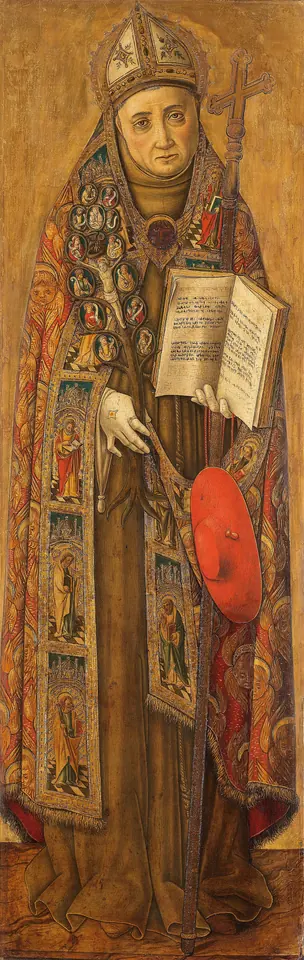
- The Tree of Life: from his meditation on Christ's life, the Lignum Vitae, which Vittore Crivelli put in his hand.
- Bishop's vestments: sometimes a cope and miter, since he was Cardinal-Bishop of Albano.
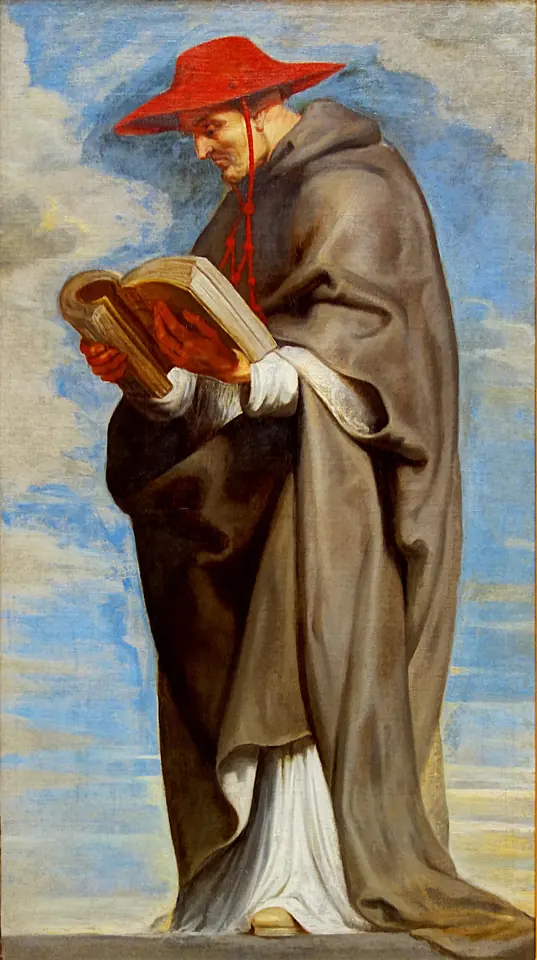

Zurbarán painted a series on his life around 1629 for the Franciscan college of San Buenaventura in Seville. Four of those canvases are on this page; they are now in Paris and Dresden, and one, once in Berlin, is known only from photographs. A large statue of Bonaventure stands at the start of the colonnade of St. Peter's Square, facing one of Thomas Aquinas on the other side.
Feast day and where St. Bonaventure is honored
His feast is July 15, a memorial on the General Roman Calendar. Before 1969 it fell on July 14. Pope Sixtus IV canonized him on April 14, 1482, and Sixtus V, another Franciscan, declared him a Doctor of the Church in 1588. See the feast day calendar.
His tomb did not survive. In 1562 the Huguenots plundered his shrine in Lyon and burned the urn with his body in the public square. The Catholic Encyclopedia says the superior hid his head at the cost of his life, but it disappeared in the French Revolution. Part of his right arm had been taken to Bagnoregio in 1491, and that "holy arm" is now his largest relic, kept in the co-cathedral of San Nicola. Benedict XVI mentioned it on his visit to Bagnoregio in 2009.

Prayers of St. Bonaventure
The Collect of the Mass on his feast, in the current English translation of the Roman Missal, asks: "Grant, we pray, almighty God, that, just as we celebrate the heavenly birthday of the Bishop Saint Bonaventure, we may benefit from his great learning and constantly imitate the ardor of his charity."
Bonaventure is also credited with a prayer that older missals print among the prayers of thanksgiving after Mass, Transfige, dulcissime Domine Jesu. Its opening, as Catholic Culture gives it:
Pierce, O most sweet Lord Jesus, my inmost soul with the most joyous and healthful wound of Thy love, and with true, calm and most holy apostolic charity, that my soul may ever languish and melt with entire love and longing for Thee, may yearn for Thee and for thy courts, may long to be dissolved and to be with Thee.
The Itinerarium itself begins with a prayer from Psalm 86, which Benedict XVI used to close his catechesis: "Lead me forth, Lord, in thy way, and let me step in thy truth; let my heart be glad, that it fears thy name."
Frequently asked questions
Why is St. Bonaventure called the Seraphic Doctor?
The title links him to St. Francis, who received the stigmata in a vision of a seraph, the highest order of angels, a flame of love. Bonaventure built his best-known book on that six-winged seraph, and his theology puts love above knowledge. Pope Sixtus V named him a Doctor of the Church in 1588; Seraphic Doctor is his traditional title among the Doctors.
When is St. Bonaventure's feast day?
July 15, the day he died in Lyon in 1274. It is a memorial on the General Roman Calendar. Before the 1969 calendar reform it was kept on July 14.
How did St. Bonaventure get his name?
He was baptized Giovanni (John) di Fidanza. A late legend says St. Francis cried "O buona ventura!" ("O good fortune!") over him as a sick baby. The Catholic Encyclopedia calls this "highly improbable"; Bonaventure himself says only that St. Francis's intercession saved his life as a child. He probably took the name when he became a friar, around 1243.
Were St. Bonaventure and St. Thomas Aquinas friends?
They were colleagues at the University of Paris, received the degree of doctor there on the same day in 1257, and both were called to the Council of Lyon in 1274; Thomas died on the way and Bonaventure during the council. The well-known stories of their meetings are traditional. Their theology differed in emphasis, as Pope Benedict XVI explained. Thomas put knowing God first, Bonaventure loving him.
What did St. Bonaventure write?
His major works include the Commentary on the Sentences of Peter Lombard, the Breviloquium, the Itinerarium mentis in Deum (The Soul's Journey into God), On the Reduction of the Arts to Theology, the Tree of Life, the Collations on the Six Days, and the Legenda Maior, the official life of St. Francis.
Sources
- Catholic Encyclopedia (1907): St. Bonaventure
- Benedict XVI, General Audience of 3 March 2010: Saint Bonaventure
- Benedict XVI, General Audience of 10 March 2010: Saint Bonaventure (2)
- Benedict XVI, General Audience of 17 March 2010: Saint Bonaventure (3)
- Benedict XVI, Meeting with the people of Bagnoregio, 6 September 2009
- St. Bonaventure, The Life of Saint Francis (Legenda Maior), trans. E. Gurney Salter (London: J.M. Dent, 1904)
- Catholic Culture: Memorial of St. Bonaventure, July 15
- Catholic Culture: Prayer after Communion (St. Bonaventure)
- Bonaventura da Bagnoregio, Italian Wikipedia (the "santo braccio" relic)
- Roman Martyrology, July 15