Angels and archangels

Angels and archangels are pure spirits, created by God, who serve him and carry his messages to us; the Church teaches their existence as a truth of faith (Catechism 328). Tradition arranges them in nine choirs, from the seraphim down to the archangels and angels. Scripture names three archangels, Michael, Gabriel and Raphael, and Jesus teaches that every little one has an angel who sees the Father's face.
Every Mass, just before the Sanctus, the priest invites us to join our voices with the angels and archangels and all the hosts of heaven. We say it so often that it can slip past. Yet it means something astonishing: when we sing "Holy, holy, holy," we are taking up the song Isaiah heard the seraphim singing before the throne of God. The angels are not a decoration on Christian faith. They are part of the world God made, and they are busy in our lives.
This page is the doorway to everything on angels at SaintsEncyclopedia.com: what angels are, how they were created and how some of them fell, the nine choirs, the three archangels Scripture names, and the guardian angel God gives to each of us.
What are angels?
The Church answers plainly. "The existence of the spiritual, non-corporeal beings that Sacred Scripture usually calls 'angels' is a truth of faith," says the Catechism (328), and "the witness of Scripture is as clear as the unanimity of Tradition."
The word itself tells us what they do rather than what they are. The Hebrew mal'akh and the Greek angelos both mean "messenger." St. Augustine put it neatly, in words the Catechism quotes: "'Angel' is the name of their office, not of their nature. If you seek the name of their nature, it is 'spirit'; if you seek the name of their office, it is 'angel.'"
So an angel is a spirit: a person with intellect and will, but no body. The Catechism calls them "personal and immortal creatures, surpassing in perfection all visible creatures" (330). St. Thomas Aquinas, the Church's great teacher on the angels, adds a striking idea. Because angels have no matter to tell one from another, each angel is its own kind, as different from the next angel as a lion is from an oak. No two are alike.

Created by God, for Christ
Angels are creatures, not little gods. The Fourth Lateran Council in 1215 taught that God "from the beginning of time made at once out of nothing both orders of creatures, the spiritual and the corporeal, that is, the angelic and the earthly," and then man, who shares in both (Catechism 327). Scripture never tells us the day. St. Augustine, in The City of God, read their creation into the first words of Genesis, when God made light.
They were made through Christ and for him. St. Paul writes in the Douay-Rheims: "For in him were all things created in heaven and on earth, visible and invisible, whether thrones, or dominations, or principalities, or powers: all things were created by him and in him" (Colossians 1:16). The Catechism draws the conclusion: "Christ is the center of the angelic world. They are his angels" (331).

What angels do
Scripture shows the angels doing three things. They worship God without ceasing, like the seraphim crying "Holy, holy, holy" (Isaiah 6:3) and the countless voices around the throne in the Apocalypse. They carry God's messages, as Gabriel did to Zachary and to Mary. And they guard and help God's people. "Are they not all ministering spirits," asks the Letter to the Hebrews, "sent to minister for them, who shall receive the inheritance of salvation?" (Hebrews 1:14).
The Catechism traces that help through salvation history. Angels closed the gates of Eden, protected Lot, saved Hagar and her child, stayed Abraham's hand over Isaac, led Israel through the desert and stood beside the prophets (332). At Bethlehem they sang "Glory to God in the highest." They served Jesus in the desert, strengthened him in Gethsemane and announced his Resurrection at the empty tomb (333). They will come with him when he returns in glory.
The fall of the rebel angels
Not every angel stayed faithful. God made all of them good, and each had to choose freely whether to love and serve him. Some refused. "The devil and the other demons were indeed created naturally good by God, but they became evil by their own doing," taught the Fourth Lateran Council (Catechism 391).
Scripture speaks of this sin in a few short, terrible lines. "God spared not the angels that sinned," says St. Peter (2 Peter 2:4). Jesus told the seventy-two, "I saw Satan like lightning falling from heaven" (Luke 10:18). St. John saw it as a battle: "Michael and his angels fought with the dragon... and that great dragon was cast out, that old serpent, who is called the devil and Satan... and his angels were thrown down with him" (Apocalypse 12:7-9). Origen and many later writers heard the fall of Satan in Isaiah's taunt against the king of Babylon, "How art thou fallen from heaven, O Lucifer, who didst rise in the morning?" (Isaiah 14:12).
What was the sin? St. Thomas answers that it could only be pride: "Without doubt the angel sinned by seeking to be as God." He wanted his happiness on his own terms rather than as a gift. Because an angel sees clearly and chooses with its whole being, that choice was final. The Catechism says, "It is the irrevocable character of their choice, and not a defect in the infinite divine mercy, that makes the angels' sin unforgivable" (393).
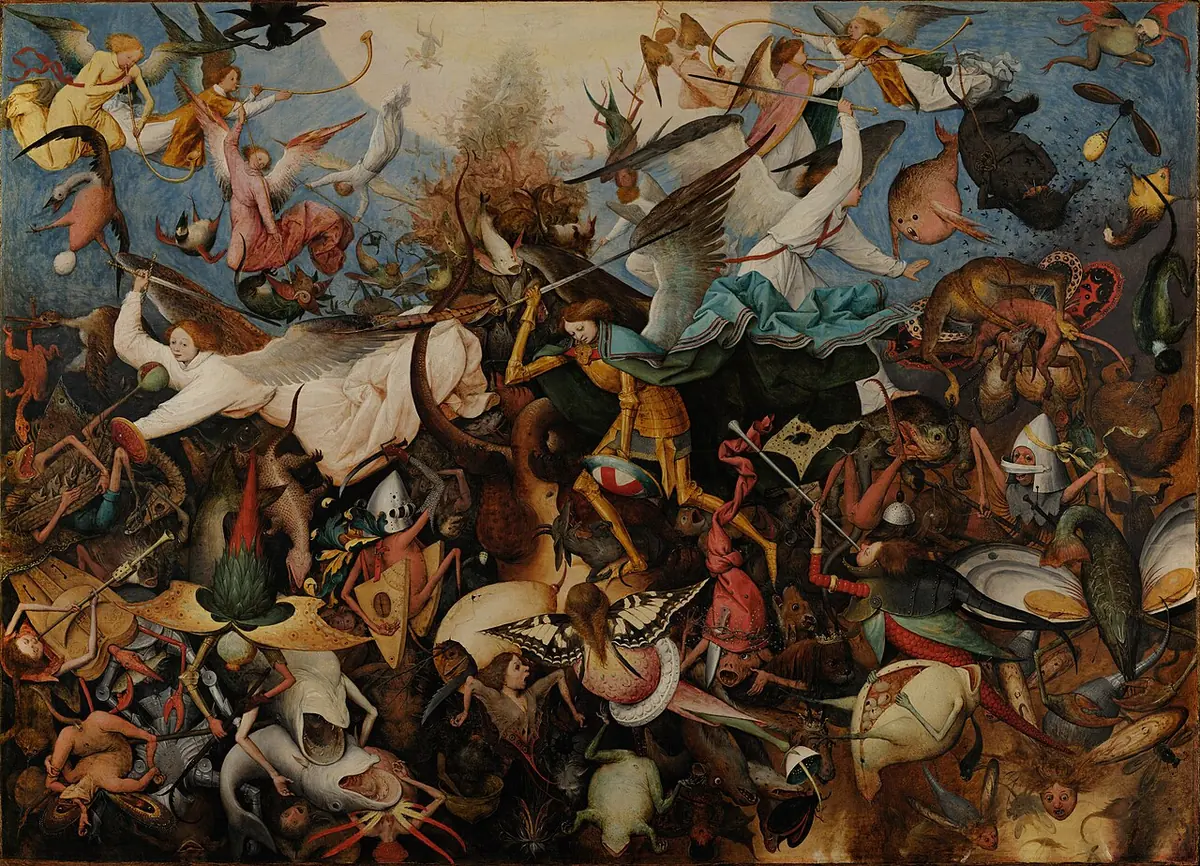
There is comfort here too. Satan is "only a creature," the Catechism reminds us, powerful but not infinite, and he "cannot prevent the building up of God's reign" (395). St. Thomas held that far more angels stayed faithful than fell. We have more friends in heaven than enemies. For more on the devil and the demons, see fallen angels.
The nine choirs of angels
Scripture uses nine names for the heavenly spirits. Isaiah sees seraphim; Genesis and Ezekiel speak of cherubim; St. Paul names thrones, dominations, principalities and powers (Colossians 1:16) and virtue (Ephesians 1:21); St. Jude and St. Paul speak of an archangel; and angels appear on nearly every page.
Around the year 500 a Syrian writer who called himself Dionysius the Areopagite gathered these names into a single order in The Celestial Hierarchy. "The Word of God has designated the whole Heavenly Beings as nine," he wrote, and he divided them "into three threefold Orders." St. Gregory the Great taught the same nine orders in Rome, and St. Thomas Aquinas built on both in his Summa (I, q. 108). The arrangement most often given today is:
- First choir, nearest to God: seraphim, cherubim, thrones.
- Second choir: dominions, virtues, powers.
- Third choir, nearest to us: principalities, archangels, angels.
The Church has never made this list a dogma. The Catholic Encyclopedia notes that "no proposition touching the angelic hierarchies is binding on our faith," even though the ninefold order "has been received in the Church with extraordinary unanimity." Gregory and Dionysius even disagreed about where to place the virtues and the principalities. The full story, with the Scripture behind each choir, is on our page about the nine choirs of angels.

The highest choirs
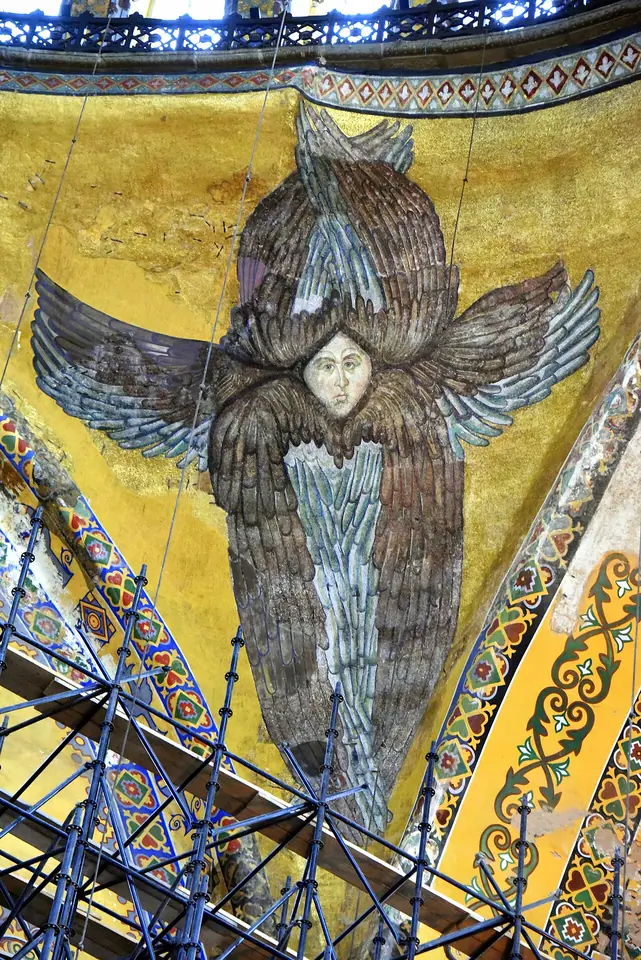
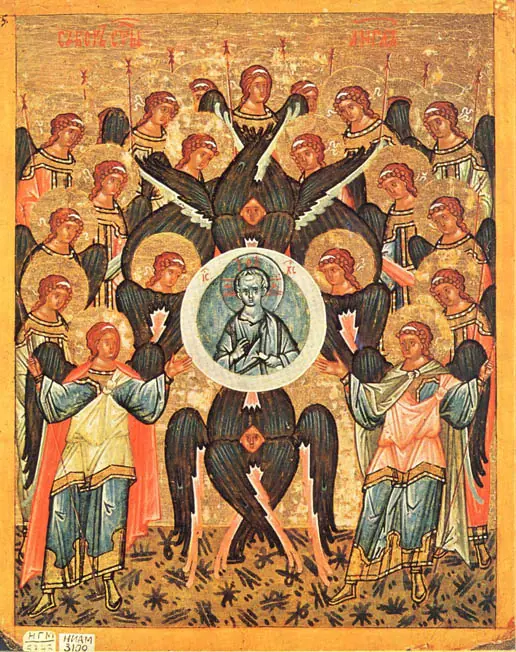
The seraphim, whose name means "burning ones," stand closest to God. Isaiah saw them with six wings, covering their faces and feet and flying, and heard them cry "Holy, holy, holy." Read more on the seraphim.
The cherubim guard the way to the tree of life after the fall (Genesis 3:24), spread their golden wings over the mercy seat of the Ark of the Covenant and bear up the throne of God in Ezekiel's vision. They have nothing to do with the chubby winged babies of later painting; see the cherubim.
The thrones are named by St. Paul. Christian tradition, especially in Byzantine art, links them with the fiery wheels "full of eyes" that Ezekiel saw beside the living creatures. Read about the ophanim, the Hebrew word for those wheels.
What do angels look like?
Angels have no bodies, so in themselves they look like nothing at all. When Scripture describes them, it uses two very different kinds of image. Sometimes they appear as ordinary men, so ordinary that Abraham fed three of them lunch and Lot took two of them home (Genesis 18 and 19). Sometimes the prophets saw overwhelming visions: Ezekiel's living creatures with four faces and wheels full of eyes, Isaiah's six-winged seraphim, Daniel's man "clothed in linen" whose face shone like lightning.
St. Thomas teaches that angels sometimes take on bodies so that people can see them, and that the strange images of the prophets are signs pointing to spiritual realities. Dionysius warned his readers not to imagine "that the heavenly and Godlike minds are certain many-footed and many-faced creatures." That is the answer to the internet craze for biblically accurate angels, and we take it up on its own page.
The archangels: Michael, Gabriel and Raphael
The word archangel means "chief angel." It appears only twice in Scripture: Michael is called "the archangel" in Jude 9, and St. Paul says the Lord will come "with the voice of an archangel" (1 Thessalonians 4:15). In the ninefold order, archangels are the eighth choir, but the Church also uses the title for the three great angels Scripture names. They share one feast, on September 29.
St. Michael the Archangel is the warrior. Daniel calls him "one of the chief princes" and the protector of God's people (Daniel 10:13, 12:1). He disputes with the devil over the body of Moses and leads the angels against the dragon. His name is a question: "Who is like God?" We ask his protection every time we pray the St. Michael prayer or the Chaplet of St. Michael.
St. Gabriel the Archangel is the messenger. He explains Daniel's visions, announces to Zachary the birth of John the Baptist, and comes to the Virgin Mary at Nazareth with the greeting we repeat in every Hail Mary. "I am Gabriel, who stand before God," he tells Zachary (Luke 1:19). His name means "strength of God." The Angelus recalls his visit three times a day.
St. Raphael the Archangel is the healer and companion. In the Book of Tobias he walks beside young Tobias on a long journey, drives away the demon that tormented Sarah and cures old Tobias of his blindness. Then he reveals himself: "I am the angel Raphael, one of the seven, who stand before the Lord" (Tobias 12:15). His name means "God heals." See the St. Raphael prayer.
Other named archangels
Raphael's "one of the seven" has led people to search for the other four. Jewish writings outside the Bible, above all the Book of Enoch, supply names such as Uriel, Raguel and Jeremiel, and Eastern Christian tradition honors Uriel and others. The Church's guidance for the Roman rite is clear: the Directory on Popular Piety and the Liturgy (2001) says that "the practice of assigning names to the Holy Angels should be discouraged, except in the cases of Gabriel, Raphael and Michael whose names are contained in Holy Scripture." We look at these traditions honestly on the pages about the seven archangels, Archangel Uriel, Metatron and the names of angels.

Guardian angels
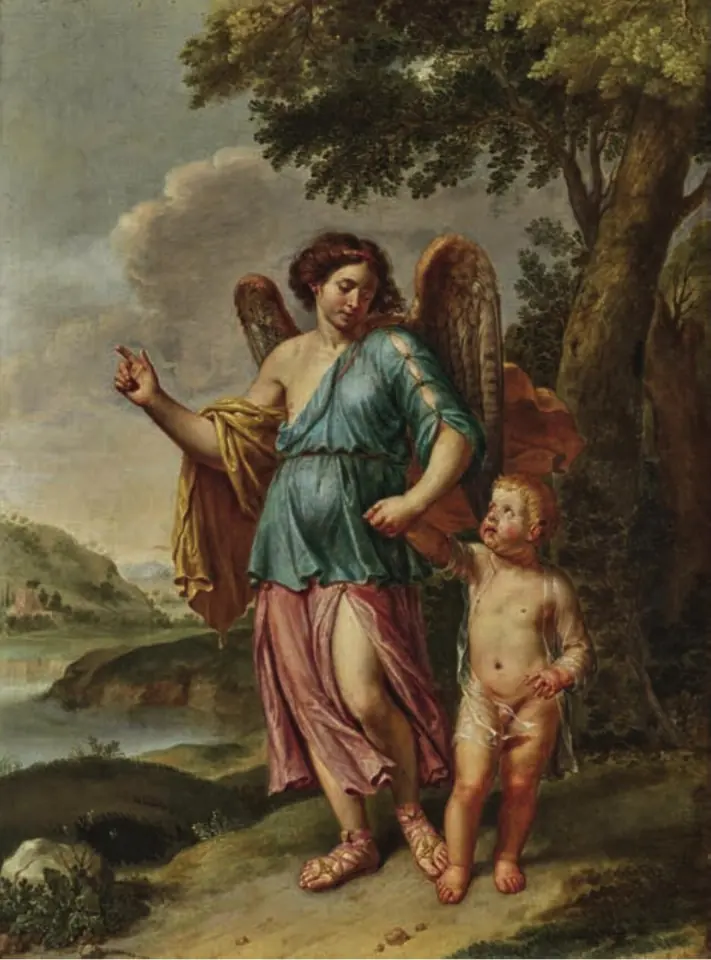
Of all the Church's teaching on angels, this is the one closest to home. Jesus set a child in front of his disciples and said: "See that you despise not one of these little ones: for I say to you, that their angels in heaven always see the face of my Father who is in heaven" (Matthew 18:10).
The Catechism gathers the Church's faith: "From infancy to death human life is surrounded by their watchful care and intercession. 'Beside each believer stands an angel as protector and shepherd leading him to life'" (336, quoting St. Basil). St. Jerome, commenting on Jesus' words, marveled at "how great the dignity of the soul, since each one has from his birth an angel commissioned to guard it." St. Thomas agreed: "Each man has an angel guardian appointed to him."
Our guardian angel cannot force our will, but he can enlighten our mind, warn us of danger and pray for us. The Church honors the guardian angels with their own feast on October 2. Children learn to greet theirs with the guardian angel prayer, "Angel of God, my guardian dear," and it is a good prayer to keep for life. The full teaching, with the history of the feast, is on our page about guardian angels.

Honoring the angels rightly
We honor the angels, but we never worship them. When St. John fell at the feet of the angel who showed him the visions of the Apocalypse, the angel stopped him at once: "See thou do it not: for I am thy fellow servant... Adore God" (Apocalypse 22:9). Adoration belongs to God alone. What we give the angels is love, gratitude and trust, and we ask for their help.
The Church's liturgy shows the way. In the Roman Canon, the Supplices te rogamus, the priest asks God to send his angel to carry our offering to the altar on high. At a funeral we pray In paradisum, "May the angels lead you into paradise." In the Byzantine Divine Liturgy the faithful sing the Cherubic Hymn, mystically joining the cherubim around the throne (Catechism 335).
The Directory on Popular Piety also warns against two errors: treating life as a helpless struggle between good and evil spirits, and childishly crediting every setback to the devil and every success to our guardian angel. Devotion to the angels is meant to make us grateful, attentive to God's presence and calm in trouble.
Other angel questions
Several angel subjects have their own pages, because people ask about them so often:
- The angel of death: what Scripture says about the destroying angel of Exodus and the angels who carry souls home, and where the idea of a single "angel of death" comes from.
- The Nephilim: the mysterious "giants" of Genesis 6 and how the Fathers read the "sons of God" in that passage.
- The fallen angels: Satan and the demons, what they can and cannot do, and how the Church protects us against them.
May the holy angels keep us in all our ways, as the psalm promises: "For he hath given his angels charge over thee; to keep thee in all thy ways" (Psalm 90:11). St. Michael, St. Gabriel and St. Raphael, and all you holy angels, pray for us.
Frequently asked questions
What are angels?
Angels are spiritual creatures, made by God, with intellect and free will but no bodies. The word angel means messenger and names their work, not their nature, as St. Augustine said. They worship God, carry out his will and help us on the way to heaven. The Catechism calls their existence a truth of faith (328).
What is the angel hierarchy?
Following Pseudo-Dionysius (about 500 AD) and St. Thomas Aquinas, the Church's tradition counts nine choirs of angels in three groups of three. Highest are the seraphim, cherubim and thrones; then dominions, virtues and powers; then principalities, archangels and angels. The Church has never defined the list as dogma, but it has been received almost everywhere.
Who are the archangels in the Bible?
Scripture names three, St. Michael, St. Gabriel and St. Raphael. Michael leads the battle against the dragon (Apocalypse 12) and is called an archangel in Jude 9. Gabriel announces the births of John the Baptist and Jesus. Raphael heals and guides Tobias and calls himself one of the seven who stand before the Lord. The Church keeps their feast together on September 29.
Do people become angels when they die?
No. Angels and human beings are different kinds of creatures. The saints in heaven are glorified human beings, who will rise again in their bodies at the end of time. Jesus says the risen will be "as the angels of God in heaven" (Matthew 22:30), meaning like them in glory, not changed into them.
Are angels male or female?
Neither. Angels are pure spirits and have no bodies, so they have no sex. Scripture describes the angels who appear to people as men, and Michael, Gabriel and Raphael are spoken of as "he", which is why Christian art usually paints them as young men.
How many angels are there?
Scripture says only that they are countless. Daniel saw "thousands of thousands" ministering to God and "ten thousand times a hundred thousand" standing before him (Daniel 7:10). St. Thomas Aquinas thought the angels far outnumber all material things.
Do I have a guardian angel?
Yes. Jesus says of the little ones that "their angels in heaven always see the face of my Father" (Matthew 18:10), and the Catechism teaches that human life is surrounded by the angels' watchful care from infancy to death (336). The Church keeps the feast of the Guardian Angels on October 2.
Can we pray to angels?
Yes. We do not worship angels, since worship belongs to God alone, but we may ask their help and intercession, as the Church does in the liturgy. The best-known prayers are the St. Michael prayer and the Angel of God prayer to one's guardian angel.
Sources
- Catechism of the Catholic Church, nos. 325-354 (Heaven and earth: the angels)
- Catechism of the Catholic Church, nos. 385-421 (The fall)
- Catholic Encyclopedia (1907): Angels
- St. Thomas Aquinas, Summa Theologiae I, q. 50 (The substance of the angels)
- St. Thomas Aquinas, Summa Theologiae I, q. 63 (The malice of the angels with regard to sin)
- Dionysius the Areopagite, The Celestial Hierarchy, tr. John Parker (1899)
- Congregation for Divine Worship, Directory on Popular Piety and the Liturgy (2001), nos. 213-217