Halo meaning
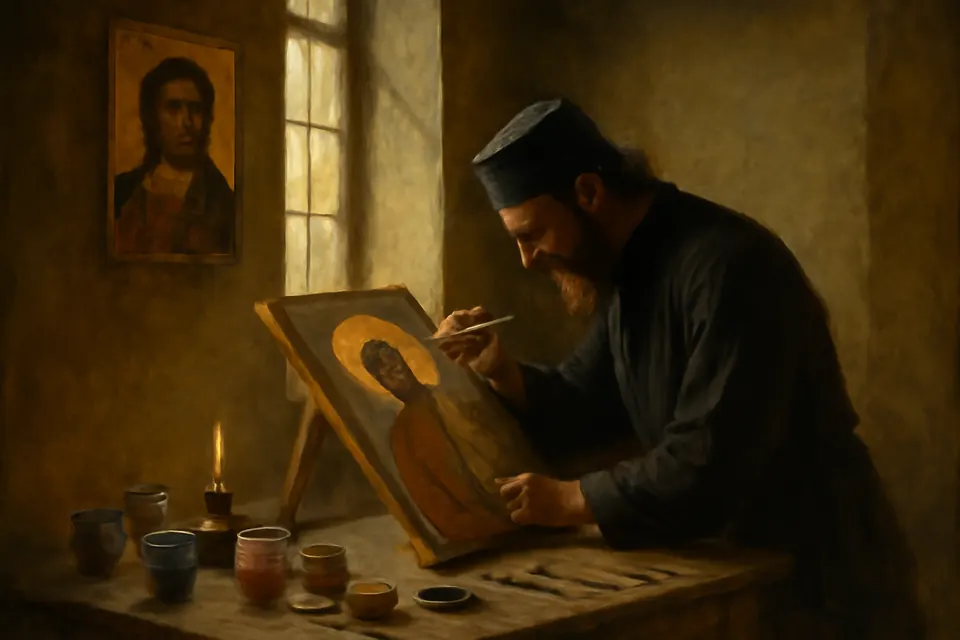
Halo meaning: in Christian art a halo, or nimbus, is a ring or disc of light around a head that shows the person is holy, filled with the light of God's grace. Saints, angels and the Blessed Virgin Mary wear round halos; Christ's halo has a cross inside it. Light around the whole body is an aureole or mandorla.
Walk into almost any Catholic or Orthodox church and you will see them: rings of gold behind the heads of the saints, in mosaics, icons, stained glass and statues. The halo is so familiar that we hardly notice it. Yet it has a long history, a few rules, and a meaning worth knowing, because it tells us what the saints are.
What does a halo mean?
The halo, or nimbus, is light. It shows that the person shines with the glory of God. A saint does not glow by his own power; he reflects the One who is Light, the way the moon reflects the sun. Scripture promises this to everyone who belongs to Christ: "Then shall the just shine as the sun, in the kingdom of their Father" (Matthew 13:43, Douay-Rheims), and "they that instruct many to justice" will shine "as stars for all eternity" (Daniel 12:3).
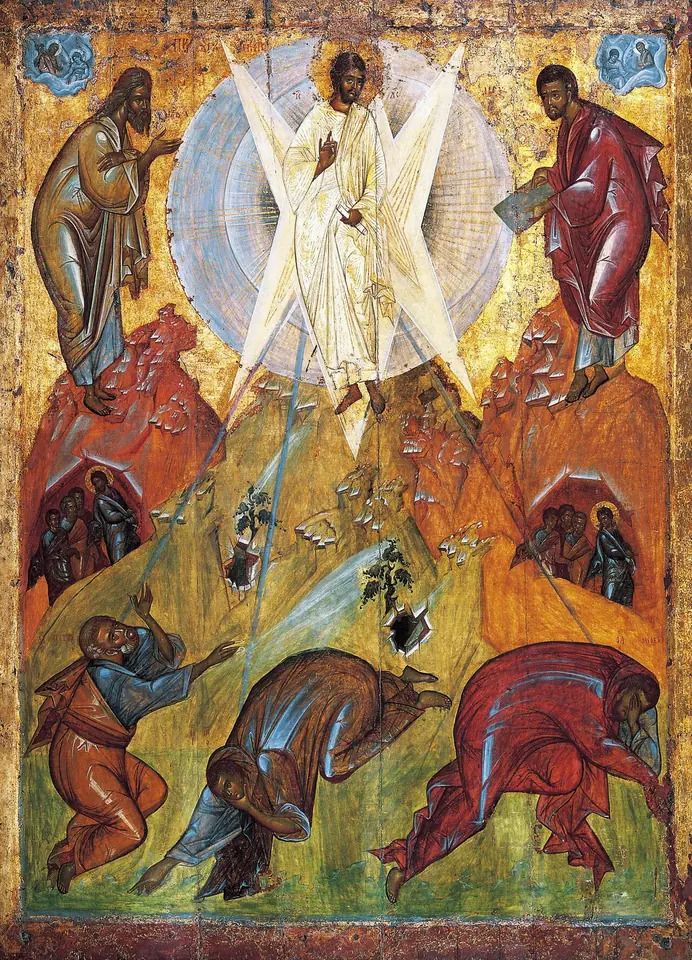
The Bible is full of holy light. When Moses came down from Sinai his face shone so brightly that the Israelites were afraid to come near him. When Jesus was transfigured on the mountain, "his face did shine as the sun: and his garments became white as snow" (Matthew 17:2). A halo puts that light into paint.
A small curiosity: the Latin Vulgate and the Douay-Rheims translation that follows it say that Moses' face "was horned" (Exodus 34:29), from a Hebrew word that can mean either rays or horns. That is why medieval and Renaissance artists, Michelangelo among them, gave Moses small horns. They were trying to show rays of light.
Where did the halo come from?
The halo is older than Christianity. The Catholic Encyclopedia's article on the nimbus (1911) traces it to Greek art of the Hellenistic age. Greek and Roman artists painted a disc or crown of rays around the heads of gods, heroes and especially gods of light, such as the sun god. In Rome the halo was first given to dead emperors as a sign of heavenly bliss, then to living ones, and after the 3rd century the emperors wore a plain nimbus without rays. It had come to mean majesty and power rather than divinity.

Christians did not take it over at once. The earliest catacomb paintings show Christ, Mary and the apostles with no halo at all. Christ first received a nimbus in the 4th century, at first only when he was shown enthroned as king and teacher. Before long it became his fixed sign, then the sign of the angels and the Lamb of God. The Catholic Encyclopedia says the number of figures given a halo "increased rapidly," and by the end of the 6th century it was as common in Christian art as it had once been in pagan art. The Blessed Virgin Mary always received one, and the martyrs and saints usually.
What changed was the meaning. In pagan art the plain disc stood for power. In Christian art it became, in the encyclopedia's words, "the emblem of such virtue and grace, which emanating from God, extends over the saints only."
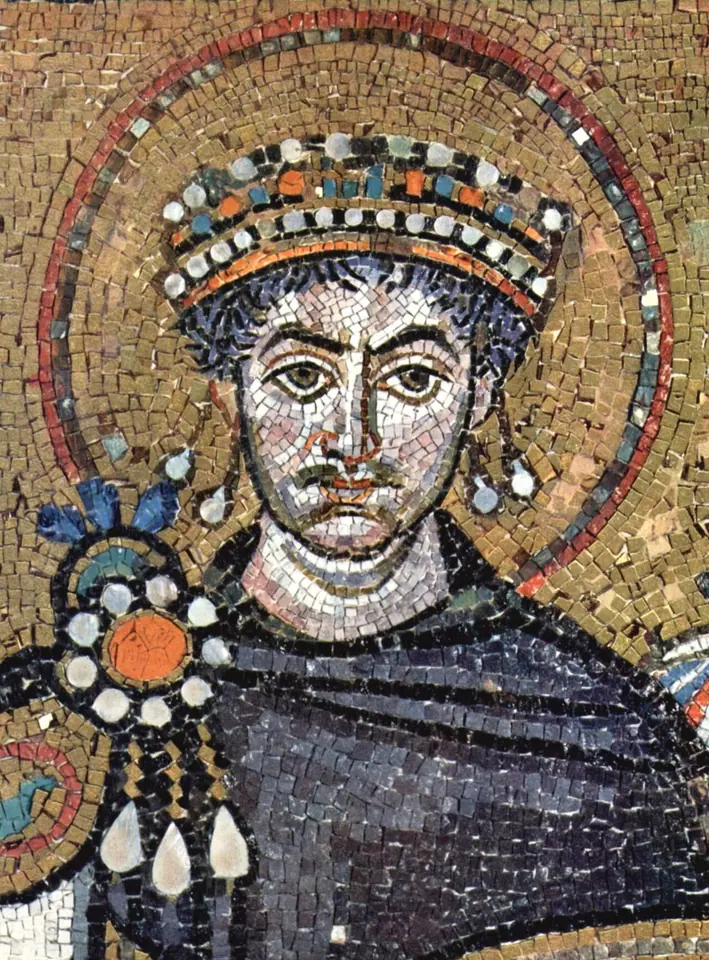
Kinds of halos and what each one means
Once you know a few shapes, you can read a church wall like a book.
The round halo
The plain round halo, a gold disc or ring, is the ordinary sign of holiness. Saints, angels and the Blessed Virgin Mary wear it. In Byzantine and Russian icons the saint's name is often written beside the halo, which makes identification easy (see saints' symbols in art for the other clues). Early halos were often blue, the color of heaven. From the 5th and 6th centuries gold replaced blue in mosaics, because gold catches the light of the candles and seems to shine by itself.
The cross halo (cruciform nimbus)
A halo with the arms of a cross inside it belongs to Christ. It became his sign in the 6th century and recalls the cross by which he redeemed the world. The Lamb of God receives it too, and occasionally the Father or the Holy Spirit. In later Greek and Russian icons the three visible arms of the cross often carry the Greek letters Ο ΩΝ, "He who is," the name God gave himself to Moses at the burning bush.

The square halo
The square halo is the rarest and the most surprising. It marked a person who was still alive when the picture was made. John the Deacon, writing the life of St. Gregory the Great in the 9th century, describes a portrait of the pope painted in his lifetime with the likeness of a square around his head, "which is the sign for a living person, and not a crown." Popes and donors who paid for a church were sometimes shown this way beside the saints. The square honored them without putting a living man on a level with the saints in glory. Later writers, such as the 13th-century liturgist Durandus, gave it other meanings, such as the four cardinal virtues, but the Catholic Encyclopedia thinks these came afterward.

The aureole and the mandorla
When light surrounds the whole body rather than the head, it is called an aureole. An almond-shaped aureole is called a mandorla, from the Italian word for almond. It was at first kept for God, and for Christ when the artist wanted to show his divinity plainly: Christ in majesty at the Last Judgment, Christ ascending, Christ transfigured. Later it was given to the Blessed Virgin Mary, especially in images of her Assumption. Its rainbow colors echo the Book of Revelation, where "there was a rainbow round about the throne" of God (Revelation 4:3).
Other signs of light
The Blessed Virgin Mary is often crowned with twelve stars, from the "woman clothed with the sun... and on her head a crown of twelve stars" of the Apocalypse (12:1). St. John Nepomucene wears five stars (sometimes seven), for the lights said to have shone over the river where he was drowned. Raphael sometimes painted halos of tiny clouds or angel heads. And the rays of the sun became the design of the monstrance that holds the Blessed Sacrament.
How halos changed over the centuries
Gold and tooled halos of the Middle Ages
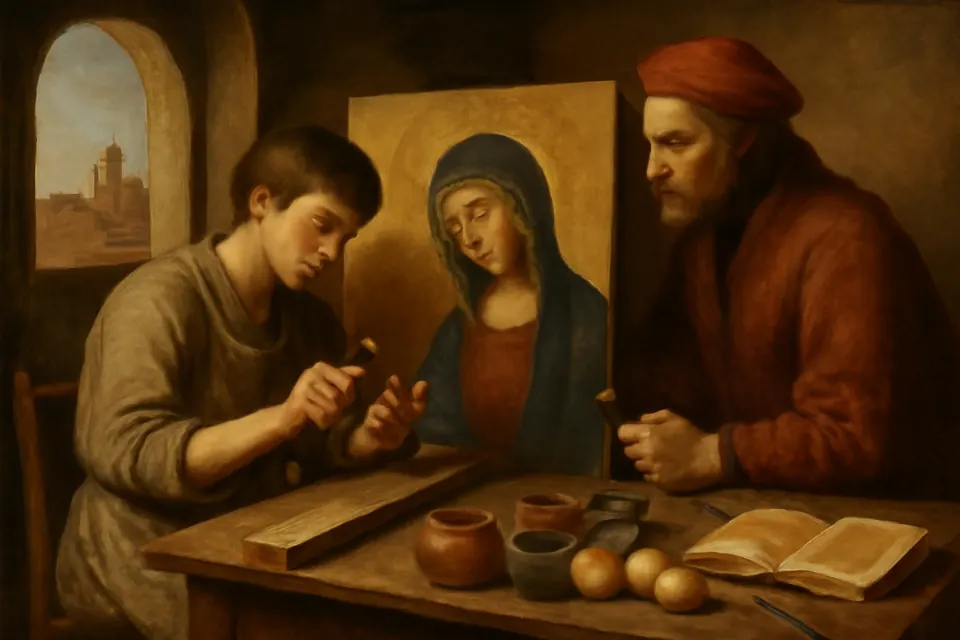
In medieval panel painting the halo was not painted at all. It was gold leaf, laid on a smooth ground, burnished until it shone, then decorated by pressing tiny metal punches into it to make rings of dots, flowers and stars. In a candlelit church those patterns flicker. The workshops of 14th-century Siena were masters of it.

Giotto turns the halo into a solid plate
Around 1305 Giotto painted the Scrovegni Chapel in Padua, and his figures turn in real space. That created a problem: what does a halo look like on someone seen from behind? Giotto's answer was a flat gold plate behind the head, raised in relief. In the Lamentation the mourners with their backs to us have halos that hide their faces.

The Renaissance ring
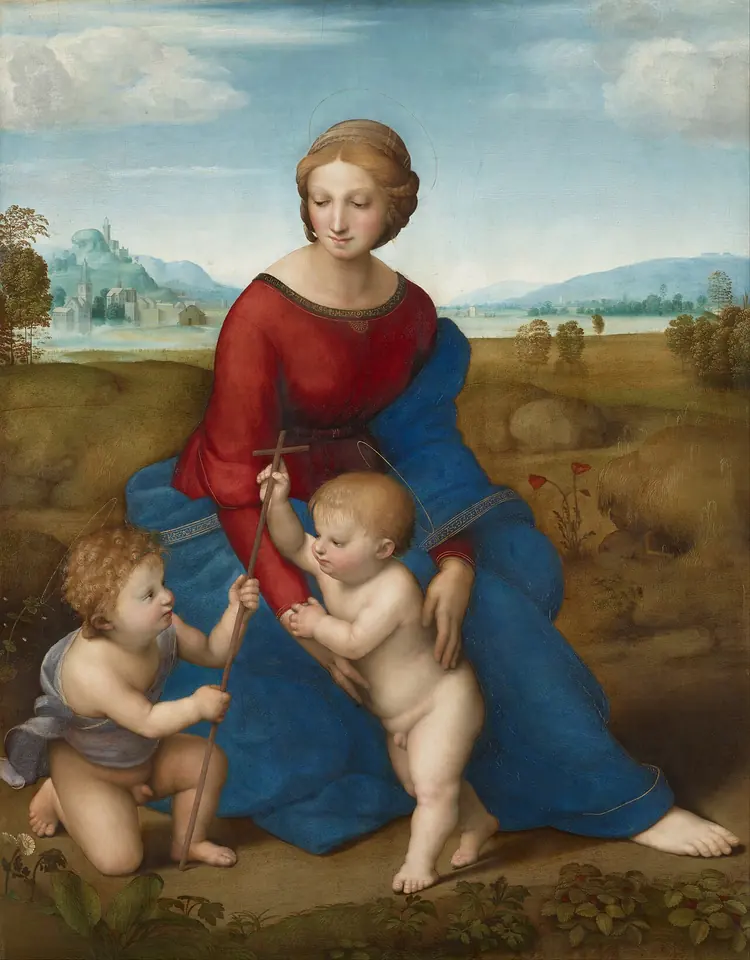
As painters learned perspective, the halo became a thin disc seen at an angle, then a fine gold line floating above the head, light as a soap bubble. In Raphael's Madonna of the Meadow (1505–1506) the halos of the Virgin, the Christ Child and the young St. John the Baptist are barely-there rings. Some later painters left them out altogether, letting the face and the story carry the holiness.
The Catholic Encyclopedia regretted this. Without the halo, it warned, images of the saints often slipped into "mere genre pictures," and "a delicate circlet of light shining or floating over the head does not lessen the artistic impression."
The Church's rule
Because a halo says "this person is in heaven," the Church guards it. Pope Urban VIII in the 17th century forbade giving the nimbus to anyone who had not been beatified. So a halo on an image in church means that the Church has declared the person Blessed or a saint, after the process described in how a person becomes a saint. Holy men and women whose causes are still open are shown without one.
The halo and us
The halo is not a crown for a few heroes. It is the light God wants to give every one of us. St. Paul wrote to the Corinthians that we, "beholding the glory of the Lord with open face, are transformed into the same image from glory to glory" (2 Corinthians 3:18). The saints are simply those in whom that work is finished.
So when we see the gold around a saint's head, let us ask their prayers, as the whole Church does on All Saints' Day, that we may one day share their light. Lord, make us shine with your grace, and bring us to the company of your saints.
For more, see what is a saint, why Catholics pray to saints and our guide to saints' symbols in art.
Frequently asked questions
What does a halo mean?
In Christian art a halo means holiness. It shows the light of God's glory shining from a person who lives in his grace, the light Jesus promised when he said, "Then shall the just shine as the sun, in the kingdom of their Father" (Matthew 13:43). It marks Christ, the angels, the Blessed Virgin Mary and the saints.
Why do saints have halos?
Because they share in the light of God. Scripture describes God as light and shows holy faces shining, from Moses coming down from Sinai to Christ at the Transfiguration. Christian artists borrowed the disc of light from older art and gave it a new meaning, grace from God, so that anyone entering a church could tell the saints from everyone else.
What is the difference between a halo and a nimbus?
In art the words mean the same thing, the disc or ring of light around the head. Nimbus is the Latin word ("cloud"); halo comes from the Greek name for the disc of light around the sun or moon. The aureole or mandorla is different. It surrounds the whole body and is kept mainly for Christ and the Virgin Mary.
What does a cross inside a halo mean?
A halo with a cross inside it, the cruciform nimbus, belongs to Christ alone (and to the Lamb of God, his symbol). It recalls the cross by which he saved us. Since the 6th century it has been the surest way to pick out Christ in a crowded painting or mosaic.
What does a square halo mean?
In early medieval Rome a square halo marked a person who was still alive when the picture was made, usually the pope or donor who paid for it. It honored the person without placing a living man on a level with the saints. Pope Paschal I wears one in the apse mosaic of Santa Prassede in Rome.
Can someone who is not canonized be shown with a halo?
Not in Church art. Pope Urban VIII in the 1600s forbade giving the halo to anyone who had not been beatified, so a halo on a church image means the Church has declared the person Blessed or a saint.