Pope St. Gregory the Great
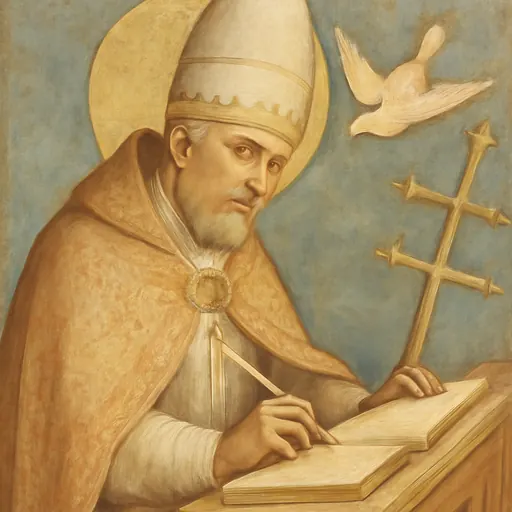
Pope St. Gregory the Great (about 540–604) was a Roman prefect who became a monk and then, against his will, pope from 590 to 604. He fed Rome through plague and war, sent the mission that converted the English, and wrote the Pastoral Rule and the Dialogues. A Doctor of the Church, he is the patron saint of musicians and teachers, and his feast day is September 3.
Who was St. Gregory the Great?
Gregory was bishop of Rome from 590 to 604, at one of the worst moments in the city's history. Floods, plague and the Lombard invasions had emptied the old capital, and the emperor in Constantinople sent little help. Gregory fed the city, made peace with its enemies, reformed the Church's clergy and worship, and sent monks to convert the English. He was also the first monk to become pope, and he never stopped wishing he were back in his monastery.
The Church counts him as a Doctor of the Church and one of the four great Latin Fathers, with St. Ambrose, St. Augustine and St. Jerome. About 800 of his letters survive, along with his sermons and books, so he is better known than almost anyone of his age.
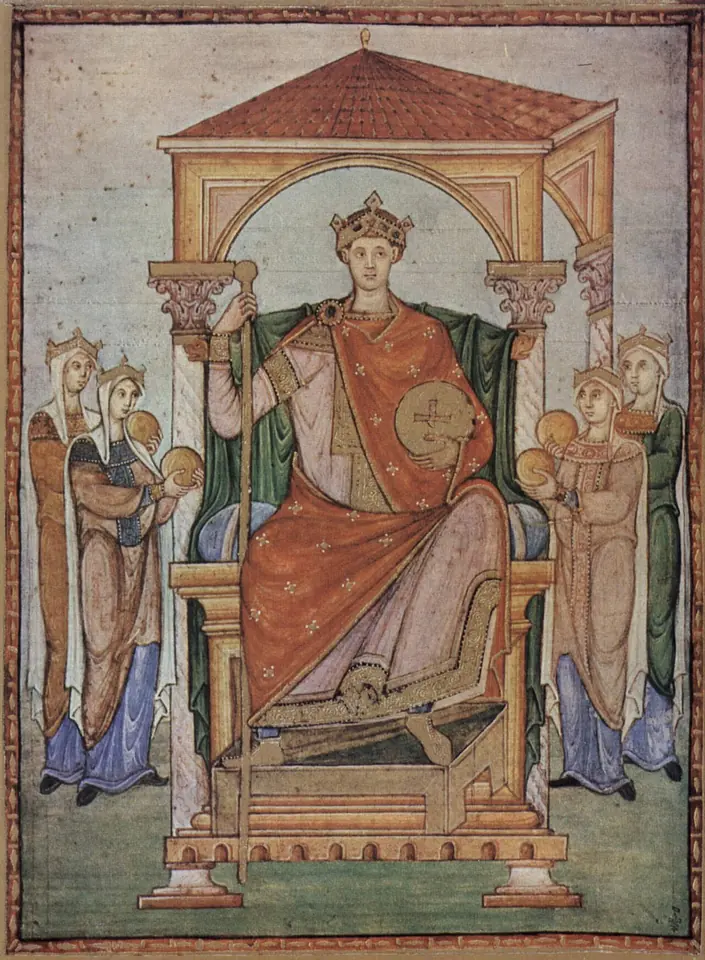

He called himself servus servorum Dei, "servant of the servants of God." Pope Benedict XVI said in 2008 that Gregory coined the phrase, and that it was "not just a pious formula on his lips but a true manifestation of his way of living and acting."
The life of St. Gregory the Great
Roman nobleman and prefect
Gregory was born in Rome about 540 into a rich and devout senatorial family. Benedict XVI says it was the Anicii, which had already given the Church two popes, including Gregory's great-great-grandfather Felix III. His mother, Silvia, and two aunts, Tarsilla and Aemiliana, are honored as saints. He grew up while the Goths and the Byzantine armies fought over the city.
About 573, while he was still in his early thirties, he was prefect of Rome, the highest civil office in the city. The Catholic Encyclopedia says he gave it up only "after long prayer and inward struggle."
Monk on the Caelian Hill
Around 574 he became a monk. He used his family estates in Sicily to found six monasteries and turned his own house on the Caelian Hill into a seventh, dedicated to St. Andrew. He later remembered those years as the happiest of his life.
In 578 or 579 Pope Pelagius II ordained him a deacon and sent him to Constantinople as his ambassador to the imperial court. He spent about six years there, lived as much like a monk as he could with brothers from St. Andrew's, and began his great commentary on Job, the Moralia, at the request of St. Leander of Seville. The Catholic Encyclopedia notes that he never learned Greek.
The Angles in the marketplace
Back in Rome as abbot of St. Andrew's, Gregory had the encounter the English never forgot. Bede, writing in 731, tells it "by the tradition of our ancestors": Gregory saw fair-haired boys for sale in the market and asked where they came from. Told they were Angles, he answered, "Right, for they have an Angelic face, and it becomes such to be co-heirs with the Angels in heaven." Their province was Deira, so they would be rescued de ira, from wrath; their king was Ælla, so "Hallelujah" must be sung there.
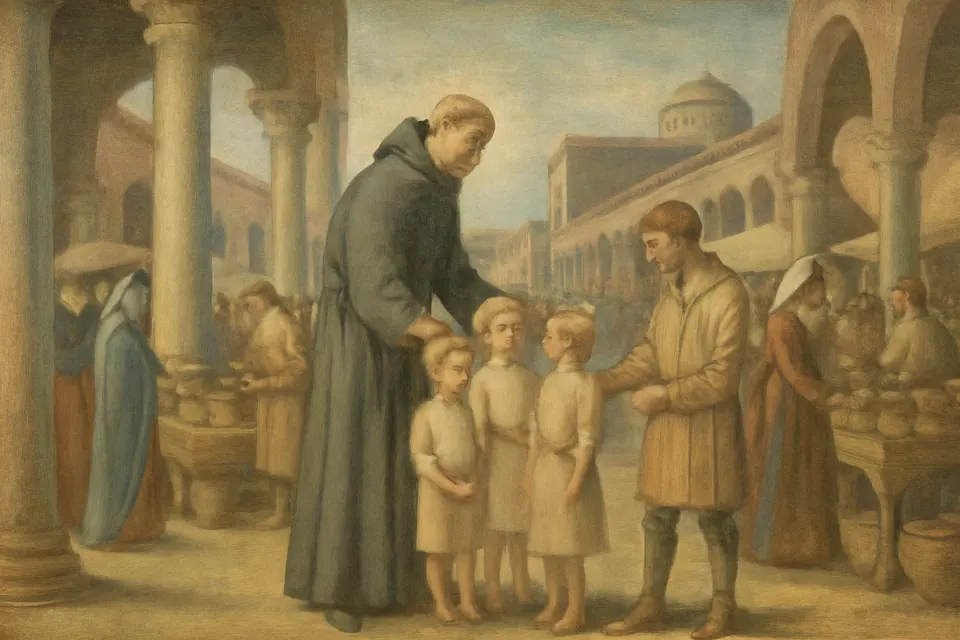
The story is traditional. Its first written form is in a life of Gregory by a monk of Whitby, about 713, and the Catholic Encyclopedia points out that in that version the Angles are free visitors to Rome; Bede is the first to make them slaves. Bede adds that Gregory set out for Britain himself, but the people of Rome demanded his return and messengers brought him back after three days.
Elected in a time of plague
In 589 the Tiber flooded, the Church's granaries were destroyed, and plague followed. Pelagius II died of it in February 590. The clergy and people elected Gregory, who wrote to the emperor Maurice begging him not to confirm the choice; the city prefect intercepted the letter.
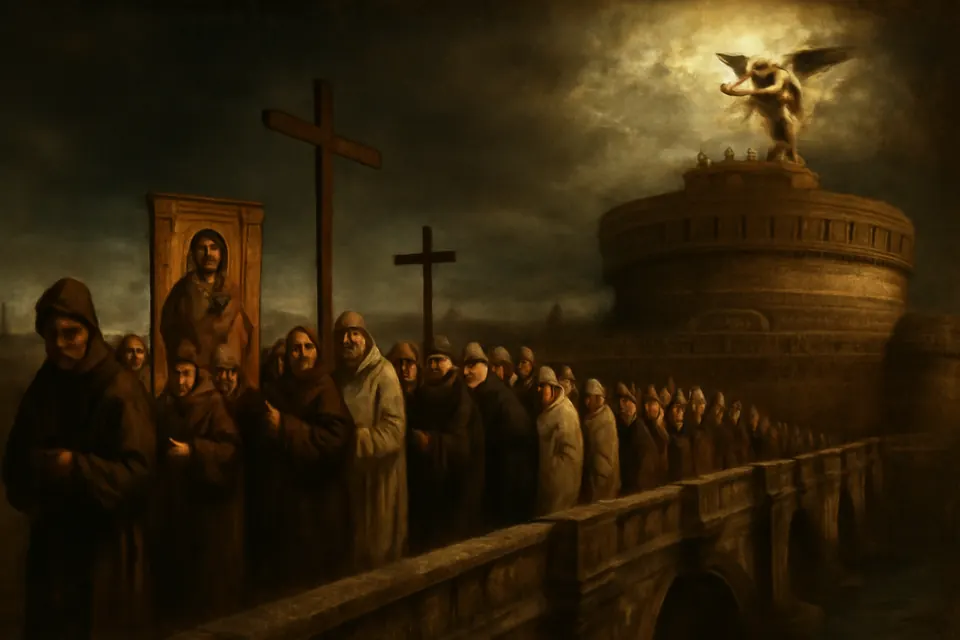
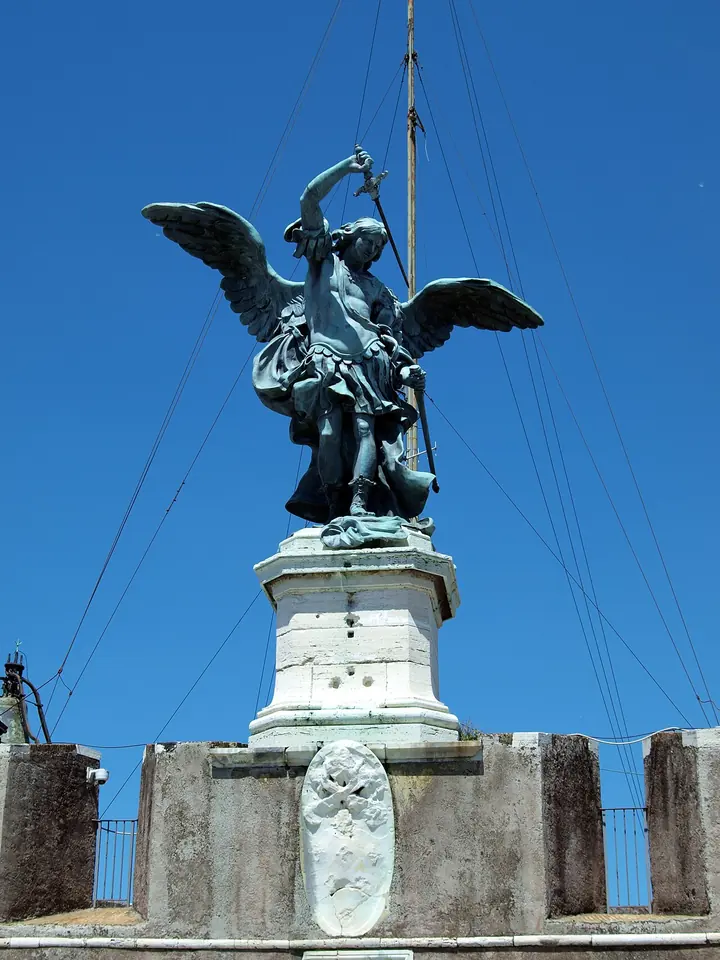
While he waited, Gregory led a great sevenfold procession of prayer from the seven districts of Rome to the basilica of the Virgin. A legend says that as the procession passed, the Archangel Michael was seen on the top of Hadrian's tomb, sheathing his sword as a sign that the plague was over. That is why the tomb is called Castel Sant'Angelo. The legend is traditional.
The emperor's confirmation came after six months, and Gregory was consecrated bishop of Rome on September 3, 590. A later story that he fled the city and hid in a forest until a pillar of light revealed him is, according to the Catholic Encyclopedia, "pure invention," contradicted by his contemporary Gregory of Tours.
Pope, 590–604
As pope Gregory lived like a monk, replaced the lay courtiers at the Lateran with clergy, and ran the Church's vast estates so carefully that his tenants were astonished. He used the income for the poor and for refugees from the Lombard wars, distributing grain from Sicily through the city's church districts. Bede's epitaph says that "before his bounteous board pale Hunger fled."
With no imperial general in Rome, he negotiated with the Lombards himself, making a separate peace in 592–593 and a formal one in 599. He wrote the Pastoral Rule at the start of his pontificate. It treats the bishop as a physician of souls and was the handbook of bishops for centuries; King Alfred had it translated into Old English.
He was sick for most of his pontificate, with digestive trouble, fevers and, in later years, gout. Benedict XVI notes that his voice was often too weak to preach, so a deacon read his homilies for him. He died on March 12, 604, and was buried the same day in the portico of St. Peter's.
The mission to England
In 596 Gregory chose about forty monks from his own monastery of St. Andrew and put their prior, Augustine, at their head. They lost heart in Gaul, and Gregory wrote to urge them on in July 596. They landed on the Isle of Thanet in Kent in 597, where King Æthelberht, whose wife Bertha was already a Christian, received them, gave them a home in Canterbury and was later baptized.
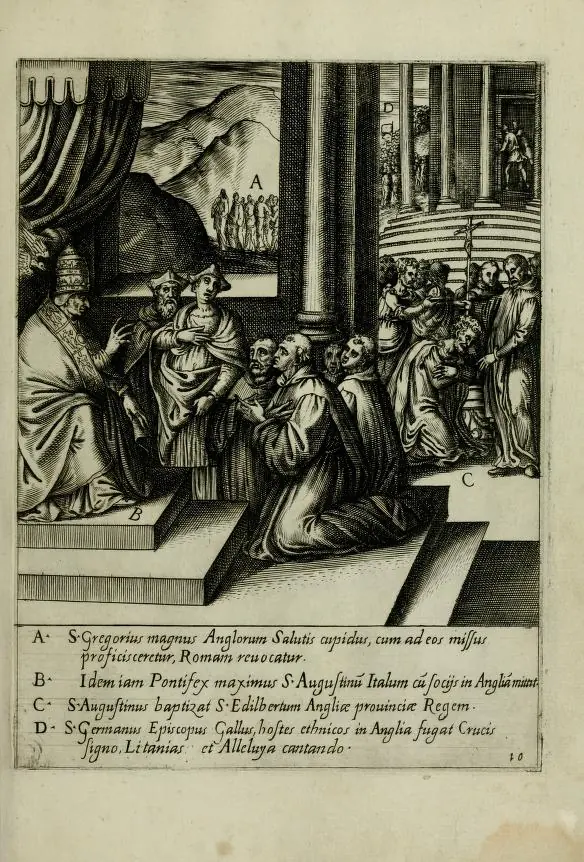

Gregory kept guiding the mission by letter. The epitaph Bede preserved for his tomb says, "To English Saxons Christian truth he taught." The English honored him as their apostle, and the Roman Martyrology still calls him "Apostle of the English."
The miracles of St. Gregory
None of Gregory's miracles is approved in the modern sense; Rome acclaimed him a saint as soon as he died. The Catholic Encyclopedia says the miracles told of him "are very many."
- The dove of the Holy Spirit: traditional. Paul the Deacon, in the 8th century, says Gregory's secretary looked through a hole in the curtain as Gregory dictated his homilies on Ezekiel and saw a dove with its beak at his lips.
- The angel over Hadrian's tomb: traditional, as told above.
- The Mass of St. Gregory: traditional. The Golden Legend (about 1260) says a woman who had baked the altar bread smiled in disbelief when Gregory offered her Communion. He set the host aside, and when he returned to the altar after Mass he found a bleeding finger on the cloth. Later artists turned it into a vision of the suffering Christ on the altar.


Writings of St. Gregory the Great
- The Pastoral Rule (590), on the life and duties of a bishop.
- The Moralia in Job, his long commentary on Job.
- Homilies on Ezekiel and on the Gospels.
- The Dialogues, stories of holy men of Italy, written to show that saints were still possible in bad times. Book II is the only ancient life of St. Benedict. In the East the book earned him the name Gregory the Dialogist. Book IV tells of the monk Justus, for whom Gregory ordered Mass offered for thirty days; Catholics still call such a series "Gregorian Masses."
- About 800 letters, the Register.
Gregory and Gregorian chant
Gregory's liturgical changes are certain in a few points: Bede and the Catholic Encyclopedia agree that he added the words "dispose our days in thy peace" to the Roman Canon, and he moved the Lord's Prayer to its place before the breaking of the bread.
His link to the chant that bears his name is traditional. Pope Leo IV already spoke of the cantus Sancti Gregorii in the 9th century, and John the Deacon wrote around 872 that Gregory "compiled a patchwork antiphonary." The tradition was questioned as early as 1675. Writing in 1909, the Catholic Encyclopedia defended it, arguing that most of the melodies were composed before 600, which fits the tradition. That is why Gregory is the patron of musicians, singers and choirs.
Why St. Gregory is the patron saint of musicians and teachers
- Musicians, singers and choirs: for the chant tradition above.
- Teachers and students: as a Doctor of the Church whose books taught the medieval Church.
- Popes: the model of the servant pope.
- England: for the mission of 597.
- Against plague and gout: for the plague of 590 and the gout he suffered.
- Stonemasons: listed by Catholic Culture; no early source explains it.
See all of them on our patron saints page.
Symbols of St. Gregory the Great in art
Gregory is an older pope in papal vestments. To tell him from other popes, look for:
- A dove at his ear, on his shoulder or on his head, from Paul the Deacon's story.
- The papal tiara and a papal cross with two or three bars.
- A book and pen or a writing desk, as a Doctor and author.
- A scribe peeking through a curtain, in older manuscript images like the Trier page above.
- Chant notation, on a sheet or book, in modern church windows.
- The Mass of St. Gregory, with the suffering Christ above the altar.
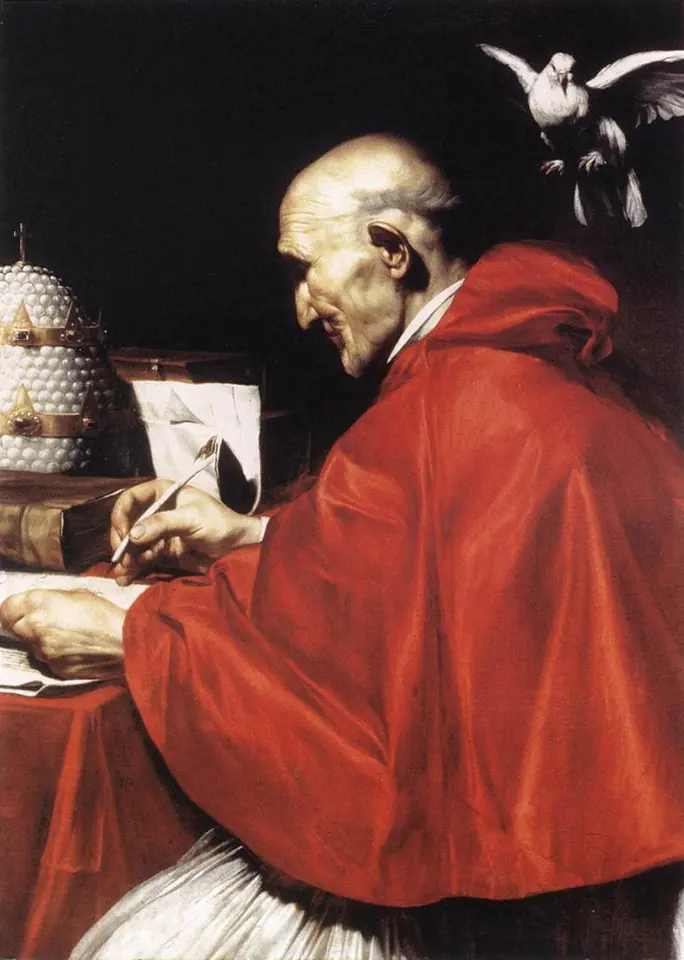

He often appears with Ambrose, Augustine and Jerome as one of the four Latin Doctors.


Feast day, tomb and Castel Sant'Angelo
Gregory's feast is September 3, a memorial in the General Roman Calendar since 1969, the anniversary of his consecration in 590. Before the reform, the Church kept it on March 12, the day he died; that date usually falls in Lent. The Orthodox Church keeps March 12 and credits him with the Liturgy of the Presanctified Gifts. See his neighbors on our feast days page.
His tomb is in St. Peter's Basilica. Pope Paul V moved his relics in 1606 to the chapel now called the Clementine Chapel, where they lie under the altar of St. Gregory.
The bronze angel on top of Castel Sant'Angelo recalls the legend of 590 and St. Michael.

Prayer to St. Gregory the Great
The Church's prayer for his feast is the collect of the Mass on September 3:
O God, who care for your people with gentleness and rule them in love, through the intercession of Pope Saint Gregory, endow, we pray, with a spirit of wisdom those to whom you have given authority to govern, that the flourishing of a holy flock may become the eternal joy of the shepherds. Through our Lord Jesus Christ, your Son, who lives and reigns with you in the unity of the Holy Spirit, God, for ever and ever.
Catholics ask his prayers for the pope and bishops, for teachers and church musicians, and for the sick.
Frequently asked questions
Why is St. Gregory the Great shown with a dove?
Paul the Deacon, writing in the 8th century, tells how Gregory's secretary peeked through a curtain while the pope was dictating his homilies on Ezekiel and saw a dove on his head with its beak between his lips. When the dove withdrew, Gregory spoke; when it returned, he fell silent. The dove stands for the Holy Spirit. The story is traditional.
Did Gregory the Great write Gregorian chant?
Not in the sense of composing it. The chant is named for him because of an old tradition, first written down by John the Deacon around 872, that he "compiled" an antiphonary of Roman chants. Scholars have debated how much he really did since the 17th century. The connection is traditional.
Why is he called "the Great"?
For what he did as pope in a time of plague, flood and Lombard invasion. He organized relief for the poor and refugees of Rome, negotiated peace with the Lombards, reformed the clergy and liturgy, sent missionaries to England, and wrote books that were the standard reading of medieval clergy. Only a few popes carry the title.
What are Gregorian Masses?
A series of thirty Masses offered on thirty consecutive days for one person who has died. The custom takes its name from a story in Gregory's Dialogues (Book IV), in which he had Mass offered for thirty days for a monk named Justus, who then appeared to his brother to say he had been released from his pains.
When is St. Gregory the Great's feast day?
September 3 in the Catholic Church, a memorial since the 1969 reform of the calendar. It was March 12, the day of his death, before then, and the Orthodox Church still keeps March 12.
Sources
- Catholic Encyclopedia (1909): Pope St. Gregory I ("the Great")
- Benedict XVI, General Audience of 28 May 2008: Saint Gregory the Great (1)
- Benedict XVI, General Audience of 4 June 2008: Saint Gregory the Great (2)
- Bede, Ecclesiastical History of the English People, Book II (Internet Medieval Sourcebook)
- Gregory the Great, Dialogues, Book 4 (1911 translation, tertullian.org)
- Catholic Encyclopedia (1909): Gregorian Chant
- Catholic Encyclopedia (1907): St. Augustine of Canterbury
- Catholic Culture: Memorial of St. Gregory the Great, Pope and Doctor of the Church, September 3
- Orthodox Church in America: Saint Gregory Dialogus, Pope of Rome
- Catholic Answers: A Golden Ticket Out of Purgatory? (on Gregorian Masses)
- Christian Iconography: St. Gregory the Great in Art
- Gregory the Great, Pastoral Rule (New Advent, Church Fathers)