Why do Catholics pray to saints?
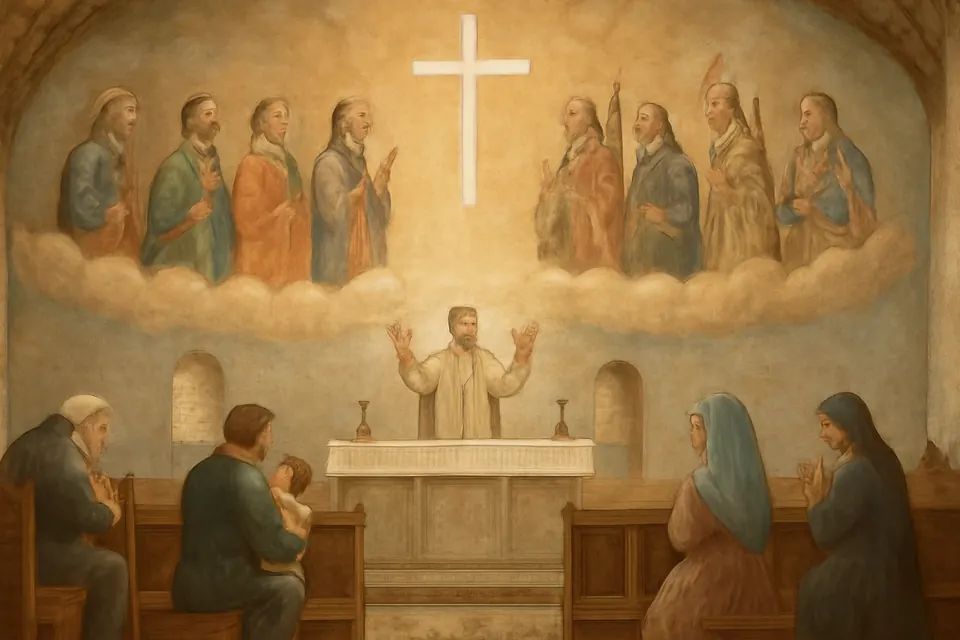
Why do Catholics pray to saints? We ask the saints to pray for us, just as we ask friends on earth to pray for us. Death does not break the bond between Christians: the saints are alive in Christ, close to God, and the Catechism says they "do not cease to intercede with the Father for us." We worship God alone; the saints we honor and ask for help.
Catholics pray to saints for the same reason we ask a friend to pray for us when we're sick or afraid. The saints are our older brothers and sisters in the faith. They have finished the race, they stand before God, and they still love us. When we say "St. Joseph, pray for us," we are asking for the prayers of a friend who happens to live in heaven.
It helps to be clear about the word. In older English "pray" simply meant "ask" ("Pray, sit down"). When we pray to a saint, we ask that saint to pray for us. Every grace still comes from God through Christ. The saint adds his or her voice to ours.
The communion of saints
Every Sunday we profess in the Creed, "I believe in... the communion of saints." The Church on earth, the souls being purified in purgatory and the saints in glory are one family in Christ. The Catechism puts it this way: all who are of Christ "form one Church and in Christ cleave together" (no. 954). It adds that the union between us and "the brethren who sleep in the peace of Christ is in no way interrupted," but "reinforced by an exchange of spiritual goods" (no. 955).
Death does not cut a Christian off from the Body of Christ. Jesus told the Sadducees that God "is not the God of the dead, but of the living: for all live to him" (Luke 20:38, Douay-Rheims). Those who die in God's friendship are more alive, not less. So the love that made them pray for others on earth does not stop at the grave.
What the Catechism says about the intercession of the saints
Paragraph 956 of the Catechism of the Catholic Church is the clearest short answer the Church gives:
"Being more closely united to Christ, those who dwell in heaven fix the whole Church more firmly in holiness.... They do not cease to intercede with the Father for us, as they proffer the merits which they acquired on earth through the one mediator between God and men, Christ Jesus.... So by their fraternal concern is our weakness greatly helped."
The Catechism then quotes two saints who understood this. St. Dominic, dying, told his brothers: "Do not weep, for I shall be more useful to you after my death and I shall help you then more effectively than during my life." And St. Thérèse of Lisieux said: "I want to spend my heaven in doing good on earth."
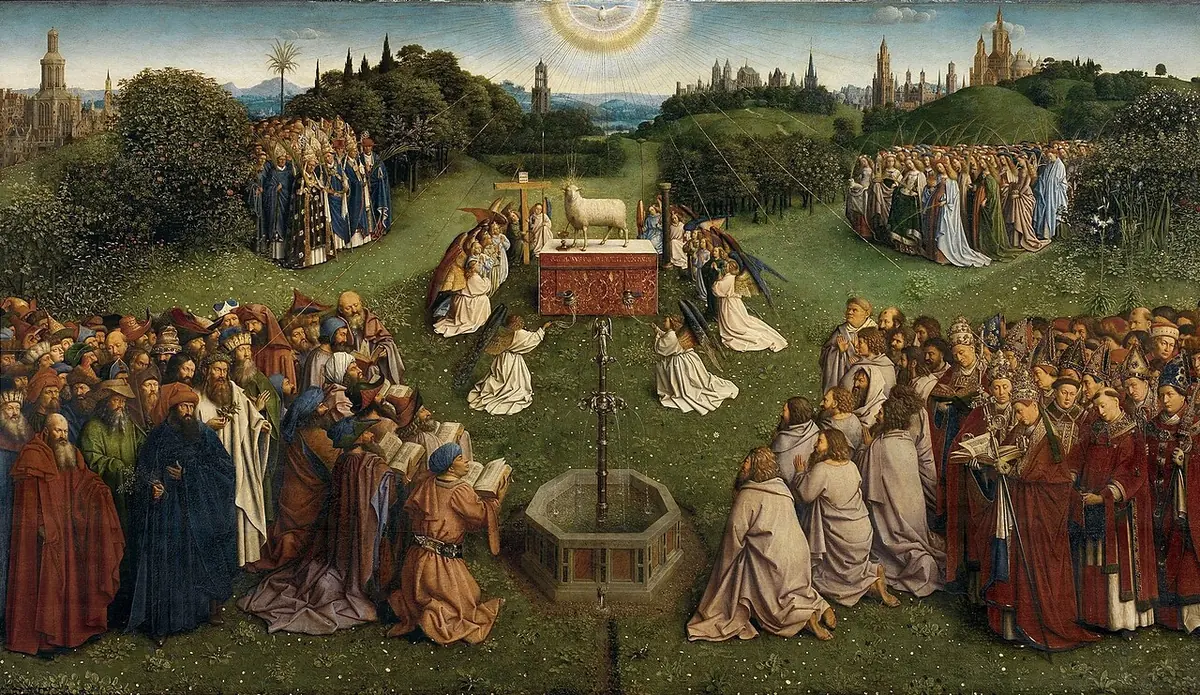
Later, in its teaching on prayer, the Catechism calls the saints "a cloud of witnesses" and says plainly: "Their intercession is their most exalted service to God's plan. We can and should ask them to intercede for us and for the whole world" (no. 2683).
Is it biblical to pray to saints?
Yes. No single verse says "ask the saints in heaven to pray for you," but the teaching rests on several things Scripture says clearly, read together as the Church has always read them.
Christians pray for one another. St. Paul asks "that supplications, prayers, intercessions, and thanksgivings be made for all men" (1 Timothy 2:1). St. James writes: "pray one for another, that you may be saved. For the continual prayer of a just man availeth much" (James 5:16). Asking for someone's prayers was ordinary Christian life from the start. And no one is more just than a saint made perfect in heaven.
One mediator, many who pray. The same chapter that asks for intercessions goes on: "there is one God, and one mediator of God and men, the man Christ Jesus" (1 Timothy 2:5). Paul saw no conflict between the two verses. The saints don't stand beside Christ as rival mediators; they pray in him, the way a mother praying for her son does.

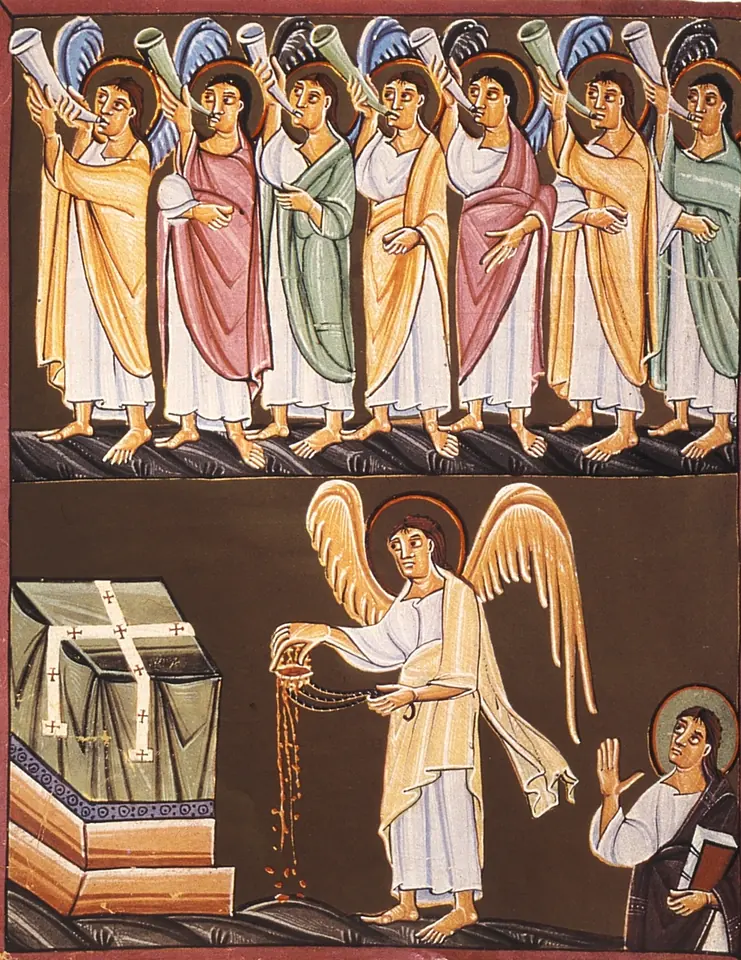
Heaven offers the prayers of the faithful. In the Book of Revelation the four living creatures and the twenty-four elders fall down before the Lamb, "having every one of them harps, and golden vials full of odours, which are the prayers of saints" (Revelation 5:8). Later an angel stands at the golden altar with a censer, "that he should offer of the prayers of all saints," and "the smoke of the incense of the prayers of the saints ascended up before God from the hand of the angel" (Revelation 8:3–4). Those in heaven are shown carrying the prayers of God's people on earth to his throne.
The saints surround us. After listing the heroes of faith from Abel to the prophets, the Letter to the Hebrews says: "we also having so great a cloud of witnesses over our head... let us run by patience to the fight proposed to us" (Hebrews 12:1). They are not spectators far away; they cheer us on.
The just in heaven pray for the people. In 2 Maccabees, Judas Maccabeus sees the dead high priest Onias "holding up his hands" and praying "for all the people of the Jews," and then the prophet Jeremiah, of whom Onias says: "this is he that prayeth much for the people, and for all the holy city" (2 Maccabees 15:12–14).
Worship and honor: latria, dulia and hyperdulia
We never worship the saints. The Church's theologians have used three Greek words for centuries to keep this clear:
- Latria is adoration, the worship owed to God alone: Father, Son and Holy Spirit. The supreme act of worship, the sacrifice of the Mass, is offered only to God.
- Dulia is the honor we give the saints as God's friends and servants, the way we honor a hero or a holy grandparent, raised to the level of grace.
- Hyperdulia is the special honor given to the Blessed Virgin Mary, the highest honor any creature receives, because God chose her to be the Mother of his Son.
The Catholic Encyclopedia (1909) puts it sharply: "the difference is one of kind and not merely of degree; dulia and latria being as far apart as are the creature and the Creator." St. Thomas Aquinas (Summa Theologiae II-II, q. 103) treats dulia as a distinct virtue, following St. Augustine, who wrote that the homage due to men "is distinct from latria which denotes the homage that consists in the worship of God."
You can hear the difference in the Church's own prayers. To God we say "have mercy on us." To the saints, in the litanies, we say "pray for us." A statue or a candle before a saint is a sign of love and remembrance, like a family photograph, never an idol.
How the first Christians prayed with the saints
Asking the saints for their prayers is not a medieval invention. It grew straight out of the Church's love for her martyrs.
When St. Polycarp was burned at Smyrna around 155, his church wrote that they worshiped Christ "as God's Son" and loved the martyrs "as the Lord's disciples and imitators" (quoted in the Catechism, no. 957). They gathered at his grave each year on the day of his death. That is how feast days began (see feast days and the Church calendar).
"Peter and Paul, pray for Victor"
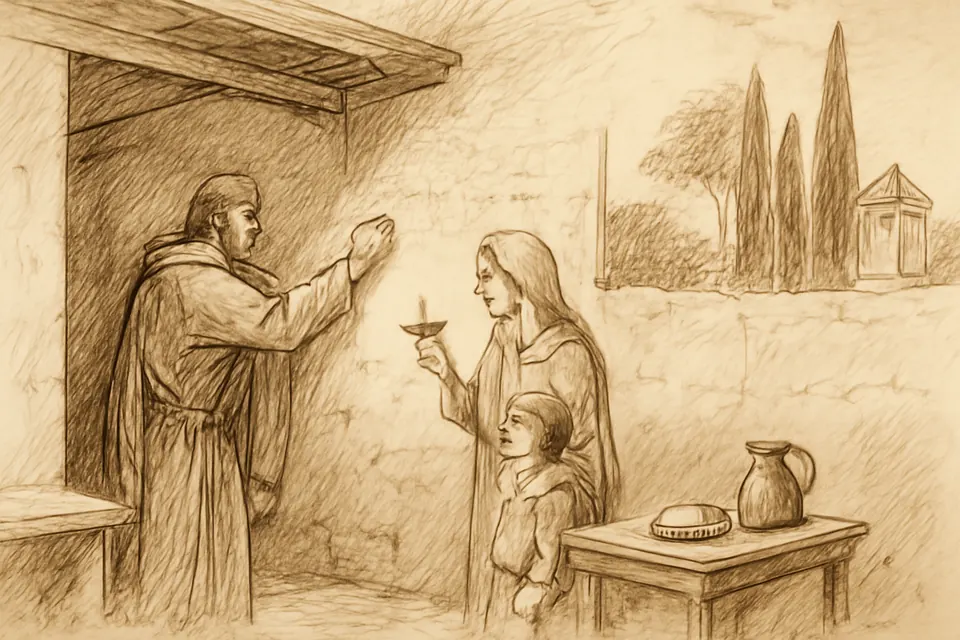
Under the Basilica of St. Sebastian on the Appian Way outside Rome there is a small courtyard where Christians gathered in the 3rd century to honor St. Peter and St. Paul. Pilgrims covered its walls with hundreds of scratched messages. The official site of the catacombs quotes one of the best known: Paule et Petre petite pro Victore, "Paul and Peter, pray for Victor." The place became known as the Memoria Apostolorum. These are the words of ordinary believers, written before Constantine, asking the apostles for exactly what we ask the saints for today.
The Fathers of the Church
The great teachers of the early Church speak the same way. Origen, in the 3rd century, wrote that not only Christ prays for those who pray sincerely, "but also the angels... as also the souls of the saints who have already fallen asleep." In Jerusalem around 350, St. Cyril explained the Eucharistic Prayer to the newly baptized: "we commemorate also those who have fallen asleep before us, first Patriarchs, Prophets, Apostles, Martyrs, that at their prayers and intercessions God would receive our petition."
St. Augustine drew the line between the martyrs and the rest of the faithful departed: "At the Lord's table we do not commemorate martyrs in the same way that we do others who rest in peace so as to pray for them, but rather that they may pray for us that we may follow in their footsteps." St. Jerome, writing against a priest who mocked the honor paid to martyrs, asked: "If the Apostles and Martyrs, while still in the body, can pray for others, at a time when they must still be anxious for themselves, how much more after their crowns, victories, and triumphs are won!"

Common questions, answered gently
"Why not go straight to God?" We do. The Our Father, the Mass, the psalms, our own words at night: they all go straight to God. Asking a saint's help is never a detour around him. A family that prays together doesn't love the Father less; God wants his children to pray for one another, and the saints are still his children.
"How can the saints hear millions of prayers?" Not by their own power. The saints are not everywhere at once, as God is. They see God face to face, and in him they know what he wills them to know. Jesus said there is "joy before the angels of God upon one sinner doing penance" (Luke 15:10), so heaven is not unaware of what happens on earth.
"Isn't it like contacting the dead?" No. Scripture forbids necromancy, trying to summon the dead or get secret knowledge from them. We summon no one and seek no messages. We simply ask those who live with God to pray, and we leave the answer to him.
"Why so many saints?" Because God's family is large, and each saint's life speaks to different needs. A mother waiting for a wayward son turns to St. Monica, who prayed and wept for years before her son Augustine came back to the faith. Someone in a hopeless situation asks St. Jude. That is the root of patron saints.
How to ask a saint to pray for you
There's no formula. Speak to a saint the way you'd speak to a friend you trust, and end by turning to God.
- Choose a saint you love, the saint you were named for, or one whose life fits your need (our patron saints pages help).
- Ask simply: "St. Anthony, please pray for my father's surgery tomorrow."
- Use the Church's prayers if you like: the Hail Mary, the Memorare, a litany, or a novena.
- Learn from the saint. Read the saint's life and try one of his or her virtues. The saints want our imitation more than our candles.
- Thank God when the prayer is answered, and keep praying when the answer seems to be "wait."
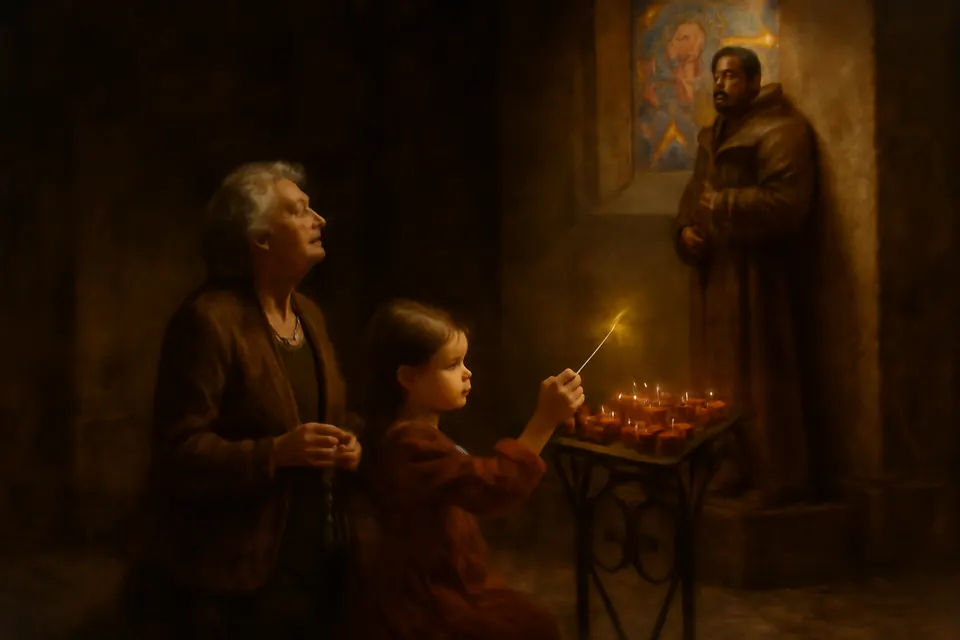
Let us close with the Church's oldest way of joining our prayer to theirs, the Litany of the Saints: Holy Mary, Mother of God, pray for us. St. Joseph, pray for us. All holy men and women, pray for us.
For more, see what is a saint, how a person becomes a saint, All Saints' Day and relics and incorruptible saints.
Frequently asked questions
Why do Catholics pray to saints instead of praying straight to God?
It isn't "instead of." Every prayer of the Church goes to God, and we pray to him directly all the time. Asking a saint's intercession is like asking a friend or a parish prayer group to pray for you, which no Christian thinks takes anything away from God. The saints are friends who happen to be in heaven, closer to God than we are.
Is it biblical to pray to saints?
Scripture tells Christians to pray for one another (1 Timothy 2:1, James 5:16), says the prayer of a just man "availeth much," and shows the elders and angels in heaven offering "the prayers of saints" before God (Revelation 5:8 and 8:3–4). God "is not the God of the dead, but of the living: for all live to him" (Luke 20:38). The Church reads these passages together, and the first Christians were already asking the martyrs for their prayers by the 3rd century.
Do Catholics worship saints?
No. Worship in the strict sense, called latria, belongs to God alone. The saints receive dulia, the honor due to God's friends, and the Blessed Virgin Mary receives hyperdulia, a higher honor because she is the Mother of God. The difference is one of kind, not degree, as far apart as the creature and the Creator.
Can the saints in heaven hear our prayers?
The saints know our prayers because they are in God and see in him what he wills them to know. They are not everywhere by their own power; God makes our requests known to them. Jesus said there is "joy before the angels of God upon one sinner doing penance" (Luke 15:10), so heaven is not unaware of what happens on earth.
Is praying to Mary different from praying to other saints?
It is the same kind of prayer, asking for her intercession, but we honor her above every other saint because God chose her to be the Mother of his Son. That is why so many prayers ask her help: the Hail Mary ends "pray for us sinners, now and at the hour of our death."
What does "communion of saints" mean?
It is the line in the Apostles' Creed that means all who belong to Christ, on earth, in purgatory and in heaven, form one family and share spiritual goods. We pray for the souls in purgatory, the saints in heaven pray for us, and we on earth pray for one another.
Sources
- Catechism of the Catholic Church, nos. 946–962: The communion of saints
- Catechism of the Catholic Church, no. 2683: A cloud of witnesses
- Catholic Encyclopedia (1910): Intercession
- Catholic Encyclopedia (1909): Dulia
- St. Thomas Aquinas, Summa Theologiae II-II, q. 103: Dulia
- St. Cyril of Jerusalem, Catechetical Lecture 23 (On the Mysteries, V)
- Catacombs of San Sebastiano (official site): the Memoria Apostolorum and the triclia graffiti