St. Dymphna prayer

The St. Dymphna prayer most often found in old prayer books is a short collect: "Oh God! thou lover of purity, grant that we who invoke the intercession of Thy holy martyr Dympna, may obtain the assistance of her merits and suffrages." We pray it for anyone suffering from mental illness, anxiety or depression, and for those who care for them.
If you have come here for someone you love, or for yourself, you are in good company. For more than seven hundred years, families have carried their sick to St. Dymphna's grave and asked her to pray for them. The prayers below are the old ones, the kind those families said. Pray them slowly, and know that asking a saint's prayers never means you have to carry this alone or without help.
The St. Dymphna prayer
This prayer closes the life of St. Dympna (the older English spelling) in a small book of saints' lives published in New York by J. A. McGee in 1872. The book is in the public domain. It is printed here word for word.
Oh God! thou lover of purity, grant that we who invoke the intercession of Thy holy martyr Dympna, may obtain the assistance of her merits and suffrages through Christ our Lord. Amen.
It is short because it is a collect, the kind of prayer the Church says at the end of a litany or an office. The same prayer, in almost the same words, stands at the end of a Flemish litany of St. Dymphna printed in Antwerp a few decades earlier, which suggests the American book translated a prayer already in use in Belgium.
The shortest prayer
On a medal from Geel, made in the 19th or early 20th century, the words around her picture are "H. Dymphna bid voor ons": St. Dymphna, pray for us. That is a whole prayer, and on the hard days it may be the only one we can manage.
St. Dymphna, pray for us.
Prayers from the old Flemish litany
This leaflet was printed by J. B. de Beer in Antwerp sometime between 1836 and 1862, approved by the archdeacon and book censor A. De Vries, and is now in the MAS museum collection in Antwerp. It was made for the Chapel of St. Roch in Antwerp, where, the leaflet says, approved relics of St. Dymphna were "honored." The translations from the old Dutch are our own.

First prayer
O God beminnaer der Zuyverheyd, geeft ons die tot U roepen, en gedenkenis houden van de H. Maegd en Martelaresse Dymphna, dat wy door haere verdiensten en gebeden mogen geholpen worden. Amen.
In English: O God, lover of purity, grant to us who call upon you and keep the memory of the holy virgin and martyr Dymphna, that we may be helped by her merits and prayers. Amen.
Second prayer
Almagtigen eeuwigen God, voor wiens H. Naem de Maegd Dymphna door 't zweêrd haer onnoozel blood vergooten heeft; geeft ons door haere glorieryke Verdiensten, dat wy alle de listen des vyands ontgaende, door eene zalige dood mogen komen tot het Vaderland van de eeuwige Glorie. Door Jesus Christus onzen Heer. Amen.
In English: Almighty, eternal God, for whose holy Name the virgin Dymphna shed her innocent blood by the sword: grant us through her glorious merits that, escaping all the snares of the enemy, we may come by a happy death to the homeland of eternal glory. Through Jesus Christ our Lord. Amen.
The opening of the litany
The litany itself begins like every litany of the saints, with the Kyrie and invocations of the Holy Trinity and of Our Lady, and then turns to St. Dymphna. The first page reads, in our translation:
Lord, have mercy on us. Christ, have mercy on us. Lord, have mercy on us. Christ, hear us. Christ, graciously hear us. God the Father of heaven, have mercy on us. God the Son, Redeemer of the world, have mercy on us. God the Holy Spirit, have mercy on us. Holy Trinity, one God, have mercy on us. Holy Mary, Mother of God, pray for us. St. Dymphna, pray for us. St. Dymphna, bride of Christ, pray for us. St. Dymphna, princess of Ireland, pray for us. St. Dymphna, patroness of Gheel, pray for us. St. Dymphna, help of those who have lost their reason, pray for us. St. Dymphna, comfort of all the sick, pray for us. St. Dymphna, help of those who call upon you, pray for us.
Notice the fourth title, "Bystand der Zinneloozen," help of those who have lost their reason. Long before anyone spoke of mental health, the faithful of Brabant were asking her, by name, to stand beside people whose minds were suffering.
The leaflet also records that Pope Pius VII granted a plenary indulgence for visiting that chapel on her feast, May 15, or on one of the seven days after it. That grant belongs to its time. The Church reorganized indulgences after 1967, so it should not be assumed to be in force today.
The St. Dymphna novena
A novena to St. Dymphna is as old as her shrine. In the Middle Ages, the Catholic Encyclopedia notes, the novena of prayer for a particular need grew up among the faithful of France, Belgium and the Lower Rhine, often to ask a saint's help in sickness, and Geel was one of the places where it was made.

When the English writer Mrs. William Pitt Byrne visited Geel in the 1860s, the sacristan of St. Dymphna's church showed her the little rooms built against the church for pilgrims. Her book Gheel: The City of the Simple (1869) explains that those who came to ask the saint's intercession had the "pious custom to make a novena or nine days' devotion," and that the rooms gave them a free place to stay. Permission to remain "held good for nine days only, but was renewable." She also saw, by the north door, two portraits of a man who had been cured "by a novena two hundred years ago," before and after. Cures like that one are reported, not formally approved. They are part of why the families kept coming.
How to pray a St. Dymphna novena today
You don't need to travel to Belgium. Choose one person or one need, and for nine days in a row:
- Make the Sign of the Cross and name the person you are praying for.
- Pray the St. Dymphna prayer above ("Oh God! thou lover of purity...").
- Pray one or both of the Flemish litany prayers, or the litany itself if you have time.
- Add an Our Father, a Hail Mary and a Glory Be.
- End with "St. Dymphna, pray for us."
The National Shrine of St. Dymphna in Massillon, Ohio, has its own nine-day novena, which gives each day a virtue (faith, hope, charity, piety, prudence, justice, fortitude, temperance and chastity) with the Our Father, Hail Mary and Glory Be said five times. The shrine prays it every weekday and makes its booklet available on its website; you can pray along with it from home.
Why St. Dymphna is the patron of those with mental illness
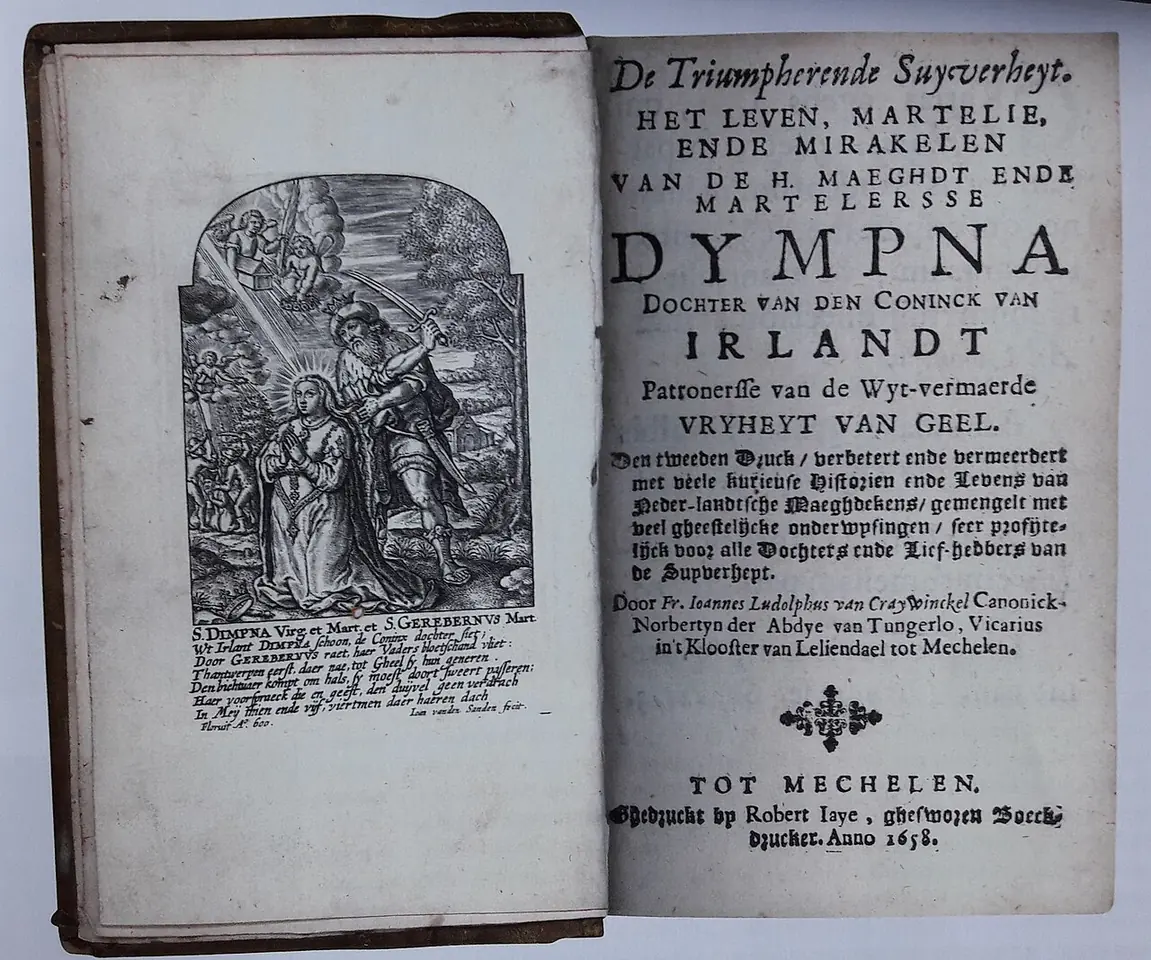
St. Dymphna's patronage comes from Geel, not from anything in her life. Her legend, written in the 1200s, makes her the daughter of a pagan Irish king who fled to Geel and was killed there by her father after his mind gave way in grief. That story is traditional, and the Catholic Encyclopedia found no historical basis for it. The 1916 English edition of the Roman Martyrology keeps her on May 15: "In Brabant, St. Dympna, virgin and martyr, daughter of an Irish king. By order of her father, she was beheaded for the faith of Christ and the preservation of her virginity."
What is not legend is what happened at her grave. People with mental illness were brought there to pray for healing, and many stayed. When the rooms by the church filled up, according to the historian Mike Jay, the overflow was lodged with families in town. Some were never cured, and their families went home without them. The people of Geel, most of them farmers, took them in as boarders. That custom of family care grew into one of the oldest systems of community mental health care in the world, supervised by the Belgian state from 1850 and still running today through the town's public psychiatric center.
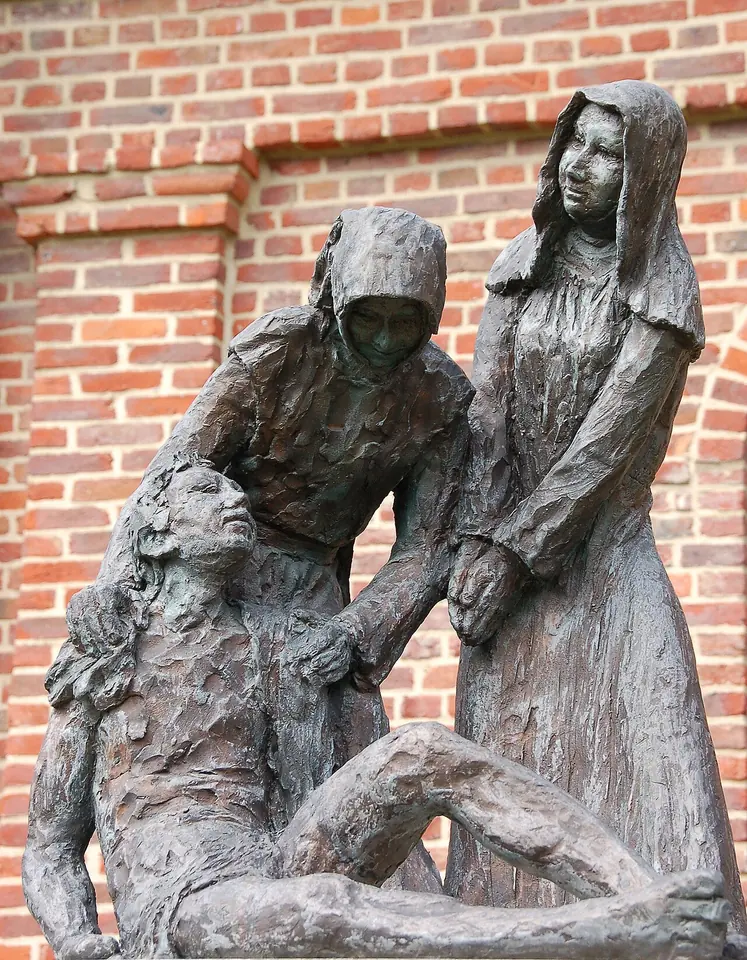
The 1872 book that preserves our prayer put it simply: "To this day the Church of St. Dympna is the resource of the insane; and the treatment of those bereft of reason, at Gheel, has made it a source of wonder throughout the world."

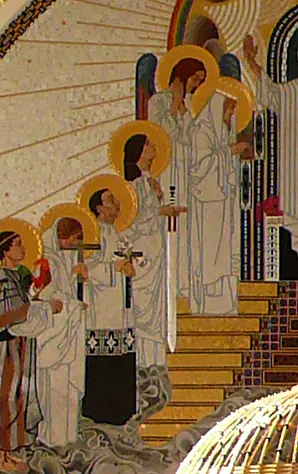
Her patronage traveled with that reputation. When Otto Wagner's Church of St. Leopold opened in 1907 at the Steinhof psychiatric hospital in Vienna, St. Dymphna was given a place among the saints in the mosaic behind its high altar.
For those who are suffering
If you are the one who is struggling, please hear this first: you are not weak, you are not being punished, and you are not alone. Mental illness is an illness. The Church has always treated the sick with tenderness, and the families of Geel showed what that looks like day after day, for centuries.
Praying to St. Dymphna goes hand in hand with getting care, never instead of it. Go to a doctor, a counselor, a priest, or someone you trust, and let them help. Medicine and therapy are gifts God works through. In the United States you can call or text 988, the Suicide and Crisis Lifeline, at any hour of the day or night. Outside the U.S., your local emergency number or health service can connect you with help.
If you are praying for someone else, know that Geel was built on people like you. Caregivers get tired and discouraged; we ask St. Dymphna to pray for them too. Light a candle, say her name, and keep showing up.
A simple way to pray in a hard moment
When a long prayer is too much, the faithful have always fallen back on a few words. Hold the person in your heart and say:
St. Dymphna, pray for us.
Then, if you can, the Our Father, and the old Antwerp prayer: "that we may be helped by her merits and prayers."
St. Dymphna and related saints
Her life, her relics in Geel and her symbols in art are in her own entry: St. Dymphna. We also ask the prayers of St. John of God, who founded hospitals for the sick after his own breakdown, and St. Raphael the Archangel, whose name means "God heals," in the St. Raphael prayer. For trust in God when worry won't let go, many find help in the Surrender Novena. Her feast, May 15, is on our feast day calendar.
St. Dymphna, pray for us.
Frequently asked questions
What is the prayer to St. Dymphna?
The traditional one printed in an 1872 book of saints' lives is short: "Oh God! thou lover of purity, grant that we who invoke the intercession of Thy holy martyr Dympna, may obtain the assistance of her merits and suffrages through Christ our Lord. Amen." The same prayer appears in Flemish in a 19th-century litany leaflet from Antwerp. Many people also simply say, "St. Dymphna, pray for us."
Is there a St. Dymphna prayer for anxiety and depression?
The old prayers ask her help for those who have lost their reason or suffer "nervous" illness, which covers what we now call anxiety and depression. Pray the traditional prayer on this page and name the person and the struggle. Asking her prayers goes together with getting care: in the U.S. you can call or text 988 at any hour.
How do you pray a St. Dymphna novena?
Pray once a day for nine days for the same person or need: the traditional prayer, an Our Father, Hail Mary and Glory Be, and the invocation "St. Dymphna, pray for us." The National Shrine of St. Dymphna in Massillon, Ohio, also publishes a nine-day novena with a virtue for each day and prays it every weekday.
Why is St. Dymphna the patron saint of mental illness?
Because of Geel, the Belgian town where her relics rest. From the Middle Ages families brought relatives with mental illness to her shrine to make a novena, and those who stayed were taken in by local families. That custom of family care still exists in Geel today.
When is St. Dymphna's feast day?
May 15. The Roman Martyrology of 1916 lists her on that day: "In Brabant, St. Dympna, virgin and martyr, daughter of an Irish king." It is the day kept at Geel and in most prayer books.
Can I pray to St. Dymphna for someone else?
Yes, and most people do: parents for a child, spouses for each other, friends and caregivers for the people they love. The Geel novenas were nearly always made by families on behalf of a sick relative.
Sources
- The Life of Saint Margaret, with lives of Saint Cecilia, Saint Catherine, Saint Agnes, Saint Angela, Saint Elizabeth, Saint Dympna, and Saint Wenefride (New York: J. A. McGee, 1872), Internet Archive. Source of the English prayer
- Litanie van de heilige Dymphna van Geel, devotional leaflet, Antwerp: J. B. de Beer, 1836–1862, MAS Antwerp collection (DAMS). Source of the Flemish prayers and litany translated here
- Mrs. William Pitt Byrne, Gheel: The City of the Simple (London: Chapman and Hall, 1869), Internet Archive
- The Roman Martyrology (Baltimore, 1916), May 15, Internet Archive
- Joseph Hilgers, "Novena," Catholic Encyclopedia (1911)
- National Shrine of St. Dymphna: Novena booklet (Litany and Novena in Honor of St. Dymphna)
- Mike Jay, Geel: where the mentally ill are welcomed home (Aeon, 2014)
- 988 Suicide and Crisis Lifeline