St. Raphael the Archangel
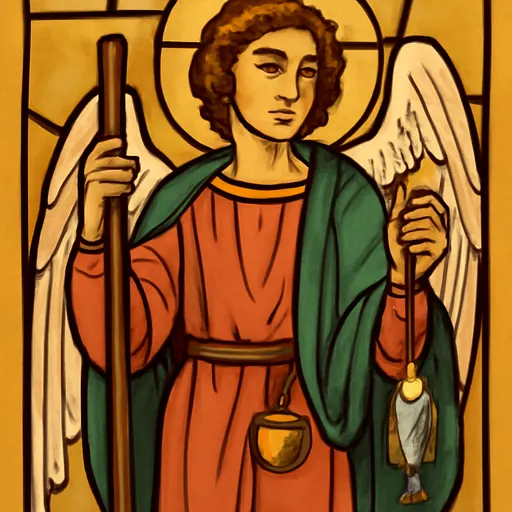
St. Raphael the Archangel is one of the three angels named in the Bible. In the Book of Tobit he travels in human disguise with young Tobias, drives away a demon, and heals the blindness of Tobias's father, then reveals himself as "Raphael, one of the seven holy angels." His name means "God heals," and he is the patron of travelers, the sick, the blind and those who care for them. His feast day is September 29, shared with Sts. Michael and Gabriel.
Who is St. Raphael the Archangel?
Raphael is an archangel, one of the three angels the Bible calls by name. The other two are St. Michael and St. Gabriel. Michael fights, Gabriel announces, and Raphael heals. His whole story is told in one book, the Book of Tobit, where he spends most of the narrative disguised as a young man named Azarias, walking beside a teenage boy on a long and dangerous errand.
His name in Hebrew means "God heals." The Catholic Encyclopedia notes that it never appears in the Hebrew Bible and, in the Greek Old Testament, only in Tobit. When he finally reveals who he is, he says he was sent by God to heal two people: the boy's blind father and a young woman tormented by a demon.
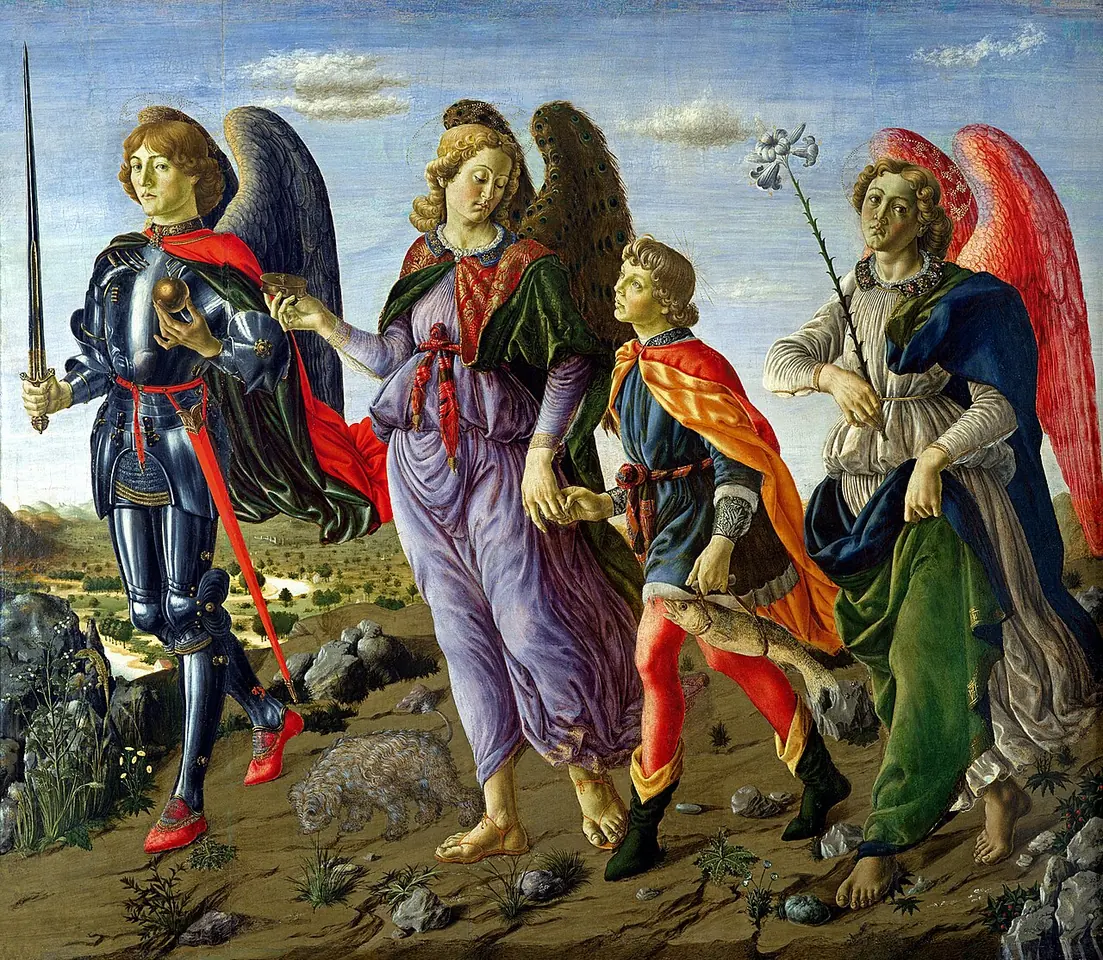

Because the angel is a guide on the road and a healer, Christians have asked his help for centuries when they travel, when they are sick, and when they care for the sick. Catholics honor him with Michael and Gabriel on September 29. The Orthodox Church honors him with all the "bodiless powers" of heaven on November 8.
The Book of Tobit
Tobit is a short book of fourteen chapters, set among the Israelites deported to Assyria in the 8th century before Christ. Catholic and Orthodox Bibles include it in the Old Testament. Jewish tradition did not keep it in the Hebrew Bible, although fragments of Tobit in Aramaic and Hebrew were found among the Dead Sea Scrolls at Qumran. Protestant Bibles leave it out or print it in a separate section of Apocrypha. The Church of England's Thirty-Nine Articles, for example, list Tobias among the books the Church reads "for example of life and instruction of manners," but not to establish doctrine.
That difference matters for this entry. For Catholic and Orthodox Christians, Raphael's story is Scripture. For most Protestants it is an edifying ancient Jewish tale. The summary below follows the Greek text, quoted from the Revised Standard Version, Catholic Edition.
Tobit and Sarah
Tobit is a devout Israelite living in Nineveh who gives alms and buries the bodies of executed countrymen, at the risk of his own life. One night, after burying a dead man, he sleeps outside by the courtyard wall, and sparrow droppings fall into his open eyes. "White films formed on my eyes," he says. "I went to physicians, but they did not help me" (Tobit 2:10). After four years of blindness, worn out, he prays to die.
On the same day, far away in Ecbatana in Media, a young woman named Sarah prays the same prayer. She has been given in marriage seven times, and each husband has been killed on the wedding night by "the evil demon Asmodeus" (Tobit 3:8). The servants mock her for it. Tobit 3 then joins the two stories: "The prayer of both was heard in the presence of the glory of the great God. And Raphael was sent to heal the two of them" (Tobit 3:16–17).
The guide named Azarias
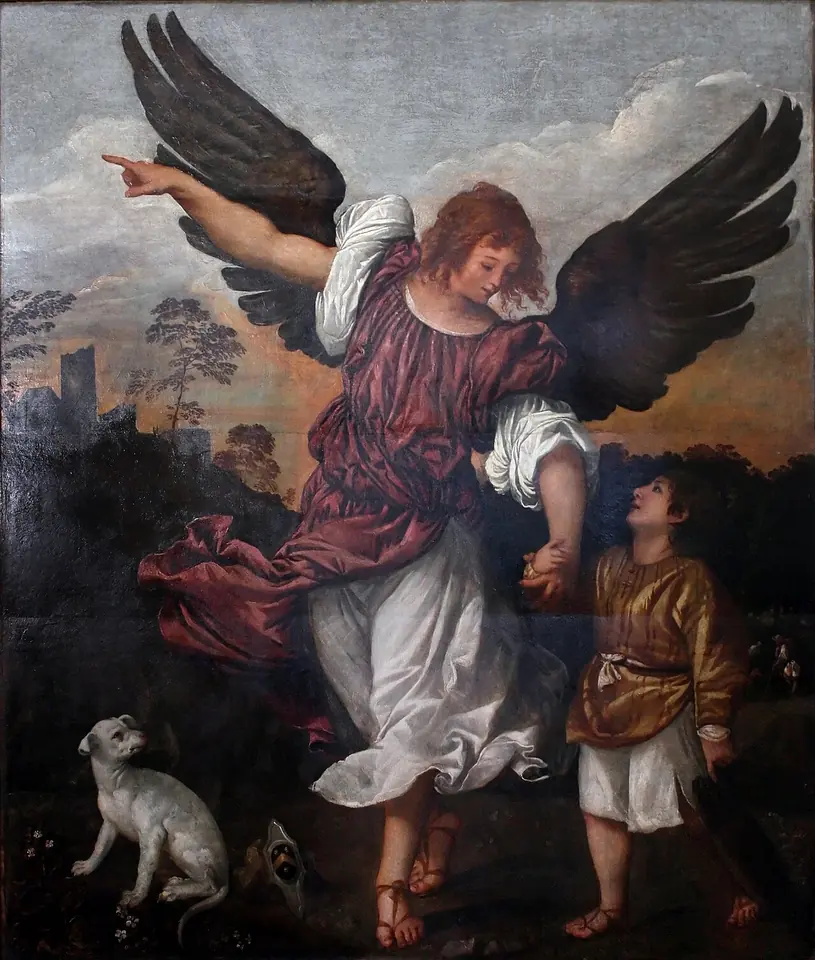
Tobit remembers that he once left a large sum of money in trust with a relative in Rages, in Media, and sends his son Tobias to collect it. Tobias needs a guide. He goes out to look for one, "and he found Raphael, who was an angel, but Tobias did not know it" (Tobit 5:4–5). The stranger says his name is Azarias, a kinsman of the family, and agrees to go for a drachma a day. Tobit sends them off with a blessing he doesn't know is literally true: "May his angel attend you." The book adds a small detail that painters loved for centuries: "the young man's dog was with them" (Tobit 5:16).

The fish in the Tigris
On the first evening the travelers camp by the Tigris. Tobias goes down to wash, and a great fish leaps out of the water "and would have swallowed the young man" (Tobit 6:2). The angel tells him to catch it, cut it open and keep the heart, liver and gall. They roast and eat the rest. When Tobias asks what the organs are for, Azarias explains that smoke from the heart and liver drives off an evil spirit, and that the gall heals white films on the eyes.

Sarah and Asmodeus
As they near Ecbatana, the angel tells Tobias that Sarah is his kinswoman and that he has the right to marry her. Tobias has heard about the seven dead husbands and is afraid. Raphael tells him to burn the fish's heart and liver on live incense ashes in the bridal chamber, and then to pray with his bride. "Do not be afraid," he says, "for she was destined for you from eternity" (Tobit 6:17).
On the wedding night Tobias does as he was told. The demon smells the smoke and flees "to the remotest parts of Egypt, and the angel bound him" (Tobit 8:3). Tobias and Sarah rise and pray together: "Grant that I may find mercy and may grow old together with her," and Sarah answers, "Amen" (Tobit 8:7–8). The Catholic Church offers this passage among the Old Testament readings for weddings.

Tobit's eyes are opened
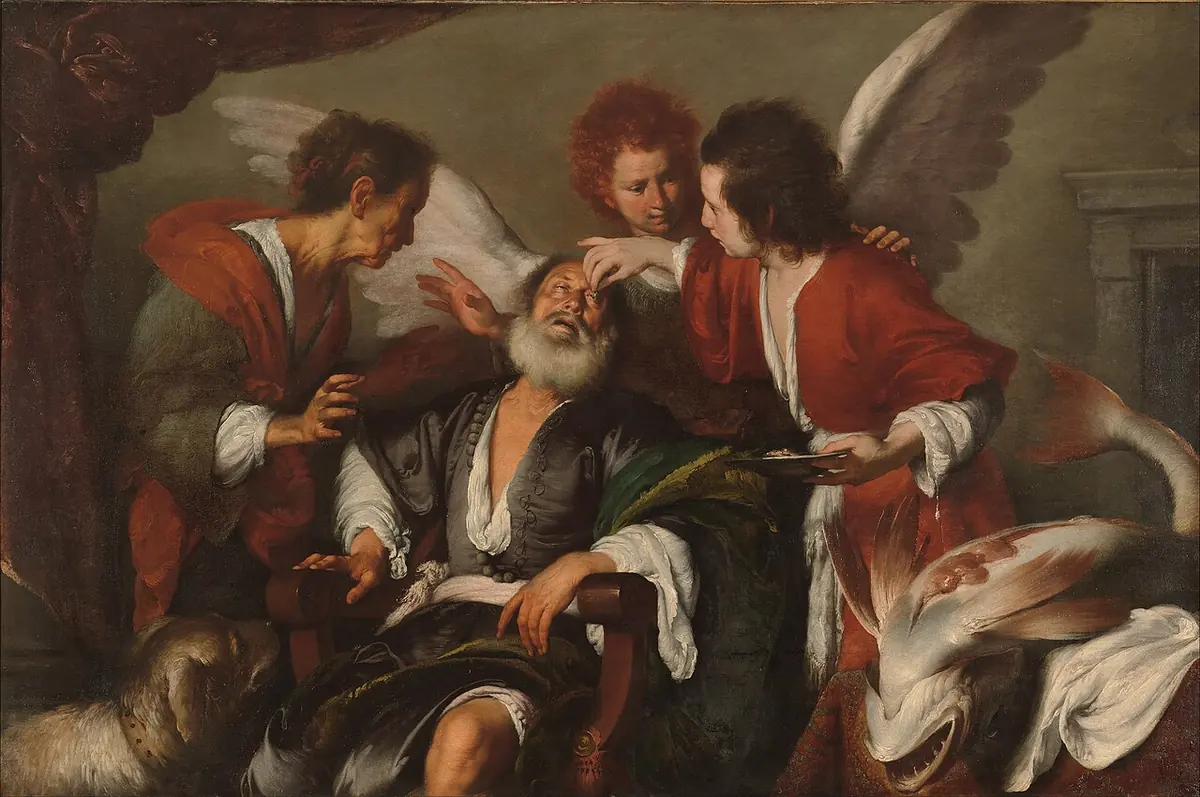
Raphael travels on to Rages to collect the money, and the party returns to Nineveh. Tobias's mother, Anna, has been watching the road every day. As they approach, Raphael tells Tobias to put the fish's gall on his father's eyes. Tobias does it; "the white films scaled off from the corners of his eyes," and Tobit sees his son and says, "Blessed art thou, O God, and blessed is thy name for ever, and blessed are all thy holy angels" (Tobit 11:13–14).

"I am Raphael"
When father and son try to pay the guide half of everything they brought back, he takes them aside. He tells them to praise God, to pray, to fast and give alms, and then he tells them who he is. When Tobit and Sarah prayed, he says, "I brought a reminder of your prayer before the Holy One." When Tobit left his dinner to bury the dead, "I was with you." Then: "I am Raphael, one of the seven holy angels who present the prayers of the saints and enter into the presence of the glory of the Holy One" (Tobit 12:12–15). The Latin Vulgate, followed by the Douay-Rheims Bible, reads "one of the seven, who stand before the Lord."
The family falls on their faces in fear. Raphael tells them not to be afraid, that he came "by the will of our God," and that they should write down everything that happened. "Then they stood up; but they saw him no more" (Tobit 12:18–21).


Raphael and the pool of Bethesda
The Gospel of John tells of a pool in Jerusalem "having five porches," where the sick lay waiting. In the Latin Vulgate and the Douay-Rheims, John 5:4 explains why: "an angel of the Lord descended at certain times into the pond; and the water was moved. And he that went down first into the pond after the motion of the water, was made whole, of whatsoever infirmity he lay under." Jesus then heals a man who had been ill for thirty-eight years.
The angel isn't named. The Catholic Encyclopedia says that many commentators identified him with Raphael because of his name and his healing work in Tobit, and that the old liturgy confirmed it: the Mass of St. Raphael on October 24 used Tobit 12 as its first reading and John 5:1–4 as its Gospel. Many of the oldest Greek manuscripts of John lack verse 4, so most modern Bibles print it only in a footnote. The link between Raphael and Bethesda is traditional, not something the Gospel states.
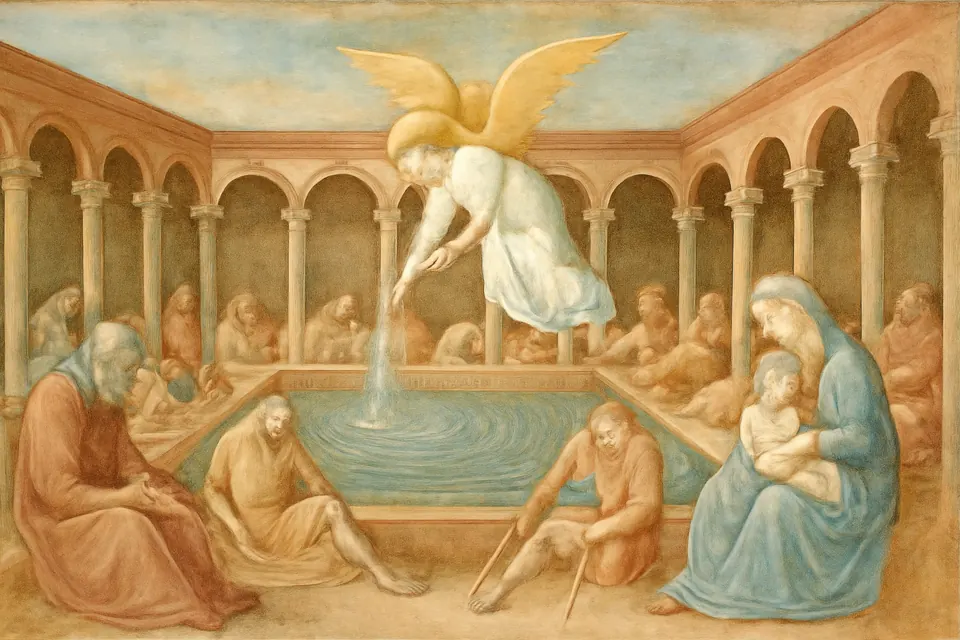
Healings and miracles of St. Raphael
Raphael's miracles are not like those of a saint who once lived on earth, and none could be approved in the sense used for canonizations. Sorted by the labels this encyclopedia uses:
- The healing of Tobit's blindness and the freeing of Sarah: in Scripture for Catholic and Orthodox Christians, who read Tobit as an inspired book. Many modern Catholic scholars read Tobit as a religious story rather than a historical chronicle, and the Church has not settled that question.
- The angel of the pool of Bethesda: traditional identification, as described above.
- Appearances in Córdoba in 1578: traditional, a local devotion described below.
- Help to St. John of God in his hospital in Granada: traditional. EWTN's life of the saint says his heavy work among the sick was "lightened at times by St. Raphael in person."
- Healings and safe journeys through Raphael's prayers: reported, in the testimonies of devotees, not examined by the Church.
Why St. Raphael is the patron saint of travelers, the sick and the blind
Each of his patronages comes straight from the Book of Tobit. See all of them on our patron saints page.
- Travelers: he guided Tobias to Media and back, and the Raccolta's prayers for emigrants ask him to be "a safe guide and an Angel of consolation" to people who must go to foreign lands. He shares this patronage with St. Christopher.
- The sick, physicians and nurses: his name means "God heals," and he told Tobit that God sent him to heal. The Brothers Hospitallers of St. John of God and many Catholic hospitals carry his name for the same reason, as do the doctor saints Cosmas and Damian and St. Luke in their own way.
- The blind and eye diseases: for the cure of Tobit's white films, which Tobit's physicians could not cure. St. Lucy is the other great patron of the blind.
- Happy meetings and those looking for a spouse: because he brought Tobias to Sarah and told him she had been destined for him from eternity. Catholics pray to him before a wedding and when looking for a husband or wife.
- Córdoba, Spain: for the reasons told below.
Symbols of St. Raphael in art
Painters had to show an angel who looked like an ordinary traveler, and they settled on a few clear signs. To tell Raphael from Michael and Gabriel, look for these:
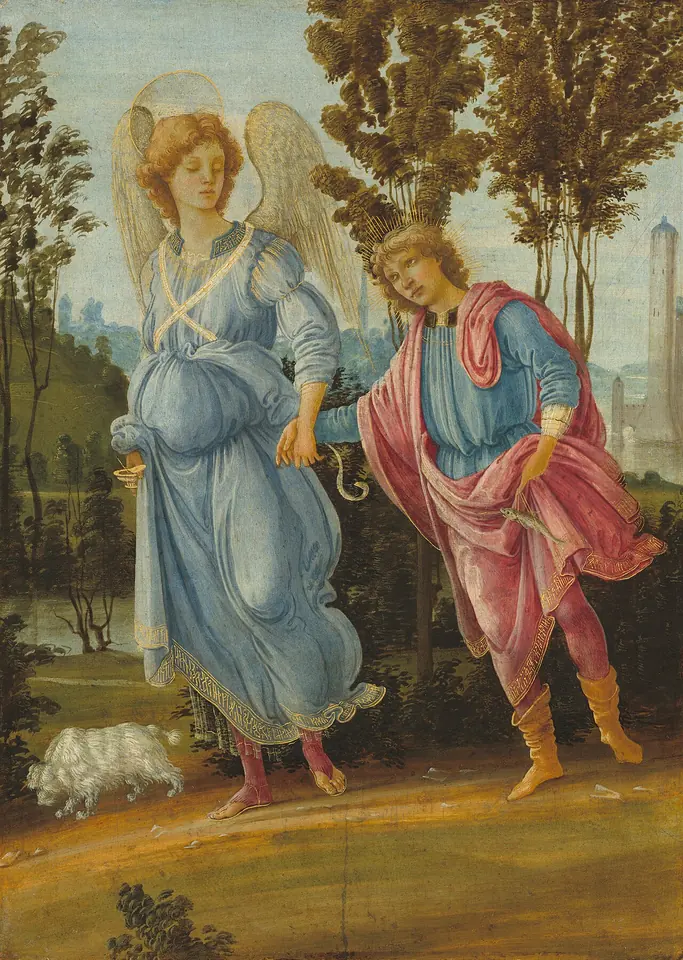
- Young Tobias at his side: Raphael is the only archangel regularly shown walking with a boy, usually holding his hand.
- A fish: carried by Tobias or held by Raphael, sometimes on a string. It is the fish of the Tigris.
- A small box or jar: the medicine made from the fish's gall, which Raphael often holds in his free hand.
- A pilgrim's staff, sandals and a gourd: the gear of a traveler, especially in Spanish and Baroque art.
- A dog: the family dog of Tobit 5:16 and 11:4, trotting at their feet in Italian paintings.
Italian painters, especially in Florence, made "Tobias and the angel" a favorite subject in the 15th century, and the young traveler is often dressed as a well-off Florentine of the day. The Verrocchio workshop panel in London is the best known.
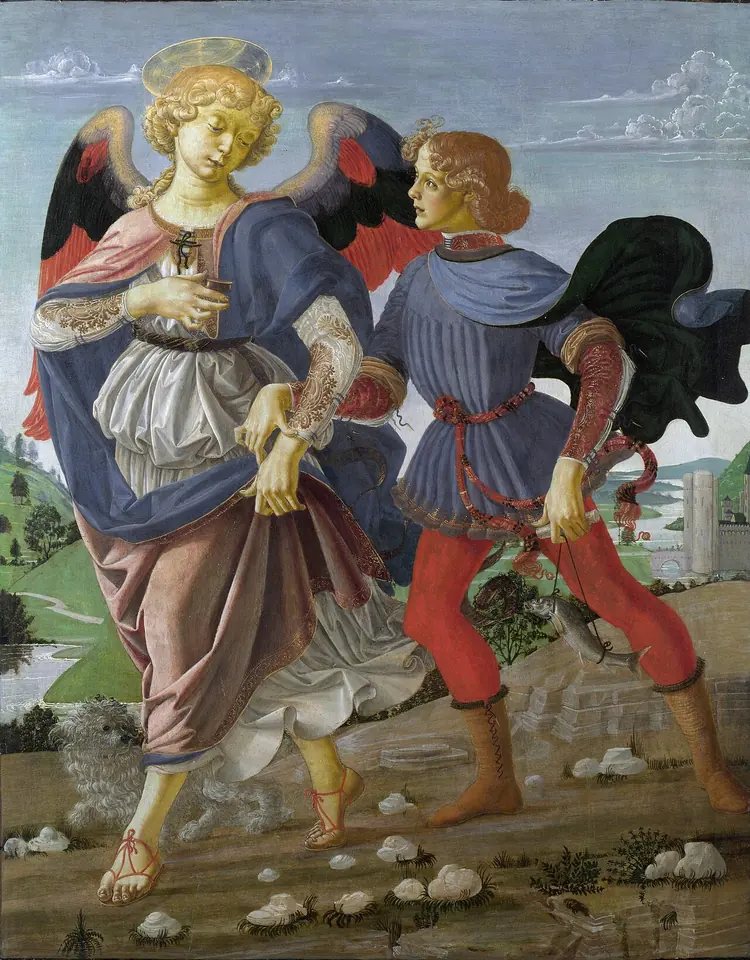

When Raphael appears with Michael and Gabriel, as in Botticini's panel near the top of the page, Michael wears armor and a sword, Gabriel carries a lily, and Raphael walks with Tobias. Rembrandt and his pupils drew and painted the Tobit story again and again, especially the healing of Tobit's eyes and the angel's departure.

Eastern icons show Raphael with a different set of clues. The Orthodox Church in America describes the standard image: Raphael "holds a vessel with healing medications in his left hand, and with his right hand leads Tobias, carrying a fish for healing." He usually wears the court dress of a Byzantine official, with a staff, and his name is written beside him. In icons of the Synaxis, the gathering of the archangels, he stands with Michael, Gabriel and the others around an image of Christ.


Feast day of St. Raphael
The Catholic Church celebrates September 29 as the Feast of Sts. Michael, Gabriel and Raphael, Archangels. Raphael's own feast on October 24 was kept in many places before it entered the General Roman Calendar in 1921, under Pope Benedict XV. The 1969 reform joined the feasts of Gabriel and Raphael to Michael's on September 29, according to Franciscan Media. Communities that use the traditional Latin calendar still keep October 24. See the feast days calendar.
The Orthodox Church honors him at the Synaxis of the Archangel Michael and the Other Bodiless Powers on November 8 (November 21 on the civil calendar for churches that follow the Julian calendar). The Orthodox Church in America explains the date: November is the ninth month counting from March, for the nine ranks of angels, and the eighth day recalls the "Eighth Day" of the Last Judgment. Its list of archangels names Raphael as "the healing of God, the curer of human infirmities."
Names of the angels
Only three angels have names in the Bible, and the Church has long been cautious about any others. The Vatican's Directory on Popular Piety and the Liturgy (2001) says that devotion to the angels is "legitimate and good," but that "the practice of assigning names to the Holy Angels should be discouraged, except in the cases of Gabriel, Raphael and Michael whose names are contained in Holy Scripture." The Orthodox Church, following other ancient traditions, also honors Uriel, Selaphiel, Jehudiel, Barachiel and Jeremiel.
Córdoba and other places named for Raphael
The guardian of Córdoba
The Andalusian city of Córdoba calls Raphael its custodio, its guardian. According to local tradition, a priest named Andrés de las Roelas saw the archangel several times in the 1570s. In the last appearance, in 1578, the angel told him, "I swear to you by Jesus Christ Crucified, that I am Rafael, whom God has appointed as the guardian of this city." The words of this oath appear on images of the archangel all over Córdoba, and the city later built the Church of the Oath of San Rafael in his honor. The story is traditional.
Córdoba keeps October 24 as a city holiday for its patron. Families go up into the hills of the Sierra for a perol, a rice dish cooked outdoors, and the mayor presents his staff of office to the image of the saint in his church.
The city is also full of triunfos, tall columns topped by statues of the archangel. The largest, the Triumph of San Rafael beside the cathedral, was carved in the 18th century by the French sculptor Michel de Verdiguier on the site of a medieval plague hospital and cemetery.


Elsewhere
The Spanish mission system in California named Mission San Rafael Arcángel (1817), north of San Francisco, for the healing angel; it began as an asistencia, a branch of Mission San Francisco de Asís, where sick mission Indians were sent to recover. The Cathedral of St. Raphael in Dubuque, Iowa, is the mother church of one of the oldest Catholic dioceses west of the Mississippi. Countless hospitals and parishes around the world are named St. Raphael's.
St. Raphael prayer
Catholics ask St. Raphael to pray for them before a journey, during illness, before surgery, for people who are blind or losing their sight, and when they are hoping to marry. The prayers below have a printed source. Many other St. Raphael prayers circulate on holy cards and websites; Catholic Culture's version of a popular one is marked as taken from "various holy cards," with no known author.
Collect from the Roman Missal
This prayer from the old Roman Missal is printed in the Raccolta, the Holy See's collection of indulgenced prayers (English edition, 1943, no. 414):
Vouchsafe, O Lord God, to send unto our assistance Saint Raphael the Archangel: and may he, who, we believe, evermore standeth before the throne of Thy Majesty, offer unto Thee our humble petitions to be blessed by Thee. Through Christ our Lord. Amen.
Prayer for travelers and emigrants
The Raccolta (no. 619) gives three prayers to St. Raphael for people who must emigrate, approved in 1910. The first begins:
O Raphael the Archangel, thou wast a faithful companion to the young man, Tobias, on his long journey from Syria to Media, rescuing him from many dangers and, in particular, from the danger of death in the river Tigris; we beseech thee with all our hearts to be a safe guide and an Angel of consolation to our dear ones on the long journey which they must undertake in order to remove to foreign lands; do thou keep them far from all dangers of body and soul, and grant that they may come in safety to the haven of their desire.
The set ends with a versicle and a collect:
Pray for us, Saint Raphael the Archangel, that we may be made worthy of the promises of Christ.
Let us pray. O God, who didst give Thy blessed Archangel Raphael unto Thy servant Tobias to be his fellow-traveler; grant unto us, Thy servants, that the same may ever keep us and shield us, help us and defend us. Through Christ our Lord. Amen.
A short invocation and a novena
A family prayer in the Raccolta (no. 657) asks each archangel for a different gift. Its line for Raphael is: "Saint Raphael, keep us free from all sickness and from every danger to our lives." The same collection (no. 413) describes a St. Raphael novena: any devotions in his honor said for nine days in a row, at any time of year, which Pope Pius IX enriched with indulgences in 1849.
Tobias's own prayer on his wedding night (Tobit 8:5–8) is also used by engaged and married Catholic couples, often with a request for Raphael's help.
Frequently asked questions
What is the Archangel Raphael the patron saint of?
Travelers, the sick, the blind, physicians and nurses, all from his role in the Book of Tobit, where he guides Tobias on a long journey and heals Tobit's eyes. Because he led Tobias to his wife Sarah, Catholics also ask his help in finding a spouse and call him the patron of happy meetings. He is the patron of the city of Córdoba in Spain.
When is St. Raphael's feast day?
September 29, the Feast of Sts. Michael, Gabriel and Raphael, Archangels, in the Catholic Church's General Roman Calendar. Before the 1969 calendar reform he had his own feast on October 24, which the traditional Latin Mass still keeps. The Orthodox Church honors him with all the archangels on November 8.
Where is Raphael in the Bible?
Only in the Book of Tobit, which is part of the Old Testament in Catholic and Orthodox Bibles. Protestant Bibles leave Tobit out or print it among the Apocrypha, so most Protestants do not read Raphael's story as Scripture. Many Catholic commentators also connect him with the unnamed angel who stirred the healing pool of Bethesda in John 5.
What does the name Raphael mean?
It means "God heals" or "God has healed," from the Hebrew rapha, to heal. The name fits his work in Tobit, where he says God sent him to heal Tobit and Sarah.
Is there a prayer to St. Raphael?
Yes. The Roman Missal had a collect asking God to send St. Raphael to our assistance, and the Raccolta, the Holy See's collection of indulgenced prayers, includes a novena to him and prayers for emigrants that recall his journey with Tobias. Both are quoted on this page.
Why is St. Raphael shown with a fish?
In Tobit 6, a large fish leaps out of the Tigris River at Tobias, and Raphael tells him to catch it and keep its heart, liver and gall. The heart and liver drive off the demon Asmodeus, and the gall heals Tobit's blindness. The fish became Raphael's most common attribute.
Are there seven archangels?
Raphael calls himself "one of the seven holy angels" in Tobit 12:15, and Revelation 8:2 mentions "the seven angels who stand before God." Only Michael, Gabriel and Raphael are named in the Bible. The Church's Directory on Popular Piety discourages using other angels' names; the Orthodox Church honors seven or eight archangels by name.
Sources
- Catholic Encyclopedia (1911): St. Raphael
- Catholic Encyclopedia (1907): Angels
- Book of Tobit, Revised Standard Version Catholic Edition (Bible Gateway)
- John 5:1-4, Douay-Rheims (Bible Gateway)
- Directory on Popular Piety and the Liturgy (2001), nos. 215–217
- Franciscan Media: Saints Michael, Gabriel, and Raphael
- Orthodox Church in America: Lives of all saints commemorated on November 8 (Synaxis of the Archangels)
- Artencordoba: Church of the Oath of San Rafael
- EWTN: St. John of God
- The Raccolta: Prayers and Devotions Enriched with Indulgences, English edition by J. P. Christopher and C. E. Spence (Benziger, 1943), nos. 413–414, 619 and 657
- Thirty-Nine Articles of the Church of England, Article VI