St. Gertrude prayer
The St. Gertrude prayer is a short offering for the souls in Purgatory: "Eternal Father, I offer Thee the Most Precious Blood of Thy Divine Son, Jesus..." It carries the name of St. Gertrude the Great (1256 to about 1302), but it is not in her writings. The earliest printing we could find is from 1936, and the promise that it frees 1,000 souls each time was never approved by the Church.
Few prayers travel as far on holy cards as this one. It is short enough to learn in a day, it asks for something every grieving Catholic wants, and it comes with a saint's name and a remarkable promise attached. The text is below, followed by what can actually be traced about where it came from.
The St. Gertrude prayer
This is the version most often printed today, as it appears on the Knights of Columbus prayer card for the holy souls:
Eternal Father, I offer Thee the Most Precious Blood of Thy Divine Son, Jesus, in union with the Masses said throughout the world today, for all the holy souls in Purgatory, for sinners everywhere, for sinners in the universal Church, those in my own home and within my family. Amen.
The earliest version we could find (1936)
The oldest printing we were able to locate is shorter. It appears in Read Me or Rue It, a booklet on Purgatory by the Irish Dominican Fr. Paul O'Sullivan, which the Cardinal Patriarch of Lisbon approved on March 4, 1936:
Eternal Father, I offer Thee the most Precious Blood of Jesus, with all the Masses being said all over the world this day, for the Souls in Purgatory.
Fr. O'Sullivan adds one sentence about it: "Our Lord showed St. Gertrude a vast number of souls leaving Purgatory and going to Heaven as a result of this prayer, which the Saint was accustomed to say frequently during the day." He gives no source for that story, and he says nothing about a number of souls.

Where the St. Gertrude prayer comes from
Not from her writings
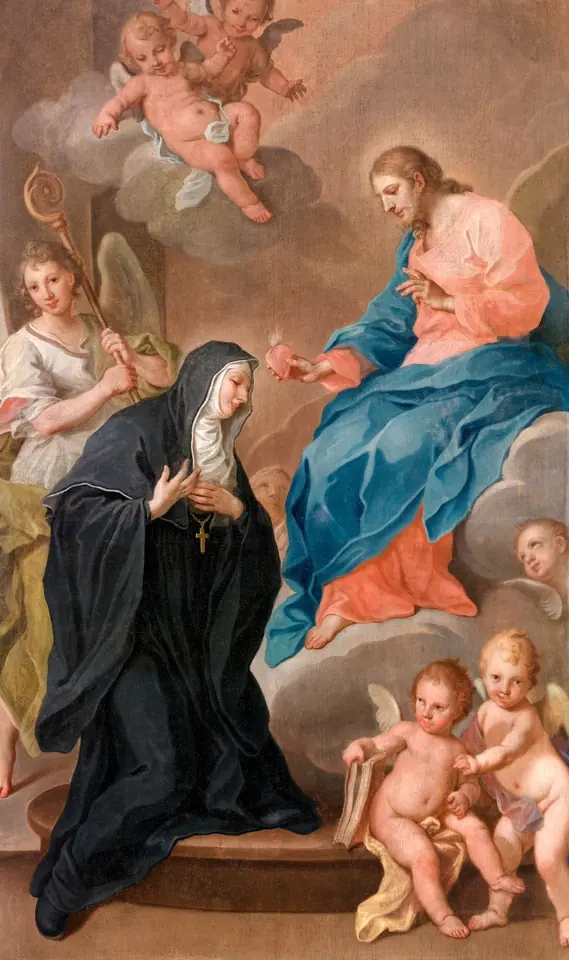
St. Gertrude the Great was a Benedictine nun at Helfta in Saxony, born on January 6, 1256, and dead by about 1302. Her surviving works are the Herald of Divine Love (Legatus divinae pietatis), in five books, of which she wrote Book II herself, and the Spiritual Exercises. Neither contains this prayer. It is also absent from the 1865 English translation of the Herald, The Life and Revelations of Saint Gertrude, a book of more than 500 pages. Fr. John Zuhlsdorf, answering a reader in 2016, said it plainly: "St Gertrude never wrote any such thing." Fr. Horton, writing on his blog Cogitans Clare in 2017, said the prayer is "not found anywhere in her extant writings" and suggested it belongs to the wave of similar devotions that spread at the end of the 19th century.
A family of Precious Blood offerings
The words themselves follow a well-known pattern. Since at least 1817, when Pius VII indulgenced them, Catholics had prayed the "Seven Offerings of the Precious Blood," each beginning "Eternal Father! I offer thee the merit of the precious blood of Jesus." The seventh asks help "in aid of the holy souls in purgatory." The 1878 English Raccolta, the official collection of indulgenced prayers, prints all seven. The St. Gertrude prayer reads like a short cousin of that devotion, joined to the old practice of uniting one's prayer with every Mass being offered in the world.


The prayer grows
Between 1936 and today the prayer gained a second half. The phrases "for sinners everywhere, for sinners in the universal Church, those in my own home and within my family" are not in O'Sullivan's text. We could not find when they were added, or when cards began to say that each recitation frees 1,000 souls.
Old cards also carry a puzzling approval line, often printed as "M. Cardinal Pahiarca, Lisbon, March 4, 1936." No such cardinal existed. Our Lady of the Rosary Library, which published one of these cards, corrected it in 2012 after learning that the line was a garbled copy of the approval in Read Me or Rue It, given by Manuel Gonçalves Cerejeira, Cardinal Patriarch of Lisbon. "Pahiarca" is very likely a misreading of "Patriarch."
The promise of 1,000 souls
The popular cards say that Christ promised St. Gertrude that 1,000 souls would be released from Purgatory each time the prayer is said with love. The Church never approved this promise. It is not in Gertrude's writings, it is not in the 1936 text, and it runs against a ruling of the Holy See.
In 1899 the Sacred Congregation of Indulgences issued rules for spotting false indulgences, and Leo XIII approved them in an audience on August 10, 1899. Rule VIII reads, in the Latin of the Acta Sanctae Sedis:
Ut commentata reiicienda sunt folia et libelli, in quibus promittitur fidelibus unam alteramve precem recitantibus liberatio unius vel plurium animarum a Purgatorio.
In plain English, leaflets and booklets that promise the faithful the release of one or more souls from Purgatory for reciting a prayer or two are to be rejected as fabrications. The congregation added that indulgences attached to such promises are apocryphal. The rule was written decades before this prayer was printed, but it describes the 1,000-souls claim exactly.
None of this makes the prayer wrong. Catholic teaching holds that the prayers of the living, and above all the Mass, help the souls being purified after death, and the prayer asks for exactly that. Fr. Zuhlsdorf put it this way: rejecting the number "doesn't mean that the prayer is a bad prayer." Catholics who love it can keep saying it. They should simply not count souls.

What St. Gertrude really taught about the dead
Gertrude does not need a borrowed prayer to be the friend of the souls in Purgatory. The Catholic Encyclopedia speaks of her "tender sympathy towards the souls in purgatory," and the Herald is full of it.
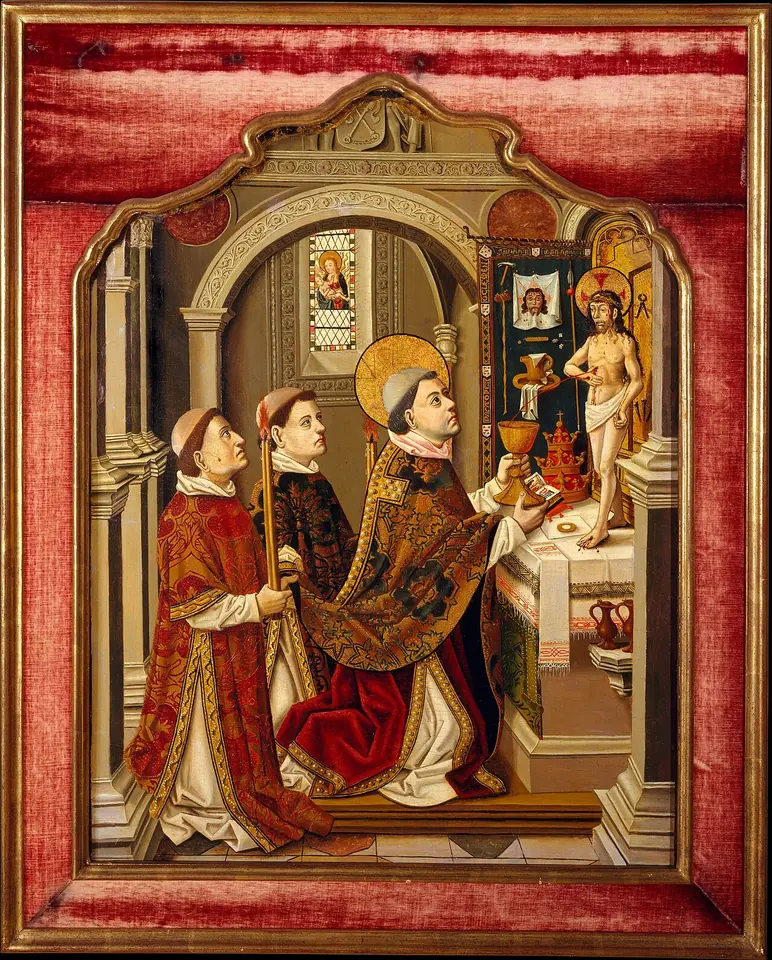
In one vision in Part IV of the 1865 translation, on a Wednesday in the days before the Ascension, she prayed at the elevation of the Host for the souls in Purgatory and "beheld our Lord descending into purgatory with a golden rod in His Hand, which had as many hooks as there had been prayers for their souls." She understood that whenever anyone prays out of charity for the souls in Purgatory, many of them are released. In another passage she offered Holy Communion for them and was told that when Christ comes to a soul in the Sacrament, "all who are in heaven, on earth, or in purgatory, receive immense benefits thereby."

A later story, told in a footnote of the same translation and not found in the Herald, says she gave away all her merits for the holy souls, and that at her death Christ promised to remit her own Purgatory. It is traditional. O'Sullivan's booklet retells it too.
A prayer for the dead from the Herald
Part V of the Herald, chapter 18, describes the "Great Psalter," a devotion for the dead that Gertrude's community prayed: the 150 Psalms, each followed by "Eternal rest give to them, O Lord, and let perpetual light shine upon them," together with Masses or Communions, alms and acts of kindness. The 1865 translation adds the prayers that go with it. This is the second, in Sister M. Frances Clare's words:
O most sweet Lord Jesus Christ, I adore Thee and bless Thee, giving thanks to Thee for Thy love in redeeming us by Thy cruel sufferings, and because Thou, the Creator of the universe, wert taken prisoner, bound, betrayed, defamed, cast upon the ground, scourged, crowned with thorns, condemned, crucified, slain cruelly, and transfixed with a lance, for love of us. I offer Thee my petitions in union with the love with which Thou didst bear these outrages and indignities; beseeching Thee, by the merit of Thy most holy Passion and Death, to pardon the sins of those for whom I pray, whether they have offended against Thee by thought, word, or deed; and I implore Thee to offer to God the Father all Thy pains and griefs of body and soul, and the merit of each pain, for those who are still indebted to Thy justice.
The Herald also says that when Gertrude asked whether a shorter form would do for people who could not manage the whole Psalter, she was told that Communions could stand in for the Masses, and a Lord's Prayer with an act of charity for each alms.


Benedict XVI, in his 2010 audience on Gertrude, quoted a prayer from the last of her Exercises, the preparation for death: "O Jesus, you who are immensely dear to me, be with me always, so that my heart may stay with you and that your love may endure with me with no possibility of division." Those are certainly her words.
How Catholics pray the St. Gertrude prayer
There are no rules. Most people say it once a day, some many times a day as O'Sullivan suggested, often at Mass after the consecration, at the end of a rosary, or when passing a cemetery. Some pray it with the name of someone who has died in mind. In November, the month of the holy souls, parishes often print it in the bulletin, and many Catholics say it on All Souls' Day and on St. Gertrude's feast, November 16.
Catholics who want to gain an indulgence for the dead use the ones the Church actually grants. The current Enchiridion of Indulgences gives a partial indulgence for praying the Requiem aeternam (Eternal Rest), and a plenary indulgence, applicable only to the souls in Purgatory, for visiting a cemetery and praying for the dead on any day from November 1 to 8. The texts of those prayers, with Psalm 130 and prayers for parents and spouses, are on our page of prayers for the dead.


Related saints and prayers
- St. Gregory the Great, whose name is attached to the "Gregorian Masses," thirty Masses offered on consecutive days for one soul.
- St. Nicholas of Tolentino, invoked as a patron of the souls in Purgatory.
- St. Catherine of Genoa, whose Treatise on Purgatory describes it as a fire of love.
- St. Margaret Mary Alacoque, who carried Gertrude's devotion to the Sacred Heart into the modern Church.


Frequently asked questions
Does the St. Gertrude prayer really release 1,000 souls from Purgatory?
No such promise has any approved basis. It is not in St. Gertrude's writings, and it is not in the earliest printed version of the prayer (1936). In 1899 the Holy See's Congregation of Indulgences, with the approval of Leo XIII, ruled that leaflets promising the release of one or more souls from Purgatory for saying a particular prayer were to be rejected as fabricated. The prayer itself is a good prayer for the dead; only the number is false.
Did St. Gertrude the Great write the St. Gertrude prayer?
There is no evidence that she did. The prayer does not appear in her Herald of Divine Love or her Spiritual Exercises. The earliest printing we found, in Fr. Paul O'Sullivan's booklet Read Me or Rue It (approved in Lisbon in 1936), links it to her only through a story that she saw many souls leave Purgatory because of it.
What are the words of the St. Gertrude prayer?
"Eternal Father, I offer Thee the Most Precious Blood of Thy Divine Son, Jesus, in union with the Masses said throughout the world today, for all the holy souls in Purgatory, for sinners everywhere, for sinners in the universal Church, those in my own home and within my family. Amen." The 1936 version is shorter and mentions only the souls in Purgatory.
Is the St. Gertrude prayer indulgenced?
The prayer itself has no indulgence of its own. Catholics who want an indulgence for the dead can use the ones the Church does grant, such as praying the Eternal Rest prayer (partial) or visiting a cemetery and praying for the dead from November 1 to 8 (plenary, under the usual conditions).
When should I pray the St. Gertrude prayer?
Any time. Many Catholics say it daily, often at Mass or during the rosary, and especially in November, the month the Church sets aside for the dead, on All Souls' Day (November 2) and on St. Gertrude's feast (November 16).
Who was St. Gertrude the Great?
A German Benedictine nun of the monastery of Helfta in Saxony, born in 1256 and died about 1302. She was a mystic, an early teacher of devotion to the Sacred Heart, and the author of the Herald of Divine Love and the Spiritual Exercises. She prayed constantly for the dead, which is why the prayer carries her name.
Sources
- Paul O'Sullivan, O.P., Read Me or Rue It (approved Lisbon, March 4, 1936), Internet Archive
- Acta Sanctae Sedis 32 (1899-1900), Sacred Congregation of Indulgences, rules on apocryphal indulgences, Rule VIII, p. 243
- The Life and Revelations of Saint Gertrude, translated by Sister M. Frances Clare, Poor Clares of Kenmare (Burns & Oates, 1870 edition)
- Benedict XVI, General Audience of 6 October 2010: Saint Gertrude the Great
- Catholic Encyclopedia (1909): St. Gertrude the Great
- Fr. John Zuhlsdorf, ASK FATHER: Does the St. Gertrude Prayer release 1000 souls from Purgatory? (2016)
- Cogitans Clare: St. Gertrude and Purgatory (2017)
- Our Lady of the Rosary Library: Prayer of St. Gertrude the Great (card and 2012 correction note)
- Knights of Columbus: Prayer for the Holy Souls in Purgatory (prayer card)
- The Raccolta, or Collection of Prayers and Good Works (1878 English edition), Seven Offerings of the Precious Blood
- CatholicCulture.org: Praying for the Dead and Gaining Indulgences During November