Prayer for the dead
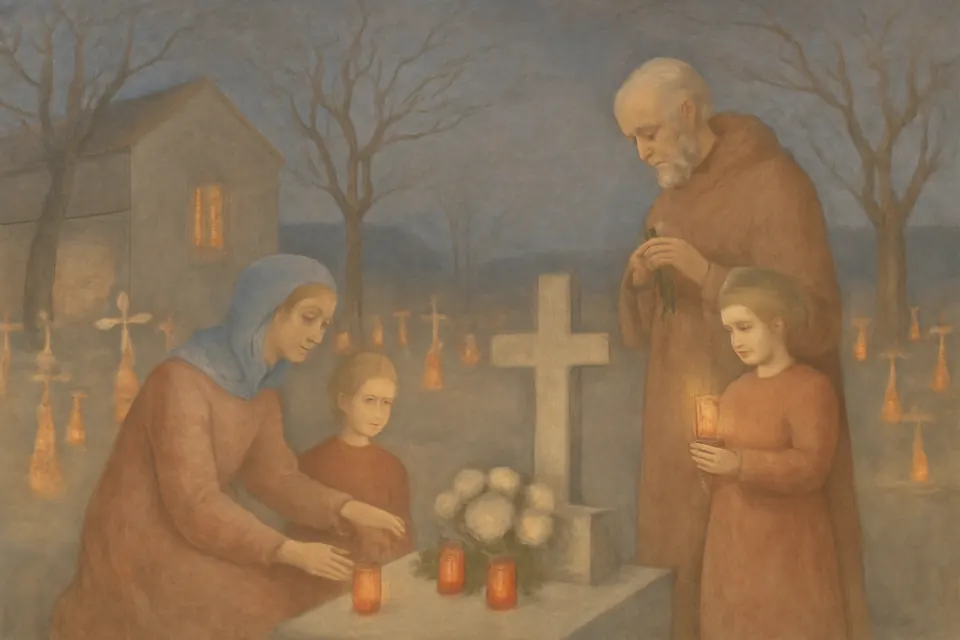
The best-known Catholic prayer for the dead is the Eternal Rest prayer: "Eternal rest grant unto them, O Lord, and let perpetual light shine upon them. May they rest in peace. Amen." Catholics also pray Psalm 130 (the De profundis), offer Masses, and say short prayers for a deceased parent, spouse or friend, trusting that prayer helps souls being purified after death.
Christians have prayed for their dead since the first centuries of the Church. The prayers below are the ones Catholics have used for centuries, all from public-domain sources: the Eternal Rest prayer, Psalm 130, the old collects for a parent, a husband or wife and a friend, and a word about praying when a child has died. After them comes the why and the when, including how Orthodox Christians pray for the departed and why most Protestants, the curator of this site among them, do not.
The Eternal Rest prayer
This is the wording of the Manual of Prayers published by order of the Third Plenary Council of Baltimore in 1888, the official American Catholic prayer book of its day:
Eternal rest grant unto them, O Lord, and let perpetual light shine upon them. May they rest in peace. Amen.
For one person, Catholics say "grant unto him" or "her." The same manual closes many prayers with this line, also used at the end of meals and of the Divine Office:
May the souls of the faithful departed, through the mercy of God, rest in peace. Amen.
In Latin: Requiem aeternam
Requiem aeternam dona eis, Domine, et lux perpetua luceat eis. Requiescant in pace. Amen.
The prayer is the opening chant (Introit) of the old Mass for the dead, which is why that Mass is called a Requiem. The Catholic Encyclopedia traces the words to the Fourth Book of Esdras, a Jewish-Christian book outside the Catholic canon: "Expectate pastorem vestrum, requiem aeternitatis dabit vobis... lux perpetua lucebit vobis" ("Wait for your shepherd; he will give you everlasting rest... perpetual light will shine on you"). The Church's Enchiridion of Indulgences grants a partial indulgence to those who pray the Requiem aeternam for the dead.
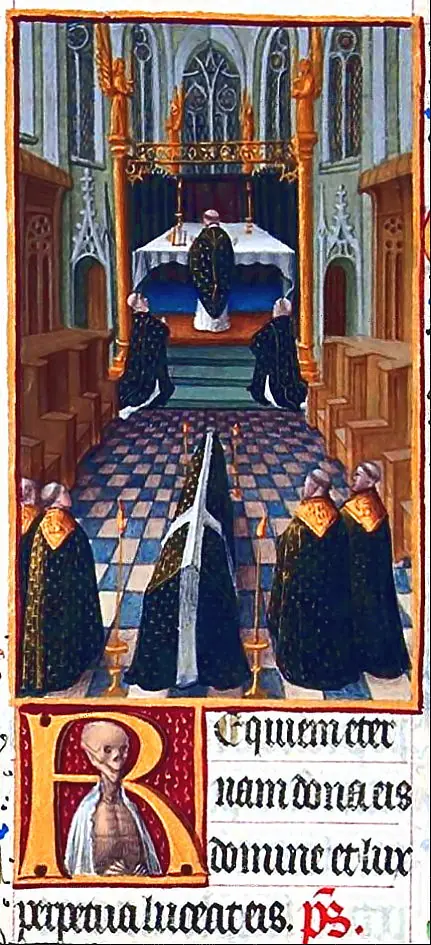

Psalm 130: the De profundis
Psalm 130 (numbered 129 in the Latin Vulgate and the Douay-Rheims Bible) is the Church's traditional psalm for the dead. This is the Douay-Rheims text, with the Eternal Rest added at the end as the Raccolta directs:
Out of the depths I have cried to thee, O Lord: Lord, hear my voice. Let thy ears be attentive to the voice of my supplication. If thou, O Lord, wilt mark iniquities: Lord, who shall stand it. For with thee there is merciful forgiveness: and by reason of thy law, I have waited for thee, O Lord. My soul hath relied on his word: my soul hath hoped in the Lord. From the morning watch even until night, let Israel hope in the Lord. Because with the Lord there is mercy: and with him plentiful redemption. And he shall redeem Israel from all his iniquities. Eternal rest give to them, O Lord. And let perpetual light shine upon them.
The 1878 English Raccolta records that in 1736 Clement XII granted an indulgence to anyone who knelt to pray the De profundis for the dead when the church bell rang at nightfall. In many Catholic countries that evening "bell for the dead" was part of ordinary life.
Prayers for a deceased parent, spouse, child or friend
These collects come from the "Various Prayers for the Dead" in the 1888 Baltimore Manual of Prayers. Most are translations of prayers from the old Roman Missal.
For deceased parents
O God, who hast commanded us to honor our father and mother, look in the tenderness of Thy mercy upon the souls of my father and mother, and forgive them their sins, and grant unto me the joy of seeing them again in the glorious light of everlasting life.
For a husband or wife
The manual has no separate prayer for a spouse. It gives one for a man and one for a woman, and families have long used them for a husband or wife, saying the name where the N. is.
O Lord, incline Thine ear unto the prayers whereby we humbly call upon Thee to show mercy unto the soul of Thy servant N., which Thou hast commanded to depart out of this life; that it may please Thee to set him in a place of peace and light, and give him a part with Thy Saints.
Lord, we beseech Thee, in the tenderness of Thy great mercy, to have pity upon the soul of Thy handmaid N.; cleanse her from all defilements which have stained this mortal body, and give her inheritance in everlasting salvation.
For a friend
Help us, O God of our salvation, and at the prayers of Mary, the most Blessed Mother of God, ever Virgin, let the soul of Thy servant have a place in the light of everlasting blessedness.
When a child has died
Old Catholic prayer books have no prayer for the repose of a baptized child, and that is deliberate. The Church holds that a baptized child who dies before the age of reason goes straight to God. The Catholic Encyclopedia describes the old Roman Ritual for burying such a child: white instead of black, a crown of flowers on the child's head, and bells rung "in a joyous peal" or not at all. Its prayer in church, which the encyclopedia calls "certainly ancient," asks nothing for the child and everything for those left behind:
Almighty and most compassionate God, Who upon all little children that have been born again in the fountain of Baptism, when they leave this world without any merits of their own, straightway bestowest everlasting life, as we believe that Thou hast this day done to the soul of this little one, grant we beseech Thee, O Lord, by the intercession of Blessed Mary ever Virgin and of all Thy saints, that we also may serve Thee with pure hearts here below and may consort eternally with these blessed little ones in paradise. Through Christ our Lord. Amen.
For a child who died before baptism, the Catechism (1261) says the Church "can only entrust them to the mercy of God, as she does in her funeral rites for them," and that Jesus' tenderness toward children allows "us to hope." Many parents simply pray the Eternal Rest and the De profundis, and entrust their child to God by name.
St. Augustine's prayer for his mother and father
The oldest prayer for a parent that most Christians know comes from the end of Book IX of the Confessions, written about 400. As St. Monica lay dying at Ostia she told her sons, "Lay this body anywhere... This only I ask, that you will remember me at the Lord's altar, wherever you be." St. Augustine ends the book by asking his readers to do it. In J. G. Pilkington's 1887 translation, as edited by New Advent:
May she therefore rest in peace with her husband... And inspire, O my Lord my God, inspire Your servants my brethren... that so many of them as shall read these confessions may at Your altar remember Monica, Your handmaid, together with Patricius, her sometime husband.

The St. Gertrude prayer
Many Catholics also say this short offering, especially in November:
Eternal Father, I offer Thee the Most Precious Blood of Thy Divine Son, Jesus, in union with the Masses said throughout the world today, for all the holy souls in Purgatory...
It is not in the writings of St. Gertrude the Great, and the promise often printed with it, that each recitation frees 1,000 souls, was never approved by the Church. The full text and its real history are on our St. Gertrude prayer page.
Why Catholics pray for the dead
Catholic teaching holds that those who die in God's grace but are "still imperfectly purified" undergo a final purification before heaven, which the Church calls Purgatory (Catechism 1030 to 1031). Because all the faithful, living and dead, are one body in Christ, the living can help them.
The Church points first to 2 Maccabees. After a battle, Judas Maccabeus found that his fallen soldiers had worn idolatrous charms, and he sent money to Jerusalem "for sacrifice to be offered for the sins of the dead." The book concludes, in the Douay-Rheims: "It is therefore a holy and wholesome thought to pray for the dead, that they may be loosed from sins" (12:46). The Catechism quotes that verse at 958 and cites it again at 1032, adding that "from the beginning the Church has honored the memory of the dead and offered prayers in suffrage for them, above all the Eucharistic sacrifice."
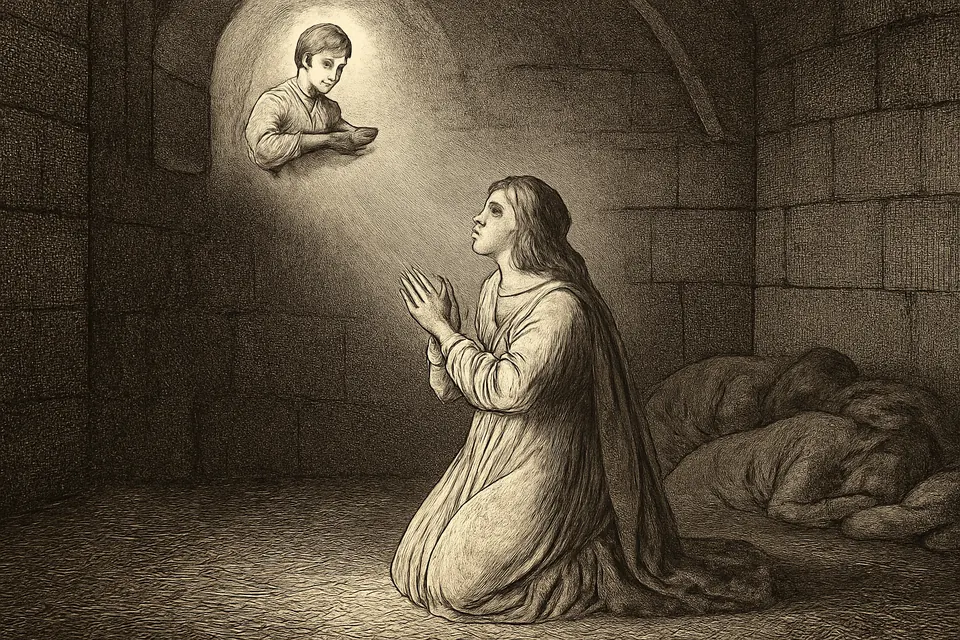
The early Church shows the practice clearly. Around 203, St. Perpetua, waiting in prison for martyrdom, prayed for her brother Dinocrates, who had died of a disease at seven, and recorded a vision of him refreshed. A few years later Tertullian listed it among Christian customs: "As often as the anniversary comes round, we make offerings for the dead as birthday honours."
How Orthodox Christians pray for the dead
The Orthodox Church does not use the Western word Purgatory, but it prays for the departed constantly. Its memorial service is the panikhida (also called parastas or mnemosyno). The Orthodox Church in America explains that a panikhida is usually served before the funeral, again on the third, ninth and fortieth days after death and on anniversaries, and that "there are five Saturdays during the course of the year dedicated to the departed." Families often bring a dish of boiled wheat and honey, called kollyva, along with a list of names. The service ends with the singing of "Memory eternal."


Why most Protestants do not pray for the dead
Most evangelical and Reformed Protestants do not pray for the dead, and it is worth saying why without arguing. They believe that a person's eternal state is fixed at death, often citing Hebrews 9:27 ("it is appointed unto men once to die, and after this the judgment"), and they do not count 2 Maccabees as Scripture. The Westminster Confession of 1646 says that prayer is to be made "for all sorts of men living, or that shall live hereafter: but not for the dead." Many Protestants instead give thanks for the faithful departed and pray for comfort for those who mourn.
Practice is not uniform. Some Anglicans and Lutherans pray for the departed in general terms, and C. S. Lewis, an Anglican much loved by evangelicals, wrote in Letters to Malcolm (1964): "Of course I pray for the dead." Pastor Lyvers curates this site and is evangelical, and he does not share the Catholic teaching on Purgatory. The prayers on this page are given as Catholics and Orthodox pray them, in their own words.


When Catholics pray for the dead
- At the funeral and burial. The funeral Mass is itself the Church's greatest prayer for the person who has died.
- On set days afterward. Old custom keeps the seventh and thirtieth days and the anniversary of death. In Ireland and Britain the Mass about a month after death is called the "month's mind."
- Mass intentions. Catholics ask a priest to offer a Mass for someone who has died, usually with a small stipend. "Gregorian Masses," thirty Masses on thirty consecutive days for one soul, are named after St. Gregory the Great.
- Every Mass. Each Eucharistic Prayer includes a remembrance of the dead.
- In November. The month opens with All Saints' Day and All Souls' Day on November 2. The Enchiridion grants a plenary indulgence, applicable only to the souls in Purgatory, to those who visit a cemetery and pray for the dead on any day from November 1 to 8, and to those who visit a church on All Souls' Day and pray the Our Father and the Creed.

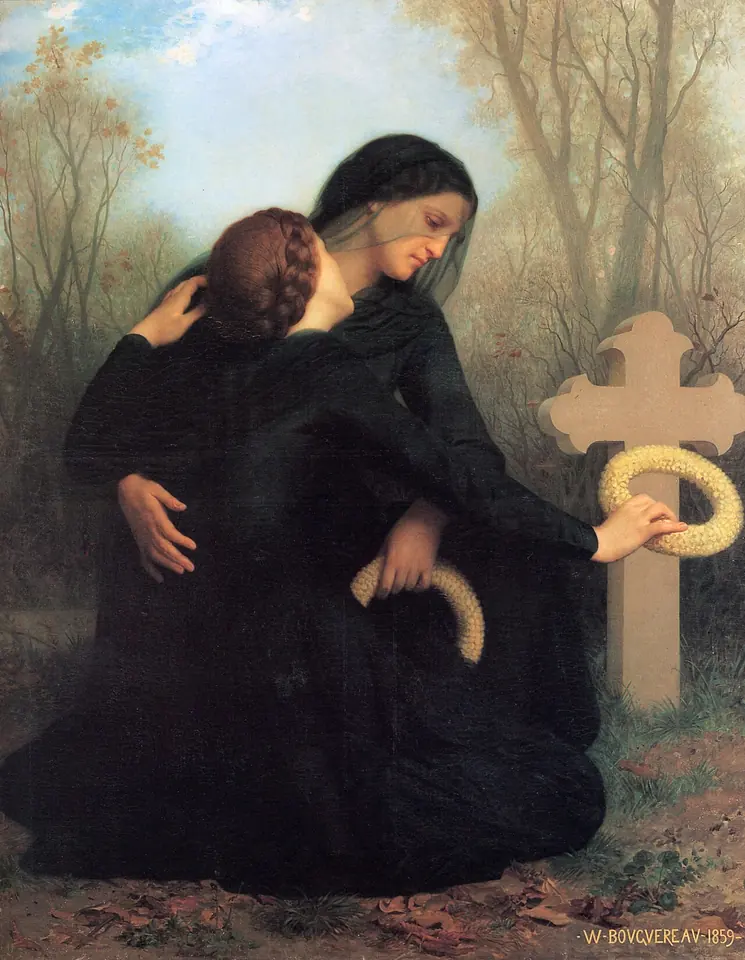
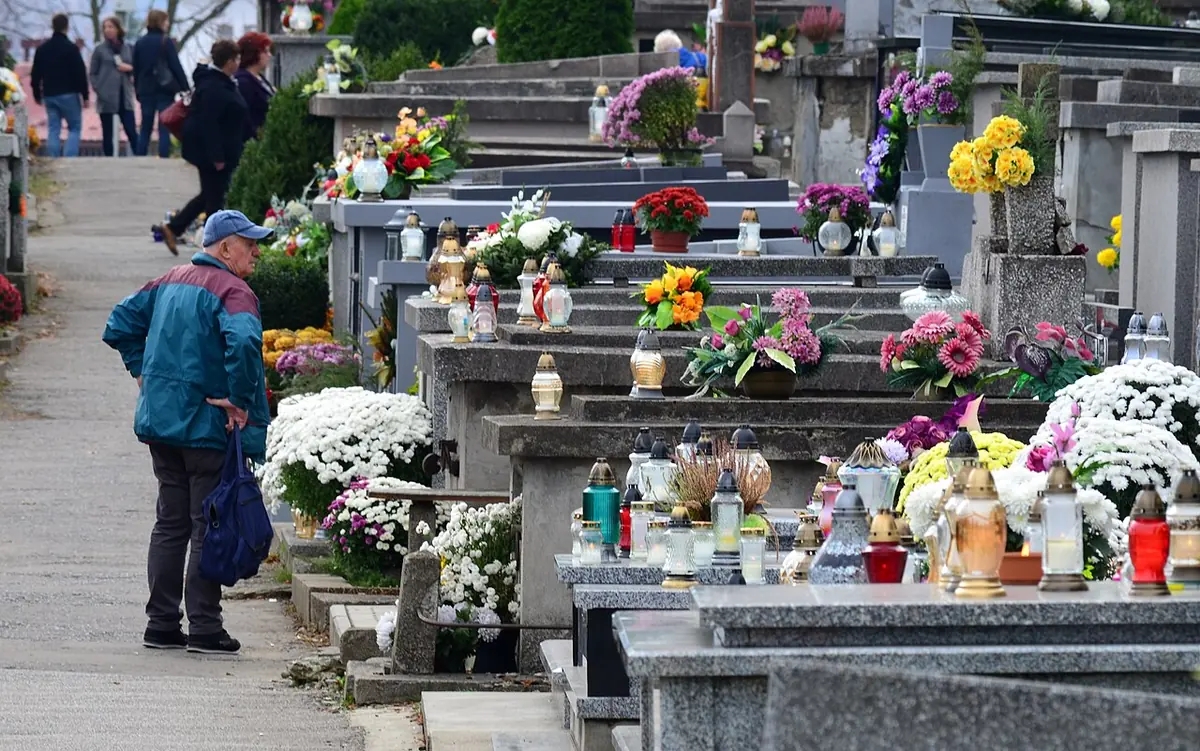
Many parishes keep a book of remembrance near the altar through November, where people write the names of their dead to be prayed for at every Mass that month. In Poland and much of Central Europe, families crowd the cemeteries on November 1 and 2 and leave thousands of candles burning on the graves.

Frequently asked questions
What is the Catholic prayer for the dead?
The most common is the Eternal Rest prayer: "Eternal rest grant unto them, O Lord, and let perpetual light shine upon them. May they rest in peace. Amen." In Latin it is the Requiem aeternam. Catholics often add it to grace before meals, the end of the rosary, or the Angelus, and say it when passing a cemetery.
Why do Catholics pray for the dead?
Because the Church teaches that some who die in God's friendship still need purification before entering heaven, and that the prayers of the living, above all the Mass, help them. The Catechism (958) quotes 2 Maccabees 12:46: "It is a holy and a wholesome thought to pray for the dead that they may be loosed from their sins."
What is a good prayer for the souls in Purgatory?
Psalm 130 (129 in the Douay-Rheims), the De profundis, followed by the Eternal Rest, is the traditional choice. Many Catholics also say the short St. Gertrude prayer, "Eternal Father, I offer Thee the Most Precious Blood of Thy Divine Son, Jesus...", though its promise of 1,000 souls was never approved.
Do Protestants pray for the dead?
Most evangelical and Reformed Protestants do not, because they believe a person's eternal state is settled at death and they do not accept 2 Maccabees as Scripture. The Westminster Confession says prayer is to be made for the living "but not for the dead." Some Anglicans and Lutherans do pray for the departed in general terms, and the Orthodox pray for them constantly.
How do you pray for a deceased parent?
The traditional Catholic prayer is: "O God, who hast commanded us to honor our father and mother, look in the tenderness of Thy mercy upon the souls of my father and mother, and forgive them their sins, and grant unto me the joy of seeing them again in the glorious light of everlasting life." Many families also have a Mass offered on the anniversary of the death.
When do Catholics pray for the dead?
At the funeral and the burial, on the seventh and thirtieth days and on anniversaries, at every Mass (the Eucharistic Prayer remembers the dead), and especially in November, which begins with All Saints and All Souls. Catholics also ask a priest to offer a Mass for a particular person who has died.
Sources
- Douay-Rheims Bible: Psalm 129 (De profundis)
- Douay-Rheims Bible: 2 Machabees 12
- Catechism of the Catholic Church, 958 (communion with the dead)
- Catechism of the Catholic Church, 1030-1032 (the final purification, or Purgatory)
- Catechism of the Catholic Church, 1261 (children who die without Baptism)
- Manual of Prayers for the Use of the Catholic Laity, prepared by order of the Third Plenary Council of Baltimore (1888)
- The Raccolta, or Collection of Prayers and Good Works (1878 English edition)
- Catholic Encyclopedia (1908): Christian Burial (the burial of little children)
- Catholic Encyclopedia (1911): Requiem Masses
- Tertullian, De Corona, chapter 3 (New Advent)
- St. Augustine, Confessions, Book IX, translated by J. G. Pilkington (New Advent)
- The Passion of Perpetua and Felicity (New Advent)
- Orthodox Church in America: Prayers for the Departed
- Westminster Confession of Faith, chapter 21 (Orthodox Presbyterian Church edition)
- CatholicCulture.org: Praying for the Dead and Gaining Indulgences During November
- C. S. Lewis, Letters to Malcolm: Chiefly on Prayer (1964), chapter 20