St. Margaret Mary Alacoque
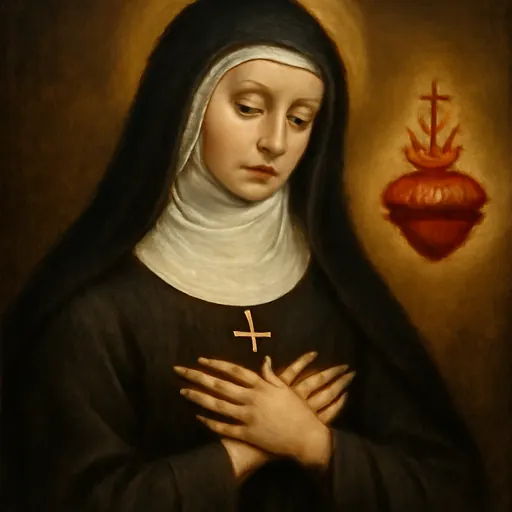
St. Margaret Mary Alacoque (1647–1690) was a French nun of the Visitation order at Paray-le-Monial who reported a series of visions of Christ between 1673 and 1675. In them, she said, Jesus showed her his heart and asked for Communion on First Fridays, a Holy Hour and a feast of the Sacred Heart. She was canonized in 1920, and her feast day is October 16.
Who was St. Margaret Mary Alacoque?
Margaret Mary Alacoque was a nun of the Visitation order in the small Burgundian town of Paray-le-Monial. Between December 1673 and June 1675 she reported a series of visions in which Christ showed her his heart, burning with love for people and wounded by their coldness, and asked her to spread devotion to it. Almost every modern Catholic practice connected with the Sacred Heart of Jesus traces back to her: the First Friday Communions, the Holy Hour, the feast of the Sacred Heart and the familiar picture of Jesus pointing to a flaming heart crowned with thorns.
She did not invent the devotion. Medieval mystics such as St. Gertrude the Great had prayed to the heart of Jesus, and in her own lifetime St. John Eudes was promoting it in France. But the movement that started at Paray-le-Monial made it a devotion of the whole Church.


Her life is documented history. Her visions are what Catholic teaching calls private revelation: the Church judged them worthy of belief, but no Catholic is bound to accept them.
The life of St. Margaret Mary
A sick child in Burgundy
She was born on July 22, 1647, at Lhautecour in Burgundy, the daughter of Claude Alacoque and Philiberte Lamyn. The Catholic Encyclopedia says she preferred silence and prayer to games, and after her First Communion at nine she began severe penances in secret. Then a paralysis kept her in bed for four years. She made a vow to the Virgin Mary to enter religious life, and, the old account says, she was "instantly restored to perfect health."
Her father's death left the family poor, and a relative took over the household and treated them harshly. When the family property was recovered, her mother wanted her to marry. For a while she went to dances. One night, coming home from a ball, she saw Christ as he was during the scourging, reproaching her. She grieved all her life over two small vanities from those years: some needless ornaments, and a carnival mask worn to please her brothers.
The Visitation convent at Paray
On May 25, 1671, at twenty-three, she entered the Visitation monastery at Paray-le-Monial. The order had been founded in 1610 by St. Francis de Sales and St. Jane Frances de Chantal. She made her final vows in November 1672, taking the name Margaret Mary.
Her community found her hard to understand. When she began to speak of visions, many sisters thought she was deluded, and her superior ordered her to live the ordinary common life. The Catholic Encyclopedia credits her obedience and patience for winning over even her harshest critics.
The revelations of 1673 to 1675
The Catholic Encyclopedia and Pope Francis's encyclical Dilexit nos (2024) describe the main visions this way:
- December 27, probably 1673, the feast of St. John the Apostle: she felt Christ let her rest her head on his heart, as John had at the Last Supper. In her Autobiography she wrote that he "revealed to me the wonders of his love and the inexplicable secrets of his Sacred Heart."
- Probably 1674: Christ appeared "radiant with love" and asked for acts of reparation: frequent Communion, Communion on the first Friday of each month, and a Holy Hour of prayer, from eleven to midnight on the Thursday night before each First Friday.
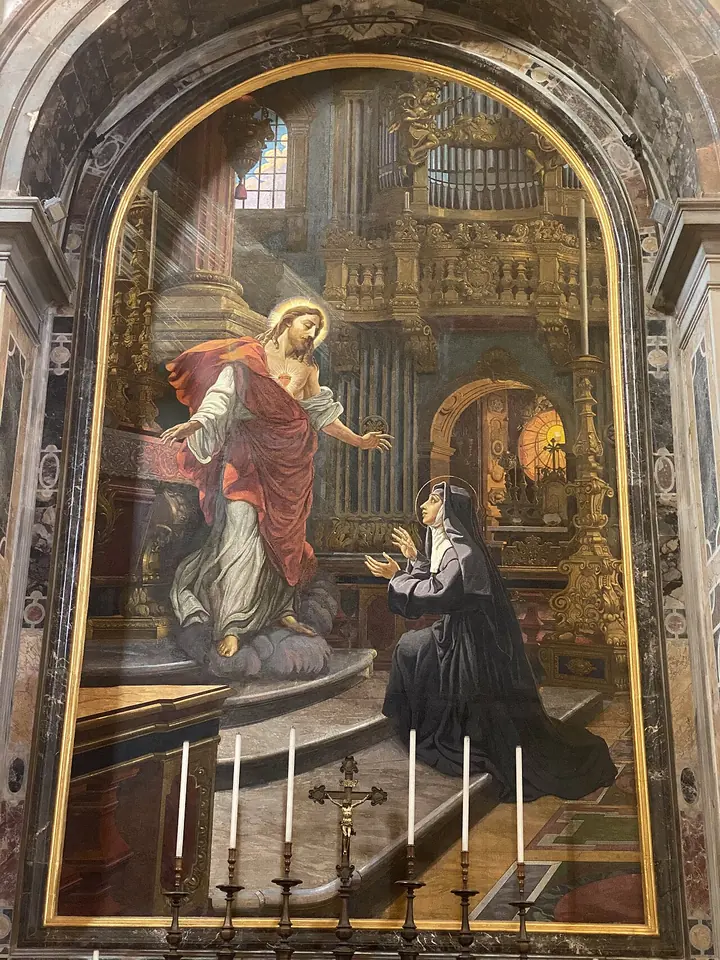
- June 1675, during the octave of Corpus Christi: the "great apparition." Christ showed her his heart and said, as she recorded it, "This is the heart that so loved human beings that it has spared nothing, even to emptying and consuming itself in order to show them its love." He asked for a feast in honor of his heart on the Friday after the octave of Corpus Christi.
Christ, she said, also told her to go to Father Claude de la Colombière, then superior of the small Jesuit house in Paray.


Claude de la Colombière
Father de la Colombière believed her. He consecrated himself to the Sacred Heart, asked her to write down what she had seen, and quietly circulated her account in France and England. When he died in 1682, a copy of her account in his own handwriting turned up in his retreat journal. It was published at Lyons in 1684, and the little book carried her message far beyond Paray. The Church now honors him as St. Claude de la Colombière, and Dilexit nos gives him a whole section.

Her last years
The convent came around. The Visitation houses at Moulins, Dijon and Semur took up the devotion, and finally Paray itself, which had resisted at first. In her last illness she refused every comfort, repeating, "What have I in heaven and what do I desire on earth, but Thee alone, O my God." She died on October 17, 1690, at forty-three, speaking the name of Jesus.
The Sacred Heart devotion after her death
The devotion spread faster than Rome was willing to approve it. According to the Catholic Encyclopedia, Rome granted a feast with its own Mass only in 1765. Pius IX extended it to the whole Church in 1856, and in 1899 Leo XIII consecrated the human race to the Sacred Heart, which he called the great act of his pontificate.
Leo XII declared her Venerable in 1824. When her tomb was opened in July 1830, the Catholic Encyclopedia reports, two instantaneous cures took place. Pius IX beatified her on September 18, 1864, and Benedict XV canonized her in 1920.
The miracles of St. Margaret Mary
- Her childhood cure after a vow to the Virgin Mary: traditional, known from her own account and her early biographers.
- The visions of Christ, 1673 to 1675: private revelation. The Church examined them before her beatification and found nothing contrary to faith, but they are not articles of faith.
- Two cures at the opening of her tomb in 1830: reported. The Catholic Encyclopedia records them; they were part of the record of her cause.
- The miracles for her beatification and canonization: approved, as in every modern cause. The sources we used don't describe the individual cases, so we don't either.
- Favors at Paray-le-Monial: reported. The Catholic Encyclopedia (1910) noted that pilgrims from all over the world had already received many favors at her shrine.
The twelve promises and the First Fridays
The "twelve promises" are blessings that Christ promised, she wrote, to people devoted to his heart, such as "I will establish peace in their homes" and "Sinners shall find in my Heart the source and the infinite ocean of mercy."
The list has a later history than many people assume. As Fr. Edward McNamara, a liturgy professor in Rome, explains, the promises are not found as a list in her writings. They are "scattered about these writings in different forms and dates," usually in indirect speech ("Our Lord has made known to me that he would bless the homes..."). Someone gathered them into a numbered list in a French booklet in 1863. In 1882 Philip Kemper, a German-American businessman in Dayton, Ohio, began printing them on cards in some 238 languages, and in 1895 Leo XIII blessed his work as "pious" and "useful." Cardinal Adolphe Perraud wished the saint's own wording had been kept.
The twelfth is the "great promise," the root of the Nine First Fridays. In her own words, as McNamara quotes them:
I promise you in the excessive mercy of my Heart that its all-powerful love will grant to all those who receive Holy Communion on nine first Fridays of consecutive months the grace of final repentance; they will not die under my displeasure or without receiving their sacraments, my divine Heart making itself their assured refuge at the last moment.
Catholic teachers stress that it is not a magic formula; the Fridays should be made out of love for Christ and lead to frequent Communion. Pope Francis, in Dilexit nos, says the practice "sent a powerful message" in an age of Jansenist rigor, when many people had stopped receiving Communion because they doubted God's mercy.
Why she is the patron of the Sacred Heart devotion
Her main patronage is the devotion itself; Catholics call her the Apostle of the Sacred Heart. Popular saint lists also name her a patron of polio patients and of people who have lost their parents. Neither patronage has an official origin; both are usually linked to the paralysis of her childhood and her father's early death. See our patron saints page for others.
Symbols of St. Margaret Mary in art
Paintings of Margaret Mary nearly always show one moment: the great apparition of 1675. Look for:
- A young nun in black: the habit of the Visitation, with a black veil and a white wimple or a white band across the forehead, sometimes with a silver cross on her breast.
- Christ showing his heart: Jesus, usually in a red cloak over white, stands or appears in clouds and points to a glowing heart on his chest.
- The heart alone: red, wrapped in a crown of thorns, topped with a small cross and flames, and often surrounded by rays. On a painting of a nun, this heart identifies her.
Giaquinto's painting at the top of the page shows the heart alone at her feet. The Piqua window and the mosaic below show the full apparition.

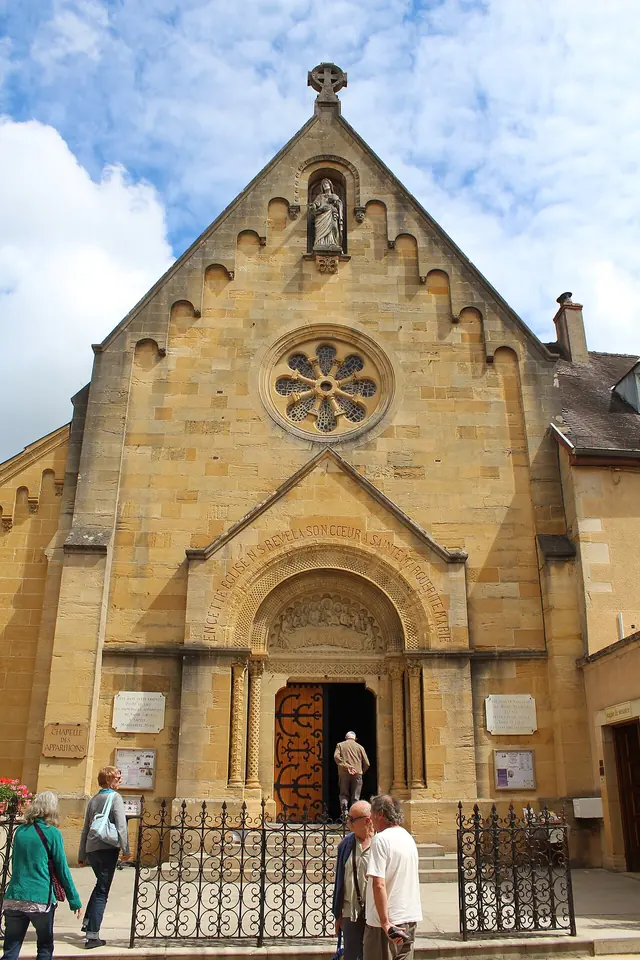
Paray-le-Monial today
The convent chapel where the visions took place, built in 1633 and redecorated in 1854, is now the Chapel of the Apparitions. Her bones rest in a shrine to the right of the choir, inside a wax figure made for her beatification in 1864.


The town's great Romanesque church, once part of a Cluniac priory, is now the Basilica of the Sacred Heart. Pope John Paul II came to Paray in October 1986. In May 2024 Pope Francis addressed a colloquium held for the 350th anniversary of the apparitions, and that October he issued Dilexit nos, his encyclical on the Sacred Heart.


The feast of St. Margaret Mary is October 16, an optional memorial. The feast of the Sacred Heart is a separate celebration, kept on the Friday after the second Sunday after Pentecost, as her vision asked. Find nearby feasts on our feast days page.
Prayer to the Sacred Heart by St. Margaret Mary
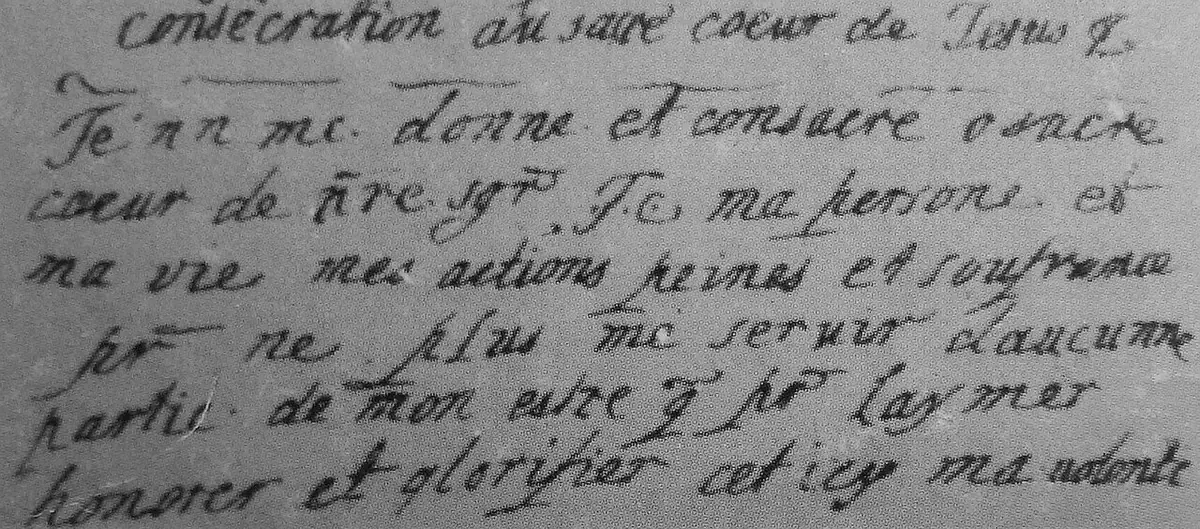
Her best-known prayer is her own act of consecration, preserved by her Jesuit friend Fr. Jean Croiset in his book Devotion to the Sacred Heart. A traditional English translation, as published by EWTN, begins:
O Sacred Heart of Jesus, to Thee I consecrate and offer up my person and my life, my actions, trials, and sufferings, that my entire being may henceforth only be employed in loving, honoring and glorifying Thee. This is my irrevocable will, to belong entirely to Thee, and to do all for Thy love, renouncing with my whole heart all that can displease Thee.
Her handwritten French original survives.

Catholics also keep the Holy Hour she was asked to make, an hour of prayer on Thursday night in memory of Christ's agony in Gethsemane.

Frequently asked questions
What are the 12 promises of the Sacred Heart?
They are twelve blessings that Catholics believe Christ promised, through St. Margaret Mary, to people devoted to his Sacred Heart, such as peace in their homes, comfort in affliction and mercy for sinners. She never wrote them as a list. They are gathered from her letters and were first printed as a numbered list in a French booklet in 1863, then spread worldwide on cards by Philip Kemper of Dayton, Ohio, from 1882.
What is the First Friday devotion?
Catholics who make it receive Communion on the first Friday of nine months in a row, in honor of the Sacred Heart. It comes from the "great promise" St. Margaret Mary reported, that those who do so would receive "the grace of final repentance" and would not die without the sacraments.
When is St. Margaret Mary Alacoque's feast day?
October 16, an optional memorial in the General Roman Calendar. It was kept on October 17, the day she died in 1690, until the calendar was revised in 1969.
Where is St. Margaret Mary buried?
In the chapel of the Visitation monastery at Paray-le-Monial in Burgundy, France, now called the Chapel of the Apparitions. Her bones rest in a shrine to the right of the choir, inside a wax figure made when she was beatified in 1864.
Has the Church approved St. Margaret Mary's visions?
Her visions are private revelation, which Catholics are not required to believe. The Church examined them closely before beatifying her, and it approved the devotion to the Sacred Heart for its own sake. Pope Francis wrote in 2024 that Catholics "need not feel obliged to accept or appropriate every detail of her spiritual experience."
Sources
- Catholic Encyclopedia (1910): St. Margaret Mary Alacoque
- Catholic Encyclopedia (1910): Devotion to the Sacred Heart of Jesus
- Pope Francis, Dilexit nos (October 24, 2024)
- EWTN: First Friday Devotion and First Friday (Fr. Edward McNamara, ZENIT)
- EWTN: Act of Consecration to the Sacred Heart (St. Margaret Mary Alacoque)
- Agenzia Fides: Relics of St Margaret Mary Alacoque begin a 3 month tour of Uruguay (2008)
- Office de tourisme Charolais-Brionnais: Chapelle des Apparitions, Paray-le-Monial
- St. Margaret Mary Alacoque, Autobiography (cited in Dilexit nos)