Angelus prayer
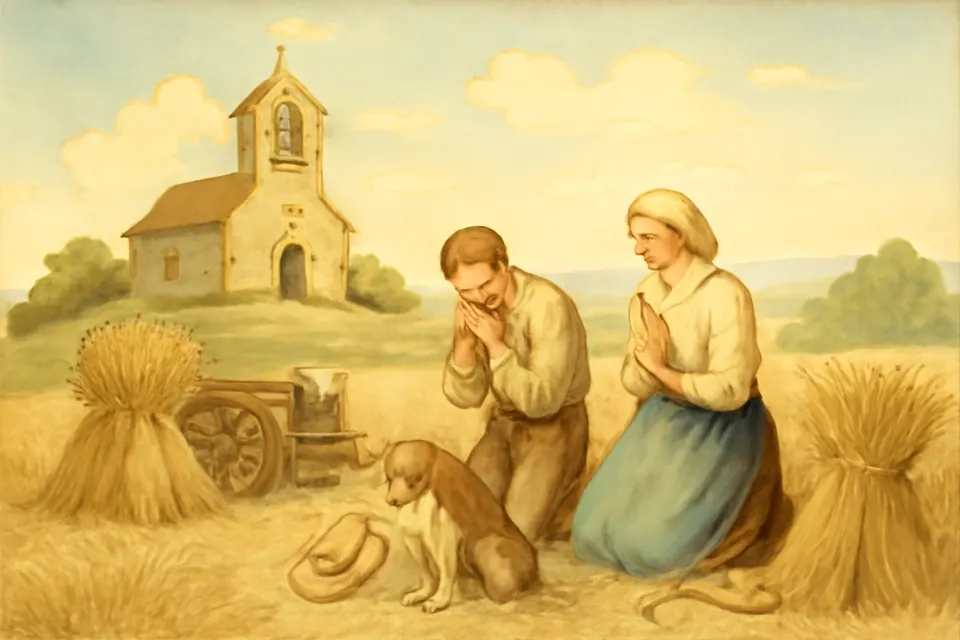
The Angelus prayer is a short Catholic devotion to the Incarnation, said three times a day, traditionally at 6 a.m., noon and 6 p.m., when the church bell rings. It recalls the angel Gabriel's message to Mary in three versicles, each followed by a Hail Mary, and ends with a prayer. In the Easter season the Regina Caeli replaces it.
Three times a day, in villages and cities across the Catholic world, a bell rings and people stop to remember one moment: the angel's visit to a young woman in Nazareth. The full Angelus prayer is below, in English and Latin, followed by its long and partly tangled history.
The Angelus prayer
This is the traditional English text from the 1878 English edition of the Raccolta, the Holy See's collection of indulgenced prayers. V. marks the versicle, said by the leader; R. the response, said by everyone.
V. The angel of the Lord declared unto Mary, R. And she conceived of the Holy Ghost. Hail Mary, etc.
V. Behold the handmaid of the Lord. R. Be it done unto me according to thy word. Hail Mary, etc.
V. And the Word was made flesh, R. And dwelt among us. Hail Mary, etc.
V. Pray for us, holy mother of God. R. That we may be made worthy of the promises of Christ.
Let us pray. Pour forth, we beseech thee, O Lord, thy grace into our hearts, that we unto whom the incarnation of Christ thy Son was made known by the message of an angel, may, by his passion and cross, be brought to the glory of the resurrection. Through the same Christ our Lord. Amen.
The Hail Mary said after each versicle is the one every Catholic child learns. This is its wording in the Baltimore Catechism (1891):
Hail Mary, full of grace! the Lord is with thee: blessed art thou amongst women, and blessed is the fruit of thy womb, Jesus. Holy Mary, Mother of God, pray for us sinners, now and at the hour of our death. Amen.
Newer prayer books often say "Holy Spirit" for "Holy Ghost" and "his Resurrection" in the closing prayer. The meaning is the same.
The Angelus in Latin
The Latin text, also from the 1878 Raccolta. The devotion takes its name from its first word, Angelus.
V. Angelus Domini nuntiavit Mariae, R. Et concepit de Spiritu Sancto. Ave Maria...
V. Ecce ancilla Domini: R. Fiat mihi secundum verbum tuum. Ave Maria...
V. Et Verbum caro factum est, R. Et habitavit in nobis. Ave Maria...
V. Ora pro nobis, sancta Dei genitrix. R. Ut digni efficiamur promissionibus Christi.
Oremus. Gratiam tuam, quaesumus Domine, mentibus nostris infunde: ut qui, angelo nuntiante, Christi Filii tui incarnationem cognovimus, per passionem ejus et crucem ad resurrectionis gloriam perducamur. Per eumdem Christum Dominum nostrum. Amen.
What the Angelus remembers
Each versicle is a line of Scripture or close to it. The first sums up the angel Gabriel's message in Luke 1. The second is Mary's answer, "Behold the handmaid of the Lord; be it done to me according to thy word" (Luke 1:38). The third is from the opening of St. John's Gospel: "And the Word was made flesh, and dwelt among us" (John 1:14). So the prayer tells the whole story of the Incarnation in three steps: the message, the consent, and God becoming man. The closing prayer then looks ahead from the Annunciation to the cross and the Resurrection.

The three bells: morning, noon and evening
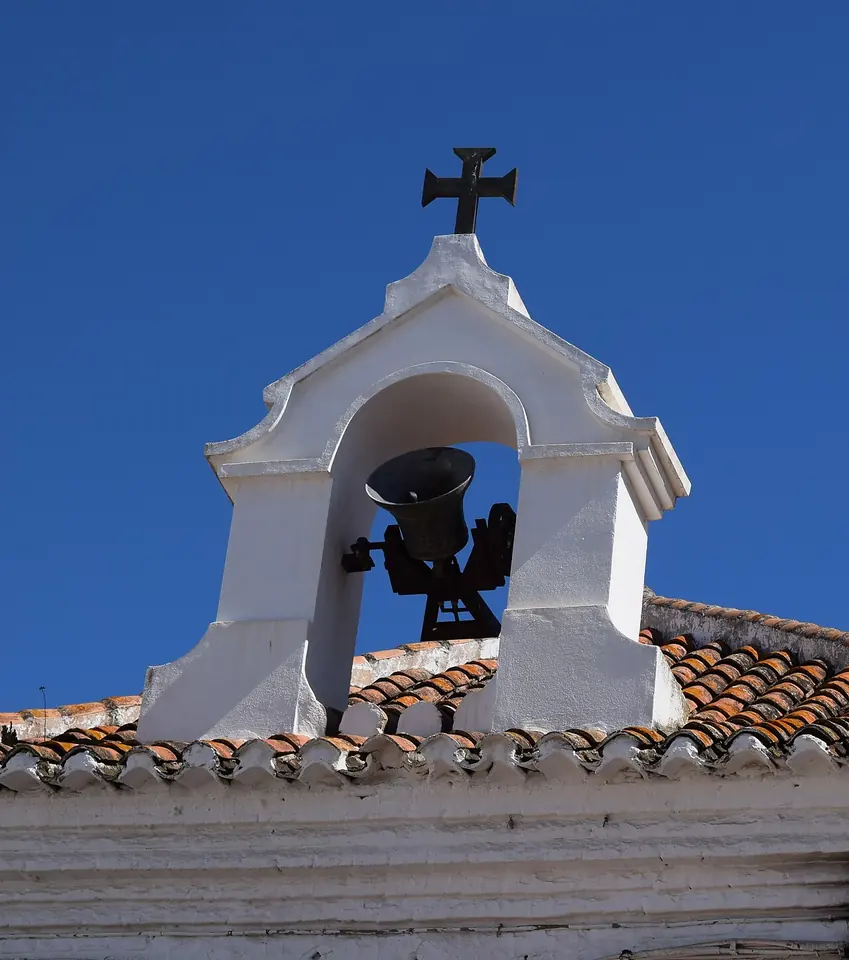
The Angelus bell rings three times a day, usually at 6 in the morning, at noon and at 6 in the evening. Older rules tied the prayer to the bell itself. The Raccolta records that Pope Benedict XIII, in 1724, granted indulgences to those who said it "at the sound of the bell, in the morning, or at noon, or in the evening at sunset," kneeling. Later popes let people pray it at about those hours even where no bell is rung. The current Enchiridion Indulgentiarum (2004) still grants a partial indulgence for praying it at dawn, at midday or toward evening (primo diluculo, vel meridiano tempore, vel sub vesperam), and in the Easter season the Regina Caeli in its place.

The 1891 Baltimore Catechism gives a neat reason for the three times: "The Angelus is said in the evening, in memory of the Incarnation; in the morning, in memory of the Resurrection, and at noon in memory of the Passion of Our Lord." That explanation is a later reading, not the historical origin. As the next section shows, the three bells came from three different customs.
History of the Angelus
Fr. Herbert Thurston, the Jesuit historian who wrote the Catholic Encyclopedia article in 1907, warned that the history "is by no means easy to trace with confidence." He separated what is certain from what is guesswork. Here is what he considered certain, plus the main conjectures, labeled as such.
The evening Angelus came first (13th and 14th centuries)
By the first half of the 14th century, saying three Hail Marys at an evening bell around sunset had become general throughout Europe, and Pope John XXII recommended and indulgenced the practice in 1318 and 1327. The earliest certain record of three Hail Marys at the evening bell is a decree of the provincial synod of Gran (Esztergom, Hungary) in 1307.
The Franciscans played a part before that. A general chapter of the Franciscan order in the time of St. Bonaventure (1263 or 1269) told the friars' preachers to encourage the people to say Hail Marys when the Compline bell rang. A few 13th-century bells still carry inscriptions that point the same way. Thurston thought the custom imitated the monks' night prayers, and he doubted the popular idea that it grew out of the curfew bell. An older tradition credits Pope Gregory IX with ordering a bell in 1239; Thurston called it "vague and not very well confirmed."
The morning bell (14th century)
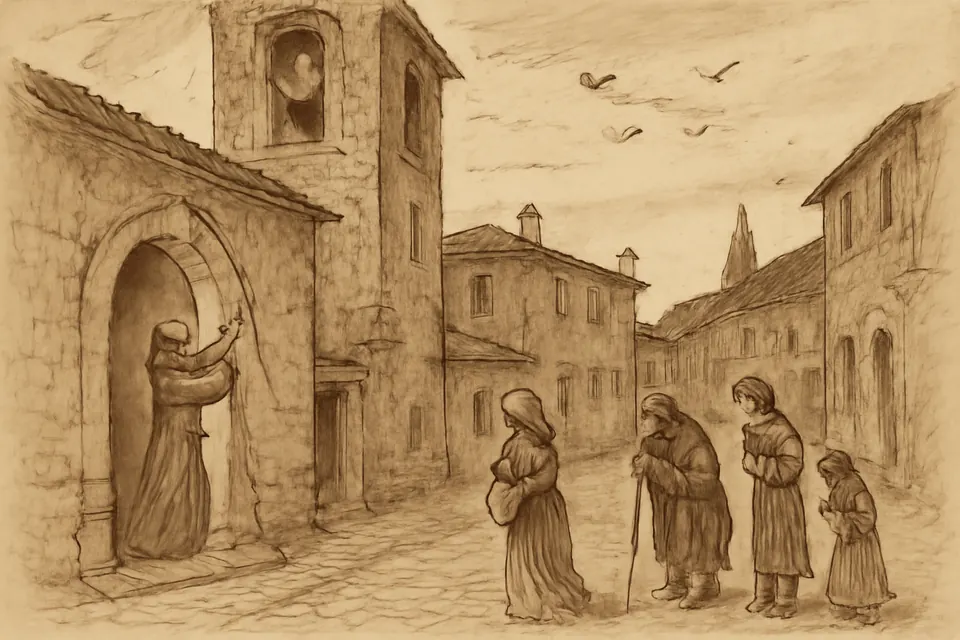
The morning Hail Marys followed soon after. The earliest mention Thurston found is from Parma in 1318, where the bishop asked everyone who heard the town bell in the morning to say three Our Fathers and three Hail Marys for peace, so it was called "the peace bell." In England, Bishop John Stratford of Winchester ordered the evening Ave in 1324, and Archbishop Arundel gave the first formal instruction about the morning ringing in 1399.
The noon bell and Pope Callixtus III (15th century)
The midday Angelus is the youngest of the three, and Thurston thought it had a separate origin. In the 14th and 15th centuries a midday bell was rung in some places, at first only on Fridays, in honor of Christ's Passion: at Prague in 1386 and at Mainz in 1423, for example. In 1475 King Louis XI of France urged it as a bell of prayer for peace.

The best-known name in the story is Pope Callixtus III. In 1456, as the Ottoman army besieged Belgrade, he called all of Christian Europe to pray for the defenders. The Catholic Encyclopedia's article on him says that "it was by order of Callistus III that the bells were rung at midday to remind the faithful that they should pray for the welfare of the crusaders." The siege was lifted that July. The popular story that the noon bell began with this order is too simple, given the earlier Friday bells, but his order did a great deal to spread the noon ringing.
The words take shape (16th and 17th centuries)
For most of its history the Angelus was just the bell and three Hail Marys. The three versicles we say now first appear in an Italian catechism printed at Venice in 1560, and the full form with the closing prayer cannot be traced before 1612. In Italy two extra customs grew up: a De profundis (Psalm 130) for the dead after the evening Angelus, and three Glory Be's in thanksgiving. On praying for the dead, see prayers for the dead.
The Regina Caeli in Eastertide
During the Easter season the Angelus gives way to a joyful anthem, the Regina Caeli ("Queen of Heaven, rejoice, alleluia"). Writers recommended the change in the early 17th century. The Raccolta records that the Pope confirmed the Angelus indulgences on April 20, 1742, and ordered the Regina Caeli said standing during the Easter season in its place. That pope was Benedict XIV; the 1878 English Raccolta misprints his name as Benedict XIII, who had died in 1730. The same decree said the Angelus is to be said standing on Saturday evening and on Sunday. Anyone who doesn't know the Regina Caeli may simply say the Angelus.
Millet's painting, The Angelus
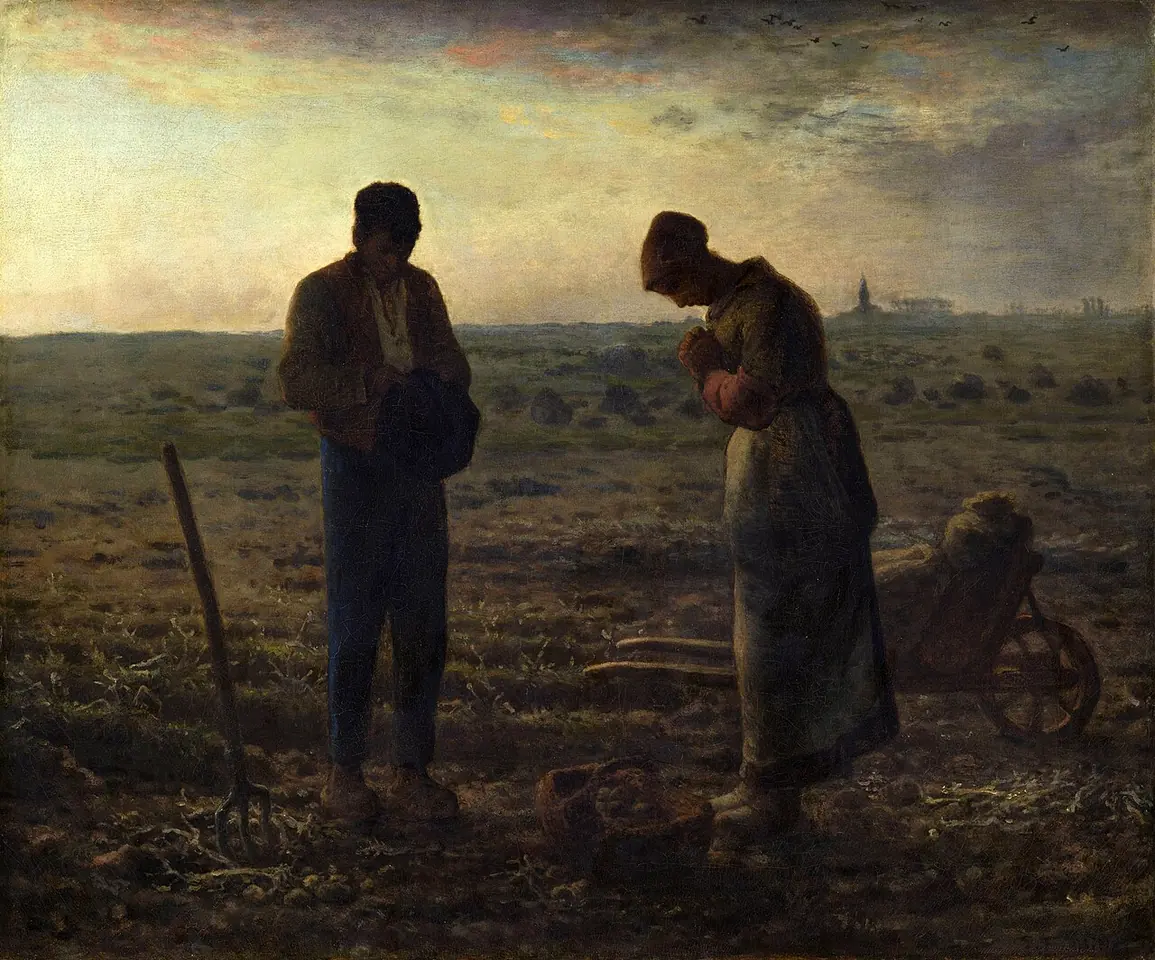
The most famous picture of the prayer is Jean-François Millet's small canvas The Angelus, painted in 1857 to 1859 and now in the Musée d'Orsay in Paris. A man and a woman have stopped digging potatoes at dusk. His hat is in his hands, her head is bowed, and a church spire stands on the far horizon. According to the museum, Millet said the idea came from a childhood memory of his grandmother, who would stop the family's work in the fields when the bell rang so they could pray the Angelus for the poor dead. The museum adds that Millet himself was not a churchgoer.

The painting became one of the best-known images of the 19th century. The museum notes the patriotic uproar when the Louvre tried and failed to buy it in 1889, Salvador Dalí's lifelong fascination with it, and an attack on it in 1932. It came to the French state as part of Alfred Chauchard's bequest and entered the national collections in 1909. Prints of it hung in Catholic homes across Europe and America for generations.
The Pope's Sunday Angelus
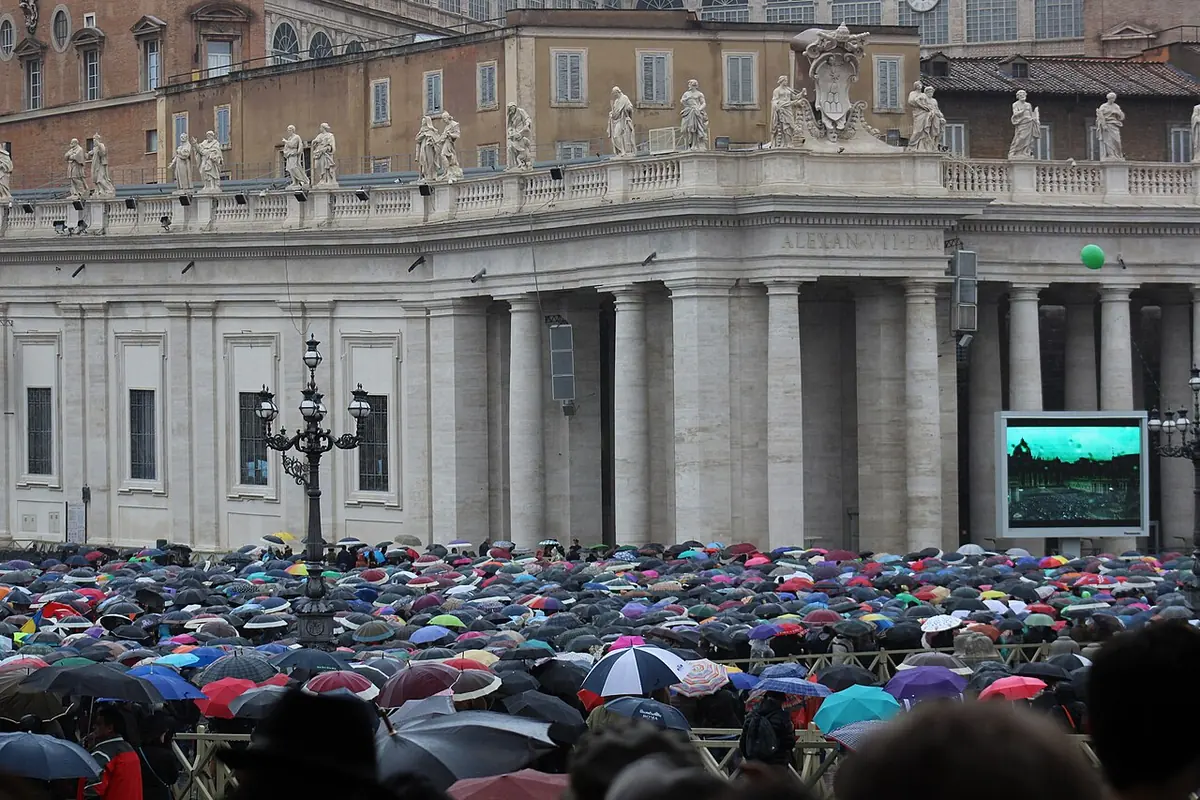
Every Sunday at noon the Pope appears at a window of the Apostolic Palace overlooking St. Peter's Square, gives a short reflection on the day's Gospel, leads the Angelus and gives his blessing. EWTN News traces the custom to Pope Pius XII, who first prayed the midday Angelus publicly on August 15, 1954, the feast of the Assumption, during a Marian Year, over Vatican Radio. The idea came from Luigi Gedda, president of Italian Catholic Action. Today the Pope speaks from the window of his library, and the address is broadcast worldwide. In the Easter season it is the Regina Caeli address instead.

Popes often use the Angelus address to speak about saints and world events. Several saints on this site were honored in one: Pope Paul VI praised St. Gianna Molla at a Sunday Angelus in 1973, and Pope Francis prayed the Angelus at the church of St. Peter Claver in Cartagena in 2017.
How to pray the Angelus
- When the bell rings (or at about 6 a.m., noon or 6 p.m.), stop what you are doing. Traditionally people knelt on weekdays and stood on Saturday evening and Sunday.
- One person says each versicle (V.) and everyone answers (R.), then all say a Hail Mary. Repeat for the three versicles.
- Finish with "Pray for us, holy mother of God," its response, and the closing prayer.
- Some add three Glory Be's at the end, and in the evening a prayer for the dead.
The prayer takes about two minutes. For more about Mary herself, see the Blessed Virgin Mary. Two other short Marian prayers are on this site: the Hail Holy Queen and the Memorare.
Frequently asked questions
What are the words of the Angelus prayer?
It begins "The angel of the Lord declared unto Mary, and she conceived of the Holy Ghost," followed by a Hail Mary. Two more versicles follow, "Behold the handmaid of the Lord" and "And the Word was made flesh," each with a Hail Mary. It ends with "Pray for us, holy mother of God" and the prayer "Pour forth, we beseech thee, O Lord, thy grace into our hearts." The full text is on this page.
What time is the Angelus prayed?
Three times a day: early morning, noon and evening, usually 6 a.m., 12 noon and 6 p.m., when the Angelus bell rings. The Church's handbook of indulgences describes the times simply as early morning, midday and toward evening.
Why is the Angelus said three times a day?
The evening prayer came first, by the early 14th century; the morning and midday prayers were added later. The 1891 Baltimore Catechism explains the three times this way: the evening Angelus recalls the Incarnation, the morning the Resurrection, and noon the Passion.
Is the Angelus prayed during Easter?
No. From Easter Sunday until Pentecost we pray the Regina Caeli ("Queen of Heaven, rejoice") instead, standing. Pope Benedict XIV ordered this change in 1742, and the Pope still replaces his Sunday Angelus with the Regina Caeli in the Easter season.
When did the Pope start praying the Angelus on Sundays?
Pope Pius XII first prayed the noon Angelus publicly on August 15, 1954, during a Marian Year, speaking over Vatican Radio. Today the Pope leads it every Sunday at noon from the window of his library in the Apostolic Palace, after a short reflection on the day's Gospel.
Do you kneel for the Angelus?
Traditionally, yes, except on Saturday evening and Sunday, when it is said standing, and in the Easter season. The Catholic Encyclopedia notes that later rules let people say it in any posture for a good reason. Many people simply stop what they are doing and bow their heads.
Sources
- Catholic Encyclopedia (1907): Angelus, by Herbert Thurston
- Catholic Encyclopedia (1908): Pope Callistus III
- The Raccolta, or Collection of Prayers and Good Works (1878 English edition), Angelus Domini and Regina Caeli
- A Catechism of Christian Doctrine No. 3 (Baltimore Catechism, 1891), Project Gutenberg
- Hannah Brockhaus, Why the pope prays the Angelus publicly on Sundays (EWTN News, 2022)
- Musée d'Orsay: Jean-François Millet, The Angelus (Google Arts & Culture)
- Apostolic Penitentiary, Enchiridion Indulgentiarum, 4th edition (2004), concession 17