Memorare prayer
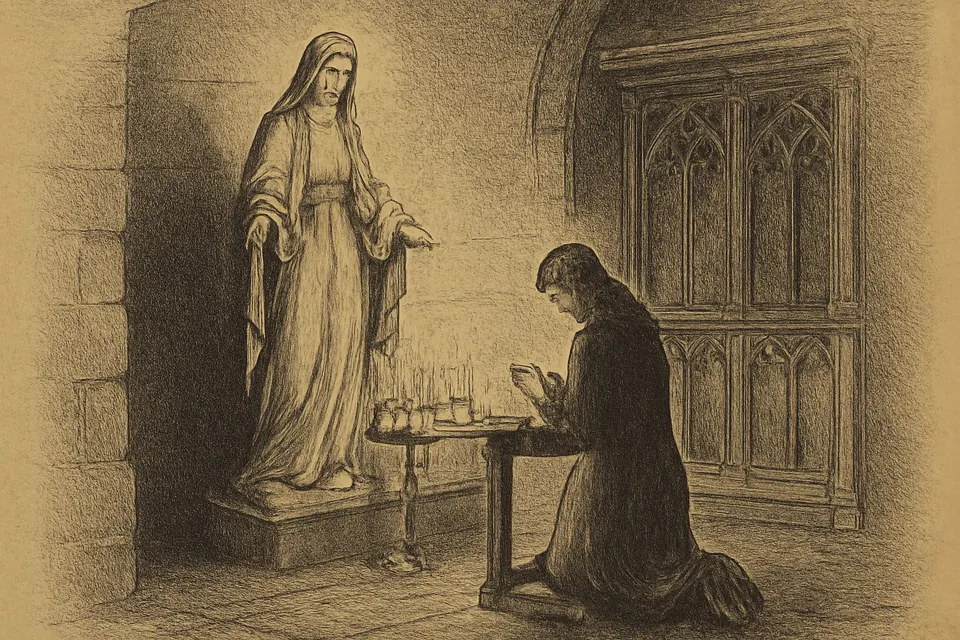
The Memorare prayer is a short Catholic prayer asking the Virgin Mary's help, beginning "Remember, O most gracious Virgin Mary, that never was it known..." It is often credited to St. Bernard of Clairvaux, but it comes from a longer 15th-century Latin prayer. A French priest, Fr. Claude Bernard (1588–1641), made it famous.
The Memorare is short enough to fit on a holy card and bold enough to remind the Mother of God of her own reputation. Catholics have prayed it in prisons, in hospital wards, before exams and in the middle of the night. The full text is below, in English and Latin, followed by its surprisingly tangled history.
The Memorare prayer
This is the traditional English text as printed in the 1878 English edition of the Raccolta, the Holy See's official collection of indulgenced prayers:
Remember, O most gracious Virgin Mary! that never was it known that any one who fled to thy protection, implored thy help, and sought thy intercession, was left unaided. Inspired with this confidence, I fly unto thee, O Virgin of virgins, my mother! To thee I come; before thee I stand, sinful and sorrowful. O mother of the Word incarnate! despise not my petitions, but, in thy mercy, hear and answer me. Amen.
Many modern prayer books use "you" and "your" in place of "thee" and "thy," and some say "anyone who fled to your protection... was left unaided." The prayer is otherwise the same everywhere.
The Memorare in Latin
The name comes from the first word of the Latin, Memorare, "Remember." This is the Latin as printed in the same 1878 Raccolta:
Memorare, O piissima virgo Maria, non esse auditum a saeculo quemquam ad tua currentem praesidia, tua implorantem auxilia, tua petentem suffragia, esse derelictum. Ego tali animatus confidentia, ad te, virgo virginum, Mater, curro, ad te venio, coram te gemens peccator assisto; noli, mater Verbi, verba mea despicere, sed audi propitia, et exaudi. Amen.
The Latin has a little wordplay the English loses: mater Verbi, verba mea, "mother of the Word, (despise not) my words."

What the Memorare asks
The prayer is built like a small legal argument. First comes the claim: no one who ever ran to Mary for help was left without it. Then the conclusion: so I come too, "sinful and sorrowful," and I ask you to hear me. The person praying doesn't plead their own merit. They appeal to Mary's record. Catholics understand this as asking Mary to intercede with her Son, the "Word incarnate" named in the last lines, not as asking her to act in his place.
The phrase "never was it known" is the heart of the prayer and the reason people reach for it in hard moments. It is a prayer of confidence more than a prayer of request.
Who wrote the Memorare?
Not St. Bernard of Clairvaux
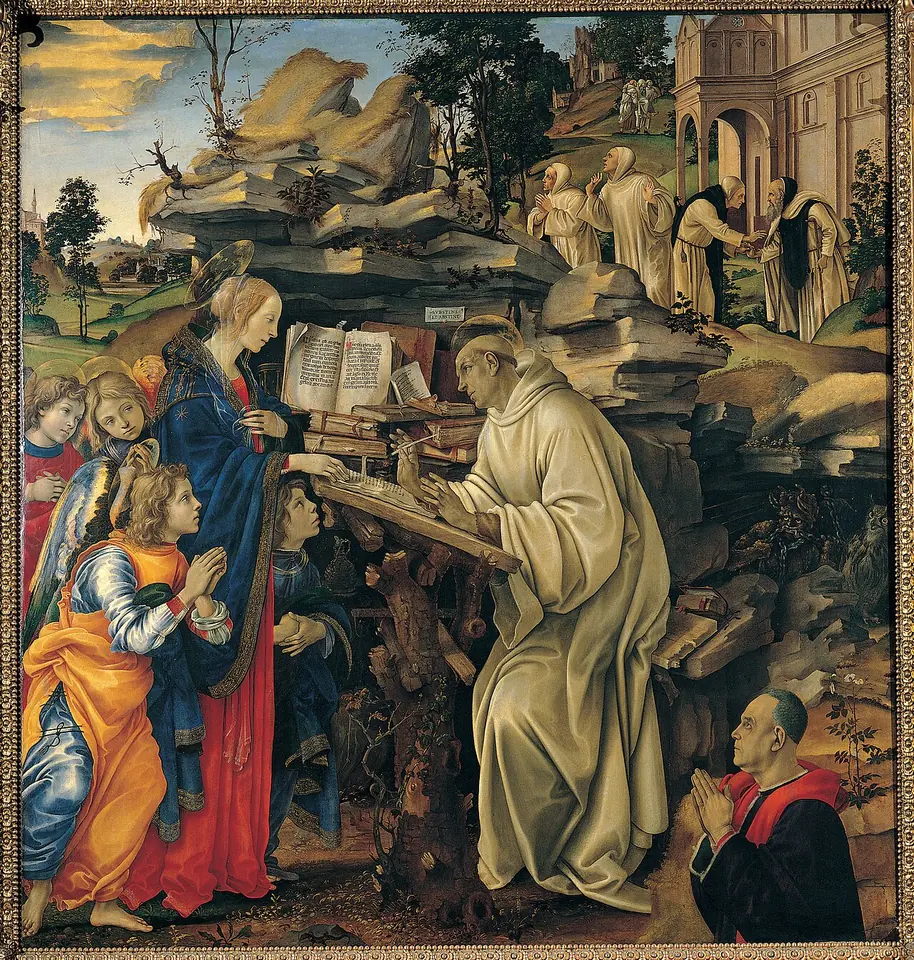
The Memorare is printed on countless cards as the "Prayer of St. Bernard," meaning St. Bernard of Clairvaux (1090–1153), the Cistercian abbot famous for his sermons on the Virgin Mary. The attribution is almost certainly wrong. The New Catholic Encyclopedia says that passages in his sermons "echo the theme," but "none comes close to the actual wording of the Memorare." Over the centuries the prayer has also been credited to St. Augustine and St. John Chrysostom, with no better evidence.
A 15th-century prayer, "Ad sanctitatis tuae pedes"
The real trail begins in the 15th century. The New Catholic Encyclopedia says the manuscript tradition "can be traced only to the 15th century," and that the Memorare appears as one section of a longer prayer in the Antidotarius animae of Nicolas Salicetus, printed in 1489. In 1503 it was included, possibly already as a separate invocation, in a prayer book called the Hortulus animae. St. Anthony Messenger identifies the longer Latin prayer by its opening words, Ad sanctitatis tuae pedes, dulcissima Virgo Maria ("At the feet of your holiness, sweetest Virgin Mary"). The author of that prayer is unknown. The short Memorare we pray is the part of it that people lifted out and kept.
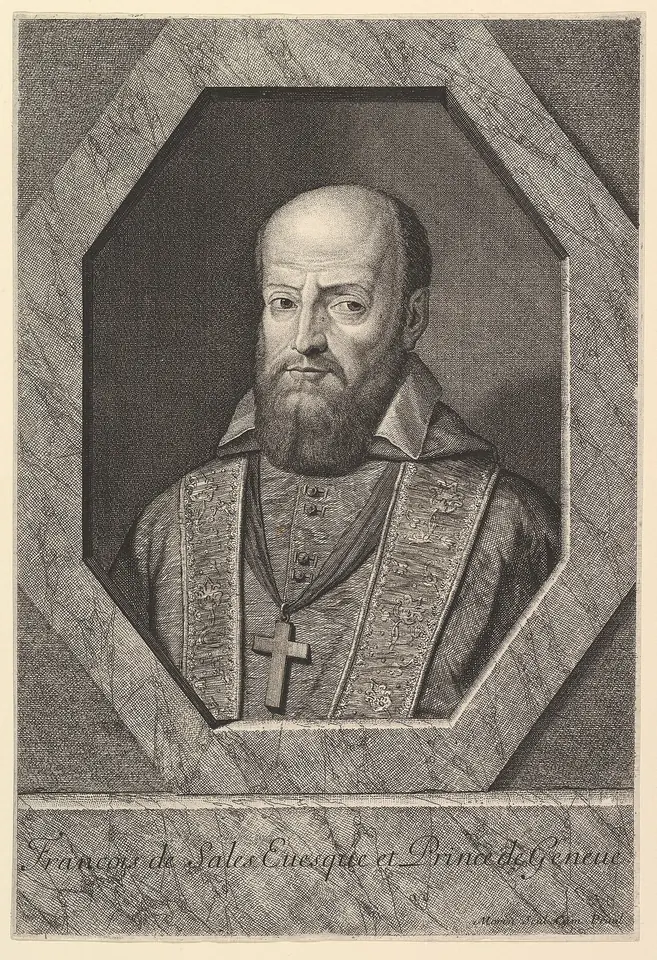
By the late 16th century the short form was in use. St. Francis de Sales (1567–1622) said that he prayed it as a student in Paris, according to St. Anthony Messenger. Tradition holds that it was saying this prayer before a statue of the Virgin that freed him from a long spiritual crisis of despair.
Fr. Claude Bernard, the "Poor Priest"
The man who made the Memorare famous was another Bernard. Claude Bernard (1588–1641) was a French priest in Paris, known as le pauvre prêtre, the "Poor Priest." He gave his life to the poor, the sick in hospitals and prisoners, including men condemned to death, and he taught them this prayer. The New Catholic Encyclopedia says he worked "miracles of grace" through Mary's intercession. St. Anthony Messenger reports that he had about 200,000 leaflets of the Memorare printed in several languages to give away.

How did the prayer end up with the wrong Bernard's name? In 1882 the German church historian Bishop Karl Joseph von Hefele suggested the simplest answer: because of the similar names, St. Bernard's was substituted for Père Bernard's. The famous saint absorbed the obscure priest. It is a guess, but a reasonable one.
Indulgenced by Pius IX
The Memorare reached the whole Church through the Raccolta. Pope Pius IX, by a rescript of July 25, 1846, granted an indulgence of three hundred days each time it is prayed, and a plenary indulgence once a month for those who say it daily. The New Catholic Encyclopedia says it first appeared in the 12th edition of the Raccolta (Rome, 1849). The Church's current handbook, the Enchiridion Indulgentiarum (2004), still lists the Memorare, o piissima Virgo Maria among the approved Marian prayers that carry a partial indulgence.
The Memorare in the lives of the saints
The prayer turns up again and again in the stories of saints and converts on this site. In Italy in 1804, St. Elizabeth Ann Seton, still an Episcopalian widow, came across the Memorare while staying with the Filicchi family, and it was one of the first steps on her road to the Catholic Church. In Rome in January 1842, Alphonse Ratisbonne, a young Jewish banker hostile to the Church, agreed on a dare to wear a Miraculous Medal and say the Memorare every day; his sudden conversion days later is told on the page for Our Lady of the Miraculous Medal. There is a separate Memorare to St. Joseph, modeled on this one.
Mother Teresa's "flying novena"
The most famous modern use of the Memorare belongs to St. Teresa of Calcutta. A novena is normally a prayer said over nine days. Mother Teresa often didn't have nine days. Her friend and adviser Msgr. Leo Maasburg, in his book Mother Teresa of Calcutta: A Personal Portrait, called it "Mother Teresa's spiritual rapid-fire weapon," quoted by EWTN News. It was nine Memorares said one after another for an urgent need. Given the pace of her travels and the problems brought to her, he wrote, "she invented the 'Quick Novena.'" And "she always added a 10th Memorare immediately, in thanksgiving for the favor received," before the favor had arrived. Maasburg calls it the Quick Novena; her Missionaries of Charity call it the "flying novena," and many Catholics also call it the "emergency novena."
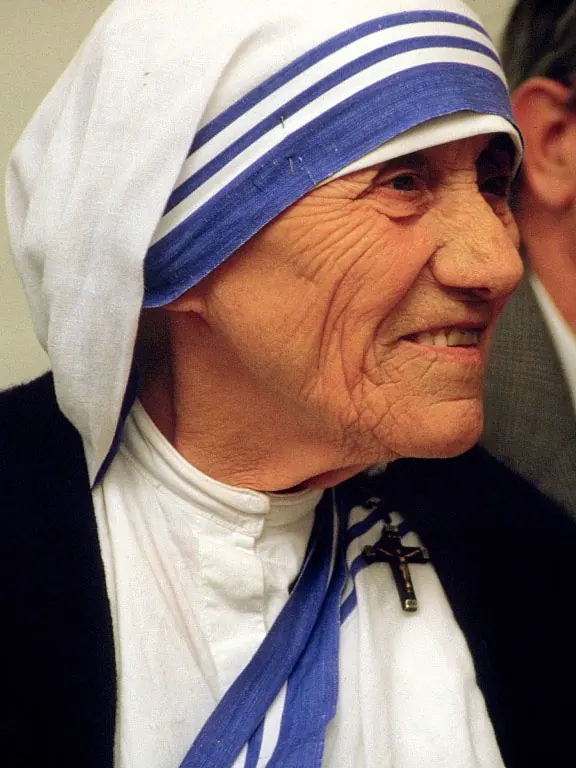
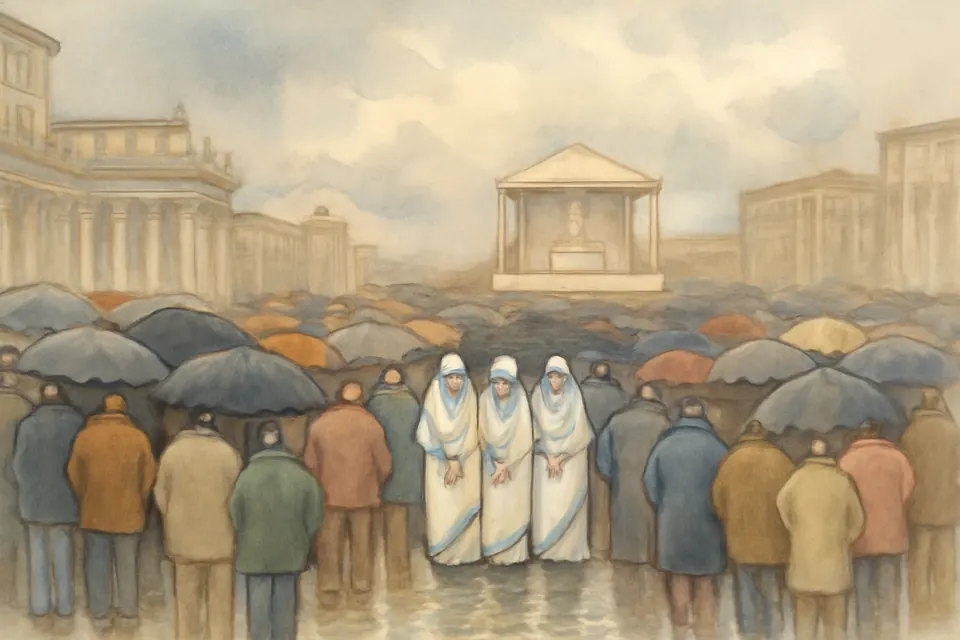
EWTN News also reports a story Mother Teresa told herself, passed on by Fr. Brian Kolodiejchuk, the postulator of her cause. In Rome, during the Holy Year of 1984, the Pope was to celebrate an outdoor Mass and it was pouring. She asked the sisters to pray a flying novena for good weather. The rain went on through the first Memorares, and by the ninth, she said, "we found all the umbrellas were closed." This is a reported answer to prayer, told by Mother Teresa herself; no Church body has examined it, and none would be expected to.
How to pray the Memorare
- On its own, at any time, especially in a moment of need, fear or temptation. Many people know it by heart and say it silently.
- As a flying novena: nine Memorares in a row for an urgent intention, then a tenth in thanksgiving.
- As a novena over nine days, praying it each day for one intention.
- After the rosary, in place of or after the Hail Holy Queen.
For more on Mary herself, her feasts and titles, see the Blessed Virgin Mary. The Angelus is another short Marian prayer, said three times a day at the sound of the bell.
Frequently asked questions
What are the words of the Memorare?
"Remember, O most gracious Virgin Mary! that never was it known that any one who fled to thy protection, implored thy help, and sought thy intercession, was left unaided. Inspired with this confidence, I fly unto thee, O Virgin of virgins, my mother! To thee I come; before thee I stand, sinful and sorrowful. O mother of the Word incarnate! despise not my petitions, but, in thy mercy, hear and answer me. Amen." This is the 1878 Raccolta translation.
Did St. Bernard of Clairvaux write the Memorare?
Almost certainly not. The New Catholic Encyclopedia says some of his sermons echo the theme, but none comes close to the actual wording, and the text can be traced only to the 15th century, three hundred years after his death. The likely source of the mix-up is Fr. Claude Bernard, a 17th-century Paris priest who spread the prayer widely.
Who was Claude Bernard?
A French priest (1588–1641), known in Paris as the "Poor Priest," who spent his ministry in hospitals and prisons and taught the Memorare to the sick and the condemned. St. Anthony Messenger reports that he had some 200,000 copies printed in several languages. Bishop Karl Joseph von Hefele suggested in 1882 that his name was later confused with St. Bernard's.
What is the Memorare flying novena?
A quick novena St. Teresa of Calcutta used in urgent needs: nine Memorares prayed one after another, with a tenth added at once in thanksgiving. Her friend Msgr. Leo Maasburg called it her "Quick Novena"; her sisters call it the "flying novena."
Is the Memorare in the Bible?
No. It is a later prayer, not a Scripture text. It does draw on the Christian conviction, found from very early times in prayers like the Sub tuum praesidium, that Mary's help can be asked with confidence.
Is there an indulgence for the Memorare?
Yes. Pope Pius IX indulgenced it in 1846, and the Church's current handbook, the Enchiridion Indulgentiarum (2004 edition), names the Memorare among the Marian prayers that carry a partial indulgence when prayed devoutly.
Sources
- New Catholic Encyclopedia: Memorare (Encyclopedia.com)
- Pat McCloskey, O.F.M., Who Wrote the Memorare? (St. Anthony Messenger, Franciscan Media)
- The Raccolta, or Collection of Prayers and Good Works (1878 English edition), no. 98, the Memorare in Latin and English
- Joseph Pronechen, How to pray Mother Teresa's famous emergency 'Flying Novena' to Our Lady (EWTN News, 2024), quoting Msgr. Leo Maasburg
- Apostolic Penitentiary, Enchiridion Indulgentiarum, 4th edition (2004), concession 17