St. Gabriel the Archangel

St. Gabriel the Archangel is one of the three angels named in the Bible. He explains visions to the prophet Daniel, announces the birth of John the Baptist to Zechariah and, most famously, tells the Virgin Mary that she will be the mother of Jesus. His feast day is September 29, shared with Sts. Michael and Raphael, and he is the patron saint of telecommunications workers and broadcasters.
Who is St. Gabriel the Archangel?
Gabriel is one of only three angels whom the Bible calls by name, with Michael and Raphael. Every time he appears in Scripture he brings a message. He explains visions to the prophet Daniel. He tells the old priest Zechariah that his wife will bear a son, John the Baptist. And in the scene that has inspired more paintings than almost any other in Christian art, he greets a young woman of Nazareth and tells her she will be the mother of the Son of God.
The Catholic Encyclopedia explains his name as Fortitudo Dei, "strength of God," and calls him the angel of the power of God. Christian tradition also calls him the angel of the Incarnation and of consolation. Pius XII named him the patron of telecommunications in 1951, so the messenger of the Annunciation now watches over people who send messages by wire and air.

Catholics celebrate him on September 29, together with Michael and Raphael. Orthodox Christians honor him on March 26, the day after the Annunciation, and again on July 13.
Gabriel in the Bible
Daniel's visions
Gabriel first appears in the Book of Daniel, during the Babylonian exile. In chapter 8 Daniel sees a vision of a ram and a he-goat and cannot understand it. Then, in the Revised Standard Version Catholic Edition, "I heard a man's voice between the banks of the U'lai, and it called, 'Gabriel, make this man understand the vision'" (Daniel 8:16). Daniel falls on his face in fear, and Gabriel touches him and sets him on his feet. The Catholic Encyclopedia reads the vision as foretelling Alexander the Great's conquest of Persia and, later, the persecution of Antiochus Epiphanes.


In chapter 9 Daniel prays and confesses the sins of his people. While he is still praying, "the man Gabriel, whom I had seen in the vision at the first, came to me in swift flight at the time of the evening sacrifice" (Daniel 9:21). Gabriel tells him, "you are greatly beloved," and gives him the prophecy of the "seventy weeks," which Christians have long read as pointing to the coming of the Messiah.
Zechariah in the Temple
The Gospel of Luke opens with Gabriel. Zechariah, an elderly priest, is chosen by lot to offer incense in the sanctuary of the Temple. An angel appears beside the altar and tells him that his prayer has been heard: his wife, Elizabeth, long childless, will bear a son, to be named John. Zechariah asks how he can know this, since he and his wife are old. The angel answers:
"I am Gabriel, who stand in the presence of God; and I was sent to speak to you, and to bring you this good news. And behold, you will be silent and unable to speak until the day that these things come to pass, because you did not believe my words, which will be fulfilled in their time." (Luke 1:19–20, RSVCE)
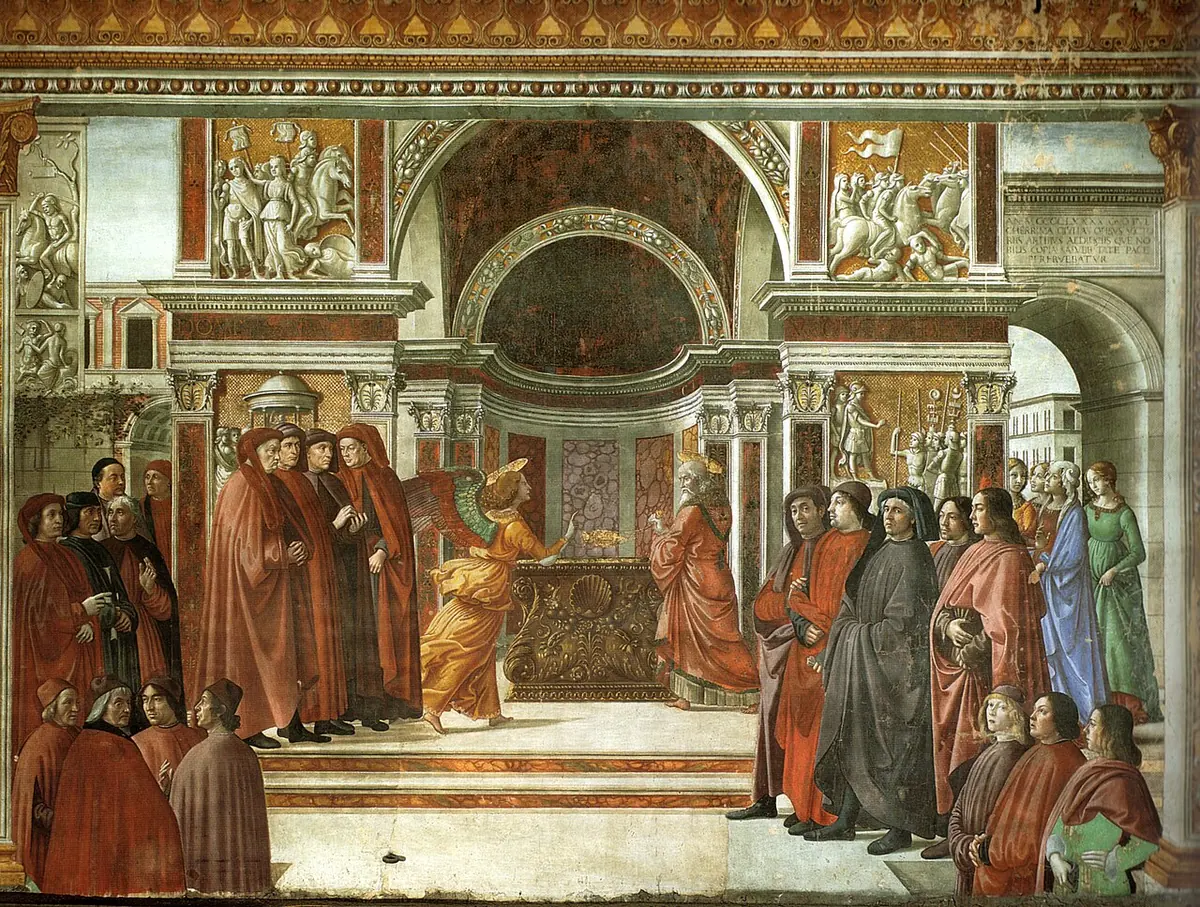

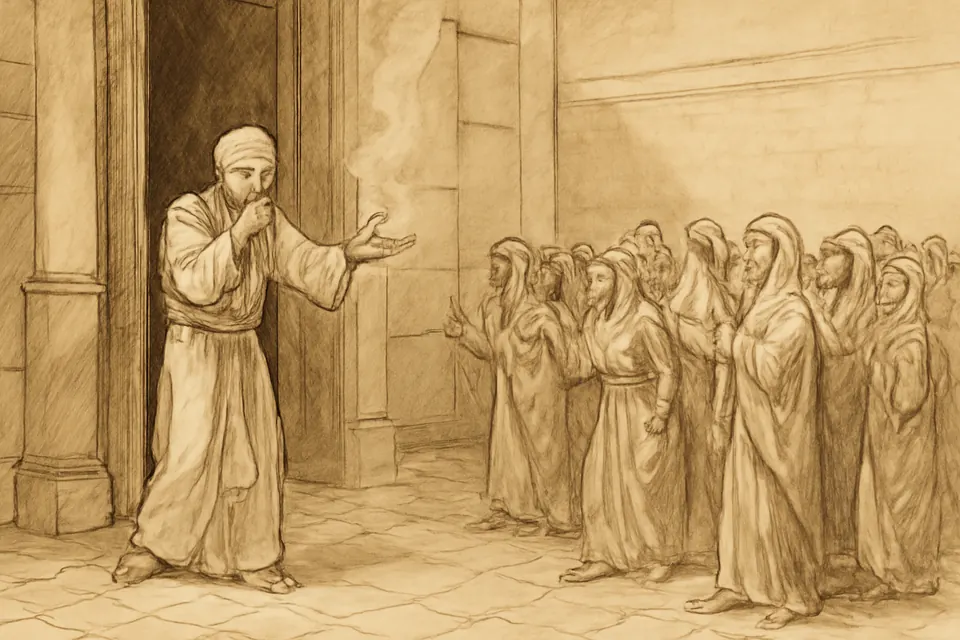
Zechariah comes out to the waiting people unable to speak and can only make signs to them. His voice returns months later, at the naming of John the Baptist.
The Annunciation
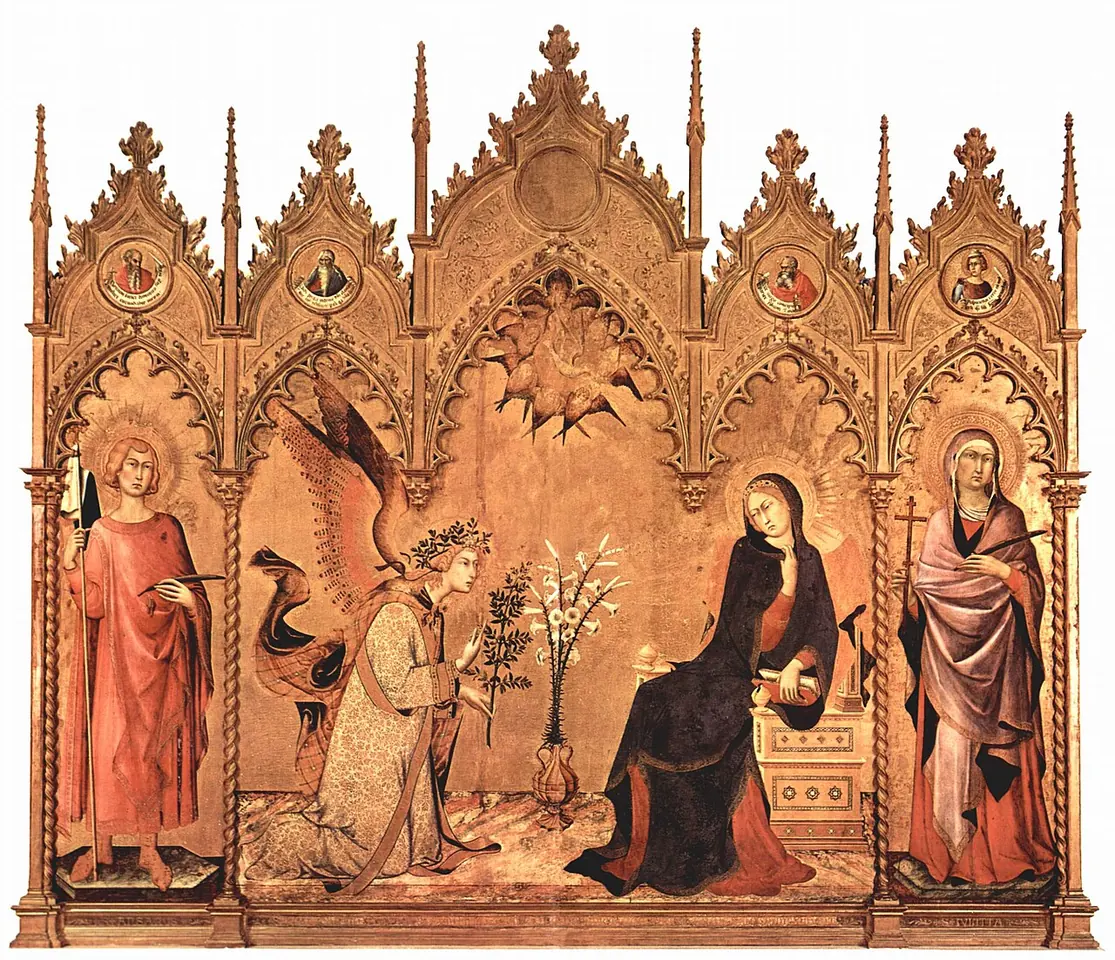
Six months later, Luke says, "the angel Gabriel was sent from God to a city of Galilee named Nazareth, to a virgin betrothed to a man whose name was Joseph, of the house of David; and the virgin's name was Mary" (Luke 1:26–27). His greeting, in the Douay-Rheims translation that Catholics in the English-speaking world prayed for centuries, is:
Hail, full of grace, the Lord is with thee: blessed art thou among women. (Luke 1:28, Douay-Rheims)
Mary is troubled. Gabriel tells her not to be afraid. She will conceive and bear a son and call him Jesus; he will be called the Son of the Most High and will reign on the throne of David forever. When Mary asks how this can be, since she has no husband, the angel answers that "the Holy Spirit will come upon you, and the power of the Most High will overshadow you," and adds that her kinswoman Elizabeth has conceived in her old age, "for with God nothing will be impossible." Mary replies, "Behold, I am the handmaid of the Lord; let it be to me according to your word," and the angel departs (Luke 1:35–38, RSVCE).
The Church celebrates this moment on March 25, the Solemnity of the Annunciation, nine months before Christmas.

The Hail Mary
The Hail Mary begins with Gabriel's words. Its first line is his greeting from Luke 1:28; the second, "blessed is the fruit of thy womb," comes from Elizabeth's greeting a few verses later (Luke 1:42). The Angelus, the prayer said morning, noon and evening in many Catholic places, retells Gabriel's visit in three versicles, beginning "The Angel of the Lord declared unto Mary."
Other appearances in tradition
Scripture names Gabriel only in Daniel and Luke. Tradition gives him a larger role. The Catholic Encyclopedia notes the belief that he is the angel who appeared to St. Joseph in his dreams and to the shepherds at Bethlehem, and the angel who "strengthened" Jesus in the Garden of Gethsemane (Luke 22:43). The Orthodox Church in America adds that he announced Mary's birth to her mother, St. Anne, watched over Mary as a child in the Temple, and brought the news of the Resurrection to the myrrh-bearing women.
The Protoevangelium of James, a 2nd-century writing outside the Bible, tells the Annunciation in two steps. Mary goes out with a pitcher to draw water and hears a voice: "Hail, you who hast received grace; the Lord is with you; blessed are you among women!" She goes home trembling and sits down to spin purple thread for the Temple veil, and then the angel appears. This is why Eastern icons often show Mary holding a spindle, and why the Greek Orthodox church in Nazareth stands over a spring.

Gabriel in Judaism and Islam
Gabriel is honored beyond Christianity. The Catholic Encyclopedia notes that in Jewish tradition Gabriel was the angel of judgment and Michael the angel of mercy, and that rabbis credited Gabriel with the destruction of Sodom and with burying Moses. He is named in the Book of Enoch, an ancient Jewish writing outside the Hebrew Bible.
In Islam, Gabriel, called Jibril, is the angel who brought the revelation of the Qur'an to the Prophet Muhammad. The Qur'an names him in a few verses. One of them (2:97) says that it was Gabriel who brought the revelation down upon Muhammad's heart, by God's permission. Muslims also honor him as the angel of the Annunciation to Mary, who is called Maryam in the Qur'an. The three traditions describe his messages very differently, but each sees him as God's great messenger.
Miracles and appearances of St. Gabriel
Angels are not canonized and do not have miracles investigated in the way saints do. Gabriel's appearances fall into three groups.
- In Scripture: his visits to Daniel, to Zechariah and to Mary. For Christians these are part of revealed Scripture, not legends.
- Traditional: his appearances to Joseph, to Anne and to the women at the tomb, and his strengthening of Christ in Gethsemane, all handed down by Christian tradition rather than named in the Bible.
- Traditional: the story of the hymn "It Is Truly Meet," told below.
"It Is Truly Meet": Gabriel on Mount Athos
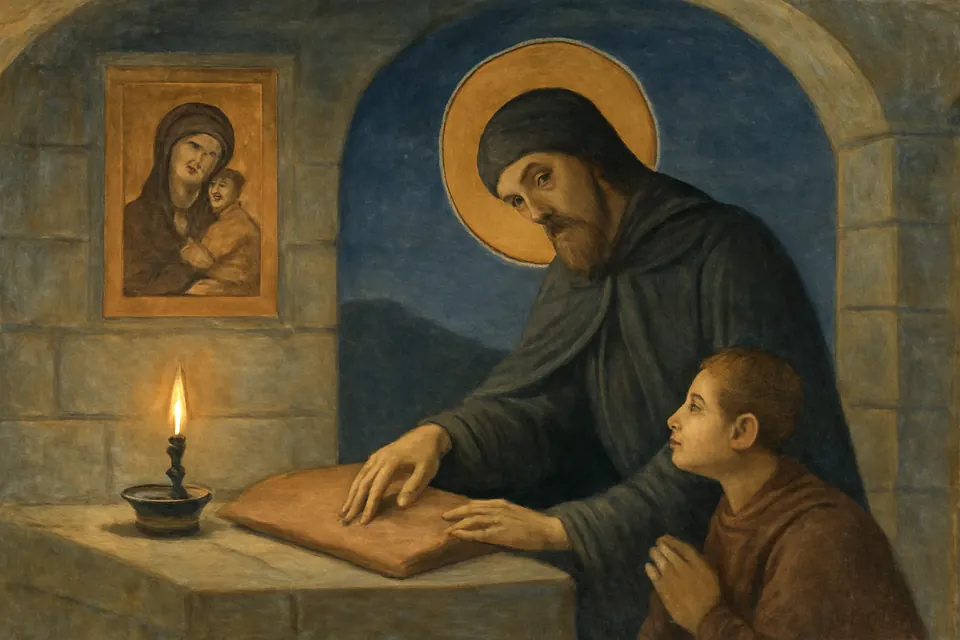
The Orthodox Church in America tells this story under June 11. In 982 an elder living in a cave near Karyes, on Mount Athos, went to the all-night vigil and left his young disciple at home. A monk the disciple did not know knocked at the door and said his name was Gabriel. The two prayed together before an icon of the Mother of God. When they reached the hymn to Mary, the visitor sang a new opening: "It is truly meet to bless thee, O Theotokos, ever blessed and most pure, and the Mother of our God." The disciple asked him to write it down, but there was no paper, so the stranger wrote the hymn with his finger on a roof tile, "as though it were made of wax." Then the disciple realized he was the Archangel Gabriel, who told him, "Sing the hymn this way, and all of the Orthodox as well," and disappeared.
The hymn, the Axion Estin, is sung at every Orthodox Divine Liturgy. The icon is kept in the Protaton church at Karyes.
Why St. Gabriel is the patron saint of communications
A messenger became the patron of messages. In a 1951 apostolic brief, Pope Pius XII sought heavenly protection for what Vatican News, quoting him, calls "queste scienze meravigliose" (these marvelous sciences) and the people who work in them: the telegraph, long-distance telephone and messages sent through the air by radio. In the Italian that Vatican News gives, he declared: "Costituiamo e dichiariamo l'Arcangelo San Gabriele, celeste Patrono presso Dio di questa professione" ("We establish and declare the Archangel St. Gabriel heavenly Patron before God of this profession"). Gabriel was named patron of Vatican Radio at the same time.
Catholics have since extended the patronage to broadcasters and communications workers in general, and to postal workers, letter carriers and messengers. Franciscan Media lists him as the patron of broadcasters and communicators. See all patron saints.

Symbols of St. Gabriel in art
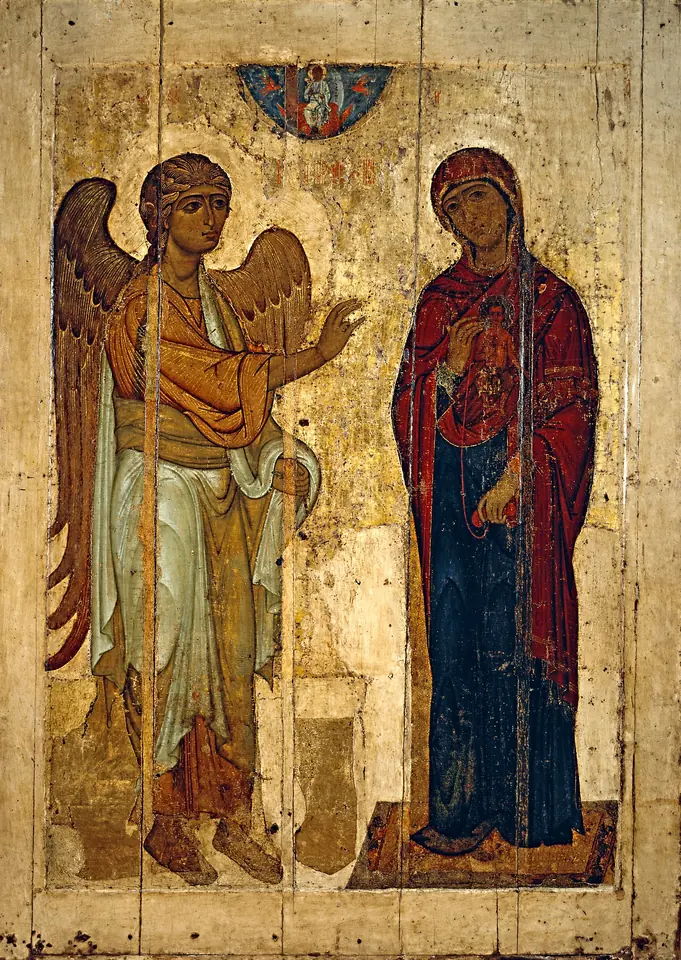
Gabriel appears in art almost entirely in one scene, the Annunciation, and painters gave him a vocabulary of signs that is easy to learn.
- A lily: Mary's purity. Florentine painters such as Leonardo and Botticelli almost always put a white lily in his hand.
- An olive branch: peace. Sienese painters such as Simone Martini sometimes gave it to him in place of the lily.
- A scepter or messenger's staff: he comes as an ambassador from the King of heaven. Eastern icons show him with a slender staff.
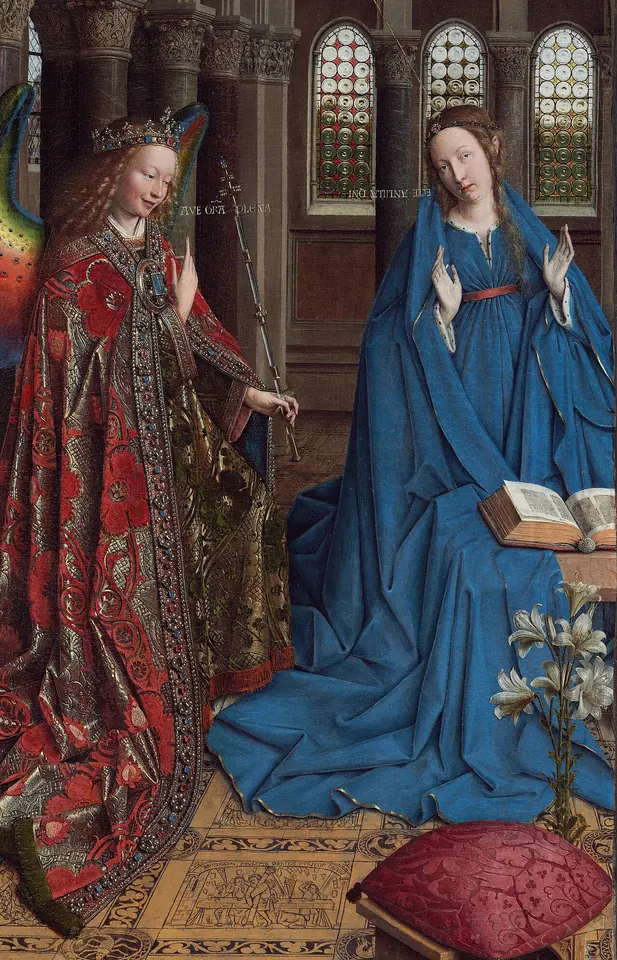
- His words written out: Ave Maria, gratia plena or Ave gratia plena Dominus tecum ("Hail, full of grace, the Lord is with thee") on a scroll or in gold letters across the panel.
- A raised hand: the gesture of greeting and blessing, often with two fingers lifted.
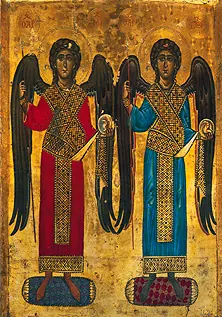
- A translucent orb: in Byzantine and Russian icons, Gabriel and Michael hold a clear sphere, sometimes marked with a cross or the initials of Christ.
- Rich robes and wings: in late medieval Flemish painting he wears a jeweled priestly cope and has wings of many colors.

Gabriel in Renaissance painting
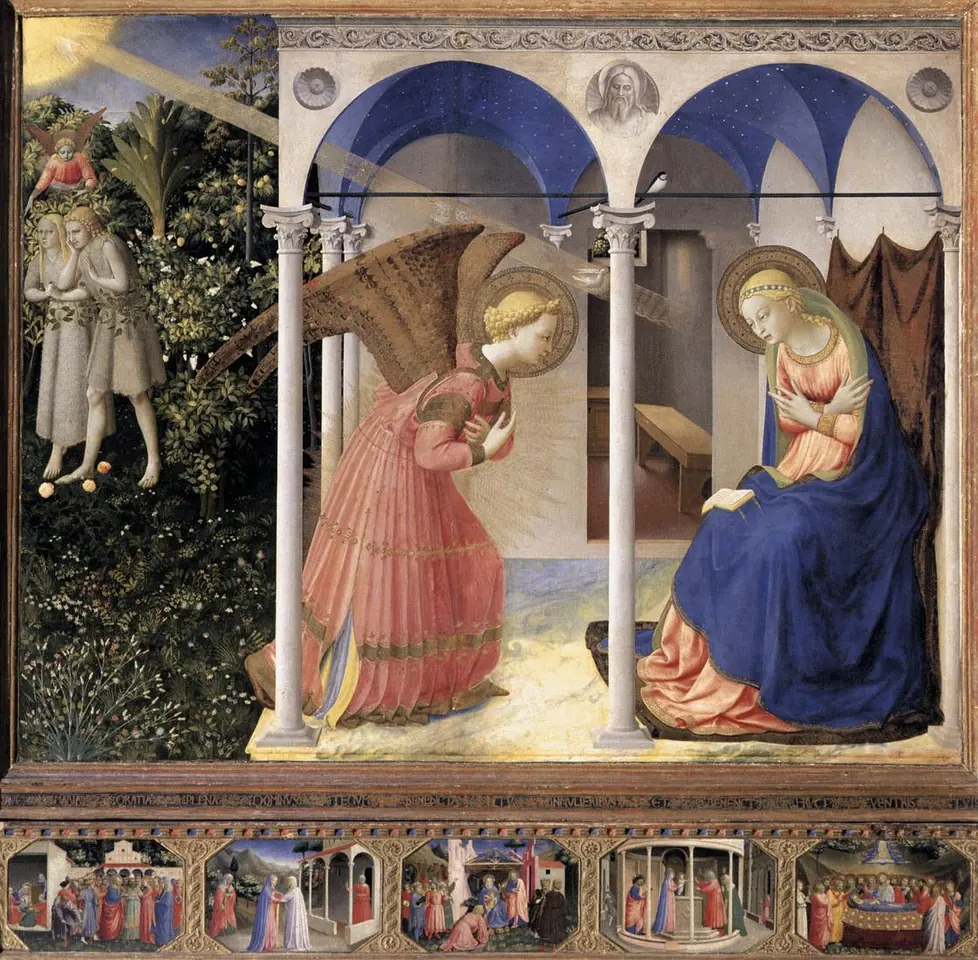
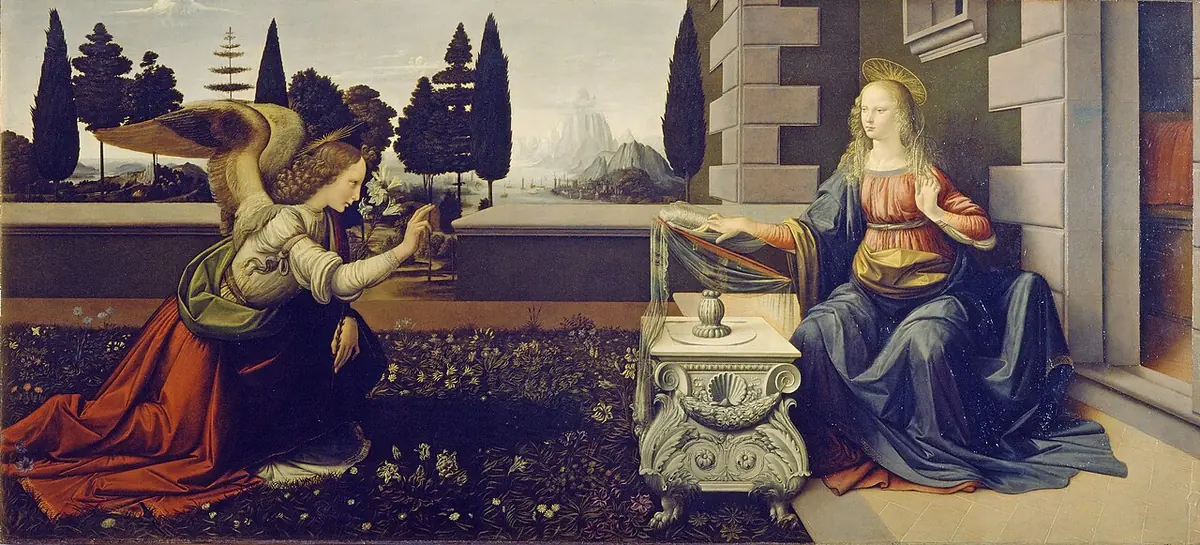
Some of the most famous paintings in Europe are Annunciations. Fra Angelico painted the scene several times; in his altarpiece now in the Prado, near the top of this page, Adam and Eve are driven out of Eden in the background, so that the first sin and the coming of the Savior share one panel. Leonardo da Vinci painted his Annunciation, now in the Uffizi, as a young artist around 1472, with Gabriel kneeling on a flowered lawn.

Jan van Eyck's Annunciation in Washington, D.C., sets the meeting inside a church. Gabriel wears a jeweled cope and has peacock-colored wings, and the words of the two speakers are painted in gold between them; Mary's answer, Ecce ancilla Domini, is painted upside down, as if addressed to God above.

Botticelli's Cestello Annunciation of 1489 to 1490 is almost a dance: the angel has just landed on his knees, and Mary sways toward him and away at the same moment.


Gabriel in Eastern icons
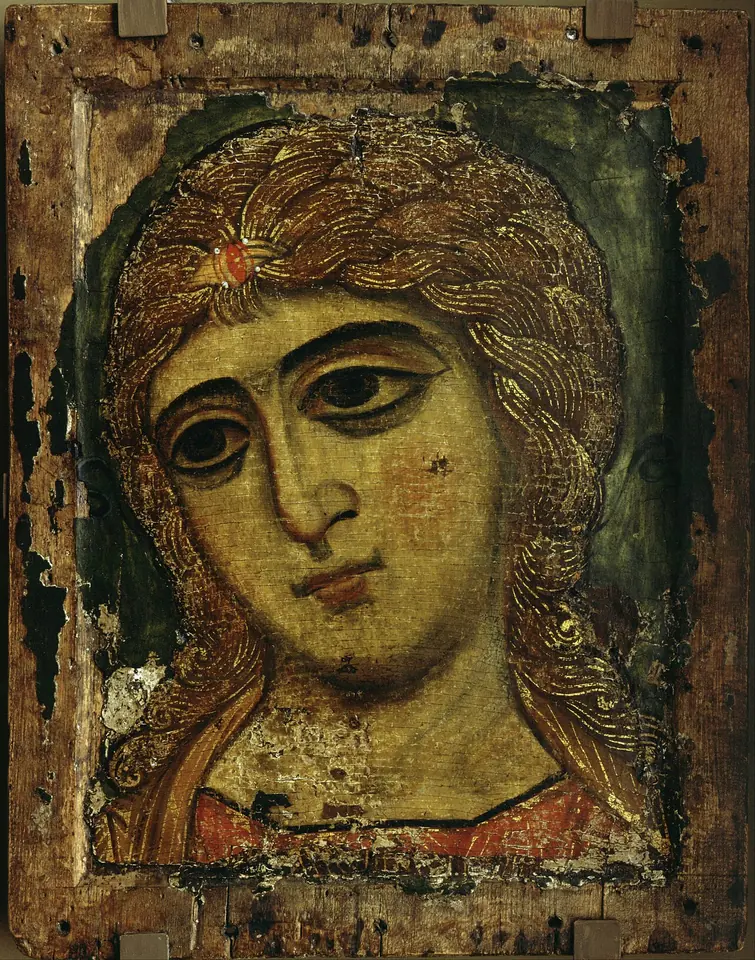
Orthodox and Eastern Catholic churches show Gabriel on the Holy Doors at the center of the iconostasis, where he and Mary face each other on the two leaves, since the Annunciation opens the way to salvation. He also stands with Michael on either side of Christ in the Deesis row of icons, and the two archangels often appear together, as in the Sinai icon below. In icons he is young, with curling hair bound by a ribbon, and he wears the robes of a Byzantine court official.

Feast day and where St. Gabriel is honored
The Catholic Church celebrates September 29 as the Feast of Sts. Michael, Gabriel and Raphael, Archangels. According to Franciscan Media, the memorials of Gabriel and Raphael were added to the Roman calendar in 1921, and the 1970 revision of the calendar joined them to Michael's feast. Before that, Gabriel's own day was March 24, the eve of the Annunciation, and the Catholic Encyclopedia mentions the hymn sung at Lauds on that day. See the feast days calendar.
The Orthodox Church keeps a Synaxis of the Archangel Gabriel on March 26, the day after the Annunciation, and a second one on July 13, a feast the Orthodox Church in America says was instituted in the 9th century. All the angels are honored on November 8.
The Church is cautious about naming angels. The Vatican's Directory on Popular Piety and the Liturgy (2001) says that "the practice of assigning names to the Holy Angels should be discouraged, except in the cases of Gabriel, Raphael and Michael whose names are contained in Holy Scripture."
Nazareth
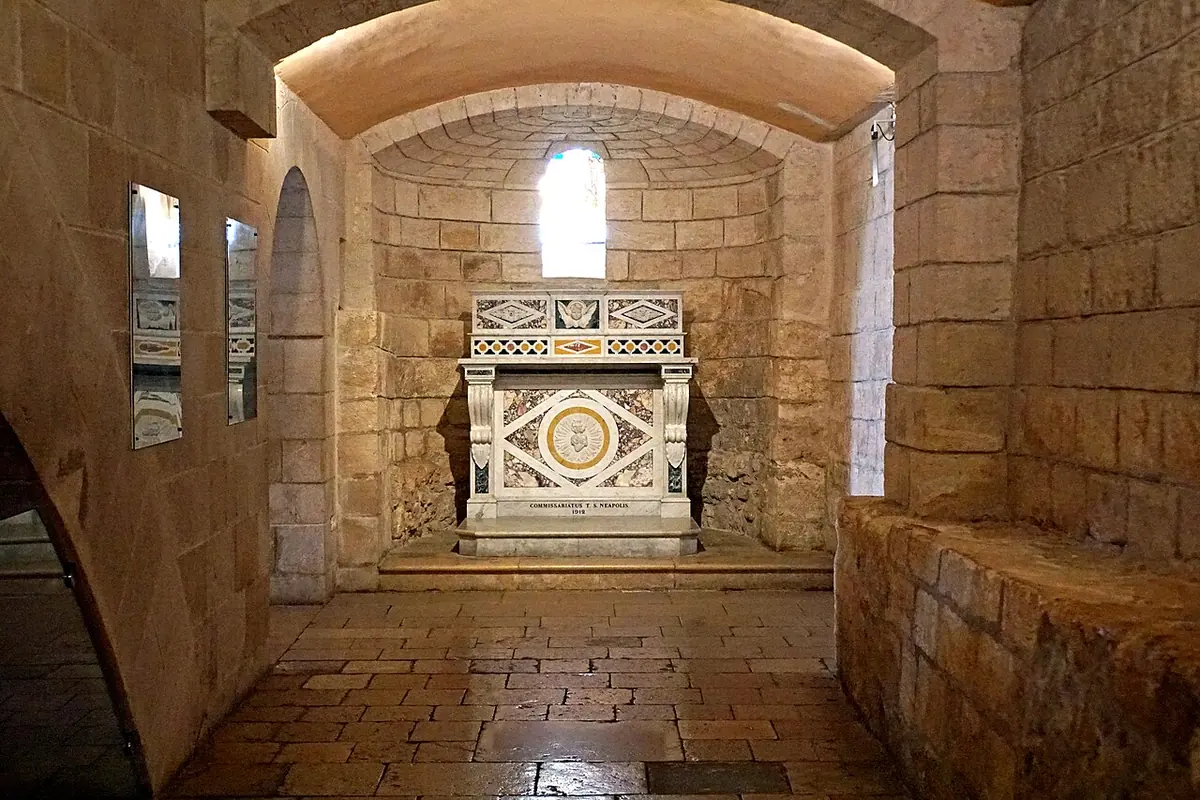

Two churches in Nazareth mark the Annunciation. The Catholic Basilica of the Annunciation, built in 1969 over earlier Byzantine and Crusader churches, stands over a grotto honored as part of Mary's house. The Greek Orthodox Church of the Annunciation, also called St. Gabriel's Church, stands over the spring where, following the Protoevangelium of James, Orthodox tradition says Gabriel first greeted Mary as she drew water.


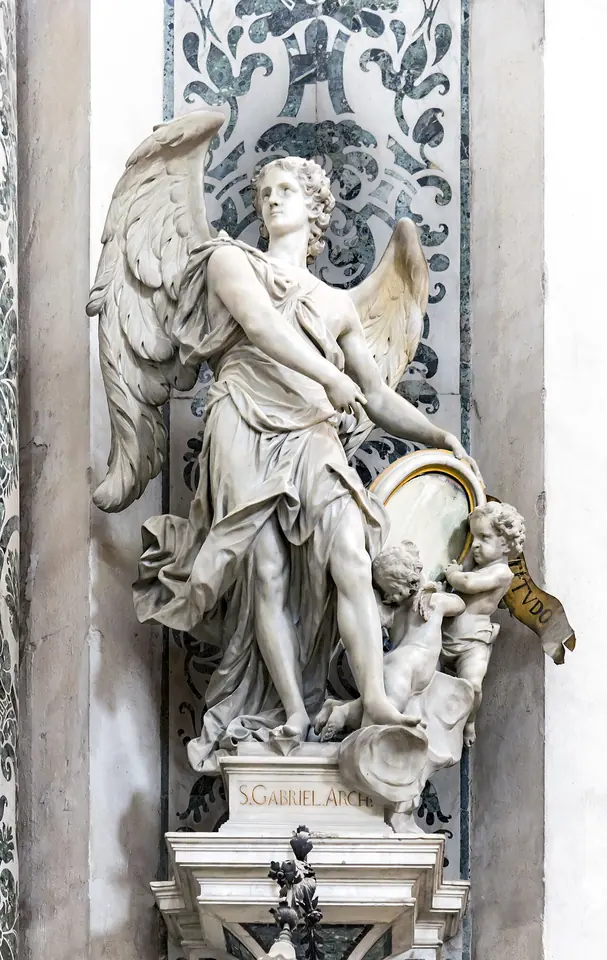
Churches, parishes and schools named for St. Gabriel are found around the world. Among Baroque churches, the Gesuiti in Venice places a marble Gabriel beside its high altar.

Prayers to St. Gabriel
Catholics ask St. Gabriel to pray for them, and people who work in communications claim him as their patron. Many short prayers to him circulate on holy cards and websites, but none has a well-documented origin, so this page quotes only texts with a known source.
The collect of the feast
The Roman Missal's collect for September 29 asks for the protection of all three archangels:
O God, who dispose in marvelous order ministries both angelic and human, graciously grant that our life on earth may be defended by those who watch over us as they minister perpetually to you in heaven. Through our Lord Jesus Christ, your Son, who lives and reigns with you in the unity of the Holy Spirit, God, for ever and ever.
The Angelus
The Angelus recalls Gabriel's message three times a day. Its versicles, as Vatican News gives them, begin:
The Angel of the Lord declared unto Mary,
And she conceived of the Holy Spirit.
A Hail Mary follows each versicle, so that Gabriel's greeting is repeated three times.
The Orthodox troparion
The Orthodox Church sings this troparion at the Synaxis of the Archangel Gabriel, in the translation of the Orthodox Church in America:
Gabriel, commander of the heavenly hosts, / we who are unworthy beseech you, / by your prayers encompass us beneath the wings of your immaterial glory, / and faithfully preserve us who fall down and cry to you: / "Deliver us from all harm, for you are the commander of the powers on high!"
Frequently asked questions
What is the Archangel Gabriel the patron saint of?
In 1951 Pope Pius XII named him the heavenly patron of telecommunications, of everyone who sends messages by telegraph, telephone and radio, and he was named patron of Vatican Radio as well. Catholics also look on him as patron of broadcasters, communications workers, messengers and postal workers, since his whole work in Scripture is delivering God's messages.
When is the feast of St. Gabriel the Archangel?
September 29, the Feast of Sts. Michael, Gabriel and Raphael, Archangels. Before the 1969 reform of the Roman calendar, Gabriel had his own feast on March 24, the day before the Annunciation. The Orthodox Church keeps a Synaxis of the Archangel Gabriel on March 26 and July 13.
What does the name Gabriel mean?
It is usually explained as "God is my strength" or "man of God." The Catholic Encyclopedia gives the Latin Fortitudo Dei, "strength of God," and calls him the angel of the power of God. The Orthodox Church in America explains it as "man of God."
What did the angel Gabriel say to Mary?
In Luke 1:28 Gabriel greets her, in the Douay-Rheims translation, "Hail, full of grace, the Lord is with thee: blessed art thou among women." He tells her she will conceive and bear a son named Jesus, the Son of the Most High, by the power of the Holy Spirit. His greeting is the first line of the Hail Mary.
Is Gabriel in the Old Testament?
Yes, in the Book of Daniel. In Daniel 8 he explains the vision of the ram and the goat, and in Daniel 9 he comes "in swift flight at the time of the evening sacrifice" to give Daniel the prophecy of the seventy weeks.
Is Gabriel the same angel in Islam?
Muslims honor Gabriel, called Jibril, as the angel who brought the revelation of the Qur'an to Muhammad. The Qur'an names him in a few verses, such as 2:97. Christians and Muslims describe his role and his messages very differently, but both see him as God's great messenger.
How do you recognize Gabriel in paintings?
In Western art he usually appears in scenes of the Annunciation, a young winged angel kneeling or arriving before Mary, often holding a lily, a scepter or an olive branch, with his hand raised in greeting. Sometimes his words, Ave Maria, gratia plena, are written in the picture. Eastern icons show him with a messenger's staff and a translucent orb.
Sources
- Catholic Encyclopedia (1909): St. Gabriel the Archangel
- Daniel 8:15-17; 9:21-23; Luke 1:11-20; 1:26-38, Revised Standard Version Catholic Edition (Bible Gateway)
- Luke 1:19, 1:28 and 1:42, Douay-Rheims (Bible Gateway)
- Vatican News: San Gabriele arcangelo (Pius XII, 1951, patron of telecommunications)
- Franciscan Media: Saints Michael, Gabriel, and Raphael
- Orthodox Church in America: Synaxis of the Archangel Gabriel (March 26)
- Orthodox Church in America: Synaxis of the Archangel Gabriel (July 13)
- Orthodox Church in America: Troparia and kontakia for March 26
- Orthodox Church in America: Synaxis of the Axion Estin Icon of the Mother of God
- Protoevangelium of James (New Advent, Church Fathers)
- Directory on Popular Piety and the Liturgy (2001), nos. 215–217
- Vatican News: The Angelus
- The Qur'an 2:97 (Saheeh International translation, Quran.com)
- Roman Missal: Feast of Sts. Michael, Gabriel and Raphael, Archangels (September 29)