Morning offering

The morning offering is a short prayer, said on waking, that offers God all the prayers, works and sufferings of the coming day through the Immaculate Heart of Mary. It began in 1844 with Fr. François-Xavier Gautrelet, S.J., and the Apostleship of Prayer, now the Pope's Worldwide Prayer Network, which still asks us to pray it daily.
Before the coffee, before the phone, before the first worry of the day, generations of Catholics have whispered a few lines that hand the whole day over to God. Here is the morning offering in its traditional words, where it came from, and how to make it part of every morning.
The morning offering prayer
This is the traditional text exactly as the Messenger of the Sacred Heart, the magazine of the Apostleship of Prayer, printed it each month in 1908:
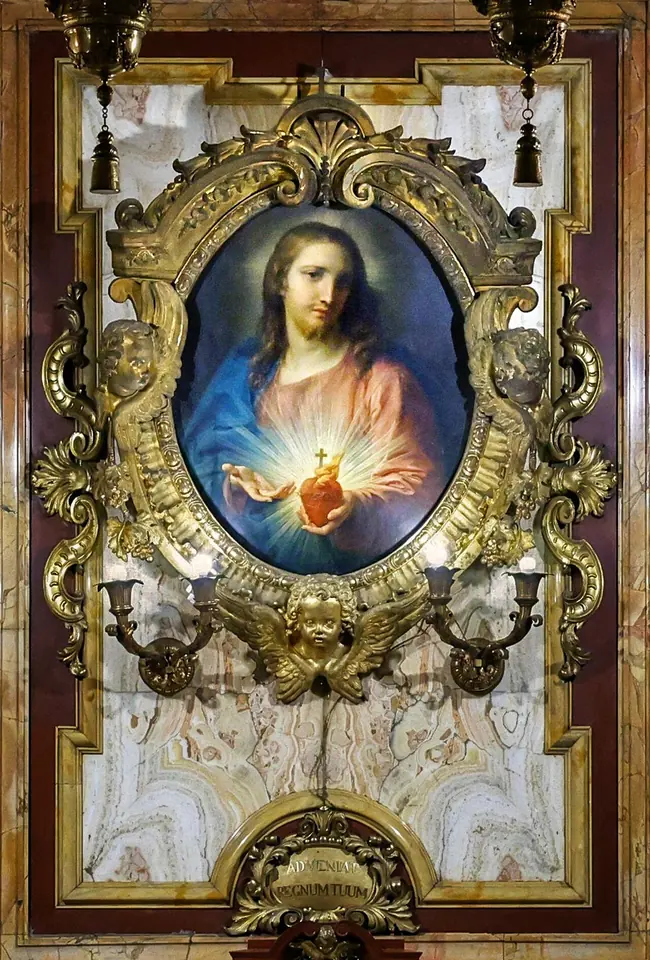
O Jesus, through the Immaculate Heart of Mary, I offer Thee my prayers, works and sufferings of this day for all the intentions of Thy Sacred Heart, in union with the Holy Sacrifice of the Mass throughout the world, for the intentions of all our Associates and in particular for ...
At the end the Messenger named the intention for that month, for example "the Integrity of the Faith." Today we finish the sentence with the intention the Holy Father has asked us to pray for this month. Many prayer books also add the words "joys" and "in reparation for my sins," and say "the intentions of the Holy Father" instead of "our Associates." The heart of the prayer is the same in every version: one day, all of it, given to Jesus through Mary.
An older form from 1878
The wording took a few decades to settle. Thirty years earlier, the Messenger printed a longer version addressed to the Sacred Heart itself:
O Sacred Heart of Jesus! through the Immaculate Heart of Mary, I offer Thee all the prayers, labours, and crosses of this day, in union with those intentions for which Thou dost unceasingly offer Thyself a Victim of love on our altars.
A short petition for the month's intention followed it, such as missionaries in Africa or religious orders under persecution. You can see the shorter, familiar prayer growing out of this one: the same three gifts (prayers, labors, crosses), the same union with the Mass, the same path through Mary's heart.
Where the morning offering comes from
The story begins on December 3, 1844, the feast of St. Francis Xavier, at the Jesuit house of studies at Vals-près-le-Puy in the hills of central France. The Pope's Worldwide Prayer Network tells it this way. The young Jesuits there were restless. They dreamed of sailing to India like Xavier and found their theology books a poor substitute. Their spiritual father, Fr. François-Xavier Gautrelet, S.J., told them in his homily that day that their mission had already begun: "Be missionaries already through your prayer, by the offering of your daily life. Your mission is here and now, in your studies and the little things of every day."
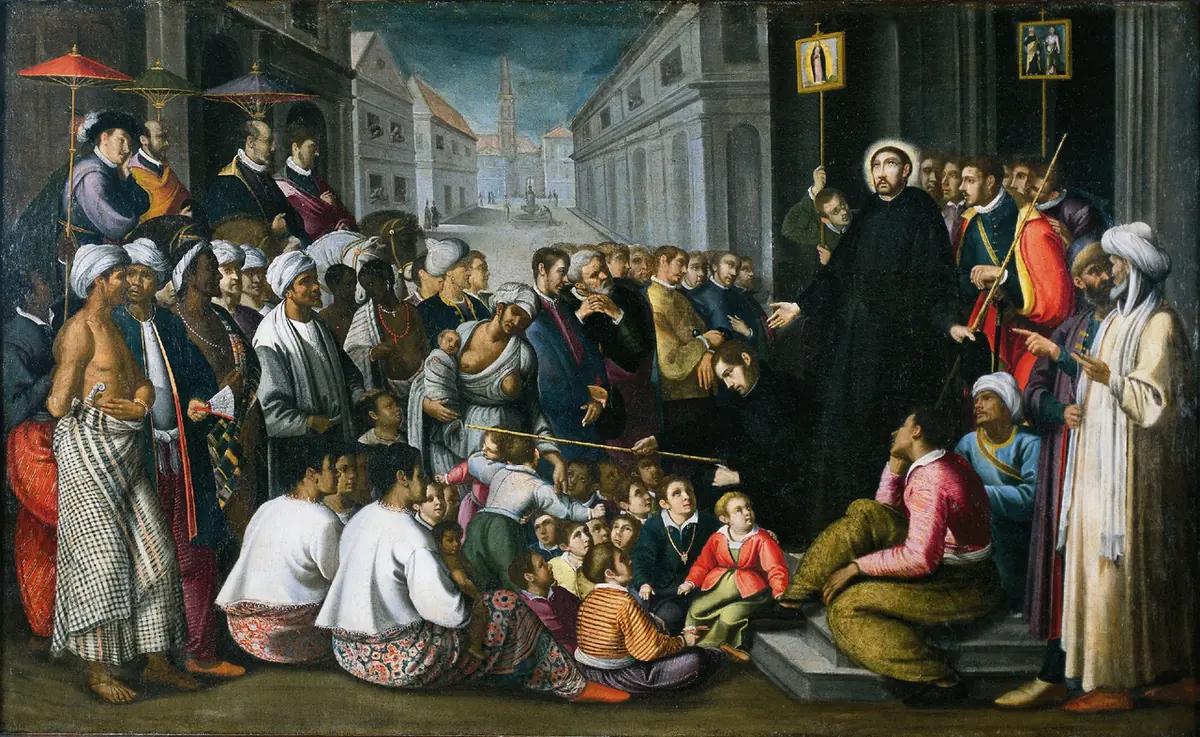
That simple idea, that ordinary work offered to God becomes a share in the Church's mission, spread from the seminary to the surrounding villages and then around the world. It took the name the Apostleship of Prayer.

How the Apostleship of Prayer grew
According to the Catholic Encyclopedia (1907), the movement owed much of its spread to another French Jesuit, Fr. Henri Ramière, who in 1861 adapted it for parishes, schools and religious houses and wrote a widely translated book, The Apostleship of Prayer. The association received its first statutes in 1879, and Leo XIII approved a revised version in 1896. Members practiced three "degrees": the daily offering, a daily decade of the rosary for the Holy Father's monthly intention, and a Communion of reparation each month or week. The encyclopedia counted more than 25 million members in 1907, about 4 million of them in the United States, organized through local centers and the Messenger of the Sacred Heart in each country.

The network's own history adds that Pius IX recognized it in 1849 and that in 1890 Leo XIII entrusted it with his monthly prayer intentions, a duty it still carries. Pius XII, on its centenary in 1944, called it "one of the most efficacious means for the salvation of souls." St. Thérèse of Lisieux was among its members, according to the network.
In 2014 Pope Francis approved a renewed identity, the Pope's Worldwide Prayer Network. He recognized it as a Pontifical Work in 2018, and it became a Vatican foundation in 2020. It is entrusted to the Society of Jesus, the order of St. Ignatius of Loyola, and it counts more than 22 million people in over 90 countries. Its youth branch is the Eucharistic Youth Movement.
What the morning offering asks
Each phrase carries a piece of the faith.
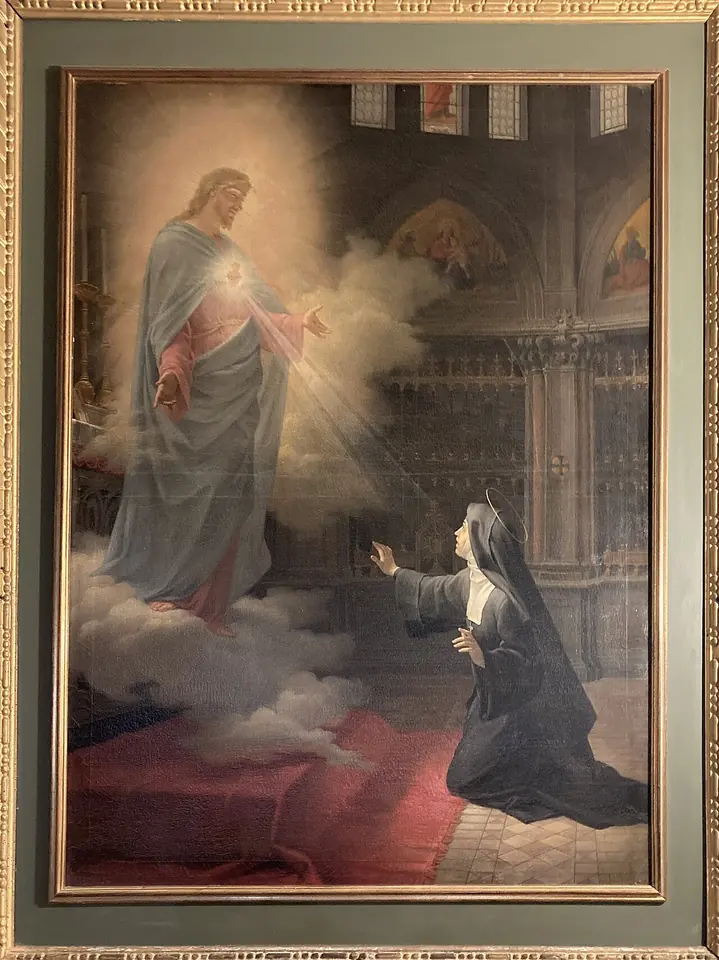
"O Jesus, through the Immaculate Heart of Mary." The prayer is addressed to Jesus. We go to him through his Mother, as the Church always has, because no one brought Christ to the world more faithfully than she did. The Apostleship of Prayer was from the start a devotion to the Sacred Heart, the devotion Our Lord revealed to St. Margaret Mary Alacoque at Paray-le-Monial in the 1670s, and the morning offering is its daily form.
"My prayers, works and sufferings of this day." Nothing is left out. The Catechism (no. 901), quoting the Second Vatican Council, teaches that the laity's "works, prayers, and apostolic undertakings, family and married life, daily work, relaxation of mind and body," and "even the hardships of life if patiently born," become "spiritual sacrifices acceptable to God through Jesus Christ." The morning offering is how we say yes to that in the first minute of the day. The dishes, the commute, the meeting, the headache: all of it can be offered.
"In union with the Holy Sacrifice of the Mass throughout the world." The Catechism continues that in the Eucharist these offerings "may most fittingly be offered to the Father along with the body of the Lord." At every hour of the day and night, Mass is being offered somewhere on earth. The morning offering joins our small gifts to that one great Sacrifice of Christ, even on days we cannot get to church.
"For all the intentions of Thy Sacred Heart." We do not need to know what those intentions are. We hand our day over and let Jesus spend it where it is most needed. Then we name one intention in particular, the one the Holy Father asks of us, so that millions of people around the world pray for the same need on the same day.
How to make the morning offering a daily habit
St. Francis de Sales, writing in 1609, called morning prayer "a general preparation for all the day's work." In his Introduction to the Devout Life he advised giving thanks for the night, remembering that the day is given "in order that you may work for Eternity," foreseeing the day's chances to serve God and its temptations, and then offering one's heart and good intentions to God. "All these acts should be made briefly and heartily," he wrote, "before you leave your room if possible."
A few practical ways to keep it:
- Tie it to something you already do. Say it while your feet touch the floor, while the coffee brews, or before you look at your phone.
- Keep the words where you will see them. A holy card on the mirror or the nightstand helps until the prayer is memorized, which takes about a week.
- Learn the month's intention. The Pope's Worldwide Prayer Network publishes it every month, with a short video. Naming it turns a private prayer into a shared one.
- Pray it with your children. It takes less than a minute at the breakfast table and teaches them that their schoolwork can be a gift to God.
- Renew it during the day. The Angelus at noon, a glance at a crucifix or a simple "Jesus, I offer you this" brings the morning's intention back.
- Close the day with an examen. At night, look back over what you offered that morning and thank God for it.
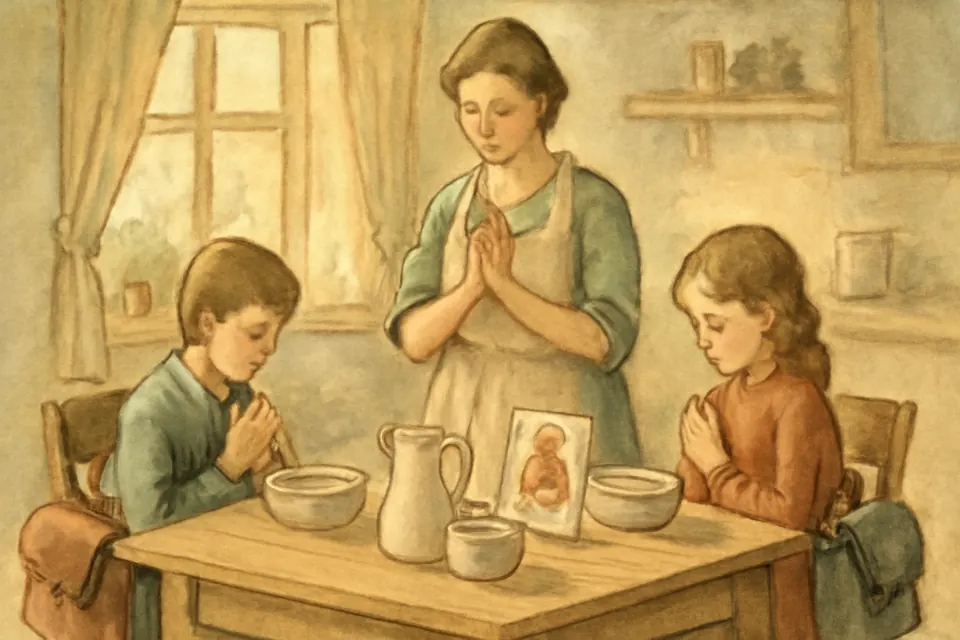
If you forget, offer the rest of the day as soon as you remember. The offering does not have to feel fervent to be real. On the hardest mornings, the words themselves are the gift.
The morning offering and the saints
The offering of one's whole day is older than its 1844 wording. It is St. Paul's "whether you eat or drink, or whatsoever else you do, do all to the glory of God" (1 Corinthians 10:31, Douay-Rheims) made concrete. St. Thérèse lived it with her "little way" of doing small things with great love, and she is a patroness of missions though she never left her Carmel, which is exactly what Fr. Gautrelet told his students they could be.

The Church also encourages this prayer through indulgences. The current Enchiridion Indulgentiarum (2004) does not name the morning offering, but its first general grant gives a partial indulgence to anyone who, while carrying out their duties and bearing life's hardships, raises their mind to God with humble trust and adds a short invocation.
Let us begin tomorrow, and every day, by giving it all to him. For other short prayers that fit the rhythm of a day, see the Angelus, the Guardian Angel prayer, the Anima Christi after Communion and the Magnificat at evening. For the Mother through whose heart we make the offering, see the Blessed Virgin Mary.
Frequently asked questions
What is the morning offering prayer?
It is a short prayer said at the start of the day that offers God everything the day will hold, prayers, work and sufferings, through the Immaculate Heart of Mary and in union with the Mass. It is the basic practice of the Apostleship of Prayer, now called the Pope's Worldwide Prayer Network.
Who wrote the morning offering?
The practice began on December 3, 1844, when Fr. François-Xavier Gautrelet, S.J., urged the young Jesuits he guided at Vals-près-le-Puy in France to offer their daily work as their mission. The exact wording grew over the following decades: the Messenger of the Sacred Heart printed a longer form in 1878 and the familiar short text by 1908.
What is the traditional morning offering?
The classic text begins "O Jesus, through the Immaculate Heart of Mary, I offer Thee my prayers, works and sufferings of this day for all the intentions of Thy Sacred Heart." The full traditional wording, as printed in 1908, is at the top of this page.
When should I say the morning offering?
As soon as you can after waking, ideally before the day's business begins. St. Francis de Sales advised making the morning offering "before you leave your room if possible." If you forget, say it as soon as you remember; God does not keep a stopwatch.
Why does the morning offering mention the Pope's intention?
Since 1890, when Leo XIII entrusted his monthly prayer intentions to the Apostleship of Prayer, members have offered their day for the intention the Holy Father names each month. The Pope's Worldwide Prayer Network publishes the intention, along with a short video, every month.
Is there an indulgence for the morning offering?
The current Enchiridion Indulgentiarum (2004) does not list it by name, but its first general grant gives a partial indulgence to the faithful who, while carrying out their duties and bearing life's hardships, raise their minds to God with humble trust and add a pious invocation. The morning offering is exactly that kind of prayer.
Sources
- Catholic Encyclopedia (1907): The Apostleship of Prayer
- Pope's Worldwide Prayer Network (USA): About, history from 1844
- Pope's Worldwide Prayer Network: Who we are (Pontifical Work 2018, Vatican Foundation 2020)
- The Messenger of the Sacred Heart of Jesus, vol. 12 (1908), monthly Morning Offering (archive.org)
- The Messenger of the Sacred Heart of Jesus, vol. IV, July to December 1878 (archive.org)
- St. Francis de Sales, Introduction to the Devout Life, part II, chapter 10: Morning Prayer (CCEL)
- Catechism of the Catholic Church, no. 901
- Apostolic Penitentiary, Enchiridion Indulgentiarum, 4th edition (2004), first general grant