St. Francis de Sales
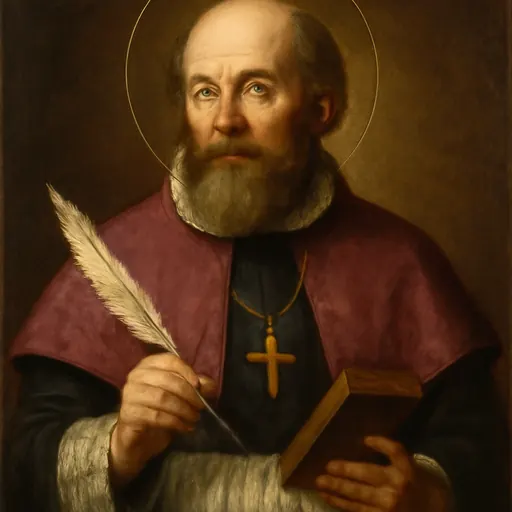
St. Francis de Sales (1567–1622) was the bishop of Geneva, a preacher and spiritual director who wrote Introduction to the Devout Life, one of the most widely read Catholic books ever printed. With St. Jane Frances de Chantal he founded the Visitation nuns, and he was named a Doctor of the Church in 1877. His feast day is January 24, and he is the patron saint of writers and journalists, and of the deaf.
Who was St. Francis de Sales?
Francis de Sales was a nobleman from Savoy who gave up the law to become a priest, won much of the Calvinist Chablais back to the Catholic faith, and served twenty years as bishop of Geneva. He never lived in Geneva. The city had been Protestant since the Reformation, so its bishops lived in exile at Annecy, where he worked and is buried.
He is best known for Introduction to the Devout Life (1609), which taught that holiness is for married people, soldiers and courtiers as well as monks and nuns. The Catholic Encyclopedia says it "was translated into nearly every language even in the lifetime of the author." With St. Jane Frances de Chantal he founded the Order of the Visitation in 1610. Pope Pius IX declared him a Doctor of the Church in 1877.


People remembered his gentleness above all. It did not come naturally: the liturgist Pius Parsch, quoted by Catholic Culture, wrote that it took him years to master a fiery temper.
The life of St. Francis de Sales
A Savoyard nobleman
Francis was born on August 21, 1567, at the Château de Sales near Thorens, in the Duchy of Savoy, the eldest of six sons. His father meant him for the Senate of Savoy and sent him from 1583 to 1588 to the Jesuit Collège de Clermont in Paris.
The crisis in Paris
In Paris the young student fell into what the Catholic Encyclopedia calls "a terrible and prolonged temptation to despair." Theologians were arguing about predestination, and Francis became convinced he was among the damned. The crisis ended when he knelt before an image of the Virgin Mary in the church of Saint-Étienne-des-Grès. Benedict XVI quoted his prayer from the canonization records: "Whatever happens, Lord, you who hold all things in your hand and whose ways are justice and truth; whatever you have ordained for me... I will love you Lord." The fear left him. He made a vow of chastity and consecrated himself to Mary.

He took a doctorate in civil and canon law at Padua in 1592, then refused both the heiress his father had chosen for him and a seat in the Senate. When the bishop of Geneva, Claude de Granier, had him named provost of the cathedral chapter, his father gave way. He was ordained a priest on December 18, 1593.
The mission to the Chablais
In 1594 the Chablais, the district on the south shore of Lake Geneva around Thonon, had been Calvinist for some sixty years and had just come back under the rule of the Catholic Duke of Savoy. Francis volunteered to go there as a missionary with no one but his cousin Louis. He lived in the fortress of Allinges and went down to Thonon to preach, but for a long time almost no one came.
So he wrote. Pius XI described it in 1923: "He sought then to refute their erroneous doctrines by means of loose leaflets which he wrote in the intervals between his sermons. These leaflets were distributed about in great quantities and passed from hand to hand." Popular retellings say he slipped them under people's doors. The pages were collected after his death and published as the Controversies.
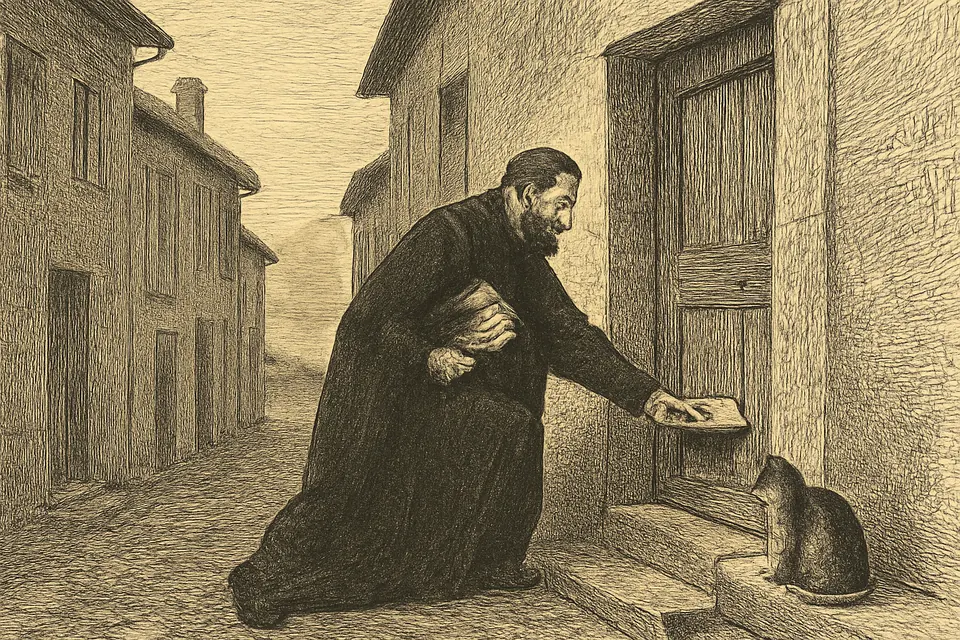
At the request of Pope Clement VIII he even went to Geneva to speak with Theodore Beza, Calvin's successor, who received him kindly but did not change his mind. By 1598 most of the Chablais had returned to the Catholic Church.
Bishop of Geneva
Bishop de Granier made Francis his coadjutor in 1599, and on Granier's death Francis was consecrated bishop of Geneva on December 8, 1602. He set up catechism classes, visited the parishes scattered through his mountains, and lived simply so he could give more to the poor. He preached in Dijon, Grenoble and Paris, where in 1618 and 1619 he came to know St. Vincent de Paul. Offered the post of coadjutor of Paris, he refused it and went home to Annecy.


The deaf man Martin
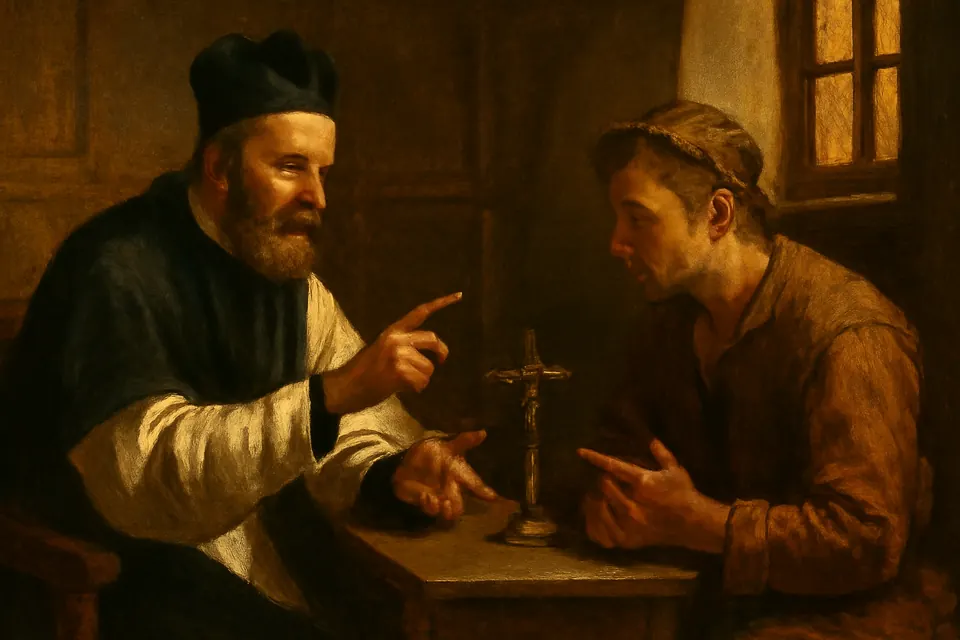
The 18th-century biography by Pietro Giacinto Gallizia, published in English in 1854, tells how a poor young man "who had been deaf and dumb from his birth" begged at the bishop's lodging. Francis heard that he was "remarkably ready in understanding and in making himself understood by signs." Over his servants' objections, he took the young man, Martin, into his household and taught him the faith himself through signs. Gallizia says Martin made his confession to the bishop by signs and received Holy Communion with great devotion, and that he died of grief a few days after Francis.
The Visitation
In Lent of 1604, preaching at Dijon, Francis met Jane Frances Frémyot, the widowed Baroness de Chantal. He became her spiritual director, and on Trinity Sunday, June 6, 1610, they began the Visitation of Holy Mary at Annecy. It was meant for women, widows included, who were not strong enough for the hard penances of the older orders. At first the sisters were to go out to visit the sick poor, hence the name. In 1616, at the urging of the archbishop of Lyon, he agreed to make the Visitation an enclosed order under the Rule of St. Augustine. St. Margaret Mary Alacoque was later a Visitation nun at Paray-le-Monial.


Death at Lyon
In late 1622 Francis traveled with the court of Savoy to Lyon, where he stayed in a gardener's cottage of the Visitation convent. He suffered a stroke on December 27 and died the next day, December 28, at 55, repeating, according to the Catholic Encyclopedia, "God's will be done! Jesus, my God and my all!" His body was taken back to Annecy. His heart stayed in Lyon, and the Visitation nuns carried it to Venice during the French Revolution.
His books
Introduction to the Devout Life grew out of his letters to a young married woman, Madame de Charmoisy. It is addressed to "Philothea," a soul who loves God, and in the author's preface he says his aim is "to teach those who are living in towns, at court, in their own households." Its most famous chapter says devotion must fit each person's state in life. In the Library of Spiritual Works for English Catholics translation, available at CCEL:
It is an error, nay more, a very heresy, to seek to banish the devout life from the soldier's guardroom, the mechanic's workshop, the prince's court, or the domestic hearth.
Treatise on the Love of God (1616) is longer and harder, written for "Theotimus," a soul further along. In Henry Benedict Mackey's translation it opens its account of God and man with the line Benedict XVI chose to begin his catechesis on Francis: "God is God of the human heart" (Book I, chapter 15). Book X begins:
Man is the perfection of the universe; the spirit is the perfection of man; love, that of the spirit; and charity, that of love.
Benedict XVI traced both the teaching method of St. John Bosco and the "Little Way" of St. Thérèse of Lisieux back to him.
The miracles of St. Francis de Sales
- Approved: the healings accepted by the Church for his beatification in 1661 and canonization in 1665 under Alexander VII. The Catholic Encyclopedia notes "a great number of wonderful favours" at his tomb in Annecy, without describing the cases.
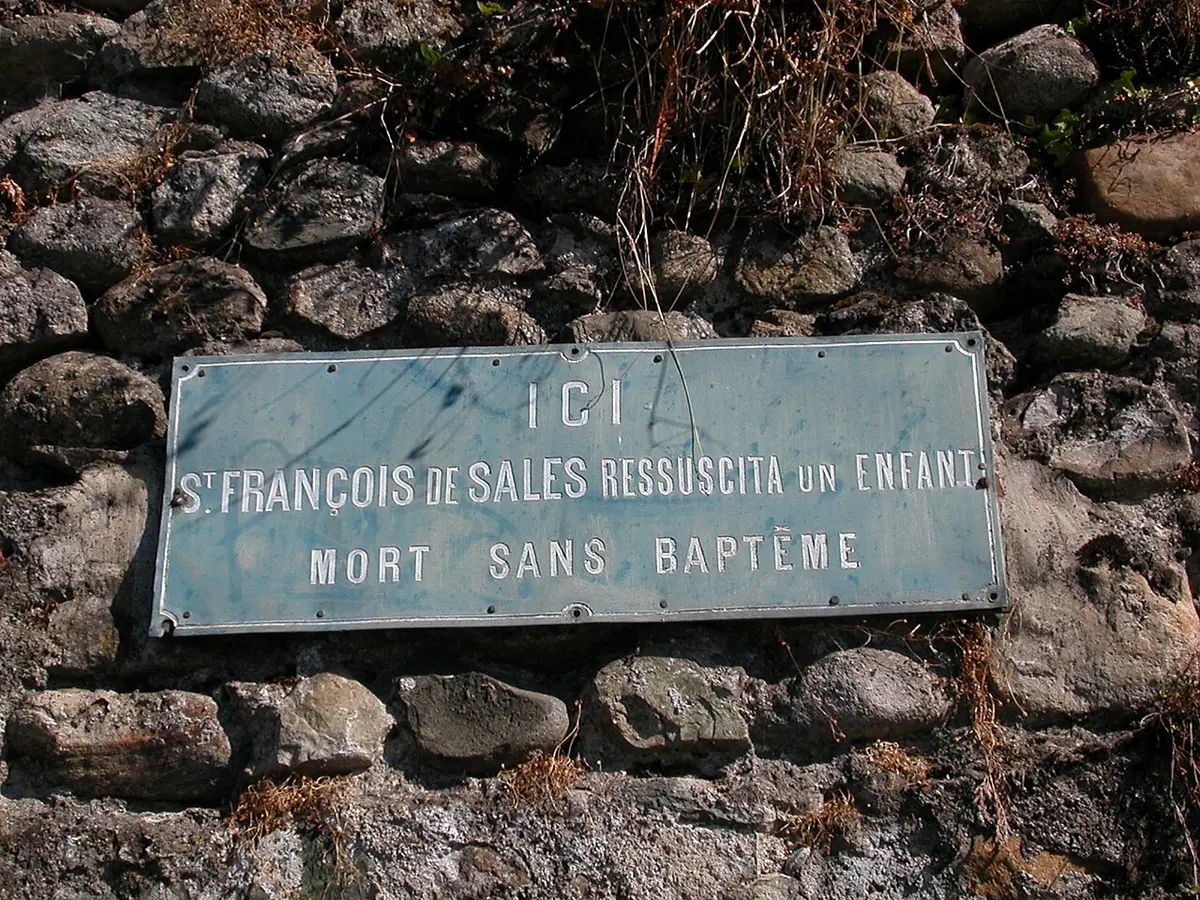
- Traditional: the raising of a child who had died without baptism at Thonon. A plaque in the town marks the spot.
- Reported: answered prayers attributed to his intercession by those who ask his help today.

Why St. Francis de Sales is the patron saint of writers and the deaf
Writers and journalists. In 1923, for the third centenary of his death, Pope Pius XI wrote the encyclical Rerum Omnium Perturbationem. He recalled the Chablais leaflets and asked Catholics "who as journalists and writers expound, spread, and defend the doctrines of the Church" to imitate the saint's "strength joined always to moderation and charity." He then declared Francis de Sales "the Heavenly Patron of all Writers." Catholic journalists and the Catholic press have claimed him as patron ever since.
The deaf. No papal document names him patron of the deaf. The patronage comes from the story of Martin, told above.
Educators and the Salesians. St. John Bosco took him as patron for his work with poor boys in Turin, and his society of priests, founded in 1859, is still called the Salesians. See more patron saints.
Symbols of St. Francis de Sales in art
His early portraits were copied so faithfully that he is easy to recognize. Look for:
- A bald head and a full, rounded beard: from the 1624 engraving to modern holy cards.
- Bishop's dress: a black cassock, a white lace rochet, a short mozzetta and a pectoral cross, as in the Bussy-Rabutin portrait.
- A book or a pen: for his writings, and for his patronage of writers.
- A heart crowned with thorns or pierced: the emblem of the Visitation, which he chose for the order. Later paintings, like Giaquinto's in Madrid, show him with St. Jane before the Sacred Heart of Jesus.
- Nuns in black habits: usually St. Jane Frances de Chantal and the first Visitation sisters, receiving the rule from him.


Francis de Sales lived long after the split between East and West, so he does not appear in Orthodox icons.
Feast day and where St. Francis de Sales is honored
His feast is January 24, a memorial in the General Roman Calendar. Before 1969 it was January 29. January 24 is the date of his burial in the Visitation church at Annecy, after his body was brought back from Lyon. See the feast day calendar.


His body rests in the Basilica of the Visitation, on a hill above Annecy, where St. Jane Frances de Chantal is also enshrined. In Thonon-les-Bains a basilica bears his name.


Prayer to St. Francis de Sales
The prayer the Church uses on his feast is the collect of the Mass in the Roman Missal (English translation, 2011):
O God, who for the salvation of souls willed that the Bishop Saint Francis de Sales become all things to all, graciously grant that, following his example, we may always display the gentleness of your charity in the service of our neighbor. Through our Lord Jesus Christ, your Son, who lives and reigns with you in the unity of the Holy Spirit, God, for ever and ever.
Catholic writers and journalists often ask his prayers before they work, and deaf Catholics ask his help as their patron.
Frequently asked questions
What is St. Francis de Sales the patron saint of?
Writers, journalists and the Catholic press, by the 1923 encyclical Rerum Omnium Perturbationem of Pope Pius XI. He is also the patron of the deaf, of educators and of the city and diocese of Annecy, and several religious congregations, the Salesians of Don Bosco among them, are named for him.
When is the feast of St. Francis de Sales?
January 24, a memorial in the General Roman Calendar. Before the 1969 calendar reform his feast was January 29, and some traditional communities still keep that date.
Why is St. Francis de Sales the patron of writers?
When the Calvinists of the Chablais would not come to hear him preach, he wrote short leaflets explaining Catholic teaching and had them passed from hand to hand. Pius XI told this story in 1923 and declared him "the Heavenly Patron of all Writers."
Why is St. Francis de Sales the patron of the deaf?
His early biographers tell how he took a deaf young man named Martin into his household, taught him the faith through signs, heard his confession and gave him Holy Communion. This made him the traditional patron of deaf people.
What did St. Francis de Sales write?
His best-known books are Introduction to the Devout Life (1609), written for lay people living in the world, and Treatise on the Love of God (1616). He also left the Controversies (his Chablais leaflets), sermons, the Spiritual Conferences given to the Visitation nuns, and thousands of letters of spiritual direction.
Sources
- Catholic Encyclopedia (1909): St. Francis de Sales
- Catholic Encyclopedia (1912): Visitation Order
- Pius XI, Rerum Omnium Perturbationem (January 26, 1923), encyclical on St. Francis de Sales
- Benedict XVI, General Audience of 2 March 2011: Saint Francis de Sales
- Francis de Sales, Introduction to the Devout Life (Library of Spiritual Works for English Catholics translation), CCEL
- Francis de Sales, Treatise on the Love of God, translated by Henry Benedict Mackey, O.S.B., CCEL
- Peter Hyacinth Gallitia, The Life of Saint Francis de Sales, Bishop and Prince of Geneva, vol. II (London, 1854)
- Catholic Culture: Memorial of St. Francis de Sales (collect of the Mass, patronages)
- Roman Martyrology, January 24