Guardian angel prayer

The guardian angel prayer is the short rhyme "Angel of God, my guardian dear, to whom His love commits me here, ever this day be at my side, to light and guard, to rule and guide. Amen." It translates the Latin Angele Dei, which grew from a poem by Reginald, a monk of Canterbury, written in the early 1100s. The faithful say it morning and night, and it is often the first prayer a child learns.
Most of us can't remember learning this prayer, because we learned it before we could read. It is four lines long, it rhymes, and it is addressed not to God or a saint but to the angel God has set beside each one of us. Here is the full text, then where it came from, which turns out to be a surprisingly well-documented story.
The guardian angel prayer
This is the English version found in Catholic prayer books since at least the 1850s, as printed in the 1857 English Raccolta, the collection of prayers the popes had indulgenced:
Angel of God, my guardian dear, To whom His love commits me here, Ever this day be at my side, To light and guard, to rule and guide. Amen.
At night, families usually change the third line to "Ever this night be at my side."
The Latin original: Angele Dei
The same book gives the Latin it translates:
Angele Dei, qui custos es mei, me tibi commissum pietate superna illumina, custodi, rege, et guberna. Amen.
Many later prayer books add hodie ("today") or hac nocte ("tonight") before illumina, which is where the English "this day" and "this night" come from.
A plainer translation
The rhyme takes a few liberties. The 1910 English Raccolta also printed a prose version that stays closer to the Latin:
Angel of God, whom God hath appointed to be my guardian, enlighten and protect, direct and govern me. Amen.
Word for word, the Latin says: "Angel of God, who are my guardian, me entrusted to you by heavenly kindness, enlighten, guard, rule and govern." The four verbs are the heart of it. The prayer asks the angel for light for the mind, protection from harm, and steady guidance through the day.
Where the Angel of God prayer comes from
A poem written at Canterbury
For a long time the prayer floated without an author. Older writers sometimes credited it to St. Anselm, the archbishop of Canterbury who died in 1109, because short prayers like it circulated with collections of his devotions. The real source lies a few hundred yards from Anselm's cathedral.
Reginald of Canterbury was a French-born poet who became a Benedictine monk of St. Augustine's Abbey, Canterbury, probably by about 1092. His editor, Levi Robert Lind, could date his writing in England from 1102 at the latest to at least 1109. Reginald's longest work is the Vita Sancti Malchi, a verse epic of 3,344 rhymed lines retelling St. Jerome's story of Malchus, a monk captured by raiders in the Syrian desert. Its sixth and last book is mostly prayers: to God, to the cross, to the Virgin, to the apostles, and to Malchus's guardian angel.
That last prayer, "The quatrains of Malchus to his angel," opens this way in Lind's 1942 edition:
Angele, qui meus es custos pietate superna, Me tibi commissum serva, tueare, guberna; Terge meam mentem vitiis et labe veterna. Assiduusque comes mihi sis vitaeque lucerna.
In our own literal English: "Angel, who are my guardian by heavenly kindness, keep me who am entrusted to you, protect and govern me; wash my mind clean of vices and the old stain, and be my constant companion and the lamp of my life." The poem goes on for more than thirty stanzas, every one beginning Angele.
Put the first two lines next to the Angele Dei and the family likeness is plain: qui meus es custos pietate superna, me tibi commissum ... guberna becomes qui custos es mei, me tibi commissum pietate superna ... guberna. Someone, at some point after Reginald, boiled his long prayer down to a single memorable sentence. We could not find who did it, or when, and no one has shown that Reginald did it himself.

Popes and prayer books
By the 1700s the short Latin prayer was so familiar that the Raccolta simply calls it "the following well-known invocation." On October 2, 1795, the feast of the Guardian Angels, Pius VI granted an indulgence of 100 days each time it was said devoutly, with a plenary indulgence on the feast for those who said it morning and evening all year. He added one for the hour of death in 1796, and Pius VII added a monthly plenary indulgence in 1821 for those who said it daily. The 1857 Raccolta records all of these. That system of counting days was reformed by Paul VI in 1967, but the prayer itself lost none of its popularity.
The rhyming English version appears in the 1857 Raccolta translated by Ambrose St. John of the Birmingham Oratory, and in American prayer books of the same years. Its translator's name has not survived.
What the Bible says about guardian angels
The prayer rests on a handful of verses. Here they are in the Douay-Rheims, the Catholic translation in use when the English prayer was made.
Matthew 18:10. Jesus, with a child standing in the middle of his disciples, says: "See that you despise not one of these little ones: for I say to you, that their angels in heaven always see the face of my Father who is in heaven." This verse is the reason the guardian angel has always been tied so closely to children, and it is read in the Gospel of the October 2 Mass.
Psalm 91:11 (numbered Psalm 90 in the Douay-Rheims and the old Latin Vulgate): "For he hath given his angels charge over thee; to keep thee in all thy ways."
Hebrews 1:14: "Are they not all ministering spirits, sent to minister for them, who shall receive the inheritance of salvation?"
Acts 12:15. When the apostle Peter, just freed from prison by an angel, knocks at the door of a house where Christians are praying, they refuse at first to believe it is him. "It is his angel," they say, which suggests that the first Christians already thought of each believer as having an angel of his own.
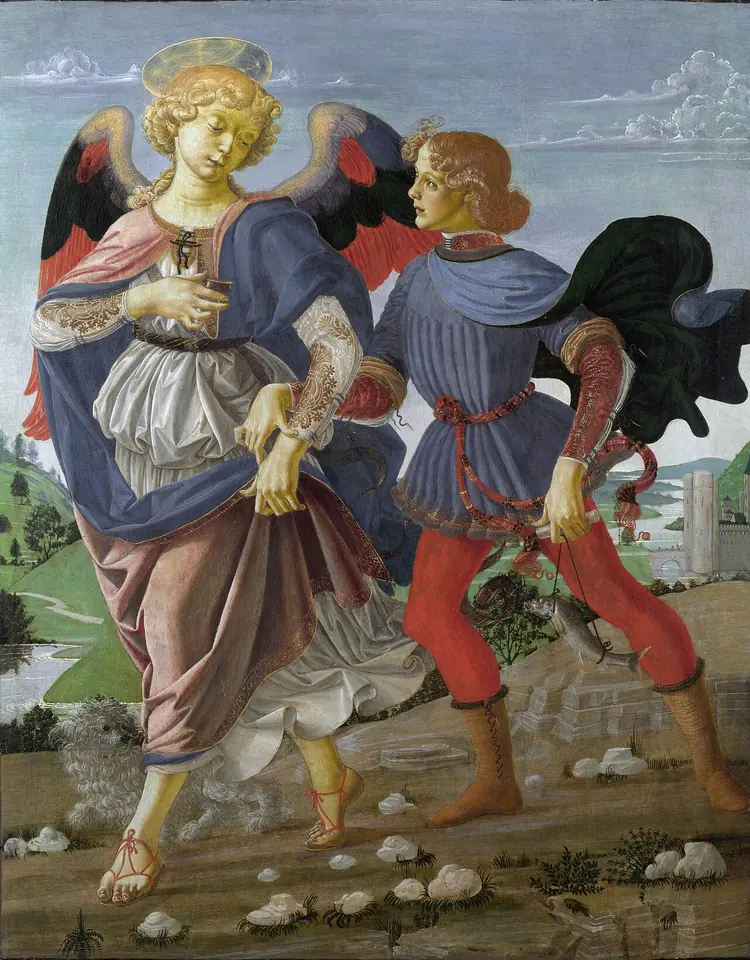
The Book of Tobit, part of the Church's canon of Scripture, tells the longest guardian story of all: the archangel St. Raphael, traveling in disguise, guides young Tobias on his journey, protects him, and brings him home. Raphael is not a guardian angel in the everyday sense, but artists have used his story to picture one for five hundred years.
What the Catholic Church teaches
The Catechism of the Catholic Church puts the teaching in three sentences (no. 336): "From infancy to death human life is surrounded by their watchful care and intercession. 'Beside each believer stands an angel as protector and shepherd leading him to life.' Already here on earth the Christian life shares by faith in the blessed company of angels and men united in God." The middle sentence is a quotation from St. Basil the Great, writing in the 360s.
The Catholic Encyclopedia of 1910 adds a careful point. That every individual soul has a guardian angel "has never been defined by the Church," so it is not an article of faith in the strict sense, but it is "the mind of the Church," as St. Jerome put it: "how great the dignity of the soul, since each one has from his birth an angel commissioned to guard it." St. Thomas Aquinas taught that every person, baptized or not, receives a guardian at birth.
Guardian angels are not the souls of the dead. The Church teaches that angels are a separate creation, pure spirits, and a grandmother who has died does not become anyone's angel, however natural the thought feels at a funeral. The only angels the Bible names are St. Michael, St. Gabriel and Raphael.

The feast of the Guardian Angels, October 2
The feast began locally. The Catholic Encyclopedia traces a request from Córdoba in 1579 for an office in honor of the guardian angels, and Valencia received approval for one in 1582. Paul V added it to the general calendar as an optional feast on September 27, 1608. Clement X then made it obligatory for the whole Church and fixed it on October 2, the first open day after the feast of St. Michael and all angels on September 29. Leo XIII raised its rank in 1883. In today's calendar it is a memorial.
Pope Francis preached on the feast in 2014 and ended with questions any listener could ask: "How is my relationship with my guardian angel? Do I listen to him? Do I bid him good day in the morning? Do I tell him: 'guard me while I sleep?' Do I speak with him? Do I ask his advice? Is he beside me?"
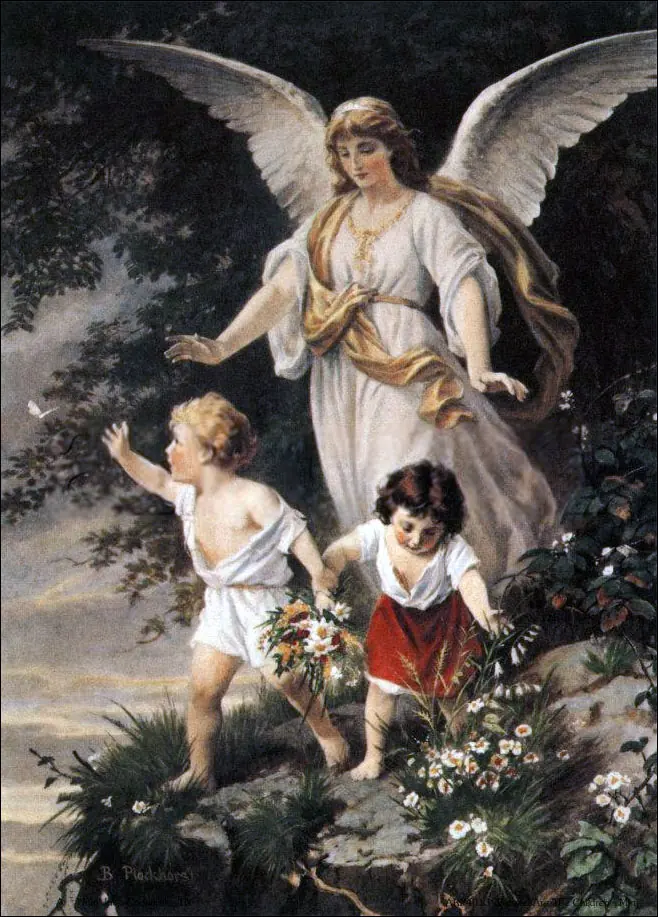
Teaching the guardian angel prayer to kids
The prayer has survived for centuries mostly because parents and teachers pass it on to small children. A few things help.
- Tie it to a time. Bedtime is the classic moment, and many families also say it in the car on the way to school. The same moment every day builds the habit.
- One line at a time. Say a line and let the child repeat it. The rhyme does most of the work.
- Explain the hard words. "Commits" means "gives into your care." "To rule and guide" means to help me choose the right thing.
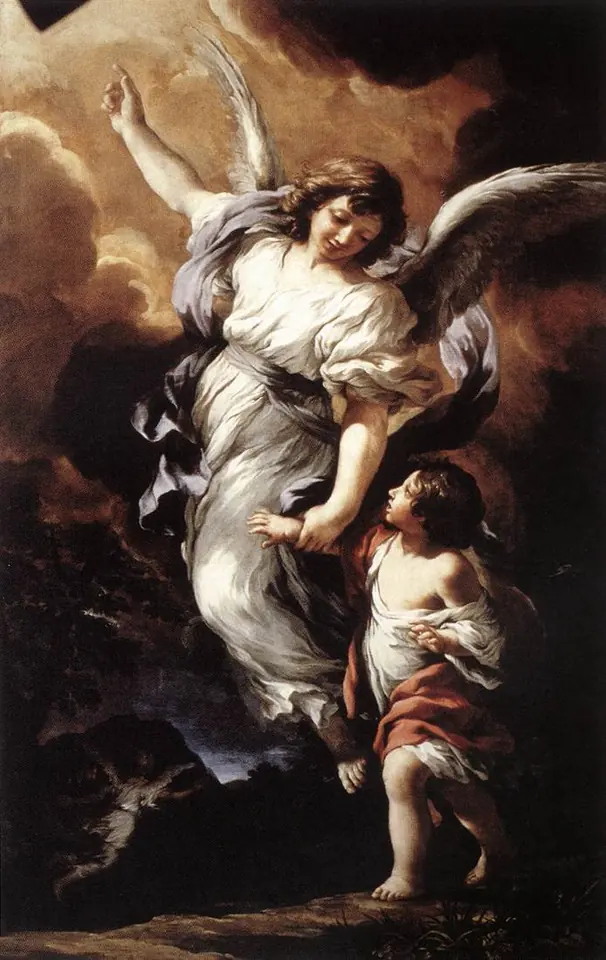
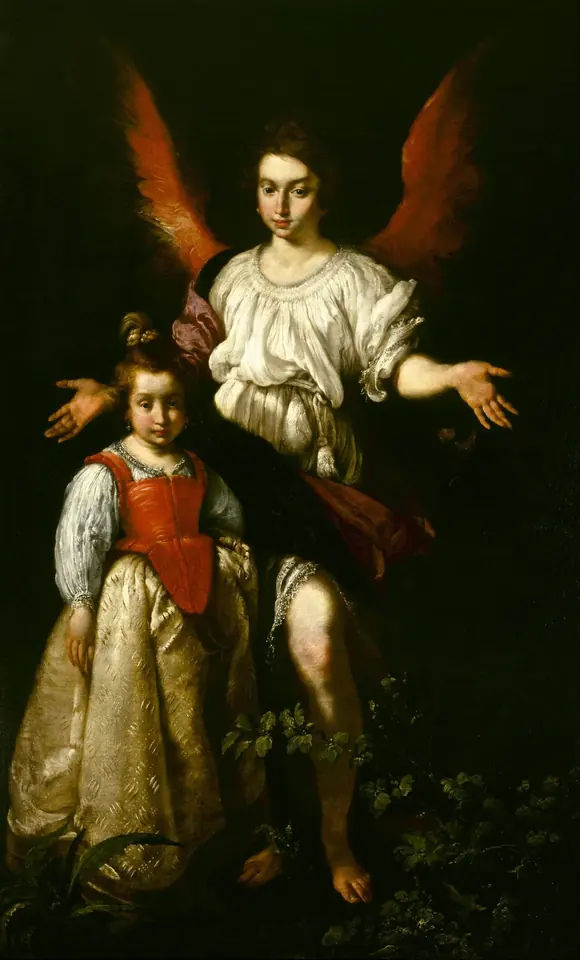
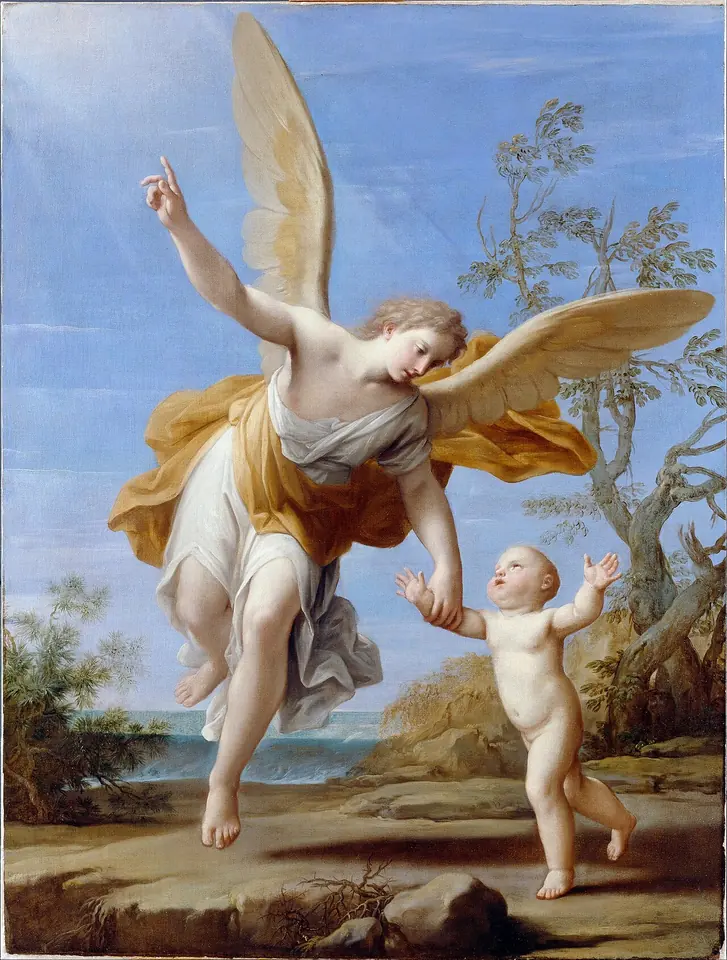
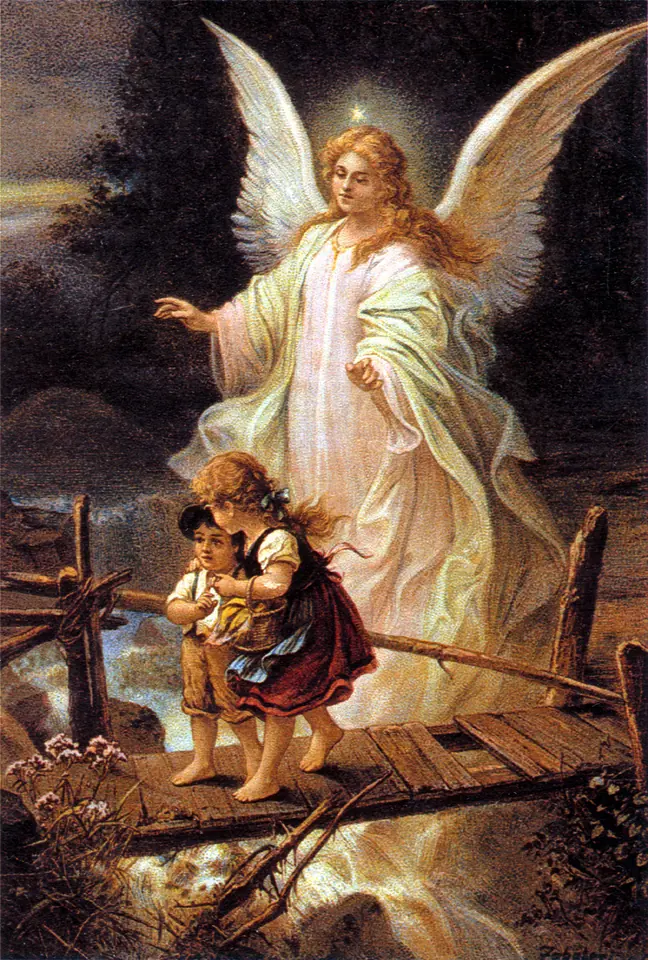
- Use a picture. The old holy card of an angel walking two children across a broken bridge has taught the idea to generations.
- Talk to the angel, not just about it. Francis's questions above work well with older children.
For generations, Catholic school days in many parishes began with this prayer, said standing beside the desks.

Grown-ups keep it too. It is one of the few prayers many of us say every day of our lives, from kindergarten to the nursing home.
Related prayers and saints
Those who want more than four lines can pray the Chaplet of St. Michael, whose last Our Father honors one's guardian angel (it is described on the St. Michael page), or a novena to the guardian angel. The 1910 Raccolta notes that Pius IX indulgenced such a novena in 1876 "with any form of prayer sanctioned by competent ecclesiastical authority," so no single text is required.
Several saints were known for closeness to their angels. St. Gemma Galgani spoke with hers, by the account of her spiritual director, and Padre Pio is often remembered for telling people to send him their guardian angel with their prayer requests. Both stories are reported, from the people around them. See also St. Raphael, patron of travelers, whose feast is September 29 with the other archangels, and the full calendar on our feast days page.
Frequently asked questions
What is the guardian angel prayer?
It is the short Catholic prayer "Angel of God, my guardian dear, to whom His love commits me here, ever this day be at my side, to light and guard, to rule and guide. Amen." At night, people often say "ever this night" instead. It is an English rhyming version of the Latin Angele Dei.
Who wrote the Angel of God prayer?
No one signed it, but its source is clear. The Latin opening is almost word for word the first two lines of a long prayer to the guardian angel in the Life of St. Malchus, a verse epic by Reginald, a Benedictine monk of St. Augustine's Abbey, Canterbury, who was active from about 1102 to at least 1109. Who first cut those lines down to the short prayer is unknown. The English rhyme was in print by 1857.
What is the Angel of God prayer in Latin?
"Angele Dei, qui custos es mei, me tibi commissum pietate superna illumina, custodi, rege et guberna. Amen." Many prayer books add hodie (today) or hac nocte (tonight) before illumina.
Where does the Bible talk about guardian angels?
The verse most often quoted is Matthew 18:10, where Jesus says of children, "their angels in heaven always see the face of my Father who is in heaven." Psalm 91 (Psalm 90 in the Douay-Rheims) says God "hath given his angels charge over thee; to keep thee in all thy ways," and Hebrews 1:14 calls angels "ministering spirits."
When is the feast of the Guardian Angels?
October 2. The feast began locally in Spain in the late 1500s; Paul V allowed it for the whole Church in 1608, and Clement X made it a feast for the whole Latin Church and fixed it on October 2, the first free day after St. Michael's feast on September 29.
Is it Catholic teaching that everyone has a guardian angel?
The Catechism (no. 336) teaches that "from infancy to death human life is surrounded by their watchful care and intercession" and quotes St. Basil: "Beside each believer stands an angel as protector and shepherd leading him to life." The Catholic Encyclopedia notes that the Church has never formally defined that every single person has one, but calls it the "mind of the Church."
How do I teach the guardian angel prayer to a child?
Say it together at the same moments every day, at bedtime and on the way to school, a line at a time until the child can say it alone. Most children learn it in a week or two because it rhymes. Simple pictures of an angel walking beside a child help them understand who they are talking to.
Sources
- Reginald of Canterbury, Vita Sancti Malchi, ed. Levi Robert Lind (University of Illinois Press, 1942), Internet Archive
- The Raccolta, or Collection of Indulgenced Prayers, tr. Ambrose St. John (1857), no. 112, The Angel Guardian, Internet Archive
- The Raccolta, or Collection of Indulgenced Prayers and Good Works (Burns & Oates, 1910), no. 296, Internet Archive
- Catholic Encyclopedia (1910): Feast of Guardian Angels
- Catholic Encyclopedia (1910): Guardian Angel
- Catechism of the Catholic Church, nos. 328-336, The angels (Vatican)
- Pope Francis, Morning Meditation, We all have an angel, 2 October 2014
- Philip Kosloski, The history behind the Angel of God prayer (Aleteia, 2017). On the older attribution to St. Anselm