Shroud of Turin

The Shroud of Turin is a linen cloth about 14 feet long, kept in Turin Cathedral, bearing the faint image of a man who was scourged and crucified. Many believe it is the burial cloth of Jesus. Radiocarbon tests dated it to 1260–1390, a result still debated, and the image is unexplained. The Church has never ruled on its authenticity.
In a side chapel of the cathedral of Turin, sealed in a case of bulletproof glass, lies a strip of old linen about fourteen feet long. On it, faint as a scorch mark, is the front and back image of a man who was beaten, crowned with thorns, crucified and pierced in the side. For more than six centuries pilgrims have knelt before it, and for more than a century scientists have argued over it. Many believe it is the very cloth in which Joseph of Arimathea wrapped the body of Jesus. This page tells the whole story as fairly as we can: what the Shroud of Turin is, its documented history, the science from the first photograph to the radiocarbon dating and the debate since, and what the Church actually says.
What is the Shroud of Turin?
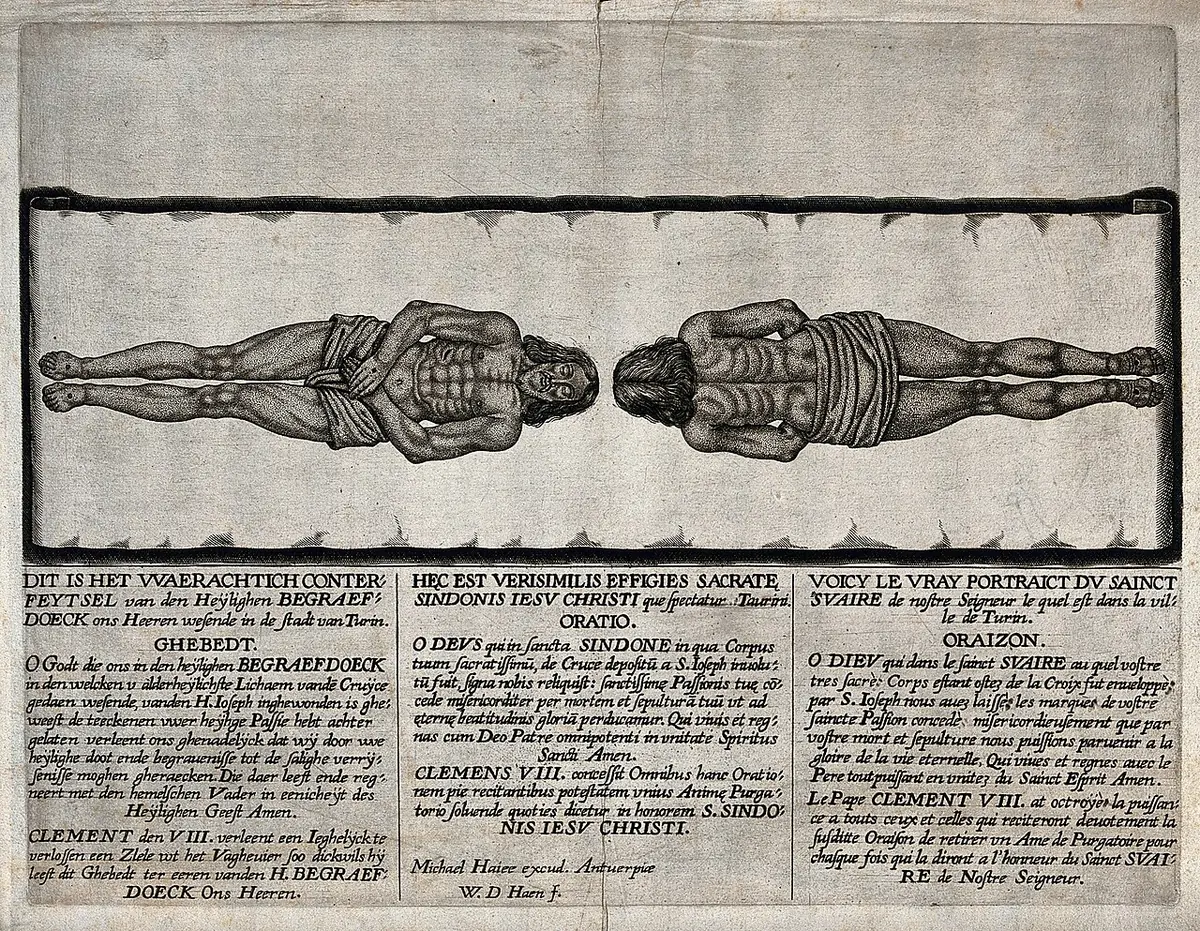
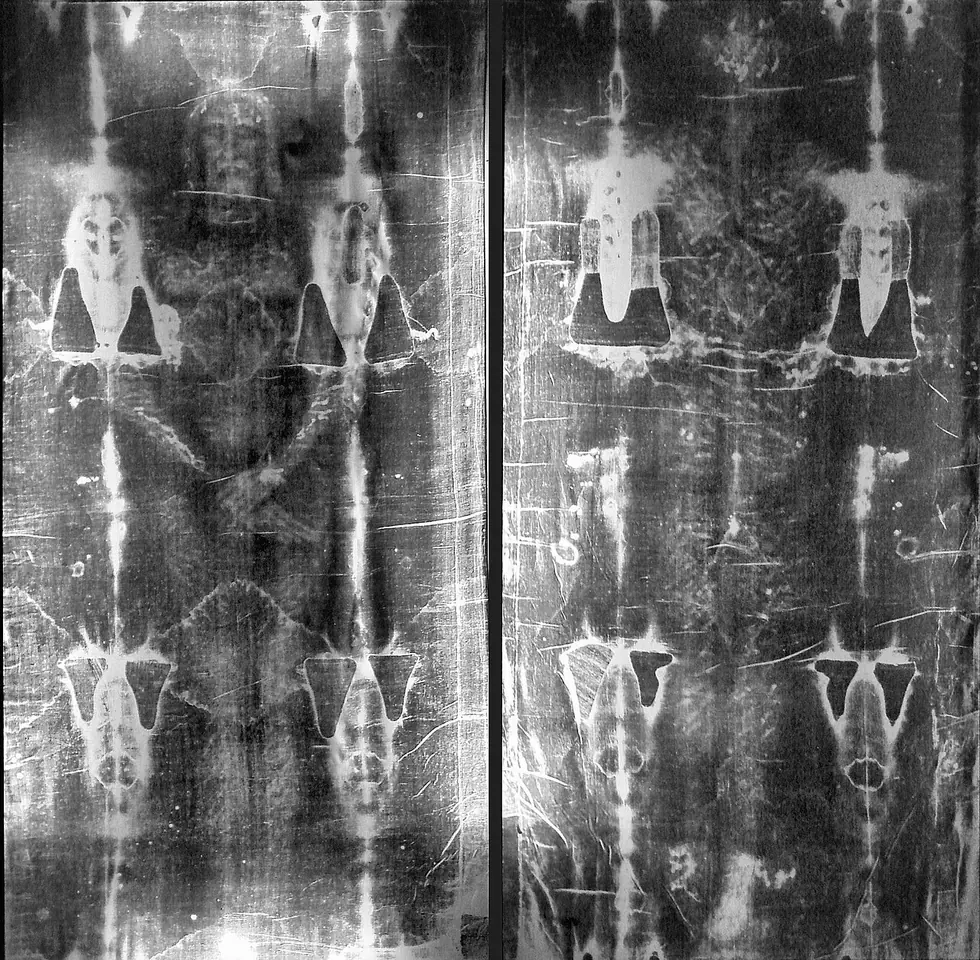
The Shroud is a single piece of linen, about 14 feet 6 inches long and 3 feet 8 inches wide (4.4 by 1.1 meters), woven in a herringbone twill. Along its length runs the faint, straw-colored image of a naked man seen from the front and from the back, laid head to head, as if a body had been placed on one half of the cloth and the other half folded over the head and down to the feet. The Catholic Encyclopedia described the arrangement in exactly these terms in 1912.
The man is bearded, with long hair. His body carries marks that match, in detail, the Gospel accounts of the Passion: small dumbbell-shaped wounds across the back and legs, like those of a Roman scourge; punctures around the scalp; a wound in the wrist and in the feet; a large wound in the right side; and darker reddish stains at the wounds. Two parallel lines of scorch marks, with triangular patches, run down both sides of the cloth. They come from a fire in 1532, and they frame the image like a border.

Is the Shroud of Turin real?
Here is the honest answer in brief, and the rest of this page fills it in.
- It is real old linen with a real, unexplained image. The 1978 American research team (STURP) found no paint, pigment or dye forming the image, and no one has yet reproduced the image with all its properties.
- Its age is disputed. Radiocarbon tests in 1988 dated the linen to AD 1260–1390. Some researchers have since challenged the sampling and the statistics; others have defended the result.
- Its documented history begins in France in the 1350s. Earlier history is a matter of hypothesis.
- The Church has never ruled on whether it is the burial cloth of Christ. She allows and encourages its veneration as an image of the Passion, which does not depend on the answer.
On this site the Shroud is presented as a disputed relic and an icon of the Passion.
What the Gospels say about the burial cloth
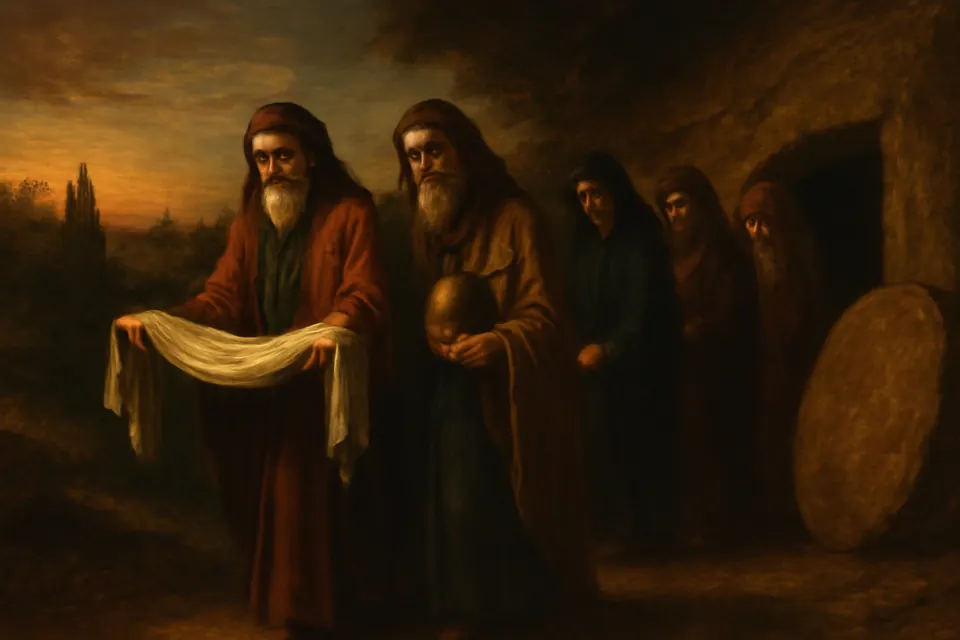
All four Gospels mention the linen in which Jesus was buried. St. Matthew tells how Joseph of Arimathea took the body and "wrapped it up in a clean linen cloth" (Matthew 27:59, Douay-Rheims), and St. Mark that Joseph, "buying fine linen," "wrapped him up in the fine linen" (Mark 15:46). St. John, who ran to the tomb on Easter morning, says that Peter "saw the linen cloths lying, and the napkin that had been about his head, not lying with the linen cloths, but apart, wrapped up into one place" (John 20:6–7). The early Church kept no clear record of what became of these cloths. A number of medieval churches later claimed to have the burial shroud; the Catholic Encyclopedia lists rivals at Besançon, Cadouin and elsewhere. Only Turin's has endured scrutiny and devotion together.
The history of the Shroud
Before 1350: hypotheses
Defenders of the Shroud have proposed ways it might have survived the first thirteen centuries. The best known, set out by the English writer Ian Wilson, identifies it with the Image of Edessa, a cloth bearing the face of Christ that was venerated in the East and brought to Constantinople in 944; folded, the argument goes, the Shroud would show only a face. Others point to a cloth bearing the figure of Christ that the French crusader Robert de Clari said he saw in Constantinople in 1203, before the city was sacked. These are hypotheses, not documented history. The Catholic Encyclopedia put the difficulty plainly in 1912: "no intelligible account, beyond wild conjecture, can be given of the previous history of the Shroud or its coming to Lirey."
Lirey, the 1350s
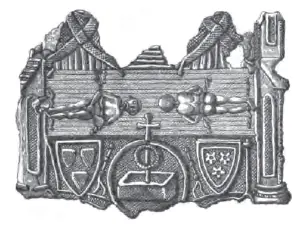
The documented history begins at Lirey, a village in the diocese of Troyes in Champagne, where the knight Geoffroi de Charny founded a small collegiate church in the 1350s. Geoffroi was killed at the Battle of Poitiers in 1356. By then the church held a long cloth bearing the image of Christ's body, and pilgrims came to see it. A pilgrim's badge found in the Seine in 1855, now in the Musée de Cluny in Paris, shows two clerics holding up the cloth with the double image, above the arms of Charny and of his wife's family, Vergy.
The cloth was controversial from the start. In 1389 Bishop Pierre d'Arcis of Troyes wrote to Clement VII, the Avignon pope then recognized in France, protesting its exhibition. The Catholic Encyclopedia summarizes his memorandum: the cloth was "the work of an artist who some years before had confessed to having painted it," but it was being shown "in such a way that the populace believed that it was the authentic shroud of Jesus Christ." Clement did not forbid the exhibitions. He ruled that when the cloth was shown, it should be announced as a picture or representation of the shroud of Christ. The authenticity of these documents is not disputed; their meaning is. Defenders of the Shroud note that no painting was ever produced or named, and that the bishop's letter is a draft whose claims rest on a predecessor's inquiry that does not survive.
The House of Savoy and the fire of 1532
In 1453 Marguerite de Charny, Geoffroi's granddaughter, gave the cloth to Duke Louis of Savoy. The Savoys enshrined it in the Sainte-Chapelle of their castle at Chambéry, and the popes began to honor it. In 1506 Pope Julius II approved a Mass and Office of the Holy Shroud with the bull Romanus Pontifex, speaking of "that most famous Shroud in which our Savior was wrapped when he lay in the tomb." As the Catholic Encyclopedia notes, popes of that era took its authenticity for granted.

On the night of December 4, 1532, fire broke out in the Sainte-Chapelle. The Shroud lay folded in a silver casket, and before it could be carried out, a drop of molten silver burned through the folds, leaving the symmetrical lines of scorch marks and holes we see today. Water thrown on the casket left stains as well.

From April 16 to May 2, 1534, the Poor Clares of Chambéry repaired it, sewing patches over the holes and stitching the whole cloth to a backing of linen. A plaque in the city still marks the place.

Turin since 1578
In 1578 Duke Emmanuel Philibert brought the Shroud across the Alps to Turin, his new capital. The occasion, by long tradition, was the vow of St. Charles Borromeo, archbishop of Milan, to walk on pilgrimage to the Shroud in thanksgiving for the end of the plague of 1576; the duke spared him the crossing of the Alps by bringing the relic to Turin. The Shroud has stayed there ever since. In 1694 it was placed in the extraordinary domed chapel designed by the priest-architect Guarino Guarini between the cathedral and the royal palace.
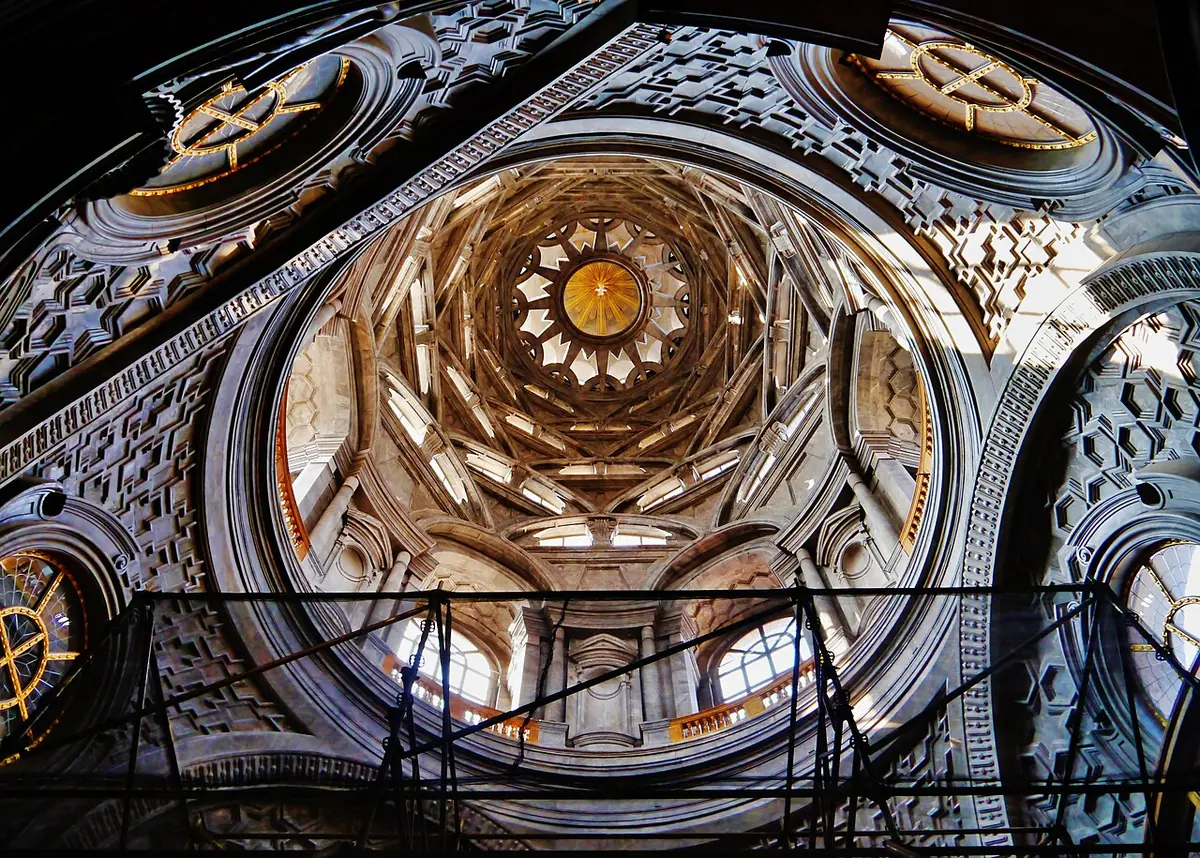
The House of Savoy owned the Shroud until 1983, when the former king Umberto II left it in his will to the pope. The Archbishop of Turin keeps it as papal custodian. On the night of April 11, 1997, fire swept through the Guarini Chapel; the Shroud, which had been moved into the cathedral during restoration work, was carried out unharmed by firefighters who smashed its protective case. In 2002 conservators removed the patches of 1534 and the old backing cloth, cleaned the charred edges and mounted the Shroud on a new support. It now lies flat in a climate-controlled case under the royal tribune of the cathedral.
Secondo Pia's photograph (1898)
The modern story of the Shroud begins with a camera. In May 1898, during an exposition marking the anniversary of the Savoy dynasty, the lawyer and amateur photographer Secondo Pia was allowed to photograph the cloth. Developing his glass plate that night, he found that the negative showed not a blur but a lifelike, three-dimensional face and body, as if the cloth itself were a negative and his plate had turned it positive. The Catholic Encyclopedia recorded the "sensation" this caused. Giuseppe Enrie's sharper photographs of 1931 confirmed it.

The photograph gave new life to devotion to the Holy Face. Céline Martin, sister of St. Thérèse of Lisieux and a Carmelite as Sister Geneviève of the Holy Face, drew a celebrated image of the face from Pia's photograph, and copies of it hung in homes and convents across the world.

The science
STURP, 1978
After the public exposition of 1978, a team of about thirty mostly American scientists, the Shroud of Turin Research Project (STURP), was given five days with the cloth in October. They photographed it in many wavelengths, took X-rays, and lifted fibers with sticky tape. Their official summary, released in 1981, said:
No pigments, paints, dyes or stains have been found on the fibrils. X-ray, fluorescence and microchemistry on the fibrils preclude the possibility of paint being used as a method for creating the image.
They found that the image lies only on the topmost fibers of the threads, that it holds three-dimensional information when analyzed with an image analyzer, and that "the blood stains are composed of hemoglobin and also give a positive test for serum albumin." Their conclusion: "the Shroud image is that of a real human form of a scourged, crucified man. It is not the product of an artist," and how the image was produced "remains, now, as it has in the past, a mystery." Not every scientist agreed. The microscopist Walter McCrone, who examined STURP's tapes, maintained that he saw iron oxide and vermilion pigment, and he regarded the image as a painting.
The radiocarbon dating, 1988
In 1988 the Holy See allowed radiocarbon dating. On April 21, a single strip was cut from one corner of the cloth and divided among three laboratories, at the University of Arizona, Oxford and the Federal Institute of Technology in Zurich, together with control samples of known age. Their joint paper appeared in Nature on February 16, 1989. The three laboratories' results gave a date for the linen between AD 1260 and 1390, with 95% confidence, and the authors wrote: "The results provide conclusive evidence that the linen of the Shroud of Turin is mediaeval." The date fit the documented appearance at Lirey, and for many scientists it settled the matter. Cardinal Anastasio Ballestrero of Turin accepted the results at the time and said the Shroud could still be venerated as an image.
The debate over the dating
The question did not stay closed. Three lines of criticism have drawn the most attention.
- The sample. All the tested linen came from one corner, near the area burned and patched in 1532 and handled for centuries at expositions. In 2005 the chemist Raymond Rogers, who had directed chemical research for STURP, published a study in Thermochimica Acta arguing that the threads from the radiocarbon sample were chemically different from the main cloth, with cotton and a madder dye, and that the main cloth had lost its vanillin, a breakdown product of flax lignin that decays over time. He estimated the main cloth to be between 1,300 and 3,000 years old. Nature's news report noted that "the radiocarbon sample, but not other parts of the shroud, seems to have been dyed with madder."
- The counter-evidence. In 2010 Rachel Freer-Waters and Timothy Jull of the Arizona laboratory examined a piece of their 1988 sample and reported "no evidence to contradict the idea that the sample studied was taken from the main part of the shroud," and "no evidence for either coatings or dyes, and only minor contaminants."
- The statistics. In 2017, after a legal request, the British Museum released the laboratories' raw data. In 2019 Tristan Casabianca, Emanuela Marinelli, Giuseppe Pernagallo and Benedetto Torrisi analyzed it in Archaeometry and concluded that it "strongly suggests that homogeneity is lacking in the data and that the procedure should be reconsidered."
Other studies using newer dating methods, some proposing a first-century date, have been published since and are themselves debated. What is agreed is that the 1988 test is the only radiocarbon dating ever done, and that many on both sides would welcome a new, carefully planned one.
The image
The deepest puzzle is the image itself. It is extremely superficial, a yellowing of the outermost fibers only. It has no outlines or brush strokes. It is a negative, and it encodes the distance between cloth and body in a way that lets it be read in three dimensions. The bloodstains, members of the STURP team later reported, lie under the image, as if the blood touched the cloth before the image formed. Many attempts have been made to reproduce it, by painting, by scorching on a hot statue, by chemical vapors, by early photography, and each has matched some properties while missing others. As STURP said in 1981, "the problem remains unsolved."
What the Church says about the Shroud
The Church has never made a judgment on whether the Shroud is the burial cloth of Christ, and she has said why. Visiting Turin in May 1998, St. John Paul II said:
Since it is not a matter of faith, the Church has no specific competence to pronounce on these questions. She entrusts to scientists the task of continuing to investigate, so that satisfactory answers may be found to the questions connected with this Sheet, which, according to tradition, wrapped the body of our Redeemer after he had been taken down from the cross.
He asked that it be studied "without pre-established positions that take for granted results that are not such," and then turned to what matters most: "For the believer, what counts above all is that the Shroud is a mirror of the Gospel." Its image, he said, is one "which everyone sees and no one at present can explain."
The popes since have spoken in the same spirit. Benedict XVI, praying before it in 2010, called it "the Icon of this mystery, the Icon of Holy Saturday," the day when Christ lay in the tomb. Pope Francis, in a video message for the television exposition of Holy Saturday 2013, called it an "icon of a man scourged and crucified" and said that the Man of the Shroud "invites us to contemplate Jesus of Nazareth." In Turin in 2015 he said, "The icon of this love is the shroud."
That is the Catholic way of approaching it. We do not have to know whether the cloth touched Our Lord's body to pray before it. The image puts before our eyes what the Gospels tell us he suffered for us, and the faithful who stand before it are drawn, as John Paul II said, not to the cloth but to Christ.

Expositions of the Shroud
The Shroud is shown publicly only on rare occasions, called expositions or ostensions, decided by the Pope and the Archbishop of Turin. In the last century and a half they have included 1898 (when Pia took his photograph), 1931, 1933, 1978, 1998 and 2000.
- 2010: a solemn exposition in the spring, when Benedict XVI came to pray before it on May 2.
- 2013: a television exposition on Holy Saturday, March 30, with a video message from Pope Francis.
- 2015: from April 19 to June 24, for the bicentenary of the birth of St. John Bosco, the great saint of Turin. Pope Francis prayed before it on June 21.
- 2020: on Holy Saturday, April 11, with Italy locked down by the coronavirus pandemic, Archbishop Cesare Nosiglia led a prayer service before the Shroud that was broadcast on television and online. Pope Francis wrote to thank him for the gesture.
Future expositions are announced by the Archdiocese of Turin on the official Shroud website.
Visiting the Shroud in Turin
The Shroud is kept in the Cathedral of St. John the Baptist, in the center of Turin, beside the royal palace. Outside of expositions it is not visible, but the faithful can pray in the cathedral before the chapel where it rests, where a large photograph of it is usually displayed. Guarini's Chapel of the Holy Shroud has reopened after its restoration and can be visited through the Royal Museums. The city also has a Museum of the Shroud, run by the Confraternity of the Holy Shroud.

Praying before the Shroud
John Paul II closed his address in Turin in 1998 with the ancient prayer Anima Christi, and we can pray it with him before the image of the Crucified:
Anima Christi, sanctifica me.
Corpus Christi, salva me.
Passio Christi, conforta me.
Intra vulnera tua, absconde me.
"Soul of Christ, sanctify me. Body of Christ, save me. Passion of Christ, strengthen me. Within your wounds, hide me."
For more on relics and how the Church honors them, see relics and incorruptible saints and our page on incorruptible saints. For the other great image the faithful venerate as not made by human hands, see the tilma of Guadalupe.
Frequently asked questions
Is the Shroud of Turin real?
It is certainly a real, very old linen cloth, and no one has explained how its image was made. Whether it is the burial cloth of Jesus is unknown. Radiocarbon tests in 1988 dated the linen to between 1260 and 1390, and its documented history begins in France in the 1350s. Defenders argue that the tested sample was unrepresentative and point to later statistical criticism of the data. The Catholic Church has never pronounced on its authenticity.
What does the Catholic Church say about the Shroud of Turin?
The Church has made no ruling. St. John Paul II said in 1998, "Since it is not a matter of faith, the Church has no specific competence to pronounce on these questions," and entrusted the question to scientists. He added, "For the believer, what counts above all is that the Shroud is a mirror of the Gospel." Benedict XVI called it "the Icon of Holy Saturday," and Pope Francis called it an "icon of a man scourged and crucified."
What did the carbon dating of the Shroud of Turin show?
In 1988 laboratories in Oxford, Zurich and Arizona dated small pieces cut from one corner of the cloth. Their joint report in Nature (February 16, 1989) gave a date range of AD 1260 to 1390 with 95% confidence and called it "conclusive evidence that the linen of the Shroud of Turin is mediaeval." Later researchers have disputed whether the corner sample represents the whole cloth and whether the data were homogeneous.
Where is the Shroud of Turin kept?
In the Cathedral of St. John the Baptist in Turin, Italy, in a climate-controlled case in a side chapel. It has been in Turin since 1578 and has belonged to the Holy See since 1983, when the former king Umberto II of Savoy left it to the pope in his will. The Archbishop of Turin is its custodian.
Can you see the Shroud of Turin?
Only during solemn expositions, which are rare and announced by the Archdiocese of Turin. Recent ones were held in 1998, 2000, 2010 and 2015, with a television exposition in 2013 and a livestreamed prayer before it on Holy Saturday 2020. At other times visitors can pray in the cathedral near the chapel where it is kept, where a large photograph of it is usually displayed.
What is on the Shroud of Turin?
The faint, straw-colored image of the front and back of a bearded man, laid head to head as if the cloth had been folded over a body. The image shows marks consistent with scourging, wounds at the wrists and feet, punctures around the head and a wound in the side, with stains that the 1978 STURP team reported as blood. Burn marks and patches from a fire in 1532 run along both sides.
Why does the Shroud look like a photographic negative?
The image on the cloth is reversed in light and shade, so a photographic negative shows a far more lifelike picture than the cloth itself. Secondo Pia discovered this when he photographed the Shroud in May 1898. Benedict XVI noted that the Shroud "acts as a 'photographic' document, with both a 'positive' and a 'negative.'"
Is the Shroud of Turin the same as the Sudarium of Oviedo?
No. The Sudarium of Oviedo is a separate, smaller cloth kept in the cathedral of Oviedo, Spain, which tradition identifies with the cloth that covered Jesus' head in the tomb (John 20:7). It bears stains but no image.
Sources
- Herbert Thurston, The Holy Shroud (of Turin), Catholic Encyclopedia (1912)
- P. E. Damon et al., Radiocarbon dating of the Shroud of Turin, Nature 337 (February 16, 1989)
- A Summary of STURP's Conclusions (October 1981), Shroud of Turin Website
- Philip Ball, To know a veil (Nature News, January 28, 2005), on Raymond Rogers's Thermochimica Acta study
- R. A. Freer-Waters and A. J. T. Jull, Investigating a Dated Piece of the Shroud of Turin, Radiocarbon 52 (2010)
- T. Casabianca, E. Marinelli, G. Pernagallo and B. Torrisi, Radiocarbon Dating of the Turin Shroud: New Evidence from Raw Data, Archaeometry (2019)
- John Paul II, Address at the Cathedral of Turin before the Shroud (May 24, 1998)
- Benedict XVI, Veneration of the Holy Shroud in the Cathedral of Turin: Meditation (May 2, 2010)
- Pope Francis, Video Message for the Exposition of the Holy Shroud (Holy Saturday, March 30, 2013)
- Laura Ieraci (CNS), Pope Francis calls Shroud of Turin 'icon of love' (America, June 22, 2015)