St. Charles Borromeo, Archbishop of Milan

St. Charles Borromeo (1538–1584) was a cardinal and the archbishop of Milan who helped bring the Council of Trent to a close and then put its reforms into practice, founding seminaries and schools of Christian doctrine. He stayed in Milan to serve the sick in the plague of 1576. He is a patron of seminarians and catechists, and his feast day is November 4.
Who was St. Charles Borromeo?
Charles Borromeo was a nobleman's son who became a cardinal at twenty-one and could have lived as a wealthy Renaissance prince of the Church. Instead he became the model reforming bishop of the Catholic Reformation. As secretary of state to his uncle, Pope Pius IV, he helped bring the Council of Trent to its end in 1563. As archbishop of Milan from 1565 he put its decrees into practice: seminaries for training priests, regular visits to every parish, schools to teach children the faith, and strict discipline for clergy, beginning with himself.
Benedict XVI, writing in 2010 for the fourth centenary of his canonization, said that Charles "neither limited himself to deploring or condemning nor merely to hoping that others would change, but rather set about reforming his own life."

He is remembered above all for the plague of 1576, when he stayed in Milan, visited the sick and organized help for the city. He died at forty-six, worn out by work and penance.
The life of St. Charles Borromeo
Arona and Pavia
Charles was born on October 2, 1538, in the castle of Arona on the southern shore of Lake Maggiore, the second son of Count Giberto Borromeo and Margherita de' Medici. His mother's younger brother, Cardinal Giovanni Angelo de' Medici, later became Pope Pius IV. At twelve Charles received the tonsure and was made titular abbot of a family abbey, a common arrangement for younger sons of noble houses. He studied law at the University of Pavia, where the Catholic Encyclopedia notes that his allowance was often too small, and took his doctorate in civil and canon law in 1559.
Cardinal at twenty-one
In December 1559 his uncle was elected pope. Within weeks Charles was in Rome, put in charge of the administration of the Papal States, and on January 31, 1560, made a cardinal. He was named administrator of the vacant archdiocese of Milan, legate of Bologna and Romagna, and protector of several countries and religious orders. He played the lute and cello, and founded an academy at the Vatican where clergy and laymen met in the evenings.
The Council of Trent
His most important work in Rome was the Council of Trent, suspended since 1552. As secretary of state he worked for years to bring it back together against the objections of the emperor, Spain and France, and wrote an enormous correspondence with the papal legates at Trent. The council reopened in January 1562 and closed in December 1563.
In November 1562 his older brother Federico died suddenly. Charles was now head of the family, and relatives, even the pope, pressed him to leave the clerical state and marry. He answered by being ordained a priest, quietly, on September 4, 1563. In December he was consecrated bishop.
After the council he oversaw the catechism it had called for. According to the Catholic Encyclopedia, the decision to write it was taken on his suggestion, and he supervised the Italian text, finished in 1564. Published in 1566 as the Roman Catechism, or Catechism of the Council of Trent, it was written for parish priests and stayed the Church's standard catechism for centuries. He also worked on the revision of the Missal and Breviary.
Archbishop in Milan
Milan had not had a resident archbishop for eighty years. Charles made his solemn entry on September 23, 1565, and settled there for good in 1566. He began with his own household, gave much of his income to the poor, and held provincial councils and diocesan synods that applied Trent's decrees in detail. He opened a seminary in 1564, and others followed. He organized the Confraternity of Christian Doctrine to teach children on Sundays, the beginning of what the Catholic Encyclopedia calls the Sunday school. In 1578 he founded the Oblates of St. Ambrose, secular priests to help him.


He traveled constantly. Trent required bishops to visit their dioceses, and Charles went on mule and on foot into the remote Alpine valleys of the Swiss part of his diocese, where the Catholic Encyclopedia says many priests had grown lax and some lived scandalous lives. Later he was sent as apostolic visitor to the Catholic Swiss cantons.

The shot in the chapel, 1569
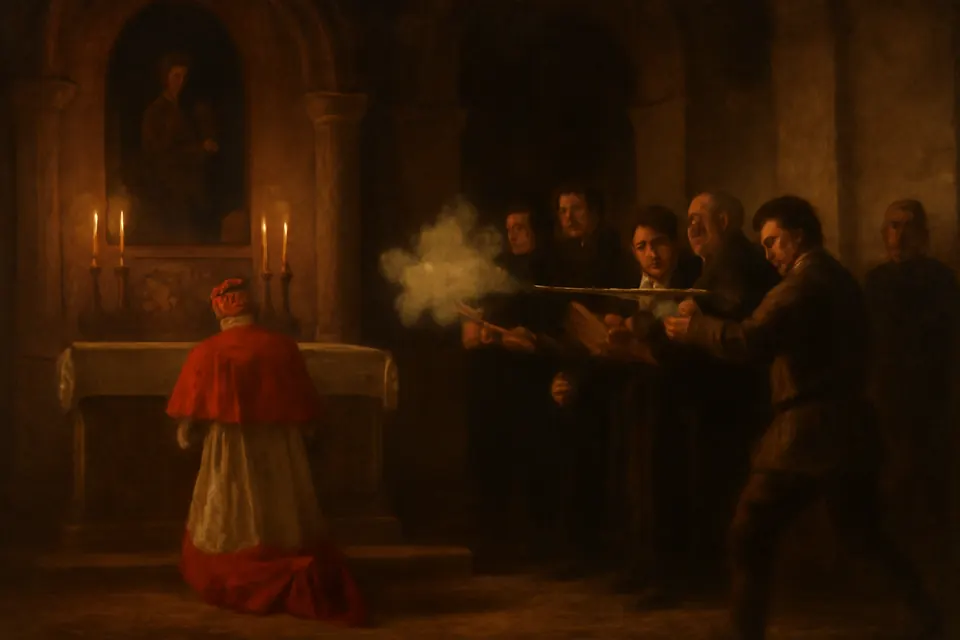
Reform made enemies. The Humiliati, a decayed religious order of which Charles was protector, resented the reforms he had imposed on them. On October 26, 1569, while Charles knelt at evening prayer with his household, a member of the order named Farina, dressed as a layman, fired at him from a few yards away. The choir was singing a motet by Orlando di Lasso and had just reached the words Non turbetur cor vestrum ("Let not your heart be troubled"). Charles, thinking himself mortally wounded, motioned for the prayers to go on. When they were over, the Catholic Encyclopedia says, the ball had not even pierced his clothes, leaving only a swelling that stayed with him for life. Charles tried to stop the prosecution of the plotters, but four of them were executed, and Pius V suppressed the order in 1571.
The plague of 1576
In August 1576 the plague reached Milan. Charles was away at a funeral in Lodi and came straight back. He made his will, and then, in Benedict XVI's words, "chose to stay in the midst of his people to encourage them, serve them and defend them with the weapons of prayer, penance and love." He went into infected houses and into the hospital of St. Gregory, where the worst cases lay, and persuaded his reluctant clergy to follow him. During the famine of 1571 he had already fed some 3,000 people a day at his own expense for three months.
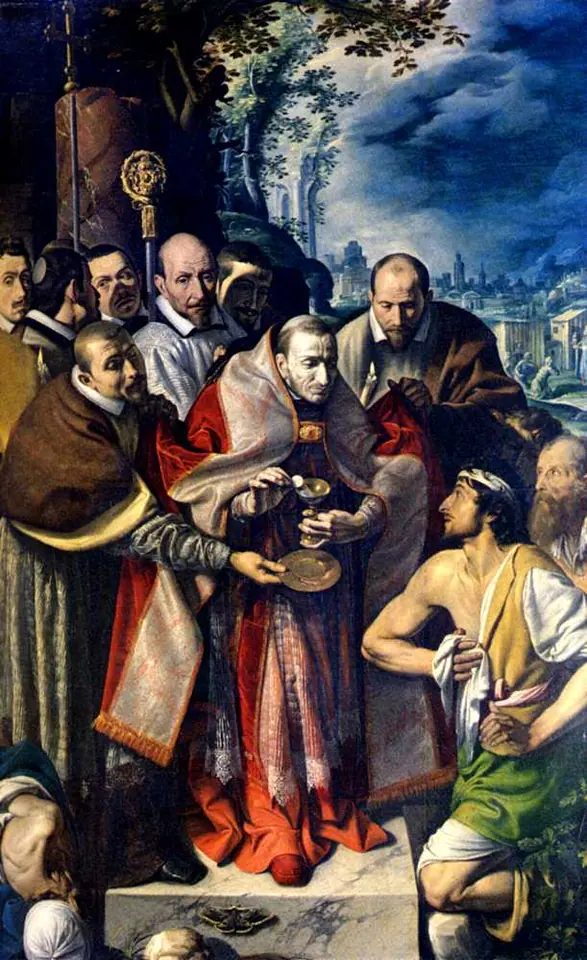

He led processions of penance through the city, walking barefoot with a rope around his neck and carrying the relic of the Holy Nail kept in the cathedral. The plague began to fade early in 1577 and was gone by 1578. Milan vowed a church to St. Sebastian in thanks, and the epidemic is still known as the plague of San Carlo.

His last years and death
In 1580 Charles gave First Communion to a twelve-year-old boy, Luigi Gonzaga, later St. Aloysius Gonzaga. In Rome he was a friend of St. Philip Neri. He slept little and ate little; one well-known painting shows him at supper with only bread and water.


In October 1584 he made a retreat at the Sacro Monte of Varallo and fell ill with fever. He kept working, crossed Lake Maggiore to visit a new college at Ascona, and returned to Milan on November 2. He died the next night, November 3, 1584, at forty-six. The last words heard from him were Ecce venio, "Behold, I come."
The miracles of St. Charles Borromeo
The Milanese honored him as a saint from the day of his death. Inquiries were held in Milan, Pavia, Bologna and elsewhere, and Paul V canonized him on November 1, 1610. The cures examined in that process are his approved miracles. His escape from the gunman in 1569 is reported: the Catholic Encyclopedia tells it without calling it a miracle, but devotion has always seen God's protection in it. Countless cures attributed to his prayers in later centuries are reported, not formally examined.
Why St. Charles Borromeo is the patron of seminarians and catechists
The Council of Trent ordered every diocese to have a seminary, and Charles was one of the first bishops to carry this out on a large scale, so Catholics regard him as the patron of seminarians. His schools of Christian doctrine and his work on the Roman Catechism make him the patron of catechists. Benedict XVI called him "an authentic and enterprising educator," for the people "with schools of Christian doctrine" and for the clergy "with the establishment of seminaries." He is also a patron of bishops and spiritual directors. See all the patron saints.
Symbols of St. Charles Borromeo in art
He is one of the easiest saints to recognize, because almost every painter followed portraits made in his lifetime. Look for:
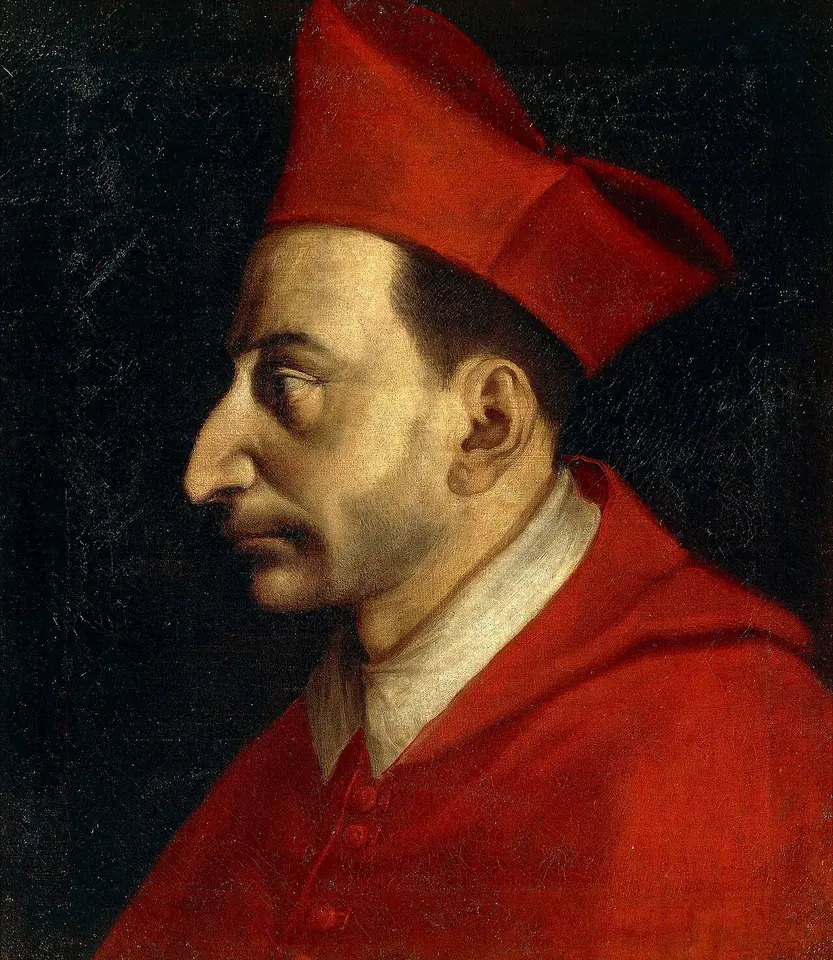
- A long, hooked nose and a thin, clean-shaven face, as in Figino's profile.
- Cardinal's red, the biretta and mozzetta, or purple for penance.
- A rope around his neck and bare feet: the plague processions of 1576. The Catholic Encyclopedia describes him as "usually represented in art in his cardinal's robes, barefoot, carrying the cross as archbishop; a rope round his neck, one hand raised in blessing."
- Plague victims around him, or giving them Communion.
- The word Humilitas under a crown: the motto from the Borromeo family arms.
- A crucifix, or a coffin, recalling his prayer and penance.


Feast day and places of St. Charles Borromeo
His feast is November 4. See the feast day calendar. In Milan Cathedral, the great canvases of his life and miracles called the Quadroni are hung along the nave each year around his feast.
The Scurolo in Milan Cathedral
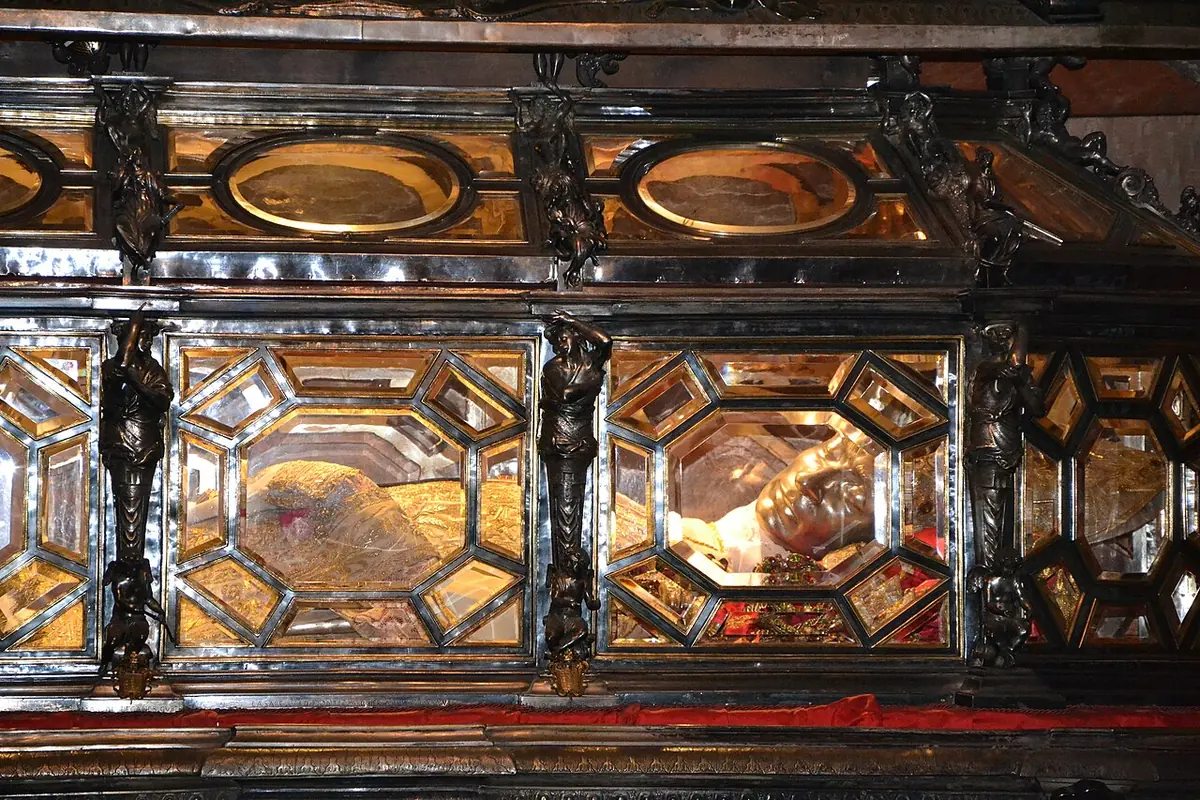
His body lies in the Scurolo di San Carlo, a small octagonal chapel under the presbytery of Milan Cathedral. His cousin and successor Cardinal Federico Borromeo had it built to designs by Francesco Maria Richini from 1606, in time for the canonization. The saint rests in a silver and crystal urn above the altar.

The Sancarlone at Arona
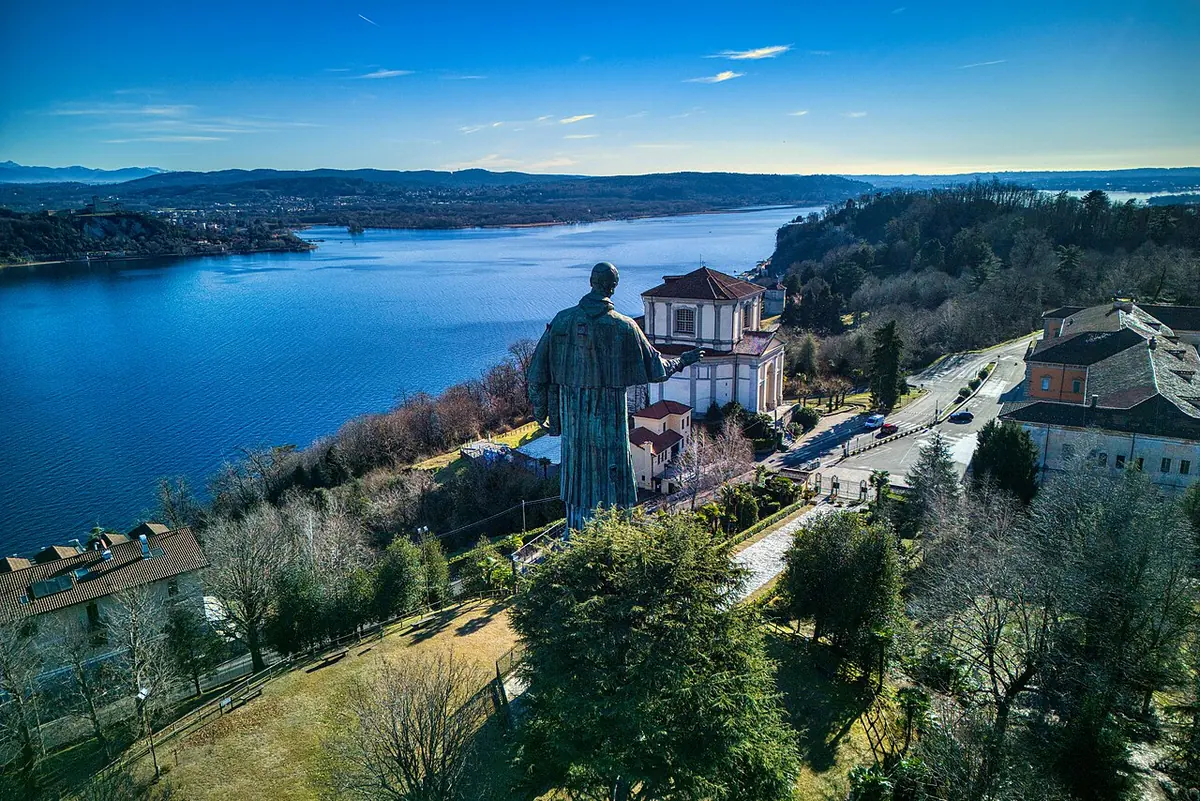
Above his birthplace at Arona stands the Sancarlone, a statue of the saint in hammered copper sheets over a frame of stone, brick and iron, designed by Giovanni Battista Crespi (Il Cerano) and finished in 1698. With its pedestal it is almost 35 meters tall. Visitors can climb stairs inside the robe to the head and look out through openings at the eyes, ears and nostrils. Frédéric Auguste Bartholdi studied it before designing the Statue of Liberty.

Prayer to St. Charles Borromeo
The Roman Missal gives this collect for his memorial:
Preserve in the midst of your people, we ask, O Lord, the spirit with which you filled the Bishop Saint Charles Borromeo, that your Church may be constantly renewed and, by conforming herself to the likeness of Christ, may show his face to the world. Who lives and reigns with you in the unity of the Holy Spirit, God, for ever and ever.
Catholics ask St. Charles to pray for priests, seminarians, bishops and catechists, and for the sick, especially in times of epidemic. Many seminaries and parishes named for him pray to him on November 4.
Frequently asked questions
When is the feast of St. Charles Borromeo?
November 4, the day after his death on November 3, 1584. Pope Paul V fixed the date when he canonized Charles in 1610. It is an obligatory memorial in the General Roman Calendar and a solemnity in Milan.
What is St. Charles Borromeo the patron saint of?
Seminarians, catechists, bishops and spiritual directors, because he founded seminaries, organized the teaching of the catechism and reformed the clergy. Catholic calendars also list him as a patron against stomach ailments, a patronage whose origin is not documented.
Why is St. Charles Borromeo shown with a rope around his neck?
During the plague of 1576 he walked barefoot in penitential processions through Milan with a rope around his neck, as a sign of offering himself for his people. Artists made the rope his best-known attribute.
What is the Sancarlone?
A hollow copper statue of St. Charles almost 35 meters (about 115 feet) tall including its pedestal, on a hill above Arona, his birthplace on Lake Maggiore. It was designed by Il Cerano and finished in 1698. Visitors can climb inside to the head.
Where is St. Charles Borromeo buried?
In the Scurolo di San Carlo, an octagonal chapel under the presbytery of Milan Cathedral, where his body lies in a silver and crystal urn.
Sources
- Catholic Encyclopedia (1908): St. Charles Borromeo
- Catholic Encyclopedia (1912): Roman Catechism
- Benedict XVI, Message Lumen caritatis for the 400th anniversary of the canonization of St. Charles Borromeo (1 November 2010)
- Colosso di San Carlo Borromeo: The statue
- Finestre sull'Arte: Milan, restoration of the Scurolo di San Carlo in the Duomo ends
- Catholic Culture: Memorial of St. Charles Borromeo, Bishop (November 4)
- Roman Martyrology, November 4