St. John Bosco (Don Bosco)
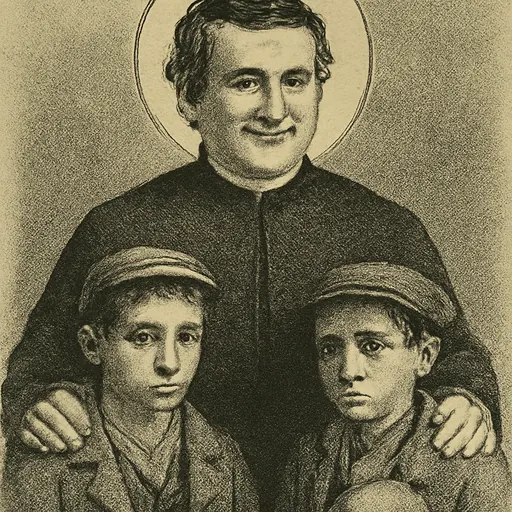
St. John Bosco (1815–1888), known as Don Bosco, was an Italian priest in Turin who gave his life to poor and abandoned boys. He founded the Salesians and, with St. Mary Mazzarello, the Daughters of Mary Help of Christians, and he taught by kindness rather than punishment. His feast day is January 31, and he is the patron saint of young people, apprentices, editors and, by popular devotion, magicians.
Who was St. John Bosco?
John Bosco was a priest in Turin, in northern Italy, at the time the city was filling with factories and with poor country boys looking for work. Many of them slept rough, worked long hours for little pay and ended up in prison. Don Bosco ("Don" is the Italian title for a priest) gathered them on Sundays for Mass, games and catechism, found them jobs and decent employers, and eventually built them a home, schools and workshops. To keep the work going he founded the Salesians, and with St. Mary Mazzarello he founded a sister congregation for girls.


He was also a storyteller, a juggler, a writer of cheap books for working people and a dreamer whose dreams his followers wrote down by the hundred. John Paul II called him the father and teacher of youth.
The life of St. John Bosco
Becchi
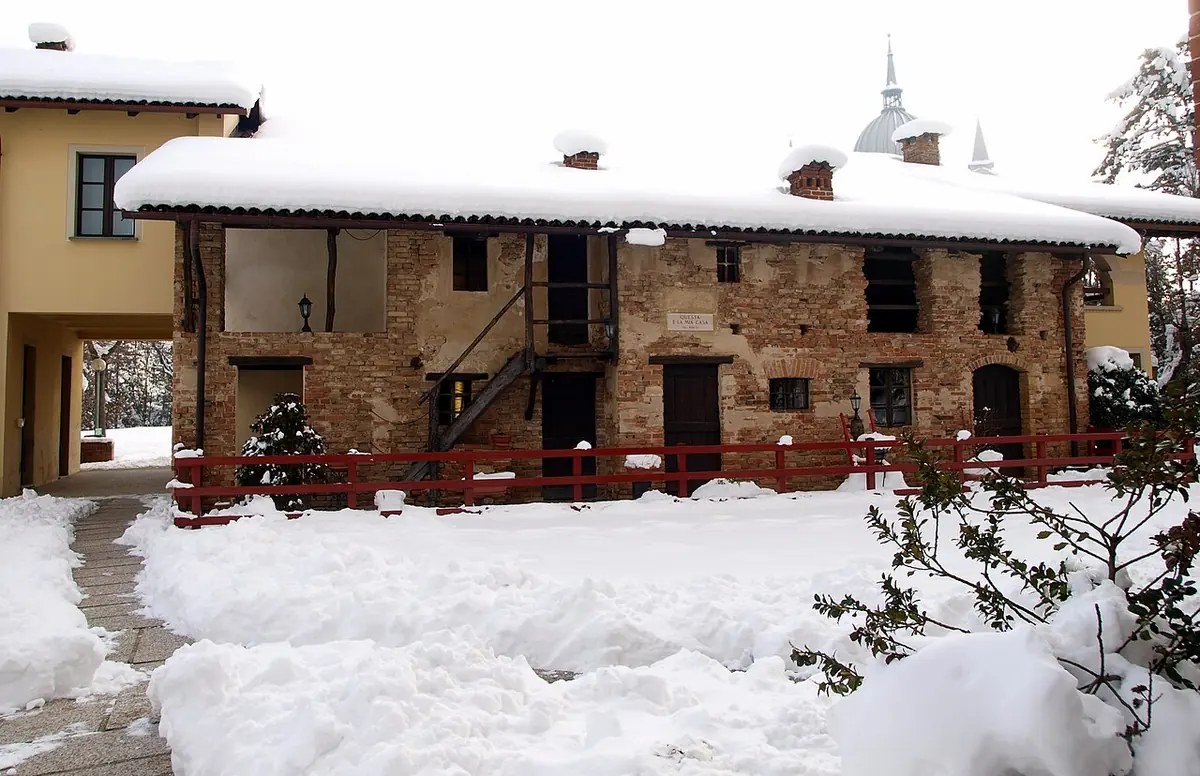
John Melchior Bosco was born on August 16, 1815, at Becchi, a hamlet of farms near Castelnuovo d'Asti in Piedmont. His father, Francis, died in May 1817, when John was not yet two. His mother, Margaret Occhiena, raised three boys alone on a small farm through years of famine. She later spent her last years cooking and mending for her son's boys in Turin, and the Salesians call her Mama Margaret.

The young acrobat
In his Memoirs of the Oratory, written in the 1870s for the Salesians, Don Bosco describes how, as a boy of ten or eleven, he watched the jugglers and conjurers at country fairs and went home to practice their tricks. "By the time I was eleven," he wrote, "I could juggle, do midair somersaults and the swallow trick, and walk on my hands. I could walk, jump, and even dance on the tightrope like a professional acrobat."
On Sunday afternoons he strung a rope between two trees at Becchi and drew a crowd. There was a price of admission. Before the show, everyone had to say the Rosary, and the boy stood on a chair and repeated the sermon he had heard in church that morning. Then he performed: he "swallowed coins and then produced them from someone's nose," multiplied balls and eggs, and pretended to change water into wine.

Seminary and priesthood
Poverty kept him out of school for years; he worked as a farmhand and studied when he could. He finally entered the seminary at Chieri on October 30, 1835, and was ordained a priest on June 5, 1841. He then moved to Turin to continue his studies at the Convitto, a residence for young priests, under his confessor and adviser St. Joseph Cafasso. With Cafasso he visited the city's prisons, and the sight of so many boys behind bars stayed with him.
The Oratory
On December 8, 1841, as Don Bosco was vesting for Mass in the Church of St. Francis of Assisi in Turin, the sacristan started beating a boy who had wandered in and didn't know how to serve Mass. Don Bosco stopped him. "He's a friend of mine," he said, and he asked the boy his name. It was Bartholomew Garelli, a sixteen-year-old orphan from Asti who could not read and was too ashamed to join the catechism class with smaller boys. Don Bosco taught him to make the sign of the cross that morning, and the next Sunday Garelli came back with friends. Salesians date the beginning of their work from that day.
He called his Sunday gatherings an "oratory," borrowing the word from St. Philip Neri, and put them under the protection of St. Francis de Sales, the gentle bishop of Geneva. After years of wandering between borrowed courtyards and meadows, on Easter Sunday 1846 it moved into a rented shed owned by a man named Francis Pinardi, in the Valdocco district. That shed became the Oratory's chapel, and Valdocco has been the Salesians' home ever since. In November 1846 Mama Margaret came from Becchi to live there and keep house.
Schools, workshops and books
The Oratory grew into a boarding house, then a school, then a set of workshops where boys learned a trade. He placed boys with employers he trusted and visited them at work, as he writes in the Memoirs, to keep them from being exploited.
He also wrote constantly. In 1853 he began the Catholic Readings, cheap booklets for ordinary readers, and he wrote lives of saints, a prayer book and the life of his pupil St. Dominic Savio, who died in 1857 at fourteen. Eventually the Oratory had its own print shop.
The Salesians and the Salesian Sisters
In 1857 he wrote a rule for the young men who were helping him, and in December 1859 he and seventeen companions formed the Society of St. Francis de Sales, the Salesians. Pius IX gave the rule final approval in 1874. In 1872, at Mornese in the hills south of Turin, he founded the Daughters of Mary Help of Christians with Mary Domenica Mazzarello, who already led a group of young women in Mornese, the Daughters of Mary Immaculate. They did for girls what the Salesians did for boys. Mazzarello was their first superior and died in 1881.

In 1875 the first Salesian missionaries left for Argentina, led by Fr. John Cagliero. By the time Don Bosco died, the Catholic Encyclopedia records, there were Salesian houses across Europe and South America.


Mary Help of Christians
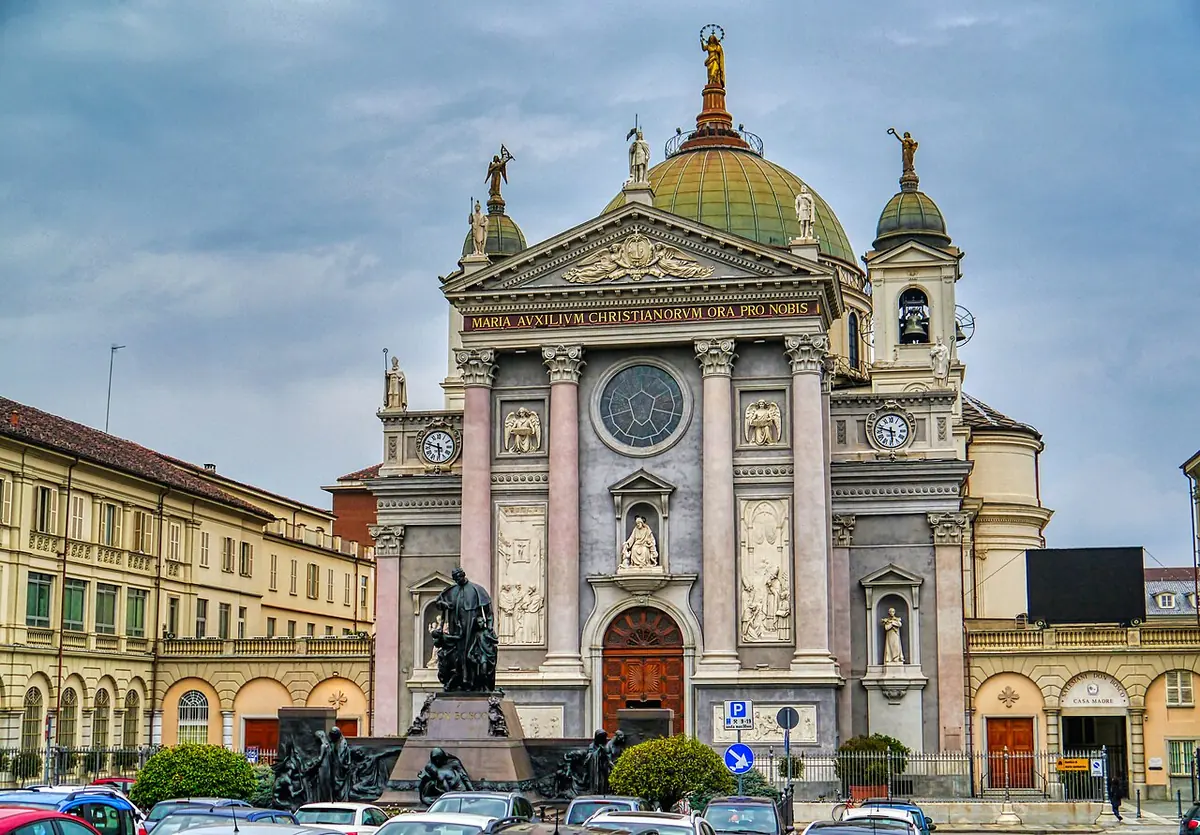
Don Bosco gave Mary, under the title Help of Christians, the credit for everything he built. Between 1863 and 1868 he raised a large church in her honor at Valdocco and commissioned the painter Tommaso Lorenzone to paint its great altarpiece of Mary crowned in glory. The church was consecrated in 1868 and is now a basilica, the mother church of the Salesians.


Last years and death
His health broke in his last decade. He still traveled to raise money for the missions, as far as Barcelona in 1886. He died at Valdocco on January 31, 1888, at seventy-two. Pius XI, who as a young priest had met him and eaten at his table at Valdocco in 1883, beatified him on June 2, 1929, and canonized him on Easter Sunday, April 1, 1934.


The preventive system
Don Bosco left only a few pages about his method. The schools of his day mostly waited for boys to break the rules and then punished them, the repressive system. His own he called the preventive system. Teachers and priests stay among the boys at play as well as in class, earn their trust and guide them so that they don't fall into trouble in the first place. He summed it up in three words: reason, religion and amorevolezza, loving kindness.
In Iuvenum Patris, his 1988 letter for the centenary of Don Bosco's death, John Paul II quoted a letter Don Bosco wrote to the Oratory from Rome in 1884: it is not enough for young people to be loved; they must know that they are loved. The pope called the preventive system the distilled essence of Don Bosco's wisdom as an educator.
The dreams of St. John Bosco
Don Bosco had vivid dreams all his life and told many of them to his boys and the Salesians, who wrote them down. He did not claim they were all revelations, and the Church has not ruled on them. They are given here as he reported them.
The dream at nine
The first, and the one that shaped his life, came when he was nine or ten. In the Memoirs he describes a yard full of children playing and swearing. He jumped in to stop them with his fists. A man appeared, nobly dressed, in a white cloak, with a face so bright he could not look at it, and told him to take charge of the children: "You will have to win these friends of yours not by blows but by gentleness and love." When the boy protested that he was poor and ignorant, the man said he would give him a teacher, and a lady appeared "wearing a mantle that sparkled all over as though covered with bright stars." The children turned into goats, dogs, cats and bears, and then into gentle lambs. "This is the field of your work," she said.

His mother said, "Who knows, but you may become a priest." His grandmother said, "Pay no attention to dreams." He kept it to himself until Pius IX asked him in 1858 to write it down for the Salesians.
The two columns
The best known of his later dreams, from 1862, showed the Church as a great ship under attack on a stormy sea, with the pope at the helm. The ship finds safety by mooring between two columns, one topped by the Eucharist and the other by a statue of Mary Help of Christians.
Miracles and wonders
- Grigio, the gray dog: traditional, though first told by Don Bosco himself. In the last chapter of his Memoirs he writes that, when attempts on his life made it unsafe to walk home alone at night, "a huge dog appeared beside me." He named it Grigio, "Gray." On a foggy night at the end of November 1854, two men threw a cloak over his head and tried to gag him; Grigio leapt at them "growling like a bear" until they ran. He last saw it in 1866, and he never found out whose it was. Early Salesians, Michael Rua among them, said they saw and petted it.

- The multiplication of rolls and chestnuts: reported. The notes to the English Memoirs record that one morning in November 1860 Don Bosco handed out breakfast rolls to the boys leaving Mass from a basket that did not run out, and that on another occasion chestnuts were multiplied the same way. A plaque outside the Church of St. Francis de Sales in Turin marks the place.
- Cures through his intercession after his death: approved, in the sense that the Church examined and accepted miracles for his beatification in 1929 and his canonization in 1934.
Why St. John Bosco is the patron saint of young people
Everything he built was for the young. Catholics pray to him for children and teenagers, especially those in trouble or far from home. See all the patron saints by cause.
- Apprentices and young workers: he trained boys in trades in his own workshops and found them honest employers.
- Editors and publishers: for the Catholic Readings, his many books and the print shop at Valdocco.
- Magicians: for the tricks he did as a boy and used all his life to catch children's attention. In January 2002 the Salesian priest Silvio Mantelli, who performs as "Sales," led 250 Italian magicians and jugglers to John Paul II's general audience with a letter asking that Don Bosco be declared patron of magicians. The Church has not formally done so, but Catholic "gospel magicians" treat him as their patron already.
Symbols of St. John Bosco in art
Artists painted Don Bosco from his photographs, so his broad, smiling face with wavy hair is easy to know. In statues and holy cards look for:
- A black cassock, sometimes with a biretta or a rosary.
- Boys around him. He is rarely shown alone.
- Mary Help of Christians, in a picture he holds or above him, for the title he spread.
- A gray dog at his side, for Grigio.
In St. Peter's Basilica his statue stands in the row of founders of religious orders, high above the bronze statue of St. Peter. In Turin, a monument to him stands in the square before the Basilica of Mary Help of Christians.

Feast day and where St. John Bosco is honored
The Church celebrates St. John Bosco on January 31, the day he died in 1888. It is a memorial in the General Roman Calendar. See his neighbors on the feast day calendar.
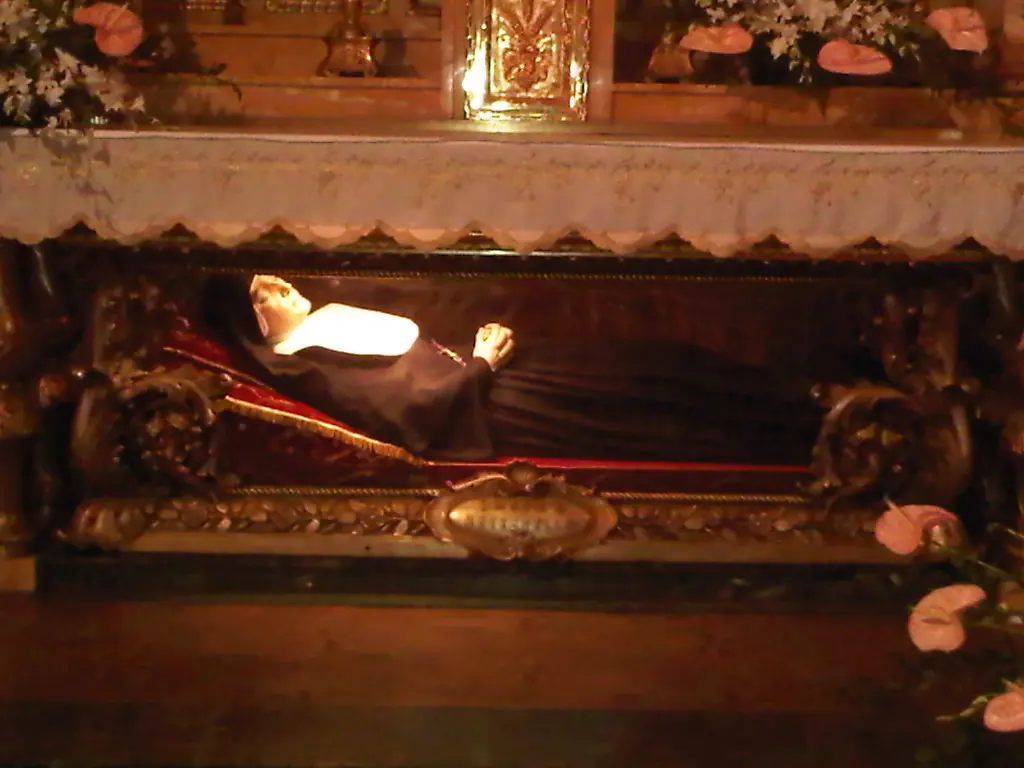
His remains rest in the Basilica of Mary Help of Christians at Valdocco in Turin, near those of Mary Mazzarello. At Becchi, renamed Colle Don Bosco, the farmhouse where he grew up stands beside a large modern basilica built in his honor, and the town of Castelnuovo d'Asti took the name Castelnuovo Don Bosco.


Prayer to St. John Bosco
The Church's own prayer for his feast is the collect of the Mass in the Roman Missal, in the current English translation:
O God, who raised up the Priest Saint John Bosco as a father and teacher of the young, grant we pray, that, aflame with the same fire of love, we may seek out souls and serve you alone. Through our Lord Jesus Christ, your Son, who lives and reigns with you in the unity of the Holy Spirit, God, for ever and ever.
Outside the liturgy there is no single traditional prayer to him. Catholics simply ask, "St. John Bosco, pray for us," for young people, teachers and children who have lost their way.
Frequently asked questions
What is St. John Bosco the patron saint of?
Young people, students and apprentices, because he spent his life teaching boys and training them in trades; editors and publishers, because he wrote and printed popular Catholic books; and, by popular devotion, stage magicians, because he used conjuring tricks to draw children to catechism. In 2002 Catholic magicians asked John Paul II to make that last patronage official.
When is St. John Bosco's feast day?
January 31, the day he died in Turin in 1888. It is a memorial in the General Roman Calendar and a solemnity in Salesian houses and parishes around the world.
What was Don Bosco's dream at nine years old?
He wrote that, at about nine, he dreamed of a yard full of swearing, fighting boys. A shining man told him to win them "not by blows but by gentleness and love," and a lady in a starry mantle showed him wild animals turning into lambs. He came to understand the man as Christ and the lady as Mary. It is his own account, written down at the request of Pope Pius IX.
Who was Grigio, Don Bosco's dog?
A large gray dog that, by Don Bosco's own account, appeared out of nowhere to escort him home through dangerous streets in Turin in the 1850s and drove off men who attacked him. He never learned where it came from, and he last saw it in 1866. The story is told as tradition; several early Salesians said they saw the dog.
What is the preventive system of Don Bosco?
His way of educating young people, built on three things he called reason, religion and loving kindness. Instead of punishing boys after they did wrong, educators stay among them, earn their trust and guide them so that wrongdoing is less likely to happen. John Paul II called it the essence of his wisdom as an educator.
Sources
- Memoirs of the Oratory of Saint Francis de Sales, 1815 to 1855: The Autobiography of Saint John Bosco, translated by Daniel Lyons, SDB (Don Bosco Publications, 1989)
- Catholic Encyclopedia (1912): The Salesian Society
- John Paul II, Letter Iuvenum Patris on the centenary of the death of St. John Bosco (1988), Italian text
- Catholic Culture: Memorial of St. John Bosco, January 31 (collect and patronages)
- Encyclopaedia Britannica: St. John Bosco
- Religion News Service via Beliefnet: Priest-Magician Presents Pope With a Magic Wand (2002)
- National Catholic Register: St. John Bosco Works His Magic Still (2007)
- Roman Missal, January 31, Memorial of Saint John Bosco
- Roman Martyrology, January 31