St. John Vianney, the Curé of Ars

St. John Vianney (1786–1859), the Curé of Ars, was a French country priest who spent 41 years in the village of Ars, near Lyon. He struggled through his studies and was nearly refused ordination, yet tens of thousands of pilgrims a year came to make their confession to him, and in his last years he spent up to sixteen hours a day in the confessional. His feast day is August 4, and he is the patron saint of parish priests.
Who was St. John Vianney?
Jean-Marie Vianney was a farmer's son from near Lyon who became the parish priest of Ars, a village of about 230 people in the French countryside. He stayed there for 41 years. He was a poor student and nearly failed to become a priest at all. By the end of his life tens of thousands of people a year were traveling to that village to make their confession to him.
Catholics know him as the Curé of Ars (curé is French for parish priest). He died on August 4, 1859, at the age of 73, and was canonized in 1925. In 1929 Pope Pius XI named him patron of all parish priests, and in 2009 Pope Benedict XVI opened a worldwide Year for Priests on the 150th anniversary of his death.
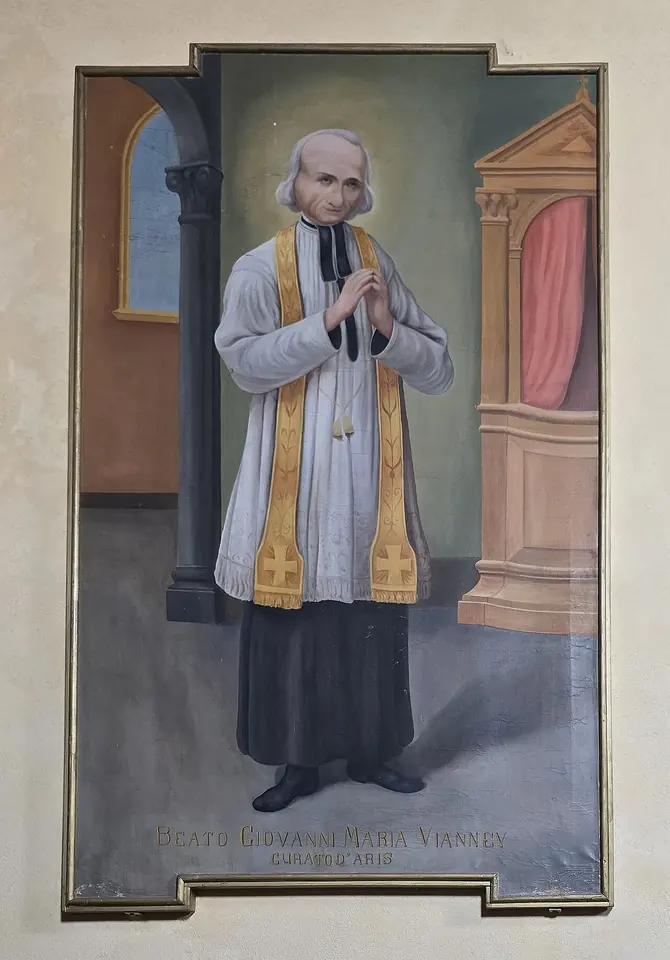

His fame rests on ordinary things done to an extraordinary degree: preaching, catechism, Mass and, above all, confession. Benedict XVI quoted the line that he "would often say" and that the Catechism of the Catholic Church also repeats: "The priesthood is the love of the heart of Jesus."
The life of St. John Vianney
A childhood under the Revolution
He was born at Dardilly on May 8, 1786, the fourth of six children of Matthieu Vianney and Marie Béluze, and grew up working on the family farm. The French Revolution closed the churches when he was a small boy. The Sanctuary of Ars says he made his first confession at home, at the foot of the great clock in the family's common room, to a priest in hiding, and received his First Communion in a barn during a secret Mass. At 17 he told his mother, "I'd like to win souls for God." His father, short of hands on the farm, held out for two years.


The struggling student
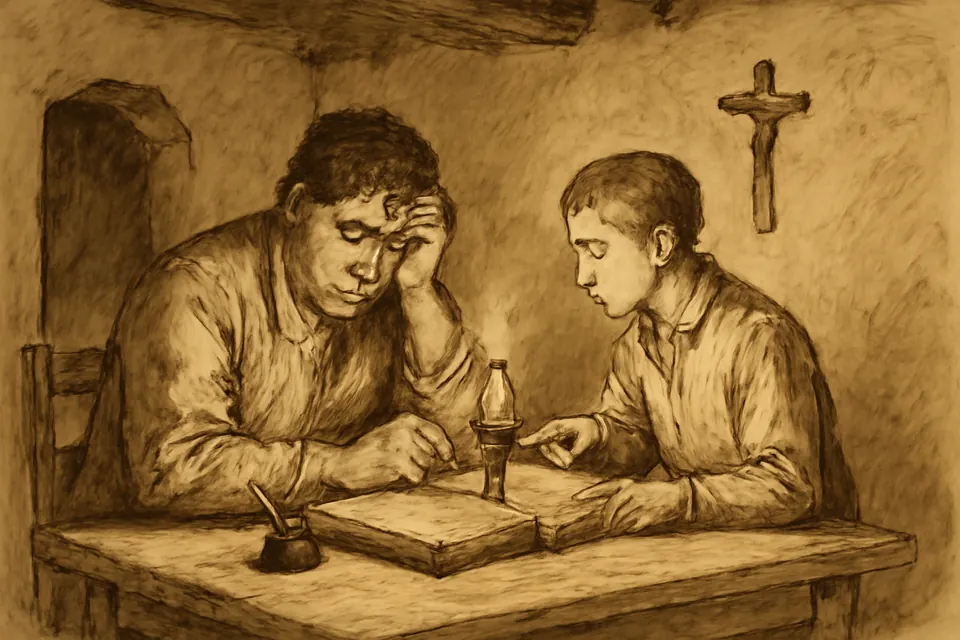
At twenty he began to study with Abbé Charles Balley, the parish priest of Écully, who had opened a small school for future priests. It was hard going. The Catholic Encyclopedia says his schooling had been "confined to a little arithmetic, history, and geography," and that he found Latin "excessively difficult." A younger fellow student, Mathias Loras, later the first bishop of Dubuque, Iowa, helped him with his Latin lessons.
The accidental deserter
In 1809 Napoleon needed soldiers for the war in Spain, and the young seminarian was drafted. On the morning his unit marched, he went to church to pray and came back to find his regiment gone. Trying to catch up, he met a young man who offered to guide him and instead led him to the village of Les Noës, where other deserters were hiding. The mayor persuaded him to stay, and for about fourteen months he lived there under another name as the village schoolmaster. The affair was settled when his younger brother agreed to serve in his place.
Ordination
Back at Écully, he was sent to the seminary, where his Latin was so poor that he had to follow the philosophy course in French. He failed the entrance examination for the major seminary and passed only on a second try three months later, after Balley interceded with the examiners. He was ordained a priest at Grenoble on August 13, 1815, and went back to Écully as Balley's assistant.
"I will show you the way to heaven"
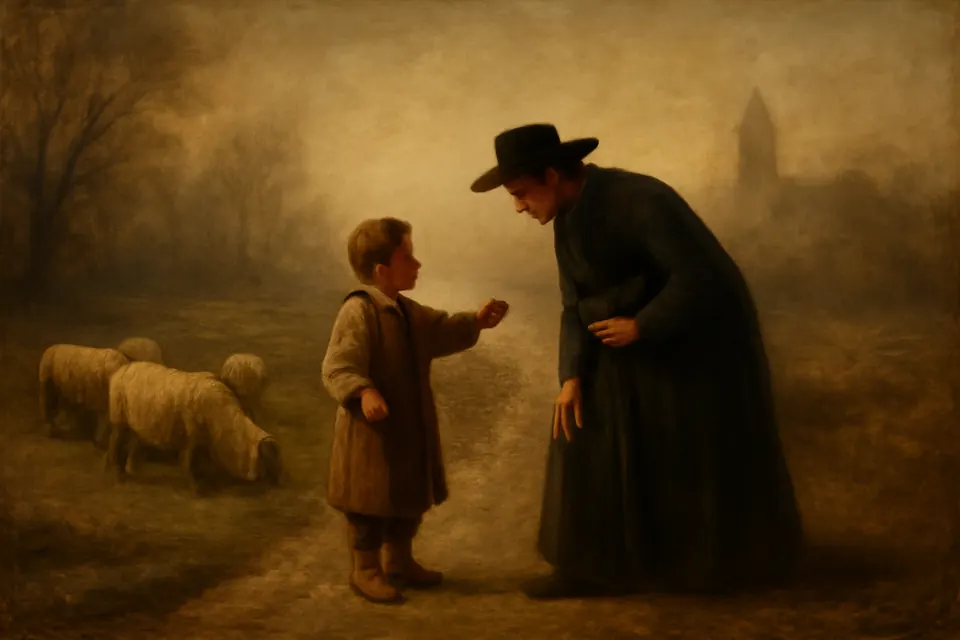
When Balley died, the diocese sent the new priest to Ars, a small village in the Dombes, north of Lyon. Benedict XVI quotes the warning his bishop gave him: "There is little love of God in that parish; you will be the one to put it there." Arriving in February 1818, Vianney lost his way and asked a young shepherd, Antoine Givre, for directions. His answer is carved on the monument that now marks the spot: "You have shown me the way to Ars; I will show you the way to heaven." Antoine Givre died five days after him, in August 1859.
The Curé of Ars at work
Ars was small, poor and, by his bishop's account, cool toward religion. Benedict XVI records Vianney's first prayer there: "[Lord,] grant me the conversion of my parish; I am willing to suffer whatever you wish, for my entire life!" His first biographer, Alfred Monnin, wrote that "upon his arrival, he chose the church as his home." He prayed for long hours before the tabernacle, visited the sick and every family, and kept hard fasts and vigils.

Catechism and preaching
He preached against drunkenness and the village dances, and the Sanctuary of Ars says he set out to protect families from alcohol and violence. In 1824 he opened La Providence, a free school for girls that became an orphanage; Benedict XVI says it took in more than sixty abandoned girls. He taught them the catechism himself. His simple daily instructions became so popular that they moved into the church, where crowds came to hear them.
His words were plain and often homely. The Sanctuary of Ars collects many of them:
Prayer is nothing other than union with God.
You have a small heart, but prayer enlarges it and makes it capable of loving God.

The confessional
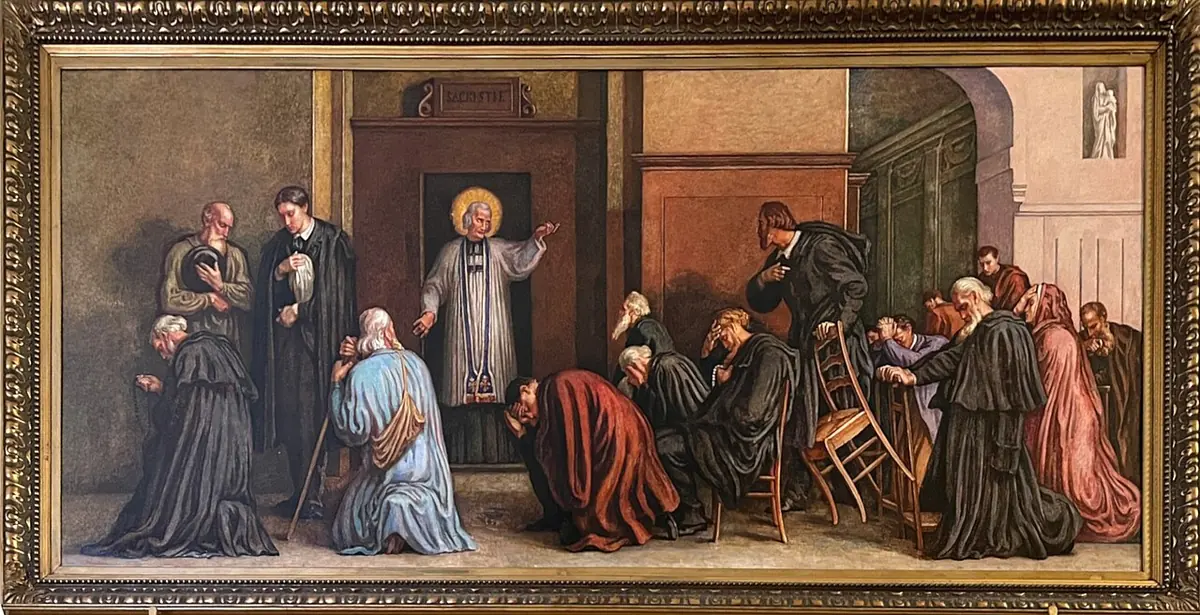
What made Ars famous was confession. From about 1830 penitents began coming from neighboring parishes, then from all over France and abroad. As early as 1835, the Catholic Encyclopedia says, his bishop forbade him to attend the annual clergy retreat because of "the souls awaiting him yonder." The Catholic Encyclopedia counts twenty thousand pilgrims a year by 1855; John XXIII wrote of eighty thousand; the Sanctuary of Ars says about one hundred thousand came in 1858, his last full year.

The sources agree only that the hours were enormous. John XXIII, in his 1959 encyclical on the Curé, wrote that "for almost fifteen hours each day, he lent a patient ear to penitents." Benedict XVI said "up to sixteen hours a day." The Sanctuary of Ars says up to seventeen in 1858, and the Catholic Encyclopedia sixteen to eighteen in his last ten years. People said Ars had become "a great hospital of souls."
He treated penitents differently, Benedict XVI noted. To the scrupulous he said, "The good Lord knows everything. Even before you confess, he already knows that you will sin again, yet he still forgives you." To the careless he said, weeping, "I weep because you don't weep." To a fellow priest he explained his method: "I give sinners a small penance and the rest I do in their place."

Attempts to run away
He never felt equal to the work. He longed for a monk's life, "to bewail his poor life, in solitude," in the words Benedict XVI quotes. He tried to leave Ars several times. The Sanctuary of Ars tells of the last attempt, in 1853: his parishioners caught him leaving in the middle of the night after ringing the alarm bell. He went back to the church and began hearing confessions at one o'clock in the morning.
His death
He died in his presbytery at about two in the morning on August 4, 1859, worn out. His last penitents had come to his bedside five days earlier. More than a thousand people, the bishop and all the priests of the diocese came to his funeral.
The "grappin": his struggles with the devil
From the end of 1823 until the end of his life, Vianney said he was tormented at night by the devil, whom he nicknamed le grappin, "the grappling hook." These episodes are reported: told by the Curé himself and by witnesses at his canonization process, and judged in different ways by the people who knew him.
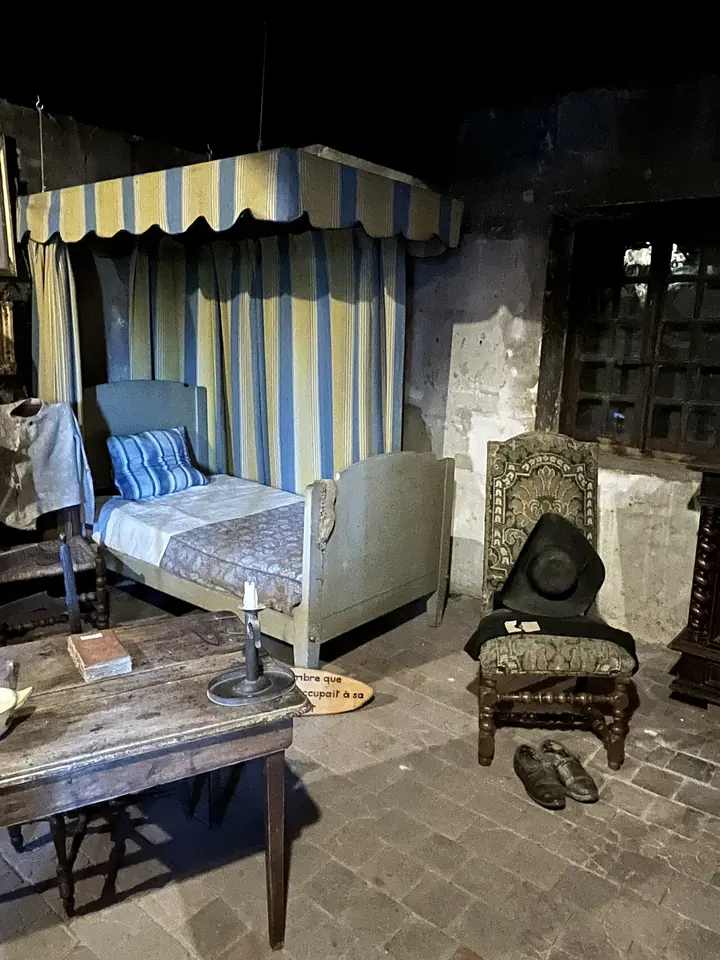
The first came in the winter of 1823 to 1824. He heard violent noises at the presbytery door and, thinking of thieves, asked a young wheelwright named André Verchère to stand guard. The Sanctuary of Ars still points out Verchère's forge, where he "stood guard at the presbytery when the Curé d'Ars was hearing strange noises." Verchère said he heard the door shaken as if by blows of a club and saw no one. In 1826 or 1827, while Vianney was preaching a mission at Saint-Trivier-sur-Moignans, the other priests in the house heard a great noise and found his bed dragged into the middle of his room.

Opinions differed then and now. His assistant, Abbé Raymond, thought most of the "diableries" were "the natural effects of a tired brain," though he could not explain the night at Saint-Trivier. The Curé's doctor rejected that view. The Curé himself told these stories calmly, sometimes with a touch of humor, according to the historian René Fourrey.


The miracles of St. John Vianney
The Catholic Encyclopedia sorts the miracles his biographers recorded into three kinds: money for his charities and food for his orphans; knowledge of the past and future; and the healing of the sick, especially children. It adds that "the greatest miracle of all was his life."
- Approved: the miracles attributed to his intercession after his death that the Church examined and accepted for his beatification in 1905 and his canonization in 1925.
- Reported: the wheat at La Providence. The best-known story comes from a witness at the diocesan process. Around 1828 to 1830 the granary that fed the orphans was nearly empty, the Curé prayed, and a few days later the mayor, Antoine Mandy, found it full. Another witness said Mandy's son claimed his father had secretly carried grain up himself. The historian René Fourrey, who quotes both, rejected the idea of a trick but admitted that the wonders at the presbytery were never rigorously checked.
- Reported: reading hearts. Many penitents said he named sins they had held back, or knew things about their lives he could not have learned. The Catholic Encyclopedia says "he would sometimes divine sins withheld in an imperfect confession."
- Reported: healings at Ars. Pilgrims reported many cures. The Curé gave the credit to St. Philomena and asked people not to speak of him.
- Reported: his own recovery in 1843, described below.
St. John Vianney and St. Philomena
In 1836 his friend Pauline Jaricot of Lyon, who had been cured at the shrine of St. Philomena in Mugnano, Italy, brought him a relic of that young martyr. He built a chapel for her in his church and from then on sent the sick and the troubled to pray to her. When cures followed, he insisted they came through her. He called her his "dear little saint."
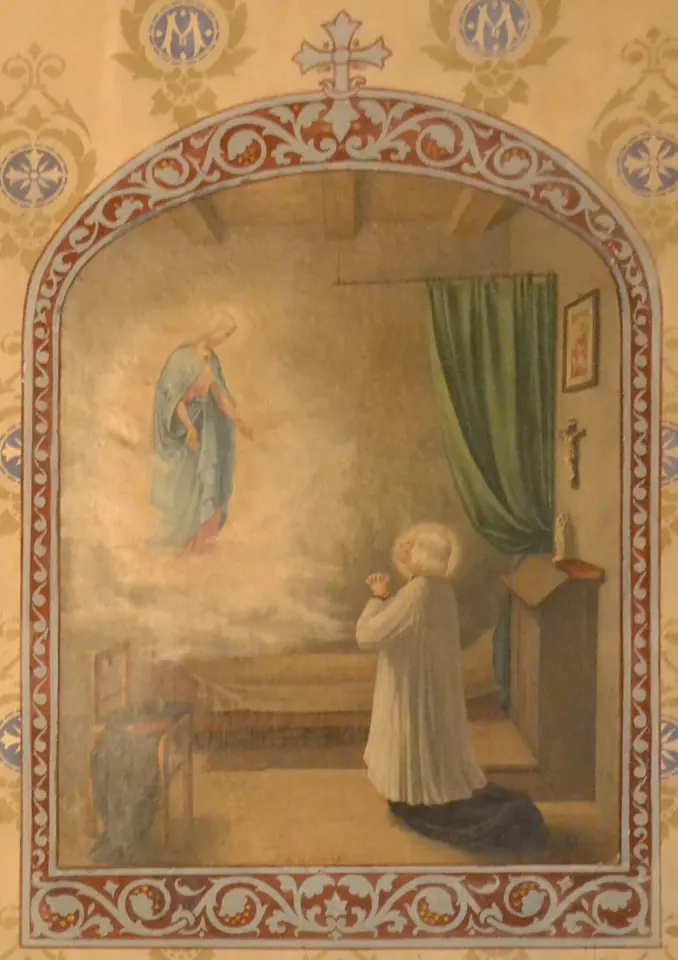
In May 1843 he fell gravely ill with pneumonia and was not expected to live. He promised a hundred Masses in Philomena's honor, and the fever broke during the first of them. He believed she had obtained his recovery, and a painting in the basilica shows her appearing over his sickbed. When someone asked whether it was true that Philomena obeyed him, he is said to have answered, "And why not, since every day God Himself obeys me at the altar?"


Why St. John Vianney is the patron saint of parish priests
Pope St. Pius X, himself once a village parish priest, beatified Vianney on January 8, 1905, and named him patron of the priests of France. On April 23, 1929, four years after canonizing him, Pope Pius XI made him "heavenly patron of all parish priests throughout the world." Catholics also ask his prayers for confessors and for men preparing for the priesthood, and the Sanctuary of Ars opened a seminary there in 1986.
Popes have kept returning to him. John XXIII wrote a whole encyclical about him, Sacerdotii Nostri Primordia, for the centenary of his death in 1959. John Paul II made a pilgrimage to Ars on October 6, 1986, for the bicentenary of his birth. Benedict XVI opened the Year for Priests on June 19, 2009, in his honor, quoting his words: "A good shepherd, a pastor after God's heart, is the greatest treasure which the good Lord can grant to a parish." See all patron saints by cause.

Symbols of St. John Vianney in art
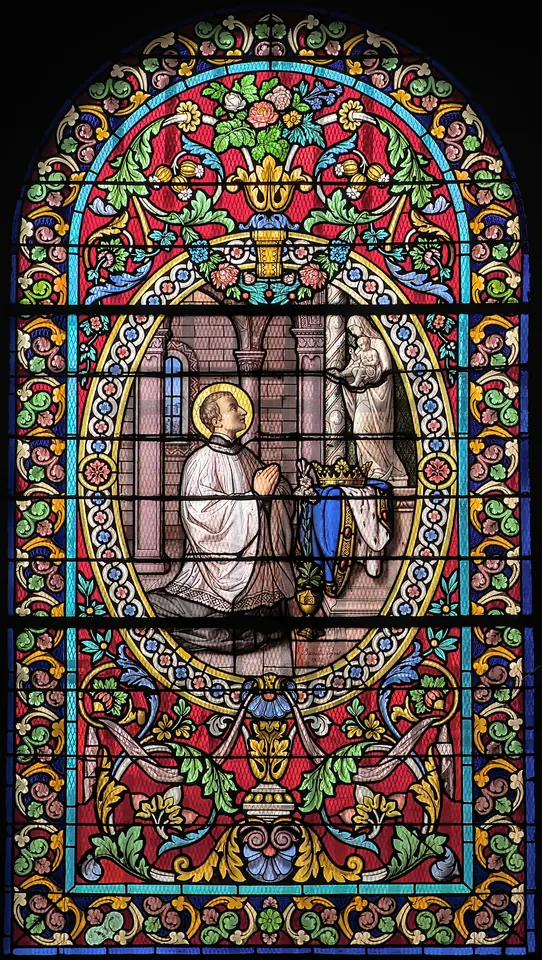
The Curé of Ars is almost always shown as an old man: a thin, stooped priest with a long, lined face and long white hair. To recognize him in a church:
- Black cassock and white surplice, usually with a stole. This is the dress of a parish priest hearing confessions or preaching.
- A confessional, or a purple stole, for the work that filled his days. The Italian painting near the top of this page puts a confessional behind him.
- A rosary or crucifix in his hands, and often hands joined in prayer.
- A shepherd boy beside him, recalling his arrival at Ars, as in the statue group of the Monument of the Meeting.
- St. Philomena nearby, in French paintings and reliefs.
Many images of him were made between his beatification in 1905 and his canonization in 1925, so they carry the title "Blessed" (Bienheureux, Beato), as in the Italian painting near the top of this page.

Feast day and the shrine at Ars
The Catholic Church celebrates St. John Vianney on August 4, the day of his death, as an obligatory memorial. Before the calendar reform of 1969 the feast fell on August 9. See his neighbors in the year on the feast day calendar.
The Basilica of Ars
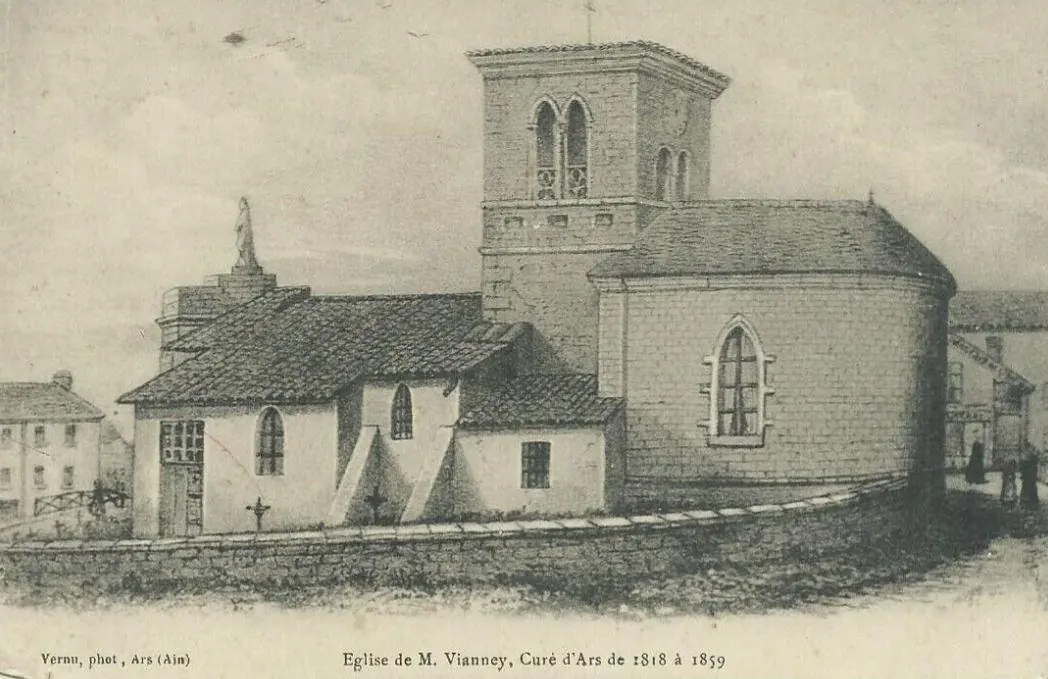
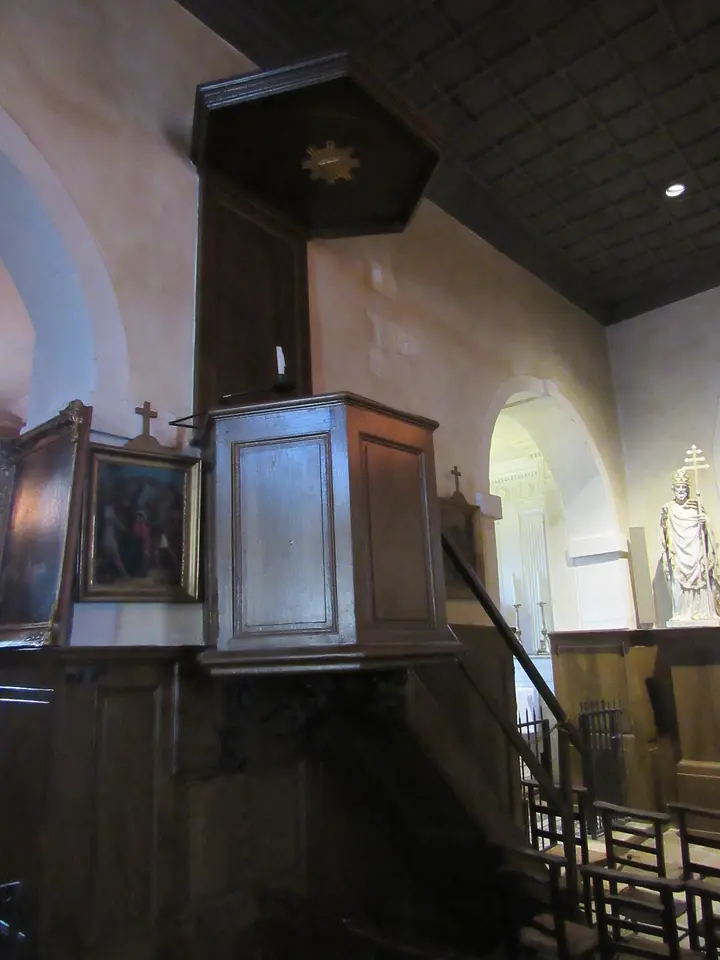
His small church at Ars still stands. Late in the 19th century a basilica was built onto it, so that the old nave, with his pulpit and confessional, opens into the new church. The Sanctuary of Ars says it now welcomes about 550,000 pilgrims a year.
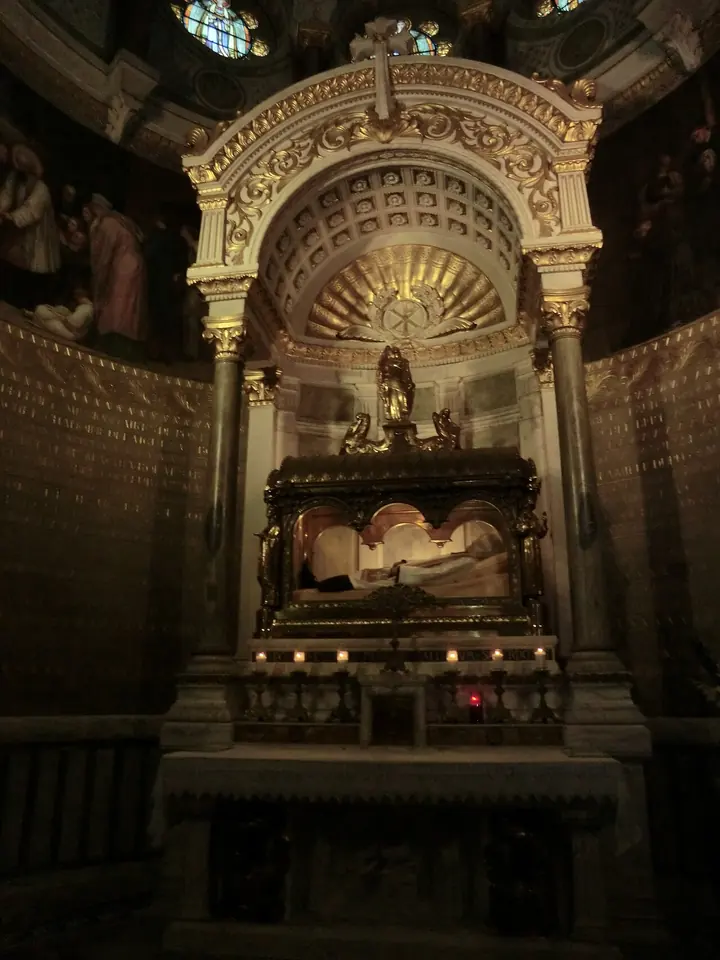
His body lies in a gilded glass shrine above an altar in the basilica. It is often described as incorrupt. When it was exhumed in 1904, the official report described it as darkened and dried, with "all the limbs whole and in their natural position." It was embalmed and placed in the shrine, and the face visitors see is covered by a wax mask. The state of the body is a reported wonder, not one the Church has ruled on.

The Chapel of the Heart
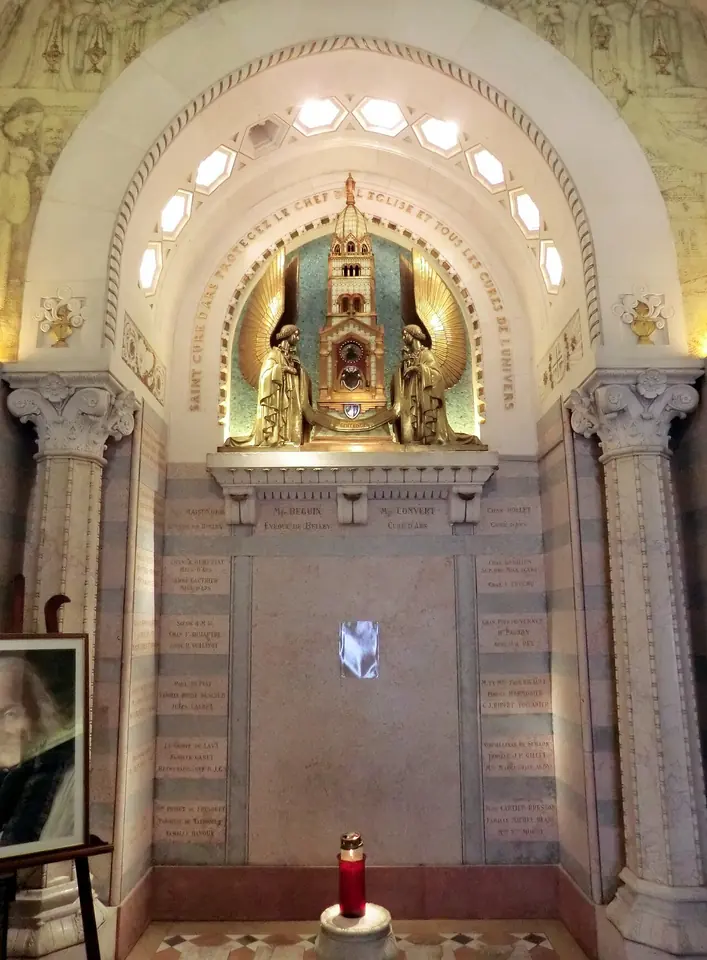
His heart was removed at the 1904 exhumation and is kept in a gilded reliquary in the Chapel of the Heart, a short walk from the basilica. In 2018 and 2019 the reliquary of his heart was taken on a tour of the United States. Visitors to Ars can also see his house and bedroom, the house of La Providence, and the Monument of the Meeting, about a 45-minute round trip on foot, where he met the shepherd boy. His birthplace at Dardilly is kept as a museum.

Prayers to St. John Vianney
The Curé of Ars's act of love
The best-known prayer connected with him is his own. The Catechism of the Catholic Church (2658) quotes it:
I love you, O my God, and my only desire is to love you until the last breath of my life. I love you, O my infinitely lovable God, and I would rather die loving you, than live without loving you. I love you, Lord, and the only grace I ask is to love you eternally.... My God, if my tongue cannot say in every moment that I love you, I want my heart to repeat it to you as often as I draw breath.
The collect of his feast
The prayer of the Mass on August 4, from the Roman Missal:
Almighty and merciful God, who made the Priest Saint John Vianney wonderful in his pastoral zeal, grant, we pray, that through his intercession and example we may in charity win brothers and sisters for Christ and attain with them eternal glory. Through our Lord Jesus Christ, your Son, who lives and reigns with you in the unity of the Holy Spirit, God, for ever and ever.
The novena of the Sanctuary of Ars
The sanctuary publishes a nine-day novena with a reading and meditation for each day: God's love, trust in God, charity and humility, prayer and others. Each day ends with the same short invocation, followed by an Our Father, a Hail Mary and a Glory Be:
Saint Curé d'Ars, I trust in your intercession. Pray and intercede especially for me during this novena for … (designate the favor desired)
Catholics pray to him especially for their parish priests, for vocations, and for the grace of a good confession. Many priests keep his words from the Year for Priests close at hand: "The priest is not a priest for himself, he is a priest for you."
Frequently asked questions
What is St. John Vianney the patron saint of?
Parish priests. Pope Pius XI named him "heavenly patron of all parish priests throughout the world" in 1929, and Catholics invoke him for all priests and for confessors. Pope St. Pius X had already called him patron of the priests of France in 1905.
When is the feast day of St. John Vianney?
August 4, the day he died in 1859. It is an obligatory memorial in the Catholic Church's General Roman Calendar. Before 1969 his feast was kept on August 9.
Why is he called the Curé of Ars?
Curé is French for parish priest, and Ars is the village north of Lyon where he served from 1818 until his death in 1859. When he arrived it had about 230 people.
How many hours a day did St. John Vianney hear confessions?
The figures vary by source. Pope John XXIII wrote "almost fifteen hours each day," Pope Benedict XVI "up to sixteen hours a day," and the Sanctuary of Ars says up to seventeen hours in 1858. The 1910 Catholic Encyclopedia says sixteen to eighteen hours in the last ten years of his life.
Is St. John Vianney's body incorrupt?
His body lies in a glass shrine in the Basilica of Ars and is often called incorrupt. When it was exhumed in 1904 the official report described it as darkened and dried but whole. The face seen by pilgrims today is a wax mask, and his heart was removed and is kept in a separate chapel nearby.
Who was St. Philomena to the Curé of Ars?
His favorite saint. He built a chapel to her in his church, sent the sick to pray to her, and gave her the credit for cures that people wanted to attribute to him. He believed her prayers cured him of a grave illness in 1843.
What did St. John Vianney say about the priesthood?
His best-known line, quoted in the Catechism of the Catholic Church (1589), is "The priesthood is the love of the heart of Jesus." Pope Benedict XVI opened the Year for Priests in 2009 with these words.
Sources
- Catholic Encyclopedia (1910): St. John Vianney
- Benedict XVI, Letter Proclaiming a Year for Priests (June 16, 2009)
- John XXIII, Sacerdotii Nostri Primordia (August 1, 1959)
- Catechism of the Catholic Church, 2658 (the Curé of Ars's act of love)
- Sanctuary of Ars: The Curé d'Ars
- Sanctuary of Ars: Timeline
- Sanctuary of Ars: The message
- Sanctuary of Ars: Words of the Curé d'Ars
- Sanctuary of Ars: Discovering Ars in the footsteps of the Holy Curé
- Sanctuary of Ars: Novena to the Holy Curé d'Ars
- Vatican News: St. John Vianney, the Curé of Ars, Patron of Parish Priests
- Catholic Culture: Memorial of St. John Vianney, Priest (collect and patronage)
- Wikipédia (French): Jean-Marie Vianney (exhumation report and diabolical phenomena, after Trochu and Fourrey)
- Vatican News: Saint Philomena
- Saint Philomena (devotional booklet), Benedictine Convent of Perpetual Adoration, Clyde, Missouri