St. Christopher
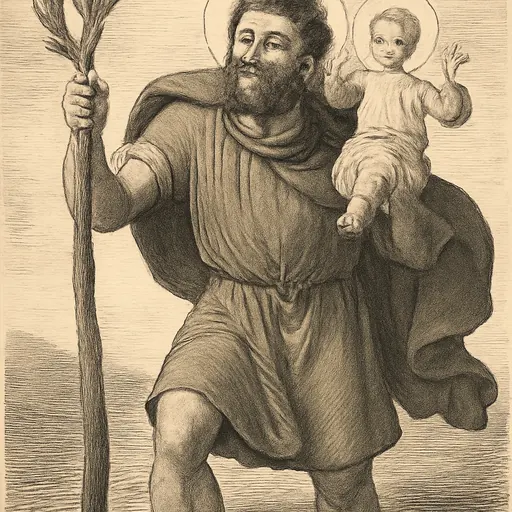
St. Christopher was a Christian martyr who, according to tradition, died in Lycia in Asia Minor around 250. Almost nothing about his life is certain, but the medieval legend of the giant who carried the Christ Child across a river made him the patron saint of travelers, drivers and sailors. The Roman Martyrology remembers him on July 25, and St. Christopher medals are among the most popular Catholic medals in the world.
Who was St. Christopher?
St. Christopher is one of the best-loved saints in Christian history and one of the least documented. The Catholic Encyclopedia sums him up as "a martyr, probably of the third century," of whom "almost nothing certain is known." Tradition places his death in Lycia, on the southern coast of present-day Turkey, under the emperor Decius around 250. His name is Greek: Christophoros, "Christ-bearer."
The evidence that a martyr named Christopher was honored early is solid. The Catholic Encyclopedia notes that St. Remigius of Reims was buried in 532 in a small church dedicated to him, and that Pope St. Gregory the Great, who died in 604, wrote of a monastery of St. Christopher. What the early Church did not have was the story most people know.
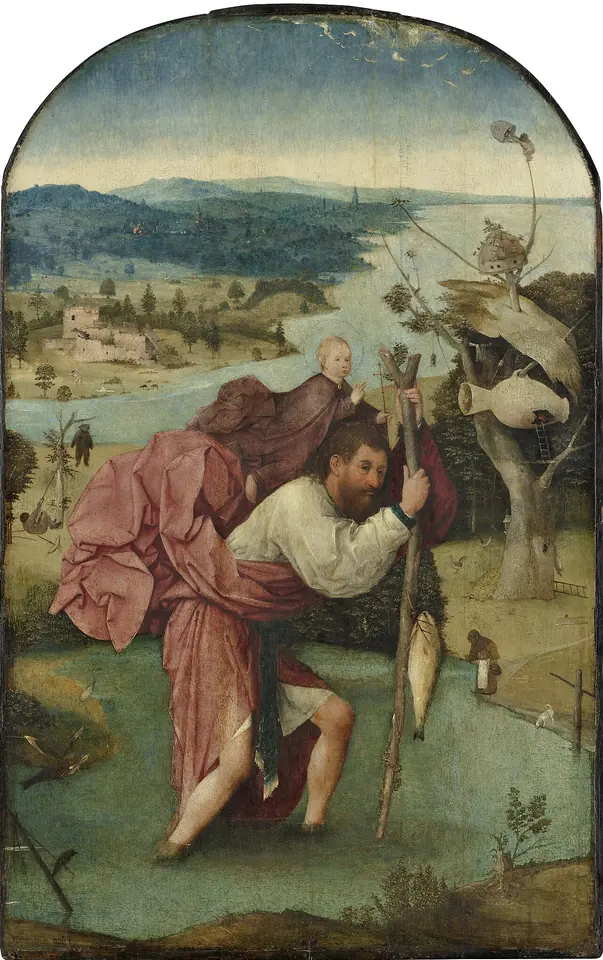

That story, of a giant who carried the Christ Child across a river, grew up in the Middle Ages and reached its classic form in the Golden Legend, the collection of saints' lives compiled by Jacobus de Voragine around 1260. It made Christopher the patron of everyone who travels, and it is why his medal hangs in so many cars today.
The legend of St. Christopher
The Golden Legend tells his story in a series of episodes. All of them are traditional. The quotations below are from William Caxton's English translation of 1483.
Reprobus, the giant who wanted the greatest master
He was a Canaanite, "of a right great stature," twelve cubits tall (about eighteen feet), with "a terrible and fearful cheer and countenance." Before his baptism his name was Reprobus. (Other versions call him Offerus.) He decided he would serve only "the greatest prince that was in the world," and entered the court of a king said to be the mightiest on earth. One day a minstrel sang a song that named the devil, and the king made the sign of the cross. Reprobus asked why. The king admitted that he feared the devil. Then the devil was greater, Reprobus reasoned, and he left to find him.
The devil and the wayside cross
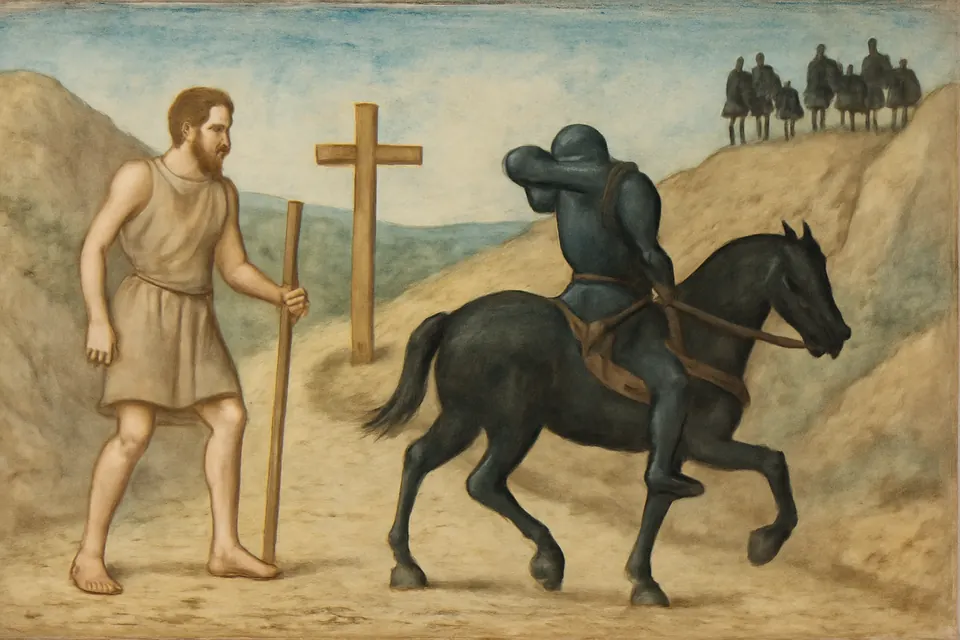
In the desert he met a company of knights. Their leader, "a knight cruel and horrible," said, "I am he that thou seekest," and Reprobus gladly became his servant. But when they came to a cross standing by the road, the devil "was afeard and fled," and led him on a long detour through the wilderness. Pressed for a reason, the devil confessed that he feared the sign of a man called Christ, who had been hanged on a cross. "Then he is greater, and more mightier than thou," said Reprobus, and he went to look for Christ.
The hermit and the river
A hermit taught him the faith and told him that Christ asks his servants to fast. Reprobus said he could not. To keep vigils and pray, then? He did not know how. So the hermit gave the giant a task that suited him. Near by was a river where many people had drowned. "Because thou art noble and high of stature and strong in thy members," the hermit said, he should live beside it and carry travelers across. Reprobus built a hut on the bank and, leaning on a great pole, carried "all manner of people without ceasing."
The child who weighed as much as the world
One night he heard a child's voice call, "Christopher, come out and bear me over." Twice he went out and found no one. The third time a child stood on the bank. Christopher lifted him to his shoulders and stepped into the river. The water rose higher, and the child grew "heavy as lead," until Christopher was afraid he would drown. On the far bank he set the child down and said, "Thou weighest almost as I had all the world upon me." The child answered:
Christopher, marvel thee nothing, for thou hast not only borne all the world upon thee, but thou hast borne him that created and made all the world, upon thy shoulders. I am Jesu Christ the king, to whom thou servest in this work.


The staff that bloomed
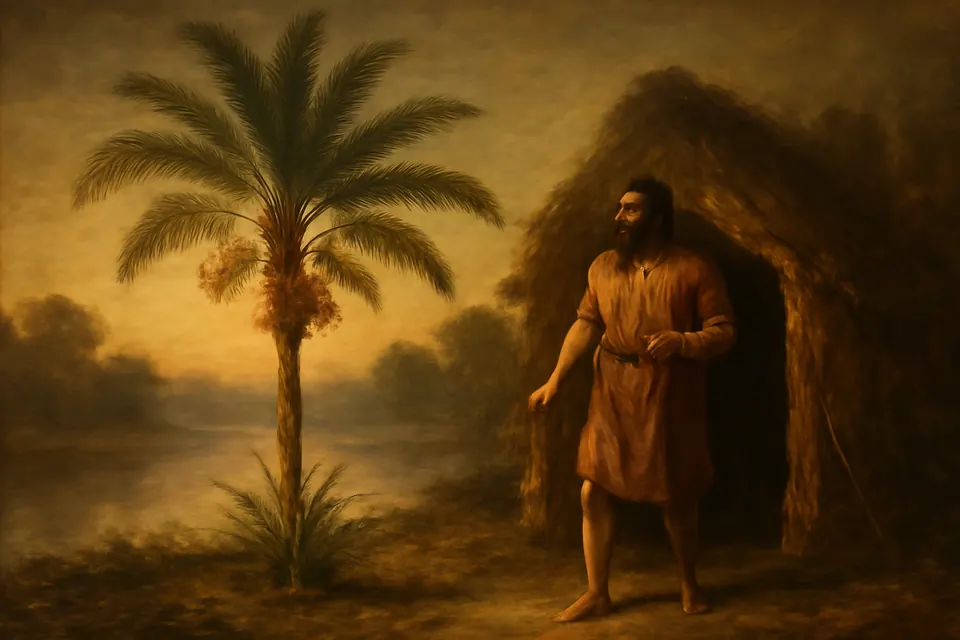
As a sign, the child told him to plant his staff beside his hut. In the morning Christopher found it grown into a palm tree "bearing flowers, leaves and dates." This is why so many paintings give him a staff sprouting leaves, and why gardeners claim him as a patron.
Martyrdom in Lycia
Christopher went to Lycia, where Christians were being put to death, and prayed to understand the local language. When a judge struck him, he did not strike back. He planted his staff again; it blossomed, and the Golden Legend says eight thousand people were converted. The king, called Dagnus, sent soldiers to arrest him; they found him praying, joined him, and became Christians themselves. Two women, Nicaea and Aquilina, were sent to tempt him in prison and were converted instead; both died as martyrs.
The king then had Christopher beaten with iron rods, set on a red-hot iron seat that "melted like wax," and tied to a stake for forty archers. Their arrows hung in the air around him, and one turned back and blinded the king. Christopher told him, "Tyrant, I shall die to-morn, make a little clay, with my blood tempered, and anoint therewith thine eye." He was beheaded. The king put the clay on his eye, was healed, and believed.


The older Eastern story and the dog-headed Christopher
The Western legend is not the oldest one. Greek accounts of his martyrdom, which the Catholic Encyclopedia says may go back to the 6th century, tell a different story. Christopher, named Reprebus, is a huge, fearsome man from a distant tribe, captured in war and pressed into a Roman army unit. He cannot speak "our language" until God gives him the gift of speech. He defends persecuted Christians, accepts a beating without striking back, and wins over the 200 soldiers sent to bring him to the emperor Decius. On the road his dry staff blossoms and bread is multiplied. Some versions say he was from the Cynocephali, the "dog-headed" people whom ancient geographers placed at the edges of the world.


The detail may have begun as a way of saying that Christopher was an outsider, a man from the wild edge of the world whom Christ made a saint. Some Eastern icons, especially in Greece, the Balkans and Russia, show him with a dog's head, and Christian Iconography notes others with the head of a wolf or a horse. Church authorities discouraged such images, and most Orthodox icons today give him an ordinary human face, often in soldier's dress. The Orthodox Church in America's life of the saint offers another explanation: some trace his origin to the Cynoscephalae, the "dog's heads," a range of hills in Thessaly in Greece. It adds a tradition that Christopher, a handsome young man, asked God to make his face unattractive so that he would not be a temptation to anyone.
The Orthodox Church remembers him on May 9, together with the martyrs Callinica and Aquilina. The Orthodox life says he converted thousands and was beheaded in Lycia in 250, and that his skull is kept at the Monastery of Karakalou on Mount Athos.
The miracles of St. Christopher
St. Christopher lived long before the Church formally investigated miracles, so none of the stories told of him is approved. Sorted by this encyclopedia's labels:
- Carrying the Christ Child across the river: traditional, from the Golden Legend and earlier Latin lives. The Church has never presented it as history.
- The blossoming staff, the arrows that would not strike him, the iron seat that melted, the healing of the king's eye: traditional.
- The gift of speech and the conversion of the soldiers: traditional, from the Greek acts.
- Protection on journeys and escapes from accidents attributed to his prayers: reported. Travelers have told such stories for centuries, but they are personal testimonies, not cases the Church has examined.
Was St. Christopher "de-sainted" in 1969?
No. This is one of the most common mistakes about any saint, and it goes back to newspaper reports in 1969.
That year Pope Paul VI approved a new General Roman Calendar, the list of feasts celebrated by the whole Latin Church. The Second Vatican Council had asked that the calendar be cleared so that the feasts of Christ would stand out, with many saints "left to be celebrated by a particular Church or nation or religious family." About 200 saints were dropped from the universal calendar. The official commentary on the new calendar (Calendarium Romanum, 1969) said of Christopher that his written acts are legendary but that devotion to him is ancient, and that his memorial had entered the Roman calendar only late, around 1550. Until 1954 it had been said only in private Masses. So his memorial was left to local calendars.
Removal from the calendar is not a judgment that a saint is false. Catholic Answers puts it plainly: "The Church never issued any kind of decree saying that Christopher never existed." The Roman Martyrology, the Church's official list of saints, still names him as a martyr on July 25, and Catholics are free to honor him, celebrate his feast where it is kept and ask for his prayers. Some saints on the same list, such as St. Valentine, went through the same change.


Why St. Christopher is the patron saint of travelers
The patronage comes straight from the legend: a man who carried travelers across a dangerous river, and once carried Christ himself, is the obvious saint to ask for a safe crossing. The Catholic Encyclopedia records a brotherhood founded under his patronage in 1386 in Tyrol and Vorarlberg to guide travelers over the Arlberg Pass, and notes that he was honored along rivers that flooded, like the Danube and the Rhine.
A second belief made him even more popular. In the Middle Ages, people held that whoever looked at an image of St. Christopher would not die a sudden death that day, without the chance to confess. The Catholic Encyclopedia gives the common inscription as "Whoever shall behold the image of St. Christopher shall not faint or fall on that day." The Buxheim woodcut above, perhaps the most famous early European print, carries it in Latin verse:
Cristofori faciem die quacumque tueris, illa nempe die morte mala non morieris.
On whatever day you look on the face of Christopher, on that day you will not die an evil death.
The print is dated 1423, though Ed Potten of the John Rylands Library argues it was more likely made in the late 1430s. The Jesuit liturgical writer Francis X. Weiser explained the belief in 1958: during epidemics, "when people never knew in the morning whether they would still be alive that evening," they hung Christopher's picture over their doors or painted it on outside walls so that everyone passing would see it.
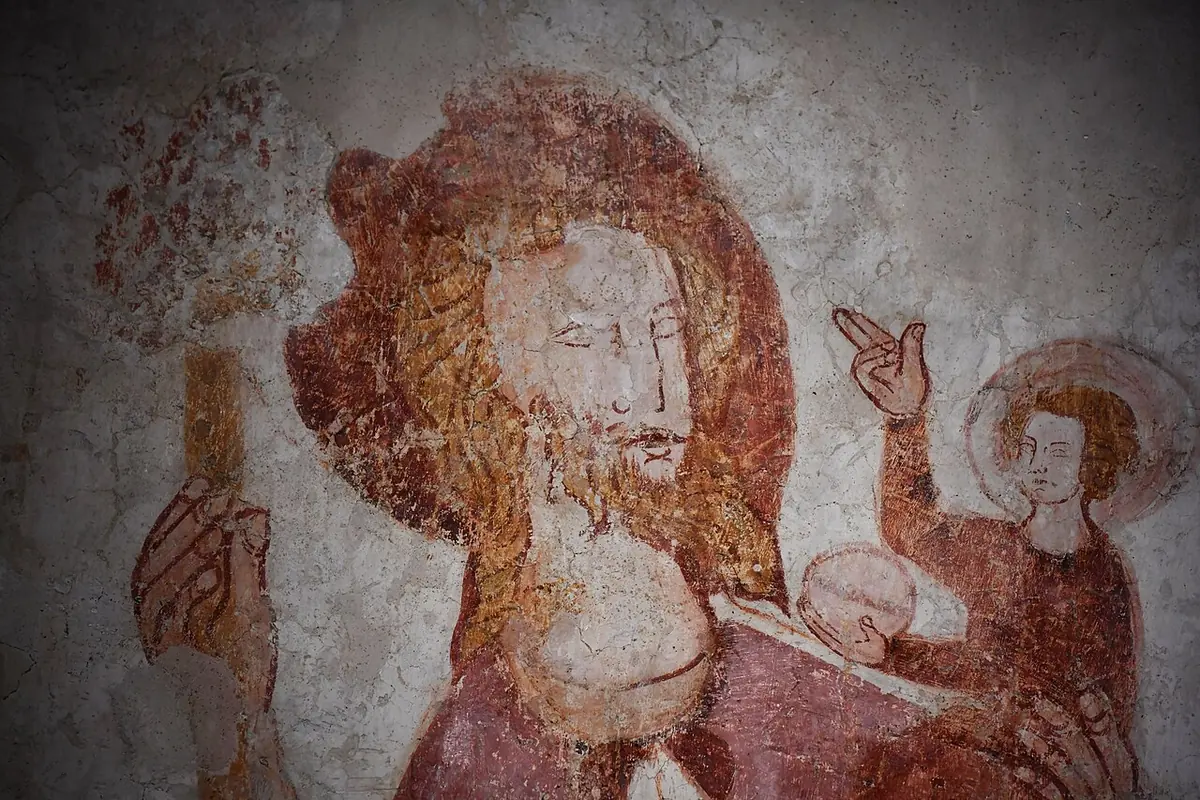
This is why medieval churches painted Christopher huge, often on the wall facing the main door, where every person entering would see him. In England many survive, uncovered in the last two centuries from under later whitewash.


The Orthodox Church has the same custom. Greek churches often place his icon at the entrance, and the Orthodox Church in America quotes a Greek rhyme, "When you see Christopher, you can walk in safety."
From ferries the patronage passed to every new kind of travel: ships, then railways, cars and airplanes. Weiser lists him as patron "of ferryboats and their crews, of pilgrims and travelers," and of "all passenger traffic, especially in automobiles." The Catholic Encyclopedia adds mariners, gardeners and bookbinders, and says he was invoked "against lightning, storms, epilepsy, pestilence." He is one of the Fourteen Holy Helpers, with St. Blaise, St. George, St. Barbara, St. Catherine of Alexandria, St. Vitus, St. Erasmus and others. For another patron of travelers, see St. Raphael the Archangel, and all the patron saints by cause.
Symbols of St. Christopher in art
Christopher is the easiest saint to recognize in a church or museum. Look for:
- A giant wading through a river, often with fish in the water around his legs.
- The Christ Child on his shoulder, often holding a globe topped with a cross, the "world" he weighed as much as.
- A staff, pole or whole tree trunk, frequently already sprouting leaves or palm fronds.
- A hermit with a lantern standing at a chapel on the bank, lighting the way.
- A red cloak blowing out behind him, common in Flemish painting.
- A dog's head in a small number of Eastern icons.
The great Flemish painters loved the subject because it let them paint a vast landscape behind a single figure. Dieric Bouts set him in a gorge at sunset. Hans Memling made him the center of the Moreel Triptych in Bruges. Bosch filled the background of his version with odd details: a fish dangling from the staff, a bear hung up by a hunter, and a hermit's house built in a broken jug wedged in a tree.
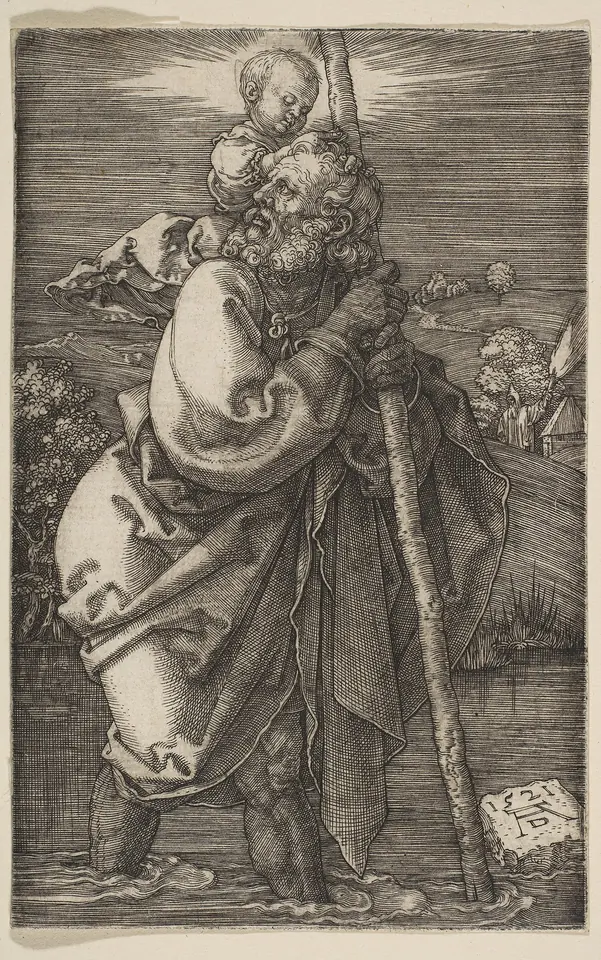

In Italy, Titian painted a powerful Christopher in fresco in the Doge's Palace in Venice in 1523 and 1524, striding through the water and looking up at the Child. Dürer made several prints of him, including a pair of engravings in 1521, one facing left and one facing right.


English parish churches keep the largest group of medieval Christopher paintings anywhere. Besides Pickering, good examples survive at Little Missenden in Buckinghamshire, painted around 1300, and at Raunds, Breage and many other villages.

The St. Christopher medal
Weiser traced the custom of carrying small images of St. Christopher to the 16th century. Their purpose, he wrote, was "to serve as a picture for travelers to gaze on every morning and ask God to save them from sudden death that day." The old belief faded, but the medals stayed, and in the 20th century they became the classic gift for anyone setting out: a soldier, a student going to college, a new driver.
Most medals show the familiar scene: Christopher crossing the river with the Child on his shoulder and a staff in his hand. Common inscriptions include:
- "St. Christopher protect us", the most common wording on English-language medals.
- "Regarde St Christophe et va-t'en rassuré", French for "Look at St. Christopher and go on your way reassured," often given in English as "Behold St. Christopher and go your way in safety." It is a direct descendant of the medieval belief about looking at his image.
- "Si en San Cristóbal confías, de accidente no morirás", a Spanish rhyme: "If you trust in St. Christopher, you will not die in an accident."
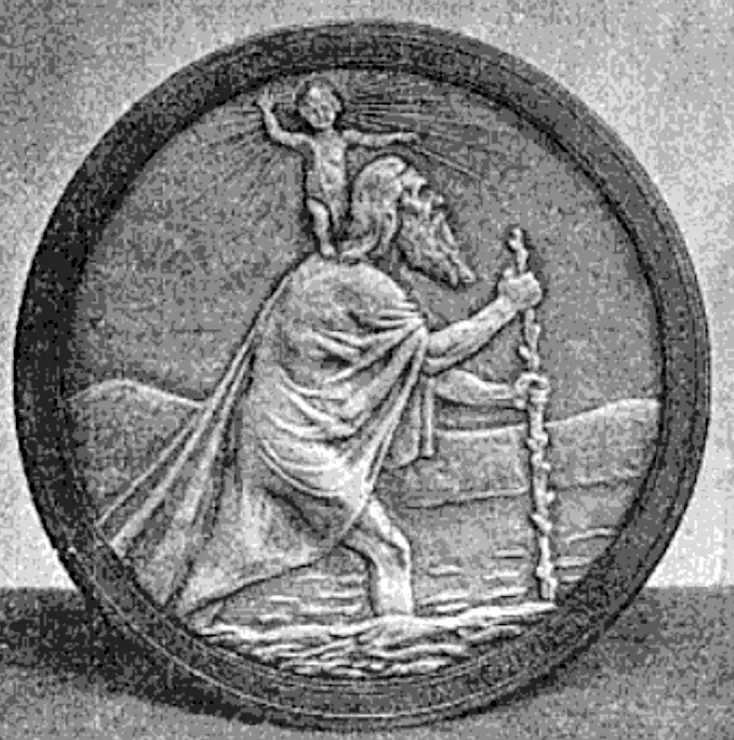

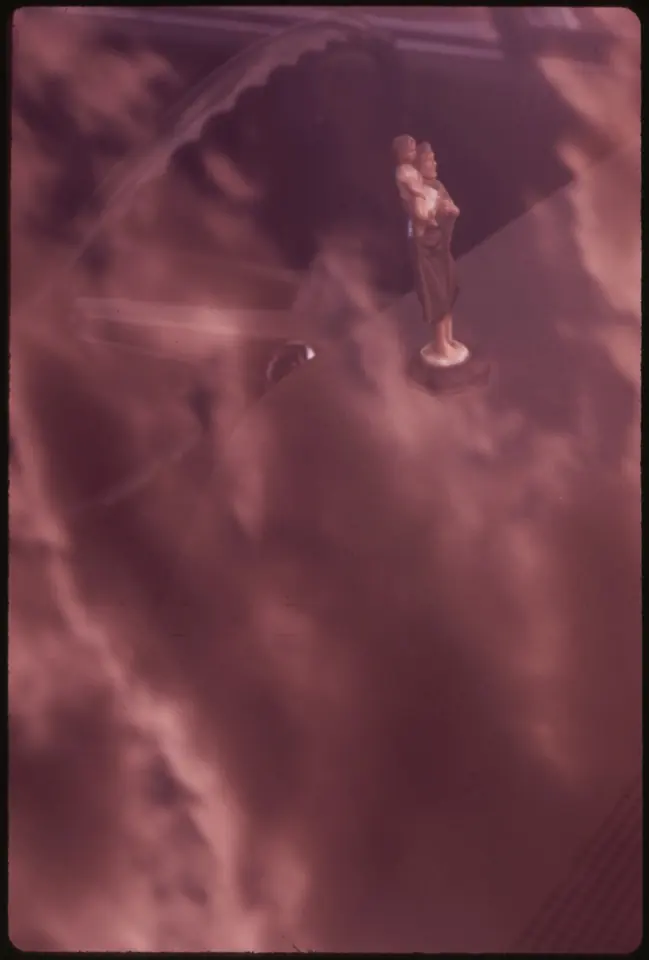
Medals are worn on chains, clipped to car visors and key rings, or set into plaques on dashboards. Small statues of the saint on the dashboard were a common sight in American cars in the mid-20th century.


As with any sacramental, Catholics usually ask a priest to bless the medal. The Church teaches that such objects work through faith and prayer, not by themselves. Weiser called the medals a token of the saint's "generous help and protection in modern traffic."

Feast day and where St. Christopher is honored
The Roman Martyrology names St. Christopher on July 25, the same day the Church celebrates the apostle St. James the Greater, patron of pilgrims. Parishes and dioceses that keep his memorial use that date. The Orthodox Church keeps May 9. See our feast days calendar.
Weiser described how "in many countries cars are blessed on his feast day," with hundreds of cars lining up at churches named for him. Many parishes still hold a blessing of cars on the Sunday nearest July 25. The Austrian ski village of St. Christoph am Arlberg takes its name from him; the brotherhood of 1386 kept a hospice for travelers on the pass there.
Places that claim his patronage include Vilnius, whose coat of arms shows him carrying the Christ Child; Havana, whose full name is San Cristóbal de La Habana; and the Caribbean island of St. Kitts, formally St. Christopher. The Croatian island of Rab claims relics, and the Orthodox venerate his skull at Karakalou on Mount Athos.
Prayer to St. Christopher
The old collect of his feast
Before 1969, Masses commemorating St. Christopher used this prayer, given here in the translation printed in Weiser's Handbook of Christian Feasts and Customs:
Grant us, O Lord, almighty God, as we celebrate the birthday of Saint Christopher, Thy Martyr, that through his intercession we may be strengthened in the love of Thy holy Name.
The "birthday" is the day of his martyrdom, his birth into heaven.
The Motorist's Prayer
This prayer is printed on countless holy cards and dashboard plaques. Its author is unknown:
Grant me, O Lord, a steady hand and watchful eye, that no one shall be hurt as I pass by. You gave life, I pray no act of mine may take away or mar that gift of thine. Shelter those, dear Lord, who bear my company, from the evils of fire and all calamity. Teach me to use my car for others' need; nor miss through love of undue speed the beauty of the world; that thus I may with joy and courtesy go on my way.
St. Christopher, holy patron of travelers, protect me and lead me safely to my destiny. Amen.
Many travelers simply say, "St. Christopher, pray for us," before setting out. The traditional blessing of a car in the Roman Ritual asks God to send his angels to guard it and does not name St. Christopher, but Catholics often add his name to their own prayers for the road.
Frequently asked questions
Is St. Christopher still a saint?
Yes. In 1969 the Catholic Church removed his memorial from the General Roman Calendar, the list of feasts kept everywhere, and left it to local calendars, because his written acts are legendary and his feast entered the Roman calendar late. He was never "de-sainted." The Roman Martyrology still lists him as a martyr on July 25, and Catholics may honor him and pray to him.
What is St. Christopher the patron saint of?
Travelers of every kind, especially drivers, sailors, ferrymen and pilgrims, because he carried people across a dangerous river. He was also invoked against sudden death, storms, plague and epilepsy, and is a patron of gardeners (from his blossoming staff), of Vilnius in Lithuania, and of the island of St. Kitts, formally St. Christopher.
When is St. Christopher's feast day?
July 25, the day the Roman Martyrology names him, and the same day as the feast of St. James the Apostle. Many parishes bless cars on or near that date. The Orthodox Church honors him on May 9.
What does a St. Christopher medal mean?
It asks the saint's protection on a journey. Most show him carrying the Christ Child across a river, often with the words "St. Christopher protect us." The custom goes back to the medieval belief that whoever looked at his image in the morning would not die a sudden death that day. Catholics usually have the medal blessed by a priest.
Who can wear a St. Christopher medal?
Anyone. Catholics wear them most, but they have long been given to travelers, soldiers, students going away and new drivers, and the Jesuit writer Francis X. Weiser noted in 1958 that they were popular with Christians of all churches. The medal is a reminder to pray, not a charm.
Was St. Christopher a real person?
Probably. Churches were dedicated to a martyr named Christopher by the 6th century, and the Catholic Encyclopedia says his existence "cannot be denied." The story of the giant carrying the Christ Child, however, is a medieval legend, best known from the 13th-century Golden Legend.
Why is St. Christopher sometimes shown with a dog's head?
Some early Greek legends said he came from a race of "dog-headed" people, a way of saying he was a fearsome foreigner from beyond the known world. A few Eastern icons, like the 17th-century one on this page, show him that way. Most Orthodox icons today show him with a human face.
What is the prayer to St. Christopher?
The old collect of his feast asks that "through his intercession we may be strengthened in the love of Thy holy Name." The popular Motorist's Prayer, "Grant me, O Lord, a steady hand and watchful eye," ends with "St. Christopher, holy patron of travelers, protect me." Its author is unknown.
Sources
- Catholic Encyclopedia (1908): St. Christopher
- Jacobus de Voragine, The Golden Legend (Caxton translation, 1483): Of St. Christopher
- Orthodox Church in America: Martyr Christopher of Lycia, and, with him, the Martyrs Callinika and Aquilina
- Christian Iconography: St. Christopher: Art, Iconography, Source Texts
- Catholic Answers: Did the Church declare that St. Christopher is a myth?
- Francis X. Weiser, Handbook of Christian Feasts and Customs (1958): Customs and Traditions of St. Christopher (Catholic Culture)
- Catholic Culture: Prayer for the Feast of St. Christopher
- Catholic Culture: Motorist's Prayer
- John Rylands Research Institute and Library: The Saint Christopher woodcut dated 1423
- Calendarium Romanum (Libreria Editrice Vaticana, 1969), p. 131
- Martyrologium Romanum (Libreria Editrice Vaticana, 2001), July 25