St. Pio of Pietrelcina (Padre Pio)
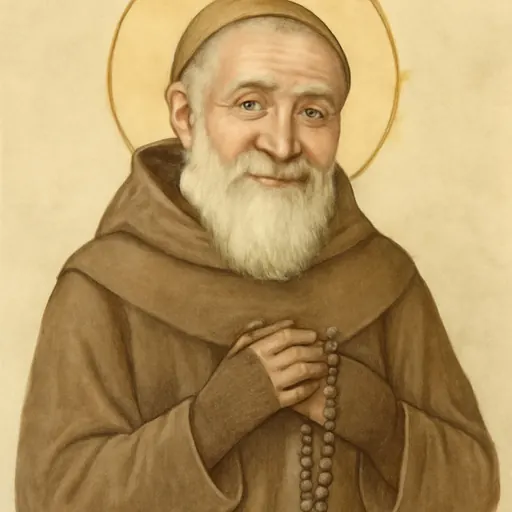
Padre Pio, now St. Pio of Pietrelcina, was an Italian Capuchin friar and priest (1887–1968) who spent fifty years at the friary of San Giovanni Rotondo, hearing confessions for long hours each day. He bore wounds like those of Christ, the stigmata, from 1918 until shortly before his death, and founded a large hospital and the Padre Pio Prayer Groups. His feast day is September 23, and he is the official patron of Italy's civil protection volunteers.
Who was Padre Pio?
Padre Pio was a Capuchin friar from the south of Italy who became, in the years after World War II, one of the most famous priests in the world. He was born Francesco Forgione in 1887 in Pietrelcina, a farming town near Benevento, and he spent fifty-two years, almost his whole adult life, in a small friary on the Gargano promontory at San Giovanni Rotondo. He rarely left it. People came to him instead: first farmers from the surrounding villages, then soldiers, then pilgrims by the busload from all over Europe and America.
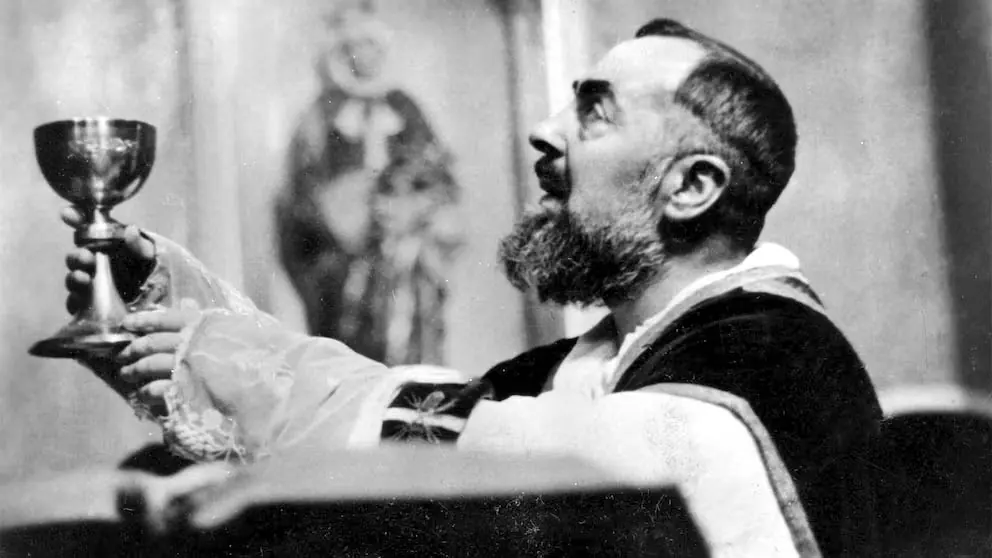
They came for three things. He said Mass with an intensity that people remembered for the rest of their lives. He heard confessions for many hours a day, and penitents said he knew sins they hadn't mentioned. And from September 1918 he bore wounds in his hands, feet and side like the wounds of the crucified Christ, the stigmata, which he tried to keep covered and which made him the object of medical examinations, Vatican investigations and decades of argument.

The Church canonized him in 2002 as St. Pio of Pietrelcina. Italians still simply call him Padre Pio, "Father Pius," and his picture hangs in shops, taxis and kitchens across the country.
The life of Padre Pio
A farm boy from Pietrelcina
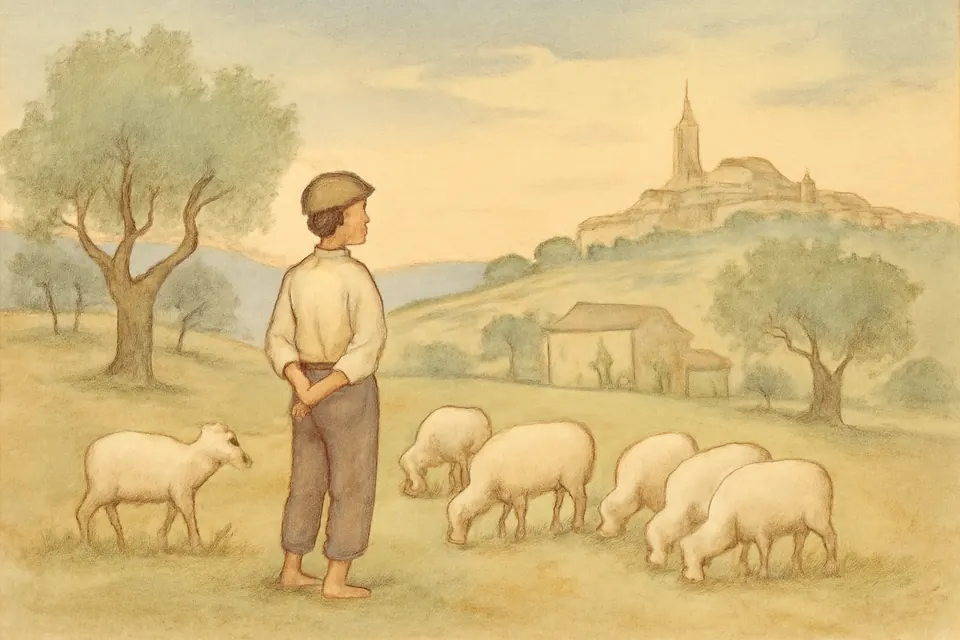
Francesco was born on May 25, 1887, to Grazio Forgione and Maria Giuseppa De Nunzio, peasant farmers, and was baptized the next day. By his own later account, he had decided to give himself to God by the age of five. As a boy he looked after the family's few sheep on their land at Piana Romana, outside town.
He wanted to join the Capuchin friars after meeting one who came begging through the countryside, but he needed more schooling first. His father went to work in the United States to pay for a private tutor. On January 6, 1903, at fifteen, Francesco entered the Capuchin novitiate at Morcone. Two weeks later he received the habit and the name Fra Pio, after Pope St. Pius I, whose relic was kept in his parish church.
Priest and invalid
He made his solemn vows on January 27, 1907, and was ordained a priest in the cathedral of Benevento on August 10, 1910. He was often ill, with fevers, stomach trouble and chest problems that his doctors never fully explained, and his superiors let him live with his family in Pietrelcina, still a Capuchin, until 1916. During those years he wrote long letters to his spiritual directors, Fr. Benedetto of San Marco in Lamis and Fr. Agostino of San Marco in Lamis. These letters, later published as his Epistolario, are the main source for his inner life: his prayer, his visions and what he described as violent attacks by the devil.
During World War I he was drafted into the medical corps in Naples in 1915. He was sent home on sick leave again and again and was finally discharged in March 1918.
San Giovanni Rotondo
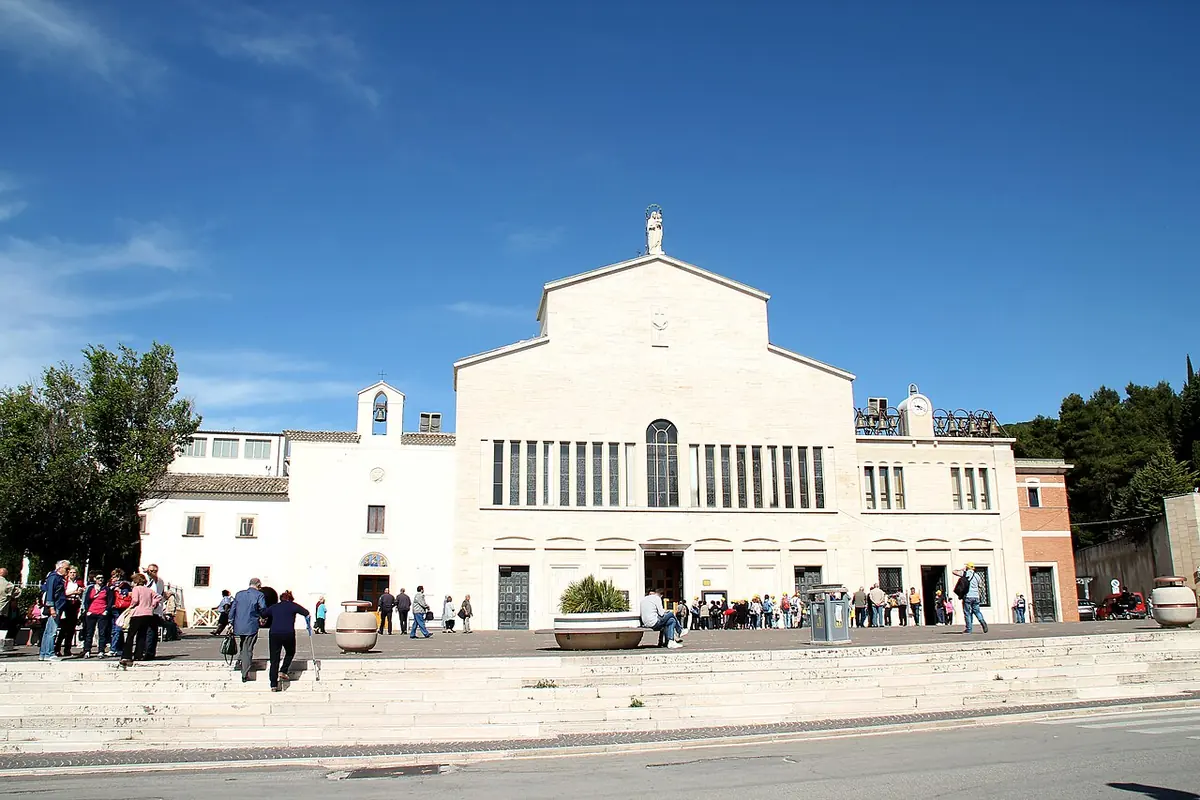
In September 1916 his superiors sent him to the friary of Santa Maria delle Grazie at San Giovanni Rotondo, then a poor, hard-to-reach town in the mountains of Apulia. He taught the boys in the friary's small seminary and gave spiritual direction. He stayed there until he died.

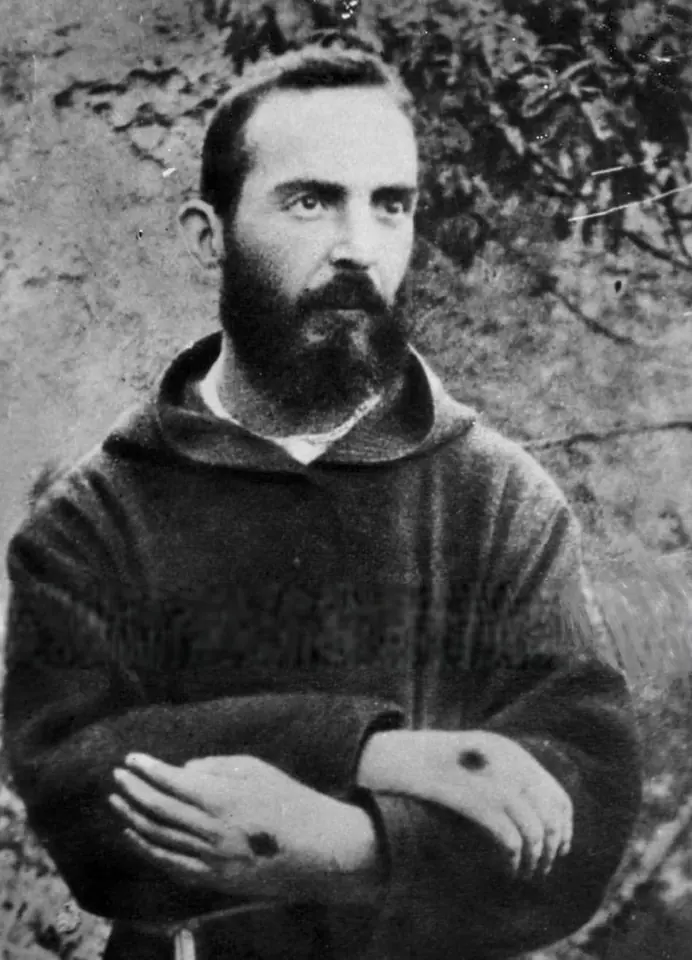
The stigmata of Padre Pio
September 20, 1918
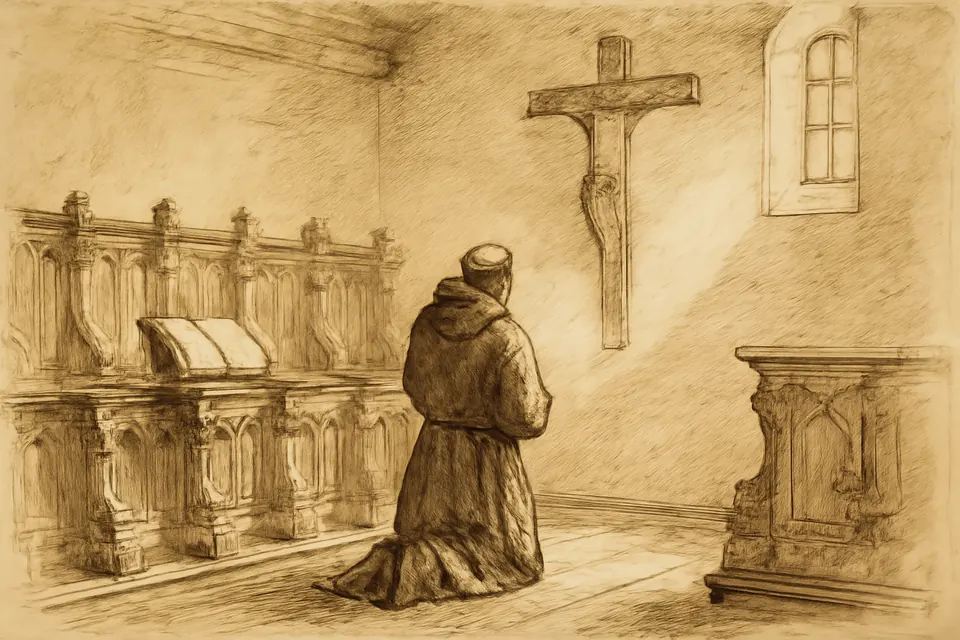
In August 1918, Padre Pio told his director that for three days, from August 5 to 7, he had felt his heart pierced as if by a fiery blade. Fr. Benedetto called the experience a transverberation, the word used for a similar experience of St. Teresa of Avila. On the morning of September 20, 1918, after Mass, Padre Pio was praying alone before a crucifix in the friary church's choir loft. He wrote to Fr. Benedetto a month later that he had seen a mysterious figure with bleeding hands, feet and side, and that when the vision ended he found his own hands, feet and side pierced and bleeding.
He asked God to take away the visible marks and leave him the pain. The wounds stayed. He wore fingerless brown gloves over his hands for the rest of his life and covered them with his sleeves at the altar.
The doctors and the Holy Office
News spread quickly, and so did controversy. The Capuchins sent Dr. Luigi Romanelli of Barletta, who examined the wounds in May 1919 and concluded they were real wounds that he could not explain. The Roman pathologist Amico Bignami, who saw them in July 1919, suggested they might be a kind of skin necrosis kept open by iodine or another chemical. Dr. Giorgio Festa examined them in 1919 and 1920 and found no natural explanation. In 1920 the Franciscan physician and psychologist Fr. Agostino Gemelli visited, did not examine the wounds, and wrote to the Holy Office that the friar was a case of hysteria and suggestion.
In 1921 the Holy Office sent Bishop Raffaele Rossi of Volterra to investigate. Francesco Castelli, who published Rossi's report from the Vatican archives in 2008, shows that it was favorable: Rossi found Padre Pio a good religious, saw the wounds, and judged that they were not a fraud. Asked about the reports that he appeared in two places at once, Padre Pio told Rossi that he did not know how it happened, or whether he was present "with my body or without it."
The Holy Office still moved against him. On May 31, 1923, it declared that the supernatural character of the facts attributed to Padre Pio had not been established, and it ordered him to say Mass privately. On May 23, 1931, it took away every priestly ministry except Mass, which he was to celebrate privately in the friary chapel. For two years he prayed, studied and wrote almost alone. On July 16, 1933, under Pope Pius XI, he was allowed to say Mass in the church again, and soon after to hear confessions.
The historian Sergio Luzzatto, in a 2007 book, published the 1919 statement of a pharmacist's cousin who said Padre Pio had secretly bought carbolic acid and veratrine. Padre Pio's explanation, recorded by Rossi, was that the acid was for sterilizing syringes and the veratrine was for a practical joke on his brothers. Rossi accepted it.
A second wave of suspicion came under Pope John XXIII. In 1960 Msgr. Carlo Maccari made an apostolic visitation and wrote a harsh report, and restrictions on visitors and confessions followed. In 1964, under Paul VI, the Holy Office let him exercise his ministry freely again. John Paul II referred to these trials in his beatification homily: "It happens at times in the history of holiness that, by God's special permission, the one chosen is misunderstood."

The confessor of San Giovanni Rotondo
Padre Pio spent most of each day in the confessional. Men and women waited for days for their turn. He could be gruff. He sometimes sent penitents away without absolution if he judged them insincere, and told them to come back. John Paul II, who confessed to him as a young priest in 1947, said in the canonization homily that "even when that unusual confessor treated pilgrims with apparent severity," they "almost always came back for the peaceful embrace of sacramental forgiveness."

He asked his spiritual children to go to confession weekly, receive Communion often, read spiritual books, meditate and examine their conscience every day. John Paul II quoted his description of himself: "I am a poor Franciscan who prays," and his conviction that "prayer is the best weapon we have, a key that opens the heart of God."
The Padre Pio Prayer Groups
On February 17, 1942, in the middle of the war, Pope Pius XII appealed to Christians to gather and pray for peace. Benedict XVI recalled in 2006 that Padre Pio urged his spiritual children to answer the pope's call, and the first prayer groups were born. Each group meets regularly to pray, under the spiritual direction of a priest, with the permission of the local bishop. The Holy See approved their statutes in 1986. The official site of the groups reports about 100 groups in 1956, and Benedict XVI spoke of more than 3,000 on every continent in 2006.
The Casa Sollievo della Sofferenza
On January 9, 1940, Padre Pio and a group of friends formed a committee to build a hospital in San Giovanni Rotondo, which had almost no medical care. Construction began in 1947, helped by donors in Italy and abroad and by a large grant from the United Nations relief agency, UNRRA. Padre Pio named it the Casa Sollievo della Sofferenza, the Home for the Relief of Suffering. It opened on May 5, 1956.
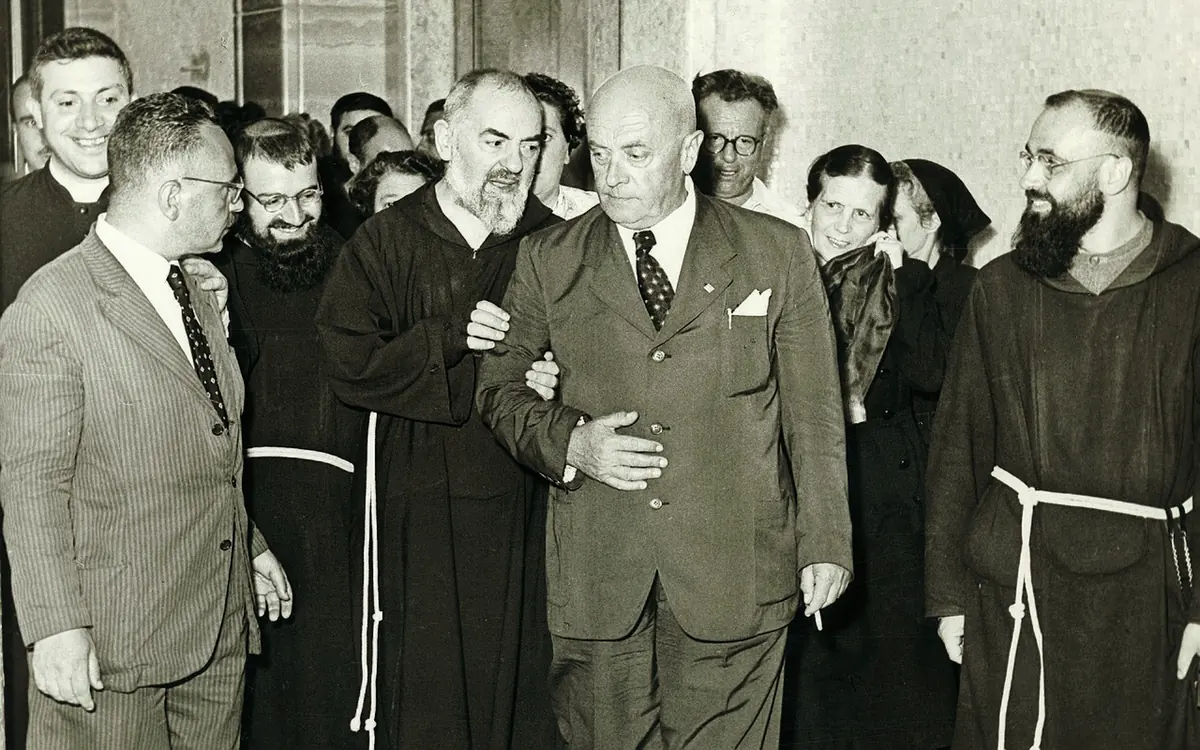

He wanted it to be a first-class hospital, and also a place of kindness. John Paul II said he wished to show "that God's 'ordinary miracles' take place in and through our charity." Pope Francis, visiting in 2018, quoted Padre Pio calling it "a temple of prayer and science." Today it is one of the largest hospitals in southern Italy and belongs to the Holy See.


Death of Padre Pio
On September 22, 1968, the fiftieth anniversary of the stigmata, Padre Pio said Mass for a crowd of pilgrims who had come for the occasion. He was eighty-one and could barely stand. That night he made his confession, renewed his vows and received the Anointing of the Sick. He died at about 2:30 in the morning of September 23, holding his rosary and repeating "Gesù, Maria." The friars reported that the wounds on his hands, feet and side had closed in his last days and left no scars.
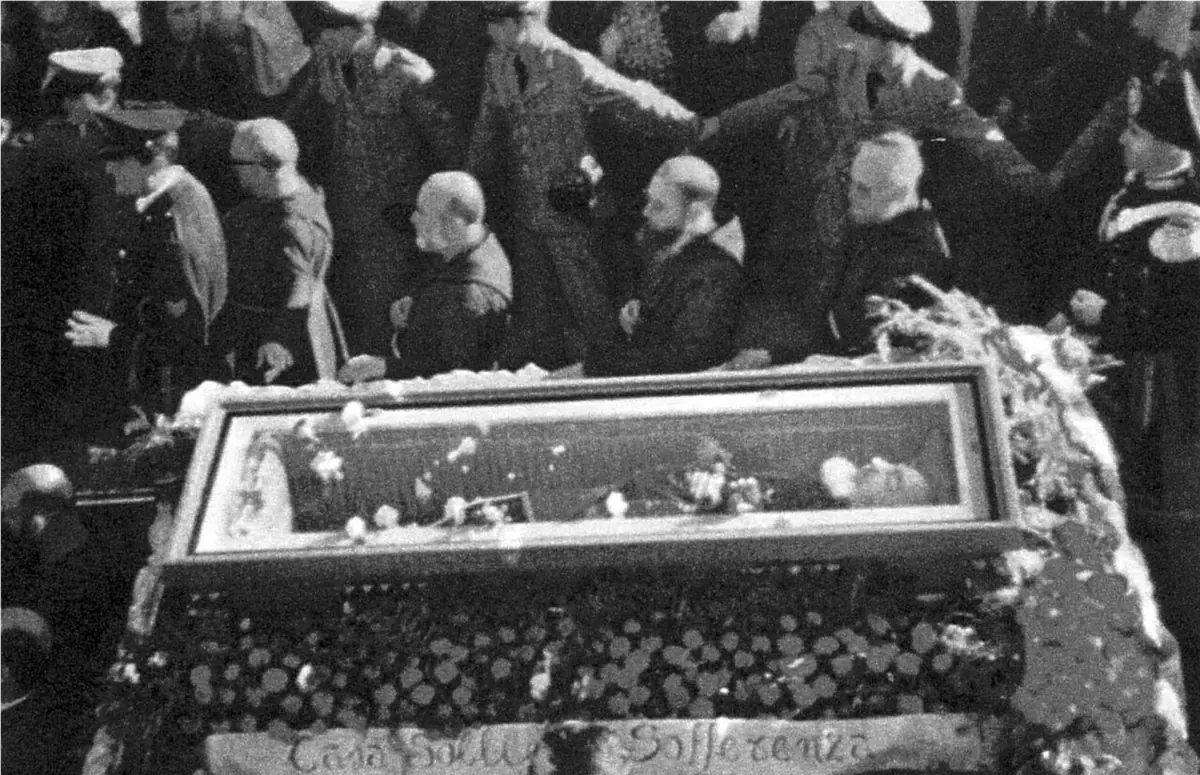

About 100,000 people came to his funeral on September 26. He was buried in the crypt of Santa Maria delle Grazie.
Beatification and canonization
The Holy See opened his cause in 1982. On December 18, 1997, John Paul II declared that he had lived the virtues to a heroic degree. He beatified him in St. Peter's Square on May 2, 1999, and canonized him there on June 16, 2002.
The miracles of Padre Pio
Hundreds of stories of healings, conversions and strange events have been told about Padre Pio. This encyclopedia sorts them into three groups.
- Approved: the healing of Consiglia De Martino (1995). A married mother of three from Salerno and a member of a prayer group, she was hospitalized on November 1, 1995, with about two liters of lymphatic fluid pooled in her neck from a ruptured thoracic duct. Surgery was planned. She phoned Brother Modestino Fucci, a friar at San Giovanni Rotondo, who prayed at Padre Pio's tomb. The swelling went down by November 3, and a scan on November 6 found the fluid gone. The Vatican's medical board called the cure "extraordinary and scientifically inexplicable" on April 30, 1998, and the decree approving it as a miracle was published on December 21, 1998. It opened the way for his beatification.
- Approved: the healing of Matteo Pio Colella (2000). The seven-year-old son of a doctor at the Casa Sollievo, Matteo was admitted to his father's hospital on January 20, 2000, with acute meningitis. He fell into a coma as one organ after another failed. His family and the friars prayed at Padre Pio's tomb. He recovered and was discharged, fully healed, on February 6, 2000. The Church approved the cure on December 20, 2001, the miracle that led to the canonization. Matteo later said that during his coma he dreamed of Padre Pio telling him he would get well.
- Reported: the stigmata. The wounds were real enough to be seen by doctors, bishops and thousands of people, but the Church has never declared them supernatural.
- Reported: bilocation, reading of souls and the "odor of sanctity." Many witnesses said Padre Pio appeared in places far from San Giovanni Rotondo, told penitents sins they had forgotten, or that a scent of violets or roses announced his presence. These accounts come from people who knew him; the Church made no judgment on them.
- Reported: healings during his lifetime, told by the people healed and their families. Bishop Rossi wrote in 1921 that many of the healings claimed at that time could not be confirmed.
Why Padre Pio is the patron saint of civil defense volunteers
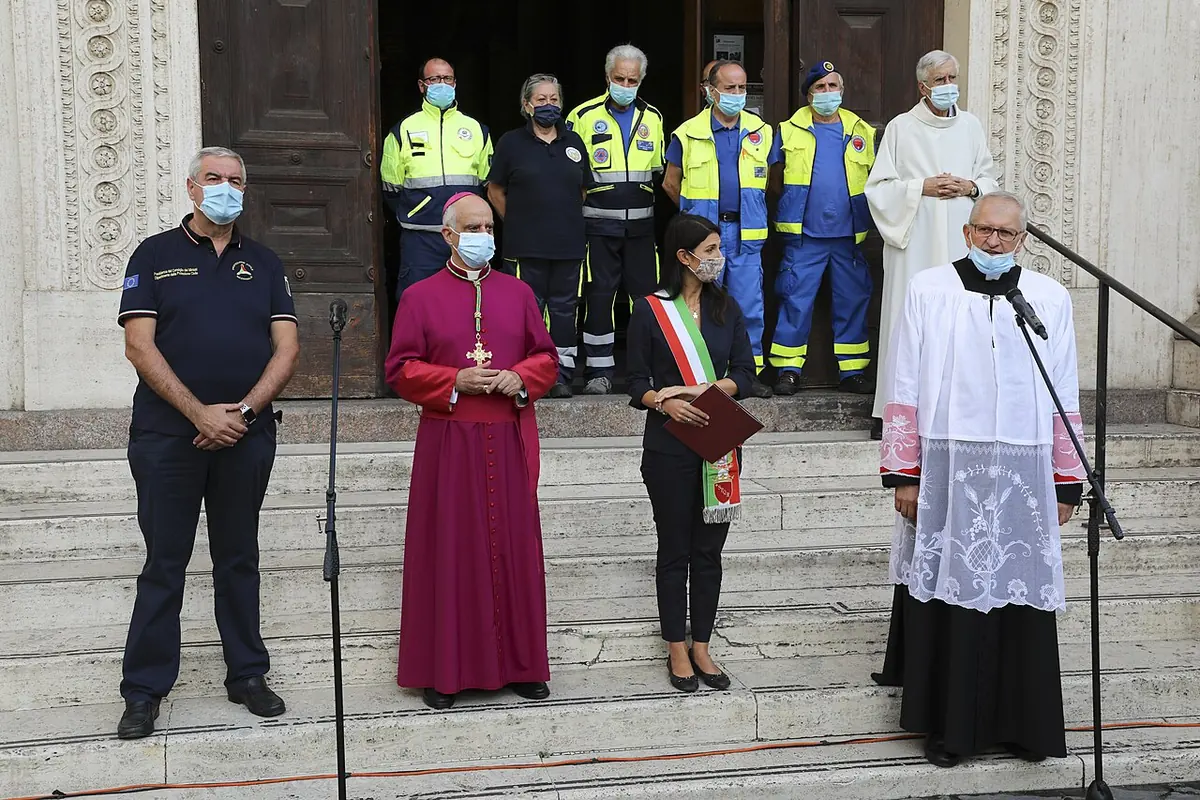
In 2004, Guido Bertolaso, head of Italy's Civil Protection Department, asked the Italian bishops to name Padre Pio as patron of the volunteer associations that help in earthquakes, floods and other disasters. The bishops forwarded the request to the Vatican, which approved it. The bishops said he would inspire "a deeper sense of charity and solidarity" in emergency work. His hospital, built in a poor and remote town, was the model they had in mind. In 2010, Benedict XVI entrusted the volunteers to "the intercession of your patron, St. Pio of Pietrelcina." Italy's civil protection volunteers celebrate him every September 23.

His other patronages are informal. In the mid-2000s, Catholics in Britain and Ireland began to call him the unofficial patron of "Don't Worry, Be Happy Day," a cheerful answer to the gloomiest Monday of January, because of his advice "Pray, hope, and don't worry." Devotional websites also list him as patron of adolescents, but no Church decree for this has been found. See all the patron saints by cause.
Symbols of Padre Pio in art
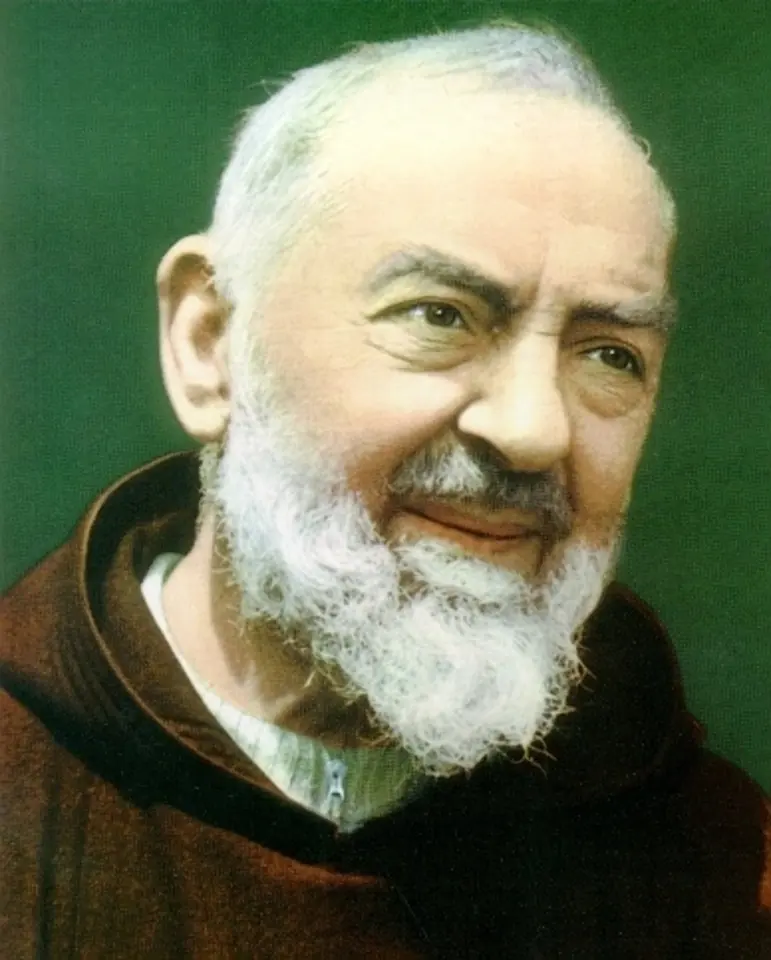
Padre Pio is one of the few saints whose image comes mainly from photographs. Statues, holy cards and paintings almost all follow a handful of well-known pictures, like the color portrait from about 1947 below. To recognize him:
- A brown Capuchin habit with a hood and a white knotted cord, the dress of the Franciscan branch he joined. The three knots stand for poverty, chastity and obedience.
- Fingerless gloves or mittens, usually brown or black, covering the wounds of his hands. Some images show the wounds themselves, small dark marks in the palms.
- A full white beard and an older man's face, since most photographs date from his later years. Images of a young, dark-bearded Padre Pio are less common.
- A rosary, which he prayed constantly and called his "weapon."
- A crucifix, recalling his stigmata and his devotion to the Passion.
- A raised hand in blessing, the pose of many statues, such as the one at the shrine of Pantasaph in Wales on this page.

Feast day and where Padre Pio is honored
Padre Pio's feast is September 23, an obligatory memorial in the General Roman Calendar. See the feast day calendar.
San Giovanni Rotondo
San Giovanni Rotondo is one of the most visited Catholic shrines in the world. Pilgrims see the old friary church where he said Mass, his confessional and the cell where he died. The large Church of St. Pio, designed by the architect Renzo Piano, was consecrated in 2004 and holds about 6,000 people.


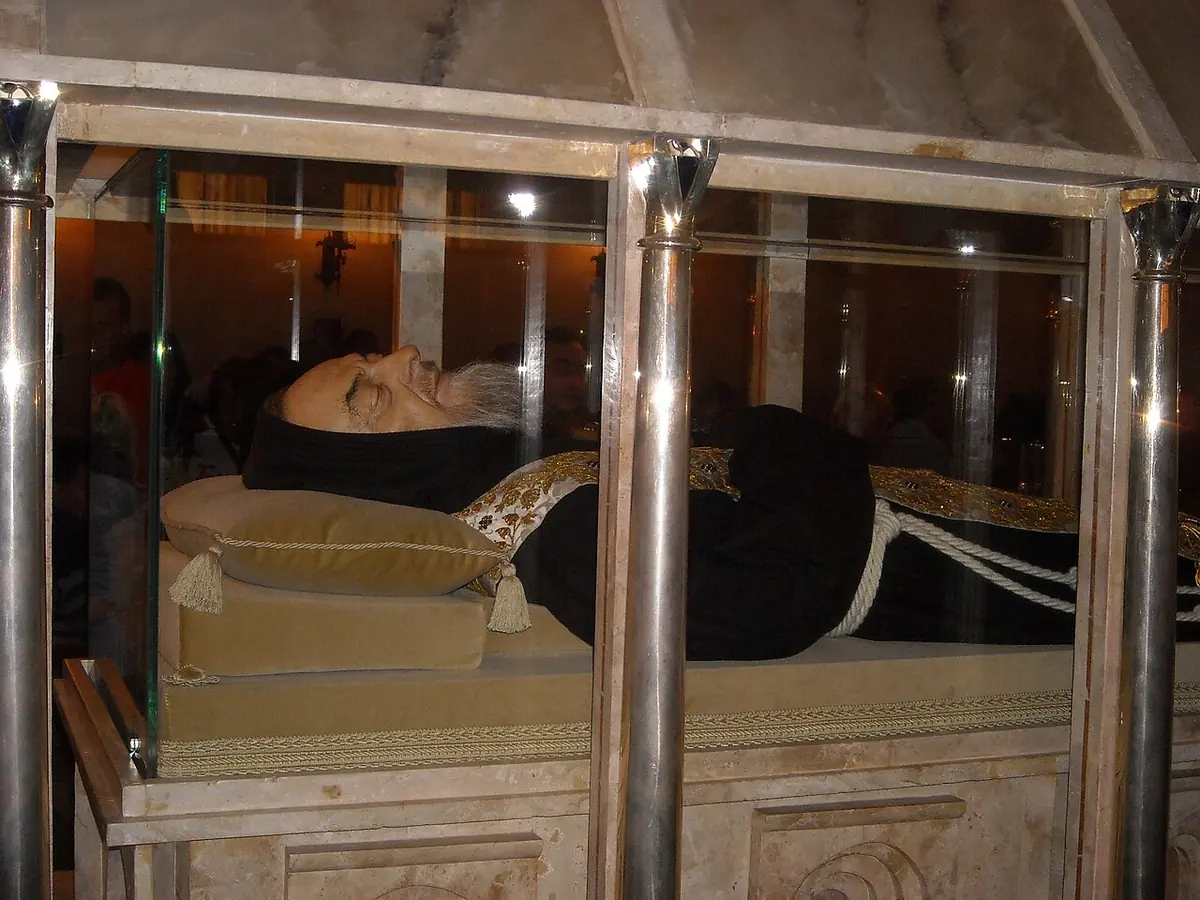
In March 2008, forty years after his death, his body was exhumed and found, as Church officials put it, in "fair condition." The body, dressed in his Capuchin habit and fingerless gloves, with a lifelike silicone mask over the face, went on display in the crypt of Santa Maria delle Grazie in late April 2008, and thousands of pilgrims a day filed past it. In April 2010 it was moved to the crypt of the new church, where it rests in a glass coffin. Pope Francis had the body brought to St. Peter's Basilica for the Jubilee of Mercy in February 2016, as a model for confessors, and he visited Pietrelcina and San Giovanni Rotondo himself on March 17, 2018.

Pietrelcina and elsewhere
In Pietrelcina, pilgrims visit his family home, the church where he was baptized, and the farmland at Piana Romana. Padre Pio also told visitors to go to the shrine of St. Michael the Archangel at Monte Sant'Angelo, a short drive from San Giovanni Rotondo, where his devotion to the archangel is well known. Outside Italy, there are major shrines in Barto, Pennsylvania, in Santo Tomas, Batangas, in the Philippines, and at Pantasaph in Wales.


Prayers to Padre Pio
Catholics ask Padre Pio to pray for them in illness, anxiety and family trouble. These prayers have a citable origin.
Prayer to St. Pio
This prayer is used by the Padre Pio shrine in Barto, Pennsylvania, and is inscribed under his statue at Pantasaph:
O God, You gave Saint Pio of Pietrelcina, Capuchin priest, the great privilege of participating in a unique way in the passion of Your Son, grant me through his intercession the grace of (here make your request) which I ardently desire; and above all grant me the grace of living in conformity with the death of Jesus, to arrive at the glory of the resurrection.
It is followed by the Glory Be, said three times.
John Paul II's prayer to Padre Pio
Pope John Paul II ended his canonization homily on June 16, 2002, with a prayer to the new saint:
Teach us, we ask you, humility of heart so we may be counted among the little ones of the Gospel, to whom the Father promised to reveal the mysteries of his Kingdom. Help us to pray without ceasing, certain that God knows what we need even before we ask him. Obtain for us the eyes of faith that will be able to recognize right away in the poor and suffering the face of Jesus. Sustain us in the hour of the combat and of the trial and, if we fall, make us experience the joy of the sacrament of forgiveness. Grant us your tender devotion to Mary, the Mother of Jesus and our Mother. Accompany us on our earthly pilgrimage toward the blessed homeland, where we hope to arrive in order to contemplate forever the glory of the Father, the Son and the Holy Spirit. Amen.
The Efficacious Novena to the Sacred Heart
This is not a prayer to Padre Pio but a prayer he prayed. According to the Padre Pio shrine in Barto, Pennsylvania, he recited it every day for everyone who asked for his prayers. It is usually attributed to St. Margaret Mary Alacoque, though that attribution is traditional. It has three petitions, each built on a promise of Jesus. The first reads:
O my Jesus, you have said: "Truly I say to you, ask and it will be given you, seek and you will find, knock and it will be opened to you." Behold I knock, I seek and ask for the grace of (here make your request).
Each petition is followed by an Our Father, a Hail Mary, a Glory Be and the words "Sacred Heart of Jesus, I place all my trust in you." The novena ends with the Hail, Holy Queen.
"Stay with me, Lord"
A long prayer beginning "Stay with me, Lord" is widely printed as Padre Pio's prayer after Holy Communion. Aleteia's version opens: "Stay with me, Lord, because I am weak and I need Your strength, that I may not fall so often." Catholic publishers credit it to him, but the published versions differ and none gives an Italian original or a date. It is best described as attributed to Padre Pio.
Sayings of Padre Pio
Padre Pio's letters fill several volumes, and many short sayings are credited to him. A few with a clear source:
- "Calvary is the hill of the saints." Quoted by John Paul II in the 1999 beatification homily.
- "It is under the Cross that one learns to love." Words Padre Pio said Jesus spoke to him, from his letters (Epistolario I, p. 339), quoted in the same homily.
- "Pray, hope, and don't worry." His most famous advice, usually given in Italian as Prega, spera e non preoccuparti. It sums up the counsel he gave in letters and in person, but the exact letter where the words first appear is not settled, so it is better quoted as a saying than as a line from a particular text.
Frequently asked questions
When is Padre Pio's feast day?
September 23, the day he died in 1968. It is an obligatory memorial in the General Roman Calendar. Pope John Paul II set the date when he beatified him in 1999.
What is Padre Pio the patron saint of?
Officially, the civil protection volunteers of Italy, a patronage approved in 2004 at the request of the Italian bishops. Informally, many Catholics call him the patron of stress relief and of the "January blues," because of his saying "Pray, hope, and don't worry." His hometown, Pietrelcina, also honors him as its patron.
Did Padre Pio really have the stigmata?
Doctors who examined him from 1919 on described wounds in his hands, feet and side, and the friars saw them for fifty years. Their cause was disputed. The Holy Office declared in 1923 that nothing supernatural had been established, and some critics thought the wounds were self-inflicted. The Church canonized him for his heroic virtue and two approved healings, and it has never issued a formal judgment that the stigmata were supernatural.
What miracles were approved for Padre Pio's canonization?
Two healings. For his beatification, the Church approved the 1995 cure of Consiglia De Martino of Salerno, whose ruptured thoracic duct healed within days. For his canonization, it approved the 2000 recovery of Matteo Pio Colella, a seven-year-old boy from San Giovanni Rotondo in a coma from meningitis.
Where is Padre Pio's body?
In San Giovanni Rotondo, in the Province of Foggia in southern Italy. His body was exhumed in 2008, displayed in the crypt of the friary church of Santa Maria delle Grazie, and moved in 2010 to the crypt of the newer Church of St. Pio next door, where pilgrims can see it in a glass coffin.
What did Padre Pio mean by "Pray, hope, and don't worry"?
It is his best-known piece of advice, usually given in Italian as "Prega, spera e non preoccuparti." He meant that worry does no good, while prayer and trust in God do. It is quoted in his letters and by the people he directed, though the exact letter where it first appears is hard to pin down.
Did Padre Pio write the "Stay with me, Lord" prayer?
It is widely printed as his prayer after Holy Communion, and Catholic publishers credit it to him. No dated Italian original is usually cited, and English versions differ from one another, so the safest description is that it is attributed to him.
Did Padre Pio meet Pope John Paul II?
Yes. Karol Wojtyła, a young Polish priest studying in Rome, visited San Giovanni Rotondo in 1947 and confessed to Padre Pio. As pope he beatified him in 1999 and canonized him in 2002, and mentioned that confession in his canonization homily.
Sources
- Vatican: Padre Pio da Pietrelcina (1887–1968), biography
- John Paul II, Homily for the Beatification of Padre Pio, May 2, 1999
- John Paul II, Homily for the Canonization of St. Pio of Pietrelcina, June 16, 2002
- Benedict XVI, Address to the Pilgrims of the Works of St. Pio, October 14, 2006 (Italian)
- Benedict XVI, Meeting with Italy's National Civil Protection, March 6, 2010 (Italian)
- Pope Francis, Homily at San Giovanni Rotondo, March 17, 2018
- Voce di Padre Pio: Biography (chronology)
- Paolino Rossi, After Much Study, a Miracle (Inside the Vatican, April 1999; Catholic Culture)
- Independent Catholic News: Padre Pio soon to become saint
- Padre Pio Prayer Groups: What are Padre Pio Prayer Groups?
- Padre Pio shrine, Barto, Pennsylvania (padrepio.org): Efficacious Novena to the Sacred Heart of Jesus
- Padre Pio shrine, Barto, Pennsylvania (padrepio.org): Prayer to Saint Pio
- Aleteia: Padre Pio prayed this prayer after receiving Holy Communion
- EWTN News: Padre Pio declared patron saint of volunteerism in Italy (2004)
- Capuchins: Capuchin Saint Helps Fight New Year's Blues (2007)
- NBC News: Exhumed body of Italian saint draws thousands (2008)
- Francesco Castelli, Padre Pio Under Investigation: The Secret Vatican Files (Ignatius Press, 2011)
- Sergio Luzzatto, Padre Pio: Miracles and Politics in a Secular Age (Metropolitan Books, 2010)