St. Olaf, King of Norway
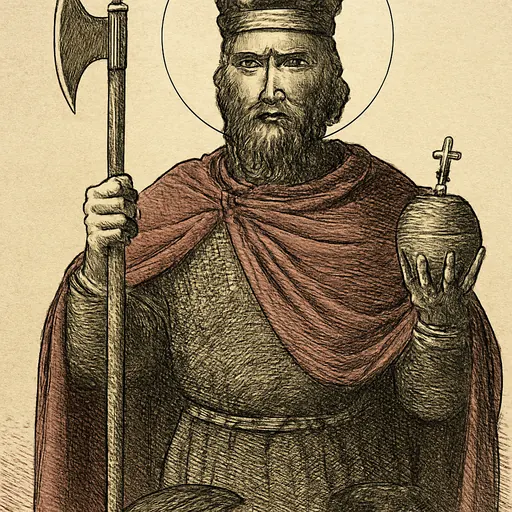
St. Olaf (Olaf II Haraldsson, about 995–1030) was a Viking who became a Christian, made himself king of Norway in 1015 and worked to make Christianity the country's religion. Driven out by his nobles, he returned and was killed at the Battle of Stiklestad on July 29, 1030. Within a year he was declared a saint, and he is the patron saint of Norway.
Who was St. Olaf?
St. Olaf was a Viking raider who became king of Norway and the country's patron saint. Born around 995, the son of a minor king named Harald Grenske, he went to sea as a boy and fought in the Baltic, England and France. He was baptized as a young man, returned to Norway in 1015, and spent the next thirteen years forcing the country together under one Christian crown. His nobles rebelled and drove him out in 1028. When he came back two years later, a peasant army met him at Stiklestad, and he was killed there on July 29, 1030.
A year later his body was dug up and found unchanged, Bishop Grimkel declared him a saint, and pilgrims began to come to his grave at Nidaros, now Trondheim. The Catholic Encyclopedia calls him "the great Norwegian legislator for the Church." Norwegians have long seen him as the founder of their nation as well as its saint, the rex perpetuus, or eternal king, of Norway.
The name causes confusion. Searches for "St. Olaf" turn up a college in Minnesota and the snowman in Frozen. In Norway he is Olav den hellige, Olaf the Holy; in England medieval churches called him St. Olave. This page is about the king.

The life of St. Olaf
Most of the details of his life come from Snorri Sturluson's Heimskringla, the sagas of the Norwegian kings written in Iceland around 1230, two centuries after Olaf's death. Snorri drew on the poems of skalds who had known the king, but he also wrote as a storyteller, and his saga is a mix of history and legend.
Viking and convert
As a teenager Olaf went raiding. In England he fought for King Æthelred against the Danes, and he spent two winters at the court of Normandy. The date and place of his baptism are uncertain. Snorri puts it in Norway in 998, when he was a small child. The Catholic Encyclopedia thinks it more likely he was baptized around 1010 in Rouen by Archbishop Robert, and Nidaros Cathedral gives Rouen in 1014.

King of Norway
Olaf came home in 1015 to claim the throne, citing descent from Harald Fairhair, and was accepted as king. He brought bishops and priests from England, among them Grimkel, and Nidaros Cathedral dates the adoption of Christianity as Norway's official religion to 1024. He built churches, wrote Church law into the law of the land, and pulled down pagan temples.
His sources are frank about the cost. The Catholic Encyclopedia says he "made frequent severe attacks on the old faith and customs," and Nidaros Cathedral writes that "his brutal actions made him unpopular." The great chieftains also resented him for breaking their local power. In 1028 they turned to King Cnut of Denmark and England, who took the country, and Olaf fled east to his brother-in-law's court in Gardariki, the land of the Rus.
Stiklestad
In 1030 Olaf came back through Sweden with a small army. The St. Olavsleden pilgrim path still follows part of his route, from the Baltic coast of Sweden over the mountains to Trondheim. At Stiklestad, north of Trondheim, a much larger army of farmers and chieftains was waiting.
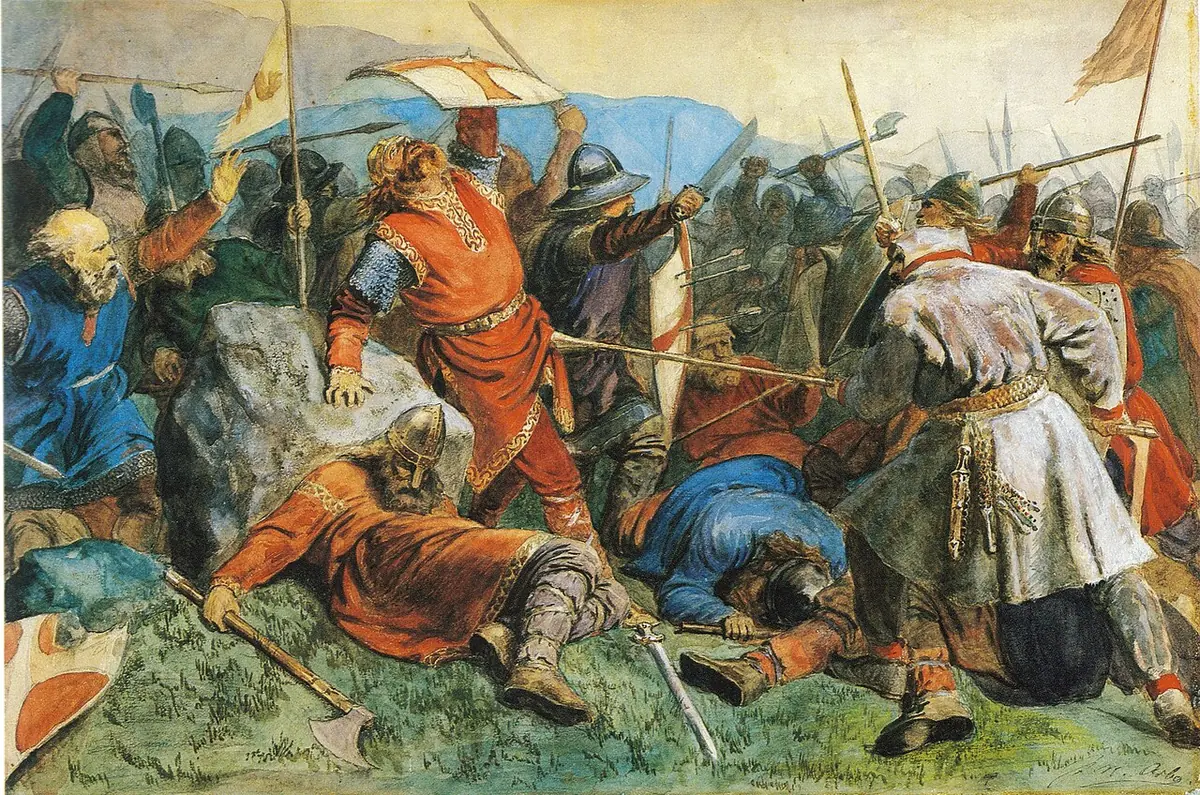
Snorri says Olaf's men went into battle shouting, "Forward, forward, Christ-men! cross-men! king's men!" He records, from the skald Sigvat, that the sun went dark during the fighting although the sky was clear. Olaf was wounded in the leg, and Snorri says he then "staggered towards a stone, threw down his sword, and prayed God to help him." Two more blows killed him. Snorri dates it Wednesday, July 29, 1030, and says the king fell before three in the afternoon.

The grave at Nidaros
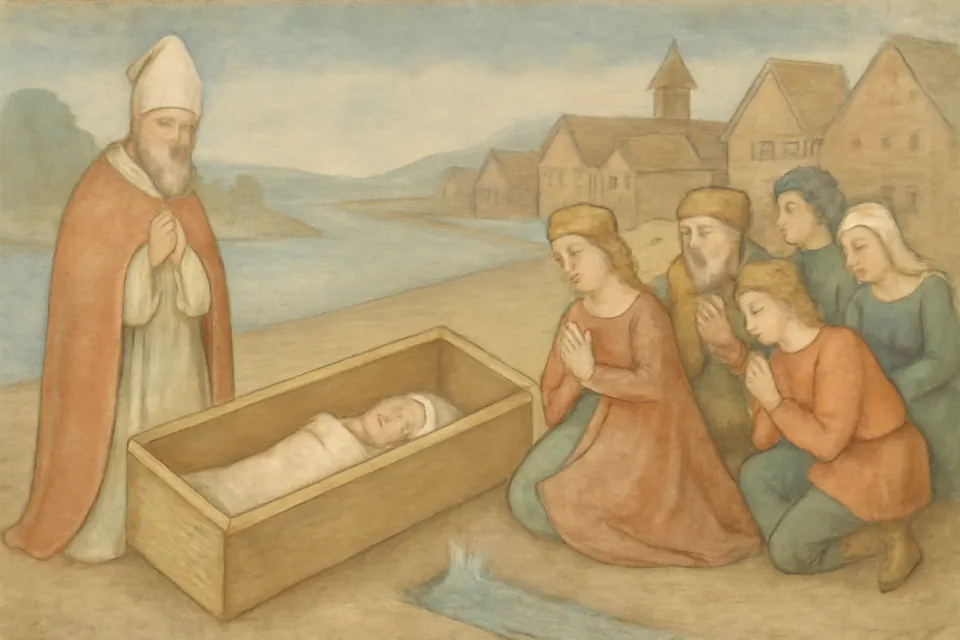
Friends hid the body and buried it in a sandbank by the River Nidelva. Stories of healings began almost at once. On August 3, 1031, Bishop Grimkel had the grave opened in the presence of King Svein and the chieftains. According to Snorri, the coffin had risen almost to the surface, the king's face was unchanged, "his cheeks were as red as if he had but just fallen asleep," and his hair and nails had grown. With the king's approval and the decision of the Thing, the assembly of free men, Olaf was declared a saint, and his body was placed by the high altar of St. Clement's Church.
The miracles of St. Olaf
None of Olaf's miracles was investigated under modern canonization procedures. Using this encyclopedia's labels:
- The incorrupt body, with growing hair and nails (traditional): told by Snorri and by Nidaros Cathedral.
- The healing of Thorer Hund's hand (traditional): Snorri says the man who speared the king got his blood on a wounded hand, and the wound healed so quickly it needed no bandage.
- A blind man who regained his sight (traditional): Snorri says a blind beggar touched his eyes with wet hands in the empty hut where the body had been hidden, and could see again.
- The spring at the first grave (traditional): Snorri says a spring rose in the sand-hill and cured "many human ailments and infirmities."
- Healings at his shrine (reported): Adam of Bremen, writing around 1070, reported healing miracles at the tomb, quoted below.
Why St. Olaf is the patron saint of Norway
Olaf united Norway under one king and made Christianity its law, so Norwegians, Catholic and Lutheran alike, look on him as the founder of the nation and its faith. In the Middle Ages he was called Norway's eternal king. The Catholic Encyclopedia notes that the arms of Norway are "a lion with the battle-axe of St. Olaf in the forepaws." His cult spread through Denmark, Sweden, Finland, Iceland and England, where churches such as St. Olave's, Hart Street, in the City of London still carry his name. See more on our patron saints page.
Symbols of St. Olaf in art
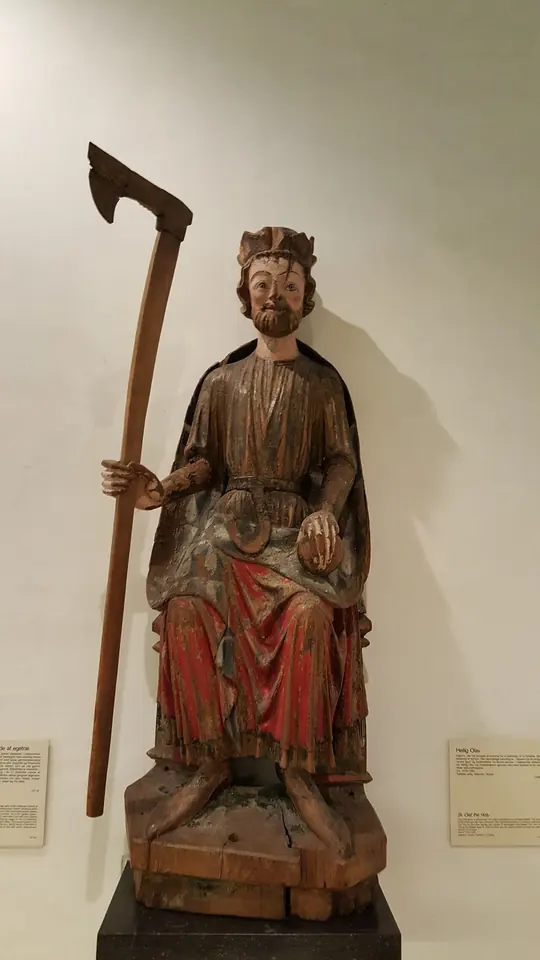
Olaf is almost always a king, crowned and often enthroned. Look for:
- A battle-axe: his chief attribute. Nidaros Cathedral explains it as the sign of a just lawgiver and the weapon that killed him.
- A crown and often an orb: Norway's eternal king.
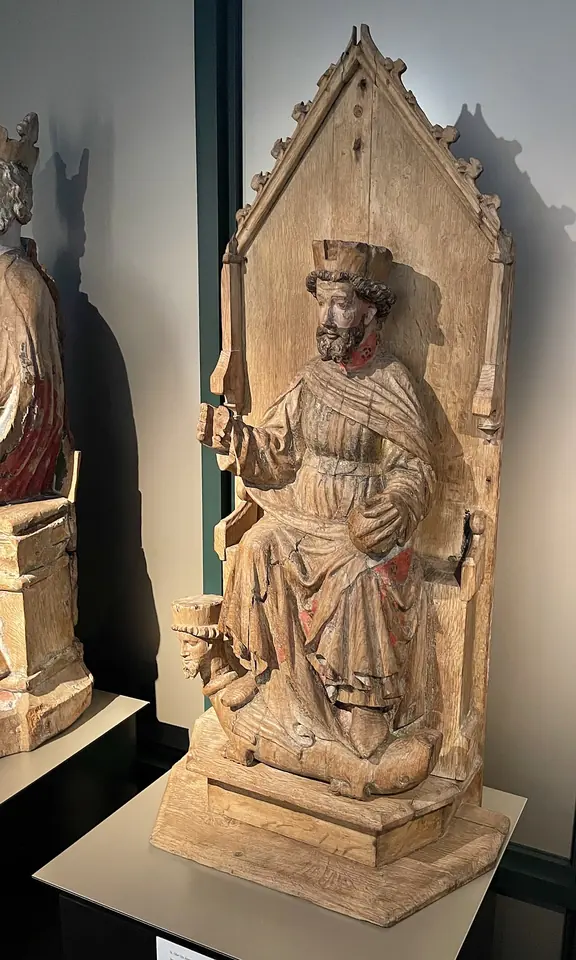
- A dragon or a beast with a human face under his feet: evil overcome; Nidaros Cathedral suggests it may also be his own sinful past.
- A red beard: early images show him clean-shaven, but from about 1200 he usually has a red beard.
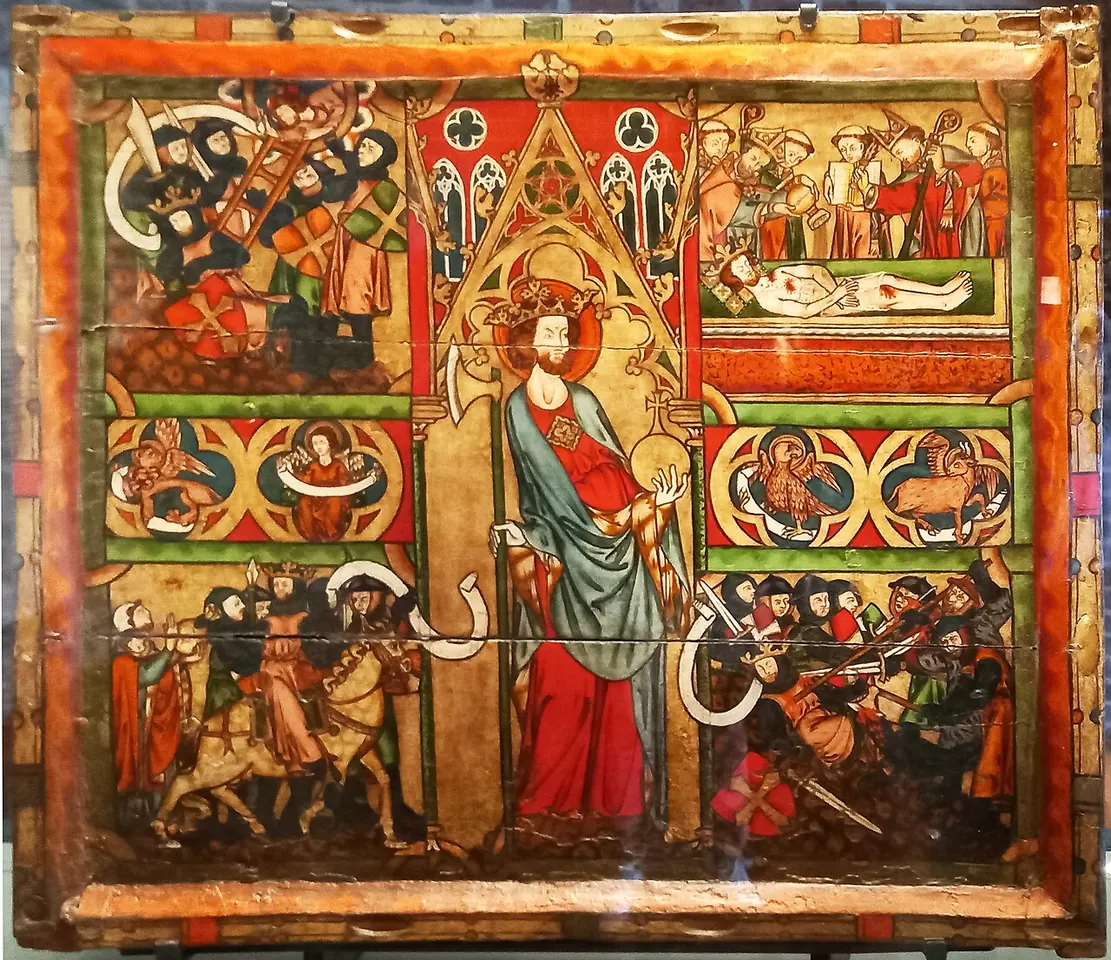
Medieval Norwegian churches were full of carved and painted Olafs. The 14th-century altar frontal now in the Nidaros Cathedral museum puts him in the center with scenes of Stiklestad around him.

In the Austevoll statue from about 1450, the beast under his throne has a human head.

Nidaros Cathedral and the pilgrim ways
A wooden chapel rose over Olaf's first grave soon after 1031. Around 1070 his nephew, King Olav Kyrre, replaced it with a stone church, and the silver shrine with Olaf's body stood by its altar. Writing about the same time, Adam of Bremen described the shrine:
There is the very blessed king and martyr Olav's relics. At his tomb the Lord also today works the greatest healing miracles. And people, who believe that they can be helped through this holy man's meritorious deeds, are coming from far away.
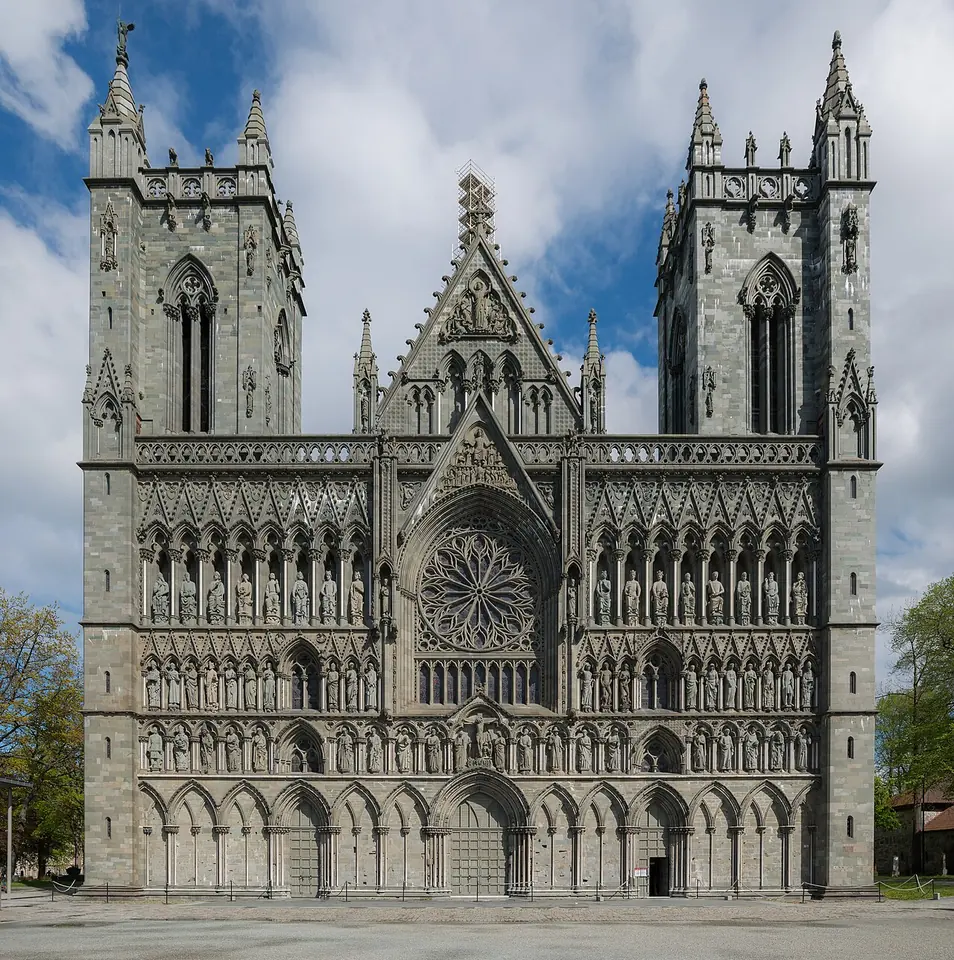
That is how the pilgrimage office of the St. Olav Ways quotes him in English. When Nidaros became the seat of an archbishop in 1152–53, building began on the great Gothic cathedral, finished around 1300. Pilgrims could walk around the shrine in the octagon behind the choir.
The Lutheran Reformation reached Norway in 1537, and pilgrimage stopped. The shrine was taken away, and the exact place where Olaf's remains were buried is no longer known. The nave stood roofless for centuries until the Norwegian parliament began restoring the cathedral in 1869.

Pilgrims came back in the 20th century. The first of the modern St. Olav Ways, the Gudbrandsdalsleden from Oslo, was opened on July 29, 1997. The routes through Norway, Sweden and Denmark are now a European Cultural Route of the Council of Europe. In the 1120s King Eystein built shelters for pilgrims on the Dovrefjell mountains, and modern walkers still cross the same plateau.

Olsok: St. Olaf's feast day
Olaf's feast is July 29, the day he died. Norwegians call it Olsok, "Olaf's wake." Before the Reformation it was one of the great church feasts of the North. It came back in the 19th and 20th centuries, and today the Catholic Church in Norway keeps it as a major feast, while the Church of Norway honors the day especially at Nidaros Cathedral. Trondheim holds its St. Olav Festival around Olsok, and an open-air play about the battle is staged at Stiklestad. See other saints of late July on our feast days page.
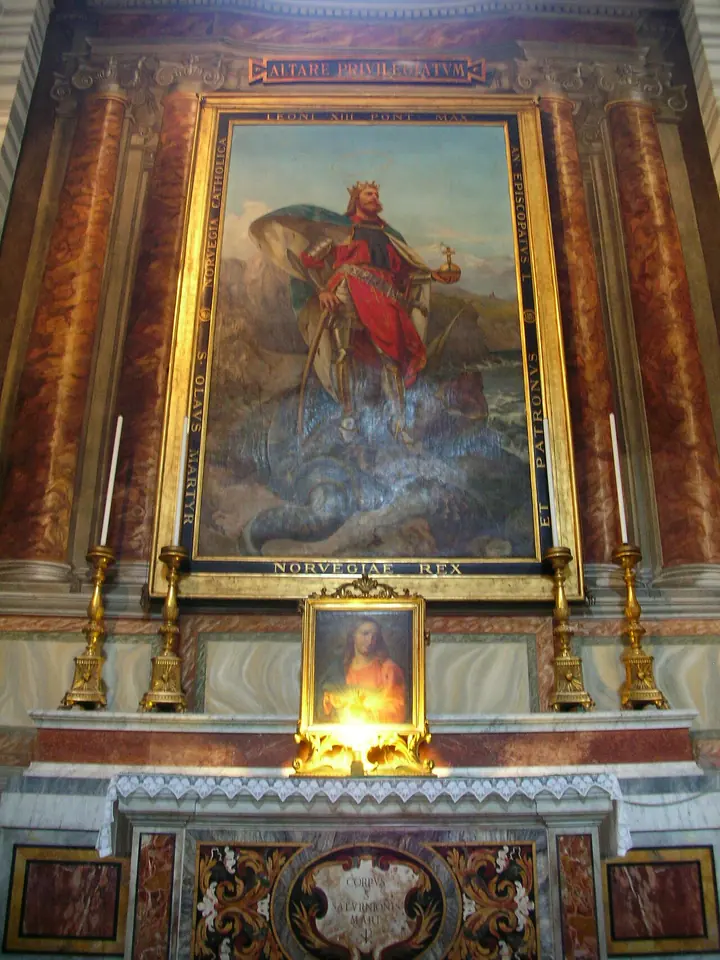
Catholics in Oslo venerate a large relic of St. Olaf in St. Olav's Cathedral. In Rome, the church of San Carlo al Corso has a chapel of St. Olav with an altarpiece given to Pope Leo XIII in 1893.

Prayer to St. Olaf
There is no widely used traditional prayer to St. Olaf in English. The Catholic Church in Norway celebrates his feast with its own Mass and Office texts, and the medieval Church of Nidaros had a rich liturgy for him. Catholics ask St. Olaf to pray for Norway and for the Church in Scandinavia. According to Snorri, his own last prayer on the field at Stiklestad was simply that God would help him.
Frequently asked questions
What is St. Olaf the patron saint of?
Norway above all. Medieval Norwegians called him Norway's "eternal king" (Rex Perpetuus Norvegiae), and Norway's coat of arms shows a lion holding his battle-axe. He is also honored by kings and by converts, since he himself was baptized as a young adult.
When is St. Olaf's feast day?
July 29, the anniversary of his death at Stiklestad in 1030. In Norway the day is called Olsok, "Olaf's wake." The Catholic Church in Norway keeps it as a major feast, the Church of Norway marks it especially at Nidaros Cathedral, and Stiklestad and Trondheim hold festivals around it.
Is St. Olaf the same as Olaf in Frozen or St. Olaf College?
No. Olaf the snowman in Disney's Frozen has nothing to do with the saint beyond the common Scandinavian name. St. Olaf College in Northfield, Minnesota, was founded in 1874 by Norwegian immigrants and named for the saint, but this page is about the 11th-century king himself.
Where is St. Olaf buried?
In Trondheim (medieval Nidaros). Nidaros Cathedral was built over the place where he was first buried, and his body lay in a silver shrine by its high altar through most of the Middle Ages. After the Reformation the shrine was removed, and the exact place of his remains is no longer known.
Why is St. Olaf shown with an axe?
Nidaros Cathedral explains that the axe shows his authority as a just lawgiver and is also the weapon that killed him at Stiklestad. His crown marks him as Norway's eternal king, and the dragon under his feet stands for the evil, and perhaps the sinful past, that he overcame.
Sources
- Catholic Encyclopedia (1911): St. Olaf Haraldson
- Snorri Sturluson, Heimskringla: The Saga of Olaf Haraldson (Samuel Laing translation, Project Gutenberg)
- Nidaros Cathedral: St. Olav
- Nidaros Cathedral: From chapel to cathedral
- Nidaros Cathedral: Decay and restoration
- Pilegrimsleden (St. Olav Ways): History
- Pilegrimsleden: St. Olavsleden
- Roman Martyrology, July 29