St. Bernadette Soubirous
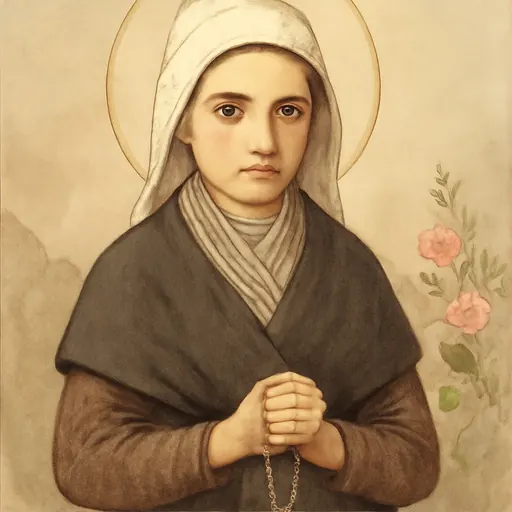
St. Bernadette Soubirous was the poor fourteen-year-old miller's daughter from Lourdes, France, who saw the Virgin Mary eighteen times at the grotto of Massabielle between February 11 and July 16, 1858. The Lady called herself "the Immaculate Conception," and the spring Bernadette uncovered made Lourdes one of the world's great places of pilgrimage. She became a nun at Nevers and died there in 1879. Her feast day is April 16 (February 18 in France), and she is a patron of the sick.
Who was St. Bernadette?
Bernadette Soubirous was a sickly, unschooled girl of fourteen from Lourdes, a market town at the foot of the French Pyrenees, when she said a beautiful young lady appeared to her in a rock grotto by the river Gave. Between February 11 and July 16, 1858, she saw the Lady eighteen times. On March 25 the Lady told her, in the local dialect, "Que soy era Immaculada Councepciou": "I am the Immaculate Conception." Four years later the bishop of Tarbes declared that the Virgin Mary had truly appeared to her, and Lourdes became one of the most visited shrines in the Christian world.
Bernadette herself spent the rest of her short life trying to step out of the light. She entered the convent of the Sisters of Charity at Nevers in 1866, worked in the infirmary and the sacristy, suffered for years from asthma and tuberculosis of the bone, and died at thirty-five. Pope Benedict XVI, preaching at Lourdes in 2008, summed up how unlikely a messenger she was: "Bernadette is the eldest daughter of a very poor family, with neither knowledge nor power, and in poor health."

She was canonized in 1933. Catholics are careful to say she was declared a saint for how she lived, not for what she saw. The apparitions she reported are honored under the title Our Lady of Lourdes, with their own feast on February 11.
The life of St. Bernadette
The miller's daughter
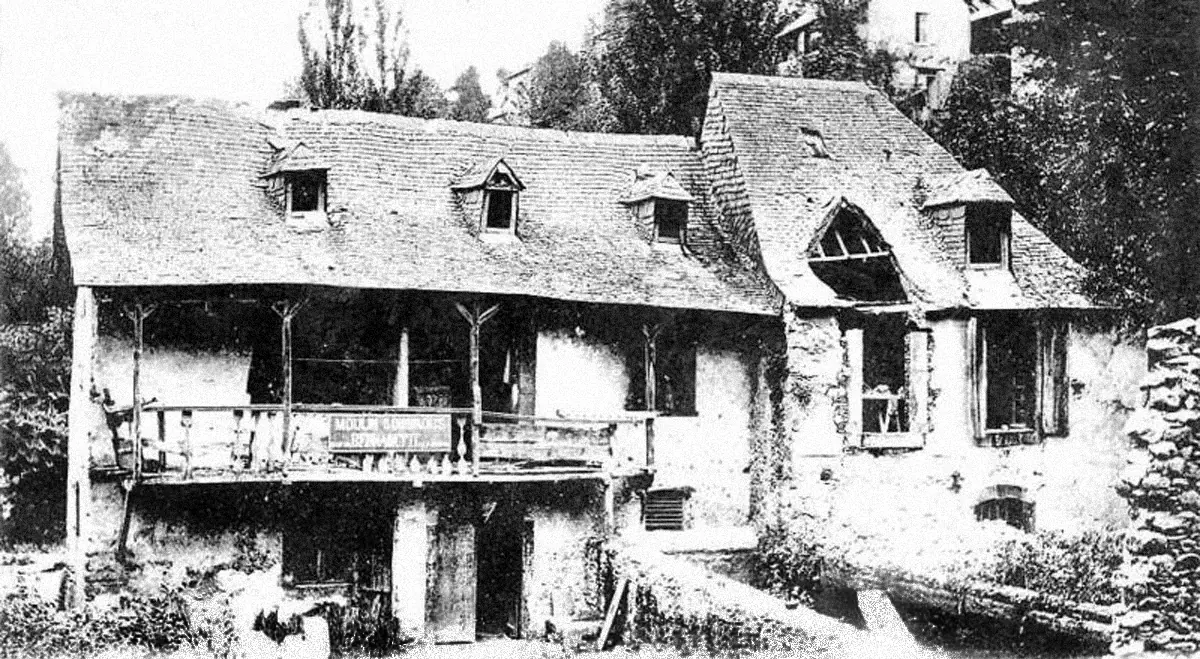
Bernadette was born on January 7, 1844, at the Boly Mill in Lourdes, the first child of François Soubirous, a miller, and Louise Castérot. She was baptized two days later at the parish church of St. Pierre as Marie-Bernarde, and the family called her Bernadette. The Sanctuary of Lourdes describes about ten happy years in a close family before everything went wrong. Her father lost the mill, work grew scarce, and cholera passed through the town. Bernadette survived it, but she was left with asthma for the rest of her life.

By 1857 the six Soubirous lived in a single room on the rue des Petits-Fossés known as the cachot, a disused town jail a relative let them have for nothing. It was dark and damp. That autumn Bernadette was sent to the village of Bartrès to work as a shepherdess and help in a farmhouse. At fourteen she could neither read nor write, and because she didn't know her catechism she had not yet made her First Communion. She came home to Lourdes on January 21, 1858, to prepare for it.
"Aquerò": the first apparitions
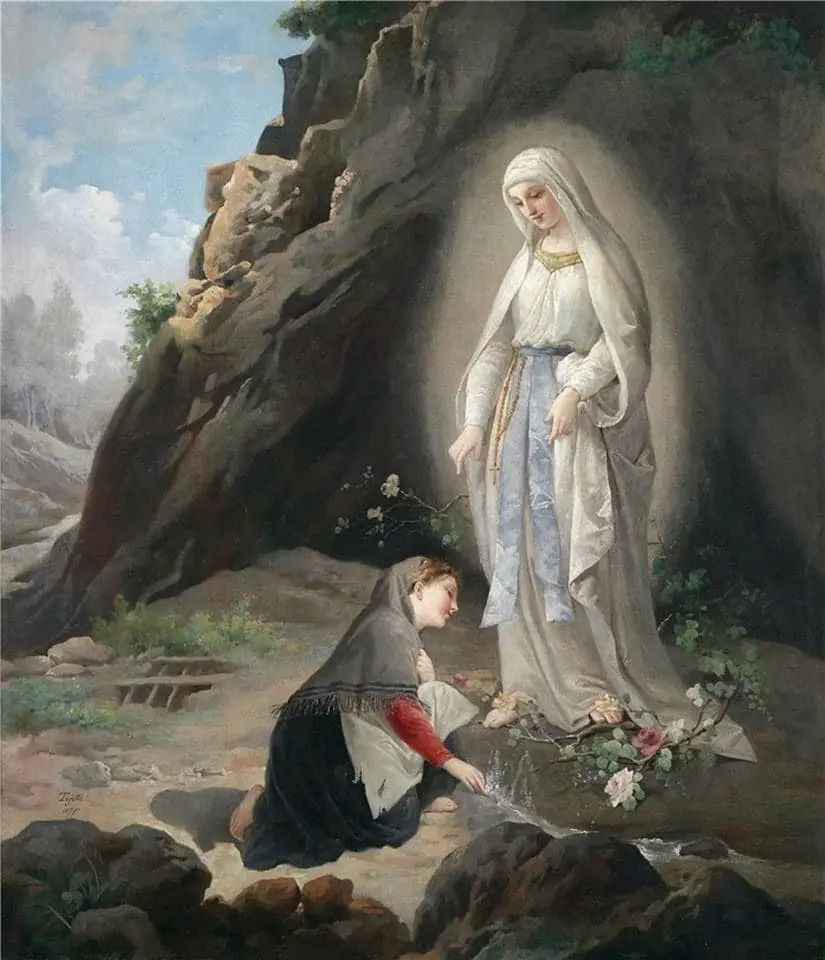
On Thursday, February 11, 1858, Bernadette went out with her younger sister Toinette and a friend, Jeanne Abadie, to gather firewood and bones along the river. At the rock of Massabielle, a grotto where the town's pigs were taken to shelter, the other two crossed a cold stream. Bernadette stopped to take off her stockings, heard a sound like a gust of wind and looked up. In a hollow in the rock she saw a young lady dressed in white, with a blue sash and a yellow rose on each foot. Bernadette took out her rosary and prayed. The Lady smiled and said nothing.

She went back on February 14, with her mother's permission, and sprinkled holy water at the vision. On February 18 the Lady spoke for the first time. She asked Bernadette to come to the grotto for fifteen days and, according to the Sanctuary's account, told her, "I do not promise to make you happy in this world but in the other." When the police commissioner, Dominique Jacomet, questioned her on February 21, Bernadette would not call the vision the Virgin Mary. She called it aquerò, "that one" in the local Occitan dialect, and protested when he wrote down "the Holy Virgin."
Crowds began to follow her: about a hundred people on February 21, eight hundred by February 27, more than a thousand the next day. On February 24 the message turned to penance. Bernadette reported the Lady's words: "Penance! Penance! Penance! Pray to God for sinners. Kiss the ground as an act of penance for sinners!"
The spring
On February 25, in front of about three hundred people, Bernadette said the Lady told her to go and drink at the spring and wash in it. There was no spring in sight. Bernadette went first to the river, then turned back to the rear of the grotto and scratched at the muddy ground. A little dirty water seeped up, and she tried several times before she could drink it. She also ate some of the bitter herbs growing there. To the crowd it looked like madness. When they asked why she did it, she said it was for sinners.
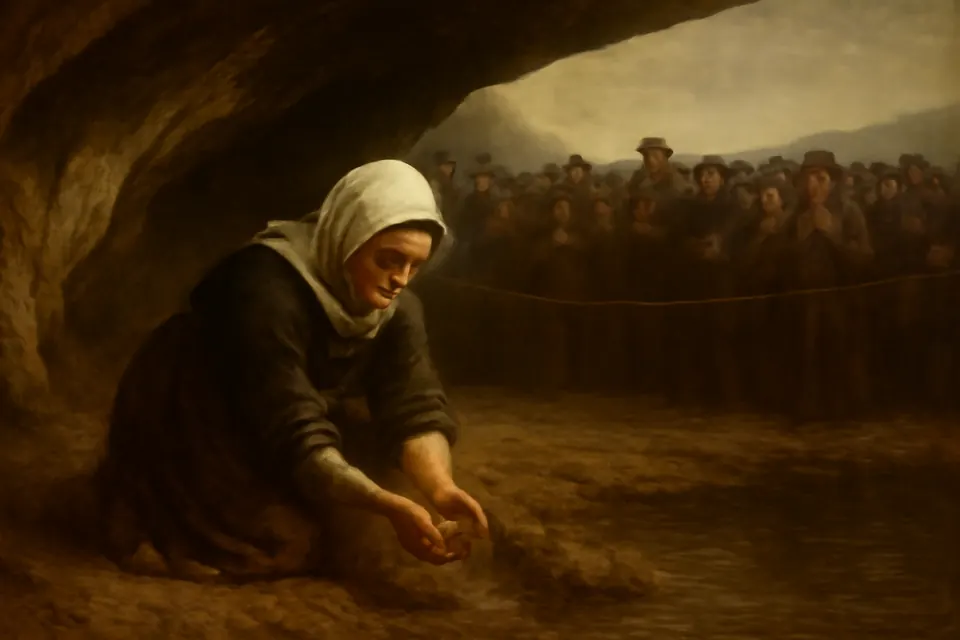
Over the following days the trickle grew into a steady flow. The Catholic Encyclopedia notes that the existence of the spring had been unknown and that it "immediately gushed forth." It still runs at the grotto, and its water feeds the taps and baths of the sanctuary. An official chemical analysis, the same article says, found that the water has no natural curative properties.
"Go and tell the priests"
On March 2 the Lady gave Bernadette a message for the clergy. Benedict XVI quoted it in his 2008 homily: "Go and tell the priests that people should come here in procession, and that a chapel should be built here." Bernadette carried it to the parish priest, Father Dominique Peyramale, a large, blunt man who was not inclined to believe her. He told her the Lady must give her name, and asked for a sign: the wild rose bush below the niche should bloom in winter.

"I am the Immaculate Conception"
Early on March 25, 1858, the feast of the Annunciation, Bernadette felt drawn back to the grotto after three weeks' absence. She asked the Lady her name several times. According to the Sanctuary of Lourdes, Bernadette later described the moment this way: the Lady "raised her eyes to heaven, stretched out her hands which were and open towards the earth then joined them in a sign of prayer, and said to me: Que soy era Immaculada Councepciou."
The phrase means "I am the Immaculate Conception." Bernadette didn't know what it meant. She repeated it to herself all the way to the presbytery so she wouldn't forget it. Pope Pius IX had defined the dogma of the Immaculate Conception, that Mary was preserved from original sin from the first moment of her existence, only four years earlier, in 1854, and a girl who had not yet learned her catechism was not likely to have heard the term. The words shook Father Peyramale. The rose bush never bloomed, but the parish priest became one of Bernadette's firmest defenders.


The last apparitions
On April 7, during the seventeenth apparition, Bernadette knelt in ecstasy with a lit candle in her hands. Witnesses, among them the town doctor Pierre-Romain Dozous, said the flame played between her fingers for some time without burning her. In June the town authorities fenced off the grotto. Bernadette made her First Communion on June 3. On July 16, the feast of Our Lady of Mount Carmel, she knelt in the meadow across the river, outside the barrier, and saw the Lady one last time.
Questioned, doubted, sought after
For the next eight years Bernadette was questioned by police, magistrates, doctors, journalists, priests and bishops, and by an endless stream of visitors who wanted to see the girl who had seen the Virgin. Her answers were short and never changed. The Sanctuary quotes one of her best-known replies: "I'm charged with telling you, not with making you believe."
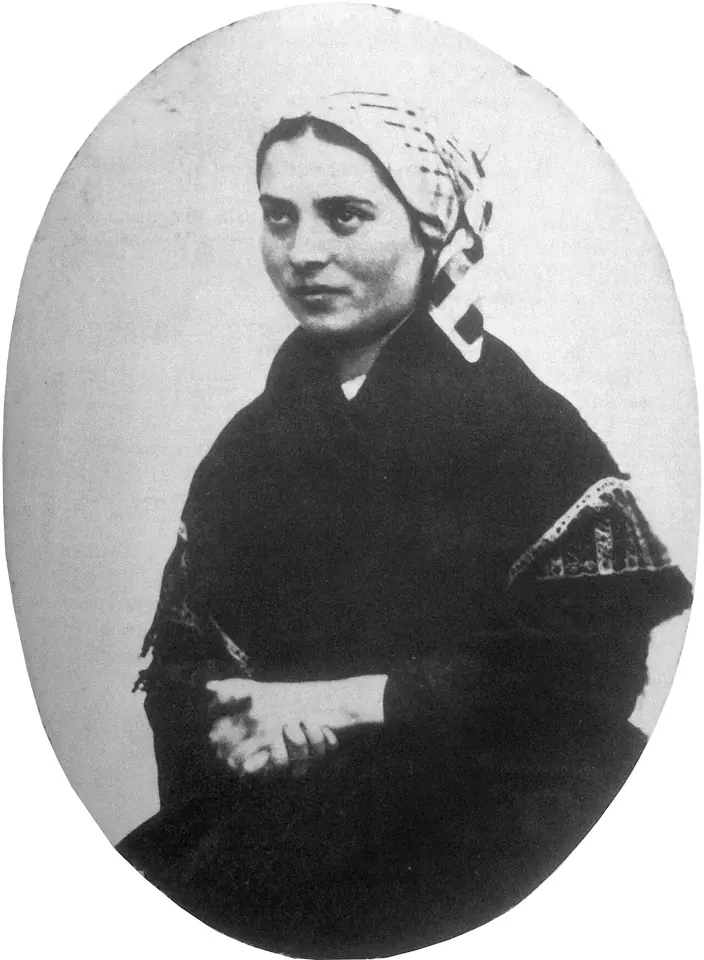

On July 15, 1860, she was taken in as "a sick poor person" at the hospice in Lourdes run by the Sisters of Charity of Nevers. There, at sixteen, she learned to read and write. People offered her money, and she refused it. Photographers sold her picture, which she disliked.
Meanwhile Bishop Bertrand-Sévère Laurence of Tarbes, who had opened a commission of inquiry in 1858, finished his investigation. On January 18, 1862, he published his pastoral letter. In the Sanctuary's English translation it judges that the Immaculate Mary really appeared to Bernadette eighteen times in the Grotto of Massabielle, "that this Apparition possesses all the characteristics of truth and that the faithful may believe in it with certainty." The same decree declared seven cures miraculous. Work began on a chapel above the grotto, and Bernadette was present when its crypt was opened in May 1866.
Sister Marie-Bernard at Nevers
In July 1866 Bernadette left Lourdes for good. She traveled to the motherhouse of the Sisters of Charity at Saint-Gildard in Nevers, in central France, and on July 29 she received the habit and the name Sister Marie-Bernard. "My mission in Lourdes is finished," she said, and of the convent, "I came here to hide myself." Her mother had died that year, and she never saw the grotto again.
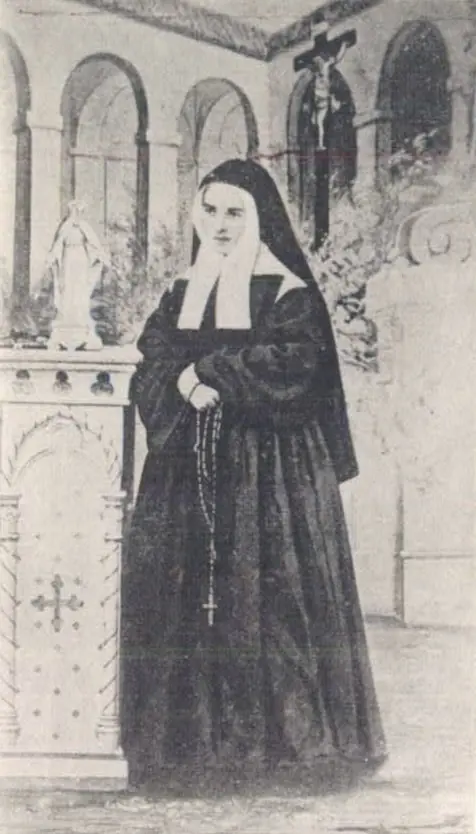

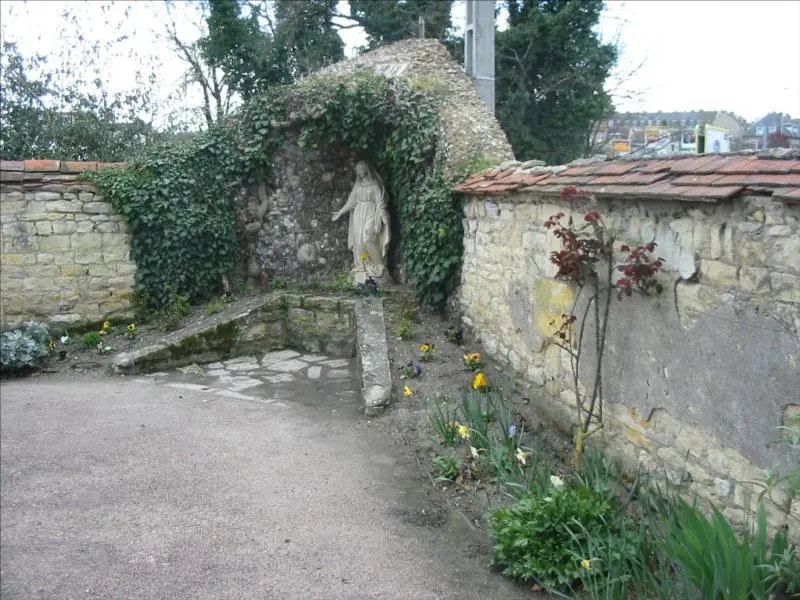
Her years at Nevers were ordinary on purpose. She worked as an assistant in the infirmary, a job she was good at, and later as sacristan, embroidering altar linens. She made her profession in 1867, and the Sanctuary of Lourdes recalls that the bishop gave her, as her task, the work of prayer. Her superiors, wary of pride, treated her coolly, and she was often in the infirmary herself. In the garden she liked to pray before a statue called Our Lady of the Waters.

Her illnesses multiplied: asthma, coughing up blood, then a tuberculous tumor of the right knee that kept her in bed for months at a time. The Catholic Culture calendar recalls her answer when someone asked what she was doing: "I am getting on with my job." And what was that? "Being ill."
Her death
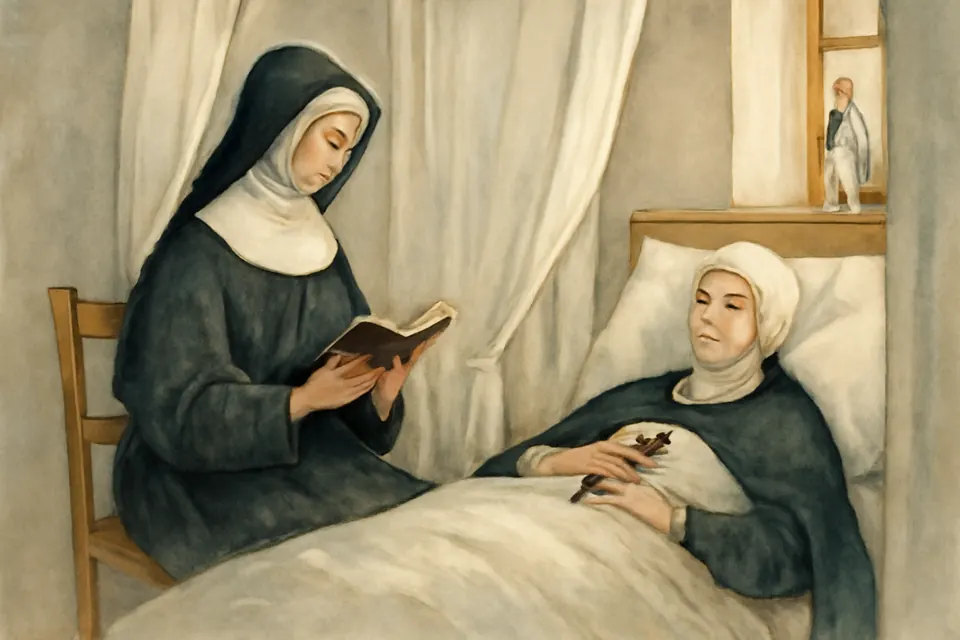
Bernadette died at Nevers in the afternoon of April 16, 1879, Wednesday of Easter week, at the age of thirty-five, while the sisters prayed around her. A few days before, the Sisters of Charity record, she said, « Je suis moulue comme un grain de blé » ("I am ground like a grain of wheat"), and also « Je n'oublierai personne » ("I will forget no one"). She was buried in the Chapel of St. Joseph in the convent garden.
The miracles of St. Bernadette and Lourdes
Two kinds of miracle are tied to Bernadette, and they need to be kept apart: the cures at Lourdes, which the Church attributes to the intercession of Our Lady of Lourdes, and the miracles examined for Bernadette's own beatification and canonization.
- Approved: the cures recognized as miraculous at Lourdes. The Sanctuary says more than 7,000 cures have been reported there since 1858 and that "72 have so far been recognised as miraculous by the Church." The first seven, among them Catherine Latapie, a woman from Loubajac whose paralyzed hand recovered after she bathed it in the spring on March 1, 1858, were declared by Bishop Laurence in 1862. In December 2024 the archbishop of Liverpool recognized the 1923 cure of Jack Traynor, a wounded Royal Navy veteran, as the 71st. On April 16, 2025, the 72nd was announced: Antonietta Raco, an Italian woman cured of primary lateral sclerosis during a pilgrimage in 2009.
- Approved: the miracles accepted for Bernadette's own cause, which led to her beatification on June 14, 1925, and her canonization on December 8, 1933, both by Pius XI.
- Reported: the candle on April 7, 1858, whose flame witnesses said touched her hand without burning it.
- Reported: the condition of her body, described below.

How a Lourdes cure is recognized
The Medical Bureau of Lourdes, the Bureau des Constatations Médicales, was founded in 1883 by Dr. Georges-Fernand Dunot de Saint-Maclou. A pilgrim who believes he or she has been cured declares it there. A doctor at the Bureau gathers the medical records, and if the case looks serious, any doctor present in Lourdes may join the examination. The case then goes to the International Medical Committee of Lourdes, about thirty specialists, which decides whether the cure is unexplained by current medical knowledge. It must be complete and lasting, from a serious illness, and sudden.
Only then does the Church step in. The file goes to the bishop of the diocese where the cured person lives, and he alone can declare the cure a miracle. That is why the number is so small next to the thousands of reported healings, and why years often pass between a cure and its recognition. The Traynor case took 101 years.
Why St. Bernadette is the patron saint of the sick
Bernadette's patronage of the sick comes from two places. Lourdes itself is the great shrine of the sick: every year volunteers bring people in wheelchairs and on stretchers to the grotto and the baths, and Pope John Paul II made February 11, the feast of Our Lady of Lourdes, the World Day of the Sick in 1993. And Bernadette was sick nearly all her life. She bore it, as far as anyone knows, without asking to be cured.
Her other patronages follow her life. She was a shepherdess at Bartrès, so shepherds claim her. She grew up in real poverty in a former jail cell, so the poor do. And she was mocked, threatened and interrogated for what she said she saw, which is why some prayer books name her the patron of people ridiculed for their faith. See all the patron saints by cause.

Symbols of St. Bernadette in art
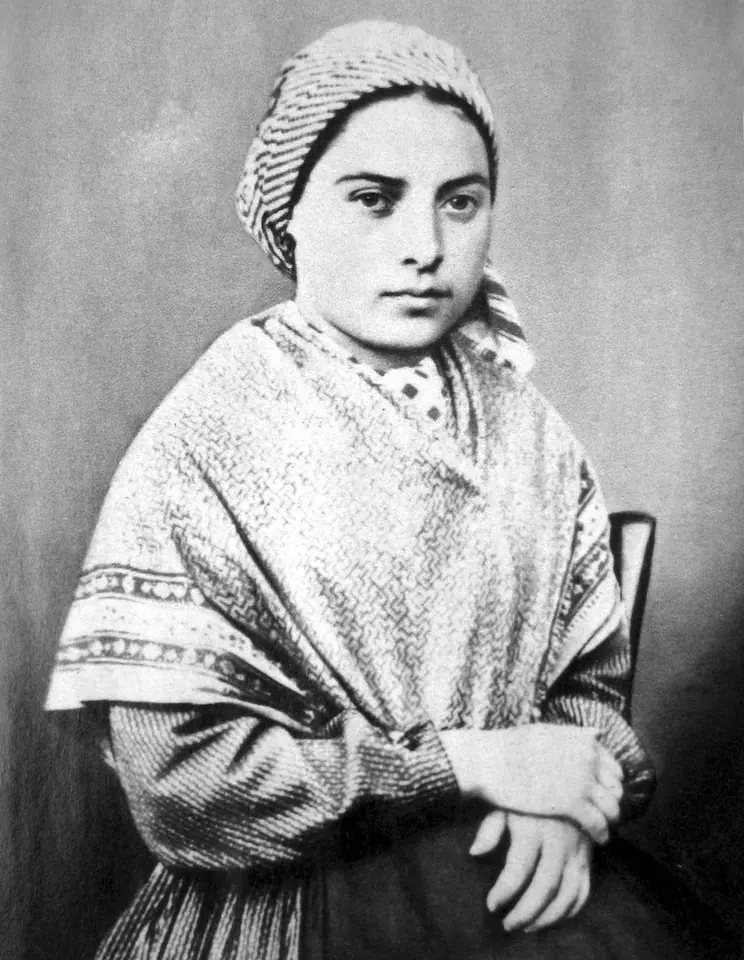
Bernadette lived in the age of photography, and painters and sculptors usually start from the photographs taken of her between about 1861 and 1866. That makes her easy to recognize.
- Peasant dress and the white capulet: the long woolen hood of the Pyrenees, falling over her shoulders, with a dark shawl and apron. Billard-Perrin's 1863 photograph on this page is the model for many statues.
- A rosary: she was praying the rosary when the Lady first appeared, and she holds it in almost every image.
- Kneeling before the grotto: the most common scene, usually with the Virgin in white and blue standing in the niche above, as in Tojetti's painting and the Épinal print.
- A lit candle: recalling the candle of April 7 and the candles that pilgrims still bring.
- Wild roses: the rose bush below the niche and the yellow roses on the Lady's feet.
- The habit of the Sisters of Charity of Nevers: a black habit with a white bonnet and wimple, in images of her later years, as in Jan Bąkowski's painting.


In a church, the pairing tells you who she is: a statue of a small peasant girl kneeling, looking up at a Madonna in white with a blue sash and her hands joined, is Bernadette at the grotto, a scene copied in thousands of "Lourdes grottoes" in parish gardens around the world. Eastern Orthodox churches don't venerate her, since she lived long after the division of the churches.
Feast day and where St. Bernadette is honored
The Roman Martyrology remembers St. Bernadette on April 16, the day she died, and that is her feast in most countries, though she is not on the General Roman Calendar. France keeps February 18, the day in 1858 when the Lady first spoke to her and promised her happiness "in the other" world. The older Latin calendar also used February 18. The feast of Our Lady of Lourdes is February 11. See our feast day calendar.
Lourdes
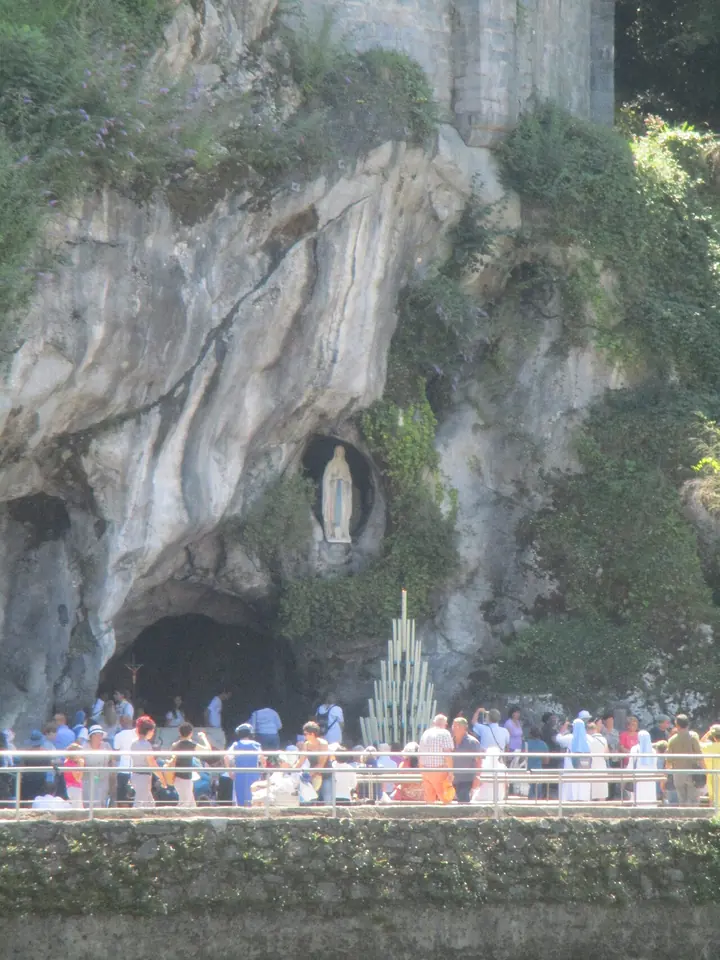
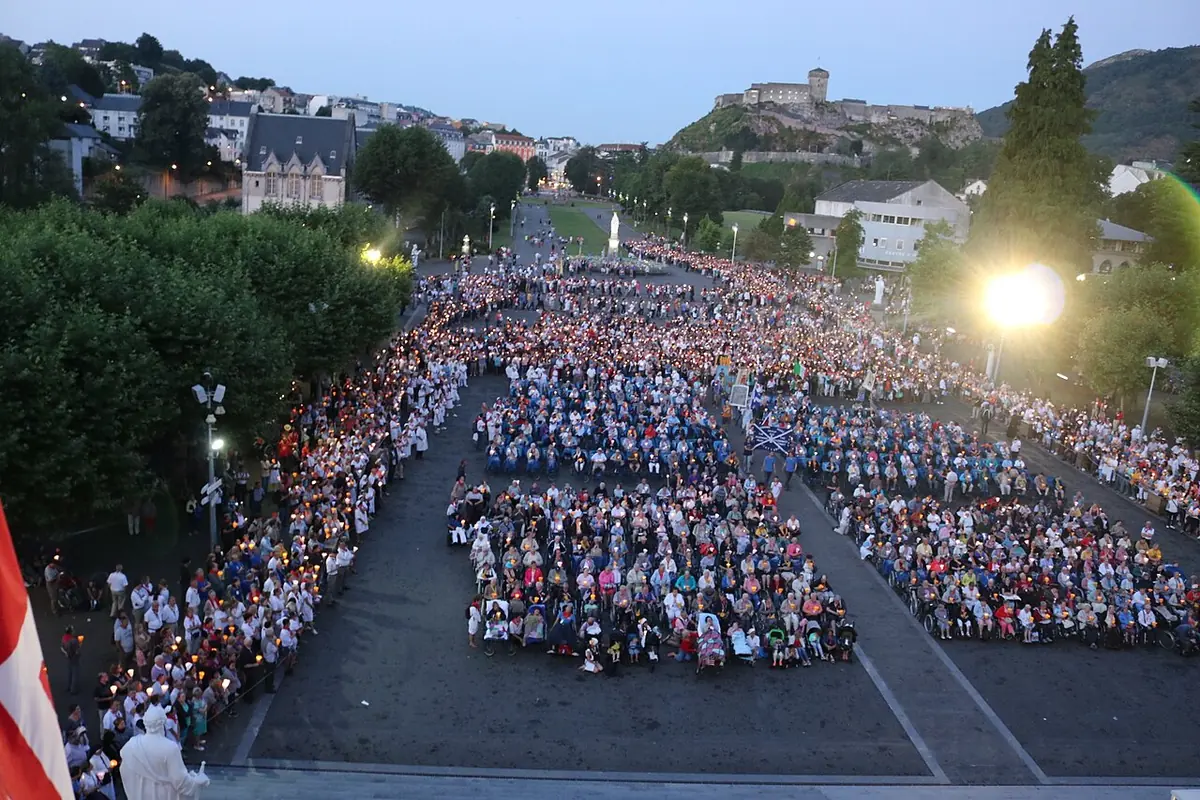
The grotto of Massabielle is now the heart of the Sanctuary of Our Lady of Lourdes, which welcomes millions of pilgrims a year. Above it stands the Basilica of the Immaculate Conception, built on the crypt Bernadette saw opened in 1866. Below it is the domed Rosary Basilica, finished in 1889, and under the great esplanade lies the underground Basilica of St. Pius X, consecrated in 1958. Pilgrims drink and wash at the taps fed by the spring, bathe in the pools and walk in the evening torchlight procession singing the Lourdes Ave Maria.


In the town, pilgrims can visit the Boly Mill where she was born and the cachot where her family lived in 1858. At Bartrès, a few miles away, the church keeps the strokes she practiced when she was learning to write.
Nevers and her body
Bernadette's body lies in a gilded reliquary with glass sides in the chapel of the former convent of Saint-Gildard at Nevers, now the Espace Bernadette, run by the Sisters of Charity. During the process for her beatification the body was exhumed three times, on September 22, 1909, April 3, 1919, and April 18, 1925. The Sisters state that each time "le corps est découvert incorrompu," the body was found incorrupt. This is a reported phenomenon. The Church has never treated it as one of the miracles of her cause, and incorruption is not proof of holiness in Catholic teaching.
It helps to know what visitors see. By 1925 the skin of the face and hands had darkened, and the nuns did not want pilgrims to see it. A thin wax mask was made for the face and wax coverings for the hands, and these were fitted over her real features before the body was placed in the reliquary in 1925. The Catholic Culture calendar puts it plainly: "Her body is incorrupt, and now covered by wax." Relics taken in 1925 were sent to Rome.


Prayer and words of St. Bernadette
Bernadette wrote no books. What she left are the accounts of the apparitions she gave to investigators, letters, a few personal notebooks and the sayings her sisters remembered. The Sisters of Charity of Nevers keep a prayer from her notebooks, sometimes called her prayer for bread. It is quoted here in French as the Sisters give it, with a plain English translation:
Ô Jésus donnez-moi je vous prie le pain de l'humilité, le pain d'obéissance, le pain de charité, le pain de force pour rompre ma volonté et la fondre à la vôtre… le pain de patience pour supporter les peines que mon cœur souffre … le pain de ne voir que vous seul en tout et toujours
"O Jesus, give me, I pray you, the bread of humility, the bread of obedience, the bread of charity, the bread of strength to break my will and melt it into yours, the bread of patience to bear the pains my heart suffers, the bread of seeing only you in everything and always."
Two other sayings of hers that the Sisters keep: « Jésus seul pour maître, Jésus seul pour richesse, Jésus seul pour ami » ("Jesus alone for master, Jesus alone for riches, Jesus alone for friend"), and « J'aurai toujours assez de santé mais jamais assez d'amour » ("I will always have enough health, but never enough love").
No single traditional prayer to St. Bernadette is used everywhere. Catholics ask her to pray for them, especially in illness, often with a simple invocation such as "St. Bernadette, pray for us," and many pray a novena from February 10 to her French feast on February 18, or before April 16. The Lourdes Sanctuary also leads the rosary at the grotto every day, the prayer Bernadette was saying when she first looked up at the rock of Massabielle.
Frequently asked questions
When is St. Bernadette's feast day?
April 16, the anniversary of her death in 1879. In France her feast is February 18, the day in 1858 when the Lady first spoke to her. The feast of Our Lady of Lourdes, which remembers the first apparition, is February 11.
What did the Virgin Mary say to Bernadette?
According to Bernadette, the Lady asked her to come to the grotto for fifteen days, told her "I do not promise to make you happy in this world but in the other," called for "Penance! Penance! Penance!" and prayer for sinners, told her to drink at the spring, asked for processions and a chapel, and on March 25, 1858, gave her name in the local dialect, "Que soy era Immaculada Councepciou," "I am the Immaculate Conception."
Is St. Bernadette's body really incorrupt?
Her body was exhumed in 1909, 1919 and 1925, and the Sisters of Charity of Nevers state that it was found incorrupt each time. Because the skin of the face and hands had darkened, a thin wax mask was fitted over the face and hands in 1925, so what visitors see in the reliquary at Nevers is wax over her real features. The incorruption is a reported phenomenon, not one of the miracles approved for her canonization.
How many miracles have been recognized at Lourdes?
The Sanctuary of Lourdes says that more than 7,000 cures have been reported since 1858 and that 72 have been recognized as miraculous by the Church. The 72nd, the cure of the Italian pilgrim Antonietta Raco, was announced on April 16, 2025. The first seven were recognized in 1862.
What is St. Bernadette the patron saint of?
Catholics invoke her for the sick and for people who are ill and suffering, and she is the patron of Lourdes. Popular devotion also makes her the patron of shepherds and shepherdesses, of the poor and of people mocked for their faith, all of which echo her life.
Why did Bernadette become a nun?
She wanted to leave the crowds that followed her at Lourdes and give her life to prayer and caring for the sick. In July 1866 she entered the Sisters of Charity of Nevers, saying she had come there "to hide." She never returned to Lourdes.
Why was Bernadette canonized?
Not because she saw the Virgin. The Sanctuary of Lourdes and the Catholic tradition stress that she was canonized for the way she lived afterward, in humility, patience in illness and simple trust in God. Pius XI canonized her on December 8, 1933, the feast of the Immaculate Conception.
What was The Song of Bernadette?
A 1941 novel by Franz Werfel, who promised to write Bernadette's story if he escaped the Nazis through Lourdes, and the 1943 Hollywood film made from it. Jennifer Jones won the Academy Award for Best Actress for playing Bernadette.
Sources
- Sanctuary of Our Lady of Lourdes: Bernadette
- Sanctuary of Our Lady of Lourdes: The Apparitions
- Sanctuary of Our Lady of Lourdes: 25th March, Feast of the Annunciation
- Sanctuary of Our Lady of Lourdes: The recognition of the Lourdes Apparitions
- Sanctuary of Our Lady of Lourdes: Miraculous healings
- Sanctuary of Our Lady of Lourdes: The Medical Bureau of the Sanctuary
- Sanctuary of Our Lady of Lourdes: Recognition of a miracle
- Catholic Encyclopedia (1910): Notre-Dame de Lourdes
- Benedict XVI, Homily for the 150th anniversary of the apparitions, Lourdes, 14 September 2008
- Sisters of Charity of Nevers: Son corps (Bernadette's body)
- Sisters of Charity of Nevers: Ses mots (Bernadette's sayings)
- Sisters of Charity of Nevers: Prier avec Bernadette
- Catholic Culture: Liturgical calendar, April 16 (St. Bernadette)
- Aleteia: Why St. Bernadette has a feast day in February and April
- Catholic World Report: Lourdes announces 72nd miracle (April 16, 2025)
- Catholic Bishops' Conference of England and Wales: Archbishop of Liverpool declares Jack Traynor case a miracle
- Roman Martyrology, April 16