Archangel Uriel

Archangel Uriel is an angel named in the Book of Enoch and in 2 Esdras, ancient Jewish writings that are not part of the Catholic Bible. The Orthodox and Ethiopian churches honor him among the archangels. The Catholic Church names only three angels, Michael, Gabriel and Raphael, because only their names are in Scripture, and it asks the faithful not to give other names to angels.
Archangel Uriel is one of the most searched-for angels, and one of the most misunderstood. His name is old and honorable: it comes from Jewish writings of the centuries before Christ, and the Eastern churches still sing it. But it is not in the Catholic Bible, and the Church gently asks us not to use it in prayer. Here is where the name comes from, who honors Uriel and why, and what the Church teaches.
Who is Archangel Uriel?
Uriel means "God is my light" or "light of God" in Hebrew. He is one of the angels named in the Book of Enoch, usually called 1 Enoch, a collection of Jewish writings put together over the last three centuries before Christ. He appears again in 2 Esdras, a Jewish apocalypse written after the Romans destroyed Jerusalem in A.D. 70. Neither book belongs to the canon of Scripture the Church received.
In the Catholic Bible, three angels have names: St. Michael in Daniel, Jude and Revelation, St. Gabriel in Daniel and Luke, and St. Raphael in Tobit. The name Uriel does occur in Scripture, but only for men. One was a chief of the Levites under King David: "Of the children of Caath, Uriel was the chief, and his brethren a hundred and twenty" (1 Paralipomenon 15:5, Douay-Rheims).
Uriel in the Book of Enoch
1 Enoch is where Uriel's story begins. In chapter 20 the book lists seven holy angels "who watch." According to the critical text summarized in the Jewish Encyclopedia (1906), the first is Uriel, set over the world's luminaries and over Sheol, the place of the dead. The others are Raphael, Raguel, Michael, Sariel, Gabriel and Jerahmeel. Elsewhere in the book, Uriel is one of four great angels, with Michael, Gabriel and Raphael, who look down on the violence of the earth before the Flood and bring the cry of the dead before God (1 Enoch 9).
His largest part comes in the section scholars call the Book of the Luminaries (1 Enoch 72–82). There Uriel is Enoch's guide through the heavens. He shows him the gates through which the sun rises and sets, the phases of the moon and the order of the stars, and the whole calendar of the year. That is how Uriel became, in later imagination, the angel of light and of hidden knowledge.
Later Jewish writings kept the four. The Jewish Encyclopedia notes that the Pirke de-Rabbi Eliezer and the Hekhalot texts place Michael, Uriel, Gabriel and Raphael on the four sides of God's throne.
Uriel in 2 Esdras
2 Esdras (numbered 4 Esdras in the Latin Vulgate) tells of visions given to Ezra in Babylon. Ezra grieves over the ruin of his people and asks God why. An angel is sent to answer him:
And the angel that was sent unto me, whose name was Uriel, gave me an answer, And said, Thy heart hath gone to far in this world, and thinkest thou to comprehend the way of the most High? (2 Esdras 4:1–2, King James Version)
The Catholic Encyclopedia sums up the scene: "The angel Uriel chides Esdras for inquiring into things beyond his understanding." The book was popular with Christians for centuries. Lines from it found their way into the liturgy, including the words "eternal rest" and "perpetual light" that we still pray for the dead. But the Church never received it as Scripture, and the old printed Vulgate set it in an appendix after the New Testament, so that it would not be lost entirely.

What the Catholic Church teaches about Uriel
The Church believes firmly in the holy angels. Their existence, the Catechism says, "is a truth of faith" (no. 328). What the Church is careful about is giving them names that God has not revealed.
The Roman synod of 745
The question came up sharply in the eighth century. A wandering Frankish bishop named Aldebert had gathered a following by claiming special powers. He handed out his own hair and nail clippings as relics and composed a prayer that called on eight angels by name. On October 25, 745, Pope St. Zachary held a synod in the Lateran to judge him. When the prayer was read aloud, the assembly heard it say, "I pray and entreat and beseech you, angel Uriel, Raguel, Tubuel, Michael, Adinus, Tubuas, Sabaoc, Simiel."
The bishops' reply, in Ephraim Emerton's translation, was blunt: "The names of the eight angels whom Aldebert invokes in his prayer are, with the exception of Michael, not angels but demons whom he has called to his aid. As we know from the teaching of the Apostolic See and divine authority, there are only three angels, Michael, Gabriel and Raphael." Aldebert was deposed. The synod was not passing judgment on everything later Christians would mean by "Uriel." It was guarding the faithful from calling on spirits by names that no one could vouch for, and that is the heart of the Church's caution to this day.
The Directory on Popular Piety (2001)
The same caution appears in our own time. The Directory on Popular Piety and the Liturgy, issued by the Holy See in 2001, praises devotion to the holy angels as "legitimate and good" and then adds: "The practice of assigning names to the Holy Angels should be discouraged, except in the cases of Gabriel, Raphael and Michael whose names are contained in Holy Scripture" (no. 217).
So, in the Latin Church, Uriel has no feast and no place in the litanies. On September 29 we keep the feast of the three archangels Scripture names, and on October 2 the feast of the guardian angels.
Uriel in the Eastern churches
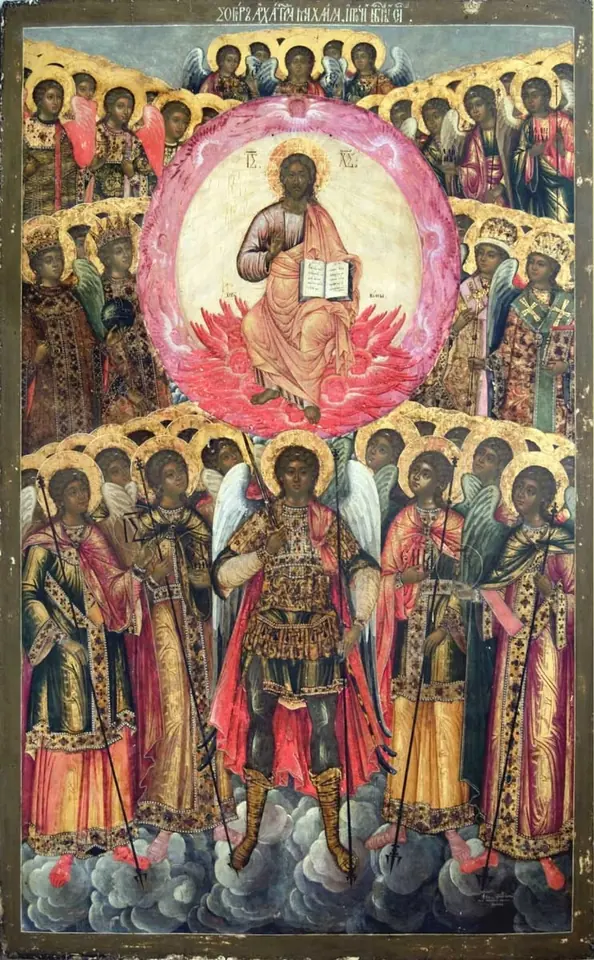
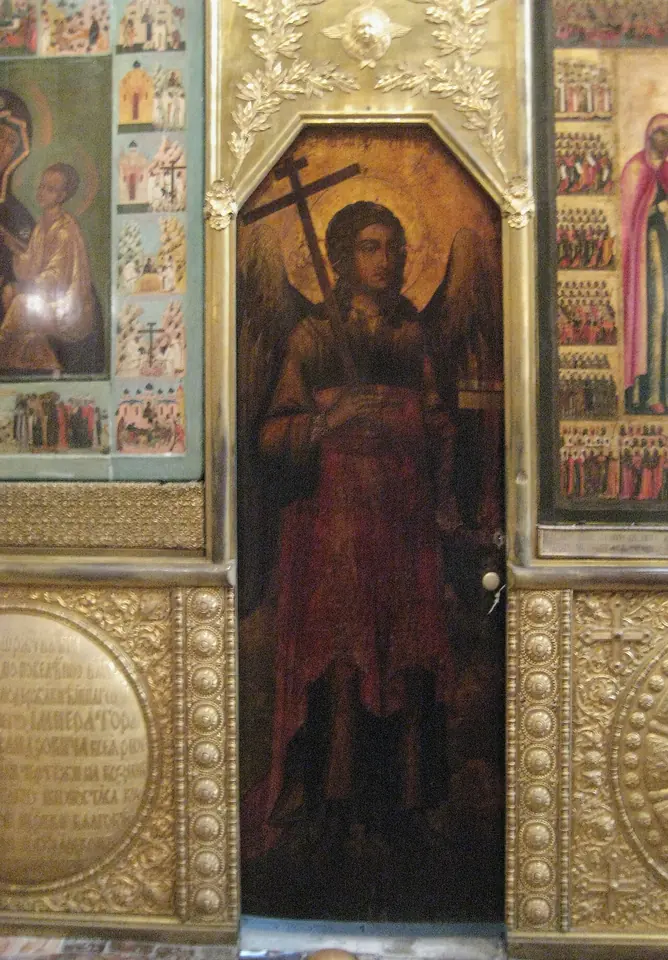
The Christian East kept more of the old tradition of the seven archangels, and it is right to describe that tradition fairly. The Orthodox Church celebrates the Synaxis of the Archangel Michael and the Other Bodiless Powers on November 8. The Orthodox Church in America names the archangels honored that day as "Gabriel, Raphael, Uriel, Selaphiel, Jehudiel, Barachiel, and Jeremiel." In Orthodox icons Uriel often holds a flame or a sword, and his image appears on the doors of many iconostases, as in the Cathedral of the Annunciation in the Moscow Kremlin.
The Ethiopian Orthodox Tewahedo Church, whose Bible includes 1 Enoch, honors Uriel even more. Its Sunday School department writes that he gave Ezra the cup of wisdom (2 Esdras 14:39), that he guided the Holy Family on the flight into Egypt, and that he received the blood of Christ in a cup at the Crucifixion. The same page says that many of Ethiopia's monasteries were founded under Uriel's patronage, and the church keeps feasts in his honor during the year. These are traditions of a sister church; the Catholic Church has never adopted them.
Uriel in Western art and devotion
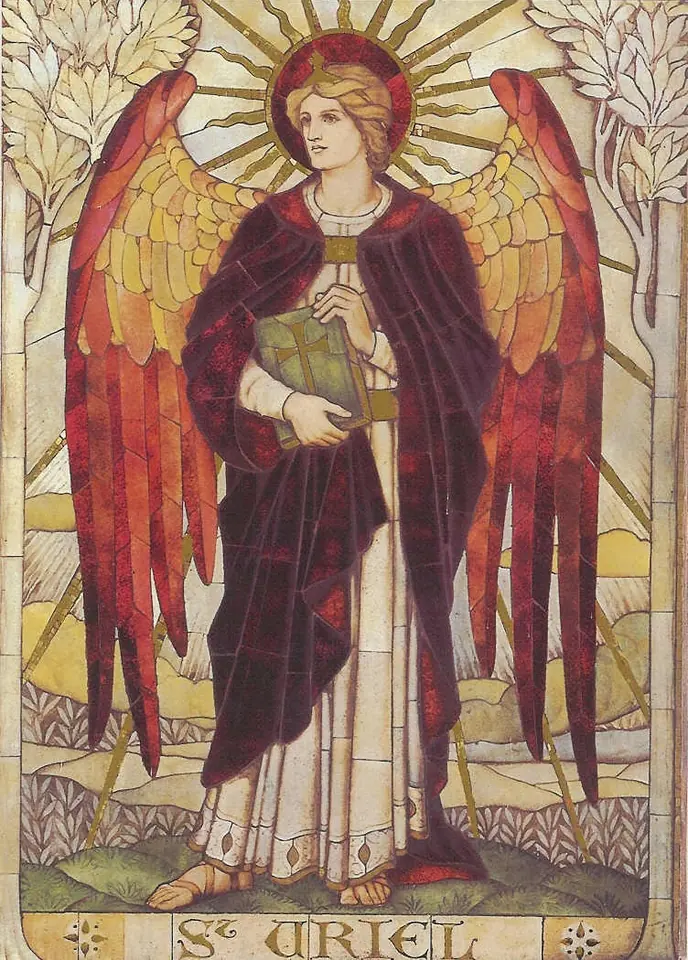
In the West, Uriel never quite disappeared. A Sicilian priest, Antonio Lo Duca, promoted devotion to seven named archangels in the 1500s, Uriel among them, and engravers spread the images; Crispijn van de Passe's plate of the seraph Uriel dates from about 1575 (the story is told on our page on the seven archangels). John Milton made Uriel the "regent of the sun" in Paradise Lost. Victorian church builders in England, and some American parishes, put him in windows beside Michael, Gabriel and Raphael, usually with a flame, a book or a scroll.

These images are part of history, and many are beautiful. They do not change the Church's guidance. A window in a parish church is not a decree; the Holy See's instruction is.

How to pray instead
None of this leaves us without help. The angels God has revealed to us by name are enough, and so is the guardian angel he has given each of us. If you were drawn to Uriel as an angel of light and wisdom, bring that same need to God through the angels the Church names. Ask St. Raphael to guide you, St. Gabriel to help you hear God's word, and St. Michael to defend you. Pray the Guardian Angel prayer morning and night. And remember that all the light the angels have, they receive from Christ, "the true light, which enlighteneth every man that cometh into this world" (John 1:9).
For more on the angels Scripture names, see names of angels.
Frequently asked questions
Is Uriel in the Bible?
Not in the Catholic Bible. The name Uriel appears in the Book of Enoch (1 Enoch) and in 2 Esdras (called 4 Esdras in the old Latin numbering), and neither book is part of the canon of Scripture the Church received. The Ethiopian Orthodox Church does count 1 Enoch among its holy books. In the Catholic Bible, Uriel is only the name of men, such as a chief of the Levites in 1 Chronicles 15:5.
Is Uriel a saint in the Catholic Church?
No. The Catholic Church honors three archangels by name, Michael, Gabriel and Raphael, on September 29. Uriel has no feast in the Roman calendar, and the Directory on Popular Piety and the Liturgy (2001) asks that names not be given to angels apart from those three, whose names are in Scripture.
What does the name Uriel mean?
Uriel is Hebrew and means "God is my light" or "light of God." That fits his role in 1 Enoch, where he is the angel set over the lights of heaven and shows Enoch the courses of the sun, moon and stars.
Can Catholics pray to Archangel Uriel?
The Church's guidance is to address the holy angels without the names found only in apocryphal books. A Roman synod under Pope St. Zachary in 745 condemned a prayer that called on Uriel and other non-scriptural names. We can and should pray to the holy angels, to our guardian angel and to St. Michael, St. Gabriel and St. Raphael.
Why do the Orthodox honor Uriel?
The Eastern churches kept the old Jewish tradition of seven archangels and give names to the four not named in Scripture. The Orthodox Church in America lists Uriel among the archangels honored at the Synaxis of the Bodiless Powers on November 8, and the Ethiopian Orthodox Tewahedo Church keeps feasts of Uriel.
Sources
- Directory on Popular Piety and the Liturgy (2001), no. 217
- Acts of the Roman Synod of October 25, 745, condemning Aldebert (The Letters of St. Boniface, tr. Emerton). Third session, with the prayer naming Uriel and the synod's judgment
- Jewish Encyclopedia (1906): Angelology. The seven archangels of 1 Enoch 20 and the four angels of the throne
- Catholic Encyclopedia (1909): Esdras (on 3 and 4 Esdras)
- 2 Esdras, chapter 4 (King James Version with Apocrypha)
- Orthodox Church in America: Synaxis of the Archangel Michael and the Other Bodiless Powers
- Ethiopian Orthodox Tewahedo Church Sunday School Department (Mahibere Kidusan): Feast of Archangel Saint Uriel