St. Michael prayer
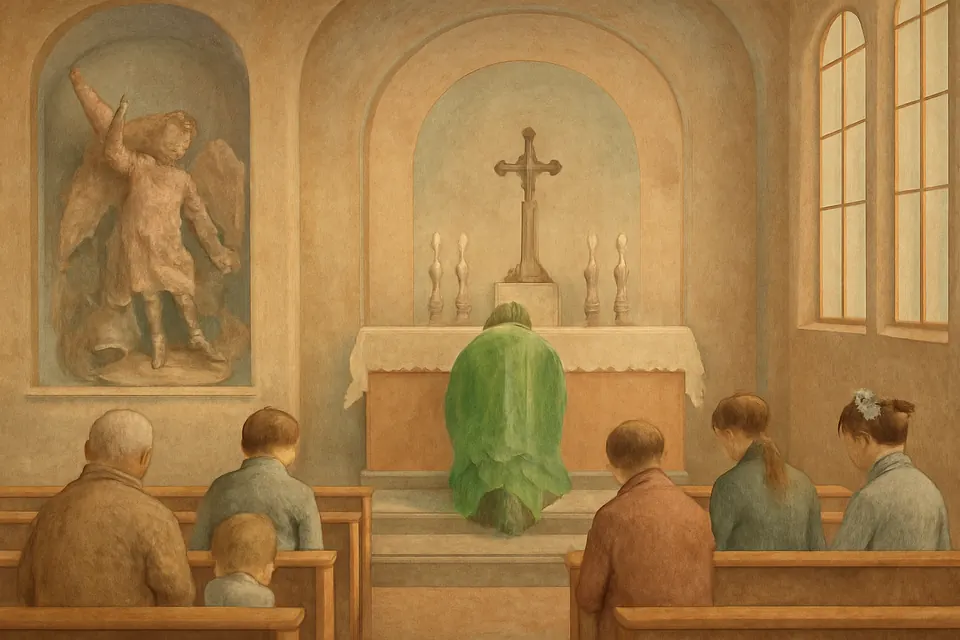
The St. Michael prayer is the short prayer that begins "St. Michael the Archangel, defend us in battle." Pope Leo XIII wrote it and added it in 1886 to the prayers said after every Low Mass. Those prayers were dropped in 1964, but John Paul II and Francis asked Catholics to keep praying it, and many parishes again say it after Mass.
More Catholics know this prayer by heart than almost any other prayer to a saint. It is short, it is blunt, and it asks for help in a fight. Below are the full English text, the Latin original Leo XIII wrote, and what can and can't be documented about where it came from.
The St. Michael prayer
This is the wording most American Catholics learned, and the one printed on most prayer cards today:
St. Michael the Archangel, defend us in battle. Be our defense against the wickedness and snares of the Devil. May God rebuke him, we humbly pray, and do thou, O Prince of the heavenly hosts, by the power of God, thrust into hell Satan, and all the evil spirits, who prowl about the world seeking the ruin of souls. Amen.
Many prayer books say "Be our protection" instead of "Be our defense." The Latin word is praesidium, a guard or protection, so "protection" is the closer translation. It is also the word the Holy See Press Office used in its English translation in 2018.
The Latin original: Sancte Michael Archangele
Leo XIII wrote the prayer in Latin. This is the text as the Holy See printed it in 2018:
Sancte Michael Archangele, defende nos in proelio; contra nequitiam et insidias diaboli esto praesidium. Imperet illi Deus, supplices deprecamur: tuque, Princeps militiae caelestis, Satanam aliosque spiritus malignos, qui ad perditionem animarum pervagantur in mundo, divina virtute, in infernum detrude. Amen.
A word-for-word reading helps with the English. Defende nos in proelio is "defend us in battle." Nequitiam et insidias diaboli is "the wickedness and snares of the devil." Imperet illi Deus is "may God command him," which most translations soften to "rebuke." Princeps militiae caelestis is "prince of the heavenly army." Pervagantur in mundo means "wander through the world," and detrude is a strong verb: thrust down, drive down.
An older English version (1912)
English translations varied a good deal in the first decades. This is the version printed under "Prayers after Low Mass" in The Little Month of November, a Catholic booklet published in Boston in 1912:
St. Michael, the Archangel, defend us in battle; be our protection against the malice and snares of the devil. We humbly beseech God to command him; and do thou, O Prince of the heavenly hosts, by the divine power thrust into hell Satan and the other evil spirits who roam through the world seeking the ruin of souls. Amen.
The same booklet notes that Leo XIII granted an indulgence of 300 days to those who said the prayers after Mass as directed. In 1905 a reader wrote to The Irish Ecclesiastical Record because two different English leaflets were in use in Dublin. One began "Blessed Michael, Archangel, defend us in the hour of conflict"; the other "Holy Michael, Archangel, defend us in the day of battle." The editors answered that both were surely approved. Readers of James Joyce will recognize the first one: in Ulysses a priest recites "Blessed Michael, archangel, defend us in the hour of conflict" after Mass.

What the prayer asks, line by line
The prayer is built on Scripture. In the Book of Revelation, "there was war in heaven: Michael and his angels fought against the dragon," and the dragon, "that old serpent, called the Devil, and Satan," was thrown down (Revelation 12:7–9). "Defend us in battle" asks Michael to fight that same battle on our side.
"May God rebuke him" comes straight from the Letter of Jude. When Michael disputed with the devil over the body of Moses, he "durst not bring against him a railing accusation, but said, The Lord rebuke thee" (Jude 9). Even in the prayer, Michael doesn't rebuke the devil in his own name. He acts "by the power of God." The phrase about evil spirits who prowl "seeking the ruin of souls" echoes 1 Peter 5:8: "your adversary the devil, as a roaring lion, walketh about, seeking whom he may devour."
So the prayer asks for three things in a few lines: Michael's protection, God's rebuke of the enemy, and the defeat of evil spirits who work against souls. For more on who Michael is in the Bible and in tradition, see our full entry on St. Michael the Archangel.
History of the St. Michael prayer
The prayers after Low Mass (1859 and 1884)
The story starts before Leo XIII. In 1859, with the Papal States facing revolt and war, Pope Pius IX ordered certain prayers to be said after Mass in the churches of his territory. On January 6, 1884, Leo XIII extended them to the whole Church. The decree of the Sacred Congregation of Rites, printed in the Acta Sanctae Sedis, ordered that at the end of every Mass celebrated without singing, priest and people should kneel and say three Hail Marys, the Hail Holy Queen, a versicle, and a collect asking God's help "in our present necessities." It attached an indulgence of 300 days. These became known as the Leonine Prayers.
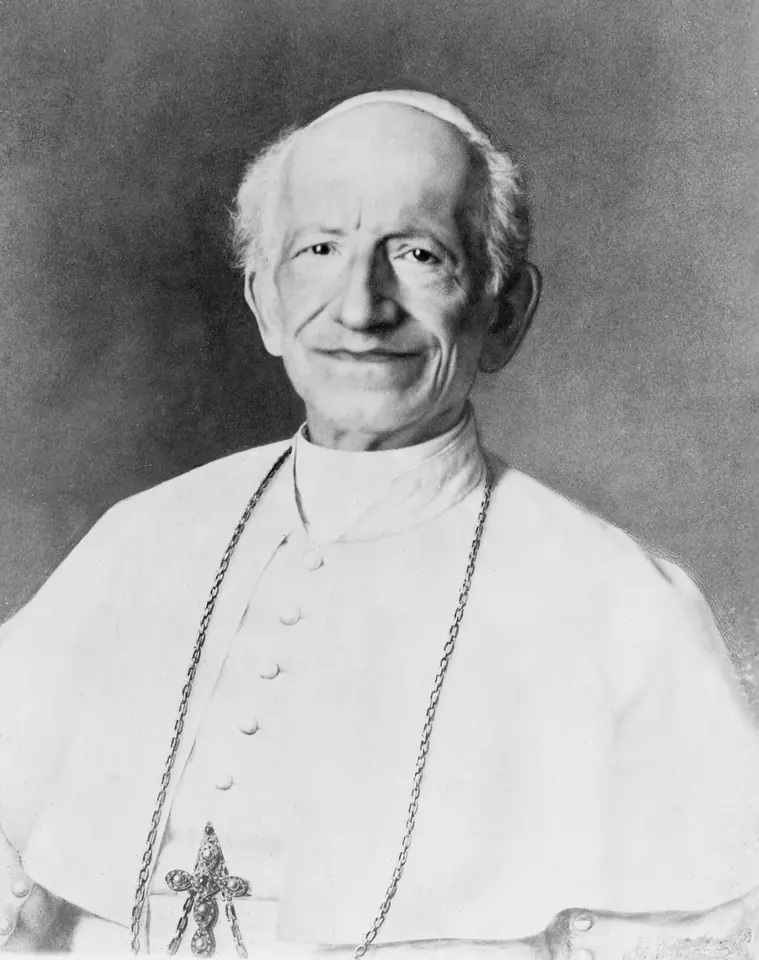
Leo XIII adds the prayer to St. Michael (1886)
In 1886 Leo revised the prayers after Mass and added his new prayer to St. Michael at the end. From then until the 1960s, Catholics around the world heard it after nearly every weekday Mass. In parishes with several Masses a day, that meant the prayer was said in many churches every morning for almost eighty years. It is the reason older Catholics can recite it without thinking.
On June 30, 1930, Pope Pius XI gave the prayers after Mass a new intention. In an allocution to the cardinals, printed in the Acta Apostolicae Sedis, he asked that the prayers Leo XIII had prescribed be said "for Russia," so that tranquility and freedom to profess the faith might be restored to its persecuted people. Many Catholics of that generation remember the prayers after Mass as "the prayers for the conversion of Russia."
The end of the prayers after Mass (1964)
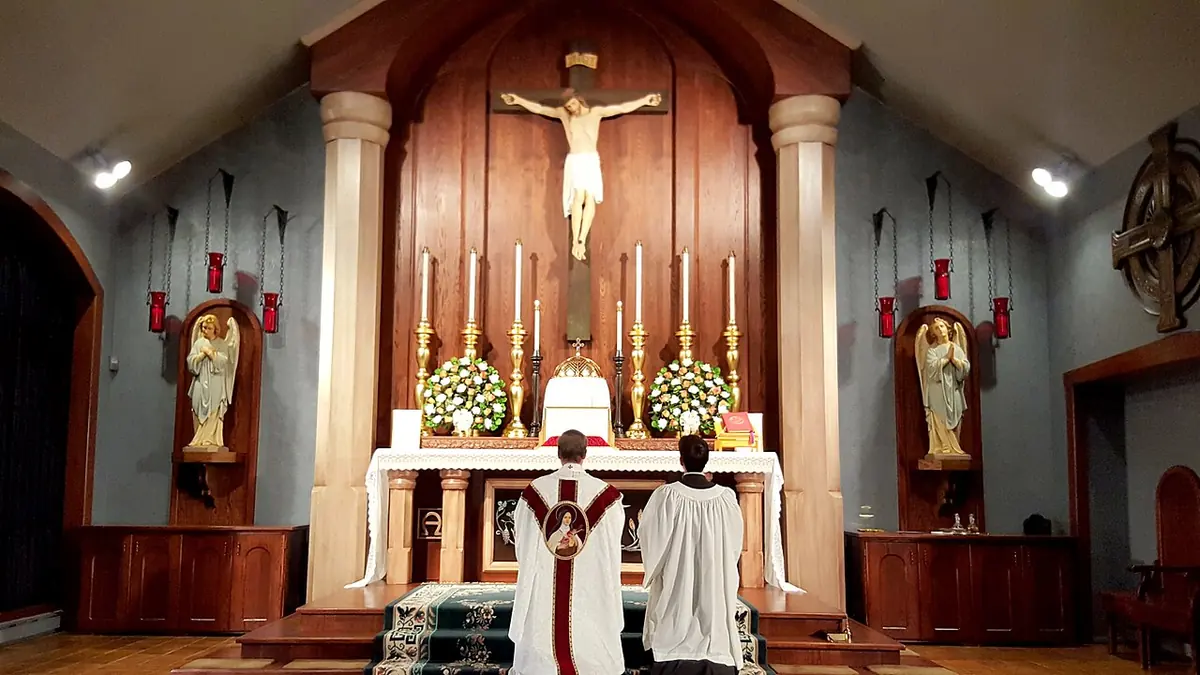
The Vatican's instruction Inter oecumenici, issued on September 26, 1964, to begin carrying out the Second Vatican Council's liturgy constitution, states in article 48 that "the Leonine Prayers are suppressed." The change took effect on March 7, 1965. That ended the obligation to say them after Mass. It did not forbid the prayer itself, and many Catholics kept saying it privately. Communities that celebrate the traditional Latin Mass still say the Leonine Prayers after Low Mass today.
The vision story: what is known and what isn't
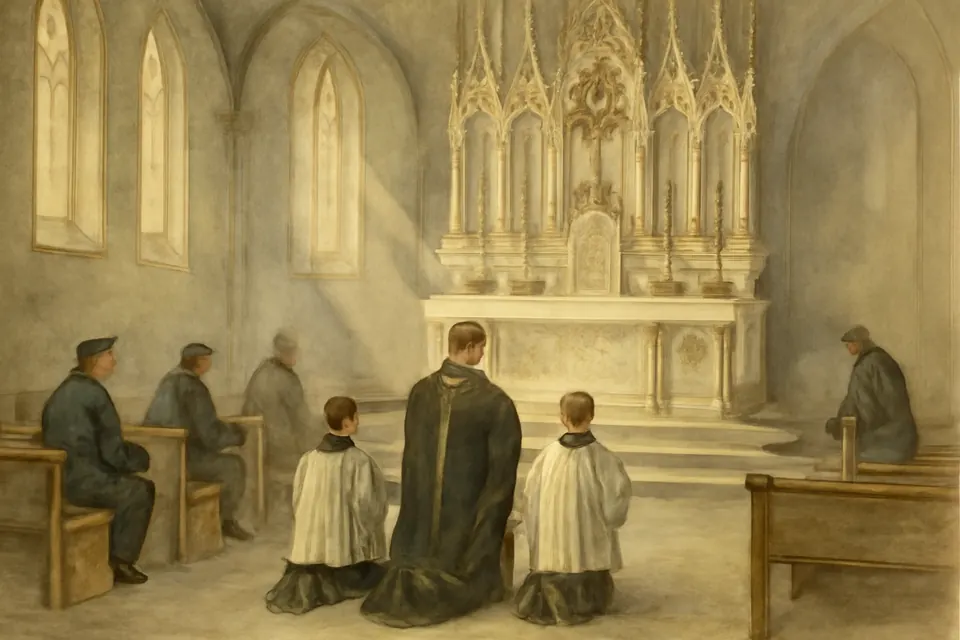
A popular story says that Leo XIII wrote the prayer after a terrifying vision. In the best-known version, the pope froze during or after Mass, heard Satan boast to Christ that he could destroy the Church if given enough time and power, and went straight to his office to write the prayer. Some versions add that Satan asked for a hundred years.
That story is unverified. Here is what the record shows.
- Nothing in Leo's lifetime. No document from Leo XIII (who died in 1903) or from his household mentions a vision.
- First printed in the 1930s. The earliest accounts appeared in German Catholic writing in the early 1930s, about thirty years after his death. According to Andrea Galli's summary in Avvenire, Msgr. Carl Vogl told it in his 1931 book on an exorcism in Earling, Iowa (published in English in 1935 as Begone Satan). In Vogl's version Leo collapses after Mass and sees the devastation of the Church; there is no dialogue between Christ and Satan and no hundred years.
- Later witnesses disagree. In 1946 Cardinal Giovanni Battista Nasalli Rocca, archbishop of Bologna, wrote in a pastoral letter that he had heard Leo's private secretary, Msgr. Rinaldo Angeli, say several times that the pope had seen demonic spirits gathering over Rome. In 1947 Fr. Domenico Pechenino published an account, from an unnamed source, of Leo staring in terror above the altar during Mass. Other writers have dated the event anywhere from the early 1880s to September 25, 1888, which is after the prayer already existed.
The fullest study is Kevin Symonds's book Pope Leo XIII and the Prayer to St. Michael (2015; expanded 2018). Symonds weighed the accounts and concluded that some kind of experience probably did lie behind the prayer, most likely between 1884 and 1886, during Mass. The dialogue between Christ and Satan, though, has no early source and looks like a later embellishment. The prayer's history doesn't depend on any of it: Leo wrote it, and he put it at the end of every Low Mass in the world.
The St. Michael prayer and the 1890 exorcism
People often confuse the short prayer with a much longer text. In 1890 Leo XIII published the Exorcismus in Satanam et angelos apostaticos, an "exorcism against Satan and the apostate angels," which appears in the Acta Sanctae Sedis for 1890–91. After two opening psalms comes a long prayer to Michael that begins Princeps gloriosissime caelestis militiae, sancte Michael Archangele, defende nos in proelio ("Most glorious prince of the heavenly army, St. Michael the Archangel, defend us in battle"), followed by the exorcism formulas themselves. A shortened form was later added to the Roman Ritual.
The two texts share an opening idea and a patron, and that's all. The short prayer is a prayer for everyone. The 1890 text is part of the Church's rite of exorcism. In 1985 the Congregation for the Doctrine of the Faith wrote to bishops that lay people may not use "the formula of exorcism against Satan and the fallen angels" taken from Leo XIII's text, and still less the whole text. The same letter says plainly that this should not discourage anyone from praying to be delivered from evil.

Recent popes and the St. Michael prayer
John Paul II (1994)
At the Regina Caeli on April 24, 1994, John Paul II spoke about the spiritual battle of Ephesians 6 and the image of Michael in Revelation 12:7. Leo XIII, he said, surely had that scene in mind when he introduced "a special prayer to St. Michael" to the whole Church. Then he added (our translation from the Italian): "Even if today this prayer is no longer recited at the end of the Eucharistic celebration, I invite everyone not to forget it, but to recite it to obtain help in the battle against the forces of darkness and against the spirit of this world." You can read more about him in our entry on St. John Paul II.
Francis (2018)
On September 29, 2018, the feast of the archangels, the Holy See Press Office announced that Pope Francis was inviting Catholics everywhere to pray the rosary every day in October, asking "the Holy Mother of God and Saint Michael Archangel to protect the Church from the devil." He asked that each rosary end with the ancient Marian prayer Sub tuum praesidium ("We fly to thy protection, O Holy Mother of God") and with the prayer to St. Michael written by Leo XIII. The communiqué printed the full Latin text given above.
That same autumn, after the clergy abuse reports of 2018, a number of bishops asked their priests to lead the prayer after Mass again. Archbishop Alexander Sample of Portland, Oregon, did so in a letter of September 14, 2018. Fr. Edward McNamara, a liturgy professor in Rome, answered the obvious question in his column that October: because the prayer is said after the final blessing, a bishop's recommendation doesn't break any liturgical rule.
There's a small coincidence in the current pontificate as well. Leo XIV took his name from Leo XIII, and he was elected on May 8, 2025, the day the Church once kept as the feast of St. Michael's apparition on Monte Gargano.
When we pray the St. Michael prayer today
- After Mass. In many parishes the priest and people say it together after the final blessing or after the recessional hymn. It isn't part of the Mass in the Roman Missal, so it comes after Mass has ended. Parishes that celebrate the traditional Latin Mass say it at the end of the Leonine Prayers.
- At the end of the rosary. Since Pope Francis's 2018 request, many families and rosary groups add it after the Hail Holy Queen, often with the Sub tuum praesidium.
- Morning and night. Many people add it to their morning offering or to night prayers, especially in times of temptation, fear or family trouble.
- On his feast. On September 29 (the feast of Sts. Michael, Gabriel and Raphael), and in the nine days before it, many Catholics pray it daily or pray the Chaplet of St. Michael as a novena. See feast days for the calendar.
- For protection. It is the standard prayer to St. Michael for protection: before travel, before surgery, in a dangerous job, or when someone feels spiritually oppressed.

The St. Michael prayer for police and the military
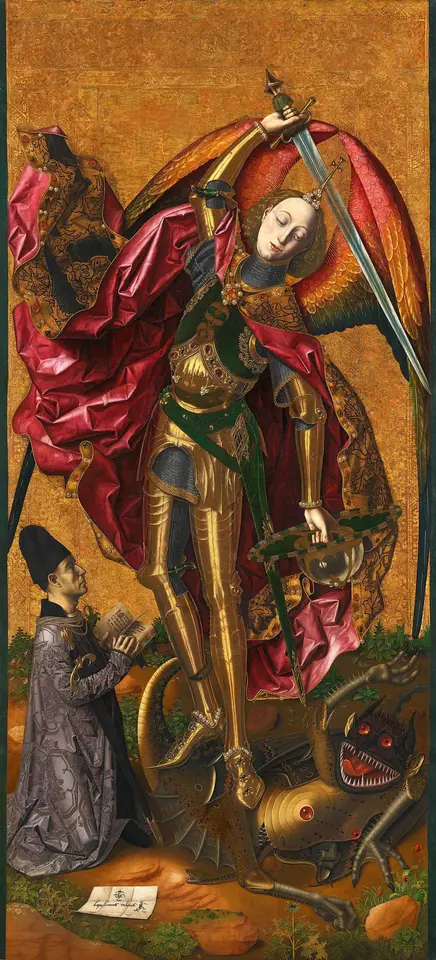
Michael is a soldier in Scripture, and soldiers and police have taken him as their own for centuries. Pope Pius XII named him the patron of police officers. Brussels, whose patron he is, set his gilded statue over a police station on the rue Saint-André. In the United States, police chaplains often close memorial services and graduations with the Leo XIII prayer, and many officers carry a St. Michael medal or a card with the prayer in their uniform pocket. Firefighters and emergency medical crews often do the same.

Paratroopers count him as their patron too. In Vicenza, Italy, soldiers of the U.S. Army's 173rd Airborne Brigade have joined Italian police and paratroopers for St. Michael's Day services on September 29, including one at the Church of Santa Maria dei Servi in 2021.
You'll also find a "Policeman's Prayer to St. Michael," which begins by calling him "heaven's glorious commissioner of police." It's popular on plaques and memorial cards. It is a modern composition, its author hasn't been established, and its copyright status is unclear, so we don't reproduce it here. When police chaplains pray officially, the Leo XIII prayer is the one they use.

Related prayers and saints
The prayer belongs to a small family of devotions to the archangel. The Chaplet of St. Michael salutes the nine choirs of angels on a string of beads. The St. Michael medal shows him in armor over the dragon. On September 29 the Church honors him together with St. Gabriel and St. Raphael, the other two angels named in Scripture.
Several saints are tied to Michael. St. Joan of Arc said he was the first of the voices who spoke to her. St. Gregory the Great is the pope in the legend of the angel sheathing his sword over Castel Sant'Angelo. Another short prayer against evil, the Vade retro Satana ("Begone, Satan"), appears on the St. Benedict medal.

Asking an angel's help
When we pray to St. Michael, we ask him to fight "by the power of God," and we ask God himself to rebuke the enemy, just as Michael did in the Letter of Jude. All the strength is God's; the archangel is his servant and our defender. Let us pray it with confidence, morning and night: St. Michael the Archangel, defend us in battle.
Frequently asked questions
What are the words of the St. Michael prayer?
"St. Michael the Archangel, defend us in battle. Be our defense against the wickedness and snares of the Devil. May God rebuke him, we humbly pray, and do thou, O Prince of the heavenly hosts, by the power of God, thrust into hell Satan, and all the evil spirits, who prowl about the world seeking the ruin of souls. Amen." Many prayer books say "Be our protection" in the second sentence, which is closer to the Latin.
Who wrote the St. Michael prayer?
Pope Leo XIII, who reigned from 1878 to 1903. He added it in 1886 to the prayers that were said kneeling after every Low Mass, which he had extended to the whole Church in 1884. The prayer was composed in Latin, and the English versions are translations.
Did Leo XIII write the prayer after a vision?
That story is unverified. No account of a vision was printed in Leo's lifetime; the first ones appeared in German Catholic writing in the 1930s, and later versions disagree about the date, the place and what he saw. The researcher Kevin Symonds thinks some experience probably lay behind the prayer, but the famous dialogue between Christ and Satan has no early source.
Is the St. Michael prayer an exorcism?
No. The short prayer is an ordinary prayer that anyone can say. Leo XIII also published a long exorcism text in 1890 that includes a longer prayer to St. Michael; that one belongs to the rite of exorcism, and a 1985 Vatican letter says lay people should not use its exorcism formula.
Why don't Catholics say the St. Michael prayer after Mass anymore?
The Vatican's 1964 instruction Inter oecumenici suppressed the Leonine Prayers after Mass, effective in 1965. Nothing forbids praying the St. Michael prayer once Mass has ended, and since 2018 many bishops and pastors have brought it back, usually after the final blessing.
Is there a St. Michael prayer for protection?
The Leo XIII prayer is itself the best-known prayer to St. Michael for protection: it asks him to defend us and be our protection against the devil. The faithful also wear the St. Michael medal and pray the Chaplet of St. Michael for the same intention.
Is there a St. Michael prayer for police officers?
Police officers usually pray the Leo XIII prayer, because Pope Pius XII named St. Michael their patron. A separate "Policeman's Prayer to St. Michael" circulates widely on cards and plaques; it is a modern composition whose author has not been established, so we don't print it here.
Can I pray the St. Michael prayer at the end of the rosary?
Yes. In October 2018 Pope Francis asked Catholics around the world to end each rosary with the Sub tuum praesidium and Leo XIII's prayer to St. Michael, and many families and parish groups have kept the custom.
Sources
- Sacred Congregation of Rites, decree Iam inde ab anno (January 6, 1884), Acta Sanctae Sedis 16, pp. 239-240
- Exorcismus in satanam et angelos apostaticos iussu Leonis XIII editus, Acta Sanctae Sedis 23 (1890-91), p. 743
- The Little Month of November (Boston, 1912), Prayers after Low Mass, pp. 29-31, Internet Archive
- The Irish Ecclesiastical Record, vol. 17 (January to June 1905), Notes and Queries, two versions of the Prayer after Mass, pp. 93-94
- Pius XI, allocution of June 30, 1930, Acta Apostolicae Sedis 22, p. 301 (the prayers after Mass offered for Russia)
- Andrea Galli, Il mistero della visione di Leone XIII e l'invocazione a san Michele arcangelo, Avvenire. Summarizes Kevin Symonds, Pope Leo XIII and the Prayer to St. Michael (2015; expanded 2018)
- Vatican News: Pope Francis invites the faithful to pray the Rosary in October (Holy See Press Office communiqué, September 29, 2018)
- Congregation for the Doctrine of the Faith, Letter to Ordinaries regarding norms on Exorcism (September 29, 1985)