St. Michael the Archangel
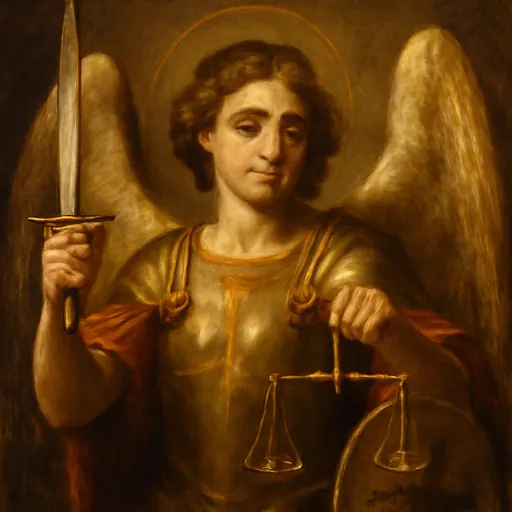
St. Michael the Archangel is the angel whom the Bible names as the great prince who protects God's people and leads the heavenly armies against Satan (Daniel 12, Jude 9, Revelation 12). His name means "Who is like God?" His feast day is September 29, which he shares with Gabriel and Raphael. Christians ask his protection against evil, and he is the patron saint of police officers, soldiers, the sick and the dying.
Who is St. Michael the Archangel?
Michael is one of only three angels whom the Bible calls by name, along with Gabriel and Raphael. He appears in the Book of Daniel as the great prince who stands guard over God's people, in the Letter of Jude as an archangel arguing with the devil, and in the Book of Revelation as the leader of the angels who throw the dragon out of heaven. Christians have honored him since the first centuries, Jews remember him as Israel's guardian, and the Qur'an mentions him by name as Mikail.
His name is a question in Hebrew: Mi-ka-El, "Who is like God?" Tradition hears in it a battle cry. When the proud angels rebelled, the answer to Michael's question was obvious: no one is like God. Painters often letter the Latin form, Quis ut Deus, on his shield.
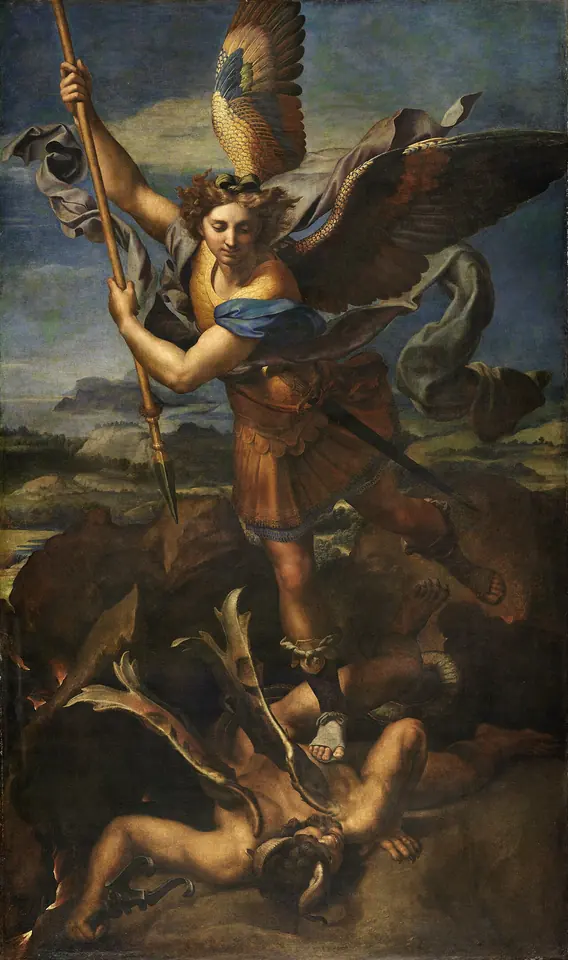

The Catholic Encyclopedia sums up the four tasks that Christian tradition gives him. He fights against Satan. He rescues the faithful from the power of the enemy, especially at the hour of death. He is the champion of God's people, first Israel and then the Church. And he brings the souls of the dead to judgment. Almost everything Christians do in his honor goes back to one of those four.
Why an angel is called a saint
Michael was never born and never died, so he doesn't fit the usual picture of a saint as a holy man or woman who lived on earth. The word "saint" simply means holy, though, and the Bible calls the faithful angels holy (Mark 8:38, Revelation 14:10). The Church has honored Michael by name since antiquity, so he never needed to be canonized; canonization is a process for human beings. The Catholic and Orthodox churches give the title of saint to only three angels, the three named in Scripture.
The Catechism of the Catholic Church quotes St. Augustine to explain what an angel is: "'Angel' is the name of their office, not of their nature. If you seek the name of their nature, it is 'spirit'; if you seek the name of their office, it is 'angel.'" An archangel is a chief angel. Michael is the only angel whom Scripture names as an archangel (Jude 9).
St. Michael in the Bible
All four biblical passages that name Michael put him in the middle of a conflict.
- Daniel 10:13 and 10:21. An angel who appears to the prophet Daniel says he was held up for twenty-one days by "the prince of the kingdom of Persia," until "Michael, one of the chief princes, came to help me."
- Daniel 12:1. At the end of time, "shall Michael stand up, the great prince which standeth for the children of thy people" (King James Version). This verse is the root of his role as protector of God's people.
- Jude 9. "Michael the archangel, when contending with the devil he disputed about the body of Moses, durst not bring against him a railing accusation, but said, The Lord rebuke thee." Jude is drawing on a Jewish tradition about Moses' burial that is not in the Old Testament.
- Revelation 12:7–9. "And there was war in heaven: Michael and his angels fought against the dragon." The dragon, "that old serpent, called the Devil, and Satan," is thrown down to the earth with his angels.
Notice Michael's words in Jude: not his own rebuke, but "The Lord rebuke thee." The St. Michael prayer echoes that phrase ("May God rebuke him, we humbly pray").
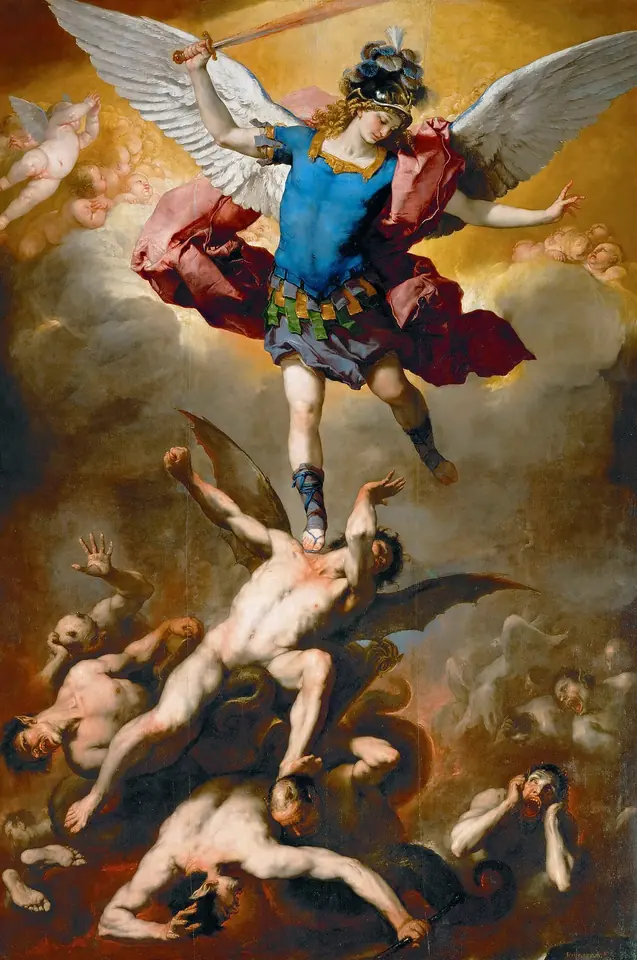

The Church Fathers also saw Michael in passages where an angel acts without being named: the angel who guards Eden with a flaming sword, the commander of the Lord's army who meets Joshua before Jericho (Joshua 5:13–15), and the angel who destroys the Assyrian army besieging Jerusalem (2 Kings 19:35). The Orthodox life of the archangel adds the pillar of cloud and fire in the Exodus. These identifications are tradition, not statements of the biblical text.
The apparitions of St. Michael
Christians have told of Michael's appearances on earth since late antiquity. Each of the great stories below is traditional: the Church honors the shrines that grew out of them, but none of the apparitions has been investigated or formally approved as a modern apparition would be.
Chonae, in Phrygia
The oldest center of Michael's cult was in Phrygia, in present-day Turkey, around Colossae and Chonae. Here he was honored first as a healer. The Catholic Encyclopedia reports the tradition that he made a healing spring flow nearby, and that when pagans tried to destroy his church by turning a river against it, Michael split the rock with a stroke of lightning and sent the water underground. The Greek churches keep this miracle on September 6. The guardian of the church in the story is the hermit Archippus, who stands at the door in the Sinai icon below.


Monte Gargano, Italy (late 5th century)
The Sanctuary of St. Michael at Monte Sant'Angelo, on the Gargano peninsula in Apulia, is a cave church. Its story comes from the Liber de apparitione Sancti Michaelis in Monte Gargano, a short work written sometime between the 5th and 8th centuries. A wealthy man named Gargano lost a bull, found it at the mouth of a cave on the mountain, and shot a poisoned arrow at it in anger. The wind turned the arrow back and it struck him instead. The bishop of nearby Siponto, Lawrence, ordered three days of prayer and fasting. Then Michael appeared to him, said the cave was sacred to him, and promised: "Where the rock opens, the sins of men can be forgiven."
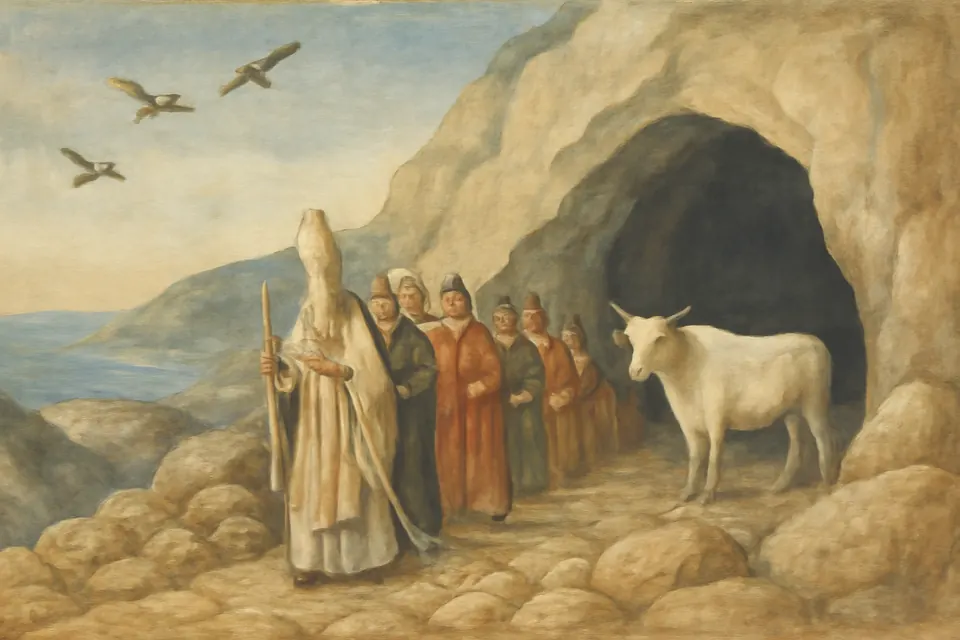
The sanctuary counts three more apparitions. In the second, dated by tradition to 492, Michael promised the people of Siponto victory over their enemies; historians link the episode to a battle between the Lombards and the Byzantines in 662 or 663, won on May 8. In the third, in 493, Michael told the bishop that he himself had consecrated the cave, and the bishops found an altar already there. The fourth came in 1656, during a plague, when the archbishop said Michael told him to bless stones from the cave and mark them with a cross and the letters M.A. The city was spared, and a monument in the town square still thanks the "Prince of the Angels, Victor over the Plague."
The Lombards, who ruled much of Italy in those centuries, took Michael as their own patron and made Gargano one of the great pilgrim shrines of medieval Europe. UNESCO lists the sanctuary as part of its "Longobards in Italy" World Heritage site and calls it "a forerunner venue for the great pilgrimages."


Mont-Saint-Michel, France (708)
In 708, tradition says, Michael appeared in a dream to St. Aubert, bishop of Avranches in Normandy, and told him to build a church on a rocky island in the bay. Aubert hesitated, and Michael came back a second and a third time. The last time, the story goes, the archangel pressed his finger to the bishop's head. A skull with a hole in it, venerated as Aubert's, is kept in the Basilica of Saint-Gervais in Avranches.
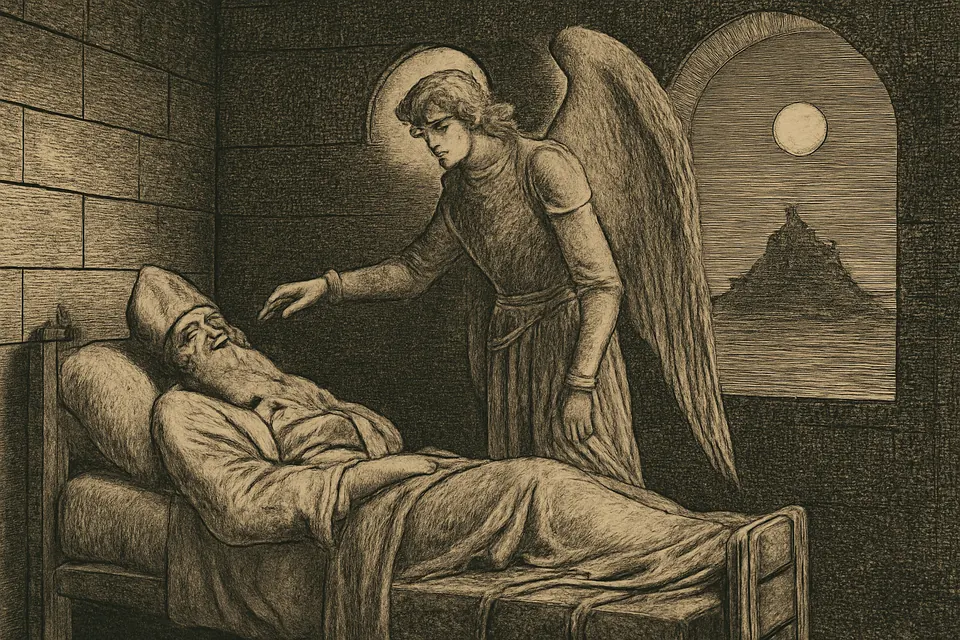
Benedictine monks founded the abbey in 966, on the site of the sanctuary that had been dedicated to the archangel since 708, according to UNESCO, which lists Mont-Saint-Michel and its bay as a World Heritage site. The Gothic abbey, built between the 11th and 16th centuries, is called the "Wonder of the West." The island held out against the English through the Hundred Years' War, and Michael came to be honored as a protector of France. A gilded statue of the archangel by Emmanuel Frémiet has stood on the top of the abbey spire since 1897.


Castel Sant'Angelo, Rome (590)
In 590 Rome was struck by plague, and the newly elected pope, St. Gregory the Great, led a penitential procession through the city. A legend that the Catholic Encyclopedia dates to the 10th century (and marks as possibly apocryphal) says that as the procession passed the great round tomb of the emperor Hadrian, Gregory saw Michael standing above it, sliding his sword back into its sheath. The plague ended. The tomb, by then a fortress, has been called Castel Sant'Angelo, the Castle of the Holy Angel, ever since.
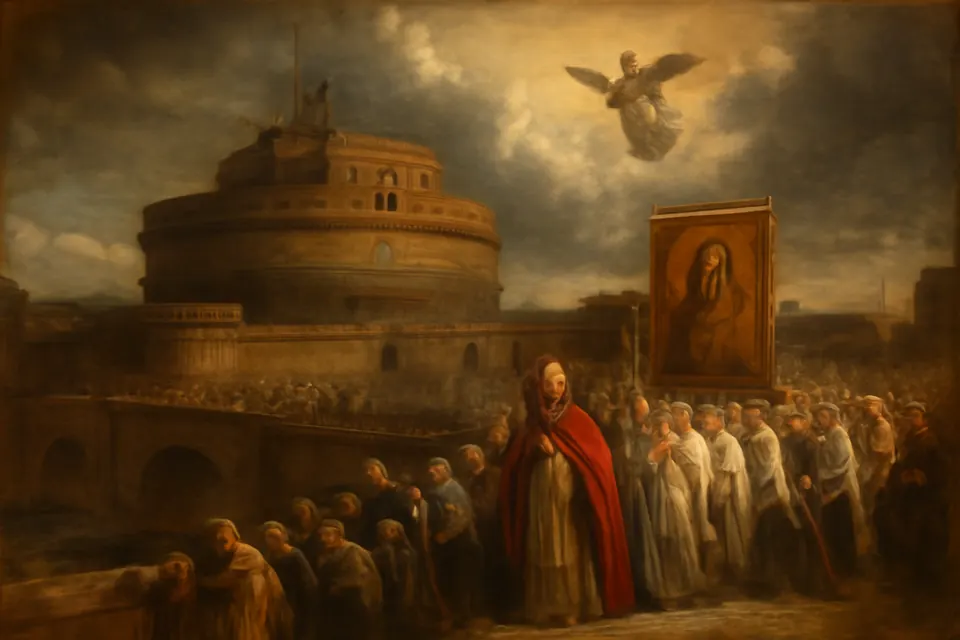
The bronze angel on the summit today is the work of the Flemish sculptor Peter Anton von Verschaffelt, put up in 1753. It replaced a marble angel by Raffaello da Montelupo, which now stands in one of the castle's courtyards.


St. Joan of Arc
Michael also has a place in the story of St. Joan of Arc. At her trial in 1431, Joan testified that the first of the voices she heard, when she was about thirteen, was St. Michael's, and that Sts. Catherine and Margaret came after. Joan was canonized in 1920, but the Church has never ruled on the voices themselves; they are best described as reported.
The miracles of St. Michael
Since Michael is not a human saint, there are no canonization miracles credited to him. The stories told about him sort into this encyclopedia's labels as follows:
- The war in heaven and the dispute over Moses: from Scripture, which Christians receive as revealed, not as a miracle claim to be judged.
- Chonae, Monte Gargano, Mont-Saint-Michel and Castel Sant'Angelo: traditional.
- The deliverance of Monte Sant'Angelo from the plague in 1656: traditional, recorded by the archbishop who reported the vision.
- Healings and protection through his intercession today: reported. Catholics and Orthodox Christians tell many such stories, and the shrines keep records of them, but none has been formally investigated.
Why St. Michael is the patron saint of police, soldiers, the sick and the dying
Each patronage grows out of one of the four tasks tradition gives him. You can browse all of these on our patron saints page.
- Soldiers. Michael leads the armies of heaven, and the Lombards, the Normans and medieval knightly orders took him as their patron. The Greek liturgy calls him Archistrategos, the "chief commander."
- Police officers. Pope Pius XII proclaimed St. Michael patron of the police on September 29, 1949. The Italian State Police and the Vatican Gendarmerie still keep his feast as their own, and many American police officers carry his medal.
- The sick. This is his oldest patronage. The Catholic Encyclopedia notes that early Christians gave their military patronages to martyrs such as St. George, but "to St. Michael they gave the care of their sick." At his shrine near Constantinople the sick slept in the church at night, hoping he would come to them.
- The dying. Christians have long asked Michael to defend them at the hour of death and to lead their souls to God. The old Latin Requiem Mass asks that "the standard-bearer St. Michael" bring the souls of the faithful departed "into the holy light."
- Sailors. At Mont-Saint-Michel, which the tide used to cut off from the land twice a day, he became the patron of mariners.
Symbols of St. Michael in art
Michael is one of the easiest figures to recognize in a church or a museum. Western art almost always shows him as a young, beardless man with large wings. Look for these attributes:
- Armor and a sword or lance: the commander of the heavenly army. In Raphael and Guido Reni he wears Roman-style armor.
- A dragon or devil under his feet: Satan defeated, from Revelation 12. In older art the enemy is a dragon; from the Renaissance on, often a fallen angel in human form.
- Scales: his role at the Last Judgment, weighing souls. This attribute comes from tradition, not from the Bible.
- A shield marked Quis ut Deus: the meaning of his name.
- A banner with a cross: victory, often in older Western and Eastern images.


Eastern icons show him differently. In a Byzantine or Russian icon Michael usually stands or appears half-length, calm and youthful, in the court dress of an imperial officer, with a staff in one hand and a clear sphere (a "mirror") marked with a cross or Christ's initials in the other, a sign that he sees God's will. Icons that show him in action, with a sword and armor, call him the Archistrategos.


The most copied image of Michael in the Western world is Guido Reni's altarpiece in the Capuchin church of Santa Maria della Concezione in Rome, painted around 1635. Reni shows the archangel setting his foot on Satan's head with almost no effort, sword raised and face untroubled. Countless holy cards, statues and medals follow its pose.


The St. Michael medal
A St. Michael medal usually shows the archangel in armor with a sword or lance, standing over Satan or a dragon. The reverse often carries a prayer such as "St. Michael, protect us" or the words "Quis ut Deus." The 19th-century French medal pictured here reads "St. Michel, protecteur de la France," the title France has given him since the days of Mont-Saint-Michel's long resistance.


Catholics treat a medal as a sacramental: a blessed object that helps prayer, not a charm that works on its own. Police officers, soldiers, firefighters and paramedics often wear one, and many Catholics hang one in the car or give one at a confirmation.
Feast day and customs
The Catholic feast is September 29. For centuries it was Michael's day alone, and in England it was called Michaelmas, one of the four "quarter days" when rents were paid and accounts were settled. Universities in England still call their autumn term the Michaelmas term. The 1969 reform of the Roman calendar moved Gabriel's feast (formerly March 24) and Raphael's (formerly October 24) to the same day, so September 29 is now the Feast of Sts. Michael, Gabriel and Raphael, Archangels. The Catholic Encyclopedia explains that the date began as the anniversary of a basilica of St. Michael on the Via Salaria outside Rome, recorded in the early Roman sacramentaries.
The Latin Church also kept May 8, the Apparition of St. Michael, from the victory at Gargano. In the East, the main feast is November 8, the Synaxis of the Archangel Michael and the Other Bodiless Powers. The Orthodox Church in America explains that November was chosen as the ninth month counting from March, for the nine ranks of angels, and the eighth day for the "eighth day" of the world to come. Our feast days page lists his feast with the other saints of the season.
Anglicans and Lutherans keep September 29 too, as the Feast of St. Michael and All Angels, and many of their parish churches carry the name.
The St. Michael prayer
Pope Leo XIII introduced the Leonine Prayers in 1884, to be said after every Low Mass for the needs of the Church; he added the Prayer to St. Michael in 1886. This is the version most English-speaking Catholics know, as printed by EWTN:
St. Michael the Archangel, defend us in battle. Be our defense against the wickedness and snares of the Devil. May God rebuke him, we humbly pray, and do thou, O Prince of the heavenly hosts, by the power of God, thrust into hell Satan, and all the evil spirits, who prowl about the world seeking the ruin of souls. Amen.
Many prayer books say "Be our protection" in the second line, which is closer to the Latin original:
Sancte Michael Archangele, defende nos in proelio; contra nequitiam et insidias diaboli esto praesidium. Imperet illi Deus, supplices deprecamur: tuque, Princeps militiae caelestis, Satanam aliosque spiritus malignos, qui ad perditionem animarum pervagantur in mundo, divina virtute in infernum detrude. Amen.
History of the prayer, and the vision story
The Leonine Prayers were said after Low Mass all over the Catholic world until the instruction Inter oecumenici of 1964 dropped them, effective in 1965. Catholics remained free to pray them privately. On April 24, 1994, Pope John Paul II recalled that Leo XIII had introduced "a special prayer to St. Michael" and asked everyone not to forget it but to pray it "to obtain help in the battle against the forces of darkness" (our translation from the Italian). In 2018 Pope Francis asked Catholics to pray the rosary every day in October and to end it with the Sub tuum praesidium and Leo XIII's prayer to St. Michael.
A popular story says that Leo XIII wrote the prayer after a frightening vision during or after Mass, in which he heard Satan claim that he could destroy the Church. That story is unverified. No account of it was published in Leo's lifetime. The earliest printed versions date from the 1930s and 1940s; they disagree about the year (dates given range from the early 1880s to 1888) and about what Leo saw. Kevin Symonds, author of the book-length study Pope Leo XIII and the Prayer to St. Michael (2015), places the experience, if it happened, between 1884 and 1886, and Aleteia's summary of his work treats the dialogue between Christ and Satan as a later embellishment. The prayer's history doesn't depend on the story.
Leo XIII also issued a much longer exorcism prayer in 1890, which includes a long invocation of St. Michael. That text belongs to the rite of exorcism. The short prayer above is the one meant for everyone.
The Chaplet of St. Michael and the novena
The Chaplet of St. Michael, sometimes called the Angelic Crown, is prayed on a string of beads. It has nine salutations, one for each of the nine choirs of angels (Seraphim, Cherubim, Thrones, Dominations, Powers, Virtues, Principalities, Archangels and Angels), each followed by one Our Father and three Hail Marys, then four Our Fathers in honor of Michael, Gabriel, Raphael and one's guardian angel. EWTN traces it to the Servant of God Antonia d'Astonac, who said Michael asked her to honor him with nine salutations. Devotional histories date her vision to 1751 and say Pope Pius IX approved and indulgenced the chaplet in 1851.
There is no single official St. Michael novena. Many Catholics pray the chaplet or the St. Michael prayer for nine days before his feast, from September 20 to 28. The collect of the September 29 Mass, from the Roman Missal, is a fitting close:
O God, who dispose in marvelous order ministries both angelic and human, graciously grant that our life on earth may be defended by those who watch over us as they minister perpetually to you in heaven. Through our Lord Jesus Christ, your Son, who lives and reigns with you in the unity of the Holy Spirit, God, for ever and ever.
The Orthodox Church sings this troparion on November 8: "Commanders of the heavenly hosts, we who are unworthy beseech you, by your prayers encompass us beneath the wings of your immaterial glory, and faithfully preserve us who fall down and cry to you: Deliver us from all harm, for you are the commanders of the powers on high!"
Frequently asked questions
What is the St. Michael prayer?
It is the short prayer that begins "St. Michael the Archangel, defend us in battle." Pope Leo XIII added it in 1886 to the Leonine Prayers that were said after Low Mass. The custom of saying it after Mass ended in 1964, but popes since then, including John Paul II in 1994 and Francis in 2018, have asked Catholics to keep praying it. The full text is in the prayer section above.
Is it true that Leo XIII wrote the prayer after a vision?
The story is popular but unverified. No document from Leo XIII's own time mentions a vision. The first printed versions appeared in the 1930s and 1940s, decades after his death, and they disagree about the date and the details. The prayer itself is certainly his, and it was certainly added to the prayers after Mass in 1886.
When is St. Michael's feast day?
September 29 in the Catholic Church, which since 1969 has honored Michael, Gabriel and Raphael together on that day. In English-speaking countries it was long called Michaelmas. The Orthodox churches keep his main feast, the Synaxis of the Archangel Michael and the Bodiless Powers, on November 8.
Why is an angel called a saint?
"Saint" means holy. Scripture calls the angels who stayed faithful to God holy, and the Church has honored Michael, Gabriel and Raphael by name since the early centuries. They were never canonized, because canonization is for human beings who lived and died on earth, but the Church gives them the title of saint and keeps their feast.
What is St. Michael the patron saint of?
Police officers (Pope Pius XII named him their patron in 1949), soldiers, the sick, the dying, sailors in Normandy, and the Church as a whole. Many people also ask his help against temptation and evil of every kind.
What does the St. Michael medal mean?
The medal usually shows Michael in armor with a sword or lance, standing on Satan or a dragon, often with the words "St. Michael protect us." Catholics wear it as a sign that they trust in God's protection and ask Michael's prayers. Police officers, soldiers and firefighters often carry one. A medal is a sacramental, not a charm.
Is there a St. Michael novena or chaplet?
The best-known devotion besides the prayer is the Chaplet of St. Michael, nine salutations to the nine choirs of angels. Devotional histories trace it to a vision of the Servant of God Antonia d'Astonac, described as a Portuguese Carmelite nun, and say Pope Pius IX approved and indulgenced it in 1851. For a novena, many Catholics pray the chaplet or the St. Michael prayer for nine days, often from September 20 to 28.
Was St. Michael at Mont-Saint-Michel?
Tradition holds that in 708 Michael appeared to St. Aubert, bishop of Avranches, and told him to build a church on the rocky island then called Mont Tombe. The story is traditional. The Benedictine abbey on the island was founded in 966, and it has been a place of pilgrimage to St. Michael ever since.
Sources
- Catholic Encyclopedia (1911): St. Michael the Archangel
- Catechism of the Catholic Church, paragraphs 328–336: The Angels
- Vatican News: Pope Francis invites the faithful to pray the Rosary in October (2018)
- Pope John Paul II, Regina Coeli, April 24, 1994 (Italian)
- EWTN: Prayer to St. Michael the Archangel
- EWTN: St. Michael the Archangel (the Chaplet of St. Michael)
- Aleteia: History of the St. Michael Prayer
- Kevin Symonds, Pope Leo XIII and the Prayer to St. Michael (2015)
- Basilica Santuario San Michele, Monte Sant'Angelo: Le quattro apparizioni
- UNESCO World Heritage List: Mont-Saint-Michel and its Bay
- UNESCO World Heritage List: Longobards in Italy. Places of the Power (568-774 A.D.)
- Orthodox Church in America: Synaxis of the Archangel Michael and the Other Bodiless Powers
- Catholic Culture: Feast of Sts. Michael, Gabriel and Raphael, Archangels
- Roman Martyrology, September 29