Chaplet of St. Michael

The Chaplet of St. Michael is a string of prayers in honor of the archangel and the nine choirs of angels: nine salutations, each with one Our Father and three Hail Marys, then four Our Fathers and a closing prayer. Pius IX indulgenced it in 1851, and many Catholics pray it as a St. Michael novena from September 20 to 28.
The Chaplet of St. Michael is older than most people who pray it realize, and its prayers are lovelier than the plain instructions on the back of a chaplet box suggest. Below is the complete text as printed in an American Catholic prayer book of 1878, with the steps for praying it on the beads.
The Chaplet of St. Michael prayers
This text comes from The Raccolta, the Church's official collection of indulgenced prayers, in the English translation published at Woodstock College, Maryland, in 1878. There the chaplet is called the "Angelical Crown in Honor of S. Michael the Archangel." Its spelling and wording are kept as printed.
V. Incline unto my aid, O God. R. O Lord, make haste to help me. Glory be to the Father, etc.
First salutation. One Our Father and three Hail Marys, to the first angelic choir:
By the intercession of S. Michael and the heavenly choir of the Seraphim, may it please God to make us worthy to receive into our hearts the fire of his perfect charity. Amen.
Second salutation. One Our Father and three Hail Marys, to the second choir:
By the intercession of S. Michael and the heavenly choir of the Cherubim, may God, in his good pleasure, grant us grace to abandon the ways of sin, and follow the path of Christian perfection. Amen.
Third salutation.
By the intercession of S. Michael and the sacred choir of the Thrones, may it please God to infuse into our hearts the spirit of true and sincere humility. Amen.
Fourth salutation.
By the intercession of S. Michael and the heavenly choir of the Dominations, may it please God to grant us grace to have dominion over our senses, and to correct our depraved passions. Amen.
Fifth salutation.
By the intercession of S. Michael and the heavenly choir of the Powers, may God vouchsafe to keep our souls from the wiles and temptations of the devil. Amen.
Sixth salutation.
By the intercession of S. Michael and the choir of the admirable heavenly Virtues, may it please God to keep us from falling into temptation, and may he deliver us from evil. Amen.
Seventh salutation.
By the intercession of S. Michael and the heavenly choir of the Principalities, may it please God to fill our souls with the spirit of true and sincere obedience. Amen.
Eighth salutation.
By the intercession of S. Michael and the heavenly choir of Archangels, may it please God to grant us the gift of perseverance in the faith and in all good works, that we may thereby be enabled to attain the glory of paradise. Amen.
Ninth salutation.
By the intercession of S. Michael and the heavenly choir of all the angels, may God vouchsafe to grant us their guardianship through this mortal life, and after death a happy entrance into the everlasting glory of heaven. Amen.
Then say the Our Father four times: the first to St. Michael, the second to St. Gabriel, the third to St. Raphael, and the fourth to your guardian angel. The chaplet ends with this anthem and prayer:
Michael, glorious prince, chief and champion of the heavenly host, guardian of the souls of men, conqueror of the rebel angels, steward of the palace of God under Jesus Christ, our worthy leader, endowed with superhuman excellence and virtue: vouchsafe to free us all from every ill, who with full confidence have recourse to thee; and by thy incomparable protection enable us to make progress every day in the faithful service of our God. V. Pray for us, most blessed Michael, prince of the Church of Jesus Christ. R. That we may be made worthy of his promises.
Let us pray. Almighty and eternal God, who in thine own marvellous goodness and pity didst, for the common salvation of man, choose the glorious archangel Michael to be the prince of thy Church: make us worthy, we pray thee, to be delivered by his beneficent protection from all our enemies, that, at the hour of our death, none of them may approach to harm us; rather do thou vouchsafe unto us that, by the same archangel Michael, we may be introduced into the presence of thy most high and divine majesty. Through the merits of the same Jesus Christ our Lord. Amen.
Modern booklets often add an act of contrition at the start and update the language ("O God, come to my assistance"). The structure is the same everywhere.
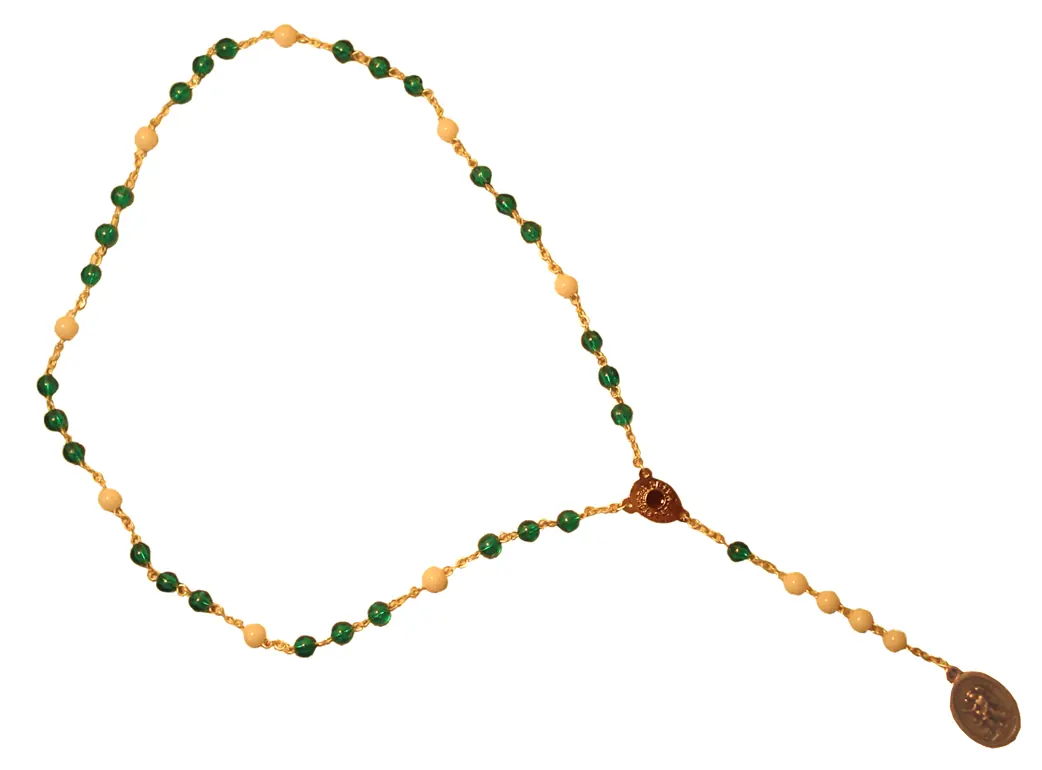
How to pray the Chaplet of St. Michael, bead by bead
A St. Michael chaplet usually has 41 beads and a medal of the archangel. The Raccolta describes the chaplet needed for the indulgences in the same terms: nine Our Fathers, each followed by three Hail Marys, and four Our Fathers at the end.
- Hold the medal and begin with "Incline unto my aid, O God" (or "O God, come to my assistance"), "O Lord, make haste to help me," and the Glory Be. Many people make an act of contrition first.
- On the first large bead, say the first salutation (the Seraphim) and an Our Father.
- On the three small beads that follow, say three Hail Marys.
- Repeat for the other eight groups, moving down the choirs: Cherubim, Thrones, Dominations, Powers, Virtues, Principalities, Archangels, Angels.
- On the four beads by the medal, say four Our Fathers: to St. Michael, St. Gabriel, St. Raphael and your guardian angel.
- Holding the medal again, say the anthem "Michael, glorious prince," the versicle and response, and the closing prayer.
The whole chaplet takes fifteen to twenty minutes. If you don't have the beads, you can count on your fingers or use an ordinary rosary, taking one decade for each choir's large bead and three of its small ones.
The nine choirs of angels
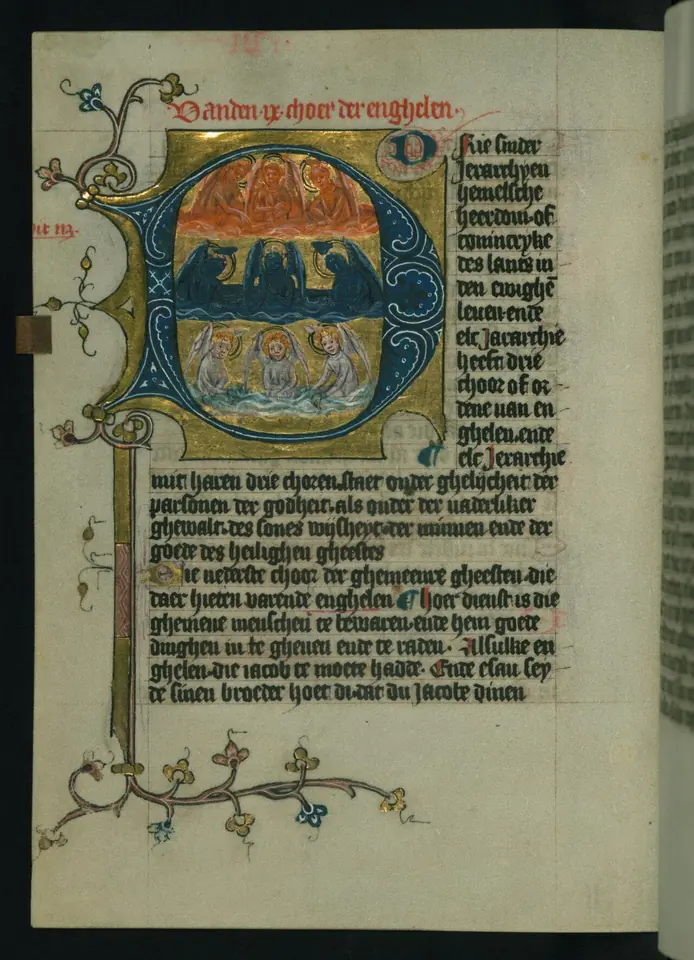
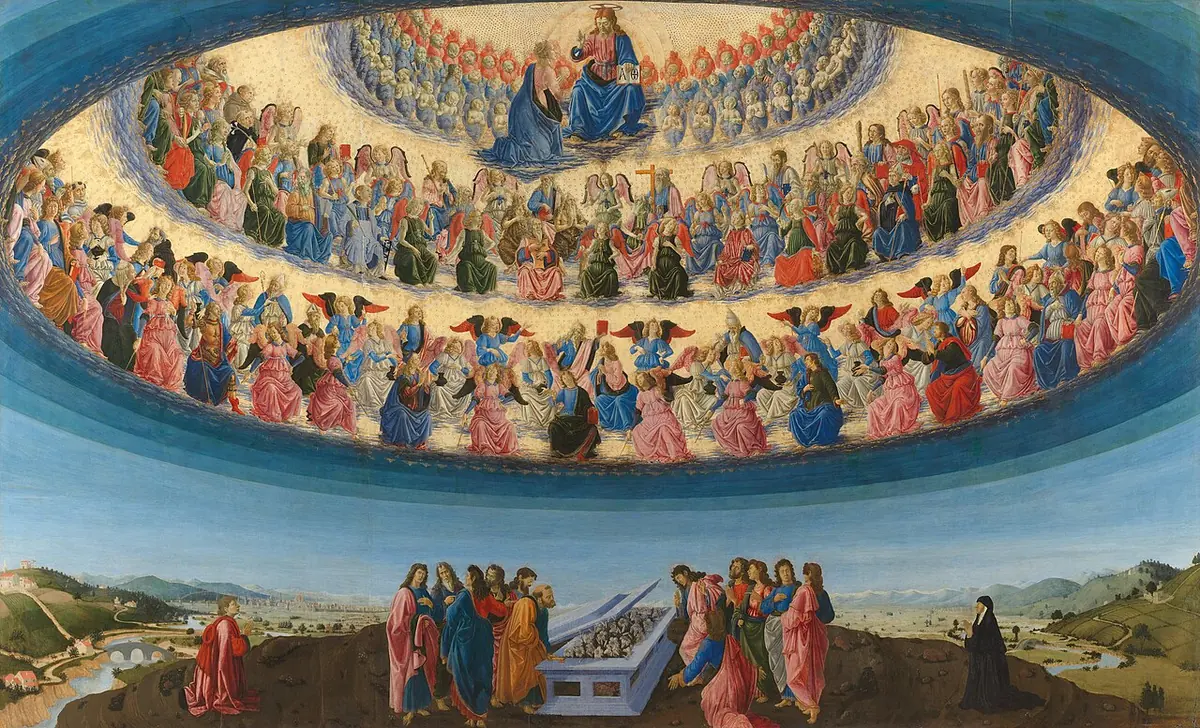
Each salutation names one of the nine choirs, so the chaplet is a small lesson in what Christian tradition taught about the angels. The names come from Scripture. Isaiah sees the seraphim around God's throne (Isaiah 6:2). Cherubim guard the way to the tree of life (Genesis 3:24). St. Paul names thrones, dominations, principalities and powers (Colossians 1:16), adds virtues in the Latin and Douay-Rheims reading of Ephesians 1:21, and speaks of "the voice of an archangel" (1 Thessalonians 4:16). Angels appear everywhere in both Testaments.
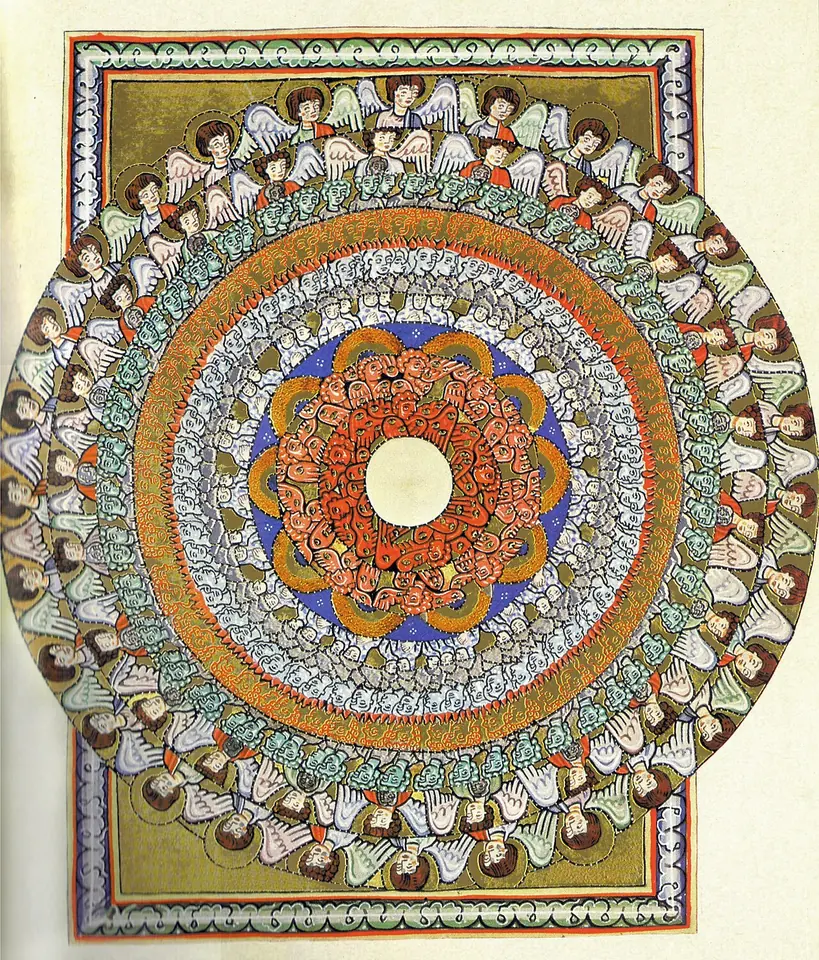
Arranging the nine into three ranks of three goes back to a Greek writer of about 500 known as Pseudo-Dionysius, whose Celestial Hierarchy St. Gregory the Great and St. Thomas Aquinas took up. The Catholic Encyclopedia says this teaching "has been received in the Church with extraordinary unanimity," yet "no proposition touching the angelic hierarchies is binding on our faith." Authors don't even agree on the order of the middle ranks. Aquinas, following Dionysius, puts the Virtues before the Powers; the chaplet puts the Powers first.

Each salutation asks for a virtue that fits its choir. The Seraphim, whose name suggests burning, are asked for "the fire of his perfect charity." The Thrones, who carry God's presence, are asked for humility. The Powers, traditionally the guards against demons, are asked to keep us from "the wiles and temptations of the devil." The Archangels, messengers of the most important news, are asked for perseverance, and the Angels, closest to human beings, for their guardianship in life and at death.
Where the chaplet comes from
Antonia d'Astonac and the vision
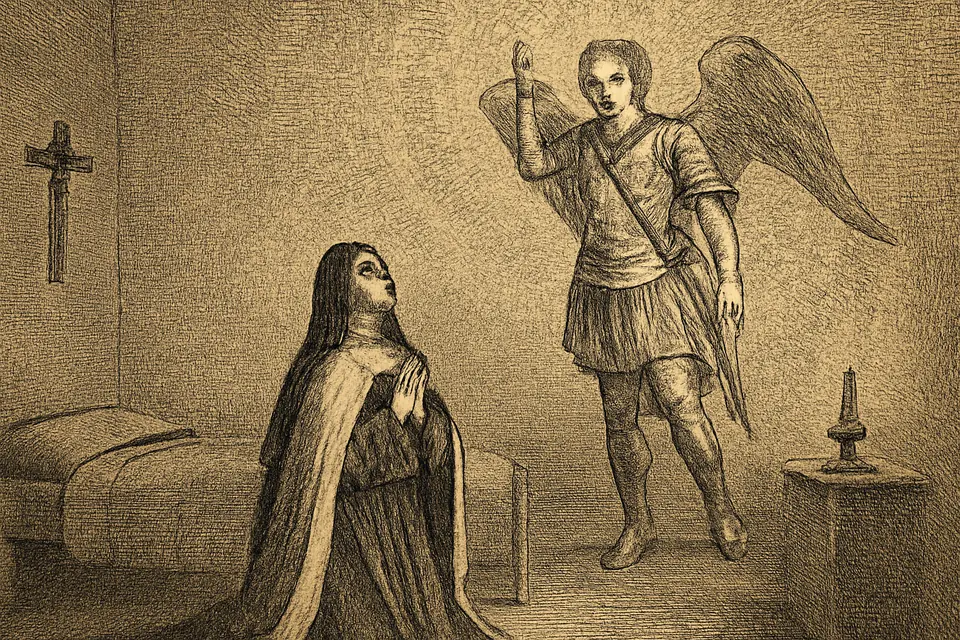
Every account of the chaplet's origin goes back to one name: Antonia d'Astonac. According to Le Précieux sang et les saints anges, a French devotional book printed in 1893, Michael appeared in 1751 to "an illustrious servant of God, Antonia d'Astonac, a Carmelite in Portugal," and told her he wished to be honored with nine salutations corresponding to the nine choirs of angels, each with one Our Father and three Hail Marys, followed by four Our Fathers. The book cites a Life of her, book 2, chapter 14, which we have not been able to find.
The trail gets fainter the further back it goes. The earliest account we found, in the Roman journal Analecta juris pontificii around 1860, says only that the devotion "was revealed, it is said, to a Portuguese nun named Antonia d'Astonac." It adds that a Carmelite nun who died in the odor of sanctity at Vetralla, near Viterbo in Italy, in 1701 had loved this practice all her life, and that her monastery had kept it ever since. In 1880 a reader of the French review Polybiblion asked where to find a life of "Blessed Antonia d'Astonac," whom he placed at the Carmelite monastery of Vetralla, dying around 1750. So the sources can't agree whether she was Portuguese or Italian, or when she lived. Modern websites call her a Servant of God, but we found no record of a cause for her beatification. Her vision is a private revelation, and it is labeled on this site as traditional.
The promises
The 1893 book also reports promises that Michael attached to the devotion. Whoever honored him this way would be accompanied at Holy Communion by an escort of nine angels, one from each choir. Those who prayed the nine salutations daily would have his continual help, and that of the holy angels, throughout life, and after death deliverance from Purgatory for themselves and their relatives.
Those promises belong to the private revelation. The Church approved the chaplet as a prayer and granted indulgences to it, but no Church document we found approves the promises, and the Raccolta doesn't mention them.
Pius IX's indulgence (1851)
What can be documented is the approval. By a decree of the Sacred Congregation of Rites dated August 8, 1851, Pope Pius IX granted these indulgences, as listed in the Raccolta:
- Seven years and seven quarantines each time the chaplet is prayed with a contrite heart.
- One hundred days, every day, for carrying the chaplet or kissing its medal of the holy angels.
- A plenary indulgence once a month for praying it every day, with confession and Communion and prayer for the Church and the pope.
- A plenary indulgence on the feasts of the Apparition of St. Michael, the Dedication of St. Michael (September 29), St. Gabriel, St. Raphael and the Guardian Angels.
The Raccolta adds that by order of the pope on February 4, 1877, the chaplets had to be blessed by a priest with the faculty to bless beads and medals.

Those grants belong to the old system of counting indulgences in days and years. Paul VI abolished that system in the apostolic constitution Indulgentiarum doctrina of January 1, 1967, and the Raccolta was replaced in 1968 by the much shorter Enchiridion of Indulgences. The chaplet itself is unchanged and is still prayed with the Church's blessing.
The St. Michael novena
There is no single official St. Michael novena. The most common practice is to pray the Chaplet of St. Michael every day for nine days before his feast, from September 20 to September 28, so that the ninth day falls on the eve of September 29, the feast of Sts. Michael, Gabriel and Raphael. Some people pray it from September 21 to 29 instead, ending on the feast itself. Parishes dedicated to St. Michael often pray it together in the evenings before the feast.
Many people add the short St. Michael prayer of Leo XIII at the end of each day's chaplet. Others pray a St. Michael novena at other times of year, before the old feast of his apparition on Monte Gargano (May 8) or simply when they need protection.

St. Francis of Assisi kept a much longer preparation. His biographer St. Bonaventure writes that out of devotion to the angels, and to Michael above all, Francis kept a forty-day fast beginning on the Assumption (August 15), and that he was keeping it on Mount La Verna in 1224 when he received the stigmata. Counted from August 15, the forty days end at Michaelmas, and some Catholics still keep this "St. Michael's Lent."
Related prayers and saints
- The St. Michael prayer, Leo XIII's "defend us in battle," often added at the end of the chaplet.
- St. Michael the Archangel: his place in the Bible, his apparitions and his feast.
- St. Gabriel and St. Raphael, honored by the second and third of the chaplet's four closing Our Fathers.
- St. Hildegard of Bingen, whose vision of the choirs of angels appears above.
- Feast days, for September 29 and the other angel feasts.
Frequently asked questions
How do you pray the Chaplet of St. Michael?
Begin with "O God, come to my assistance" and the Glory Be. Then say nine salutations, one for each choir of angels; after each one, pray one Our Father and three Hail Marys. Finish with four Our Fathers (to St. Michael, St. Gabriel, St. Raphael and your guardian angel), the antiphon "Michael, glorious prince," and the closing prayer. It takes about fifteen to twenty minutes.
How many beads are on a St. Michael chaplet?
Usually 41 beads and a medal: nine groups of one large bead and three small beads (36 beads) for the salutations, plus four beads near the medal for the four closing Our Fathers. Some chaplets are made with a different number, and you can pray it on your fingers or on an ordinary rosary.
Is there a St. Michael novena?
There is no single official St. Michael novena. The most common practice is to pray the Chaplet of St. Michael, or the Leo XIII St. Michael prayer, every day for nine days from September 20 to 28, ending on the eve of his feast on September 29.
Who started the Chaplet of St. Michael?
Devotional books of the 1800s say Michael appeared to Antonia d'Astonac, described as a Portuguese Carmelite nun, and asked for nine salutations to the nine choirs; one 1893 book dates the vision to 1751. The earliest account we found says only that the devotion was revealed "it is said" to her, and her identity is uncertain. What is documented is the decree of August 8, 1851, by which Pius IX indulgenced it.
What promises are attached to the Chaplet of St. Michael?
The 19th-century books report that Michael promised an escort of nine angels, one from each choir, at Holy Communion to those who honor him this way, his help through life, and for daily practice, release from Purgatory for themselves and their relatives. These promises come from the private revelation; the Church approved the chaplet and attached indulgences to it, but it never approved the promises.
Is the Chaplet of St. Michael indulgenced today?
In 1851 Pius IX granted seven years and seven quarantines each time it was prayed, plus plenary indulgences on certain feasts. Those grants used the old system of days and years, which Paul VI abolished in 1967. The Raccolta that listed them was replaced in 1968 by the much shorter Enchiridion of Indulgences.
Sources
- The Raccolta, or Collection of Prayers and Good Works (Woodstock College, 1878), no. 137, Angelical Crown in Honor of S. Michael the Archangel, pp. 301-306
- Analecta juris pontificii, fourth series (Rome, about 1860), Couronne angélique en honneur de S. Michel Archange
- Le Précieux sang et les saints anges, ou Nouveau mois de saint Michel archange et des saints anges (1893), origin of the Angelic Crown
- Polybiblion, vol. 28 (1880), Questions: Antonia d'Astonac
- Catholic Encyclopedia (1907): Angels
- Paul VI, Apostolic Constitution Indulgentiarum Doctrina (January 1, 1967)