St. Hildegard of Bingen

St. Hildegard of Bingen (1098–1179) was a German Benedictine abbess, visionary, writer and composer who founded the monastery on the Rupertsberg near Bingen. She recorded her visions in the Scivias, wrote on medicine and nature, and composed liturgical music still sung today. Benedict XVI extended her cult to the whole Church and named her a Doctor of the Church in 2012. Her feast day is September 17.
Who was St. Hildegard of Bingen?
Hildegard was a Benedictine nun of the Rhineland who became abbess of two monasteries, wrote three large books of visions, composed music for the liturgy, wrote on medicine and the natural world, and corresponded with popes, emperors, bishops and ordinary people. She was born in 1098, probably at Bermersheim near Alzey, and died at her monastery on the Rupertsberg, near Bingen, on September 17, 1179, at the age of 81.
Benedict XVI, in the letter that made her a Doctor of the Church, said that her writings, "for their quantity, quality and variety of interests," are "unmatched by any other female author of the Middle Ages." Her contemporaries called her the "Teutonic prophetess." Today she is often called the Sibyl of the Rhine.

The life of St. Hildegard of Bingen
Oblate at Disibodenberg
Hildegard came from a large noble family, and she was often ill as a child. At eight her parents offered her to God, following chapter 59 of the Rule of St. Benedict. She was entrusted to Jutta of Sponheim, a young noblewoman who lived as an enclosed recluse beside the men's Benedictine abbey of Disibodenberg. A small community of women grew up around Jutta, and Hildegard made her profession there in 1115. When Jutta died around 1136, the sisters chose Hildegard to succeed her.

"Write what you see"
Hildegard said she had seen visions since early childhood but kept them to herself. When she was about forty, the Catholic Encyclopedia says, she received a command to make known what she saw and heard. She began dictating to the monk Volmar, her teacher and secretary, helped by the nun Richardis of Stade. In a letter to St. Bernard of Clairvaux, quoted by Benedict XVI, she described her experience: "I do not see with the eyes of the body but it appears to me in the spirit of the mysteries." Bernard encouraged her.
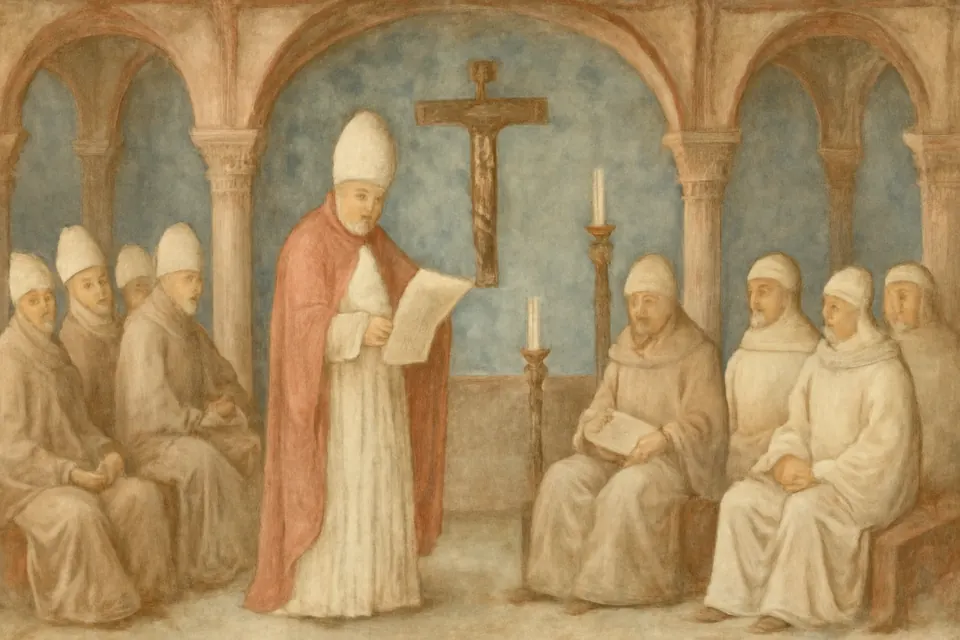
In 1147 Pope Eugene III was holding a synod at Trier. Archbishop Henry of Mainz brought him a text Hildegard had dictated, and the pope read it and authorized her to go on writing. From then on her reputation spread across Europe.
The Rupertsberg and Eibingen
With more and more women asking to join, Hildegard broke away from the monks of Disibodenberg and moved her community around 1150 to a new monastery on the Rupertsberg, a hill near Bingen. In 1165 she founded a second house across the Rhine at Eibingen and governed both. Invited by popes Hadrian IV and Alexander III, she made several preaching journeys, speaking in Cologne, Trier, Mainz, Metz, Bamberg, Würzburg and elsewhere, which was very unusual for a woman of her time.
Near the end of her life she allowed a young man who had once been excommunicated to be buried in her convent's cemetery. The cathedral chapter of Mainz put the convent under interdict. After much worry and many letters, she had it lifted in the last months of her life.
Her writings and music
Her three books of visions are the Scivias ("Know the ways"), the Liber Vitae Meritorum (Book of the Merits of Life) and the Liber Divinorum Operum (Book of Divine Works). About four hundred of her letters survive, along with 58 sermons for her sisters, works on medicine and natural science (Physica and Causae et Curae), and a made-up language, the Lingua Ignota.

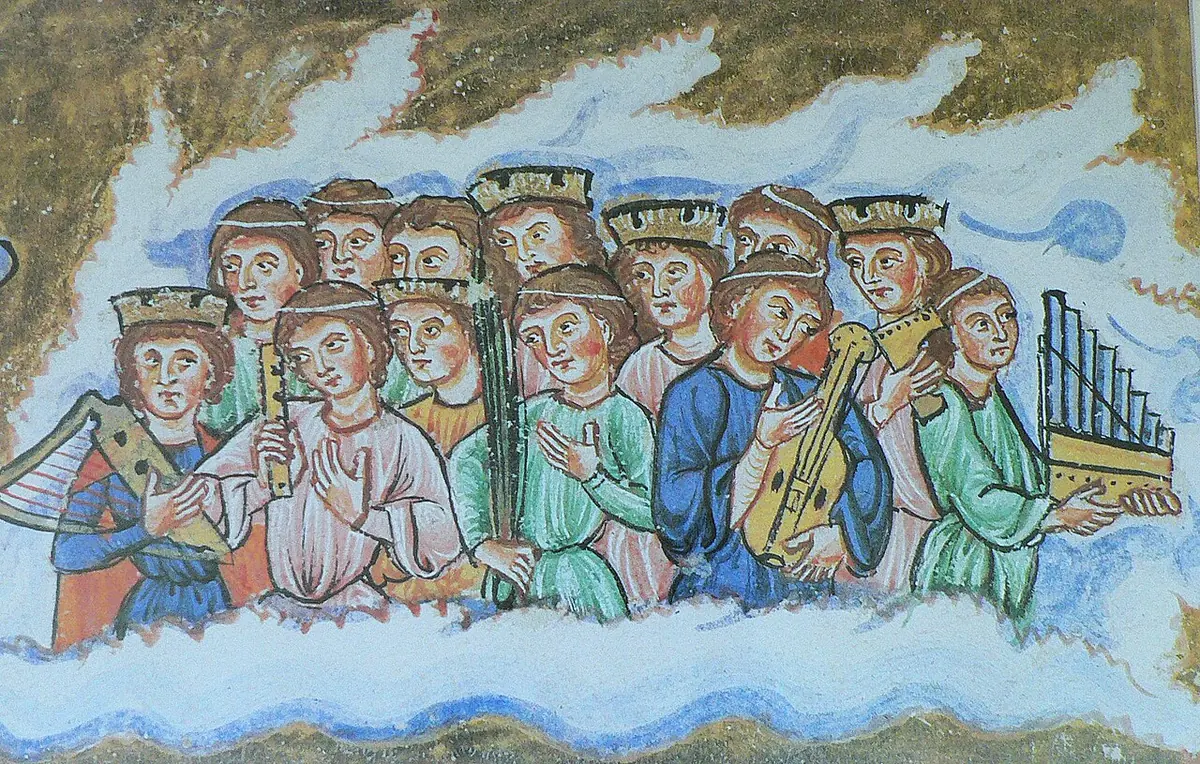
Her songs, collected as the Symphonia Harmoniae Caelestium Revelationum, were sung in her monasteries. Benedict XVI wrote that for Hildegard "the entire creation is a symphony of the Holy Spirit."
Miracles of St. Hildegard
Her contemporary biographer, the monk Theodoric, already called her a saint, and the Catholic Encyclopedia reports that "many miracles are said to have been wrought through her intercession," in her lifetime and at her tomb. These are reported or traditional. None was examined in a modern process, because her canonization in 2012 was an equivalent one, confirming centuries of veneration rather than judging new miracles.
Symbols of St. Hildegard in art
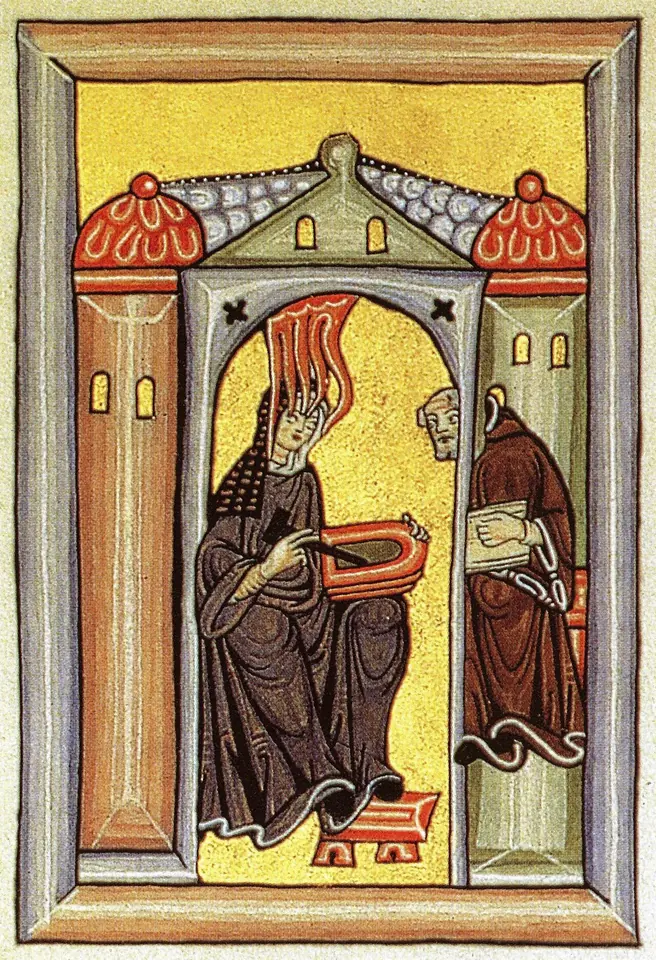
Hildegard is shown as a Benedictine nun in a black habit and veil. Her most recognizable image comes from the 12th-century illuminated Scivias made at the Rupertsberg, shown near the top of this page. Look for:
- Tongues of fire descending on her head, for her visions.
- A wax tablet and stylus, the tools she used to write them down.
- A monk at a window, Volmar, taking her words.
- An abbess's crozier, in later statues.
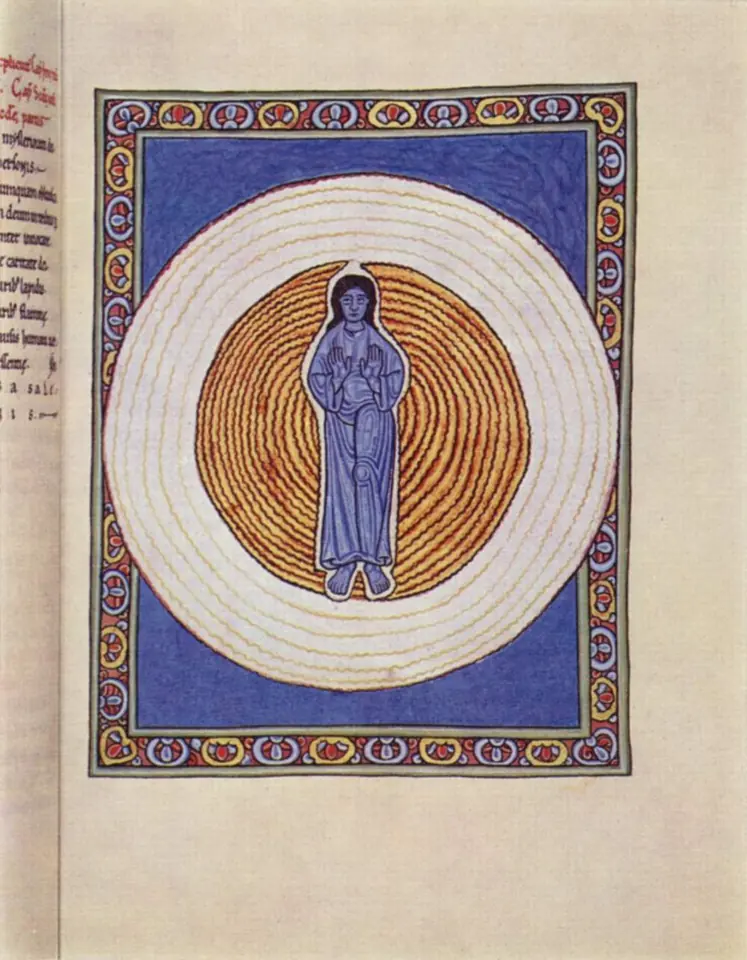
The pictures of her visions are famous in their own right, like the rings of angels and the Trinity in circles of light on this page.


Feast day and where St. Hildegard is honored
Her feast is September 17. A decree of January 25, 2021, added it to the General Roman Calendar as an optional memorial. See the feast days calendar.
Benedict XVI extended her cult to the whole Church in May 2012, and on October 7, 2012, at a Mass in St. Peter's Square, he declared her a Doctor of the Church together with St. John of Avila.

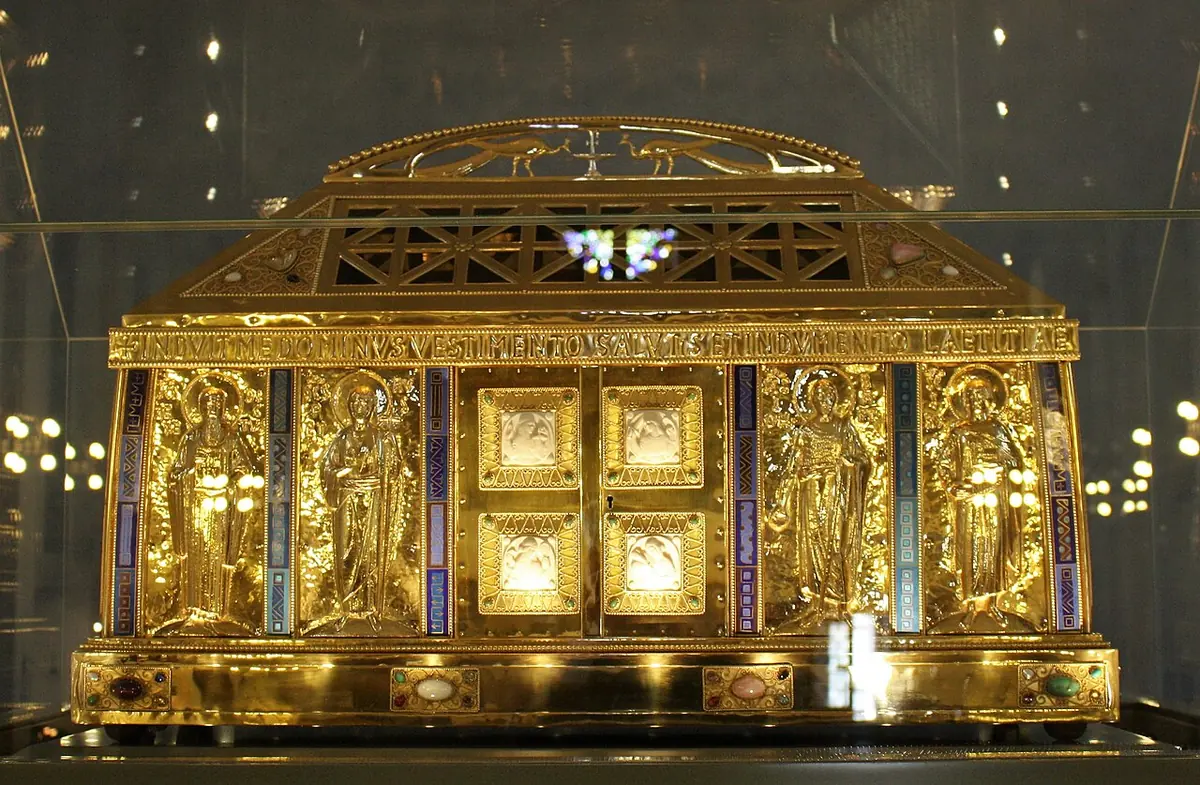
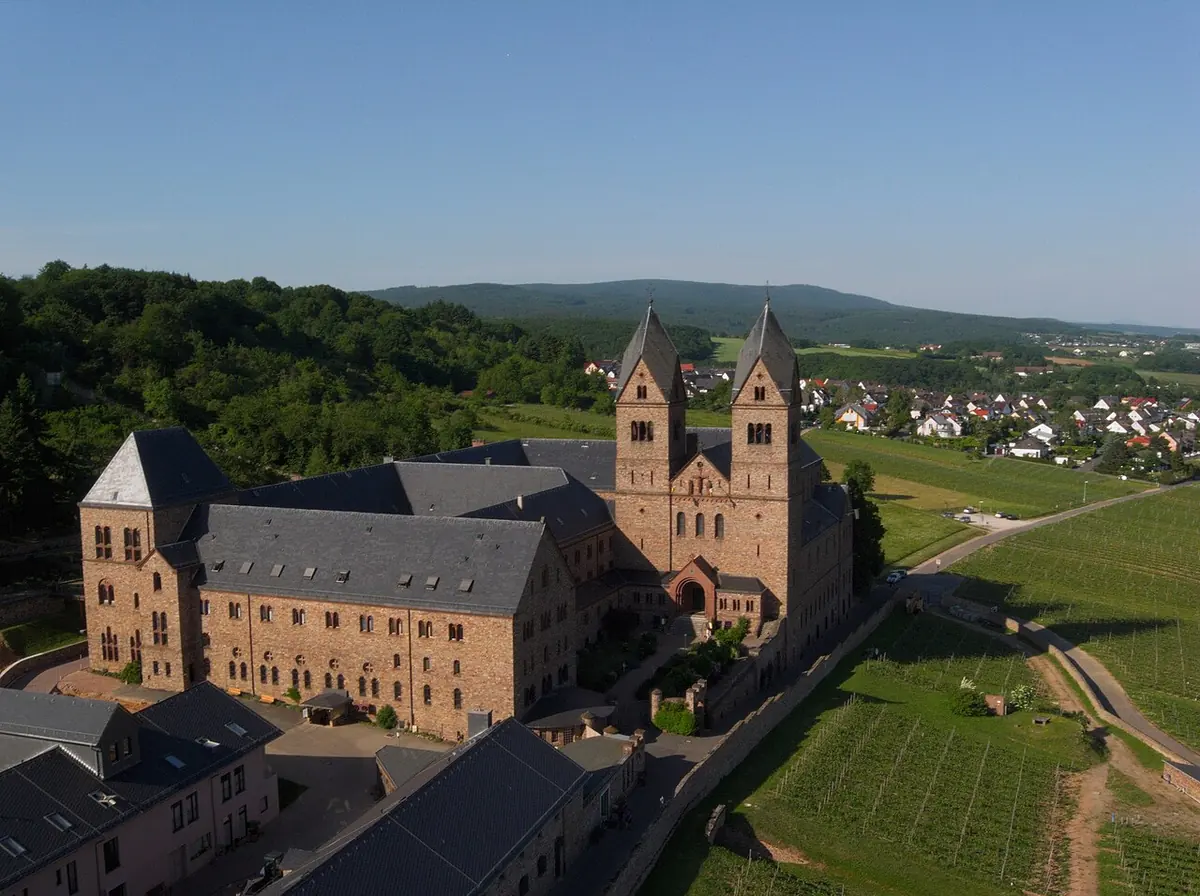
The Rupertsberg monastery was destroyed in 1632, during the Thirty Years' War. Her relics were taken to Cologne and then to Eibingen, where the bishop of Limburg recognized them in 1857. They rest in a gilded shrine in the parish and pilgrimage church of St. Hildegard in Eibingen, a village that chose her as its patron. Above the village stands the Benedictine Abbey of St. Hildegard, whose nuns' petition Benedict XVI singled out when he named her a Doctor of the Church.

Prayer to St. Hildegard
The Church's own prayer for her memorial, the collect of the Roman Missal (English translation as given by Catholic Culture), reads:
O God, fount of life, who imbued the Virgin Saint Hildegard with a spirit of prophecy, grant us, we pray, by her example and intercession, to know your ways, and in the darkness of this age to perceive the splendor of your light. Through our Lord Jesus Christ, your Son, who lives and reigns with you in the unity of the Holy Spirit, God, for ever and ever.
"To know your ways" echoes the title of her Scivias.

Frequently asked questions
When was Hildegard of Bingen canonized?
In May 2012 Pope Benedict XVI extended her liturgical cult to the whole Church, an "equivalent canonization." Formal processes had been opened under Gregory IX and Innocent IV in the 13th century but never finished, though her name had long been in the Roman Martyrology. On October 7, 2012, he declared her a Doctor of the Church.
What is the Scivias?
Her first and best-known book of visions, written with the help of the monk Volmar. The title comes from Scire vias Domini, "to know the ways of the Lord." In 35 visions, as Benedict XVI counted them, it traces the history of salvation from creation to the end of time, and illuminated copies show what she saw.
When is St. Hildegard's feast day?
September 17, the day she died in 1179. Since a decree of January 25, 2021, it has been an optional memorial on the General Roman Calendar.
Did Hildegard of Bingen write music?
Yes. Her songs for the liturgy are gathered in the Symphonia Harmoniae Caelestium Revelationum, and her monasteries sang them in her lifetime. They are widely recorded today.
Sources
- Benedict XVI, Apostolic Letter proclaiming Saint Hildegard of Bingen a Doctor of the Universal Church (October 7, 2012)
- Benedict XVI, General Audience of September 1, 2010: Saint Hildegard of Bingen
- Benedict XVI, General Audience of September 8, 2010: Saint Hildegard of Bingen (2)
- Catholic Encyclopedia (1910): Saint Hildegard
- Congregation for Divine Worship: Decree on the inscription of Saint Hildegard of Bingen and others in the General Roman Calendar (January 25, 2021)
- The Equivalent Canonization of Hildegard of Bingen (L'Osservatore Romano, via EWTN)
- Catholic Culture: Saint Hildegard of Bingen, September 17