Sts. Perpetua and Felicity
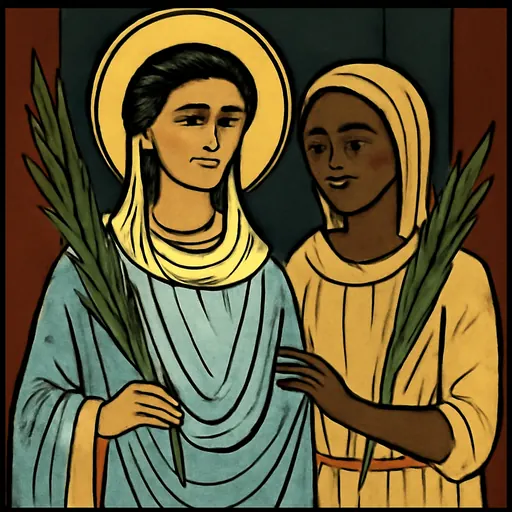
Sts. Perpetua and Felicity were young North African Christians martyred in the amphitheater of Carthage on March 7, 203. Perpetua was a 22-year-old noblewoman nursing her baby; Felicity was an enslaved woman who gave birth in prison days before she died. Perpetua's own prison diary survives in The Passion of Perpetua and Felicity, one of the oldest writings by a Christian woman. Their feast day is March 7.
Who were Sts. Perpetua and Felicity?
In the spring of 203, at Carthage in Roman Africa, a small group of catechumens, people preparing for baptism, were arrested for being Christians. Among them were Vibia Perpetua, a well-born young wife and mother of about 22, and Felicity, an enslaved woman who was eight months pregnant. With them were Revocatus, also enslaved, and two other men, Saturninus and Secundulus. Their teacher Saturus later gave himself up so that he could share their fate. On March 7 they died in the city's amphitheater, at games held for the birthday of Geta, the emperor's son.
We know this because Perpetua wrote it down. The Passion of Perpetua and Felicity contains her own prison diary, "described by her own hand and with her own mind," as the editor puts it, along with a vision written by Saturus and an eyewitness account of their deaths. The 1909 Catholic Encyclopedia calls it "a genuine, contemporary description." Tertullian, writing in Carthage only a few years later, already refers to "the most heroic martyr Perpetua" and her vision of paradise. Few early saints come to us this directly.

The quotations below come from the English translation by R. E. Wallis, published in the Ante-Nicene Fathers in 1885.
Perpetua's prison diary
"I am a Christian"
Perpetua's father was a pagan who loved her and could not bear what she was doing. Her mother and two brothers were Christians. The diary opens with an argument between father and daughter. She pointed to a water jug:
'Father,' said I, 'do you see, let us say, this vessel lying here to be a little pitcher, or something else?' And he said, 'I see it to be so.' And I replied to him, 'Can it be called by any other name than what it is?' And he said, 'No.' 'Neither can I call myself anything else than what I am, a Christian.'
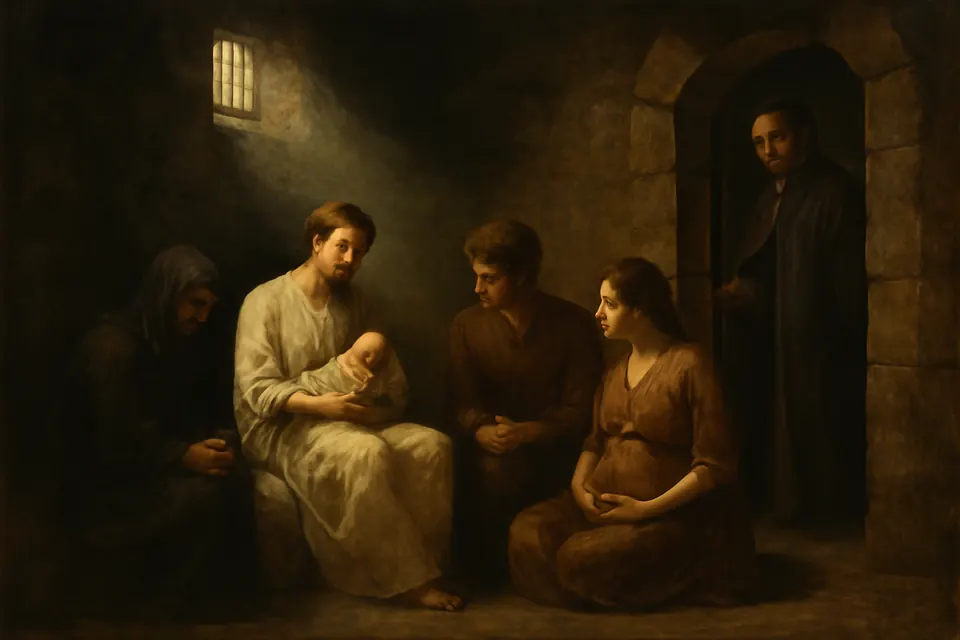
He left in a rage. In the days that followed, the group was baptized. Then they were taken into the prison, and Perpetua wrote that she "was very much afraid, because I had never felt such darkness." Her worst fear was for her baby, who was weak with hunger. Two deacons bribed the guards for better quarters, and she was allowed to keep her son with her. After that, she wrote, "the dungeon became to me as it were a palace, so that I preferred being there to being elsewhere."
The golden ladder
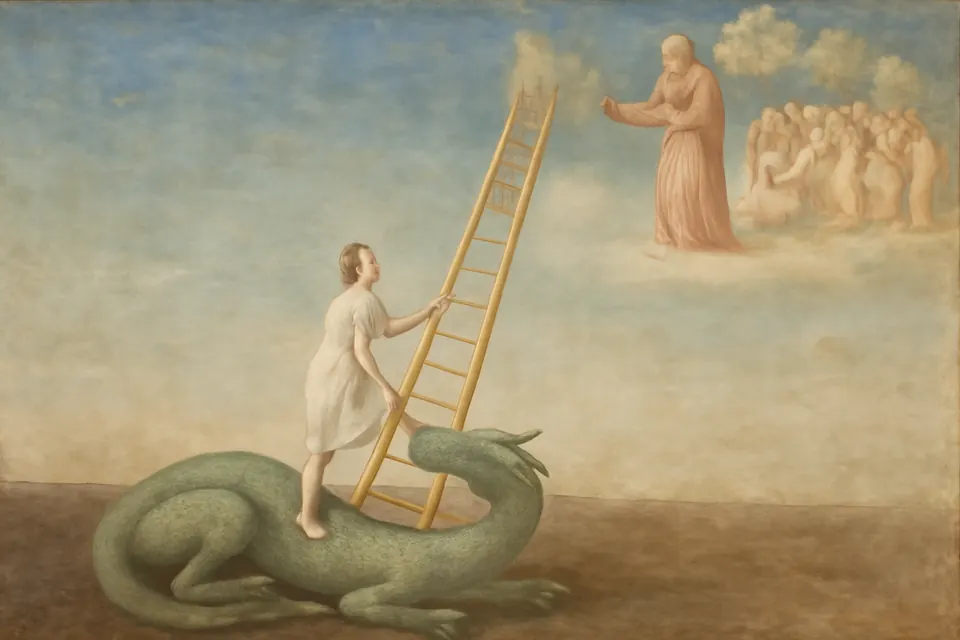
Her brother asked her to pray for a vision showing whether they would die or be released. That night she saw "a golden ladder of marvellous height, reaching up even to heaven, and very narrow, so that persons could only ascend it one by one." Weapons hung from its sides, and a huge dragon lay at its foot. Saturus climbed first and called back, "Perpetua, I am waiting for you; but be careful that the dragon do not bite you." She answered, "In the name of the Lord Jesus Christ, he shall not hurt me," and stepped on the dragon's head as the first rung. At the top, in a great garden, a tall white-haired shepherd was milking sheep among thousands dressed in white. He told her, "You are welcome, daughter," and gave her a mouthful of the cheese. She woke "still tasting a sweetness which I cannot describe," and they understood that they would die.
The trial
At the hearing before the procurator Hilarianus, her father appeared with the baby in his arms, and Hilarianus urged her to spare them both and offer sacrifice for the emperors. The exchange is short: "Hilarianus said, 'Are you a Christian?' And I replied, 'I am a Christian.'" All of them were condemned to the wild beasts, and she writes that they "went down cheerfully to the dungeon." Her father kept the baby. She notes that the child no longer needed to nurse, and she was spared that pain.
Dinocrates
While praying in prison, Perpetua suddenly remembered her brother Dinocrates, who had died of illness at seven. She saw him in a dark place, thirsty and unable to reach a pool of water, and prayed for him day and night. In a second vision he was well, drinking from a goblet that never ran dry, and ran off "to play joyously, after the manner of children." Catholic writers have long pointed to this passage as early evidence of Christians praying for the dead.
The last vision
On the day before the games Perpetua dreamed that she wrestled a fierce Egyptian in the arena and threw him down. She woke understanding that "I was not to fight with beasts, but against the devil." Her diary ends there: "This, so far, I have completed several days before the exhibition; but what passed at the exhibition itself let who will write."


Felicity's story
Felicity appears in the editor's part of the Passion. She was eight months pregnant, and Roman law did not allow a pregnant woman to be executed. She was afraid she would be held back and die later among strangers. Three days before the games they all prayed together, and her labor began. As she cried out in pain, a guard mocked her, asking what she would do when she faced the beasts. She answered:
Now it is I that suffer what I suffer; but then there will be another in me, who will suffer for me, because I also am about to suffer for Him.
She gave birth to a girl, whom "a certain sister brought up as her daughter." Of the whole group, Felicity is the one whose name the Church joined to Perpetua's in its prayers and calendars.
The martyrdom in the amphitheater
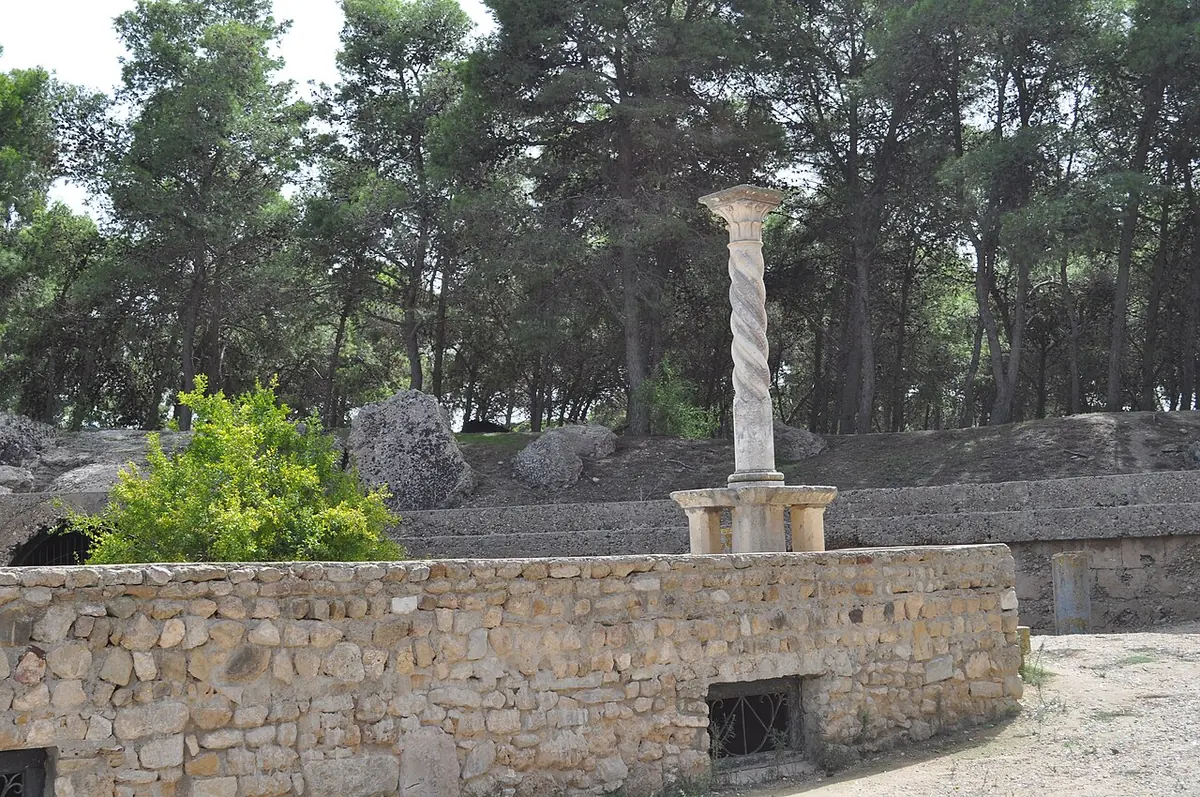
The editor writes as someone who was there. The prisoners walked into the amphitheater "as if to an assembly, joyous and of brilliant countenances." When the guards tried to dress them as priests and priestesses of Saturn and Ceres, Perpetua refused, and the tribune gave way. The men faced a leopard, a bear and a boar. Saturus had said he feared the bear most, and twice the animals would not touch him.
The two women were sent against a wild cow. Perpetua was thrown down. She got up, pinned back her hair, and went to Felicity, who had fallen: "she approached and gave her her hand, and lifted her up." The crowd let them be called back to the gate. Perpetua, as if waking from a trance, asked when they would face the cow; she had not noticed it happen. Then she spoke to her brother and a catechumen named Rusticus: "Stand fast in the faith, and love one another, all of you, and be not offended at my sufferings."
At the end the crowd demanded to watch the executions. The martyrs walked to the center of the arena, "but they first kissed one another, that they might consummate their martyrdom with the kiss of peace," and were put to death with the sword. The editor adds that the young gladiator assigned to Perpetua hesitated, and she guided his hand herself.

Visions and miracles in the Passion
The Passion is an early document, and what it describes counts in this encyclopedia as reported: claims written down by witnesses, never formally examined by the Church, since their cult began long before any such process.
- Perpetua's four visions and Saturus's vision of heaven: reported, in the visionaries' own words.
- Felicity's labor beginning after the group's prayer: reported by the eyewitness editor as an answer to prayer.
- The beasts refusing to touch Saturus: reported by the editor.
- The conversion of the jailer Pudens: reported. The editor says Pudens came to respect the prisoners, and Saturus urged him to "believe with your whole heart" before he died.
Why Perpetua and Felicity are patron saints
Catholic Culture lists Perpetua as patron of married women, of ranchers and cattle, and of Carthage, the cattle patronage coming from the wild cow in the arena. In France, Vierzon honors her as its patron and asks her protection for herds. Many Catholics today pray to both saints for mothers and expectant mothers, since Perpetua went to prison nursing a baby and Felicity gave birth there. That patronage comes from popular devotion rather than any formal act. See our full list of patron saints.
Symbols of Sts. Perpetua and Felicity in art
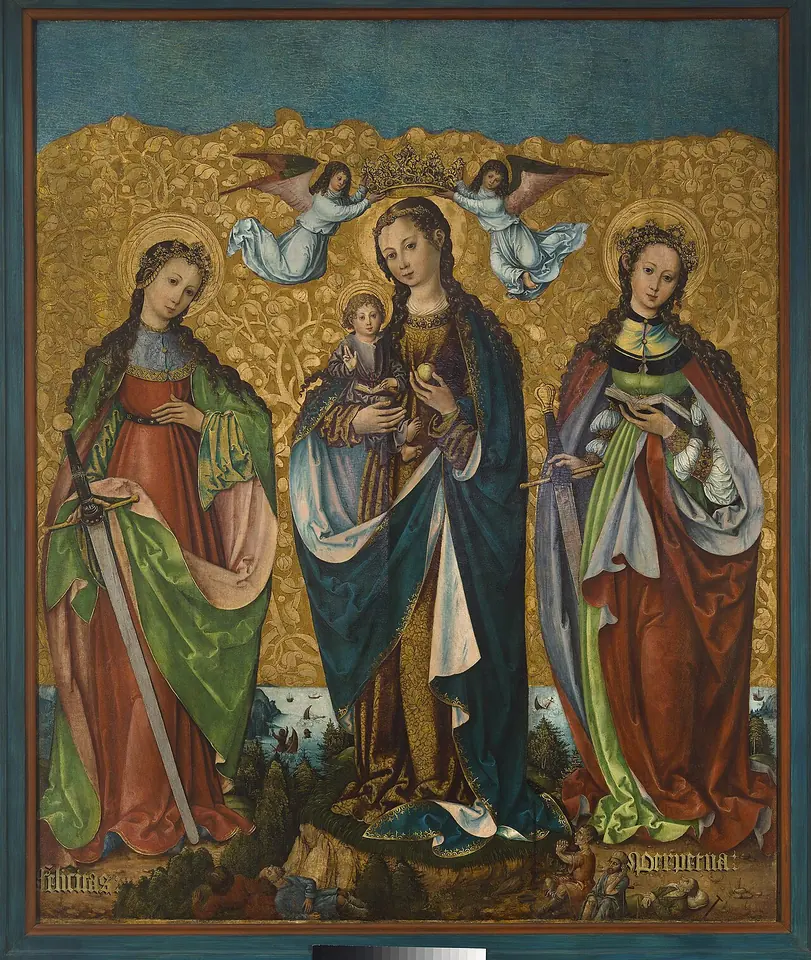
Early images of the two are mostly portraits; story scenes are rare after the first millennium. Look for:
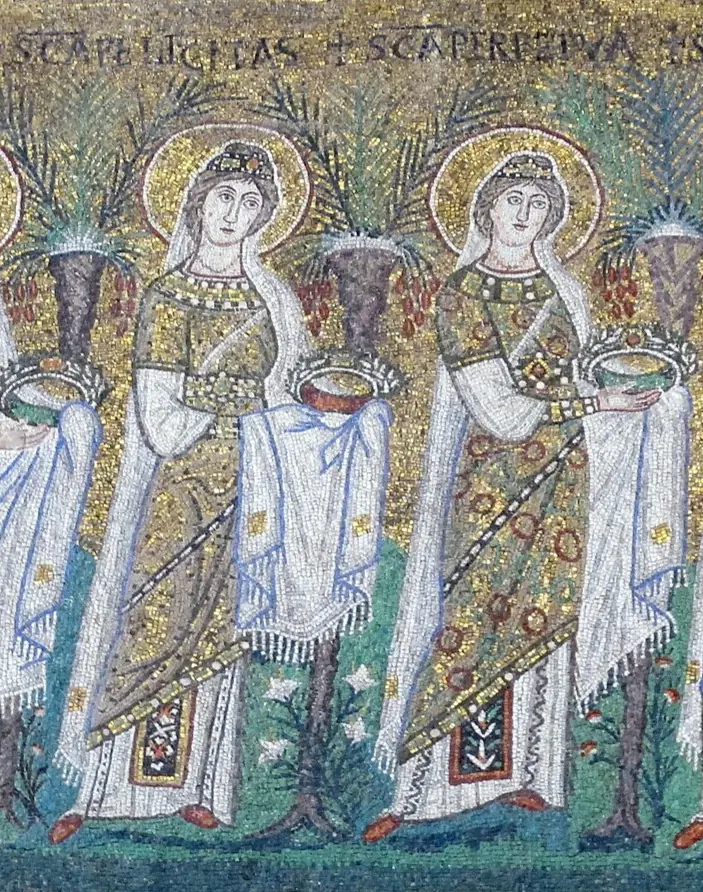
- Crowns and palms: the sign of martyrs. In Ravenna they carry crowns toward the Virgin and Child among the virgin martyrs, with St. Agnes, St. Agatha, St. Lucy and St. Cecilia.
- A wild cow, heifer or bull: the beast that attacked them, sometimes at Perpetua's feet.
- A ladder and a dragon: from Perpetua's first vision, more common in modern art.
- An infant: Perpetua's son or Felicity's newborn daughter.
- Names lettered beside them: often the only sure way to identify them in old mosaics and panels.
Watch for the namesake: a woman with seven sons, or seven swords, is St. Felicity of Rome, a different martyr.

Their feast and the Basilica Majorum
Their names appear on March 7 in the Philocalian calendar, the list of martyrs Rome was honoring publicly by the 4th century. Felicity and Perpetua are also among the women saints named in the Roman Canon, the oldest Eucharistic prayer of the Latin Mass, and in the Litany of the Saints sung at the Easter Vigil.
Their feast is March 7, an optional memorial on the General Roman Calendar. From 1908 to 1969 Rome kept it on March 6, because the feast of St. Thomas Aquinas occupied March 7; when Aquinas moved to January 28, the martyrs returned to their own day. The Orthodox Church remembers them on February 1. See them on our feast days page.
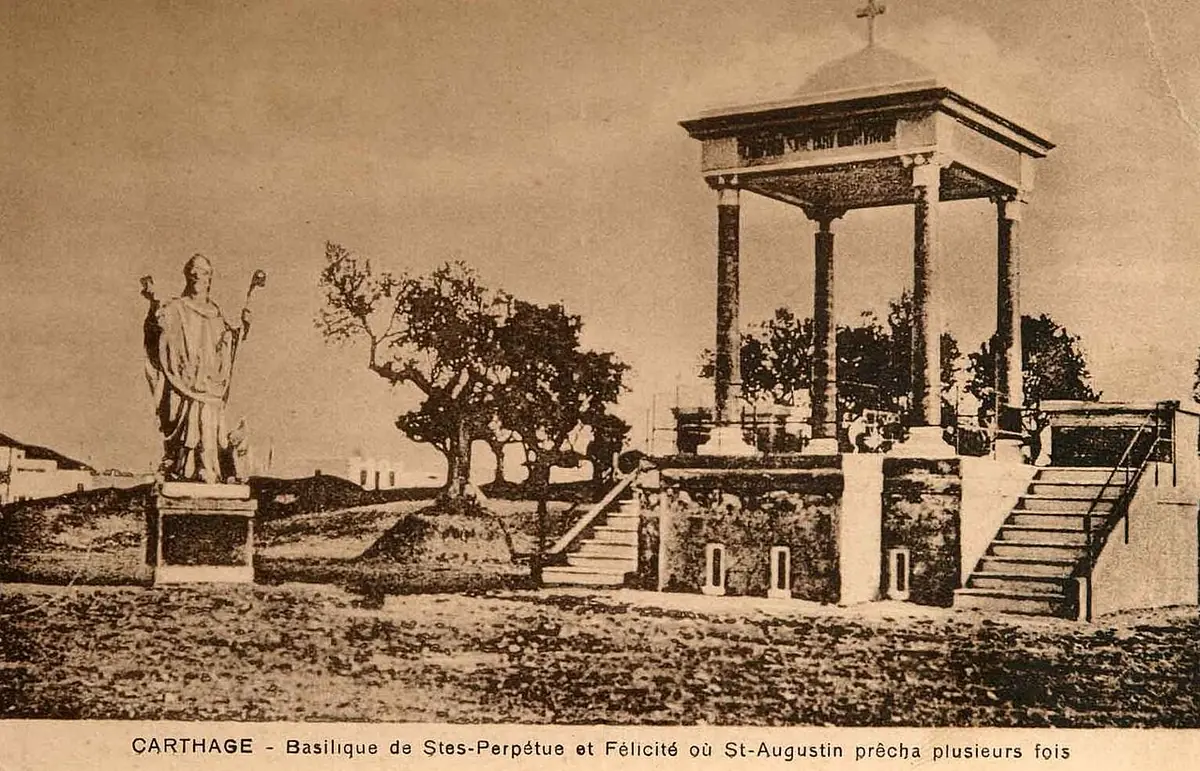
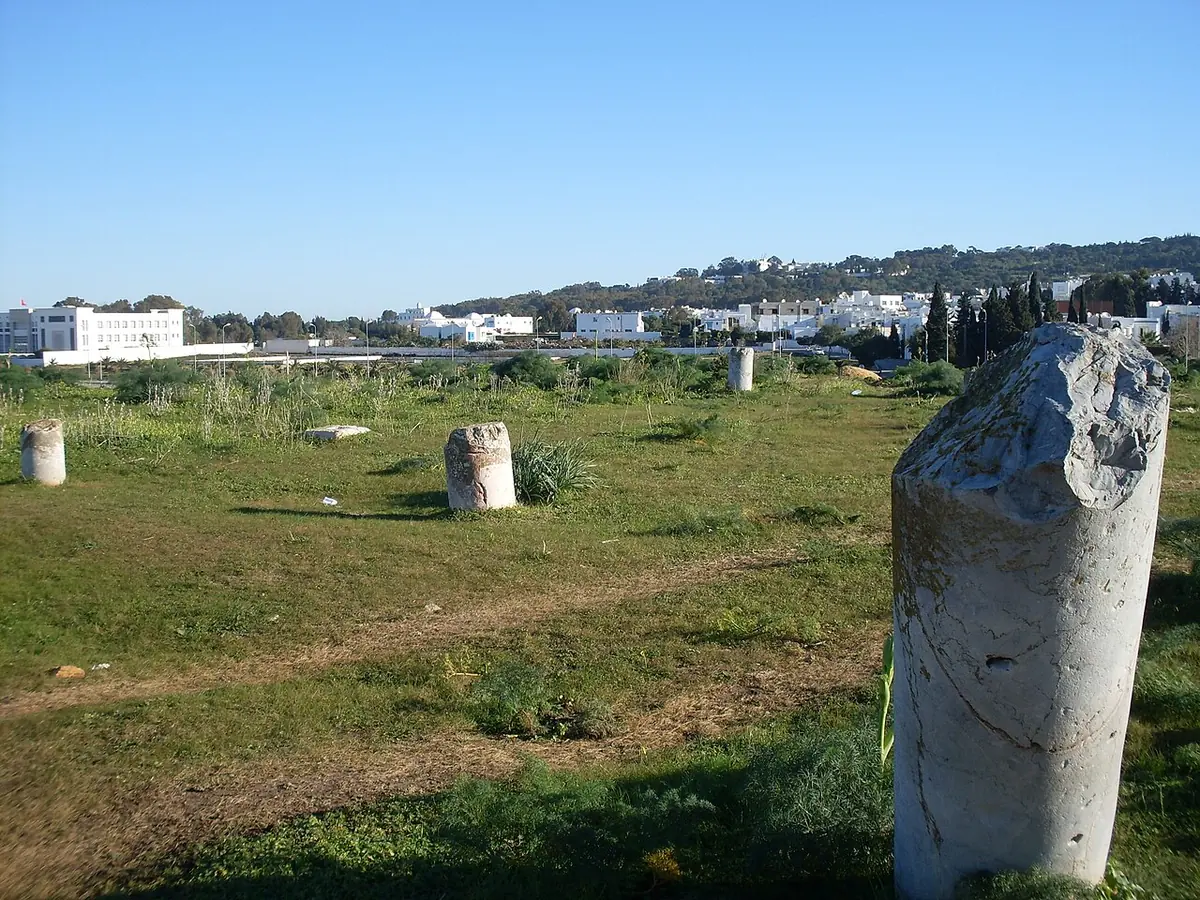
At Carthage a great church, the Basilica Majorum, rose over their tomb. In 1907 the French missionary and archaeologist Father Alfred-Louis Delattre found an ancient inscription there with the names of the martyrs, confirming the tradition. A memorial at the site was restored for the International Eucharistic Congress held at Carthage in 1930.

Today only column stumps stand in a field near the coast.

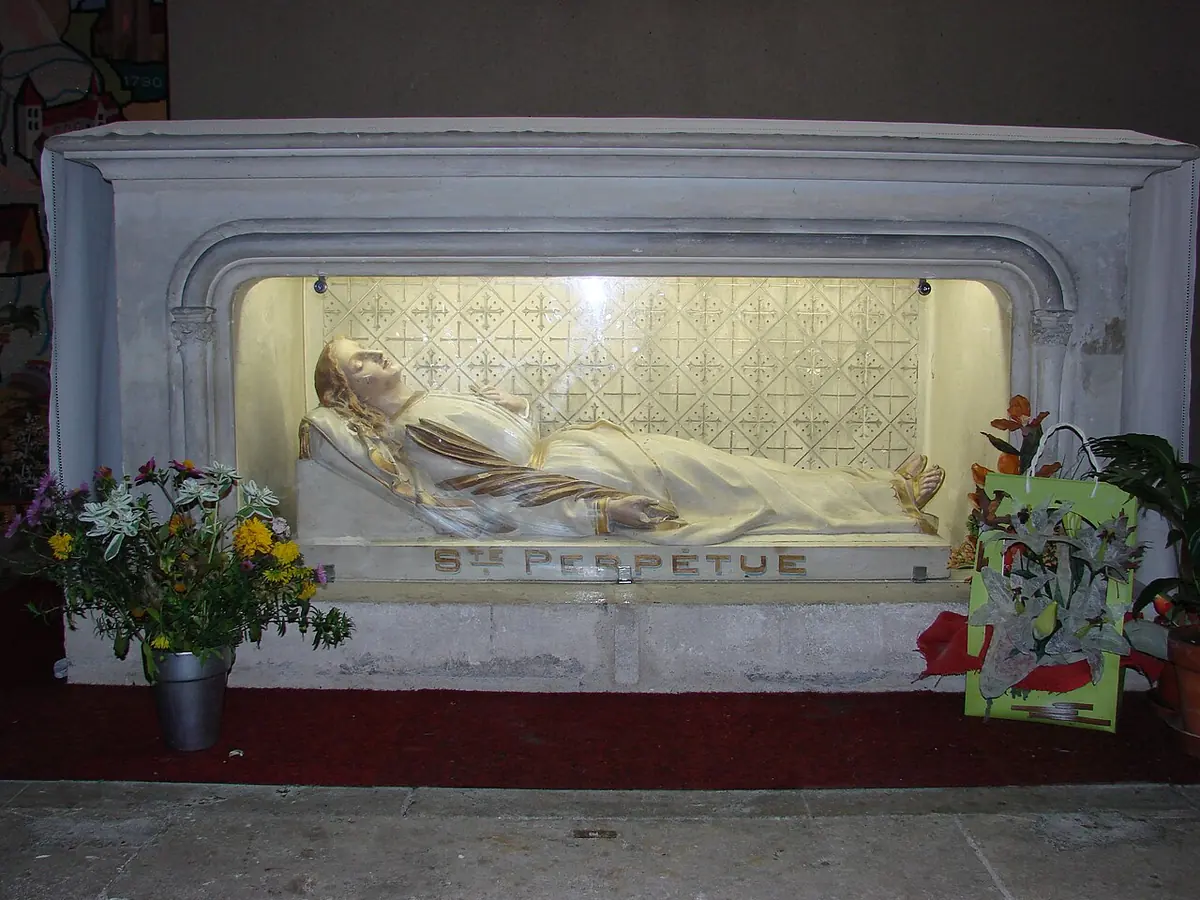
The church of Notre-Dame in Vierzon, in central France, claims relics of Perpetua. Local tradition says they went to Rome in 439, came to an abbey near Bourges in 843, and reached Vierzon in 926. That chain can't be verified.

Prayer to Sts. Perpetua and Felicity
The Catholic Church's prayer for their memorial is the collect of the Roman Missal, as given by Catholic Culture:
O God, at the urging of whose love the Martyrs Saints Perpetua and Felicity defied their persecutors and overcame the torment of earth, grant, we ask, by their prayers, that we may ever grow in your love. Through our Lord Jesus Christ, your Son, who lives and reigns with you in the unity of the Holy Spirit, God, for ever and ever.
No traditional devotional prayer to the two is in wide use. Catholics ask their intercession in their own words, often for mothers, for women in a difficult pregnancy and for families divided over faith. Many simply read the Passion, which the early Church read aloud on their feast.
Frequently asked questions
Who wrote The Passion of Perpetua and Felicity?
The work has three voices. Most of the middle is Perpetua's own account of her imprisonment and visions, "as she left it described by her own hand." A shorter section is the vision of her teacher Saturus, also written by him. An unnamed editor who saw their deaths wrote the opening and the account of the martyrdom. Some have credited Tertullian with the editing, but the Catholic Encyclopedia calls that unproved.
When is the feast of Sts. Perpetua and Felicity?
March 7 in the Catholic Church's General Roman Calendar, the day they died in 203. Between 1908 and 1969 the Roman calendar kept them on March 6, a date the older Latin calendar still uses. The Orthodox Church commemorates them on February 1.
What are Sts. Perpetua and Felicity the patron saints of?
Catholic Culture lists Perpetua as a patron of married women, ranchers and cattle, and of Carthage. Many Catholics also ask both women to pray for mothers and expectant mothers, a popular devotion that grew out of their story, since Perpetua was nursing a baby and Felicity gave birth in prison.
Is this St. Felicity the same as St. Felicity of Rome?
No. St. Felicity of Carthage was the enslaved companion of Perpetua, martyred in 203. St. Felicity of Rome was a widow who, by tradition, was martyred with her seven sons in the 2nd century; her feast is November 23. Pictures of a woman with seven sons or seven swords show the Roman Felicity.
Where are Sts. Perpetua and Felicity buried?
They were buried at Carthage, and a large church, the Basilica Majorum, was later built over their tomb. In 1907 the archaeologist Father Alfred-Louis Delattre found an ancient inscription there bearing their names. The church of Notre-Dame in Vierzon, France, claims relics of Perpetua.
Sources
- The Passion of the Holy Martyrs Perpetua and Felicitas, translated by R. E. Wallis, Ante-Nicene Fathers, Vol. 3 (1885), New Advent
- Catholic Encyclopedia (1909): Sts. Felicitas and Perpetua
- Tertullian, A Treatise on the Soul, chapter 55, New Advent
- Orthodox Church in America: Martyrs Perpetua, a woman of Carthage, and the Catechumens
- Catholic Culture: Optional Memorial of Sts. Perpetua and Felicity (March 7 liturgical calendar, collect and patronages)
- Christian Iconography: St. Perpetua and St. Felicity, Art, Legend, Iconography
- Perpétue et Félicité (French Wikipedia: the relics at Vierzon)