St. Benedict prayer

The St. Benedict prayer is the Latin verse abbreviated on his medal: "Crux sacra sit mihi lux; non draco sit mihi dux. Vade retro Satana; numquam suade mihi vana. Sunt mala quae libas; ipse venena bibas." It is a short prayer against temptation, "May the holy cross be my light... Begone, Satan," said with faith in Christ's cross.
When temptation comes hard, the oldest Christian answer is the sign of the cross. The prayer tied to St. Benedict is that answer put into a few lines of rhyming Latin, short enough to say in a breath and old enough that it was already written down in 1415. Here it is in Latin and English, with a traditional prayer to St. Benedict himself.
The St. Benedict prayer
These are the words abbreviated on the back of every St. Benedict medal. The English is from the 1880 translation of Abbot Prosper Guéranger's book on the medal.
Crux sacra sit mihi lux. Non draco sit mihi dux. Vade retro, Satana; nunquam suade mihi vana. Sunt mala quae libas; ipse venena bibas.
May the Holy Cross be my Light. Let not the Dragon be my Guide. Begone, Satan! and suggest not to me thy vain things: the cup thou profferest me is evil; drink thou thy poison.
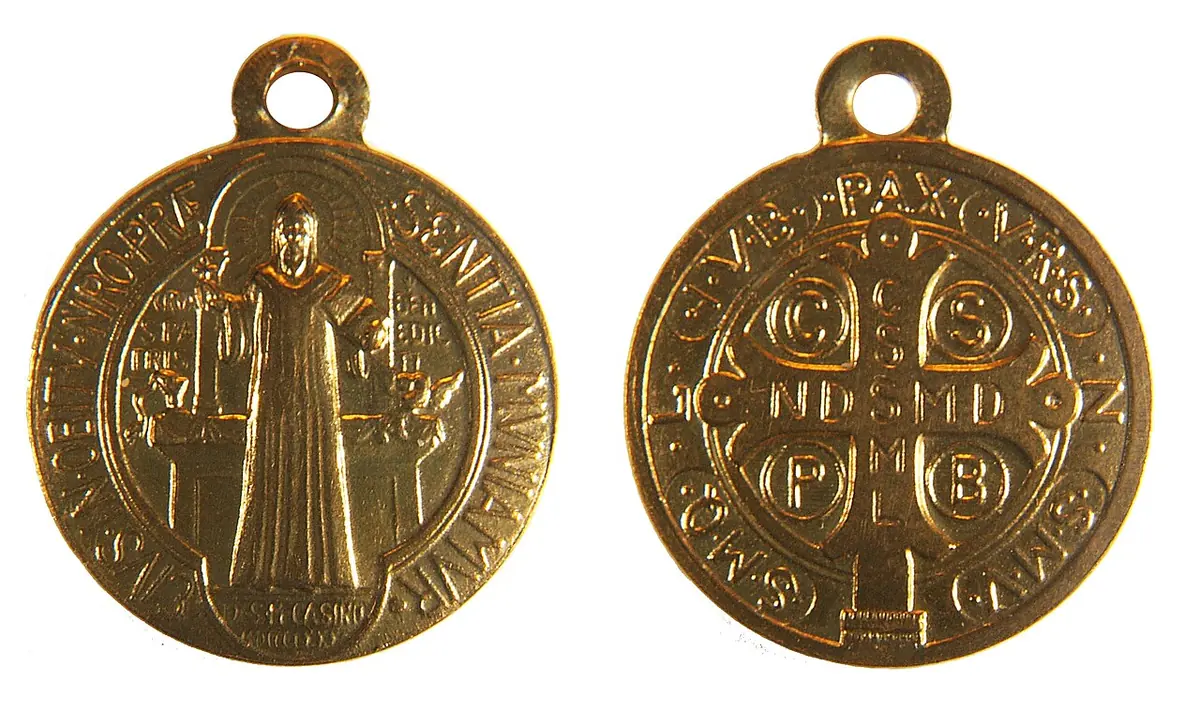
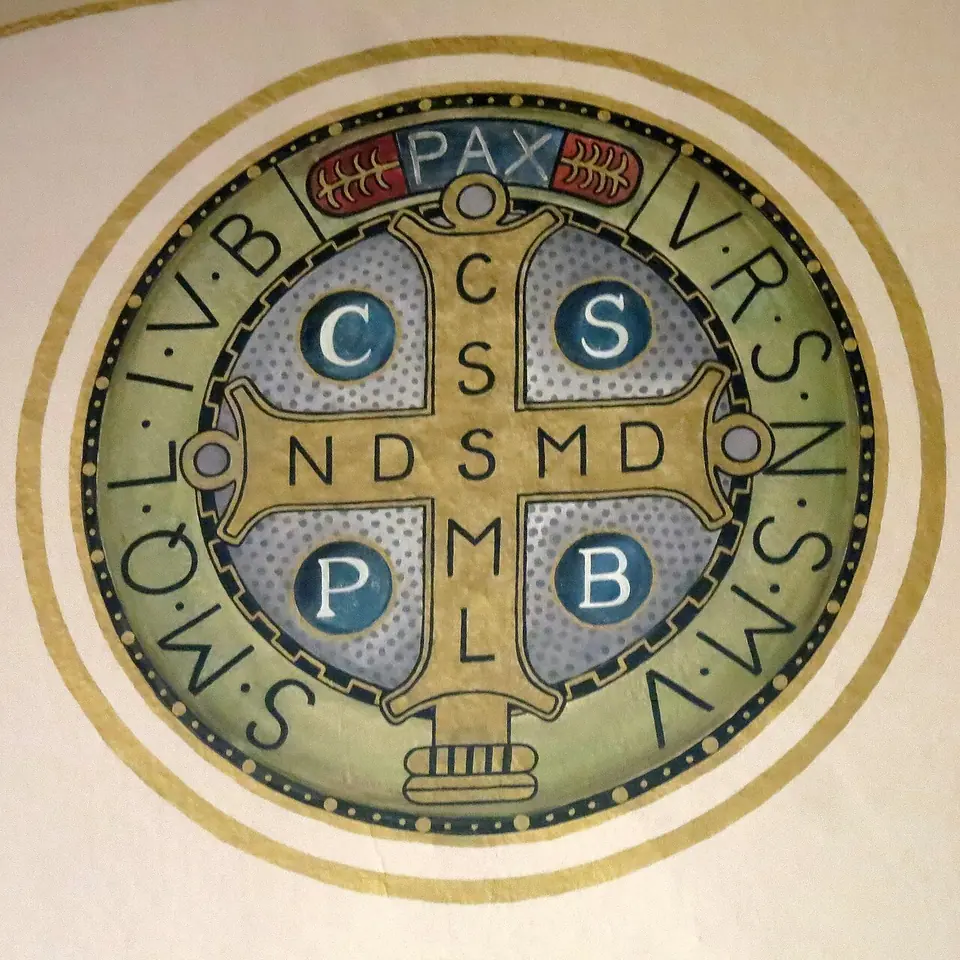
On the medal they appear only as initials: C S S M L down the cross, N D S M D across it, and V R S N S M V S M Q L I V B around the rim. In the corners of the cross, C S P B stands for Crux Sancti Patris Benedicti, "the cross of our holy father Benedict," and at the top is PAX, "peace."
What it means
Guéranger explains that the first two lines "form a pentameter verse, containing the Christian's protestation that he confides in the holy cross, and refuses to bear the yoke which the devil would put upon him." The second pair recalls two stories from St. Gregory the Great's life of Benedict: the temptation he overcame in his cave at Subiaco by the sign of the cross, and the cup of poisoned wine that shattered when he blessed it. "The Christian may make use of these same words," Guéranger writes, "as often as he finds himself tormented by the temptations and insults of the invisible enemy of our salvation."
"Vade retro, Satana" goes back further than Benedict. Jesus himself said it to Peter: "Go behind me, Satan" (Mark 8:33, Douay-Rheims). As Guéranger puts it, Christ "sanctified the first of these words by himself making use of them."
Where the prayer comes from
According to the Catholic Encyclopedia, the verse was rediscovered in 1647 in Bavaria. During a witchcraft trial at Natternberg, the accused said they had no power over the nearby abbey of Metten because it was protected by the cross. Painted crosses with rows of mysterious letters were found on the abbey walls, and the meaning turned up in a manuscript of 1415 in Metten's library, which showed St. Benedict with the full Latin words. Pope Benedict XIV approved the medal in 1741 and 1742. Who first composed the verse is not known.
How to pray it
Say it whenever temptation, fear or a sense of evil presses in, slowly and with the sign of the cross:
- Make the sign of the cross, or hold your medal or crucifix.
- Say the four lines, in Latin or in English.
- Add a short prayer to Jesus in your own words, or an Our Father.
It is a prayer anyone may say. The Church reserves the solemn exorcism of a possessed person to a priest with the bishop's permission; the medal prayer is something humbler, a Christian's own refusal of the devil, like the renewal of our baptismal promises. Many people pray it at night, on entering a new home, or when a habit of sin returns.
A prayer to St. Benedict for a happy death
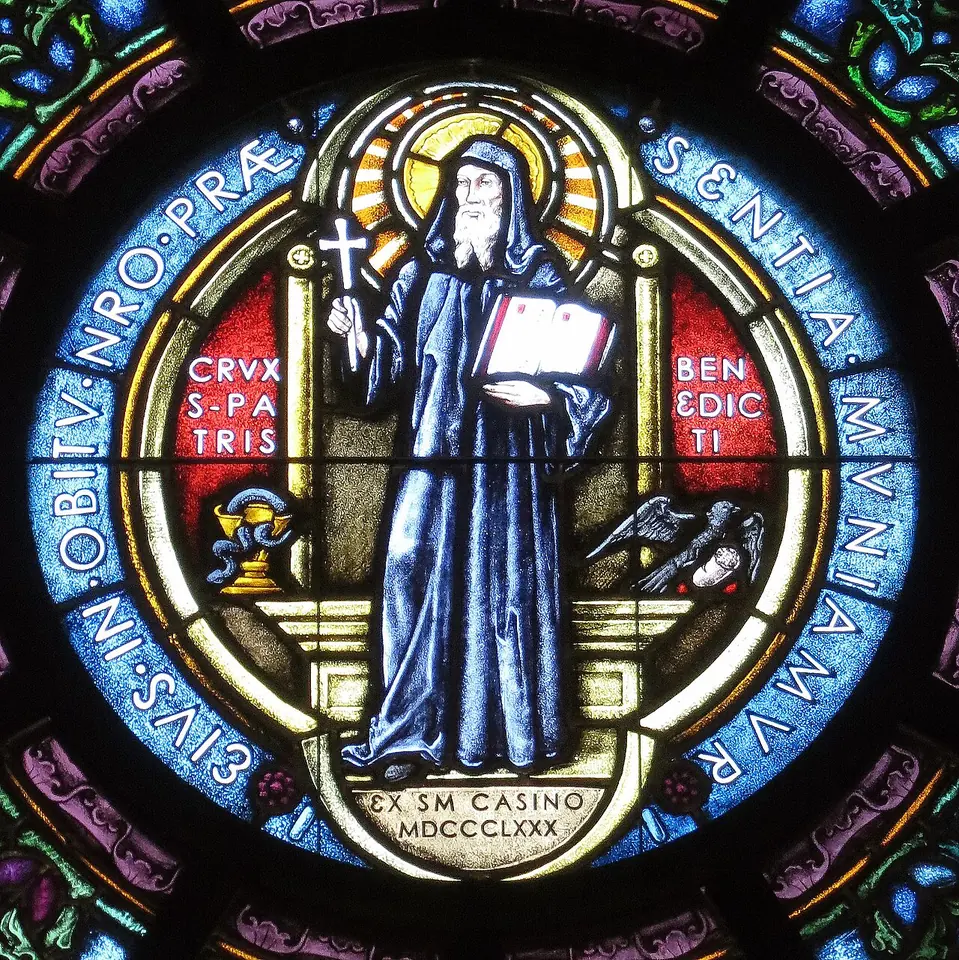
The Benedictines have long asked St. Benedict to be with them at the hour of death, because he died standing in the oratory, held up by his monks, with his hands raised in prayer. The front of the 1880 jubilee medal carries the words Eius in obitu nostro praesentia muniamur, "May we be strengthened by his presence in the hour of our death." They are taken from this prayer, printed in Latin and English in Guéranger's book in 1880:
V. Thou didst appear glorious in the sight of the Lord. R. Therefore did he clothe thee with beauty.
O God! who didst adorn the precious death of most holy Father Benedict, with so many and so great privileges; grant, we beseech thee, that at our death we may be defended from the snares of our enemies, by the blessed presence of him whose memory we celebrate. Through Christ our Lord. Amen.
The Latin:
Deus, qui pretiosam mortem sanctissimi Patris Benedicti tot tantisque privilegiis decorasti: concede, quaesumus, nobis: ut cujus memoriam recolimus, ejus in obitu nostro beata praesentia ab hostium muniamur insidiis. Per Christum Dominum nostrum. Amen.

A triduum to St. Benedict
An English edition of St. Gregory's Life and Miracles of St. Benedict published in 1880 ends with three days of prayers to prepare for his feast. This is the first day's prayer, with the closing versicle and collect said each day:
Oh, glorious Patriarch St. Benedict! who from thy childhood didst abandon the honours and riches of the world, and didst betake thyself to the lonely cave of Subiaco, there to serve thy God, with all the fervour of thy youthful heart; we beseech thee to obtain for us poor sinners this grace — that we may learn to despise the lying follies of the world, and give our whole attention to the great work of our own sanctification, by a faithful observance of the commandments of God, and of His Church.
V. Pray for us, O holy Father St Benedict. R. That we may be made worthy of the promises of Christ.
Raise up, O Lord, in Thy Church, the spirit wherewith our holy Father, St Benedict, Abbot, was animated; that, filled with the same, we may strive to love what he loved, and to practise what he taught, through Jesus Christ our Lord. Amen.
After the first prayer the book directs the Our Father, Hail Mary and Glory Be, three times. The triduum was meant for his old feast of March 21; today the Church keeps his feast on July 11, so pray it July 8 to 10.
Sacramentals are not charms
The medal and its prayer have power only from God, through the prayer of the Church and our own faith. The Catechism teaches that sacramentals "do not confer the grace of the Holy Spirit in the way that the sacraments do, but by the Church's prayer, they prepare us to receive grace and dispose us to cooperate with it." The Order of St. Benedict says the same about its medal: "we reject any use of religious articles as if they were mere charms or had some magic power to bring us good luck."
So wear the medal, have it blessed by a priest, and say its prayer, but let it lead you to what it points to: the cross of Christ, the sacraments, and a life turned toward God. Benedict's own Rule asks his monks to "prefer nothing to the love of Christ."
Related prayers and saints
The full story of the medal, its letters and its uses is in St. Benedict, with his twin sister St. Scholastica and his biographer St. Gregory the Great. For another prayer against the devil, pray the St. Michael prayer or the Chaplet of St. Michael. The medal itself has its own page, the St. Benedict medal, and his feast is on the feast day calendar.
St. Benedict, pray for us.
Frequently asked questions
What is the St. Benedict prayer?
The prayer most people mean is the Latin verse whose initials are on the back of the St. Benedict medal: "Crux sacra sit mihi lux; non draco sit mihi dux. Vade retro Satana; numquam suade mihi vana. Sunt mala quae libas; ipse venena bibas." In English: May the holy cross be my light; let not the dragon be my guide. Begone, Satan; never suggest vain things to me. What you offer is evil; drink the poison yourself.
What does "Vade retro Satana" mean?
"Begone, Satan," or literally "Go back, Satan." It echoes Jesus' words to Peter in Mark 8:33, "Go behind me, Satan" (Douay-Rheims), and is used to refuse the devil's temptations. On the medal it is abbreviated V R S.
Is the St. Benedict prayer an exorcism?
It is a prayer of protection against temptation that any of the faithful may say. The medal's blessing in the old Roman Ritual includes an exorcism prayed by the priest, and solemn exorcism of a possessed person is reserved to a priest with the bishop's permission. Saying the medal prayer yourself is simply calling on Christ's cross, as Benedict did.
Is the St. Benedict medal a good luck charm?
No. It is a sacramental. The Catechism teaches that sacramentals "prepare us to receive grace and dispose us to cooperate with it" by the Church's prayer; they have no power of their own. The Benedictines themselves reject using religious articles "as if they were mere charms."
Sources
- Prosper Guéranger, The Medal or Cross of St. Benedict: Its Origin, Meaning, and Privileges (London: Burns and Oates, 1880), Internet Archive
- The Life and Miracles of St. Benedict, from an old English version by P. W., ed. E. J. Luck (1880), appendix, Internet Archive
- Catholic Encyclopedia (1912): Medal of Saint Benedict
- Order of St. Benedict: The Medal of Saint Benedict
- The Rule of St. Benedict, translated by Leonard J. Doyle (1948), Order of St. Benedict
- Catechism of the Catholic Church, nos. 1667–1679: Sacramentals