St. Benedict of Nursia
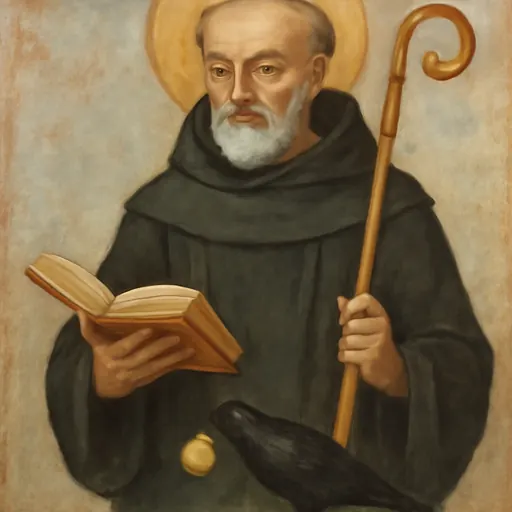
St. Benedict of Nursia (about 480 to 547) was an Italian monk who wrote the Rule of St. Benedict, the guide to monastic life followed by Benedictine monks and nuns for nearly 1,500 years, and founded the abbey of Monte Cassino. He is called the father of Western monasticism and is the patron saint of Europe. His feast day is July 11, and the St. Benedict medal, with its Latin prayer against evil, is one of the most popular Catholic medals.
Who was St. Benedict?
Benedict of Nursia was a monk who lived in Italy in the late 5th and early 6th centuries, while the old Roman world was breaking apart under Gothic kings and Byzantine armies. He left his studies in Rome to live as a hermit, gathered disciples, founded monasteries at Subiaco and then at Monte Cassino, and wrote a short rule for his monks. That rule, a book of 73 brief chapters, became the pattern for monastic life across Western Europe. Benedictine, Cistercian and Trappist monks and nuns still live by it.
Almost everything known about his life comes from one source: the second book of the Dialogues of Pope St. Gregory the Great, written around 593, roughly half a century after Benedict died. Gregory says he got his stories from four of Benedict's disciples, including Constantinus, who succeeded him as abbot, and Honoratus, then abbot of Subiaco. The Catholic Encyclopedia calls Gregory's account "rather a character sketch than a biography." Its only firm date is Totila's visit to Monte Cassino, which the Catholic Encyclopedia places in 543. Benedict's traditional dates are about 480 to 547.
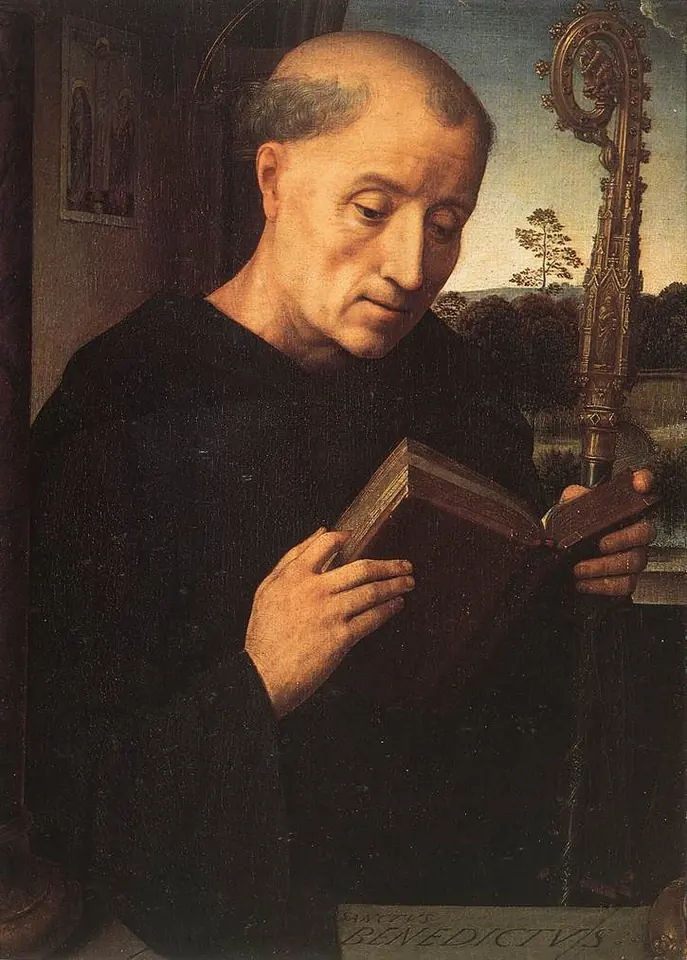

Today most people meet Benedict through a small medal. The St. Benedict medal, with its cross and rows of Latin initials, hangs from rosaries, car mirrors and front doors around the world, and is explained in full below.
The life of St. Benedict
Nursia and Rome
Gregory says Benedict was born "in the province of Nursia, of honorable parentage," the town in the mountains of Umbria now called Norcia. He was sent to Rome to study. Disgusted by the loose lives of the students around him, he "drew back his foot," in Gregory's words, and left the city, "instructed with learned ignorance, and furnished with unlearned wisdom." A tradition accepted by St. Bede gives him a twin sister, St. Scholastica.
The broken sieve
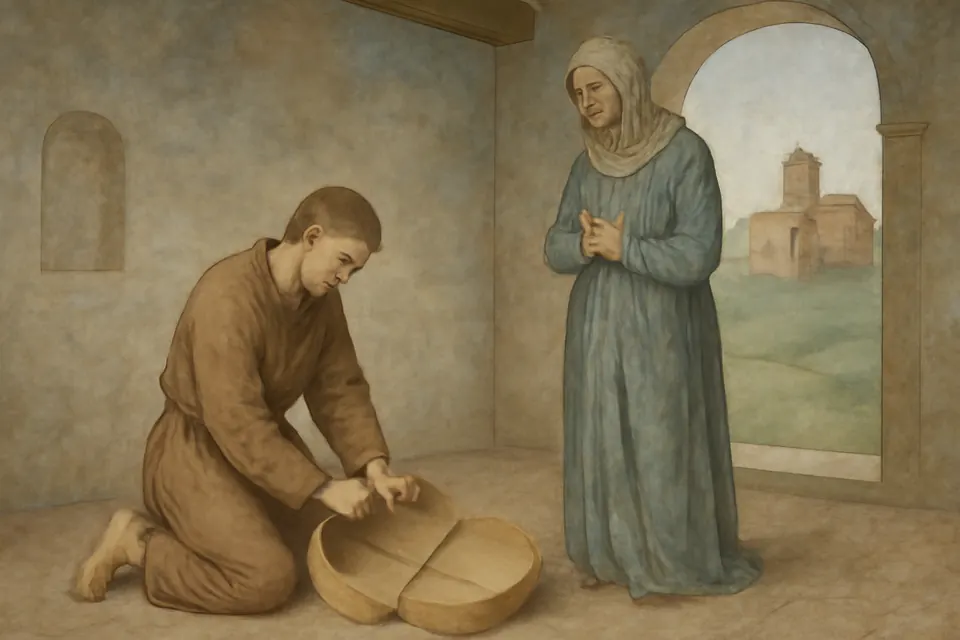
His old nurse went with him when he left Rome, and they settled at a village Gregory calls Enfide (today's Affile, near Subiaco), living near the church of St. Peter. There the nurse borrowed an earthenware sieve for cleaning wheat and broke it in two. Benedict took the pieces, prayed over them with tears, and found the sieve whole. The villagers hung it over the church door, where Gregory says it stayed until the Lombard invasions. The story is traditional.
Three years in the cave at Subiaco
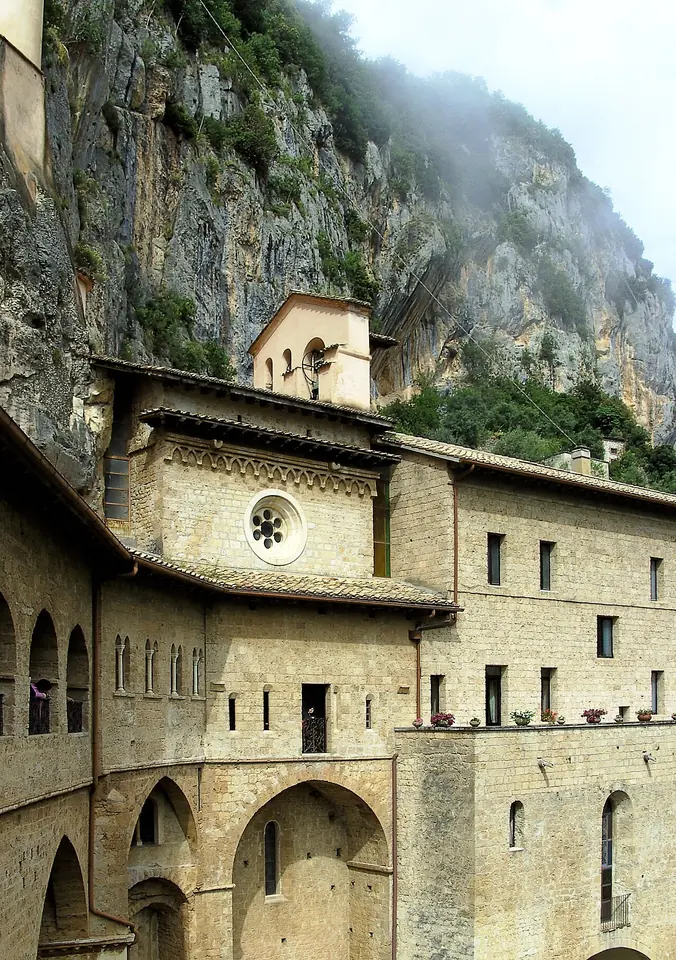
Embarrassed by the attention, Benedict slipped away from his nurse and went alone into the gorge of the Aniene River at Subiaco, about forty miles east of Rome. A monk named Romanus, from a monastery on the cliff above, gave him a monk's habit and kept his secret. For three years Benedict lived in a narrow cave. Romanus saved part of his own bread and let it down to him on a long rope, with a little bell tied on so Benedict would hear it coming. Gregory says the devil once threw a stone and broke the bell.


In the cave Benedict faced a fierce temptation of the flesh, the memory of a woman he had once seen. Gregory says he threw off his clothes and rolled in a thicket of briars and nettles until the temptation left him, and that he never felt it so strongly again. The cave, now called the Sacro Speco ("holy cave"), lies inside a monastery built into the cliff face in the Middle Ages.

The poisoned wine
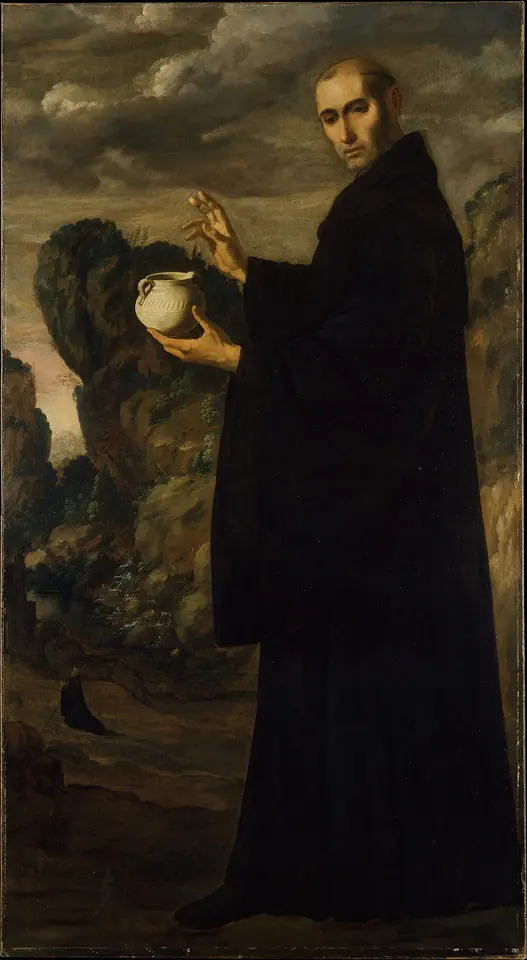
Word spread. When the abbot of a nearby monastery died (the Catholic Encyclopedia notes the tradition that it was at Vicovaro), its monks begged Benedict to lead them. He warned them that their ways and his would never agree, then gave in. When he enforced a regular life, they turned on him and put poison in his wine. Following custom, the glass was brought to the abbot to bless. Benedict made the sign of the cross over it, and the glass shattered "as though the sign of the cross had been a stone thrown against it." He told the monks calmly, "Almighty God have mercy on you," and went back to his cave. This is the cup on the St. Benedict medal.

Twelve monasteries, Maurus and Placid
Disciples kept coming, and Benedict built twelve small monasteries in the valley around Subiaco, each with twelve monks and a superior. Roman nobles brought their sons to be trained, among them two boys named Maurus and Placid, who became his best-known disciples.
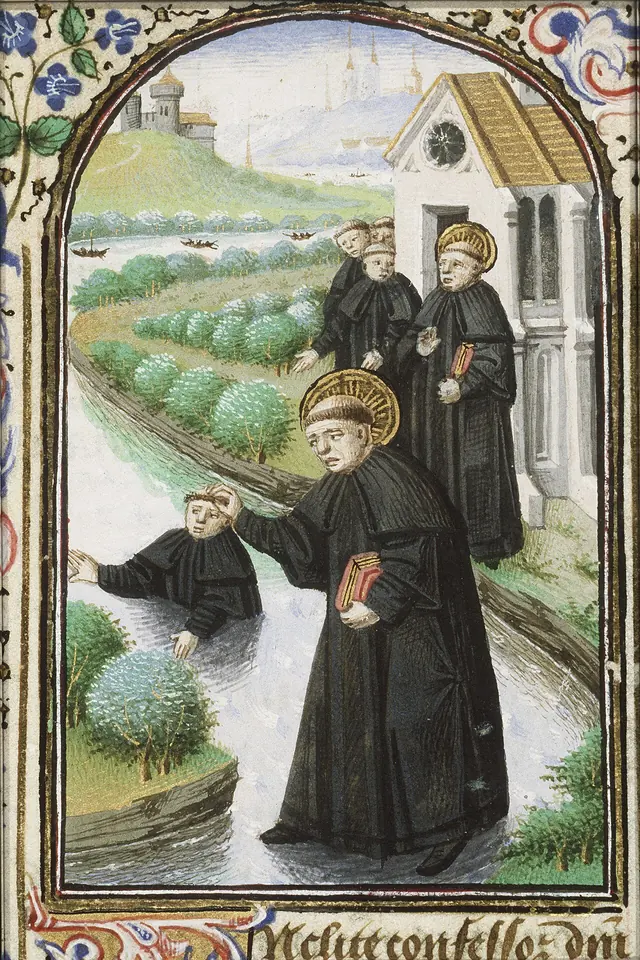
One day, Gregory says, Placid went to the lake for water and fell in, and the current carried him out "as far as one may shoot an arrow." Benedict, in his cell, knew it at once and sent Maurus running. Maurus reached the boy, pulled him out by the hair, and only on the shore realized he had been running on the water. Each credited the other, until Placid said that as he was pulled out he had seen the abbot's cloak above his head.

Florentius and the raven
A jealous local priest, Florentius, sent Benedict a poisoned loaf as a gift. A raven from the woods came to Benedict every day at dinner to be fed. Benedict threw it the loaf and told it, "In the name of Jesus Christ our Lord, take up that loaf, and leave it in some such place where no man may find it." The bird hopped around the bread, croaking, then carried it off and came back three hours later for its usual meal. When Florentius next tried to corrupt the young monks, Benedict left Subiaco to protect them.
Monte Cassino
Around 529 (the traditional date; Gregory gives none), Benedict moved with a few monks to Monte Cassino, a mountain above the town of Cassino about eighty miles southeast of Rome. On its summit stood an old temple of Apollo with sacred groves around it, where country people still offered sacrifice. Gregory says Benedict smashed the idol, turned the temple into an oratory of St. Martin and built an oratory of St. John the Baptist where Apollo's altar had been. Here he built a single large monastery instead of many small ones, and here, most historians think, he wrote his Rule.
The visit of King Totila
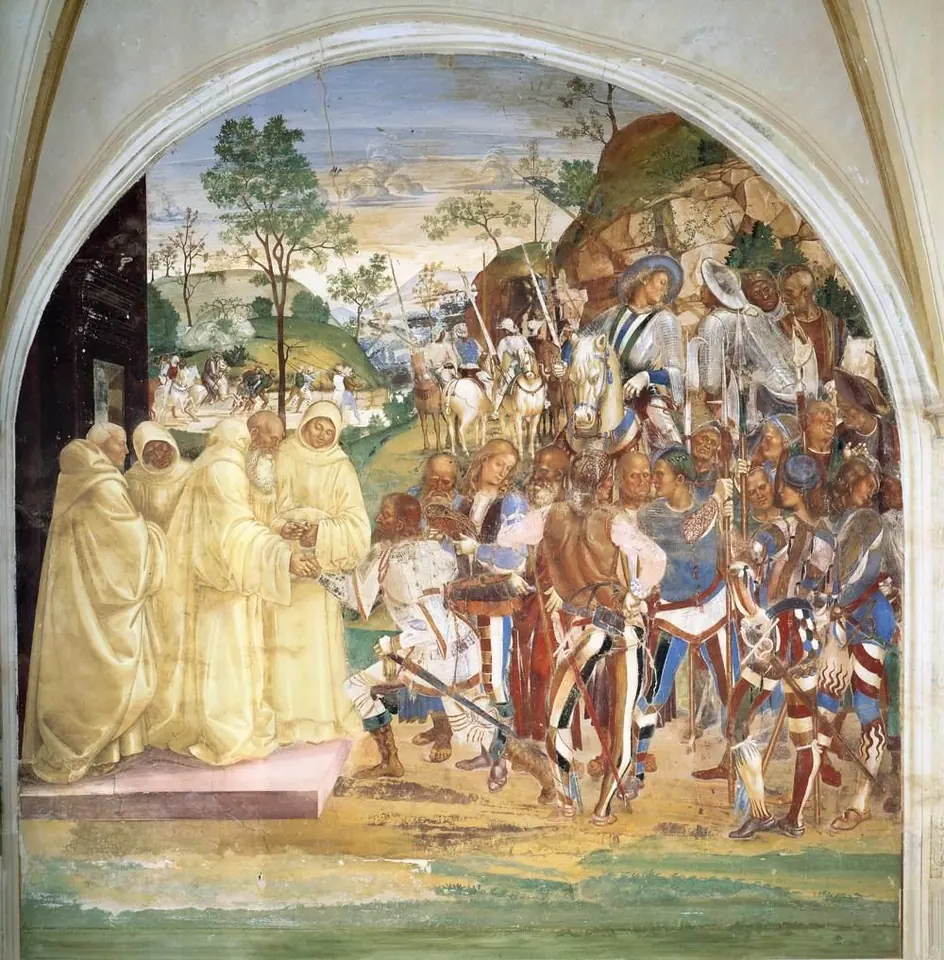
Gregory's best-known story from Monte Cassino involves Totila, king of the Ostrogoths. To test Benedict's gift of prophecy, Totila first sent a guardsman named Riggo dressed in the king's own shoes and robes. Benedict saw through it at once. When the king came himself, he fell on the ground at a distance, and Benedict lifted him up and rebuked him: "Into the city of Rome shall you enter, and over the sea shall you pass: nine years shall you reign, and in the tenth shall you leave this mortal life." Gregory says Totila was less cruel from then on, and that the prophecy came true.

Scholastica and the storm
Benedict's sister Scholastica, a nun "dedicated from her infancy to our Lord," lived near Monte Cassino and visited him once a year at a house a little way from the monastery. At their last meeting she begged him to stay the night and talk about heaven. He refused, saying he could not spend a night outside his monastery. Scholastica bowed her head on her hands and prayed, and a storm broke out of a clear sky, so violent that no one could leave. "I desired you to stay, and you would not hear me," she told him; "I have desired it of our good Lord, and he has granted my petition." Gregory's comment is short: "she who loved more, did more."
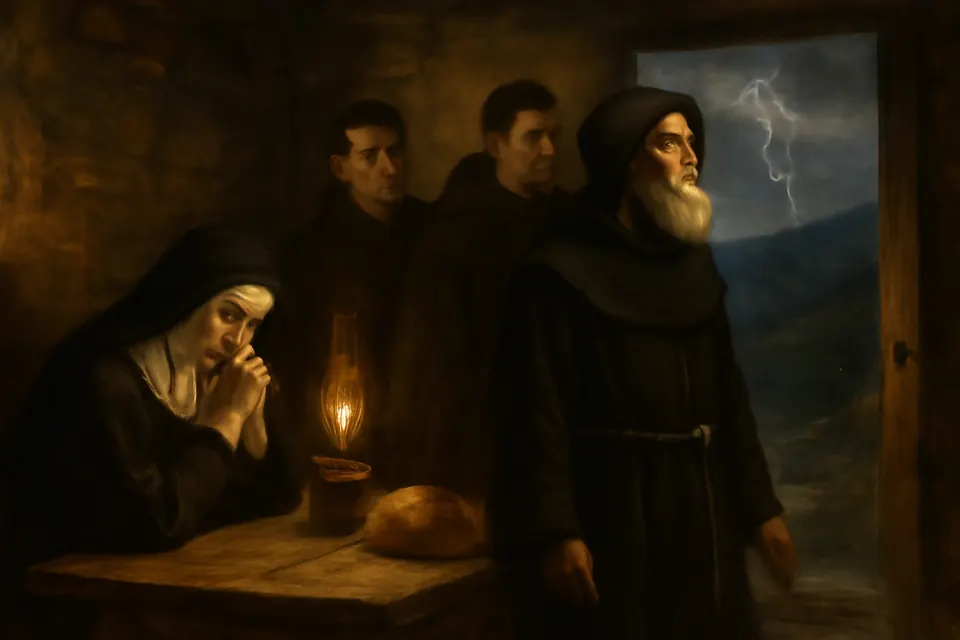
Three days later, standing in his cell, Benedict saw her soul rise to heaven in the form of a dove. He had her buried in the grave he had made for himself. Not long after, Gregory says, Benedict saw "the whole world, gathered together, as it were, under one beam of the sun" in a vision at his window before dawn.


His death
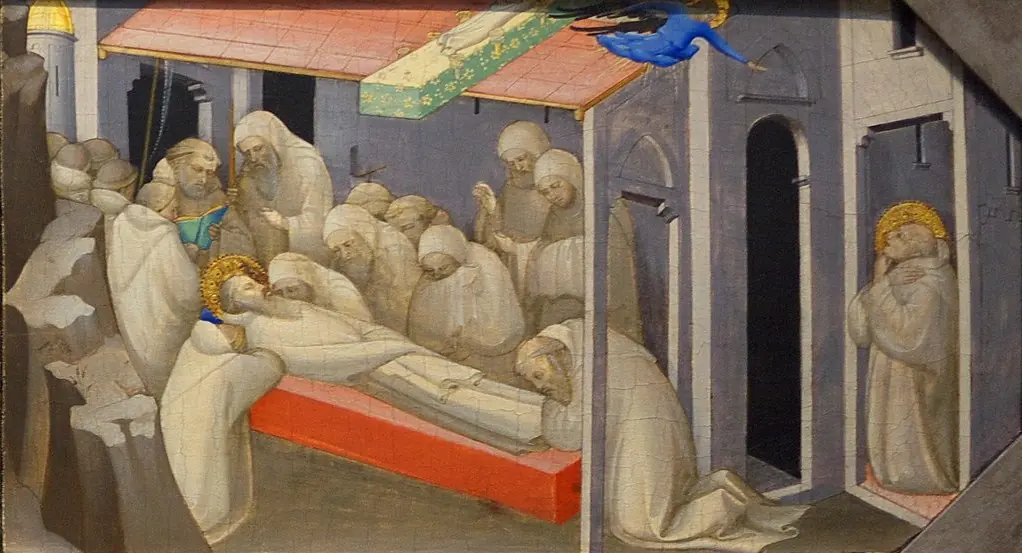
Benedict foretold his own death. Six days before, he had his grave opened, and a fever took hold of him. On the sixth day he had the monks carry him into the chapel, received Communion, and died standing, his arms held up by his brothers, praying. Two monks, one in the monastery and one far away, saw the same vision that day: a road covered with carpets and lit with lamps, running east from Monte Cassino into heaven, and a man who told them, "This is the road taken by blessed Benedict, the Lord's beloved, when he went to heaven."

The Rule of St. Benedict
Gregory sends readers to the Rule to know Benedict's life, "for the holy man could not otherwise teach, than he himself had lived." The Rule borrows from earlier monastic writings, especially the anonymous Rule of the Master, and from the desert tradition of St. Anthony the Great and John Cassian. What made it last was its moderation. The quotations below are from the translation by Leonard J. Doyle (1948), published by the Order of St. Benedict.
The Prologue begins, "Listen carefully, my child, to your master's precepts, and incline the ear of your heart." It promises a community that is demanding but humane:
And so we are going to establish a school for the service of the Lord. In founding it we hope to introduce nothing harsh or burdensome.
The Rule organizes the day around the Opus Dei, the "work of God," the prayer of the psalms sung together seven times a day and once at night. Around it come reading and manual work. Chapter 48 opens, "Idleness is the enemy of the soul." Chapter 53 sets the rule for hospitality: "Let all guests who arrive be received like Christ, for He is going to say, 'I came as a guest, and you received Me.'" Among the "tools for good works" in chapter 4 is a line Benedictines quote often: "To prefer nothing to the love of Christ."
"Ora et labora"
"Ora et labora," pray and work, is often given as the Benedictine motto. It is a fair summary of the Rule's balance, and Paul VI used it in 1964 when he named Benedict patron of Europe. But the words are not in the Rule. The Benedictine scholar Terrence Kardong writes that the phrase appears nowhere in Benedictine history before the 19th century and traces it to a popular book on monastic life by Maurus Wolter, the German abbot who founded the Beuronese Congregation. The older motto, found over many abbey doors, is simply Pax, peace.
The miracles of St. Benedict
No miracle of Benedict's has been formally investigated; his cult is far older than that process. Gregory names his witnesses, but his stories are labeled traditional here.
- The broken sieve made whole at Enfide: traditional (Dialogues II, 1).
- The poisoned wine glass that shattered at his blessing: traditional (II, 3).
- The billhook blade a Gothic monk lost in the lake, which rose and fit back onto its handle: traditional (II, 6).
- Maurus walking on the water to save Placid: traditional (II, 7).
- The raven and the poisoned loaf: traditional (II, 8).
- A boy crushed under a fallen wall restored to life: traditional (II, 11).
- Prophecies, including Totila's reign and the sack of Monte Cassino by the Lombards: traditional (II, 15 and 17).
- Favors attributed to the St. Benedict medal, especially in temptation and spiritual trouble: reported. These are personal testimonies; the Church has not examined them.


Why St. Benedict is the patron saint of Europe
On October 24, 1964, the day he consecrated the rebuilt church of Monte Cassino, Pope Paul VI proclaimed Benedict principal patron of all Europe in the apostolic letter Pacis nuntius ("Messenger of peace"). The letter says Benedict and his monks brought Christian civilization to the peoples from the Mediterranean to Scandinavia and from Ireland to Poland "with the cross, the book and the plow." Pope John Paul II later named Sts. Cyril and Methodius, and then St. Bridget of Sweden, St. Catherine of Siena and St. Edith Stein, as co-patrons. Pope Benedict XVI said at his first general audience in 2005 that he took his name partly in honor of Benedict, "a fundamental reference point for European unity."
His other patronages come from his life. He is patron of monks and nuns who follow his Rule; of protection against poison, from the wine glass and the raven's loaf; of people fighting temptation, from the briars at Subiaco and the prayer on his medal; and of the dying, because he died standing in prayer after Communion. See all the patron saints by cause.
Symbols of St. Benedict in art
Benedict is usually shown as an older abbot, often with a beard, in the black habit of the Benedictines. Painters for the reformed white-robed orders, such as the Olivetans at Monte Oliveto Maggiore, dressed him in white instead. Look for:
- The book of the Rule, open or closed, sometimes open to its first word, Ausculta ("Listen").
- An abbot's crozier, the staff of his office.
- A broken cup or jug, like the cracked jug in Zurbarán's painting, sometimes with a serpent crawling out of it to show the poison.
- A raven, often with a loaf in its beak.
- A bundle of rods, the discipline of an abbot.
- His sister Scholastica in a nun's veil, often with a dove.
- A cave or a rocky landscape, for Subiaco.
The great painted cycles of his life follow Gregory scene by scene. The best known are the frescoes in the Great Cloister of Monte Oliveto Maggiore near Siena, begun by Luca Signorelli in the late 1490s and finished by Sodoma between 1505 and 1508. Eastern icons, which remember him on March 14, show him as a monastic father in a dark mantle and hood, holding a scroll.
The St. Benedict medal
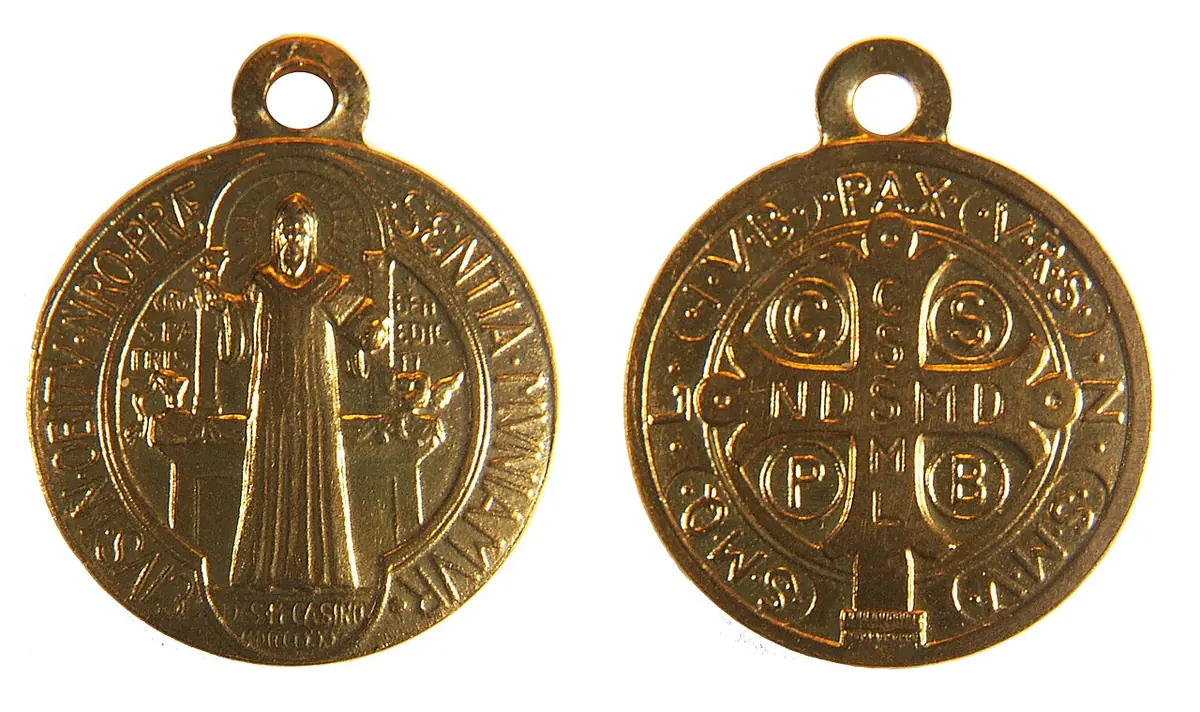
The St. Benedict medal is a sacramental: an object blessed by the Church to stir up faith and devotion, not a charm. Pope Benedict XIV approved it in briefs of December 23, 1741, and March 12, 1742.

Where the letters came from
According to the Catholic Encyclopedia, the medal's story starts with a witchcraft trial in 1647 at Natternberg, near the abbey of Metten in Bavaria. The accused women said they had no power over Metten because it was under the protection of the cross. Investigators found crosses painted on the abbey walls with rows of letters no one could explain. The answer turned up in the Metten library: a manuscript of 1415 (the Mettener Armenbibel, now in the Bavarian State Library in Munich as Clm 8201) showing St. Benedict holding a staff ending in a cross, with the full Latin words written out. "Vade retro Satana" itself is older and echoes Jesus' words to Peter, "Get behind me, Satan" (Mark 8:33).
The back of the medal, letter by letter
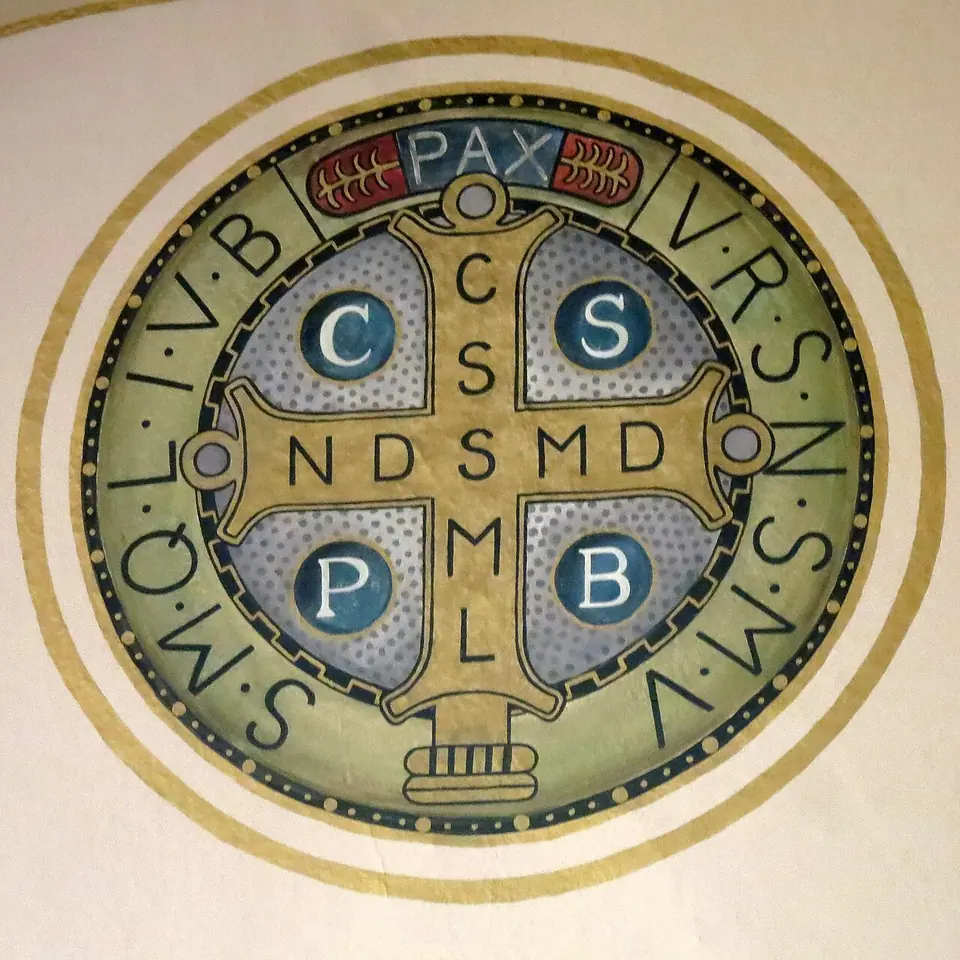

- PAX at the top of the cross: "Peace," the old Benedictine motto. Some older medals have IHS, the monogram of the name of Jesus, instead.
- C S P B in the four corners of the cross: Crux Sancti Patris Benedicti, "The cross of our holy father Benedict."
- C S S M L down the upright beam: Crux sacra sit mihi lux, "May the holy cross be my light."
- N D S M D across the crossbeam: Non draco sit mihi dux, "Let not the dragon be my guide." The dragon is the devil.
- V R S N S M V around the rim, beginning at the right of PAX: Vade retro Satana! Numquam suade mihi vana! "Begone, Satan! Never tempt me with your vanities!"
- S M Q L I V B finishing the circle: Sunt mala quae libas. Ipse venena bibas! "What you offer me is evil. Drink the poison yourself!"
The front: the 1880 jubilee medal
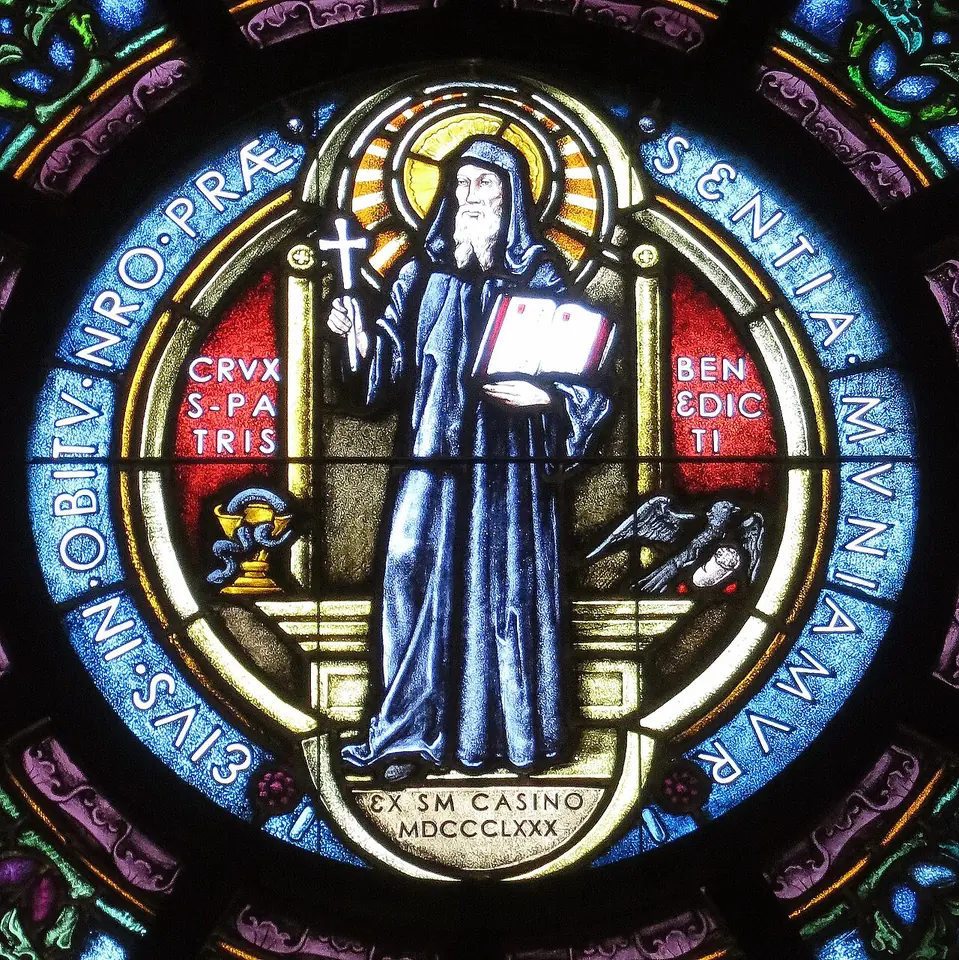
The design most people own today is the jubilee medal struck by the monks of Monte Cassino in 1880, the 1,400th anniversary of Benedict's birth. The Order of St. Benedict says it was designed at St. Martin's Archabbey in Beuron, Germany, at the request of Monte Cassino's prior, Boniface Krug. The Catholic Encyclopedia adds that only Monte Cassino had the right to strike the jubilee medal. On the front:
- St. Benedict stands holding a cross in his right hand and the book of his Rule in his left.
- A cup on one side, sometimes with a serpent rising from it, recalls the poisoned wine.
- A raven on the other side recalls the poisoned loaf.
- Crux s. patris Benedicti, "The cross of our holy father Benedict," appears above the cup and raven.
- Around the edge: Eius in obitu nostro praesentia muniamur, "May we be strengthened by his presence in the hour of our death."
- Below his feet: Ex S M Casino MDCCCLXXX, "From holy Monte Cassino, 1880."

How the medal is used
The Order of St. Benedict says there is no prescribed way to carry it. People wear it on a chain, set it into a rosary or crucifix, keep it in a pocket, purse or car, or place it in the home. Some set medals into the foundations of new buildings. Any priest or deacon may bless it; the traditional blessing includes an exorcism, a prayer for health of soul and body, and holy water. Benedictine oblates may wear it in place of a small scapular.
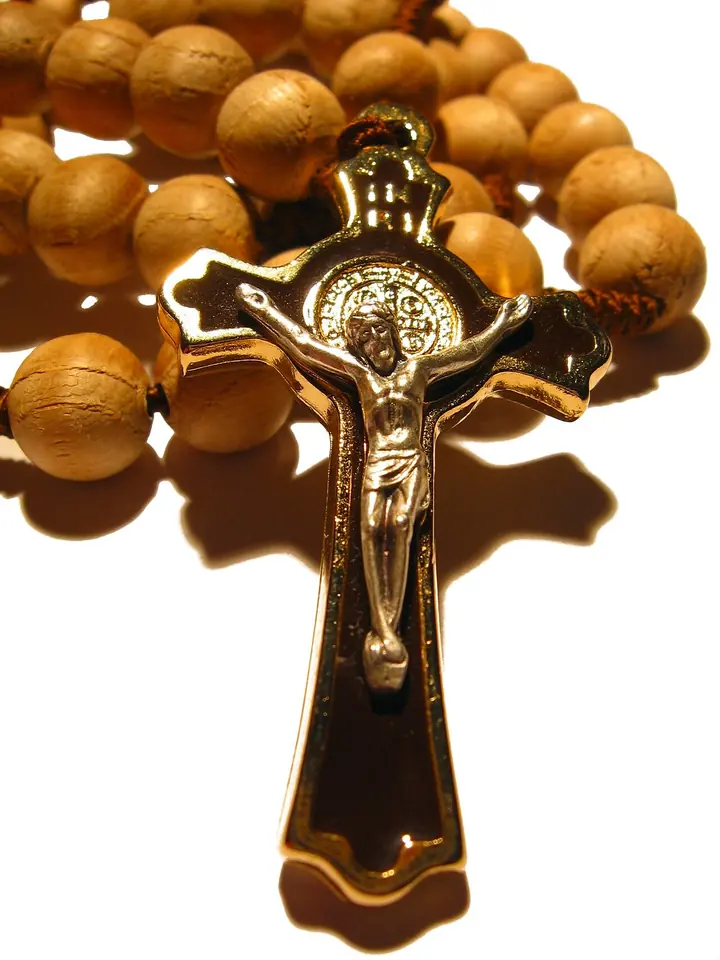

The Benedictines are firm that the medal works only through faith and prayer. The Order's own explanation says plainly that "we reject any use of religious articles as if they were mere charms or had some magic power to bring us good luck."
Feast day and where St. Benedict is honored
The Catholic Church celebrates St. Benedict on July 11. For centuries his main feast was March 21, the traditional day of his death, called his Transitus ("passing"), with a second feast on July 11 for the translation of his relics. Because March 21 always falls in Lent, the 1969 reform of the calendar moved the universal feast to July 11. Benedictine monasteries keep both days, and the Orthodox Church remembers him on March 14. See our feast days calendar.
Monte Cassino
Benedict's monastery has been destroyed four times: by the Lombards in the late 6th century (the disaster Gregory says Benedict foresaw), by Saracens in the 880s, by an earthquake in 1349, and by Allied bombing on February 15, 1944, during the battle for the Gustav Line. Each time it was rebuilt. Paul VI consecrated the new church on October 24, 1964. The tomb of Benedict and Scholastica lies beneath the high altar.
Fleury and the relics
The Abbey of Fleury, now Saint-Benoît-sur-Loire in France, holds that in the late 7th century, while Monte Cassino lay in ruins, its monks carried the bodies of Benedict and Scholastica to France. Monte Cassino has long denied it, though the Catholic Encyclopedia's article on the abbey (1911) judged the translation to Fleury "almost impossible to doubt." Both abbeys venerate relics of the saint today.
Subiaco and Norcia
Pilgrims still visit Benedict's cave at the Sacro Speco. In Norcia, the Basilica of St. Benedict, built over the traditional site of his family home, collapsed in the earthquake of October 30, 2016, leaving little more than its facade.
Prayer to St. Benedict
The prayer of the medal
The oldest prayer tied to St. Benedict is the exorcism formula from the Metten manuscript of 1415, which the medal abbreviates. Many Catholics say it in temptation:
Crux sacra sit mihi lux; non draco sit mihi dux. Vade retro Satana, numquam suade mihi vana; sunt mala quae libas, ipse venena bibas.
May the holy cross be my light; let not the dragon be my guide. Begone, Satan, never tempt me with your vanities; what you offer me is evil, drink the poison yourself.
The collect of his feast
The Roman Missal (English translation, 2011) gives this prayer for the Mass of July 11:
O God, who made the Abbot Saint Benedict an outstanding master in the school of divine service, grant, we pray, that, putting nothing before love of you, we may hasten with a loving heart in the way of your commands. Through our Lord Jesus Christ, your Son, who lives and reigns with you in the unity of the Holy Spirit, God, for ever and ever.
The phrases "school of divine service" and "putting nothing before love of you" come from Benedict's own Rule.
Other prayers
A prayer beginning "Gracious and holy Father, give us the wisdom to discover you" circulates widely as "the Prayer of St. Benedict." It is not in the Rule or in Gregory's Dialogues, and its origin is uncertain. The Rule itself ends by promising that whoever keeps "this minimum Rule which we have written for beginners" will, "under God's protection," reach "the loftier heights of doctrine and virtue."
Frequently asked questions
What is St. Benedict the patron saint of?
Europe, which Pope Paul VI declared in 1964, and monks and nuns who follow his Rule. Because of the poisoned cup in his life story and the prayer on his medal, Catholics also ask his help against poison, temptation and evil, and for a good death, since the medal asks for his presence "at the hour of our death."
What do the letters on the St. Benedict medal mean?
On the back, CSPB stands for Crux Sancti Patris Benedicti (the cross of our holy father Benedict). Down the cross, CSSML means Crux sacra sit mihi lux (may the holy cross be my light); across it, NDSMD means Non draco sit mihi dux (let not the dragon be my guide). Around the edge, VRSNSMV SMQLIVB stands for Vade retro Satana, numquam suade mihi vana; sunt mala quae libas, ipse venena bibas: "Begone, Satan, never tempt me with your vanities; what you offer me is evil, drink the poison yourself." PAX, peace, is at the top.
When is St. Benedict's feast day?
July 11 in the Catholic Church's General Roman Calendar. Until the calendar reform of 1969 his feast was March 21, the traditional day of his death, which always falls in Lent. Benedictine monasteries still keep March 21 as well, and the Orthodox Church remembers him on March 14.
Does a St. Benedict medal need to be blessed?
The medal is a sacramental, and the custom is to have it blessed. The Order of St. Benedict says any priest or deacon may bless it; the traditional blessing includes a prayer of exorcism. There is no required way to wear or carry it, and Benedictines stress that it is not a charm.
What is the St. Benedict prayer?
Usually people mean the Latin verses on the medal, "Vade retro Satana," a short prayer against temptation found in a manuscript of 1415 from Metten Abbey in Bavaria. The Mass of his feast has its own collect, quoted on this page. A longer "Prayer of St. Benedict" that circulates online does not come from his Rule or from Gregory the Great's account of his life.
Did St. Benedict say "ora et labora"?
No. "Pray and work" is a fair summary of the balance of prayer, reading and manual labor in his Rule, but the phrase does not appear in the Rule. The Benedictine scholar Terrence Kardong traces it to a 19th-century book on Benedictine life by the German abbot Maurus Wolter.
Who was St. Benedict's sister?
St. Scholastica, a consecrated nun who, Gregory the Great says, visited him once a year near Monte Cassino. A tradition accepted by Bede makes them twins. She died a few days after their last meeting, and Benedict buried her in the grave he had prepared for himself.
Where is St. Benedict buried?
Gregory the Great says he was buried in the chapel of St. John the Baptist at Monte Cassino, in the same grave as Scholastica. The French abbey of Fleury (Saint-Benoît-sur-Loire) says monks carried both bodies there in the 7th century. Monte Cassino has always said the relics stayed, and both abbeys honor them today.
Sources
- Gregory the Great, Dialogues, Book II: Life of Saint Benedict (P. W. translation, 1608, ed. Edmund Gardner, 1911), Order of St. Benedict
- The Rule of St. Benedict, translated by Leonard J. Doyle (1948), Order of St. Benedict
- Catholic Encyclopedia (1907): St. Benedict of Nursia
- Catholic Encyclopedia (1912): Medal of Saint Benedict
- Order of St. Benedict: The Medal of Saint Benedict
- Paul VI, Apostolic Letter Pacis nuntius (October 24, 1964)
- Benedict XVI, General Audience of 27 April 2005
- Benedict XVI, General Audience of 9 April 2008: Saint Benedict of Norcia
- Terrence Kardong, Work Is Prayer: Not! (Order of St. Benedict)
- New Liturgical Movement: The Feast of St Benedict (2014)
- Catholic Encyclopedia (1911): Abbey of Monte Cassino
- Orthodox Church in America: Lives of all saints commemorated on March 14
- Roman Missal, Third Edition: Collect for July 11, Saint Benedict, Abbot
- Roman Martyrology, July 11 and March 21