St. Benedict medal

The St. Benedict medal is a sacramental showing St. Benedict on the front and, on the back, a cross ringed with the initials of a Latin prayer against evil: "May the holy cross be my light... Begone, Satan!" Pope Benedict XIV approved it in 1742. We wear it, blessed by a priest or deacon, as a prayer for protection, never as a charm.
Few objects pack so much prayer into so little metal. A St. Benedict medal is about the size of a thumbnail, yet it carries a picture of the saint, a cross, and twenty-four letters that spell out a whole Latin prayer against the devil. Here is what every image and every letter means, where the medal came from, and how the Church asks us to use it.
What is the St. Benedict medal?
The St. Benedict medal is a sacramental: a sacred sign, blessed by the Church, that disposes us to receive God's grace and reminds us to pray. The Catechism teaches that sacramentals "do not confer the grace of the Holy Spirit in the way that the sacraments do, but by the Church's prayer, they prepare us to receive grace and dispose us to cooperate with it." So the medal has no power of its own. Its strength is the cross of Christ it shows, the prayer of the Church that blesses it, and the faith of the one who wears it.
The Catholic Encyclopedia describes it as "a medal, originally a cross," and the Benedictines still call it the medal-cross of St. Benedict. That name says what it is about. Benedict worked his miracles with the sign of the cross, and the medal puts that cross in our hands.
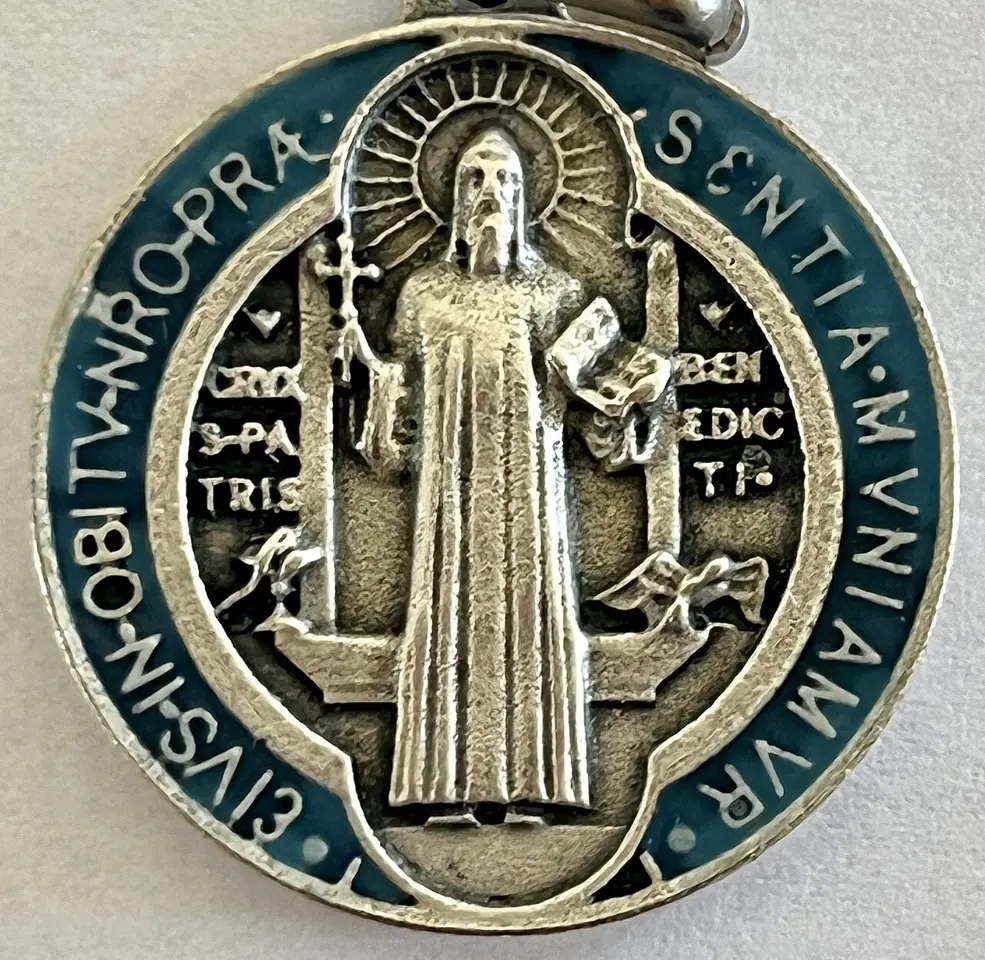
The front of the medal: St. Benedict and his miracles
Most medals sold today follow the jubilee design of 1880. Each detail on the front recalls a story from St. Gregory the Great's life of St. Benedict, written about fifty years after the saint's death.
- St. Benedict stands in his monk's habit. In his right hand he holds up a cross, the sign he trusted above everything.
- In his left hand is the book of his Rule, the guide for monks that Benedictines still follow.
- A cup, often with a small serpent rising from it, stands on a pedestal at one side. Monks who resented his discipline once handed him poisoned wine; when he made the sign of the cross over it, the cup shattered.
- A raven stands at the other side. Gregory tells how a jealous priest sent Benedict a poisoned loaf, and the saint ordered a raven that came to him each day to carry it away where no one could find it.
- Crux s. patris Benedicti, "the cross of our holy father Benedict," is lettered above the cup and the raven.
- Around the rim runs Eius in obitu nostro praesentia muniamur: "May we be strengthened by his presence in the hour of our death." Benedict died standing in the oratory at Monte Cassino with his hands raised in prayer, held up by his monks, and so the Church has long asked his help for a holy death.
- Below his feet, Ex S M Casino MDCCCLXXX: "from holy Monte Cassino, 1880."
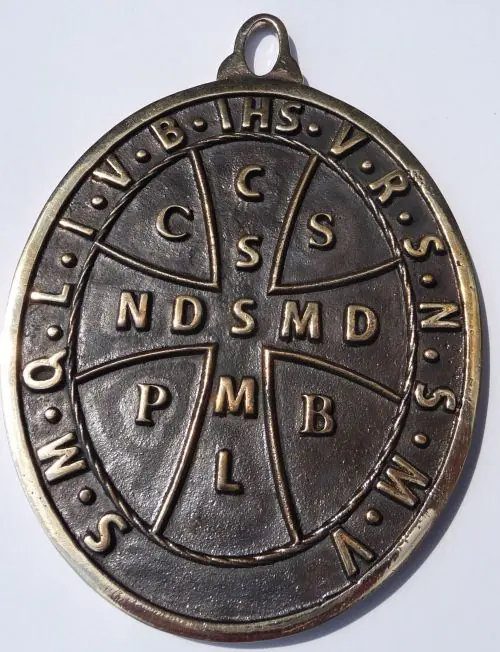
The back of the medal: what every letter means
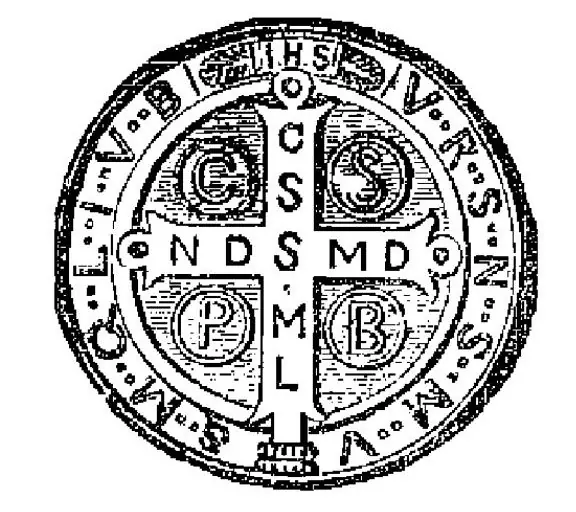
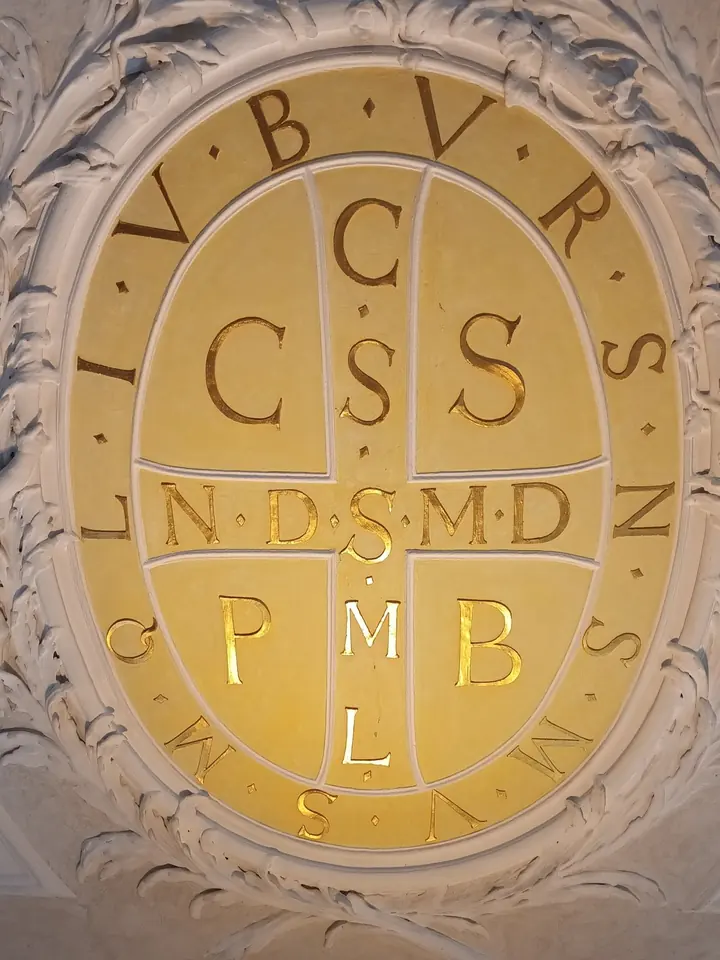
Turn the medal over and the cross fills it. The letters are initials, a kind of shorthand familiar to anyone who knows that IHS stands for the name of Jesus. Read them in this order:
- C S P B, in the four corners of the cross: Crux Sancti Patris Benedicti, "The cross of our holy father Benedict."
- C S S M L, down the upright beam: Crux sacra sit mihi lux, "May the holy cross be my light."
- N D S M D, across the crossbeam: Non draco sit mihi dux, "Let not the dragon be my guide." The dragon is the devil, as in Revelation 12. Some versions read Nunquam draco, "never let the dragon."
- PAX, at the top: "Peace," the old Benedictine motto. Older medals often have IHS here instead.
- V R S N S M V, around the rim, starting at the right of PAX: Vade retro Satana, nunquam suade mihi vana, "Begone, Satan, never tempt me with your vain things."
- S M Q L I V B, finishing the circle: Sunt mala quae libas, ipse venena bibas, "What you offer me is evil; drink the poison yourself."

Abbot Prosper Guéranger, whose little book of 1862 made the medal known across the Catholic world, explained that the first two lines are "the Christian's protestation that he confides in the holy cross, and refuses to bear the yoke which the devil would put upon him." The second pair takes up the two great temptations of Benedict's life: the struggle he won in his cave at Subiaco by the sign of the cross, and the poisoned cup. Vade retro, Satana goes back further still, to Jesus' own rebuke to Peter, "Go behind me, Satan" (Mark 8:33, Douay-Rheims).
The history of the St. Benedict medal
The witches' testimony and the Metten manuscript (1647)
No one knows when the first medal of St. Benedict was struck. What we do know begins with a trial. In 1647, at Natternberg in Bavaria, women accused of witchcraft testified that their spells had never worked where a cross was hung up or buried, and that they had no power over the nearby Benedictine abbey of Metten. The magistrates asked the monks why. Searching the abbey, the monks found old crosses painted on the walls, each ringed with rows of capital letters. Nobody in the house could say what they meant.
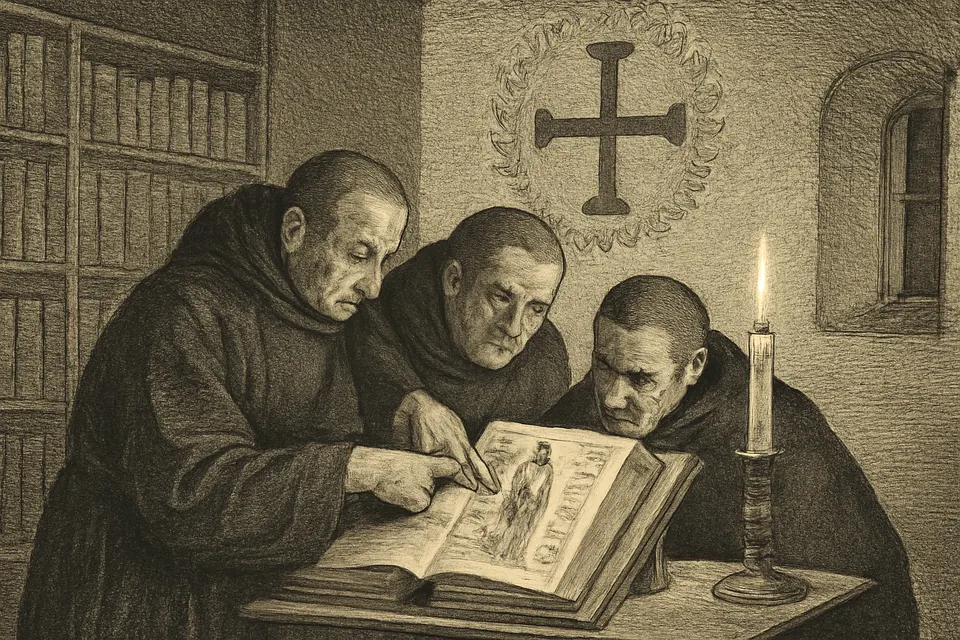
The answer turned up in the library. Guéranger describes a richly bound book of the Gospels written for Abbot Peter of Metten in 1415. Among its pen drawings was one of St. Benedict in his cowl, holding a staff that ended in a cross. Written on the staff were the words Crux sacra sit mihi lux, non draco sit mihi dux; on a banner in his other hand were the lines beginning Vade retro Satana. The painted letters were the initials of that prayer, which was evidently already old and loved in 1415. The Benedictine scholar Bernard Pez published an engraving of the drawing in 1721.
After Metten, medals bearing St. Benedict, the cross and the letters were struck in Germany and spread through Catholic Europe. Guéranger adds that the Daughters of Charity of St. Vincent de Paul wore the medal on their rosaries, and that for many years, at least in France, it was made only for them.
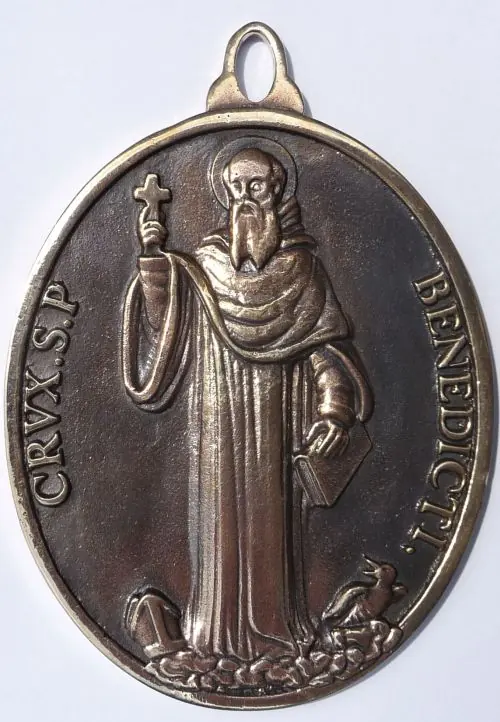
Approved by Pope Benedict XIV (1741 and 1742)
Not everyone welcomed it. A French priest, Jean-Baptiste Thiers, attacked the medal in his treatise on superstitions, arguing that letters no one could easily read must hide something suspect. The Holy See examined the question. At the request of Abbot Benno Löbl of the Benedictine abbey of St. Margaret in Prague, the Sacred Congregation of Indulgences approved a form for blessing the medal by a decree of December 23, 1741, and Pope Benedict XIV approved the medal itself, its cross, its image and its letters, in a brief of March 12, 1742, attaching indulgences to its devout use. Rome found nothing superstitious in it.
The jubilee medal of Monte Cassino (1880)
The design most of us own today was made for a birthday. In 1880 the Benedictines kept the 1,400th anniversary of St. Benedict's birth, and the monks of Monte Cassino, where he died and is buried, struck a new medal to mark it. The Order of St. Benedict says the design was produced at St. Martin's Archabbey in Beuron, Germany, at the request of Monte Cassino's prior, Boniface Krug, a monk who had come to Italy from St. Vincent Archabbey in Latrobe, Pennsylvania. The Catholic Encyclopedia notes that Pius IX granted it extra indulgences in a decree of December 31, 1877, and that Monte Cassino held the exclusive right to strike it.
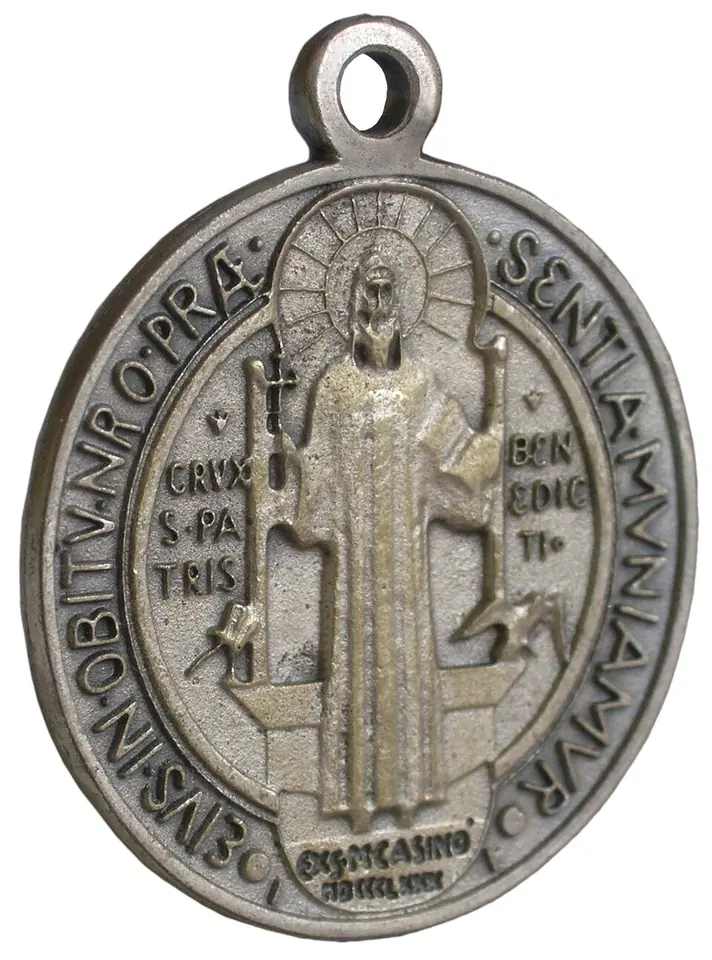
Medals in the older "ordinary" style never disappeared. They usually lack the prayer for a happy death around the front and may carry IHS above the cross. Both kinds are the same sacramental.
The St. Benedict crucifix
A St. Benedict crucifix sets the medal into a crucifix, usually where the two beams meet, so that Christ crucified and the cross of St. Benedict are held together. It is the old medal-cross in a new form. Guéranger's English editor recorded in 1880 that the Holy See had allowed the blessing and indulgences of the medal to be applied to a medal-cross, and English Benedictines struck one for the jubilee: the medal set "at the intersection of a floriated Latin cross," with briars, thistles, a rose and a lily recalling Benedict's victory over temptation. Today the most common form is the small crucifix at the end of a rosary.

How the medal is blessed
Any priest or deacon may bless a St. Benedict medal; it no longer needs a Benedictine. The traditional Latin blessing that Benedict XIV approved begins, like every blessing, with "Our help is in the name of the Lord." The priest then exorcises the medals in the name of the Father, the Son and the Holy Spirit, so that they may bring "health of mind and body" to those who use them. He asks God, through St. Benedict's intercession, to pour out his blessing on the medals so that those who wear them and strive to do good may escape the snares of the devil, and he sprinkles them with holy water. The Catechism calls it exorcism when the Church asks "publicly and authoritatively in the name of Jesus Christ" that a person or object be protected against the power of the Evil One. Blessing a medal in this way is a humble thing, quite different from the solemn exorcism of a possessed person, which only a priest with the bishop's permission may perform.
The old books list long series of indulgences attached to the medal. These belong to the time before Pope Paul VI's reform of 1967. Today the Church grants a partial indulgence to the faithful who devoutly use a medal "properly blessed by any priest," and a plenary indulgence on the feast of Sts. Peter and Paul, June 29, if the medal was blessed by the pope or a bishop and the faithful also make a profession of faith, with the usual conditions.
How to wear it, and why we do
The Order of St. Benedict says there is no prescribed way to carry the medal. The faithful wear it on a chain, attach it to a rosary, keep it in a pocket, purse or car, hang it in a home or business, and set it into the foundations of new buildings. Lay oblates of St. Benedict have been allowed since 1965 to wear it in place of the small scapular, and since 1959 priests may give the Blessing of St. Maur over the sick with a St. Benedict medal when no relic of the True Cross is at hand.
People wear it in temptation, in illness, on long journeys, in a house where things have gone wrong, and at the hour of death. The Benedictines are firm about the spirit of it: "we reject any use of religious articles as if they were mere charms or had some magic power to bring us good luck or better health." The Catechism names the danger plainly. To expect results from sacred signs by "their mere external performance, apart from the interior dispositions that they demand, is to fall into superstition." A medal worn without faith is a piece of metal. Worn with faith, it is a short prayer we carry everywhere, and a promise to turn to the cross when evil comes near.
The prayer of the St. Benedict medal
These are the words abbreviated on the back of the medal, in the English of the 1880 translation of Guéranger's book:
May the Holy Cross be my Light. Let not the Dragon be my Guide. Begone, Satan! and suggest not to me thy vain things: the cup thou profferest me is evil; drink thou thy poison.
Say it slowly, with the sign of the cross, when temptation comes. The Latin, its history and a traditional prayer to St. Benedict for a happy death are on our page for the St. Benedict prayer. His life, his Rule and his feast on July 11 are in our entry on St. Benedict, with his twin sister St. Scholastica and his biographer St. Gregory the Great. For another prayer of protection, pray the St. Michael prayer, and see every feast on the feast day calendar.
St. Benedict, pray for us.
Frequently asked questions
What do the letters on the St. Benedict medal mean?
They are initials of Latin prayers. C S P B: Crux Sancti Patris Benedicti, "the cross of our holy father Benedict." C S S M L: Crux sacra sit mihi lux, "may the holy cross be my light." N D S M D: Non draco sit mihi dux, "let not the dragon be my guide." V R S N S M V: Vade retro Satana, nunquam suade mihi vana, "begone, Satan, never tempt me with your vain things." S M Q L I V B: Sunt mala quae libas, ipse venena bibas, "what you offer is evil, drink your own poison." PAX means peace.
Is the St. Benedict medal a good luck charm?
No. It is a sacramental, a sacred sign blessed by the Church. Its value comes from God, through the Church's prayer and the faith of the one who wears it, not from the metal or the letters. The Catechism calls it superstition to expect results from sacred signs "apart from the interior dispositions that they demand." The medal is a prayer you carry, and it should lead you to Christ and the sacraments.
Who can bless a St. Benedict medal?
Any priest or deacon. When Benedict XIV approved the medal in 1742, the faculty to bless it was reserved to certain Benedictines, but the Order of St. Benedict notes that since 1964 any priest or deacon may bless it. The traditional Latin blessing includes an exorcism over the medals, a prayer for health of soul and body, and a sprinkling with holy water.
What is a St. Benedict crucifix?
A crucifix with a St. Benedict medal set where the beams cross, so that the front shows Christ crucified and the medal together. It grew out of the old "medal-cross of St. Benedict." In 1880 English Benedictines struck a cross of this kind for the saint's 1,400th birthday, with the medal at the center of a flowered Latin cross. Many rosaries end in one.
Can anyone wear a St. Benedict medal?
Yes. It isn't reserved to Benedictines or to Catholics, though it is meant to be worn with faith, as a prayer. Benedictine oblates, lay people attached to a monastery, have been allowed since 1965 to wear the medal in place of the small black scapular they once wore.
How should I wear a St. Benedict medal?
There is no required way. The Order of St. Benedict says it may be worn on a chain, attached to a rosary, carried in a pocket or purse, or kept in a car or home; some people set it into the foundations of a new house or hang it in a barn or shop. Have it blessed, and pray its words now and then so it stays a prayer and not an ornament.
What does "Eius in obitu nostro praesentia muniamur" mean?
It means "May we be strengthened by his presence in the hour of our death." It runs around the front of the 1880 jubilee medal. St. Benedict died standing in prayer in his oratory at Monte Cassino, held up by his monks, and the faithful have long asked his help for a holy death.
Sources
- Prosper Guéranger, The Medal or Cross of St. Benedict: Its Origin, Meaning, and Privileges (London: Burns and Oates, 1880), Internet Archive. The 1647 Metten story, the 1415 manuscript, Benno Löbl's petition, the brief of 1742 and the Latin rite of blessing (chapters IV, XI and XIV); the 1880 English medal-cross (appendix)
- Catholic Encyclopedia (1912): Medal of Saint Benedict
- Order of St. Benedict: The Medal of Saint Benedict. The 1880 jubilee medal's design at Beuron, use of the medal, oblates (1965), the Blessing of St. Maur (1959), blessing by any priest or deacon
- Catechism of the Catholic Church, paragraphs 1667–1673: Sacramentals
- Catechism of the Catholic Church, paragraphs 2110–2128 (2111 on superstition)
- Paul VI, Apostolic Constitution Indulgentiarum doctrina (January 1, 1967), norm 17