St. Andrew the Apostle
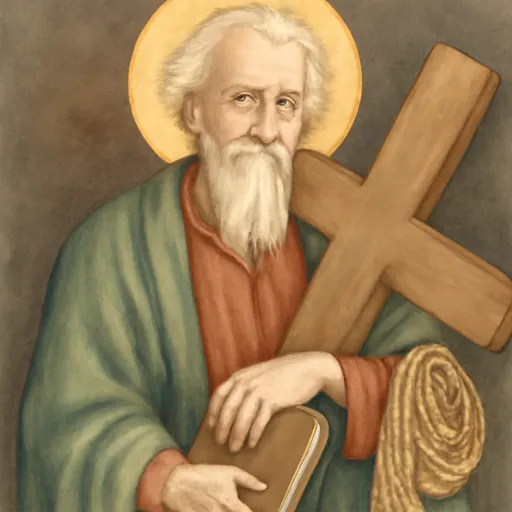
St. Andrew was a fisherman from Bethsaida in Galilee, a disciple of John the Baptist and the first of the twelve apostles to follow Jesus, so the Eastern Church calls him the "First-Called." He brought his brother Simon Peter to Jesus. Tradition says he was crucified at Patras in Greece on an X-shaped cross. His feast day is November 30, and he is the patron saint of Scotland, Greece, Russia and fishermen.
Who was St. Andrew?
St. Andrew was a fisherman from Bethsaida, on the Sea of Galilee, and the brother of Simon Peter. He was a disciple of John the Baptist before he met Jesus, and the Gospel of John makes him the first of the Twelve to follow Jesus and the one who brought Peter to him. For that reason the Byzantine Church calls him Protokletos, the "First-Called."
His name is Greek, not Hebrew. Pope Benedict XVI saw in it a sign of "a certain cultural openness in his family," and tradition made Andrew the apostle of the Greek world: he preached around the Black Sea and in Greece and died at Patras, crucified, according to a later tradition, on the X-shaped cross now named for him. Scotland, Russia, Ukraine and Greece all claim him as patron.

St. Andrew in the Gospels
The first to follow Jesus
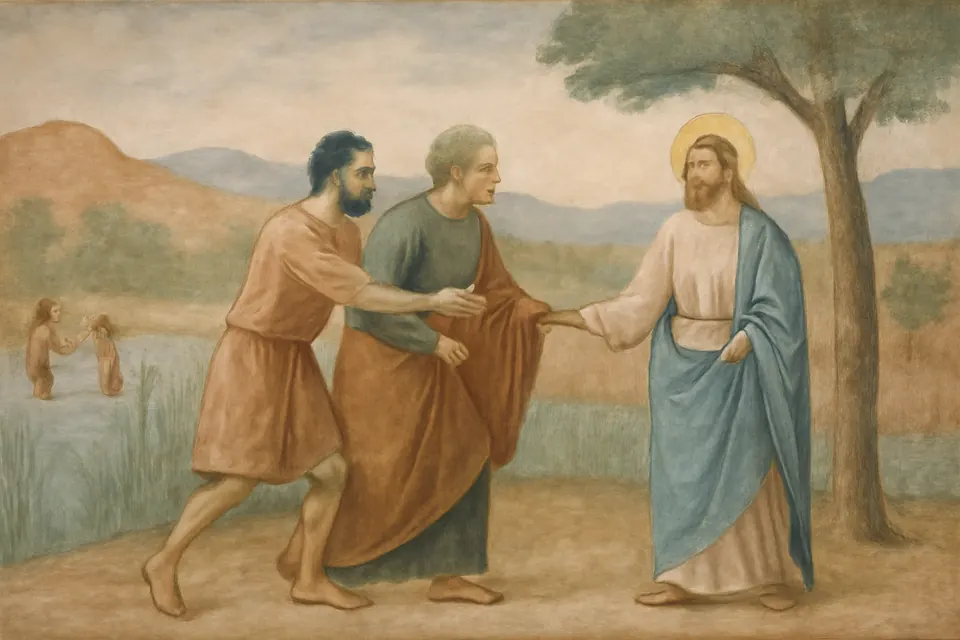
John's Gospel tells how it began. John the Baptist was standing with two of his disciples when Jesus walked by, and he said, "Behold, the Lamb of God!" The two followed Jesus, who turned and asked, "What do you seek?" They asked where he was staying, and he said, "Come and see." They spent the rest of the day with him. Then:
One of the two who heard John speak, and followed him, was Andrew, Simon Peter's brother. He first found his brother Simon, and said to him, "We have found the Messiah" (which means Christ). He brought him to Jesus. (John 1:40–42, RSV)
The other disciple is not named. Tradition, and the Orthodox life of St. Andrew, identify him as St. John, the beloved disciple.
Fishers of men
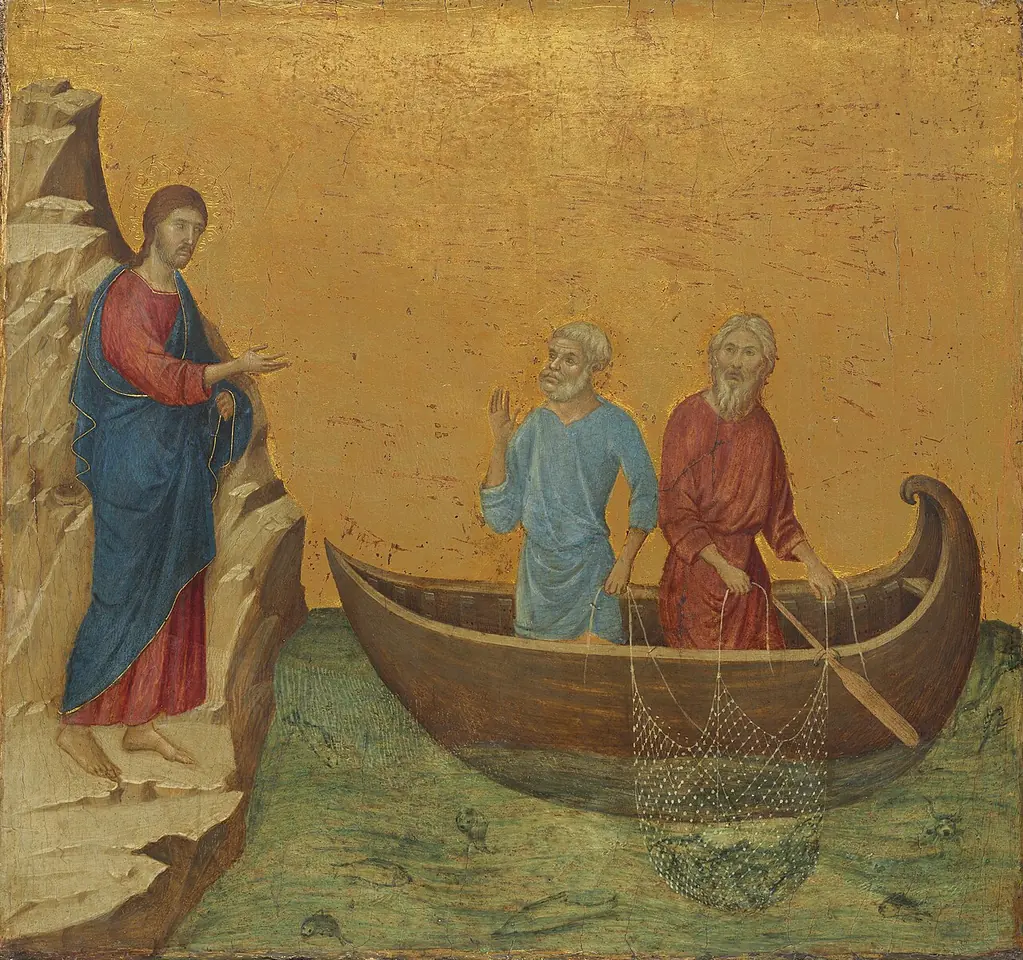
Matthew and Mark tell the call differently, as a scene on the lakeshore: Jesus "saw two brothers, Simon who is called Peter and Andrew his brother, casting a net into the sea; for they were fishermen. And he said to them, 'Follow me, and I will make you fishers of men.' Immediately they left their nets and followed him" (Matthew 4:18–20). The Catholic Encyclopedia reads the two accounts together: Andrew met Jesus first at the Jordan, and later the brothers were called to leave their work for good. Mark adds that Andrew and Peter shared a house at Capernaum.

Three small scenes
Andrew always appears among the first four names in the lists of the Twelve, but the Gospels give him only a few moments of his own, and Benedict XVI found something in each.
- At the feeding of the five thousand, it is Andrew who notices "a lad here who has five barley loaves and two fish; but what are they among so many?" (John 6:9).
- On the Mount of Olives, Andrew, with Peter, James and John, asks Jesus when the Temple will be destroyed, which leads to Jesus' long discourse on the end of the age (Mark 13:3–4).
- In Jerusalem before the Passion, some Greeks ask Philip, "Sir, we wish to see Jesus." Philip tells Andrew, and the two of them tell Jesus (John 12:20–22). Benedict XVI noted that Andrew and Philip were the two apostles with Greek names.
Mission and martyrdom
The New Testament says nothing more about him after the first chapter of Acts. The rest is traditional.
Scythia, Greece and the hills of Kyiv
Eusebius, drawing on Origen, wrote that "Scythia" fell to Andrew when the apostles divided the world, meaning the lands north of the Black Sea. Other early writers name Epirus, Achaia and Greece. The Catholic Encyclopedia suggests the reports may all be partly true and repeats a later tradition that Andrew preached in Asia Minor, around the Black Sea and in Byzantium, where he made Stachys its first bishop, before ending in Greece.
The Orthodox tradition adds more. The Orthodox Church in America says Andrew traveled along the Black Sea, through Crimea and up the Dnieper to the hills where Kyiv now stands, where he set up a cross and said, "See these hills? Upon these hills shall shine forth the beneficence of God, and there will be a great city here." Georgians keep the "Entrance of the Apostle Andrew into Georgia" on his feast. Because the Church of Constantinople counts Andrew as the founder of the church at Byzantium, the Ecumenical Patriarch celebrates November 30 as the feast of his see.
Crucifixion at Patras
The Catholic Encyclopedia says it is "generally agreed" that Andrew was crucified at Patras, in Achaia, by order of the Roman governor Aegeas or Aegeates, around the year 60, and that he was tied rather than nailed to the cross to make him suffer longer. The Orthodox life tells that Andrew had healed Maximilla, the governor's wife, and his brother Stratocles. On the cross he taught the crowd for two days. When the people tried to free him, he prayed to die on the cross, a light shone around him, and he gave up his spirit.
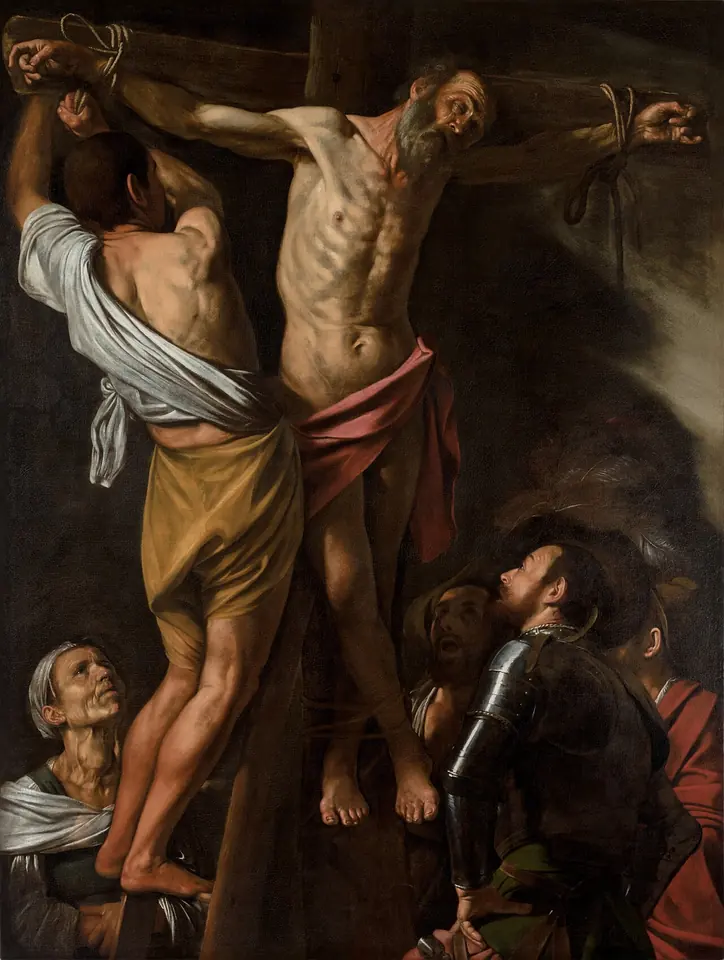

Benedict XVI quoted the greeting that the 6th-century Passion of Andrew puts in his mouth when he saw his cross:
Hail, O Cross, inaugurated by the Body of Christ and adorned with his limbs as though they were precious pearls. Before the Lord mounted you, you inspired an earthly fear. Now, instead, endowed with heavenly love, you are accepted as a gift.
The X-shaped cross
The diagonal cross came later. The Catholic Encyclopedia states that the evidence for the X-shaped, or saltire, cross "seems to be no older than the fourteenth century," and the Christian Iconography site notes that earlier art shows Andrew on a cross like Christ's. Later tradition explained the shape by saying Andrew, like his brother Peter, did not consider himself worthy to die on the same kind of cross as his Lord.


The miracles of St. Andrew
No miracle of Andrew's has been approved in the modern sense. The Orthodox and Western legends tell many:
- Traditional: at Sinope, by the Black Sea, he was stoned and survived unharmed, and at Patras he healed the blind and the sick, including Maximilla and Stratocles (Orthodox life).
- Traditional: the light from heaven that surrounded him on the cross at his death (Orthodox life and Roman Martyrology).
- Reported: since 1846, according to St. Mary's Cathedral in Edinburgh, the relics in Amalfi have produced an oil called "manna" on his feast days, January 28 and November 30. The Church has not issued a judgment on it.
Why St. Andrew is the patron saint of Scotland
Two legends explain it, and both are traditional.
The first concerns his relics. According to St. Mary's Cathedral in Edinburgh, legend says a monk named Rule (Regulus) brought relics of Andrew from Patras to Scotland. The cathedral thinks it more likely that they came from Rome with St. Augustine's mission to England in 597 and were brought to Fife in 732 by Bishop Acca of Hexham, who took refuge with the Pictish king Oengus. They were kept at Kilrymont, which was renamed St. Andrews, and it became one of the great pilgrimage shrines of Europe. St. Margaret of Scotland paid for a ferry and hostels at Queensferry for pilgrims crossing the Forth.


The second legend gave Scotland its flag. The Scottish Flag Trust tells it this way: in 832 an army of Picts and Scots under King Angus mac Fergus faced a larger army of Angles under Athelstan near the present village of Athelstaneford in East Lothian. Angus prayed and saw a white saltire of cloud against the blue sky. He vowed that if he won, Andrew would be the patron saint of his people. He won, and the white cross on blue became the flag of Scotland.
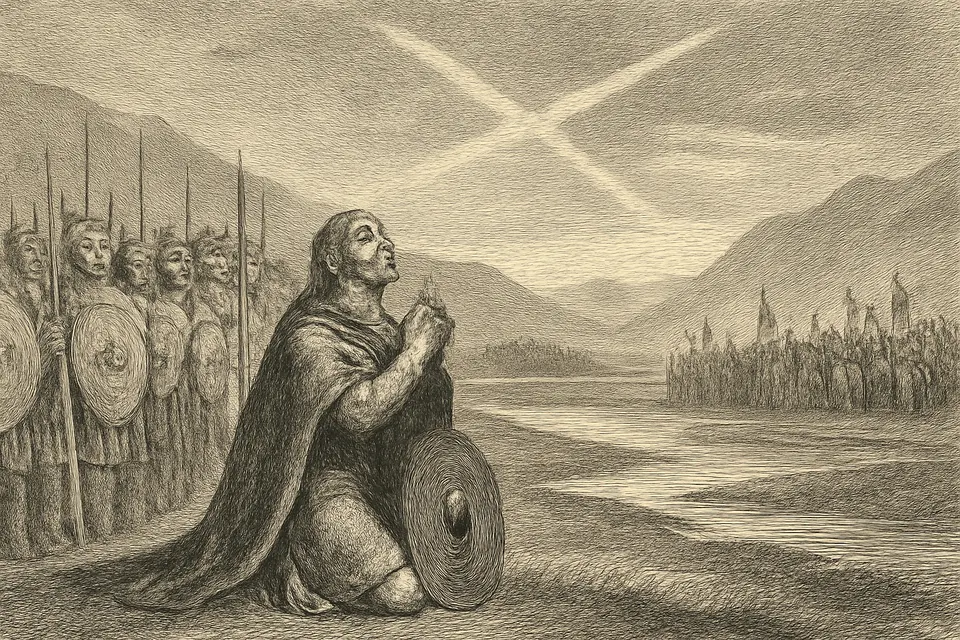
On June 14, 1559, reformers who had come to St. Andrews with John Knox destroyed the interior of the cathedral, including the shrine and its relics. St. Andrew's Day is still Scotland's national day.
Symbols of St. Andrew in art
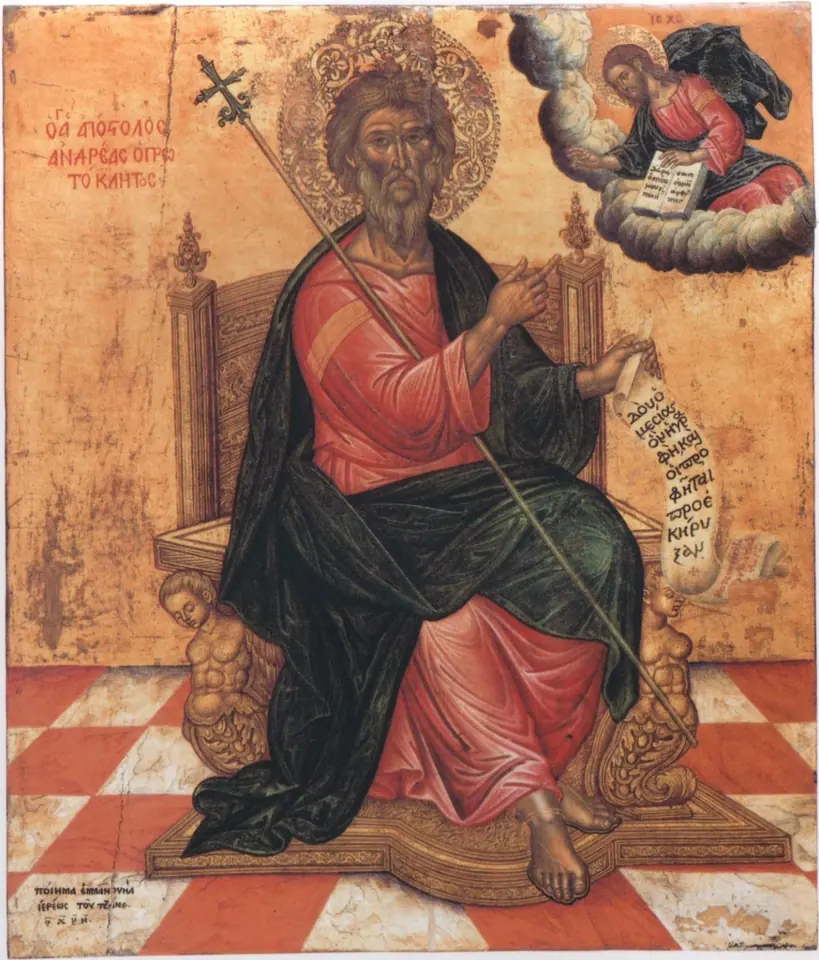
- The X-shaped cross, or saltire: his best-known sign, common from the 15th century on. Older art gives him an ordinary cross, a small processional cross or a staff cross, as in the Tzanes icon above.
- Wild hair and a long beard: the Christian Iconography site points out that from as early as the 6th century, Andrew is the apostle with untidy hair and a long, often forked beard, usually gray or white.
- A fishing net or fish: his trade, and the scene of his call.
- A book or scroll: as an apostle. In Eastern icons the scroll often carries his words to Peter, "We have found the Messiah."
- Paired with Peter: two older fishermen together, one with keys and one with a cross, are Peter and Andrew.
In Eastern icons, St. Mary's Cathedral in Edinburgh notes, Andrew is shown in green, or in red to recall his martyrdom. He usually holds a scroll and a slender cross and has a full head of gray hair.
Relics and where St. Andrew is honored
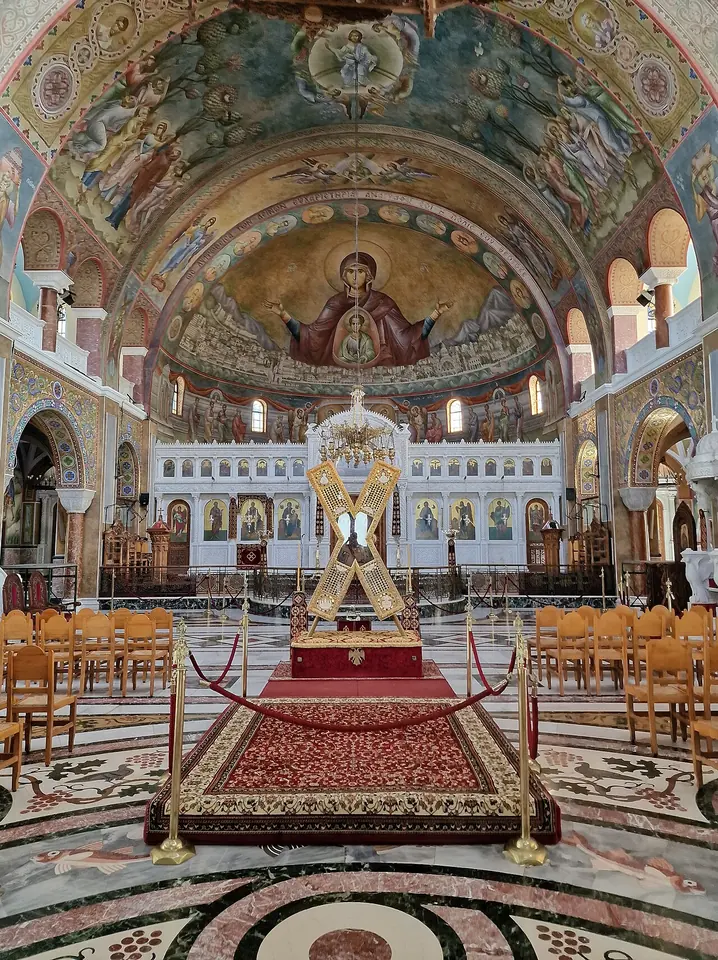
Patras. The Catholic Encyclopedia says Andrew's relics were taken from Patras to the Church of the Holy Apostles in Constantinople around 357. His head was later back in Patras, and in the 15th century, as the Ottoman Turks conquered the Peloponnese, it was carried to Rome and kept in St. Peter's Basilica. In 1964 Pope Paul VI sent it back to the Orthodox Metropolitan of Patras, a gesture Benedict XVI connected with the bond between Rome and Constantinople as "Sister Churches." It is kept in the large Byzantine-style Cathedral of St. Andrew, beside a reliquary in the shape of his cross.

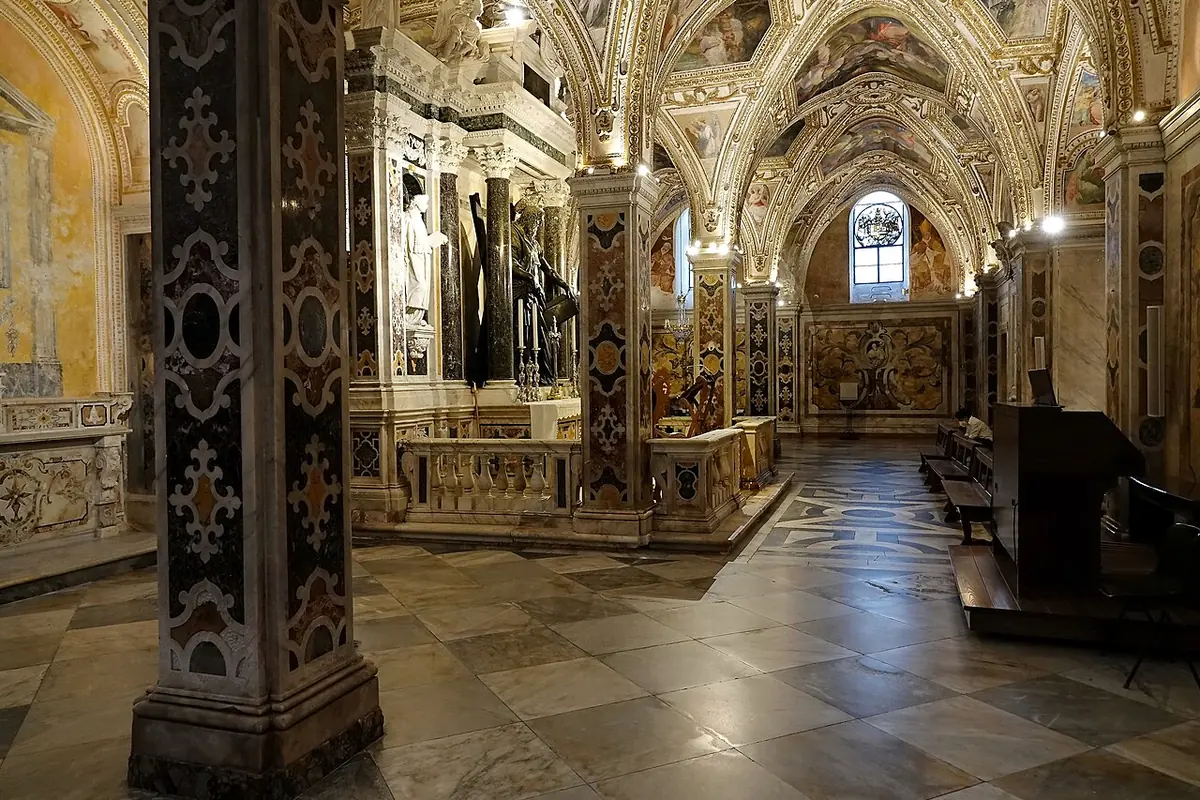
Amalfi. When the Crusaders sacked Constantinople in 1204, Cardinal Peter of Capua, a native of Amalfi, brought the relics from the Holy Apostles to his home town. The Catholic Encyclopedia says that most of them still remain in the crypt of Amalfi Cathedral.

Edinburgh. In 1879 the Archbishop of Amalfi gave a large portion of the apostle's shoulder to Archbishop Strain of St. Andrews and Edinburgh. In 1969 Pope Paul VI gave a second relic to Cardinal Gordon Gray with the words "Peter greets his brother Andrew." Both are in the National Shrine of St. Andrew at St. Mary's Catholic Cathedral, where Pope John Paul II prayed in 1982.
Constantinople. Every year on November 30 a delegation from the Holy See joins the Ecumenical Patriarch for the feast of St. Andrew, just as the Patriarchate sends a delegation to Rome for Sts. Peter and Paul on June 29. In 2014 Pope Francis came himself, and he and Patriarch Bartholomew signed a common declaration on the feast of "Saint Andrew, the first–called and brother of the Apostle Peter."
See the feast day calendar and the full list of patron saints.
Prayer to St. Andrew
The collect of his feast in the Roman Missal:
We humbly implore your majesty, O Lord, that, just as the blessed Apostle Andrew was for your Church a preacher and pastor, so he may be for us a constant intercessor before you. Through our Lord Jesus Christ, your Son, who lives and reigns with you in the unity of the Holy Spirit, God, for ever and ever.
O Bona Crux
Catholic Culture gives this prayer from the legend of his martyrdom, the words Andrew is said to have spoken when he saw his cross:
O GOOD CROSS, made beautiful by the body of the Lord, long have I desired thee, ardently have I loved thee, unceasingly have I sought thee, and now thou art ready for my eager soul. Receive me from among men and restore me to my Master, so that He, who redeemed me through thee, shalt receive me through thee. Amen.
The St. Andrew Christmas prayer
The prayer most people call the "St. Andrew novena" is really a prayer about the birth of Christ, begun on his feast because it falls near the start of Advent. It is of unknown authorship and is traditionally said fifteen times a day from November 30 until Christmas:
Hail and blessed be the hour and moment in which the Son of God was born of the most pure Virgin Mary, at midnight, in Bethlehem, in piercing cold. In that hour vouchsafe, O my God! to hear my prayer and grant my desires, [here mention your request] through the merits of Our Saviour Jesus Christ, and of His blessed Mother. Amen.
Frequently asked questions
When is St. Andrew's feast day?
November 30, in both the Catholic and Orthodox churches. It is St. Andrew's Day, Scotland's national day, and the patronal feast of the Ecumenical Patriarchate of Constantinople. Since it falls near the start of Advent, Catholics traditionally begin the St. Andrew Christmas prayer that day.
Why is St. Andrew the patron saint of Scotland?
Legend says his relics were brought to the place now called St. Andrews in Fife, which became a great pilgrimage shrine. Another legend says a Pictish king, Angus, saw a white X-shaped cross in the sky before a battle around 832 and vowed to make Andrew his kingdom's patron if he won. The saltire on Scotland's flag is St. Andrew's cross.
Why is St. Andrew's cross X-shaped?
Later tradition says he asked not to die on a cross like Christ's. The Catholic Encyclopedia notes that the evidence for the X-shaped cross seems no older than the 14th century, and earlier art shows him on an ordinary cross. The oldest accounts say he was tied, not nailed, so that he would suffer longer.
What is the St. Andrew Christmas novena?
A short prayer beginning "Hail and blessed be the hour and moment in which the Son of God was born," traditionally said fifteen times a day from November 30 until Christmas. Its author is unknown, and it is a prayer about the birth of Christ rather than a prayer to St. Andrew.
Where are St. Andrew's relics?
Most of his body is in the crypt of Amalfi Cathedral in Italy. His head is in the Cathedral of St. Andrew in Patras, Greece, returned there from Rome in 1964. St. Mary's Catholic Cathedral in Edinburgh keeps two relics as the National Shrine of St. Andrew.
Sources
- Catholic Encyclopedia (1907): St. Andrew
- Benedict XVI, General Audience of 14 June 2006: Andrew, the Protoclete
- Eusebius, Church History, Book III, chapter 1 (the apostles' mission fields)
- Orthodox Church in America: Apostle Andrew, the Holy and All-Praised First-Called
- Orthodox Church in America: Entrance of the Apostle Andrew into Georgia
- Christian Iconography: St. Andrew in Art
- St Mary's Catholic Cathedral, Edinburgh: St Andrew
- The Scottish Flag Trust: The Legend of the Saltire
- Pope Francis and Ecumenical Patriarch Bartholomew I, Common Declaration, 30 November 2014
- Catholic Culture: Feast of St. Andrew, Apostle
- Catholic Culture: Christmas Anticipation Prayer
- Catholic Culture: O Bona Crux!
- Roman Martyrology, November 30