St. Catherine of Alexandria, Virgin and Martyr

St. Catherine of Alexandria is a virgin martyr of the early 4th century who, according to her legend, out-argued fifty pagan philosophers, broke the spiked wheel meant to kill her and was beheaded in Alexandria. Her story survives only in much later, embellished accounts, but she was one of the most loved saints of the Middle Ages and is the patron saint of philosophers, students and unmarried women. Her feast day is November 25.
Who was St. Catherine of Alexandria?
Catherine of Alexandria is a virgin martyr remembered on November 25. Her legend makes her a young noblewoman of Alexandria in Egypt, brilliantly educated, who confronted a persecuting Roman emperor in the early 4th century, defeated his philosophers in debate, survived a spiked wheel and was beheaded. Angels, the story ends, carried her body to Mount Sinai.
That is the legend. The history is thinner. Catholic Culture notes that the old Eastern sources do not mention her, and the accounts that tell her story were written centuries later and grew with each retelling. The Catholic Encyclopedia of 1908 sums it up: the long speeches and most of the marvels "are to be rejected as inventions, pure and simple," though the article adds that this is not meant to doubt that the saint existed.


None of that stopped her from becoming, in the late Middle Ages, one of the most popular saints in Europe. She was one of the Fourteen Holy Helpers, a patron of every university, and one of the voices St. Joan of Arc said she heard.
The legend of St. Catherine
The oldest surviving full version of her Passio (the account of her martyrdom) is in Greek, written by Symeon Metaphrastes in the 10th century. Latin and vernacular versions follow his order of events. All of what follows is traditional.
The scholar of Alexandria
Catherine was born to a ruling family of Alexandria; the Orthodox life names her father as Konstos, the city's governor. She studied the philosophers and poets, and at eighteen, the Roman Breviary lesson said, she surpassed everyone of her age in learning.
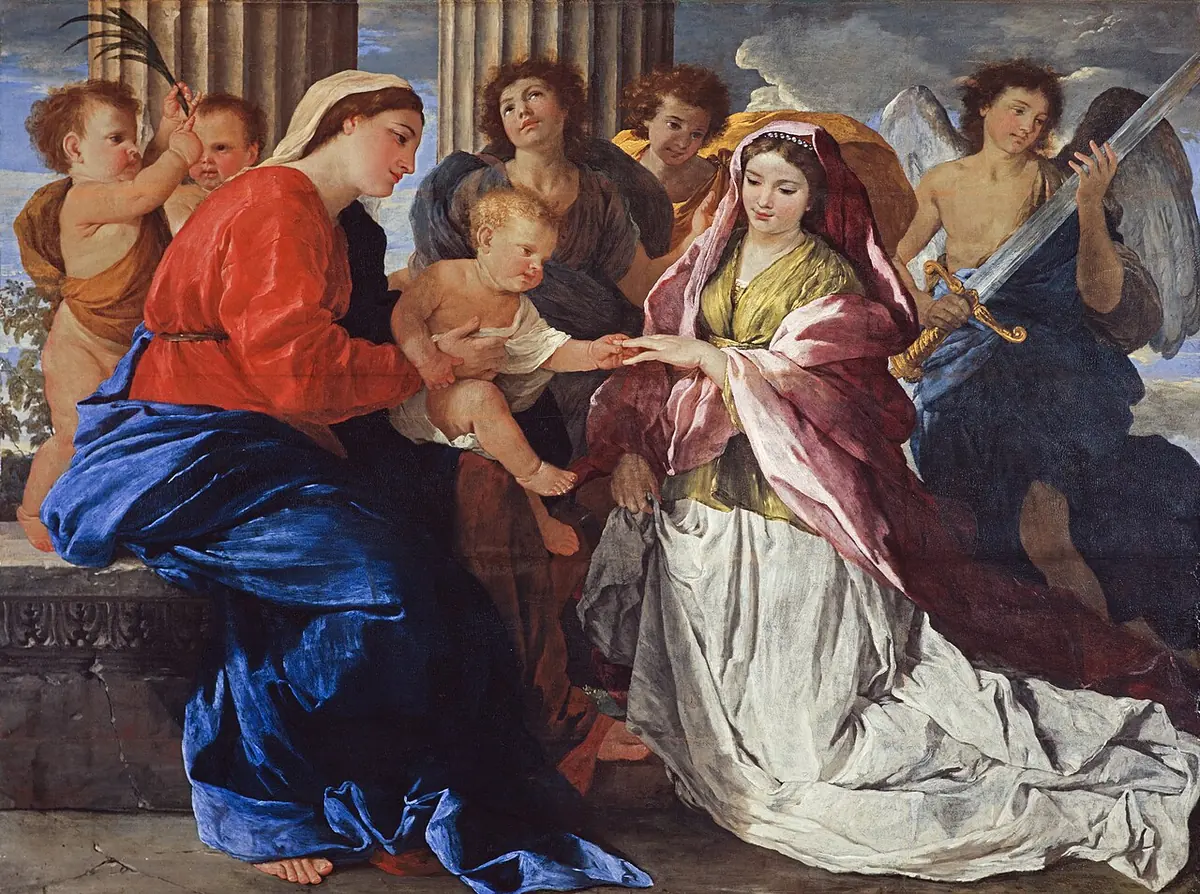
Later versions add a prelude. Asked to marry, she said she would accept only someone who surpassed her in nobility, wealth, beauty and wisdom. A hermit in the desert gave her an icon of the Virgin and Child. In a dream, the Child turned his face away from her; after she was baptized, he appeared again and gave her a ring. This is the "mystical marriage" of St. Catherine, which entered her story in the 14th century and became one of the favorite subjects of Renaissance painting.

The fifty philosophers
When the emperor came to Alexandria for a pagan festival, with Christians being put to death, Catherine went to him and told him his gods were false. The versions disagree on his name: the Catholic Encyclopedia and the Roman Martyrology say Maximinus, Symeon says Maxentius, and the Orthodox life says Maximian.
Unable to answer her himself, the emperor summoned fifty of the empire's best philosophers and orators to argue with her. She won. The philosophers declared themselves Christians, and the emperor had them burned. In the Orthodox telling, Catherine made the sign of the cross over them before they died.

Prison and the empress
Catherine was scourged and imprisoned without food. In the Western versions angels tended her wounds and a dove brought her food. The empress, curious about this young woman, visited her in prison with Porphyry, the commander of the guard. Both were converted, and with two hundred soldiers they were later executed.
The wheel and the sword
The emperor then had a machine built of wheels set with iron spikes. When Catherine was bound to it, an angel, or her touch, broke it apart, and the flying pieces killed bystanders. Finally she was beheaded. The legend says milk, not blood, flowed from the wound, and that before she died she prayed that God would hear anyone who remembered her.
The miracles of St. Catherine
Every miracle in Catherine's story is traditional. None has been examined by the Church in the way modern canonizations require; her cult is far older than that process.
- The debate with the philosophers and their conversion: traditional.
- The breaking of the wheel: traditional, and the source of her emblem.
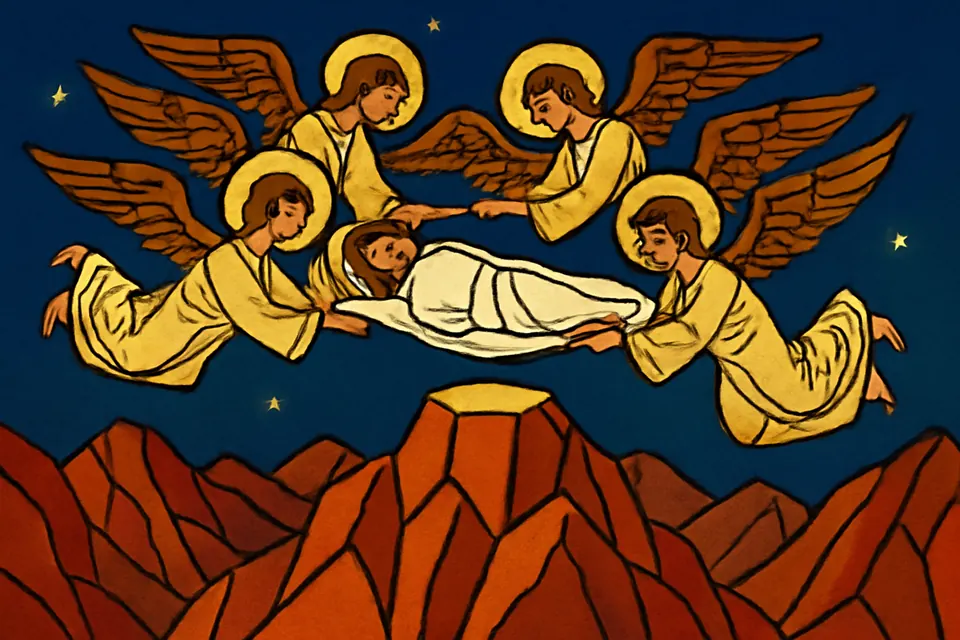
- Angels carrying her body to Mount Sinai: traditional. The Catholic Encyclopedia points out that the early pilgrims to Sinai say nothing about it.
- Healing oil and fragrance from her relics: reported. The monks of Sinai say her relics "continue to emit a sweet fragrance, and many miracles are wrought to this day," and medieval pilgrims brought home vials of oil from her tomb.
Why St. Catherine is the patron saint of philosophers and students
Because she defeated the emperor's scholars, theologians, apologists, preachers and philosophers adopted her. The Catholic Encyclopedia says that before studying, writing or preaching they asked her "to illumine their minds, guide their pens, and impart eloquence to their words." Medieval universities took her as patron of their faculties of philosophy.
As the model of the learned virgin, she was the patron of young unmarried women and girl students, much as St. Nicholas was of young men. Her spiked wheel made her the patron of wheelwrights, millers, spinners and mechanics. See the full list on our patron saints page.
She is also one of the Fourteen Holy Helpers, whom Christians in medieval Germany called on together in times of plague, with St. Barbara, St. Margaret of Antioch, St. Blaise, St. Christopher and others.
Symbols of St. Catherine of Alexandria in art
Catherine is one of the easiest saints to recognize. Look for:
- A spiked wheel, whole or broken. It is her main attribute, and Raphael's and Caravaggio's paintings both put it at her side.
- A sword, for her beheading.
- A crown, for her royal birth. In icons she wears imperial robes.
- A book, for her learning.
- A martyr's palm.
- A ring, or the Christ Child giving her one, in scenes of the mystical marriage.
- A crowned man under her feet: the defeated emperor, as in a 15th-century Spanish alabaster relief described by Christian Iconography.


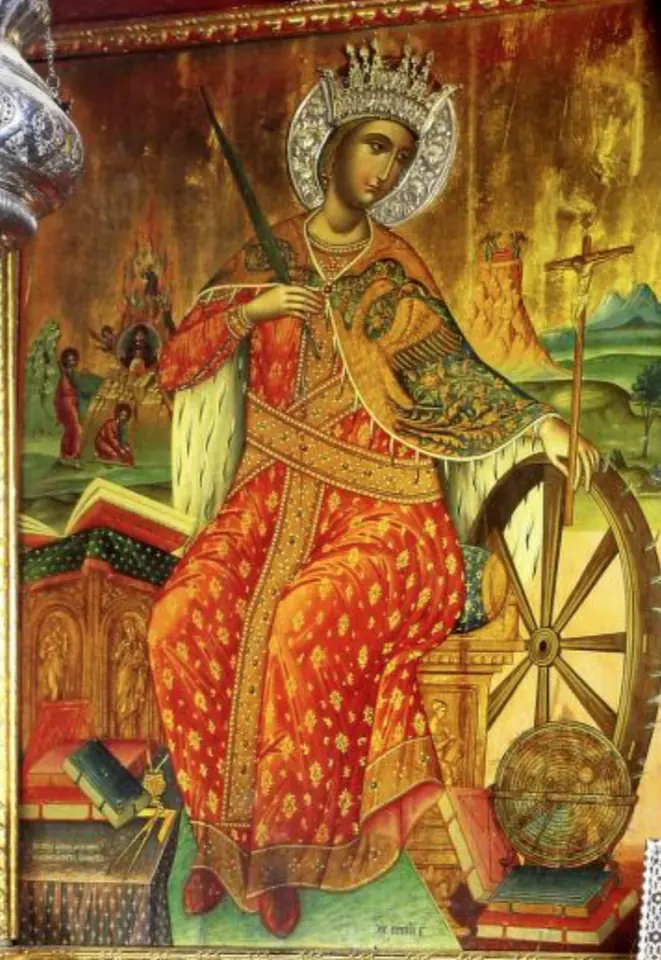
Eastern icons show her standing or enthroned, crowned, in the robes of a Byzantine princess, holding a cross. Later Greek icons add her wheel and the tools of learning, as in the Cretan icon by Ieremias Palladas below. Don't confuse her with St. Catherine of Siena, the 14th-century Dominican, who wears a plain black and white habit and is also shown in a mystical marriage with Christ.

Mount Sinai and the relics of St. Catherine
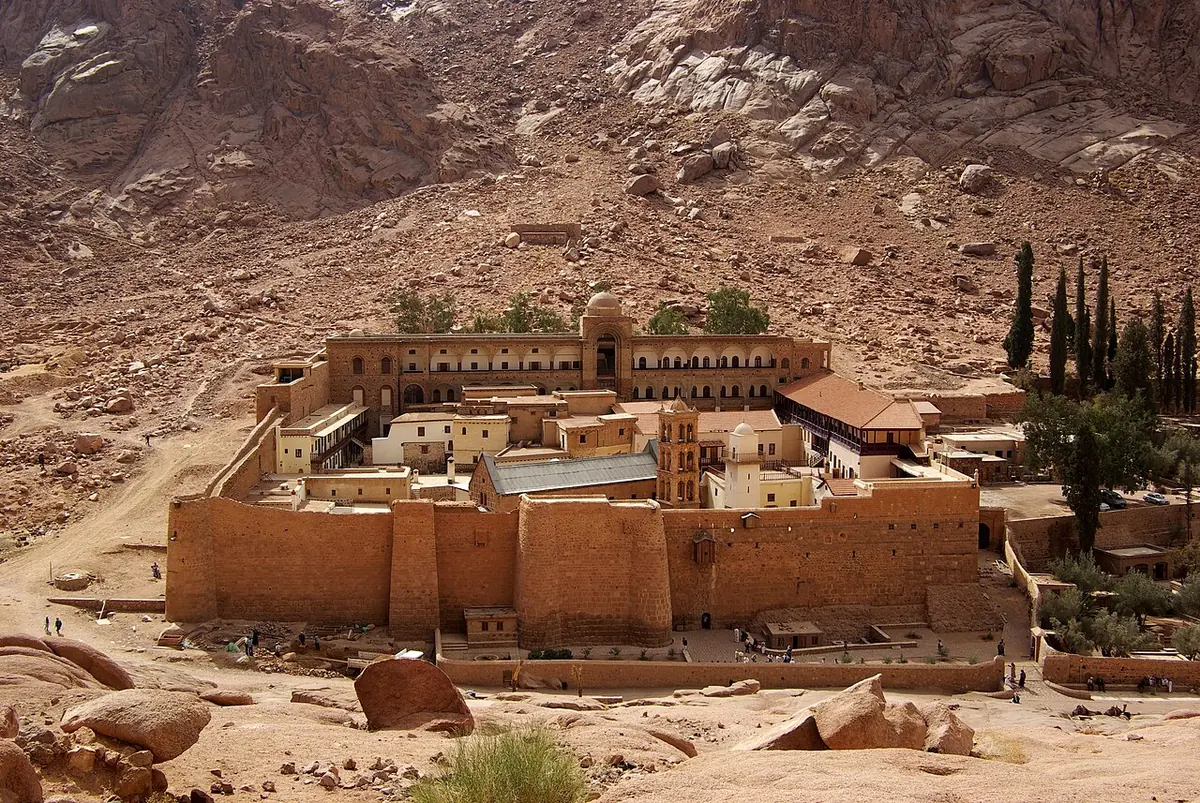
The Greek Orthodox monastery at the foot of Mount Sinai, built by the emperor Justinian in the 6th century around the site of the burning bush, has guarded Catherine's relics for over a thousand years. The monastery says angels laid her body on the peak now called Mount Saint Catherine, from which it was brought down to the church. The Orthodox life says her head and left hand were found "through a revelation" and placed in Justinian's new church.
The pilgrims who came for her gradually changed the monastery's name. Its own history says that after relics were taken to Rouen in the early 11th century, devotion to Catherine spread across the West, and the Holy Monastery of Sinai became known as St. Catherine's Monastery.
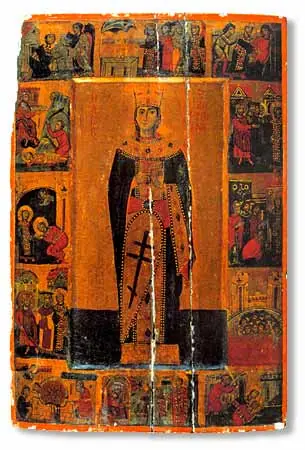

Today her relics rest in a marble shrine on the south side of the sanctuary, in two reliquaries given by the Russian Empire, one for her head and one for her left hand. When they are brought out for veneration, each pilgrim receives a silver ring with her monogram, in memory of the ring of her mystical marriage.

St. Catherine and Joan of Arc
At her trial in Rouen in 1431, Joan of Arc told her judges that St. Michael, St. Catherine and St. Margaret had spoken to her since childhood. She said she loved the sword she carried because it had been found in the church of St. Catherine at Fierbois, behind the altar. Asked how she knew who was speaking, she answered: "I have told you often enough that it is St. Catherine and St. Margaret; believe me if you will."

Feast day: removed in 1969, restored in 2002
Catherine's feast is November 25. In parts of France it was once a holy day of obligation, with work suspended, until the early 17th century. In the 18th century, as critics questioned her legend, it was dropped from the Breviary of Paris, and devotion in the West declined.
In 1969 Pope Paul VI's revised General Roman Calendar removed her, along with St. Barbara and others, because so little reliable history survives. She remained in the Roman Martyrology and in the Eastern churches. In 2002 Pope John Paul II restored her feast as an optional memorial. Orthodox churches of the Greek tradition keep November 25; churches of the Russian tradition, including the Orthodox Church in America, keep November 24. See nearby saints on the feast days calendar.
Prayer to St. Catherine of Alexandria
The Roman Missal gives this collect for her memorial, in the current English translation:
Almighty ever-living God, who gave Saint Catherine of Alexandria to your people as a Virgin and an invincible Martyr, grant that through her intercession we may be strengthened in faith and constancy and spend ourselves without reserve for the unity of the Church. Through our Lord Jesus Christ, your Son, who lives and reigns with you in the unity of the Holy Spirit, God, for ever and ever.
Students and teachers have long asked her prayers before study and examinations, and Orthodox Christians ask her help for women in difficult labor.
Frequently asked questions
What is St. Catherine of Alexandria the patron saint of?
The Catholic Encyclopedia says she became patron of young women and female students, of wheelwrights and mechanics because of her wheel, and of theologians, apologists, preachers and philosophers because she was said to have silenced the emperor's scholars. Catholic Culture adds librarians, lawyers and many trades that use a wheel. The Orthodox Church also calls on her in difficult childbirth.
Was St. Catherine of Alexandria a real person?
No early source mentions her. The oldest surviving accounts were written centuries after the date of her martyrdom, and the Catholic Encyclopedia says most of their details and speeches "are to be rejected as inventions, pure and simple." The same article adds that this does not mean to "cast even the shadow of a doubt around the existence of the saint." The Church keeps her in the Roman Martyrology as a martyr of Alexandria.
Why was St. Catherine removed from the calendar, and is she still a saint?
In the 1969 revision of the General Roman Calendar, Pope Paul VI removed several saints, Catherine among them, because so little reliable history about them survives. She was never "decanonized." In 2002 Pope John Paul II restored her feast to the calendar as an optional memorial on November 25.
What is the Catherine wheel?
The spiked wheel on which, in her legend, the emperor tried to have her torn apart; it shattered when she touched it. It became her symbol in art, and the spinning firework called a Catherine wheel is named after it.
Did Joan of Arc hear St. Catherine?
Yes, by her own testimony at her trial in 1431. Joan said St. Michael, St. Catherine and St. Margaret spoke to her, and when pressed by her judges she answered, "I have told you often enough that it is St. Catherine and St. Margaret; believe me if you will."
Sources
- Catholic Encyclopedia (1908): St. Catherine of Alexandria
- Orthodox Church in America: Great Martyr Katherine of Alexandria
- Holy Monastery of St. Catherine, Mount Sinai: Saint Catherine
- Christian Iconography: St. Catherine of Alexandria
- Catholic Culture: Optional Memorial of St. Catherine of Alexandria, November 25
- National Catholic Register: Why John Paul II Restored This Saint to the Calendar (2017)
- Internet Medieval Sourcebook: The Trial of Joan of Arc
- Roman Martyrology, November 25