St. Barbara
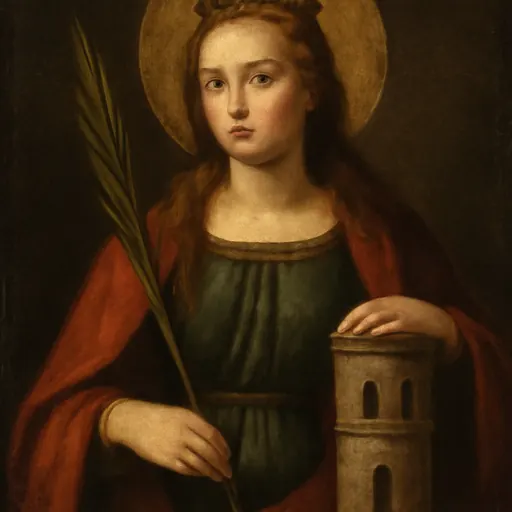
St. Barbara is a virgin martyr of the early Church, known only from legend: her pagan father shut her in a tower, she became a Christian, and he beheaded her himself, after which he was struck by lightning. Because of that lightning she is the patron saint of artillerymen, miners, firefighters and everyone in danger of sudden death. Her feast day is December 4; it was removed from the General Roman Calendar in 1969 but remains in the Roman Martyrology.
Who was St. Barbara?
Barbara is one of the best-loved saints of the Middle Ages and one of the least documented. The Catholic Encyclopedia says frankly that no early historical source mentions her, and that her name is missing from the oldest version of the martyrology attributed to St. Jerome. Yet by the 7th century she was venerated across the Christian world, and her story was told in Greek, Syriac and Latin.
The story goes like this. A rich pagan named Dioscorus kept his beautiful daughter shut in a tower. She refused every suitor, secretly became a Christian and, while her father was away, had a third window cut in his new bathhouse in honor of the Holy Trinity. When he found out, he handed her over to the authorities, and after she had been tortured, he beheaded her with his own hand. On his way home he was struck by lightning.

All of this is traditional. The Catholic Encyclopedia calls the accounts "purely legendary" and says there is "no genuine historical tradition" about her. That is why, in 1969, her feast was dropped from the General Roman Calendar. It is not why people stopped loving her, because they didn't: gunners, miners, firefighters and families with cherry branches still keep December 4.
The legend of St. Barbara
Her Passion was collected in Greek by Symeon Metaphrastes, and in the West by the martyrologists of the 9th century and later the Golden Legend. The versions agree on the main points and disagree on the place and date. Some put her death at Heliopolis, others at Nicomedia (İzmit, in Turkey), and the emperor is called Maximian in some texts and Maximinus in others.
The tower
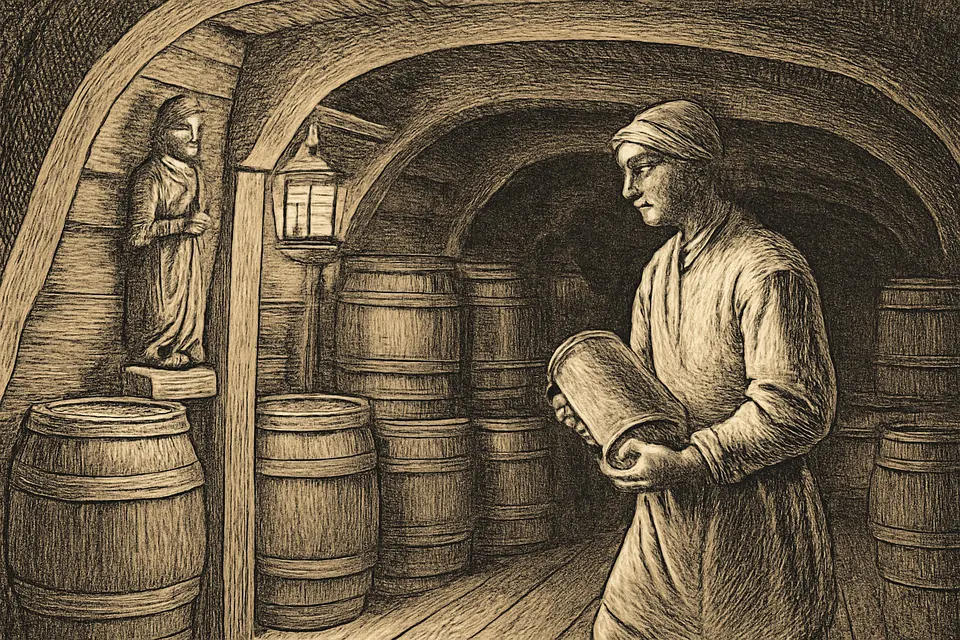
The Orthodox life tells the beginning most fully. Dioscorus, a wealthy man of Heliopolis, lost his wife and devoted himself to his only daughter. To hide her beauty from strangers he built her a tower, where only her pagan teachers could visit. From its windows she watched the hills, the rivers and the stars, and began to ask who had made them. She decided the idols her father worshiped could not be the answer, and she resolved to give her life to God and remain a virgin.
The three windows
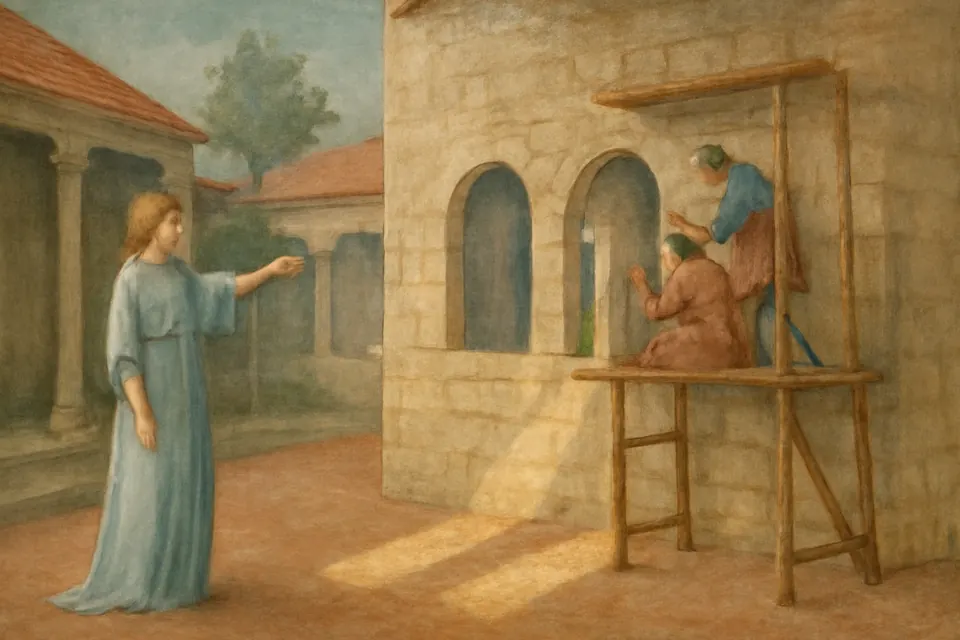
Dioscorus later let her come down, thinking solitude had made her stubborn. She met Christian women in the city, and a priest disguised as a merchant baptized her. While her father was traveling, workmen were building a bathhouse with two windows on its south side. Barbara told them to add a third. In the Orthodox telling it formed "a Trinity of light," and she traced a cross on the marble wall with her finger.
The flight, the trial and the martyrdom
When Dioscorus came home and she told him why there were three windows, he drew his sword. She fled, and the Orthodox life says a hill opened to hide her. A shepherd showed her father where she was. He beat her, starved her and handed her to the prefect, Martianus, who had her cruelly tortured. A Christian woman named Juliana cried out against the torturers in the crowd and was arrested too, and the two women died together. Dioscorus beheaded his daughter himself. Both he and the prefect were struck by lightning. A man named Valentinus buried the martyrs, and the Catholic Encyclopedia says the sick were healed at their grave.
The miracles of St. Barbara
- The cross traced on marble, the hill that opened, the healing of her wounds in prison and the lightning: traditional.
- The rescue of Henry Kock at Gorkum, 1448: reported. The Catholic Encyclopedia tells how a man nearly burned to death in a fire in the Dutch town of Gorkum called on Barbara, who helped him escape and kept him alive until he could receive the last sacraments. It says the story "did much to further the spread of the veneration of the saint."
Why St. Barbara is the patron saint of artillerymen, miners and firefighters
Everything goes back to the lightning. The Catholic Encyclopedia explains that her father's death "caused her, probably, to be regarded by the common people as the patron saint in time of danger from thunder-storms and fire, and later by analogy, as the protector of artillerymen and miners." Christian Iconography puts it simply: the gunners' fire falling on their targets is like the fire from heaven that killed her father.
- Artillerymen and gunners: many artillery units still mark St. Barbara's Day on December 4.
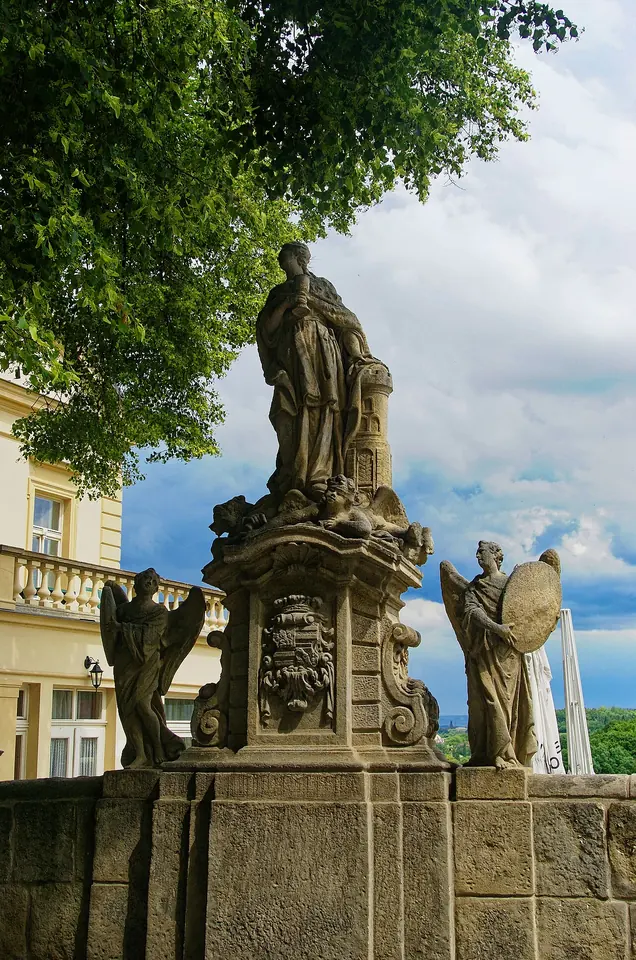
- Miners, tunnelers and explosives workers: for the same reason. Her statues stand in mining towns and in the mines themselves.
- Firefighters and against fire and lightning: from the fire from heaven.
- Against sudden death: she was believed to obtain for her devotees the grace of confession and Communion before dying, which is why she holds a chalice.
- Architects, builders and mathematicians: Catholic Culture lists these too, probably because of the tower she is always shown with.
See the full list on our patron saints page.

Santa Barbara, the powder magazine
In Spanish (santabárbara), Italian (santabarbara) and older French (Sainte-Barbe), the saint's name came to mean the powder magazine of a ship or fortress, where the gunpowder was stored. Christian Iconography notes that in the Italian translation of Tintin, Captain Haddock explains that the part of a ship that holds the munitions is called the "santabarbara."
St. Barbara and the Fourteen Holy Helpers
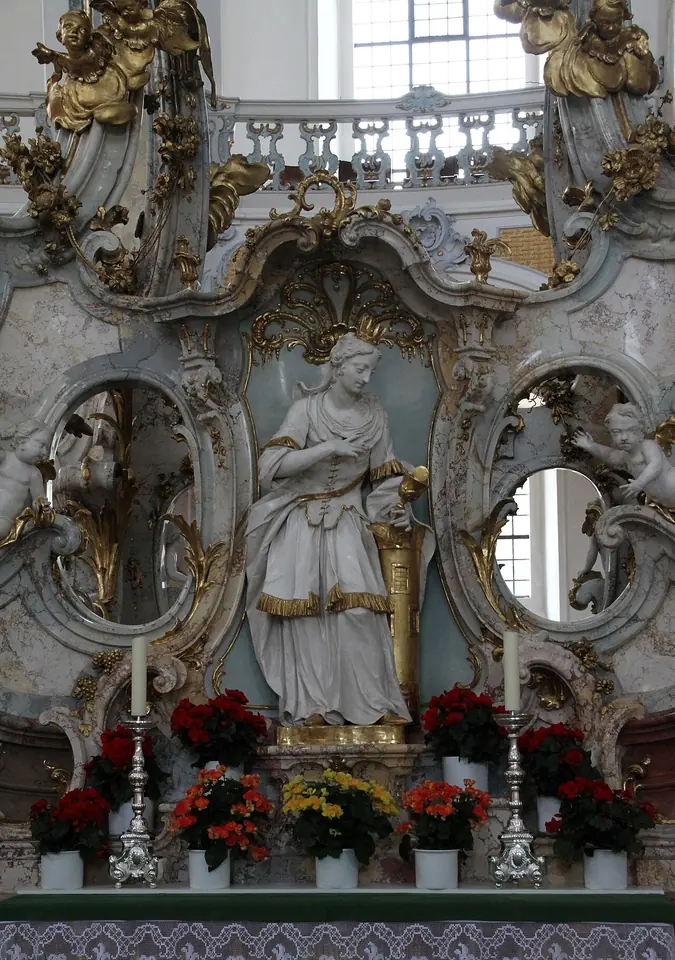
Barbara is one of the Fourteen Holy Helpers, a group of saints, all of them martyrs except St. Giles, whom Christians in medieval Germany called on together, especially during the Black Death. The group includes St. Blaise (for the throat), St. Christopher, St. George, St. Erasmus, St. Vitus, St. Catherine of Alexandria and St. Margaret of Antioch. Barbara, Catherine and Margaret are the three women of the group. Catholic Culture says she is invoked "against fever, lightning, fire and sudden death." The group had a common feast on August 8 until 1969.
The great pilgrimage church of the Holy Helpers is the Basilica of Vierzehnheiligen in Franconia, Germany, built by Balthasar Neumann. Its shrine altar holds statues of all fourteen. Christian Iconography notes that Barbara's story stayed fairly obscure until the 15th century, when she came to the fore as one of the Holy Helpers.

Symbols of St. Barbara in art
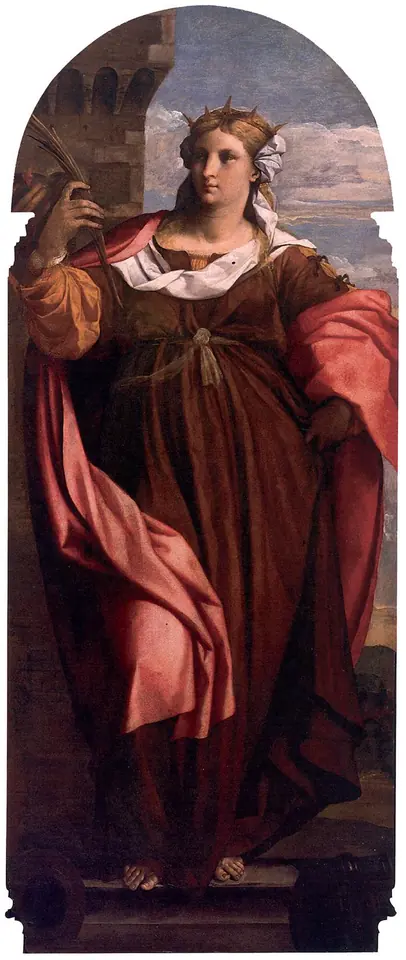
Barbara is one of the easiest saints to identify, because her main symbol is so unusual:
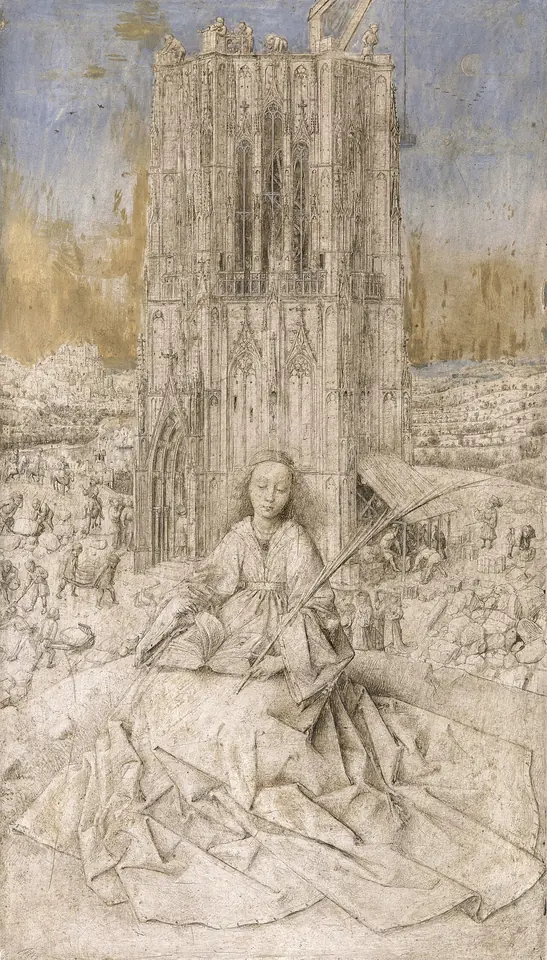
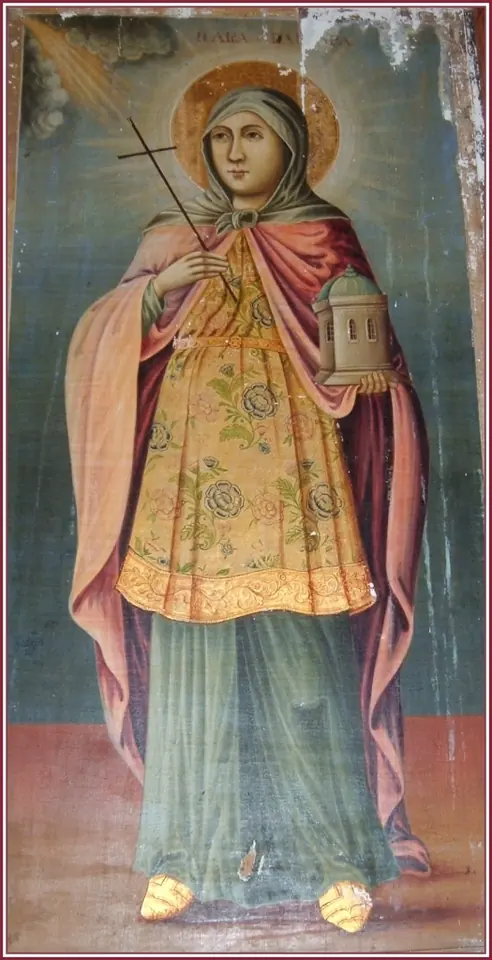
- A tower with three windows: the Trinity. She may hold a small model of it, stand beside it or, as in Van Eyck's drawing, sit before a huge one.
- A chalice and Host: her promise of the last sacraments. The Council of Cambrai and the theologian Molanus criticized this attribute in the 1570s, Christian Iconography says, and it became rare in Catholic art afterward, though it survives in Orthodox and popular images.
- A cannon: for the artillery, often at her feet.
- A crown, a palm and sometimes a sword: the signs of a virgin martyr.
- A peacock feather: in some images; Catholic Culture lists it among her symbols.


In Eastern icons Barbara is a "Great Martyr," crowned, in rich robes, holding a cross and sometimes a small tower. Western paintings of the 15th and 16th centuries often show her with other virgin martyrs, and the tower is the quickest way to pick her out.

Feast day, the 1969 calendar and Barbara branches
St. Barbara's feast is December 4 in both East and West. In the 1969 revision of the Roman calendar, her feast was removed from the General Roman Calendar. Catholic Culture explains that this was because no accurate historical basis for her story could be found, and adds: "This is not to state that she did not exist." She is still a saint, the Roman Martyrology still commemorates her on December 4, and dioceses, parishes and military units that honor her still keep the day. See her neighbors on the feast days calendar.

Barbara branches
The best-known custom of the day is the Barbara branch, or Barbarazweig. On December 4 families cut a twig from a cherry tree (or a peach) and set it in water in a warm room. With luck, it blooms on Christmas Eve. A 1950s Catholic family book quoted by Catholic Culture says the child whose twig has the most blossoms is "holy Mary's most favored 'Twig.'" Catholic Culture connects the custom with Advent: "The bud from the root of Jesse and the flower from its root" is Christ, who "will blossom forth as a flower at Christmas."


Where her relics are
The Orthodox life says her relics were taken to Constantinople in the 6th century and to Kyiv in the 12th, brought by a Byzantine princess also named Barbara. They are now in St. Volodymyr's Cathedral in Kyiv, where an akathist hymn to her is sung every Tuesday.
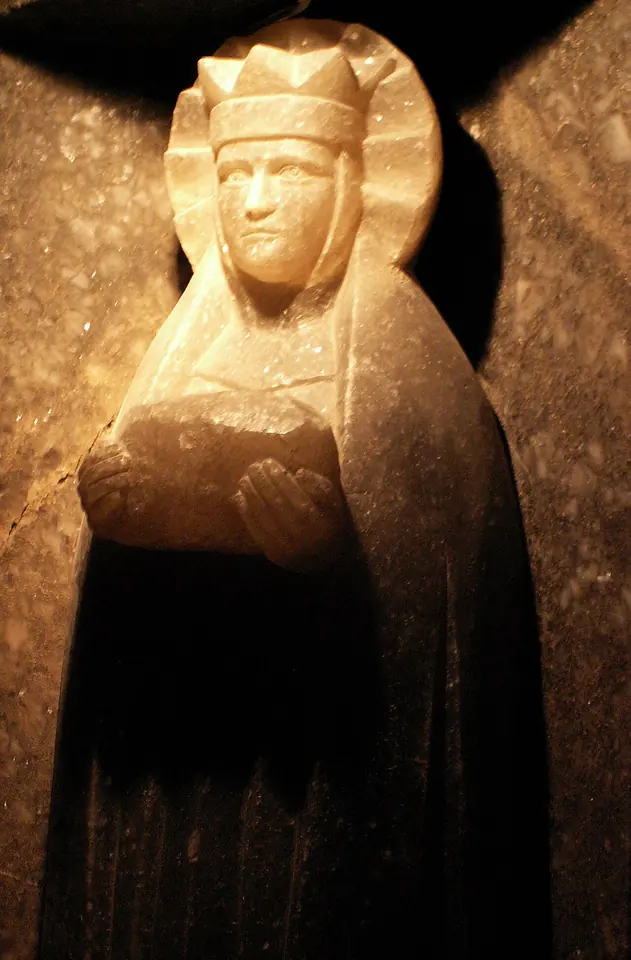

Prayer to St. Barbara
Catholic Culture gives this short traditional prayer, "often recited" in the past, asking for her help at the hour of death:
Saint Barbara, thou noble bride,
To thee my body I confide
As well in life as at life's end.
Come, aid me when I breathe my last,
That I may, ere here all is past,
Receive the Blessed Sacrament!
Orthodox Christians, the Orthodox Church in America says, often sing the troparion of St. Barbara every day, remembering the promise that those who honor her and her sufferings will be kept from a sudden death and will not die without the Holy Mysteries.
Frequently asked questions
Why was St. Barbara removed from the calendar?
In the 1969 reform of the General Roman Calendar, the Church dropped several saints whose stories could not be supported by historical evidence, and Barbara was one of them. She was not "decanonized." She is still a saint, still listed in the Roman Martyrology on December 4, and her feast is still kept locally and by the Orthodox Church.
Why is St. Barbara the patron saint of artillerymen and miners?
Her legend ends with her father struck by lightning after he killed her. The Catholic Encyclopedia says this made people call on her against thunderstorms and fire, and later, "by analogy," as the protector of artillerymen and miners, whose work involves sudden blasts.
What is a Barbara branch?
In Germany and other parts of Europe, families cut a cherry twig on December 4 and put it in water indoors. If it flowers on Christmas Eve, it is a sign of blessing. Catholic Culture connects the custom with the "flower" from the root of Jesse, an Advent image of Christ.
Is St. Barbara one of the Fourteen Holy Helpers?
Yes. She is one of the fourteen saints whom medieval Germans grouped together and called on in time of plague, along with St. Blaise, St. Christopher, St. Catherine, St. Margaret, St. George and others. Barbara is the helper against sudden death.
What are the symbols of St. Barbara?
A tower with three windows, for the Trinity; a chalice and Host, for her promise of the sacraments at the hour of death; a cannon, for artillery; and the martyr's palm, crown and sword.
Sources
- Catholic Encyclopedia (1907): St. Barbara
- Orthodox Church in America: Greatmartyr Barbara and Martyr Juliana, at Heliopolis in Syria
- Catholic Culture: December 4 liturgical calendar (St. Barbara)
- Catholic Culture: St. Barbara Branch or Barbarazweig
- Catholic Culture: Fourteen Holy Helpers
- Christian Iconography: St. Barbara in Art
- Christian Iconography: The Fourteen Holy Helpers in Art
- Roman Martyrology, December 4