St. Peter the Apostle
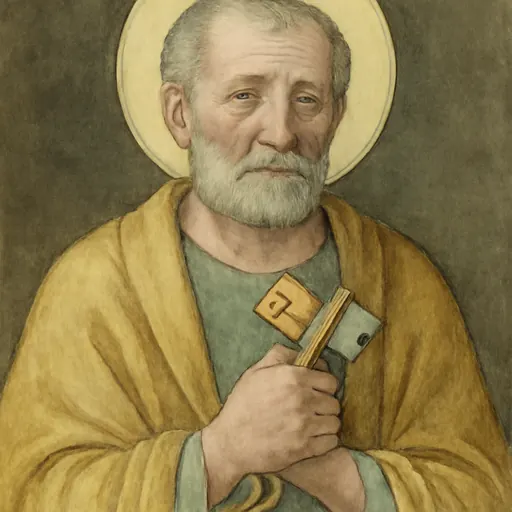
St. Peter was a fisherman from Galilee whom Jesus renamed Cephas, "rock," and made the leader of the twelve apostles. He denied Jesus three times on the night of the arrest, was restored by the risen Christ, preached the first Christian sermon at Pentecost and died a martyr in Rome under Nero, by tradition crucified head downward. Catholics honor him as the first pope. His feast day is June 29, shared with St. Paul, and he is the patron saint of fishermen, popes and Rome.
Who was St. Peter?
Simon Peter was a fisherman from Galilee who became the leader of Jesus' twelve apostles. After Jesus himself, he is the person the New Testament mentions most often. Pope Benedict XVI counted 154 uses of the name Petros, nine of the Aramaic Cephas and 75 of Simon. Both Petros and Cephas mean "rock," a name Jesus gave him.
He was impulsive and brave, quick to speak and quick to fail. He walked on water and sank. He swore he would die with Jesus and then denied knowing him three times in one night. After the Resurrection he became the spokesman of the first Christian community in Jerusalem, and ancient tradition says he died a martyr in Rome under the emperor Nero.
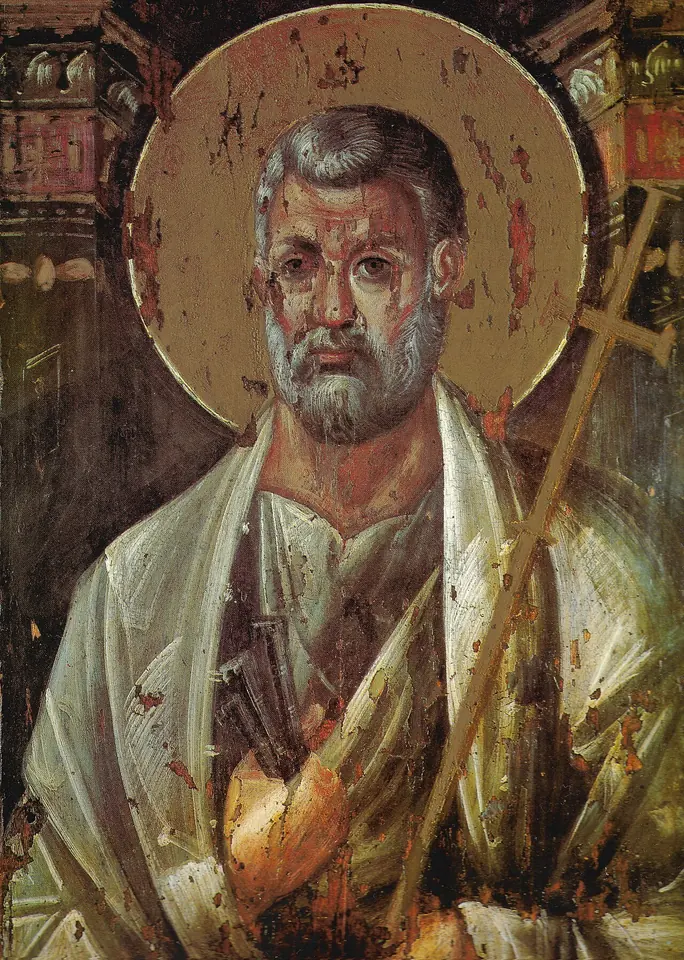

Christians remember him in different ways. Catholics honor him as the first pope and believe the bishops of Rome inherit his office. Orthodox Christians honor him as the first-ranked of the apostles. Protestants read his story in the Gospels and Acts as the story of a forgiven disciple. All of them keep his feast on June 29, together with St. Paul.
The life of St. Peter
A fisherman of Bethsaida and Capernaum
His name was Simon, son of John (or Jonah). The Gospel of John says he came from Bethsaida, a village near the north end of the Sea of Galilee, the hometown of his brother St. Andrew and of Philip. By the time Jesus began preaching he lived in Capernaum, a lakeside town, in a house he shared with his mother-in-law. So Peter was married. Paul mentions in passing that "Cephas" took his wife along on his missionary travels (1 Corinthians 9:5), and Clement of Alexandria, around 200, passed on a tradition that Peter had children.
Simon fished with Andrew and worked in partnership with the sons of Zebedee, James and John. Benedict XVI suggested he must have been "reasonably well-off," the owner of his own boat in a small family business.


Under a small octagonal Byzantine church at Capernaum, excavators found an older church built inside one house, with graffiti invoking Peter.
The call: "You shall be called Cephas"
The Gospels tell the call in two ways. In John, Andrew, a disciple of John the Baptist, met Jesus and brought his brother to him, and "Jesus looked at him, and said, 'So you are Simon the son of John? You shall be called Cephas' (which means Peter)" (John 1:42).
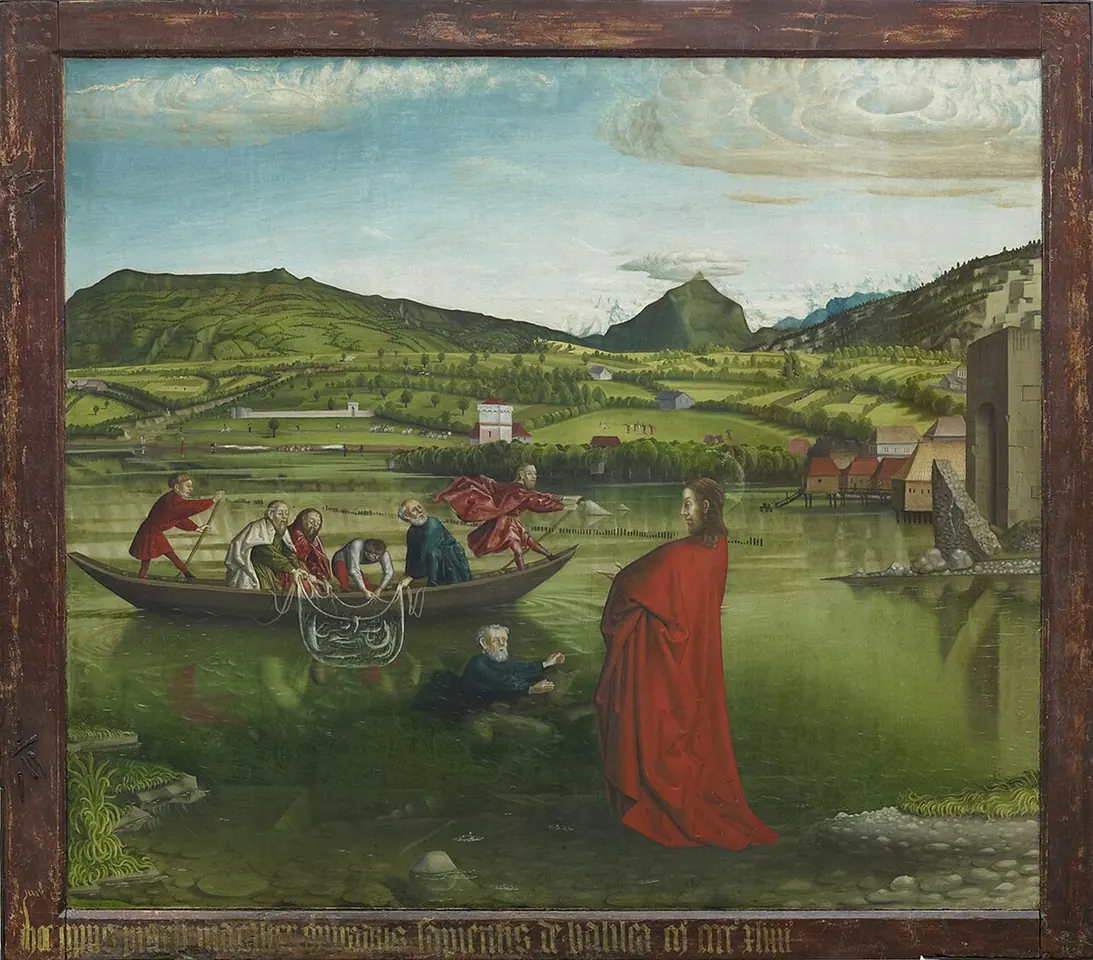
In Luke, Jesus preached from Simon's boat, then told him to let down his nets after a night of catching nothing. The nets filled until they began to break, and Peter "fell down at Jesus' knees, saying, 'Depart from me, for I am a sinful man, O Lord.'" Jesus answered, "Do not be afraid; henceforth you will be catching men" (Luke 5:8–10, RSV).
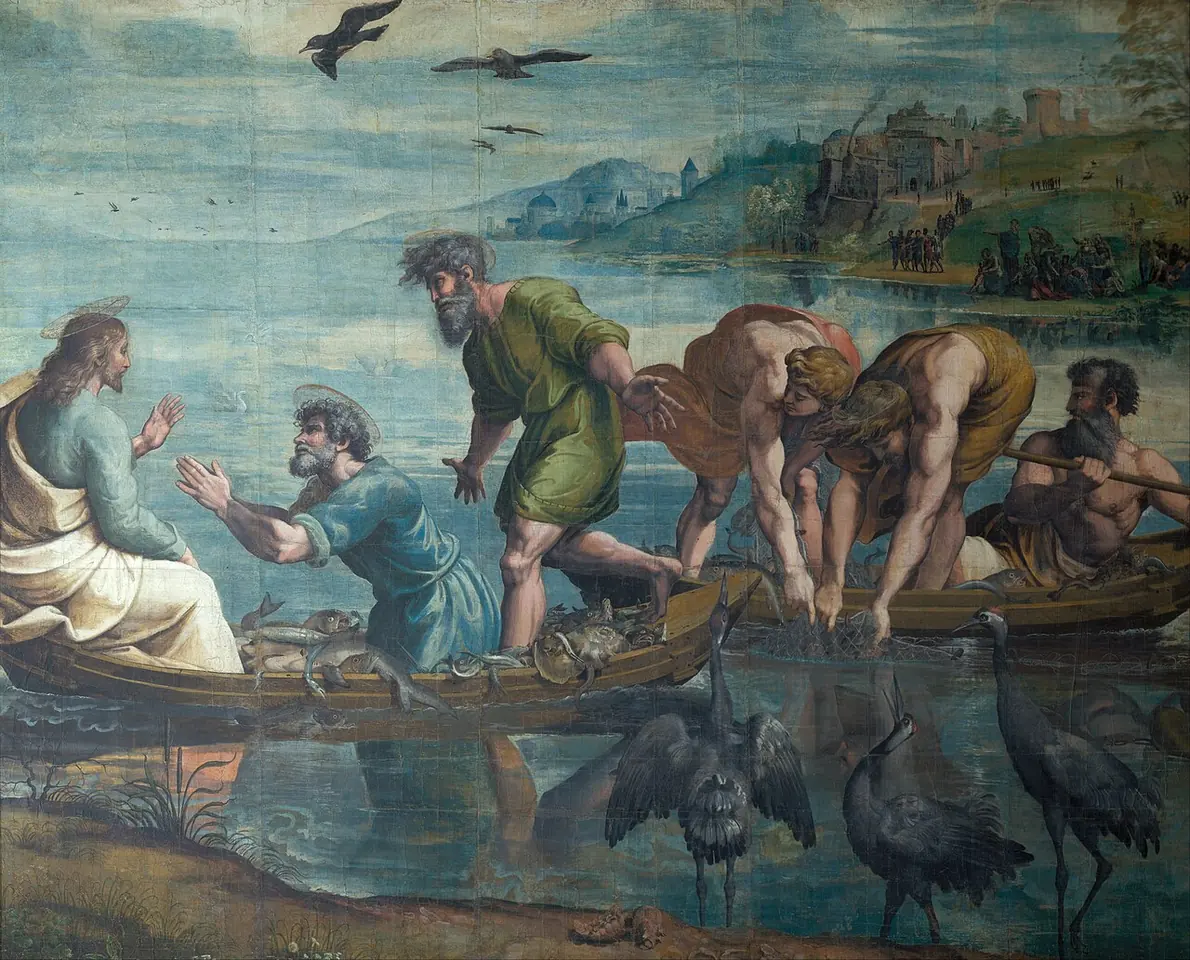

From then on Peter is always first in the lists of the Twelve, and with James and John he witnessed the raising of Jairus' daughter, the Transfiguration and the agony in Gethsemane.
Walking on the water
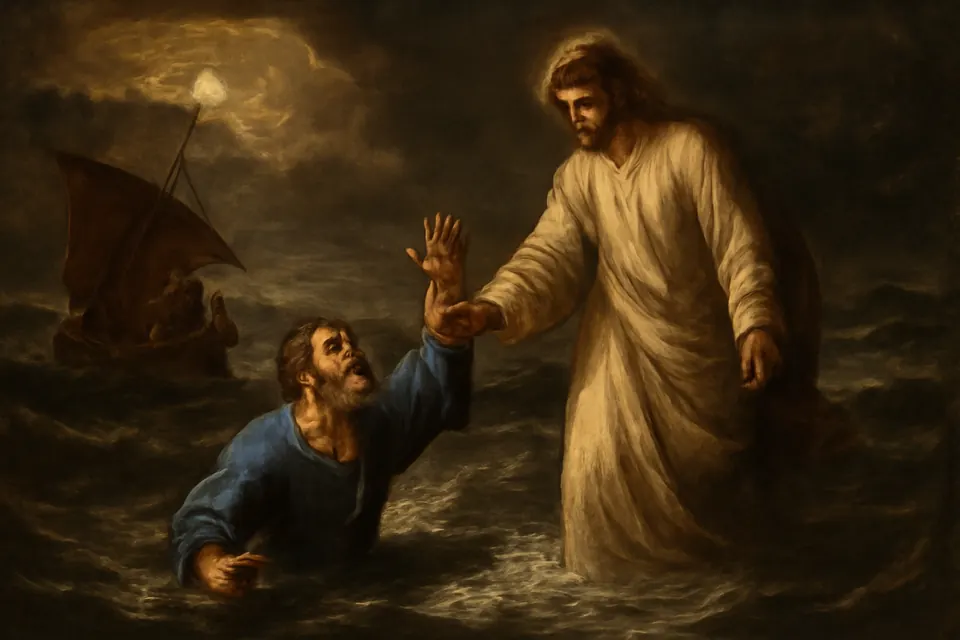
One night the disciples were rowing across the lake against the wind when they saw Jesus walking toward them on the water. Only Matthew tells what Peter did next. He asked Jesus to bid him come, stepped out of the boat and walked on the water, "but when he saw the wind, he was afraid, and beginning to sink he cried out, 'Lord, save me.'" Jesus caught him by the hand: "O man of little faith, why did you doubt?" (Matthew 14:30–31, RSV)
Caesarea Philippi: "On this rock I will build my church"
Near Caesarea Philippi, Jesus asked his disciples, "But who do you say that I am?" Peter answered for them:
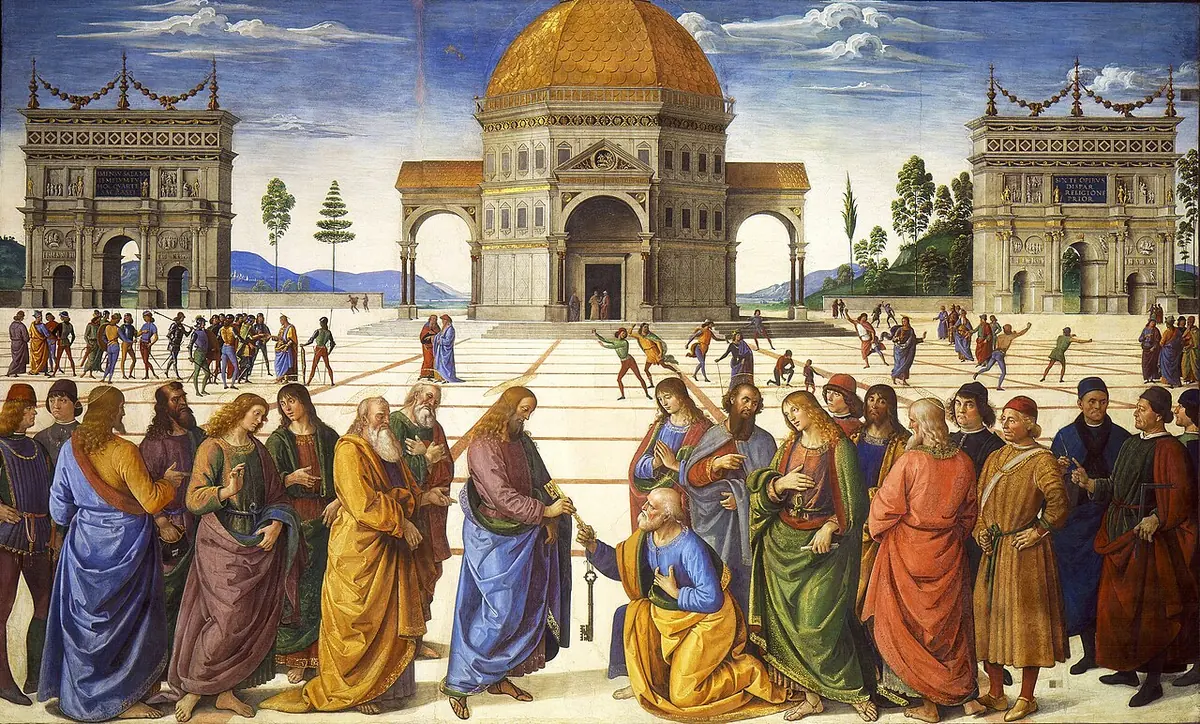
Simon Peter replied, "You are the Christ, the Son of the living God." And Jesus answered him, "Blessed are you, Simon Bar-Jona! For flesh and blood has not revealed this to you, but my Father who is in heaven. And I tell you, you are Peter, and on this rock I will build my church, and the powers of death shall not prevail against it. I will give you the keys of the kingdom of heaven, and whatever you bind on earth shall be bound in heaven, and whatever you loose on earth shall be loosed in heaven." (Matthew 16:16–19, RSV)
In Greek the wordplay is between Petros (Peter) and petra (rock). Christians have read the verse in different ways for many centuries:
- Catholic teaching holds that Peter himself is the rock, and that the keys and the power to bind and loose describe an office of leadership that passes to his successors, the bishops of Rome. Benedict XVI said the three images "portray what the subsequent reflection will describe by the term: 'primacy of jurisdiction.'"
- Some Church Fathers read the rock as the faith Peter confessed. John Chrysostom wrote that Jesus meant "the faith of his confession." Augustine, in one of his sermons on John, wrote, "For the Rock (Petra) was Christ," and said the Church received the keys "in the person of Peter."
- The Orthodox Church, in the life of the two apostles it reads on June 29, teaches that Peter received the keys as "the representative of the Church," so that "it was not one man, but rather the One Universal Church, that received these 'keys.'"
- Protestant churches generally read the rock as Peter's confession of faith, or as Peter himself in his role as a founding apostle, without a continuing papal office.
Right after this, when Jesus spoke of his coming death, Peter rebuked him and heard, "Get behind me, Satan!" (Mark 8:33). Benedict XVI called it Peter's "second call," to follow a Messiah who would suffer.

Three denials
At the Last Supper Jesus warned him: "Simon, Simon, behold, Satan demanded to have you, that he might sift you like wheat, but I have prayed for you that your faith may not fail; and when you have turned again, strengthen your brethren" (Luke 22:31–32). Peter answered that he was ready to go to prison and to death. Jesus told him that before the rooster crowed he would deny him three times.
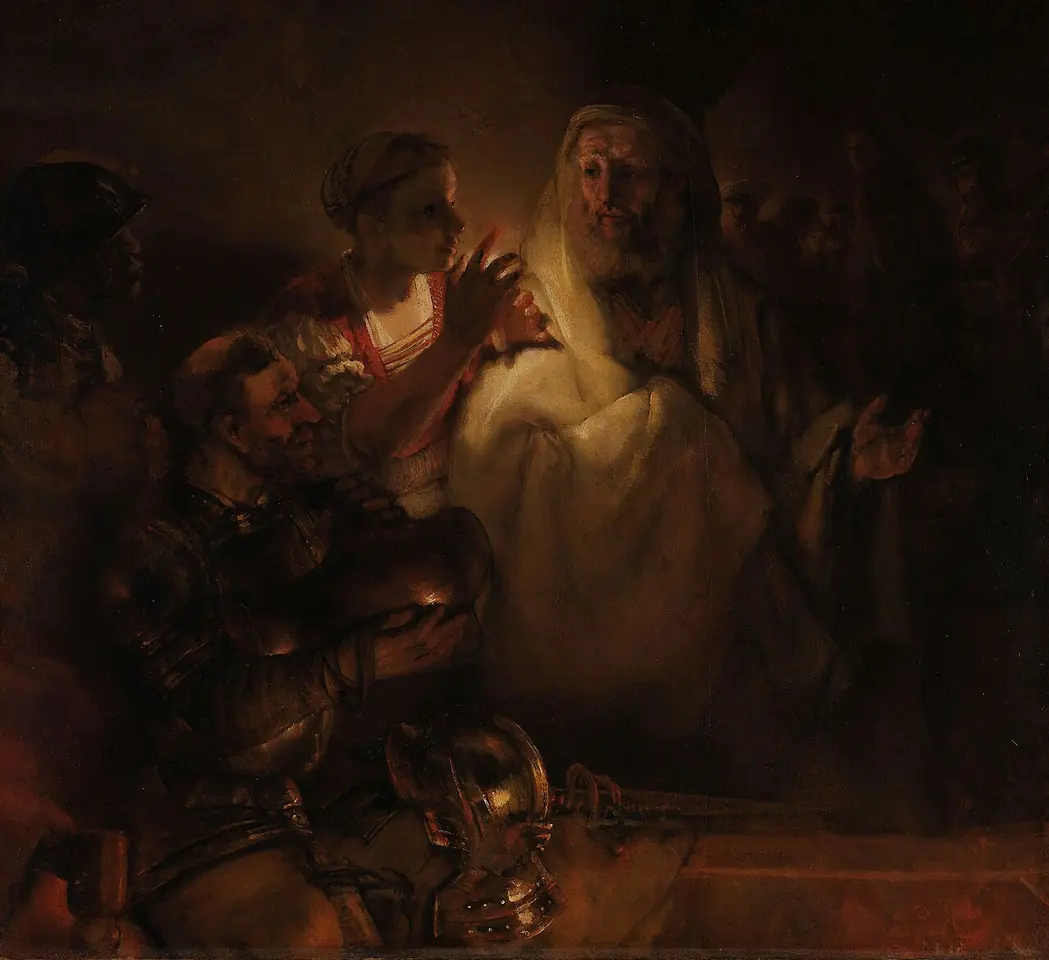
That night, in Gethsemane, Peter drew a sword and cut off the ear of the high priest's servant (John 18:10). Then he followed the arrested Jesus into the high priest's courtyard, where, warming himself by a fire, he three times swore he did not know the man. "And immediately, while he was still speaking, the cock crowed. And the Lord turned and looked at Peter," Luke writes, and Peter "went out and wept bitterly" (Luke 22:60–62, RSV).

The empty tomb and "Feed my sheep"
On Easter morning, when Mary Magdalene reported the stone rolled away, Peter and John ran to the tomb, and John let Peter go in first (John 20:3–8). Paul's list of witnesses to the Resurrection begins: "he appeared to Cephas, then to the twelve" (1 Corinthians 15:5).
The last chapter of John's Gospel returns to the lake. After a night of catching nothing, the disciples obeyed a man on the shore and netted 153 fish, and when John said, "It is the Lord," Peter threw himself into the sea. After breakfast Jesus asked him three times, matching the three denials, "Simon, son of John, do you love me?" Each time Peter said yes, and each time Jesus gave him a charge: "Feed my lambs," "Tend my sheep," "Feed my sheep." Then he foretold Peter's death:
"Truly, truly, I say to you, when you were young, you girded yourself and walked where you would; but when you are old, you will stretch out your hands, and another will gird you and carry you where you do not wish to go." (This he said to show by what death he was to glorify God.) And after this he said to him, "Follow me." (John 21:18–19, RSV)

Benedict XVI pointed to the Greek verbs: Jesus twice asks for agape, total love, and Peter answers with the humbler philia, the love of friendship, until Jesus asks the third time with Peter's own word.
St. Peter in the Acts of the Apostles
Pentecost
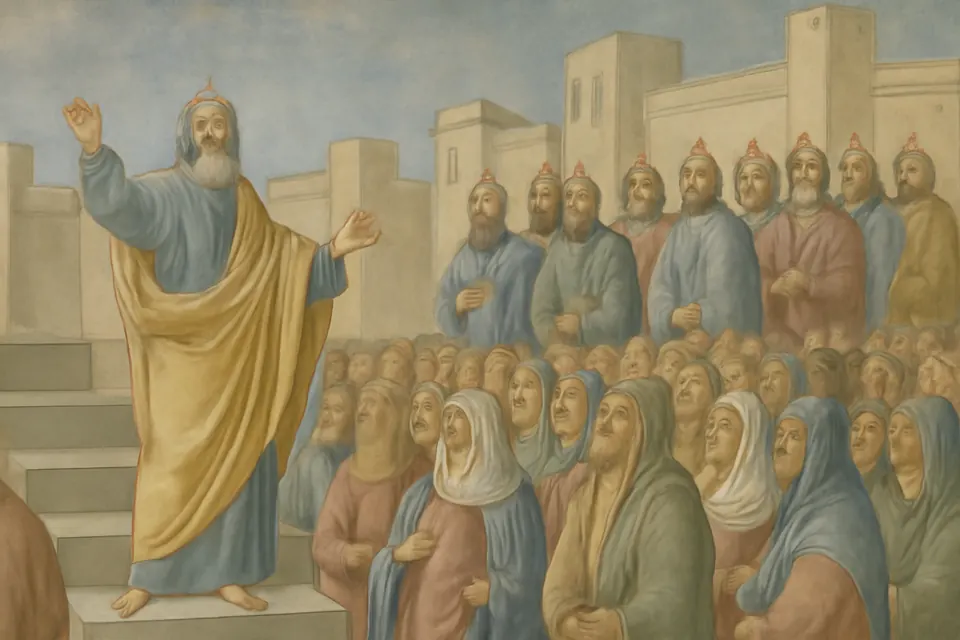
In the first chapters of Acts, Peter leads. He proposes choosing a replacement for Judas, and the lot falls on St. Matthias. On Pentecost, after the Holy Spirit came on the disciples, he stood up with the eleven and preached the first Christian sermon to the crowds in Jerusalem, calling them to repent and be baptized. "So those who received his word were baptized, and there were added that day about three thousand souls" (Acts 2:41).
Healings and prison
At the Beautiful Gate of the Temple, a man lame from birth asked Peter and John for money. "But Peter said, 'I have no silver and gold, but I give you what I have; in the name of Jesus Christ of Nazareth, walk'" (Acts 3:6). The man leaped up, and the two apostles were arrested for preaching.
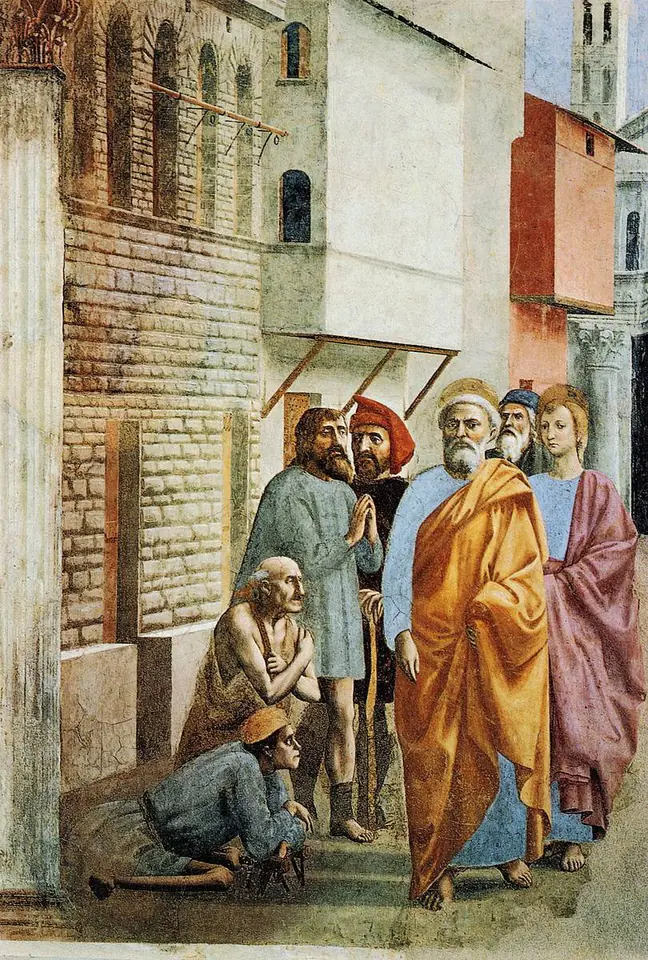
Acts says that people "even carried out the sick into the streets, and laid them on beds and pallets, that as Peter came by at least his shadow might fall on some of them" (Acts 5:15). At Lydda he healed a paralyzed man, Aeneas, and at Joppa he said to a dead woman, "Tabitha, rise," and she opened her eyes (Acts 9:40).

Cornelius and the Gentiles
After a vision at Joppa of a sheet full of animals the Law called unclean, Peter went to the house of Cornelius, a Roman centurion at Caesarea, and said, "Truly I perceive that God shows no partiality, but in every nation any one who fears him and does what is right is acceptable to him" (Acts 10:34–35). Cornelius and his household were baptized, the first Gentiles received into the Church in Acts.
Freed by an angel
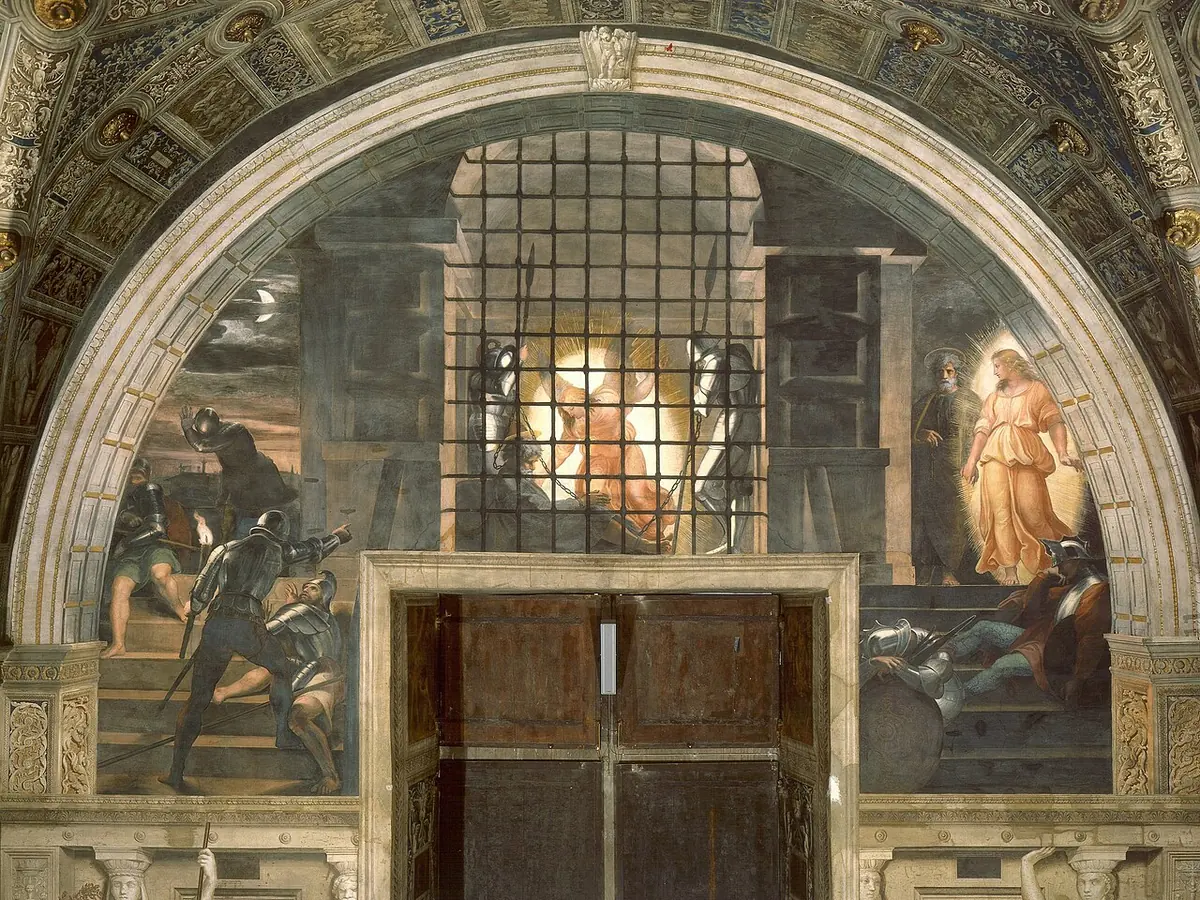
Around the year 44, King Herod Agrippa I killed James the brother of John with the sword and put Peter in prison, chained between two soldiers. The night before his trial, "an angel of the Lord appeared, and a light shone in the cell; and he struck Peter on the side and woke him, saying, 'Get up quickly.' And the chains fell off his hands" (Acts 12:7). Peter walked out past the guards and "departed and went to another place."

Jerusalem and Antioch
Peter speaks once more in Acts, at the meeting in Jerusalem around 49 that decided Gentile converts need not keep the Law of Moses (Acts 15). Paul adds that he stayed fifteen days with "Cephas" in Jerusalem (Galatians 1:18), and that at Antioch he "opposed him to his face" when Peter stopped eating with Gentile Christians (Galatians 2:11). Two letters of the New Testament carry Peter's name. The first ends with greetings from "she who is at Babylon," which early Christians read as a code name for Rome, "and so does my son Mark" (1 Peter 5:13).
Peter in Rome: tradition and history
The New Testament doesn't say that Peter went to Rome or how he died. The evidence comes from the generations right after him.
Around 95, the Church of Rome wrote to the Church of Corinth, in the letter known as First Clement, about the "illustrious apostles": "Peter, through unrighteous envy, endured not one or two, but numerous labours; and when he had at length suffered martyrdom, departed to the place of glory due to him." Irenaeus, around 180, called the Roman church the one "founded and organized at Rome by the two most glorious Apostles, Peter and Paul." Tertullian, around 200, wrote that at Rome "Peter has emulated the Passion of the Lord." A Roman priest named Gaius, writing about the same time, told an opponent: "But I can show the trophies of the apostles. For if you will go to the Vatican or to the Ostian way, you will find the trophies of those who laid the foundations of this church."
Papias and Clement of Alexandria say that St. Mark wrote his Gospel in Rome from Peter's preaching. Later tradition, recorded by St. Jerome around 392, gives Peter twenty-five years as bishop of Rome. The Catholic Encyclopedia grants that no precise information survives about his stay in Rome, and the year of his death is uncertain too: the sources point to the persecution Nero began after the fire of Rome in 64, and Jerome to the fourteenth and last year of Nero's reign.
Quo vadis?
The Acts of Peter, an apocryphal work of the late 2nd century, tells the best-known story of his last days. As persecution threatened, the Christians of Rome begged Peter to leave the city. He set out alone in disguise, and at the gate he met Jesus coming in. In M. R. James's translation, Peter asks, "Lord, whither goest thou thus?" and the Lord answers, "I go into Rome to be crucified." Peter understood that the words were meant for him and went back to the city to die. In Latin his question is Domine, quo vadis? A small church on the Appian Way marks the place. The story is traditional.


Crucified head downward
Tertullian is the first to say that Peter was crucified. Origen, quoted by Eusebius, adds the detail that made Peter's death famous: "having come to Rome, he was crucified head-downwards; for he had requested that he might suffer in this way." In the Acts of Peter he tells the executioners, "crucify me thus, with the head downward and not otherwise," and gives a long mystical reason. The explanation most Christians know comes from Jerome, who wrote that Peter asked for it "asserting that he was unworthy to be crucified in the same manner as his Lord." The upside-down crucifixion is traditional. The place was most likely Nero's circus on the Vatican Hill, near where he was buried.


The miracles of St. Peter
The miracles in the Gospels and Acts are part of Scripture, and Christians receive them as Scripture, not as later reports. Peter lived long before the Church began formally investigating miracles, so none is approved in the modern sense. The stories told after the New Testament are sorted here by this encyclopedia's labels.
- In the New Testament: walking on the water toward Jesus; the two great catches of fish; the healing of the lame man at the Temple gate (Acts 3); healings in the streets of Jerusalem where his shadow fell (Acts 5); the healing of Aeneas and the raising of Tabitha (Acts 9); and his release from prison by an angel (Acts 12).
- Traditional: his contest in Rome with Simon Magus, the magician of Acts 8, who in the Acts of Peter flies over the city and falls when Peter prays; the Quo vadis meeting with Christ.
- Reported: favors attributed to his intercession by pilgrims at his tomb and at the bronze statue in his basilica over many centuries. These are personal testimonies.
The tomb of St. Peter and the Vatican excavations
The emperor Constantine built the first St. Peter's Basilica in the 4th century over a small monument in a cemetery on the Vatican Hill, which Christians believed marked Peter's grave. The present basilica, built in the 16th century, keeps the same center.
In 1939, right after his election, Pius XII ordered excavations beneath the high altar. Over the next decade archaeologists uncovered a street of Roman tombs and, directly under the altar, a small 2nd-century shrine set against a red-plastered wall. Paul VI identified it with the "trophy" Gaius mentioned. A wall beside it was covered with graffiti. In his Christmas message of 1950, Pius XII announced that the tomb had been found, but left open whether the bones had.
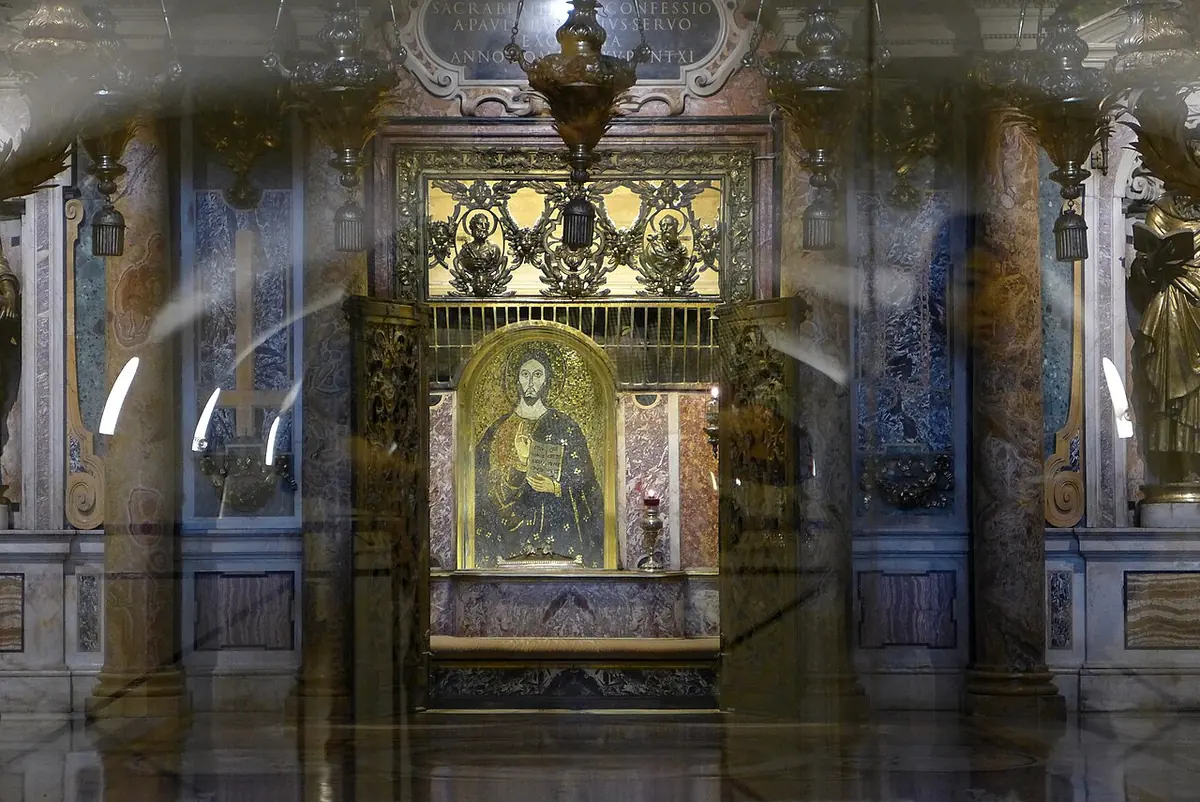

The rest of the story is reported, and complicated. In the 1950s the epigrapher Margherita Guarducci, studying the graffiti, learned that bones had been taken years earlier from a small repository inside the graffiti wall and set aside. Pope Francis's 2019 letter says the repository was found in 1952 and that one graffito beside it, naming Peter in Greek, is "of fundamental importance." Walsh reports that the bones belonged to a man between sixty and seventy years old and still carried shreds of cloth with "purplish highlights and gold threads." On June 26, 1968, Paul VI told a general audience, in Walsh's translation, that "the relics of St. Peter have been identified in a manner which we believe convincing," while expecting research and debate to continue. The next day the bones were returned to their place beneath the altar.
The identification still has critics. John E. Walsh, whose book The Bones of St. Peter tells the story in full, observes that belief or doubt has often followed people's views on the papacy more than the evidence. In 2019 Pope Francis gave nine of the fragments, kept in a bronze case in the papal chapel since Paul VI's time, to Ecumenical Patriarch Bartholomew of Constantinople. He wrote that the joining of the relics of the two brother apostles, Peter and Andrew, could be a sign of the unity the two churches seek.
Why St. Peter is the patron saint of fishermen and popes
Fishermen have the plainest reason: Peter was one, and Jesus called him from his nets to be a "fisher of men." Fishing towns hold festivals with a blessing of the fleet around his feast, as Gloucester, Massachusetts, does each June, and the fish served to pilgrims on the Sea of Galilee is sold as "St. Peter's fish."
Popes are, in Catholic belief, his successors as bishop of Rome. The pope's coat of arms carries the crossed keys, and the ring a new pope receives is called the Fisherman's Ring. Rome honors him and Paul together as its founders and patrons; June 29 is a public holiday in the city.
See all the patron saints by cause.
Symbols of St. Peter in art
Peter is one of the easiest saints to recognize. Christian art gave him the same face from at least the 4th century: curly hair, often balding at the crown in later art, and a short, square beard, usually gray. Look for these clues:
- Two keys: his attribute in the West since about the end of the 6th century, from Matthew 16:19. Painters often make one key gold and one silver, as Perugino does. Orthodox icons use the keys less often and may give him a scroll or a cross instead.
- A rooster: the cock that crowed after his third denial. It appears in scenes of the denial and sometimes alone beside him.
- An upside-down cross: his martyrdom.
- A boat, net or fish: his trade and his call.
- A book or scroll: his letters.
- Chains: less common; the chains that fell from his hands in prison.
- Next to St. Paul: the two often stand on either side of Christ, Peter with the keys and Paul with a sword or book.
In Western paintings he usually wears a blue or green tunic under a yellow or golden cloak, as in Masaccio and Perugino.
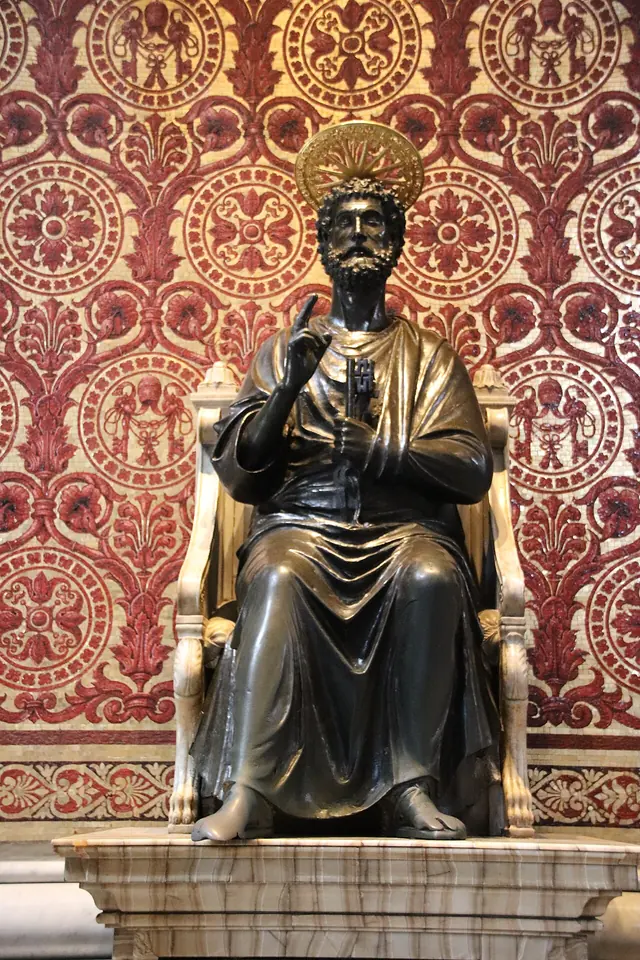

The best-known image of Peter is the bronze statue in the nave of St. Peter's Basilica. Proposed dates once ranged from the 5th century to the 13th; the basilica's guidebooks now give it to the circle of Arnolfo di Cambio, around 1300. On June 29 it is dressed in a red cope, a stole and a papal tiara.
Feast days and where St. Peter is honored
The great feast is June 29, the Solemnity of Sts. Peter and Paul. The Catholic Encyclopedia traces it in Rome to at least 258, when the two apostles were honored together that day. On the solemnity the pope blesses the pallia, the woolen bands worn by archbishops, which are kept beforehand in the gilded niche above Peter's grave. Orthodox Christians keep the Apostles' Fast in the weeks before the feast. See the feast day calendar.
Two other days belong to Peter alone:
- February 22, the Chair of St. Peter. Rome kept a feast of Peter's "chair" by 354. The day honors his teaching office, which the bishop's chair stands for. In the apse of St. Peter's Basilica, Bernini's great bronze throne, finished in 1666, encloses an old wooden chair venerated as Peter's.
- August 1 and January 16, his chains. Rome long kept August 1 as the feast of St. Peter's Chains, the dedication day of San Pietro in Vincoli, where the chains are shown under the high altar. The Orthodox venerate the chains on January 16.
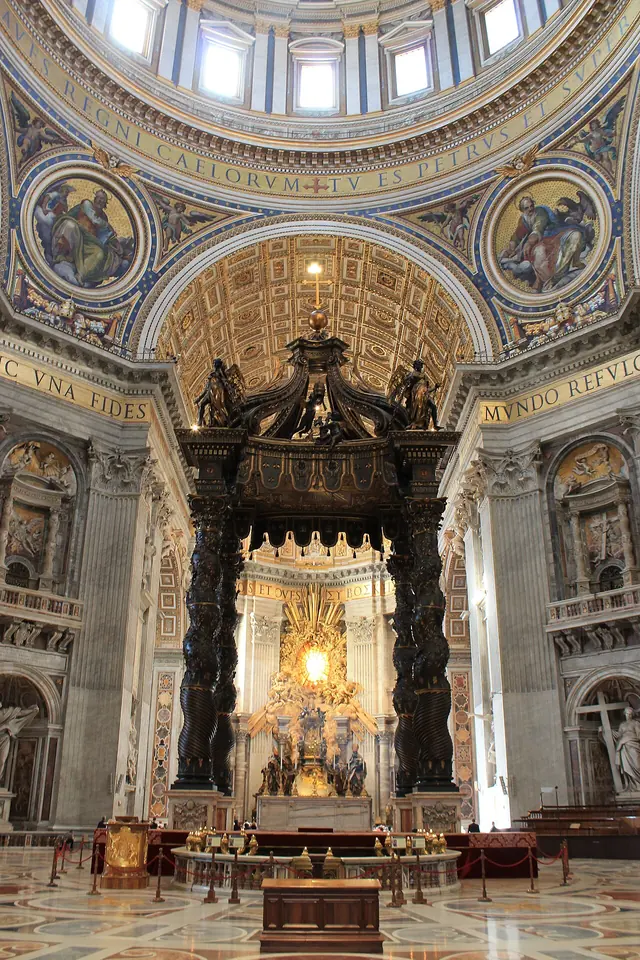

Visitors to Rome can tour the necropolis under the basilica through the Vatican Excavations Office. The Lateran Basilica keeps reliquaries said to hold the heads of Peter and Paul. In Galilee, the Church of the Primacy of St. Peter at Tabgha stands where tradition places the breakfast of John 21.
Prayer to St. Peter
Catholics and Orthodox ask St. Peter to pray for them, usually together with St. Paul. These prayers come from the liturgy. A prayer to both apostles from the Raccolta is on the St. Paul page.
The Collect of the Solemnity of Sts. Peter and Paul
From the Roman Missal, the prayer of the Mass on June 29:
O God, who on the Solemnity of the Apostles Peter and Paul give us the noble and holy joy of this day, grant, we pray, that your Church may in all things follow the teaching of those through whom she received the beginnings of right religion. Through our Lord Jesus Christ your Son, who lives and reigns with you in the unity of the Holy Spirit, God, for ever and ever.
The Collect of the Chair of St. Peter
Grant, we pray, almighty God, that no tempests may disturb us, for you have set us fast on the rock of the Apostle Peter's confession of faith. Through our Lord Jesus Christ, your Son, who lives and reigns with you in the unity of the Holy Spirit, God, for ever and ever.
The Orthodox troparion
Orthodox churches sing this hymn on June 29, in the translation of the Orthodox Church in America:
O foremost of the Apostles and teachers of the inhabited earth, / intercede with the Master of all / to grant peace to the world and great mercy to our souls.
Frequently asked questions
When is St. Peter's feast day?
June 29, the Solemnity of Sts. Peter and Paul, in the Catholic Church, and the same day in the Orthodox Church (July 12 on the civil calendar for churches that keep the old Julian calendar). Catholics also celebrate the Chair of St. Peter on February 22. The Orthodox venerate his chains on January 16.
What is St. Peter the patron saint of?
Fishermen, because he was one; popes, whom Catholics regard as his successors as bishop of Rome; and the city of Rome, which he shares with St. Paul.
Why does St. Peter hold keys?
Because Jesus told him, "I will give you the keys of the kingdom of heaven" (Matthew 16:19). From about the end of the 6th century the keys became his standard attribute in Western art, usually two of them, often one gold and one silver.
Was St. Peter crucified upside down?
That is the tradition. Origen, in the early 3rd century, is quoted by Eusebius as saying Peter "was crucified head-downwards; for he had requested that he might suffer in this way." St. Jerome later explained that Peter felt unworthy to die in the same way as his Lord. The New Testament says only that his death would glorify God (John 21:19).
Was St. Peter the first pope?
The Catholic Church holds that he was the first bishop of Rome and that the popes succeed to his office. The Orthodox Church honors him as the first among the apostles but teaches that the keys were given to the whole Church. Most Protestant churches honor Peter as an apostle and leader of the early Church without accepting a continuing papal office.
Where is St. Peter buried?
Beneath the high altar of St. Peter's Basilica in Vatican City. Excavations ordered by Pius XII in 1939 uncovered a 2nd-century monument over a simple grave, and in 1968 Paul VI announced that bones found in a wall beside it had been "identified in a manner which we believe convincing."
What does "Quo vadis" mean?
It is Latin for "Where are you going?" In the 2nd-century Acts of Peter, Peter is fleeing Rome when he meets Jesus walking into the city and asks him, "Lord, whither goest thou?" Jesus answers that he is going to Rome to be crucified again, and Peter turns back to face his own death. The story is a traditional legend.
Was St. Peter married?
Yes. The Gospels say Jesus healed Peter's mother-in-law at his house in Capernaum (Matthew 8:14–15), and Paul mentions that Cephas took a believing wife along on his travels (1 Corinthians 9:5). Clement of Alexandria adds the tradition that Peter had children.
Sources
- Catholic Encyclopedia (1911): St. Peter, Prince of the Apostles
- Catholic Encyclopedia (1908): Chair of Peter
- Catholic Encyclopedia (1910): Saint John Lateran
- Benedict XVI, General Audience of 17 May 2006: Peter, the fisherman
- Benedict XVI, General Audience of 24 May 2006: Peter, the Apostle
- Benedict XVI, General Audience of 7 June 2006: Peter, the rock
- Benedict XVI, General Audience of 22 February 2006: On this rock I will build my Church
- Paul VI, Udienza generale, 26 giugno 1968 (announcement on the relics of St. Peter)
- Letter of Pope Francis to Bartholomew I accompanying the gift of some relics of Saint Peter (30 August 2019)
- Eusebius, Church History, Book II (chapter 25: Gaius and the trophies of the apostles)
- Eusebius, Church History, Book III (chapter 1: Origen on Peter's death)
- Clement of Rome, Letter to the Corinthians
- Jerome, De Viris Illustribus (chapter 1: Simon Peter)
- John Chrysostom, Homily 54 on Matthew
- Augustine, Tractate 124 on the Gospel of John
- The Acts of Peter, translated by M. R. James (The Apocryphal New Testament, 1924)
- Orthodox Church in America: The Holy Glorious and All-Praised Leaders of the Apostles, Peter and Paul
- Orthodox Church in America: Veneration of the Precious Chains of the Apostle Peter
- Orthodox Church in America: Troparia and kontakia for June 29
- Catholic Culture: Solemnity of Saints Peter and Paul, Apostles (June 29)
- Catholic Culture: Feast of the Chair of St. Peter, Apostle (February 22)
- Catholic Culture: The Holy Apostles Peter and Paul (prayer from the Raccolta)
- St. Peter's Basilica: Statue of St. Peter
- John E. Walsh, The Bones of St. Peter (full text at St. Peter's Basilica.info)
- St. Peter in Art (Christian Iconography)
- Roman Martyrology, June 29