Our Lady of the Miraculous Medal
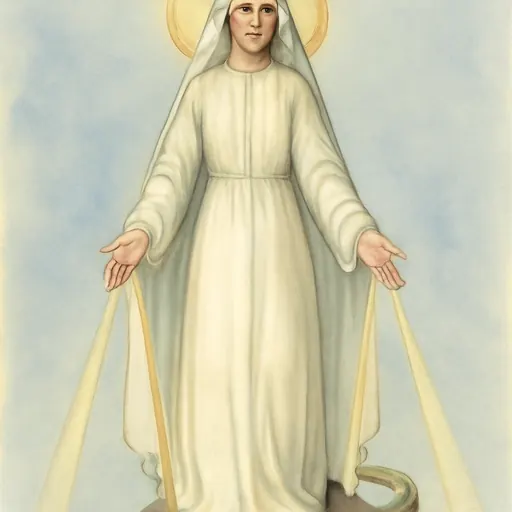
Our Lady of the Miraculous Medal is the title Catholics give the Virgin Mary as she appeared in 1830 to St. Catherine Labouré, a young novice of the Daughters of Charity, in their chapel on the rue du Bac in Paris. Catholic tradition holds that Mary showed Catherine the design of a medal, with the prayer "O Mary, conceived without sin, pray for us who have recourse to thee," and asked that it be made. Struck in 1832, it became the Miraculous Medal, one of the most widely worn Catholic medals in the world. Her feast is kept on November 27.
Who is Our Lady of the Miraculous Medal?
Our Lady of the Miraculous Medal is the Virgin Mary as Catholics believe she appeared in 1830 to St. Catherine Labouré, a 24-year-old novice of the Daughters of Charity, in the chapel of the order's mother house at 140 rue du Bac in Paris. In the second of three apparitions, on November 27, Catherine saw the design of a medal and heard a request to have it made. The first medals were struck in 1832, while cholera was killing thousands in Paris, and so many cures and conversions were reported that people called it "the Miraculous Medal."
The medal was first called the Medal of the Immaculate Conception, and that is its real subject. Its prayer, "O Mary, conceived without sin," was repeated by millions of Catholics in the decades before Pope Pius IX defined the Immaculate Conception as dogma in 1854.


The apparitions at the rue du Bac
Catherine Labouré was a farmer's daughter from Fain-lès-Moutiers in Burgundy. She entered the novitiate, which the Daughters of Charity call the "seminary," at the rue du Bac in April 1830. The account below follows her own descriptions as the chapel publishes them.
The night of July 18, 1830
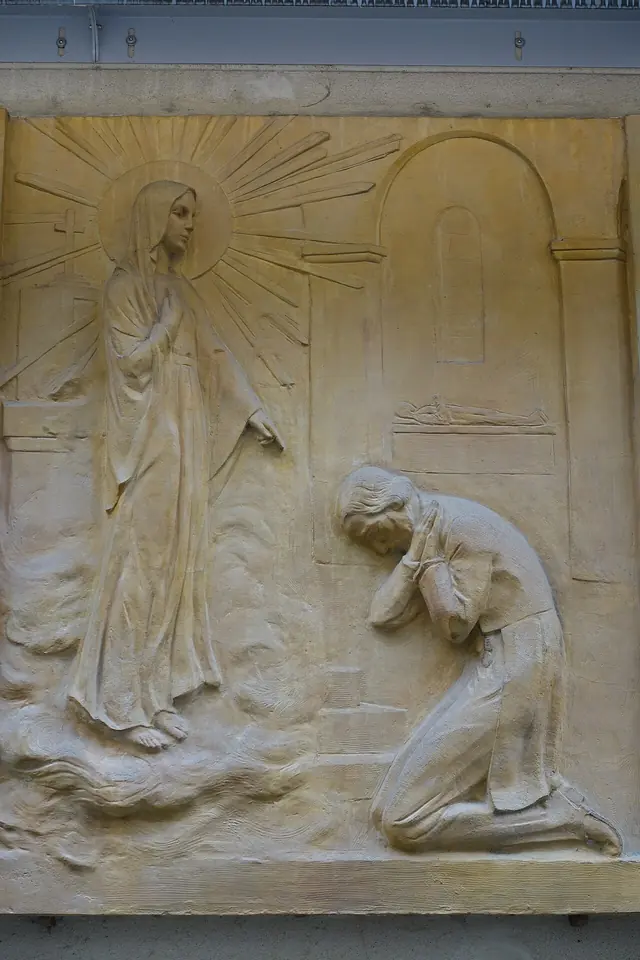
On the eve of the feast of St. Vincent de Paul, Catherine prayed that she might see the Blessed Virgin. At half past eleven that night she heard her name. A child stood at the foot of her bed and said, "The Blessed Virgin is waiting for you." She followed the child, who seemed to bring "rays of brightness wherever he passed," to the chapel. She heard a sound "like the rustle of a silk dress," and the Virgin sat down in the director's chair beside the altar.
Catherine threw herself at her feet and rested her hands on Mary's knees. "There, a period of time passed, the sweetest of my life," she wrote. Mary pointed to the altar and told her, "Come to the foot of this altar. Here, graces will be spread over all who ask for them with confidence and fervour." She spoke of a difficult mission ahead. The chair is still in the chapel.

November 27: the medal is shown
At 5:30 in the evening of November 27, during the sisters' meditation, Catherine saw Mary again, near a painting of St. Joseph on the right side of the sanctuary. The scene changed as she watched, "like two living paintings." First the Virgin stood on a half-globe with a serpent under her feet, holding a small golden globe topped by a cross, which she raised toward heaven. Catherine heard: "This globe represents the entire world, including France, and every person."
Then rings set with gems appeared on Mary's fingers, and rays of light streamed from them. "These rays are a symbol of the graces that I pour out on those who ask them of me." An oval formed around the figure with words in gold. In the English that became standard: "O Mary, conceived without sin, pray for us who have recourse to thee." A voice told her, "Have a medal made according to this model. For those who wear it with confidence, there will be abundant graces." Then the image turned, and Catherine saw the back.

December 1830
A third time, in December, Catherine saw the same image near the tabernacle and heard that she would not see the Virgin again. She told her confessor, Fr. Jean-Marie Aladel, a Vincentian priest. At first he forbade her even to think about it. In 1831 she was sent to a home for old men at Reuilly, on the poor east side of Paris, where she served for 46 years and kept her secret.
The design of the Miraculous Medal
Every part of the medal comes from Catherine's description. Here is how the chapel at the rue du Bac explains it.
The front
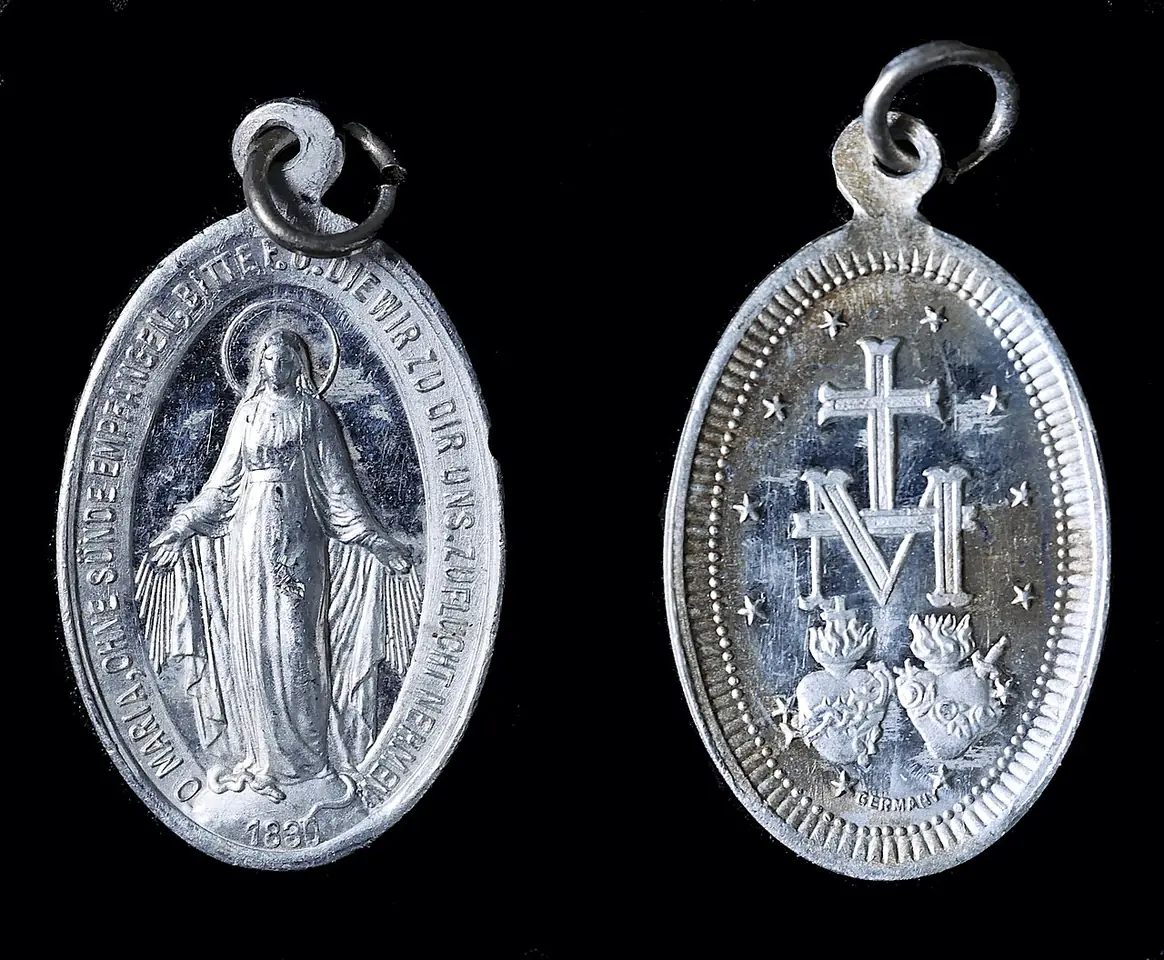
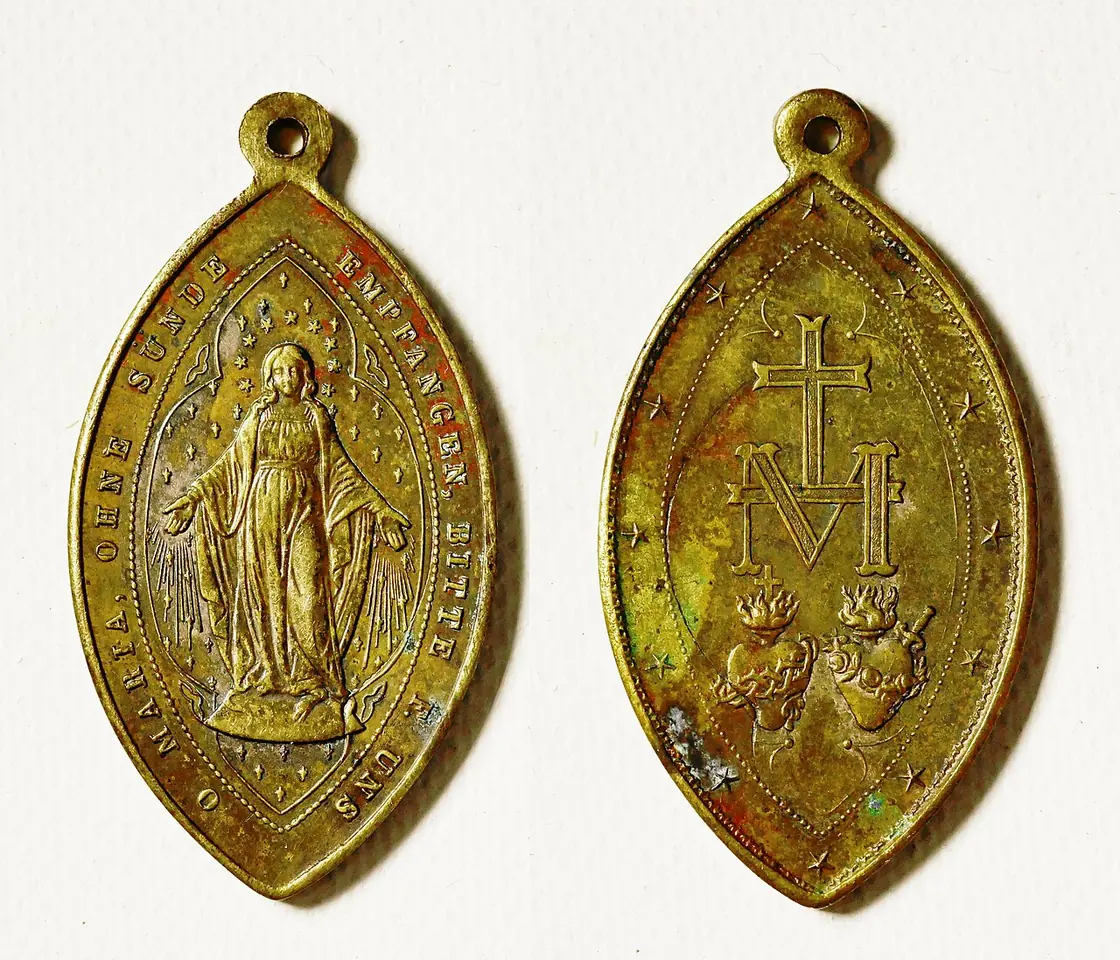
- Mary standing on a globe: the half-sphere is the world, and the serpent under her feet is Satan, recalling Genesis 3:15. The chapel calls the scene a spiritual battle that Mary fights on behalf of the world.
- Rays from her hands: the graces she obtains for those who ask. Catherine noticed that some of the gems gave no light. The account Catholic Culture repeats explains these as "the graces for which souls forget to ask."
- The inscription: "O Mary, conceived without sin, pray for us who have recourse to thee," in French on the original, Ô Marie conçue sans péché, priez pour nous qui avons recours à vous, with the year 1830 at the bottom.
The back
- The letter M with a cross: Mary's initial bound to the Cross of Christ, with a bar under the cross. The chapel reads it as the inseparable link between the Son and his mother, who shared in his sacrifice.
- Two hearts: the Sacred Heart of Jesus crowned with thorns, and the Immaculate Heart of Mary pierced by a sword, for Simeon's prophecy in Luke 2:35.
- Twelve stars: around the edge. The chapel explains them as the twelve apostles, and so the Church. Readers also hear an echo of the woman "crowned with twelve stars" in Revelation 12:1.

The cholera of 1832 and the spread of the medal
Fr. Aladel at last took the matter to the Archbishop of Paris, Hyacinthe-Louis de Quélen, who approved it. Early in 1832 cholera reached Paris; the chapel puts the deaths at more than 20,000. In June the Daughters of Charity began giving out the first 2,000 medals. The Catholic Encyclopedia dates the first striking to June 30, 1832.
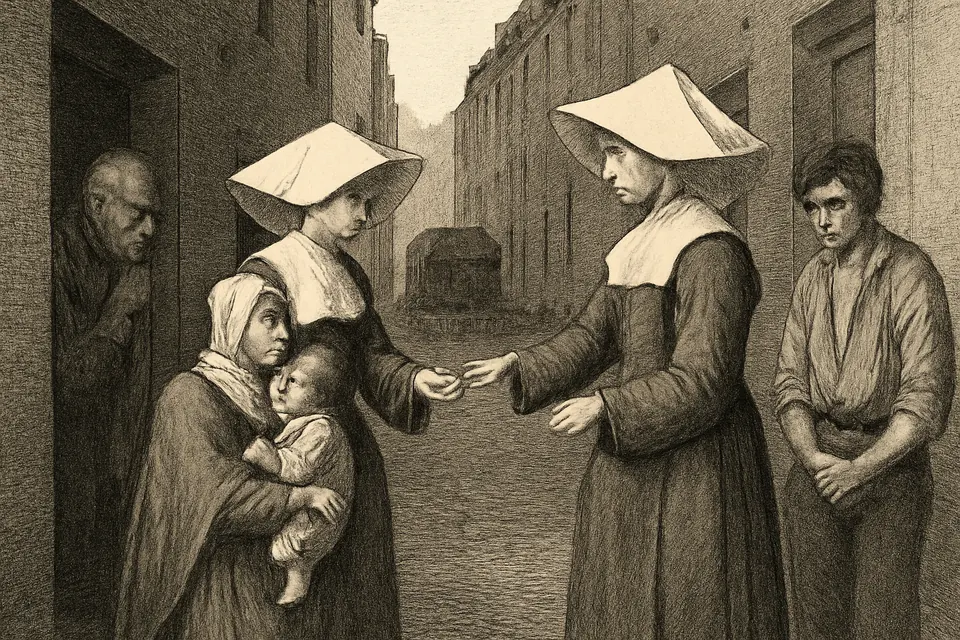
Cures, protection from the disease and conversions were reported, and Parisians started calling the medal "miraculous." The chapel's figures show how fast it spread: 500,000 by the autumn of 1834, more than a million in 1835, more than 10 million by 1839, and over a billion at Catherine's death. St. Maximilian Kolbe later wrote that 80 million were struck in the first ten years.

The miracles of the Miraculous Medal
- Reported: the cures and protections during the Paris cholera of 1832, never examined one by one.
- Approved: the conversion of Alphonse Ratisbonne in Rome in 1842, examined by the tribunal of the Vicariate of Rome and declared a true miracle.
- Reported: the incorrupt body of St. Catherine Labouré, found intact in 1933.
- Reported: the many healings and conversions attributed to the medal since then.
Alphonse Ratisbonne, 1842
Alphonse Ratisbonne was a 27-year-old Jewish banker from Strasbourg. His brother Théodore had become a Catholic priest, and Alphonse, by the Catholic Encyclopedia's blunt account, had become "a rabid enemy of everything Catholic." In Rome in January 1842, a French acquaintance, Baron Théodore de Bussierre, persuaded him to wear a Miraculous Medal and say the Memorare, a prayer to Mary, every day. He agreed, reluctantly.
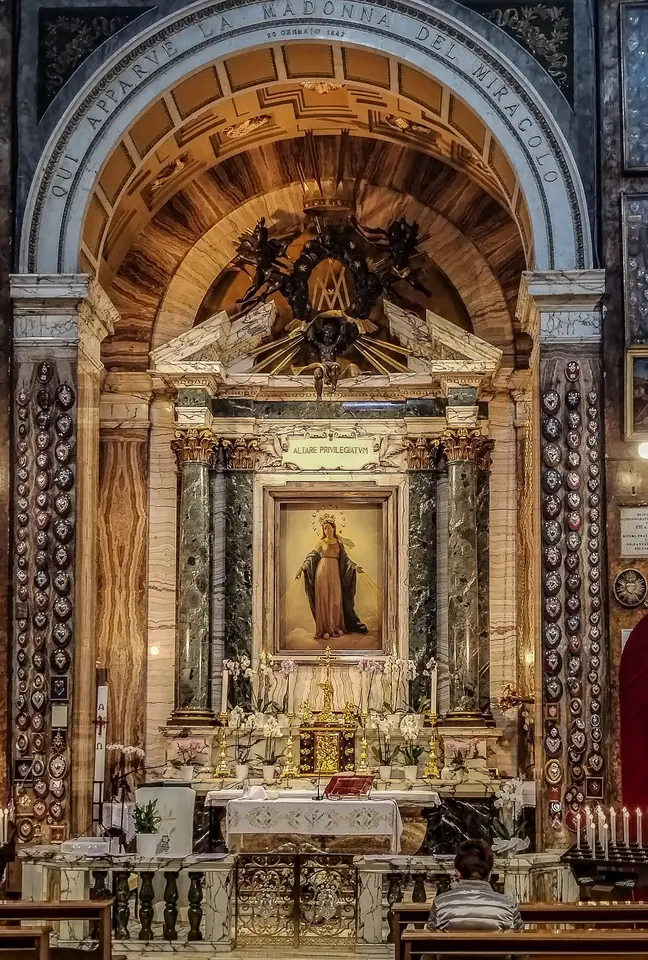
On January 20, 1842, Ratisbonne waited for the baron in the church of Sant'Andrea delle Fratte. When the baron came back a few minutes later, he found him on his knees in tears. Ratisbonne said he had seen the Virgin above a side altar, "just as she is represented on my medal." He told them: "She spoke not a word, but I understood all." He was baptized on January 31.
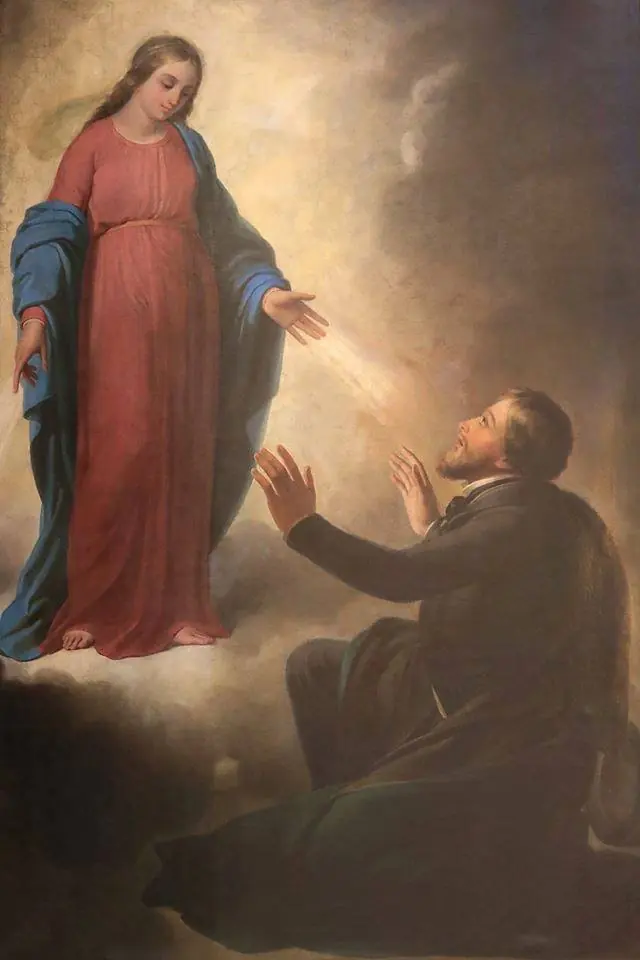

On June 3, 1842, Cardinal Constantino Patrizi, the pope's vicar for Rome, declared after examining nine witnesses that the conversion was a true miracle obtained through Mary's intercession. Ratisbonne became a priest and spent his last decades in Jerusalem with the Sisters of Our Lady of Sion, whom he and his brother founded. Older Catholic retellings speak of Judaism in language the Church set aside after the Second Vatican Council.

St. Maximilian Kolbe and the Militia of the Immaculata
In Rome in 1917, the young Polish Franciscan St. Maximilian Kolbe founded the Militia Immaculatae, a movement of total consecration to Mary Immaculate. He made the Miraculous Medal its outward sign. In his writings he retold Catherine's vision and asked, "Is it not fitting, therefore, that as we consecrate ourselves to the Immaculata without reserve, we should grace our chest with the Miraculous Medal?" He called the medal "the external sign of consecration to the Immaculata." The Militia still calls it the "silver bullet." Kolbe died in Auschwitz in 1941 and was canonized in 1982.
Symbols of Our Lady of the Miraculous Medal in art
Statues and paintings of Our Lady of the Miraculous Medal copy the front of the medal. Look for these signs:
- White dress and white veil to the feet, sometimes with a blue mantle added by artists. Catherine described a plain white dress buttoned at the neck and a thin band of lace on the forehead.
- Arms lowered, palms open, rays falling from the rings on her fingers. This is the clearest way to tell her from the many images of the Immaculate Conception in which Mary joins her hands.
- A globe under her feet and a green serpent. Catherine's companion Sister Dufès recorded her description of a greenish serpent with yellow spots.
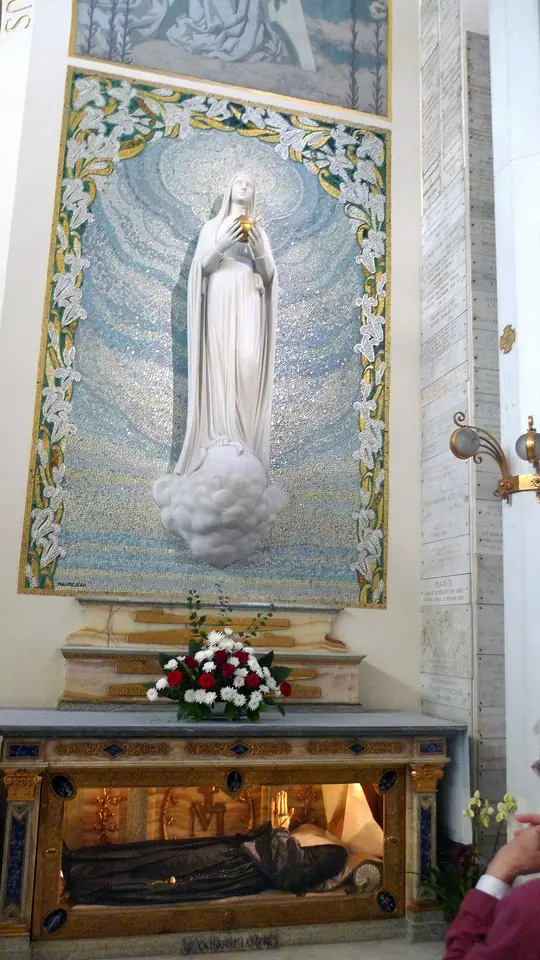
- The Virgin of the Globe, a second form, in which she holds a small golden globe topped by a cross up toward heaven. Catherine pressed for this statue for years; the one in the chapel, by Maxime Real del Sarte, dates from 1930.
- The oval of words around the figure, and on reverse-side images, the M, cross, two hearts and twelve stars.
The chapel at 140 rue du Bac
The chapel of the mother house of the Daughters of Charity, built in 1815, stands at the end of a long courtyard off the rue du Bac, in the 7th arrondissement of Paris. Stone reliefs of Catherine's life and rows of marble plaques reading Merci line the courtyard.
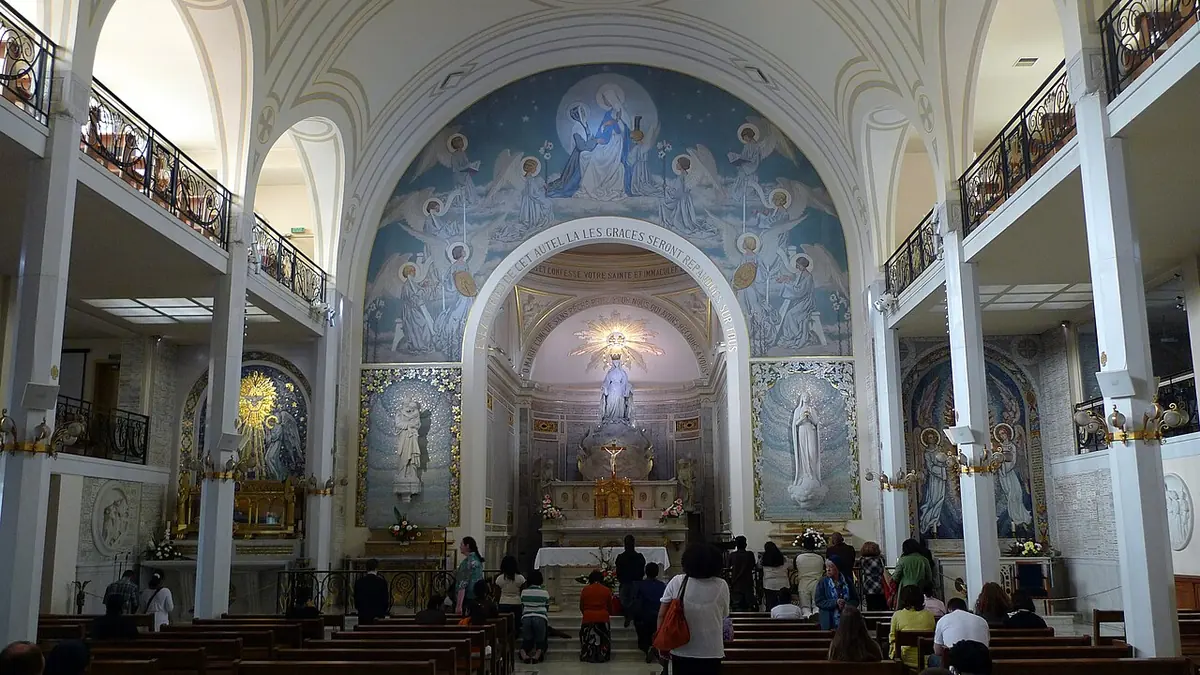

Inside are three relics that draw pilgrims:
- St. Catherine Labouré: when her vault at Reuilly was opened in 1933, the year of her beatification, the chapel reports that her body was found intact. It lies under the altar of the Virgin of the Globe, where Mary appeared, with a wax mask over the face. Her incorruption is reported.
- St. Louise de Marillac: the co-founder of the Daughters of Charity (died 1660). Since 1920 her remains have rested in a reliquary over a side altar. Popular books sometimes call her body incorrupt; the chapel speaks only of her "relics."
- St. Vincent de Paul's heart, placed on the altar of St. Vincent in 1947. That altar was the main altar in 1830, and a mosaic over it says the apparitions took place at its foot.

Pope John Paul II prayed in the chapel in 1980 during his first visit to France. In the United States, the Vincentians' Basilica Shrine of Our Lady of the Miraculous Medal in the Germantown neighborhood of Philadelphia has held a Perpetual Novena every Monday since 1930. Pope Francis made it a minor basilica in 2022.
The feast of November 27
On July 23, 1894, after an examination by the Congregation of Rites, Pope Leo XIII granted a feast of "the Manifestation of the Immaculate Virgin under the title of the Miraculous Medal," to be kept every November 27 by the priests of the Congregation of the Mission. It is still a feast of the Vincentian family and a local observance elsewhere, but not part of the General Roman Calendar. See the feast day calendar and the Immaculate Conception on December 8.
Prayers to Our Lady of the Miraculous Medal
The first prayer is the one on the medal itself, which Catherine reported seeing in gold letters. It is an invocation, often said three times:
O Mary, conceived without sin, pray for us who have recourse to thee.
The Daughters of Charity also keep a short prayer from the time of St. Louise de Marillac, who was devoted to the Immaculate Conception long before it was defined. They add it at the end of each decade of the rosary, and part of it is written in gold in the dome of the chapel:
Most holy Virgin, I believe and confess your holy and Immaculate Conception.
Many parishes pray a weekly novena to Our Lady of the Miraculous Medal, as the Philadelphia shrine does every Monday. Catholics usually have the medal blessed by a priest. The Church treats it as a sacramental: in Catholic teaching the grace comes from God through Mary's prayer, not from the metal.
Frequently asked questions
What does the Miraculous Medal mean?
The front shows Mary standing on a globe and crushing a serpent, with rays of grace falling from her hands, inside the prayer "O Mary, conceived without sin, pray for us who have recourse to thee." The back has the letter M for Mary under a cross, the Sacred Heart of Jesus crowned with thorns, the Immaculate Heart of Mary pierced by a sword, and twelve stars. The chapel in Paris explains the stars as the twelve apostles and so the Church.
When is the feast of Our Lady of the Miraculous Medal?
November 27, the day of the 1830 apparition in which Catherine Labouré was shown the medal. Pope Leo XIII granted the feast in 1894 to the Vincentian priests. It is celebrated by the Vincentian family and in some places, but it is not on the General Roman Calendar.
Why is it called the Miraculous Medal?
It was first made as the "Medal of the Immaculate Conception." When it was given out during the cholera epidemic in Paris in 1832, so many cures, protections and conversions were reported that people began calling it "miraculous," and the name stuck.
Who can wear the Miraculous Medal?
Anyone. Catholics regard it as a sacramental, a blessed object that disposes the wearer to grace, not a charm. Catherine reported Mary's promise of great graces for those who wear it "with confidence." It is usually blessed by a priest and worn around the neck.
Where did the Miraculous Medal apparitions happen?
In the chapel of the mother house of the Daughters of Charity at 140 rue du Bac, in the 7th arrondissement of Paris. The chapel is open to pilgrims, and the body of St. Catherine Labouré, reported to have been found incorrupt in 1933, lies there under the altar of the Virgin of the Globe.
Sources
- Catholic Encyclopedia (1911): Miraculous Medal
- Catholic Encyclopedia (1911): Maria Alphonse Ratisbonne
- Chapel of Our Lady of the Miraculous Medal: The apparitions and the Miraculous Medal
- Chapel of Our Lady of the Miraculous Medal: Family History (Vincent, Louise, Catherine)
- Chapelle Notre-Dame de la Médaille Miraculeuse: Chapelle en ses détails (French)
- Théodore de Bussierre, The Conversion of Marie-Alphonse Ratisbonne (English translation, with the 1842 decree)
- Militia of the Immaculata: The Miraculous Medal, Silver Bullet of the MI (from the writings of St. Maximilian Kolbe)
- Central Association of the Miraculous Medal: About CAMM
- Catholic Culture: Our Lady of the Miraculous Medal, November 27