St. Valentine
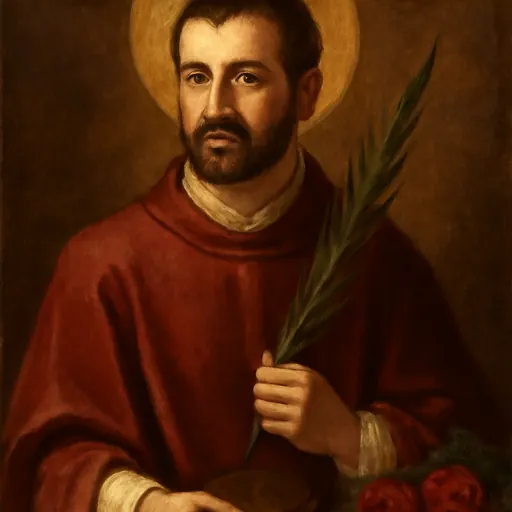
St. Valentine was a Christian martyr beheaded on the Via Flaminia north of Rome, probably in the late 3rd century. Early records name two Valentines buried on that road, a priest of Rome and a bishop of Terni, who may have been one man. His feast is February 14, and since the 14th century he has been the patron saint of lovers and engaged couples.
Who was St. Valentine?
St. Valentine was a Christian martyr of the early Church, beheaded and buried beside the Via Flaminia, the great Roman road that runs north from Rome across the Tiber at the Milvian Bridge and on into Umbria. That much is solid. Almost everything else people say about him, from the jailer's daughter to the secret weddings, comes from later legend, and the romantic side of February 14 came more than a thousand years after his death.
The oldest firm record is a building. The Roman list of popes compiled in 354 says that Pope Julius I (337–352) built a basilica on the Via Flaminia "which is called the Valentinian." By the 7th century, pilgrim guides to Rome describe a large and finely decorated church of St. Valentine the martyr near the Milvian Bridge, and the city gate on that road, today's Porta del Popolo, was known for a time as St. Valentine's Gate.

The Catholic Encyclopedia (1912) counts at least three martyrs named Valentine under February 14 in the early martyrologies: a priest of Rome, a bishop of Interamna (modern Terni, about 60 miles north), and a martyr in Africa with several companions, of whom nothing more is known. The first two, it says, seem to have died in the second half of the 3rd century and were both buried on the Via Flaminia, at different distances from Rome.
One Valentine or two?
The stories of the Roman priest and the bishop of Terni are strikingly alike. Each heals a sick child of a powerful man, converts the household, is arrested, and is beheaded on the Via Flaminia. The Martyrology of the English monk Bede, written around 730, already lists both. Many modern historians think the two are one martyr remembered at two shrines on the same road. Vatican News, in its saint-of-the-day page, takes that view, pointing to the shared place of martyrdom and burial and the matching miracles.
The current Roman Martyrology, revised in 2001 and 2004, lists a single Valentine on February 14, a martyr on the Via Flaminia at the Milvian Bridge.
Why St. Valentine left the general calendar in 1969
For centuries Valentine had a commemoration on February 14 in the universal Catholic calendar. The reform of the calendar under Pope Paul VI in 1969 aimed to keep on the General Roman Calendar only saints of universal importance and those about whom reliable history survives. Valentine, like St. Christopher, fell on the wrong side of that line: apart from his name, his martyrdom and his burial on the Via Flaminia, nothing about him can be confirmed.
Removal from the general calendar is not removal from sainthood. Valentine is still in the Roman Martyrology, the official list of the Church's saints, and dioceses and parishes may celebrate him. Terni keeps February 14 as the feast of its patron, and priests who use the 1962 Missal still make his commemoration. In most Catholic churches, February 14 is now the memorial of Sts. Cyril and Methodius, the 9th-century brothers who brought the Gospel to the Slavs.
The legends of St. Valentine
Two early accounts of his martyrdom, called Passions, survive. The Catholic Encyclopedia calls them "of relatively late date and of no historical value," and Roger Pearse's survey of the early texts dates the Terni Passion to before 700. They are the source of the popular stories, and everything in this section is traditional.


The priest of Rome and the judge's daughter
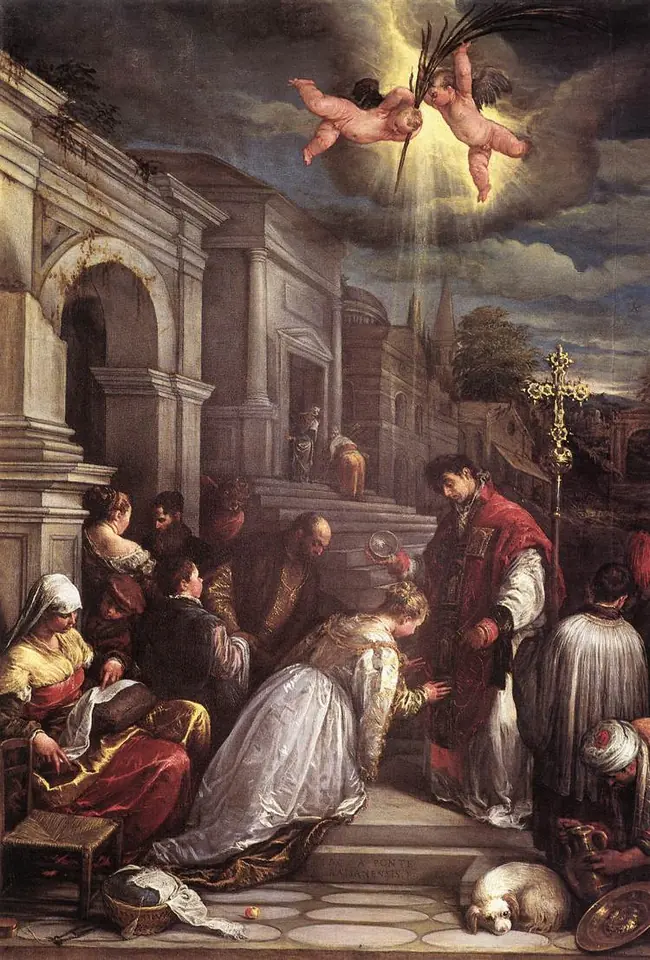
The Roman story is told within the Passion of Sts. Marius and Martha, written before 600. Valentine, a priest, is arrested under the emperor Claudius II Gothicus (268–270) and handed over to a judge named Asterius. The judge has a blind adopted daughter. He challenges Valentine to prove his God by healing her, and Valentine lays his hands on her eyes and prays, and she sees. Asterius and his whole household are baptized. When the emperor hears of it, Valentine is beaten and beheaded on the Via Flaminia.
Later art gives the daughter a name, Lucilla, and shows Valentine baptizing her, as in Bassano's painting above. Older English sources often turn the judge into a jailer, which is why the story is usually told today as "the jailer's daughter."

The bishop of Terni and the student's son
The Terni Passion tells of Valentine, bishop of Interamna, who was known as a healer. In Rome a teacher of Greek and Latin rhetoric named Craton had a son, Cheremon, whose illness had left him bent double and unable to move. Craton sent for Valentine, who prayed over the boy through the night, and in the morning he stood up healed. Craton, his family and three of his Athenian students, Proculus, Ephebus and Apollonius, were baptized. When the prefect's son Abundius also became a Christian, Valentine was arrested, beaten and beheaded.
The three students carried their teacher's body back to Terni by night and buried it there. The Orthodox Church in America tells how they kept preaching until they too were arrested and beheaded, and Abundius buried them beside Valentine.

The note, the soldiers and the crocus
Some of the best-known Valentine stories are much newer than the Passions.
- The letter signed "from your Valentine." Many websites say that on the night before his execution, Valentine wrote a farewell note to the girl he had healed and signed it "from your Valentine." No ancient or medieval source has this, and it is best read as a modern legend built on the Asterius story.
- The secret weddings. A widely repeated story says Claudius II forbade young men to marry so they would make better soldiers, and Valentine married couples in secret. It does not appear in the early Passions either.
- The crocus. At Whitefriar Street in Dublin, Valentine's statue holds a crocus, an early spring flower. It is a modern devotional touch, not part of the ancient story.
The miracles of St. Valentine
Valentine's cult began centuries before the Church developed any process for examining miracles, and none has been formally investigated. Using the labels this encyclopedia applies:
- The healing of Asterius's blind daughter: traditional, from the Passion of Marius and Martha.
- The healing of Craton's son Cheremon: traditional, from the Terni Passion.
- Cures of epilepsy: reported. Pilgrims to his shrines in Germany and Alsace, including Rufach and Kiedrich, left accounts of cures over many centuries, but none was formally examined by the Church.
- Prayers answered by couples at Whitefriar Street and Terni: reported, in the sense that couples testify to them, not that they have been investigated.
Why February 14 became a day for lovers
Chaucer and the birds
Nothing in the early sources ties Valentine to romantic love. The connection first appears in English poetry of the 1380s. In Geoffrey Chaucer's Parlement of Foules, the poet dreams of a garden where Nature gathers all the birds to choose their mates:
For this was on seynt Valentynes day,
Whan every foul cometh there to chese his make.
The Catholic Encyclopedia explains the custom by a medieval belief in England and France that birds began to pair in mid-February. In a 1981 article in the journal Speculum, the medievalist Jack B. Oruch went through the surviving texts and found no romantic tradition attached to the day before Chaucer. Within a generation, though, poets around him were writing valentine poems: John Gower, John Lydgate, Sir John Clanvowe, and in France Oton de Grandson and later Charles d'Orléans. Henry Ansgar Kelly, in Chaucer and the Cult of Saint Valentine (1986), went further and argued that Chaucer may have had in mind a different Valentine, a bishop of Genoa honored in May, when English birds really do pair. Scholars still debate that point.

By the 1400s, "Valentine" meant a sweetheart. In 1477 a young Norfolk woman, Margery Brews, wrote to the man she hoped to marry and addressed her letter "Unto my right well-beloved Valentine, John Paston, squire." The letter survives among the Paston family papers and is one of the oldest valentines in English.
The Lupercalia question
A popular story says the Church created Valentine's Day to replace the Lupercalia, a pagan Roman fertility festival held on February 15, and that Pope Gelasius I made the switch in 496. There is no evidence for it. Gelasius did write against Christians who wanted to keep the Lupercalia, but no ancient text says he put Valentine's feast in its place, and February 14 was linked to Valentine because that was the date of his martyrdom and burial. The Lupercalia theory was first suggested by 18th-century writers such as Alban Butler and Francis Douce. Oruch and most later historians reject it.
Cards and gifts
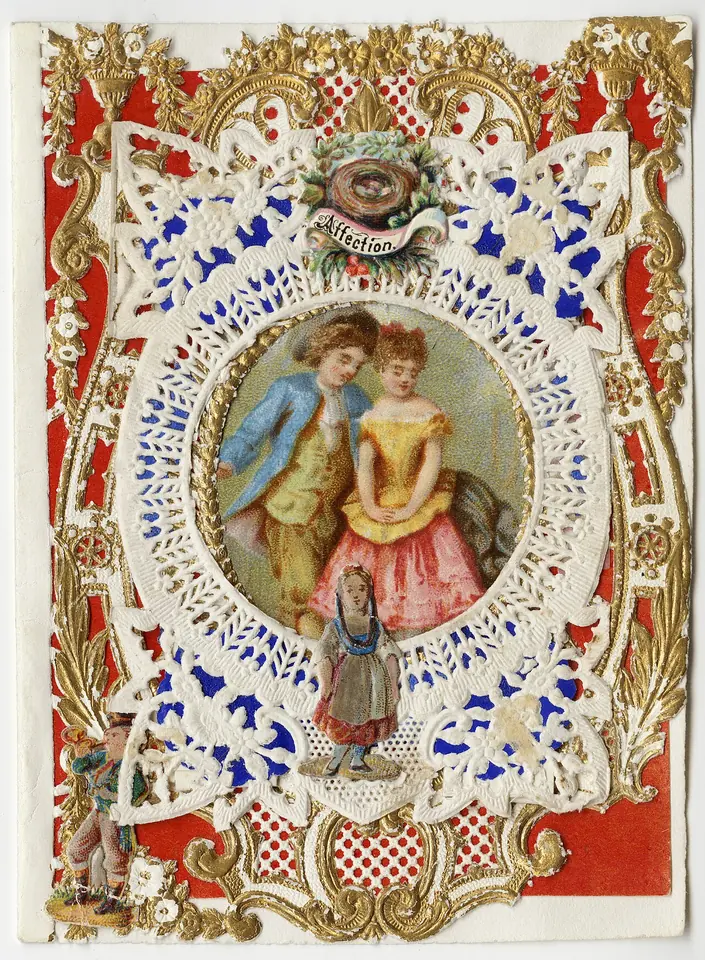
Handwritten valentine verses spread in England in the 1600s and 1700s. Printed and lace-paper cards took over in the 1800s. In the United States, Esther Howland of Worcester, Massachusetts, built a business in the late 1840s on cards of embossed paper lace and colored pictures, and she is often called the mother of the American valentine.

Why St. Valentine is the patron saint of lovers, couples and epilepsy
Each patronage has a different root, and some are clearer than others. For more, see our patron saints page.
- Lovers and engaged couples: from Chaucer's poem and the courtly custom of choosing a Valentine on February 14, not from anything in his life.
- Happy marriages: a natural extension of the same custom. Couples ask his prayers at his shrines in Terni and Dublin, and every year on a Sunday near February 14, engaged couples make a promise of love before his urn in the basilica at Terni, in a rite called the Feast of the Promise.
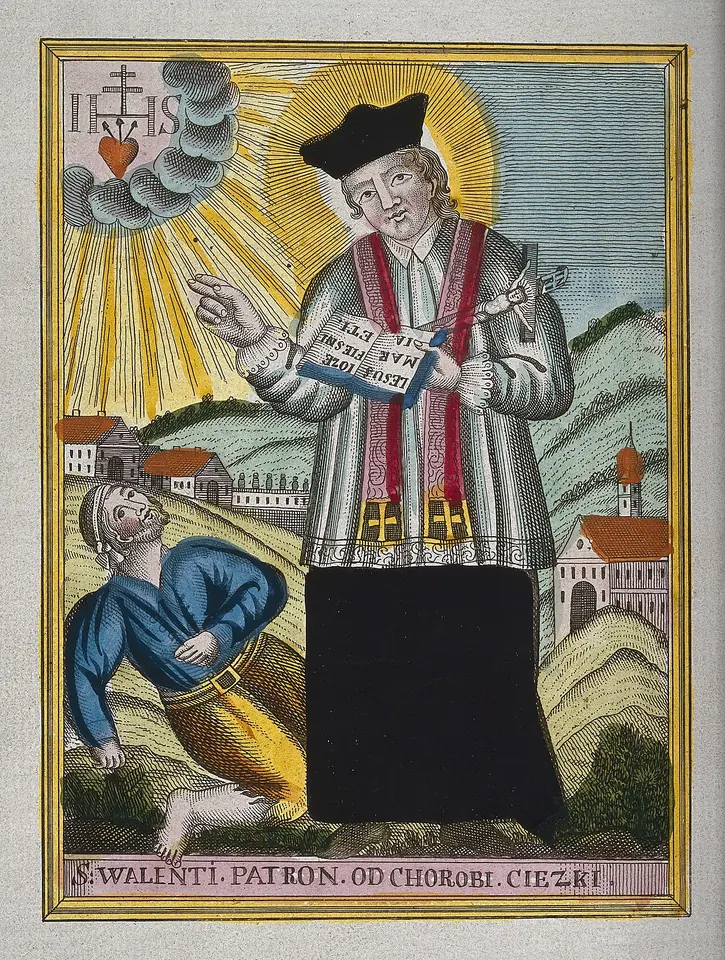
- Epilepsy: strongest in German-speaking lands, where the illness was once called "St. Valentine's sickness." Epilepsy Action notes the sound-alike between the German fallen, "to fall," and Valentin, since epilepsy was known as the falling sickness. Martin Luther thought this wordplay was the whole reason. Another Valentine, the 5th-century missionary bishop of Raetia, venerated at Passau, was also invoked against seizures, and the two saints were often blended in German art. St. Vitus is another saint long invoked for the same illness.
- Beekeepers: listed in many modern patron-saint references, but the origin of this patronage is not recorded in any early source we could find.
- Terni: the city where his body lies.

Symbols of St. Valentine in art
St. Valentine has no single fixed emblem, so you identify him by a combination of details and, often, by a name on the frame. Look for:
- A martyr's palm: the sign of a martyr, carried by Valentine in most images, as in the Nuremberg Chronicle woodcut.
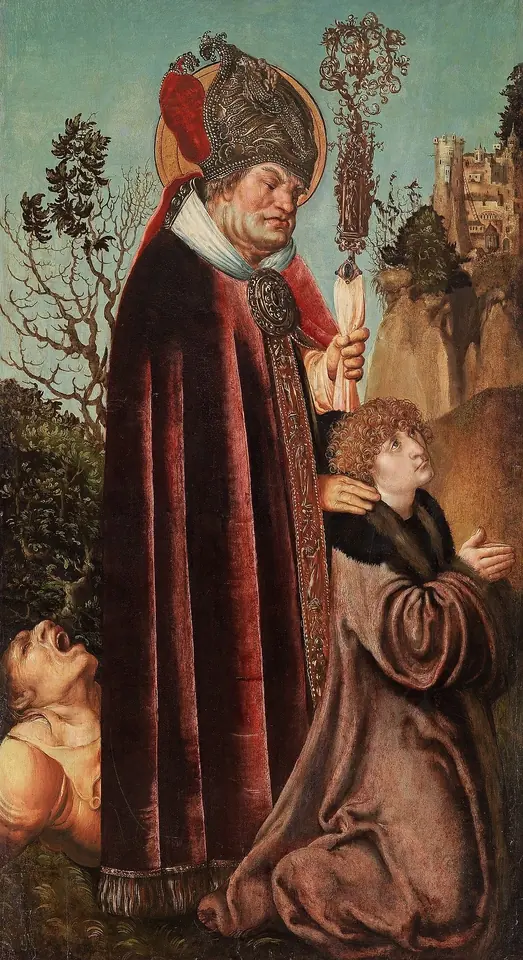
- Vestments: in Italy he is usually a priest in a red chasuble or cope, red for a martyr. In Germany and Austria he is often a bishop with miter and crozier, partly because he was merged with the bishop of Terni and with Valentine of Raetia.
- A person having a seizure: a man or child fallen at his feet, sometimes with foam at the mouth. This is the surest sign of Valentine in northern European art, from Cranach's panel to folk prints sold at pilgrimage shrines.
- A young woman or child being healed or baptized: the Asterius story, as in Bassano's painting.
- A sword: the instrument of his beheading, held in some later images.
- Birds, roses and hearts: in modern holy cards and popular art, borrowed from the customs of his day.

Relics and shrines of St. Valentine
As with many early martyrs, several churches claim his remains, and the Church does not rule on which claims are genuine. The historian Lisa Bitel told National Geographic simply, "The Vatican doesn't take a position on bodies."
Rome: Santa Maria in Cosmedin
The old basilica on the Via Flaminia fell into ruin in the Middle Ages, and its relics were moved to churches inside the city, among them Santa Prassede. The best-known Roman relic today is a skull crowned with dried flowers, displayed in a gilded reliquary in a side chapel of Santa Maria in Cosmedin, the church that also holds the Mouth of Truth. The label calls it the skull of St. Valentine, though Roman guides note that it may belong to another martyr of the same name.


Dublin: Whitefriar Street
In 1835 the Irish Carmelite John Spratt preached in Rome to great acclaim, and Pope Gregory XVI gave him relics of St. Valentine, recovered from the old cemetery on the Via Flaminia, together with a small vessel said to be tinged with the martyr's blood. On November 10, 1836, the reliquary was carried in procession to Whitefriar Street Carmelite Church and received by Archbishop Daniel Murray of Dublin. After Spratt's death the relics went into storage. During a renovation in the 1950s and 1960s they were given their own altar and shrine, with a statue by Irene Broe of the saint in red vestments holding a crocus. Couples visit all year, and the church is crowded every February 14.


Terni: the Basilica of San Valentino
Terni, in Umbria, honors Valentine as its patron saint and as one of its early bishops. The city's tourism office describes the basilica, about two kilometers from the center, as standing on an early Christian cemetery over the saint's tomb. A shrine on the grave grew into a five-aisled basilica. The present church was built in the early 1600s after a search for the saint's body under Pope Paul V, and its classical facade was finished only in 1854. Beneath the high altar, a crystal shrine holds a reliquary figure of Valentine containing his remains, and on his feast the city carries the urn in procession.


Other churches that claim relics include the Franciscan church of Blessed John Duns Scotus in Glasgow, which received bones from a wealthy French family in the late 1870s, the Basilica of Sts. Peter and Paul at Vyšehrad in Prague, Madrid, Vienna, Chełmno in Poland, Roquemaure in France and Balzan in Malta.


St. Valentine's feast day
February 14 is still St. Valentine's feast in the Roman Martyrology and in local calendars, including Terni's, where it is the city's great festival. Find his neighbors on the calendar, including St. Agatha on February 5 and St. Blaise on February 3, on our feast days page.
Catholics who keep the day often go to Mass together as couples, and some parishes offer a blessing for engaged and married couples. The Orthodox Church in America commemorates Valentine of Terni and his disciples on July 30.
Prayer to St. Valentine
No prayer to Valentine survives from the early Church, and there is no official liturgical prayer for him in the current Roman Missal. The prayer most associated with him today is the one published by the Carmelites of Whitefriar Street in Dublin, who keep his relics:
Saint Valentine, true servant who shed his blood in defence of the sacraments and faith in Jesus Christ, intercede for us today, we pray.
Gain for us the strength to be steadfast like you in witnessing to the true faith to the end of our days, and help us never to lose hope in the Lord who is always near us.
Intercede for those men and women who are preparing for marriage: help them to know one another and the true meaning of the sacramental bond they are preparing to enter.
Intercede for those who are joined together in the sacrament of marriage, that they may never give up when trials come their way but may remain faithful to each other, and to the Lord who blessed their union.
May your love for the Lord be an inspiration for our love for each other, for the love between husband and wife, and for the love and charity we extend to all whom we meet. Amen.
Beyond that prayer, Catholics ask St. Valentine to pray for them in matters of love, courtship and marriage, and people with epilepsy and their families still ask his help, especially in Germany and Austria.
Frequently asked questions
Who was the real St. Valentine?
The oldest records name a martyr Valentine buried on the Via Flaminia, the road north from Rome, where Pope Julius I (337–352) built a basilica. By the 8th century, martyrologies such as Bede's listed two Valentines on February 14, a priest of Rome and a bishop of Terni, 60 miles up the same road. Their stories are so alike that many historians, and Vatican News, treat them as one man honored in two places.
Is St. Valentine still a saint?
Yes. The 1969 reform of the Catholic calendar removed his memorial from the General Roman Calendar, because so little is known about him, but it did not remove him from the list of saints. The current Roman Martyrology still lists him on February 14, and local churches, including his city of Terni, still keep his feast.
When is St. Valentine's feast day?
February 14 in the Roman Martyrology and in places that still celebrate him. In the General Roman Calendar, February 14 is now the memorial of Sts. Cyril and Methodius. The Orthodox Church in America remembers Valentine of Terni on July 30.
Why is St. Valentine the patron saint of love?
Nothing in his early story links him to romance. The connection first appears in the 1380s, in Geoffrey Chaucer's Parlement of Foules, where birds gather "on seynt Valentynes day" to choose their mates. Courtly poets in England and France picked up the idea, and by the 1400s lovers called each other "Valentine."
Did Valentine's Day come from the Roman Lupercalia?
There is no evidence for it. The Lupercalia was a Roman festival on February 15, and Pope Gelasius I did oppose it in the 490s, but no ancient text says he put Valentine's feast in its place. The idea was proposed by 18th-century writers such as Alban Butler and Francis Douce, and the earliest romantic link to the day is Chaucer's.
Where are St. Valentine's relics?
Several churches claim them. His body is venerated in the Basilica of San Valentino in Terni, a flower-crowned skull is displayed in Santa Maria in Cosmedin in Rome, and Whitefriar Street Carmelite Church in Dublin holds relics that Pope Gregory XVI gave to the Irish Carmelite John Spratt, which arrived in 1836. Glasgow, Prague and other cities claim smaller relics.
Did St. Valentine really write a letter signed "from your Valentine"?
There's no early source for it. The ancient story says Valentine healed the blind daughter of his jailer, the judge Asterius. The farewell note signed "from your Valentine" appears only in modern retellings, and the story of his secretly marrying soldiers against the emperor's orders is also a modern addition. Both are best treated as legend.
Is there a prayer to St. Valentine?
There is no ancient prayer. Whitefriar Street Carmelite Church in Dublin, where his relics are kept, publishes a prayer asking his intercession for engaged and married couples, and Catholics in Terni and elsewhere ask his help with love, marriage and epilepsy.
Sources
- Catholic Encyclopedia (1912): St. Valentine
- Vatican News: St. Valentin, Martyr on the via Flaminia
- Roger Pearse: The earliest mentions of St Valentine
- Orthodox Church in America: Hieromartyr Valentine, Bishop of Interamna, Terni in Italy, and those with him
- Aleteia: Why is St. Valentine's feast day not on the Church's calendar?
- Irish Carmelites: St Valentine's Day (Whitefriar Street relics and prayer)
- Vivi Terni: Basilica of St Valentine
- National Geographic: Behind the mystery of Saint Valentine's bones
- Epilepsy Action: St Valentine and others, patron saints of epilepsy
- Jack B. Oruch, St. Valentine, Chaucer, and Spring in February (Speculum 56, 1981)
- Geoffrey Chaucer, The Parlement of Foules, lines 309–310
- Henry Ansgar Kelly, Chaucer and the Cult of Saint Valentine (Brill, 1986)
- Roman Martyrology, February 14