St. Blaise of Sebaste
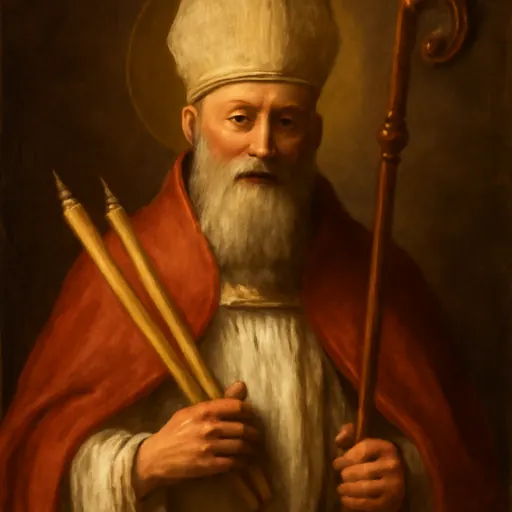
St. Blaise was a bishop of Sebaste in Armenia, in present-day Turkey, martyred around 316 under the Roman emperor Licinius. Tradition says he saved a boy choking on a fish bone, so he is the patron saint of throats and of people with throat ailments. His feast day is February 3, when Catholic churches bless throats with two crossed candles.
Who was St. Blaise?
Blaise was a bishop of Sebaste, a city in Roman Armenia that is now Sivas in central Turkey. He died as a martyr around 316, under the emperor Licinius, who ruled the eastern half of the empire and turned against Christians in his last years. Most of what Christians tell about him comes from the Acts of St. Blaise, written centuries after his death, and from the medieval Golden Legend, which retold the Acts for European readers. The Catholic Encyclopedia calls the Acts legendary, while adding that the traditions behind them may be old and shouldn't be dismissed outright.
His cult spread early and far. A Greek physician, Aëtius of Amida, writing around the year 500, already advised calling on Blaise when a bone was stuck in a patient's throat. By the Middle Ages he was one of the most popular saints in Europe, with churches, altars and relics from England to Russia.

Latin speakers called him Blasius, the Greeks Vlasios, the Italians San Biagio, the Spanish San Blas and the people of Dubrovnik Sveti Vlaho. In English the name is spelled both Blaise and Blase; the American edition of the Book of Blessings uses "Blase."
The life of St. Blaise
The Golden Legend (compiled by Jacobus de Voragine around 1260 and printed in English by William Caxton in 1483) tells his story in a series of short episodes. All of them are traditional.
Physician and bishop
The Catholic Encyclopedia reports the tradition that Blaise was a physician before he became a bishop. The Golden Legend says that the Christians of Sebaste chose him as their bishop because he was "so sweet, holy and humble in manners."
The hermit in the cave
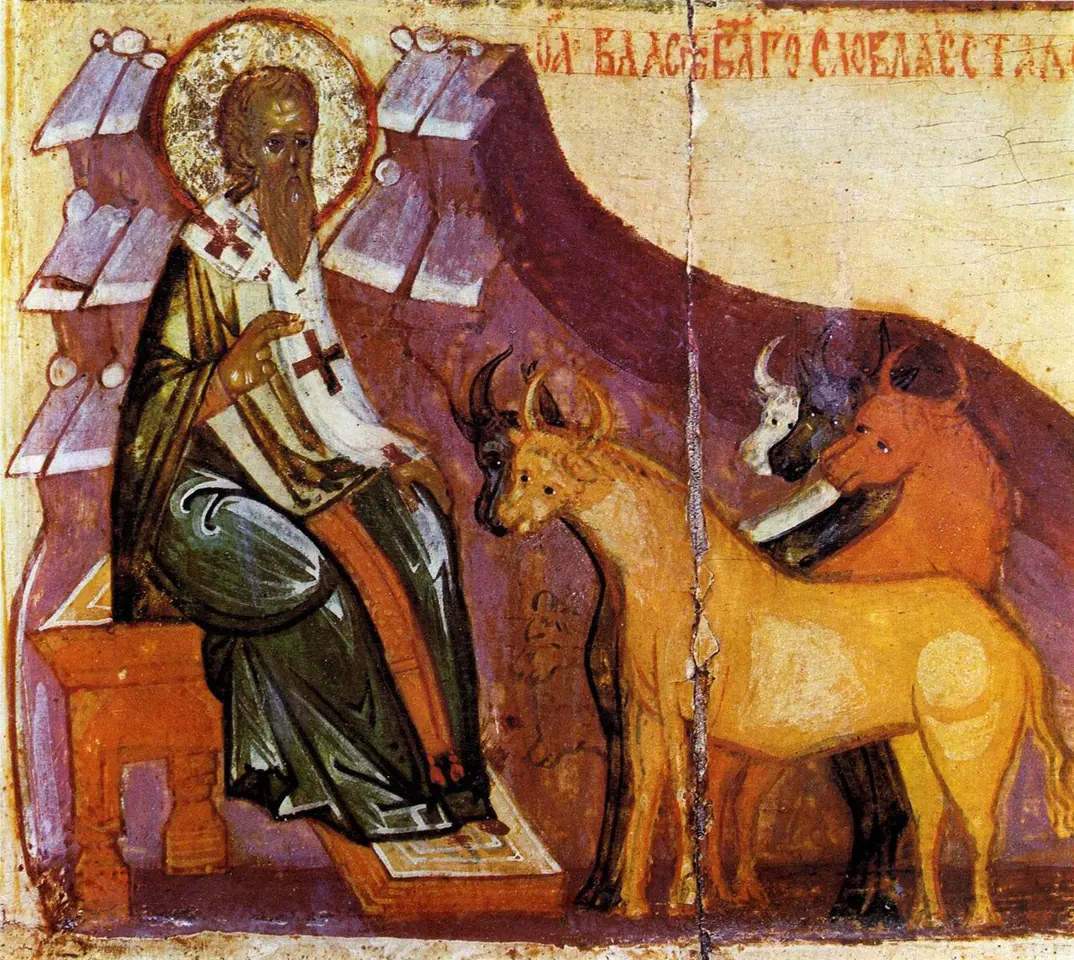
When persecution came, Blaise withdrew to a cave in the wilderness; the Orthodox tradition places it on Mount Argeos. The Golden Legend says birds brought him food and would not leave until he blessed them, and that sick people came and were healed. Wild animals gathered around him too, and the Orthodox life says he healed sick beasts by laying his hands on them.
The governor's hunters found a crowd of animals around the hermit, none of which they could catch, and soldiers were sent to arrest him. According to the legend he went with them gladly, saying, "I see now well that God hath not forgotten me."

The boy with the fish bone
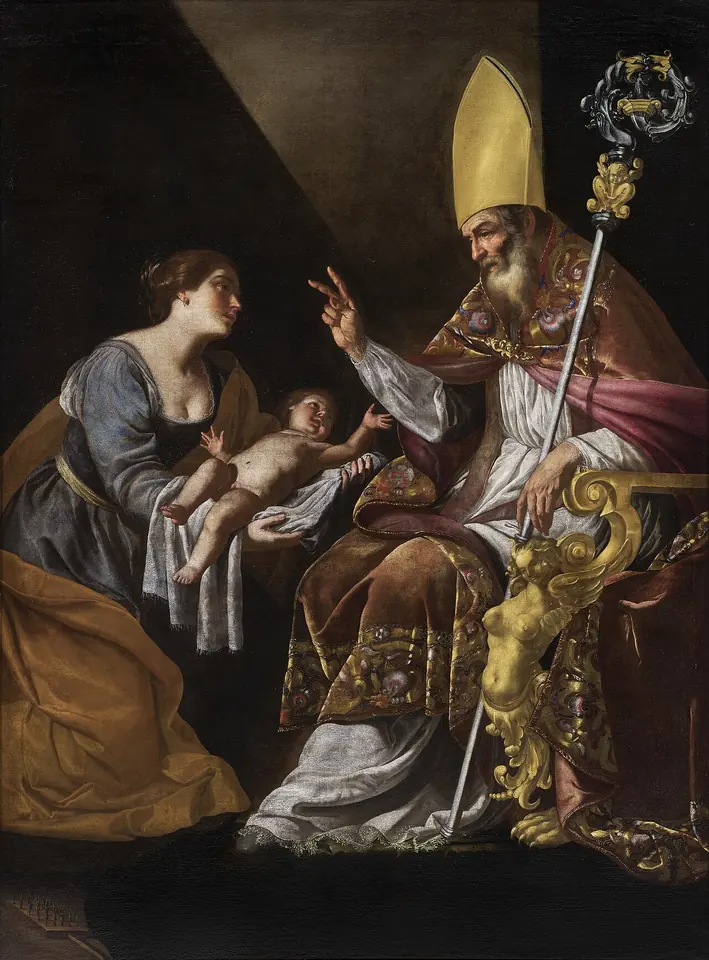
On the road to the city a mother pushed through the crowd and laid her son at his feet. A fish bone had lodged crosswise in the boy's throat and he was choking to death. Blaise put his hand on the child and prayed that he, and everyone who asked for healing in Blaise's name, would be helped. The boy recovered. This is the story behind the blessing of throats.

The wolf and the widow's pig
A poor widow then came to him in tears: a wolf had carried off her only pig. The Golden Legend says Blaise smiled and told her, "Good woman anger thee not, for thou shalt have again thy swine," and the wolf brought the pig back.
The candle in prison
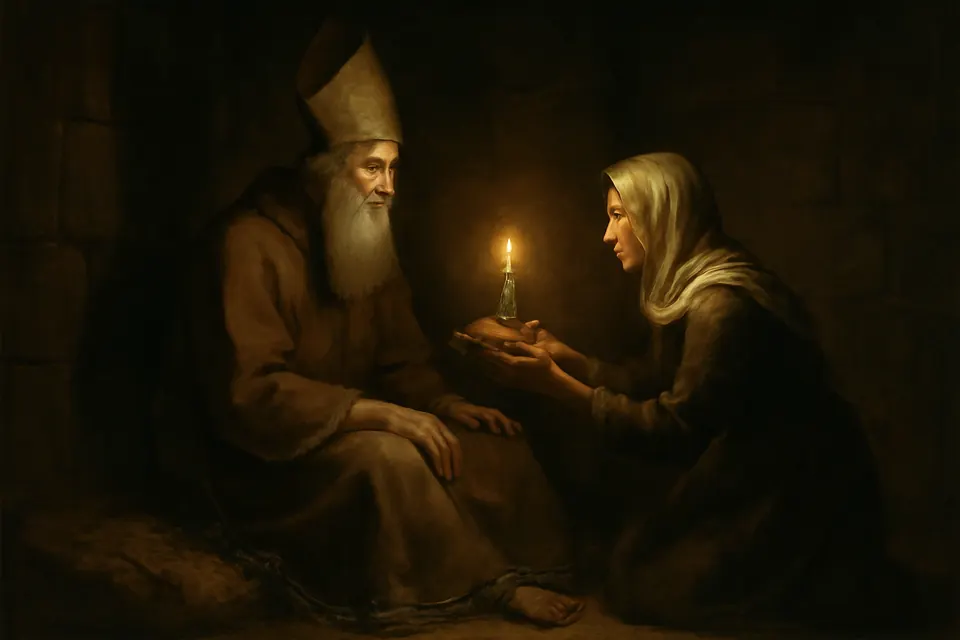
The governor, Agricolaus, had Blaise beaten and thrown into prison when he refused to sacrifice to the gods. The widow heard about it. She killed the pig and brought him its head and feet, with a little bread and a candle. Blaise thanked God, ate, and told her to offer a candle in his church every year, promising that it would go well for her and for everyone who did the same. Later tellings turn the single candle into two, which may explain the crossed pair in his blessing.
The martyrdom
The legend says Blaise was hung up and his flesh torn with iron combs, the kind used to card wool. The governor then had him thrown into a lake. Blaise made the sign of the cross over the water and stood on it, inviting his persecutors to follow if their gods were real. In the Golden Legend, sixty-five men waded in after him and drowned (the Orthodox life says sixty-eight). Blaise was finally beheaded. Before he died, the Golden Legend says, he asked God to hear anyone who called on him for "the infirmity of the throat" or any other sickness, and a voice from heaven granted the request.
The miracles of St. Blaise
None of Blaise's miracles has been investigated in the way modern canonizations require, since his cult began long before that process existed. Sorted by the labels this encyclopedia uses:
- The boy choking on a fish bone: traditional. It is the oldest and most widespread story, and the source of his patronage of throats.
- Animals in the wilderness, the wolf and the pig, the lake: traditional.
- Healings through the blessing of throats: reported. Catholics have told of cures through his intercession for centuries, but the Church has not formally examined them.
- The warning to Dubrovnik in the 10th century: traditional, a civic legend described below.
Why St. Blaise is the patron saint of throats
The fish-bone story made him the saint of throats as early as Aëtius of Amida, and his prayer before death in the Golden Legend extended that to every illness. Catholics today ask his help for sore throats and for every kind of throat illness, from a child's cough to cancer. See the full list on our patron saints page.
Several other patronages come from details of the legend:
- Wool combers and the wool trade: the iron combs of his martyrdom looked like the carding combs used in the wool trade. English wool towns kept his feast with pageants as late as the 1800s.
- Animals: because beasts gathered around his cave. In Russia, where he is known as Vlasy, farmers prayed to him for their cattle, and the Orthodox life still asks his prayers "for the health of domestic animals, and for protection from wild beasts."
- Physicians: from the tradition that he practiced medicine.
- Dubrovnik: for the city's own reasons, told below.
He is also one of the Fourteen Holy Helpers, the group of saints whom Christians in medieval Germany called on together during the Black Death, alongside St. Christopher, St. George, St. Barbara, St. Catherine of Alexandria, St. Vitus, St. Erasmus and others.
Symbols of St. Blaise in art
Blaise is almost always an older, bearded bishop with miter and crozier. To tell him from other bishops, look for:
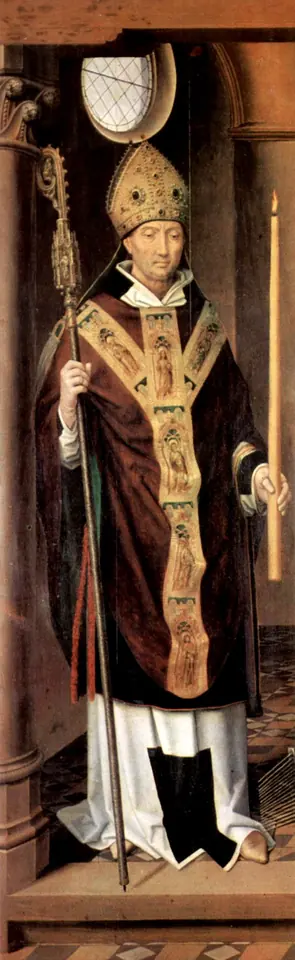
- Two crossed candles: his most common attribute in later Western art, from the widow's candle and the blessing of throats. Sometimes he holds a single candle.
- An iron comb: a toothed comb or rake, the instrument of his martyrdom.
- A child or a mother with a child: the fish-bone healing, as in Gentileschi's painting.
- Wild animals around a cave: common in Eastern icons and in story panels.
- A model of a walled city: in Dubrovnik, where his statues hold the city in their hands.
Memling's panel near the top of this page gives him two attributes at once: a tall lit candle in his hand and an iron comb lying at his feet. Eastern icons show him differently: a gray-bearded hierarch in a white omophorion marked with black crosses, often standing beside St. Nicholas, another bishop from Asia Minor.


St. Blaise Day and the blessing of throats
Blaise's feast is February 3 in the Catholic Church, an optional memorial on the General Roman Calendar. Eastern Orthodox and Greek Catholic churches keep it on February 11. You can find his neighbors on the calendar, including St. Agatha on February 5, on our feast days page.
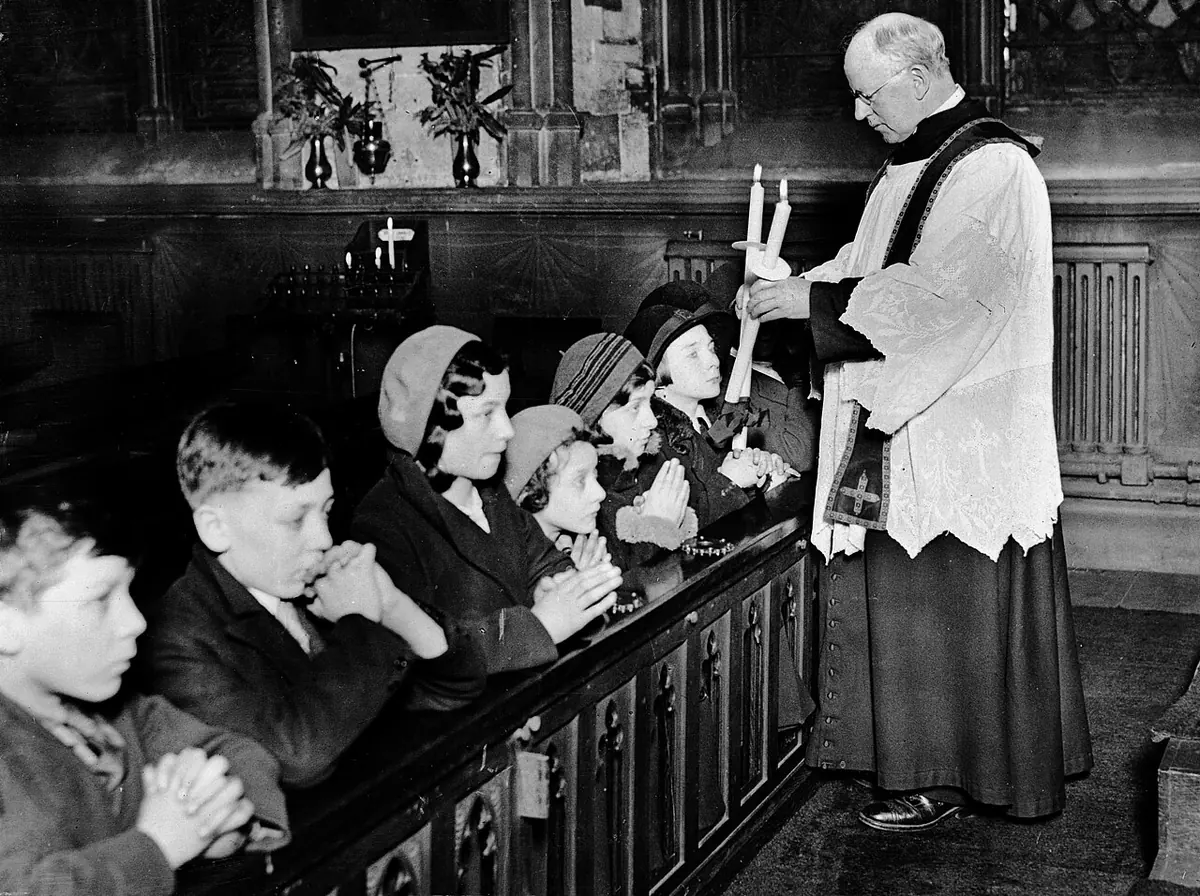
The best-known custom of the day is the blessing of throats. The Book of Blessings (English edition 1989) gives the rite. The minister touches each person's throat with two candles joined in the form of a cross, normally candles blessed the day before on the Presentation of the Lord, or Candlemas.
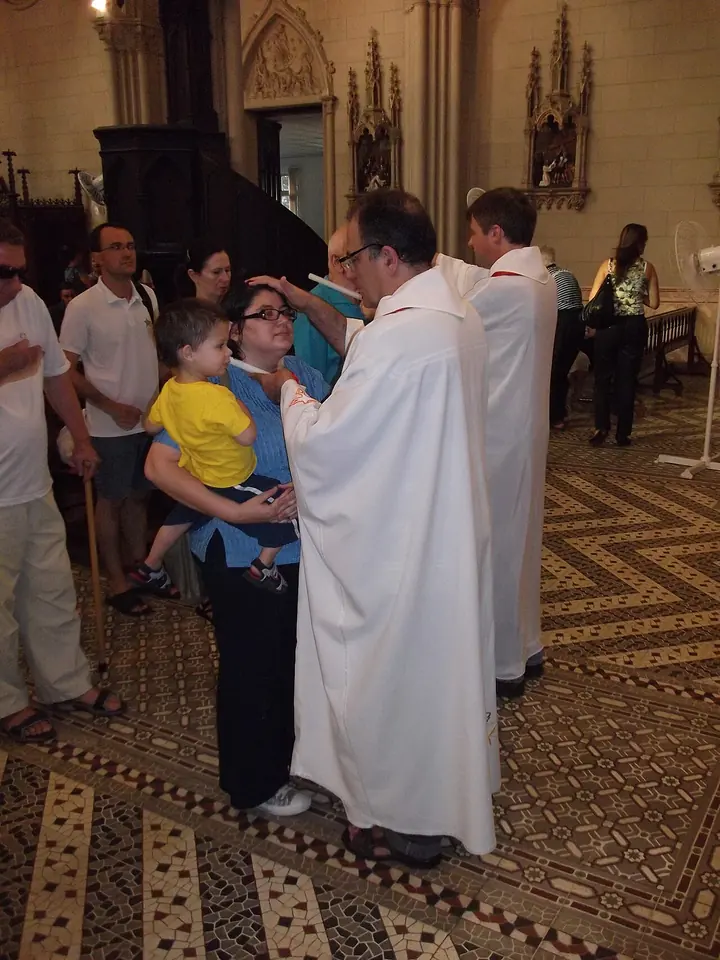

The blessing may be given by a priest, a deacon or a lay minister. If people can't come forward one at a time, the Book of Blessings allows the priest or deacon to extend his hands over the whole congregation and say the prayer once.

Dubrovnik and the Festivity of St. Blaise
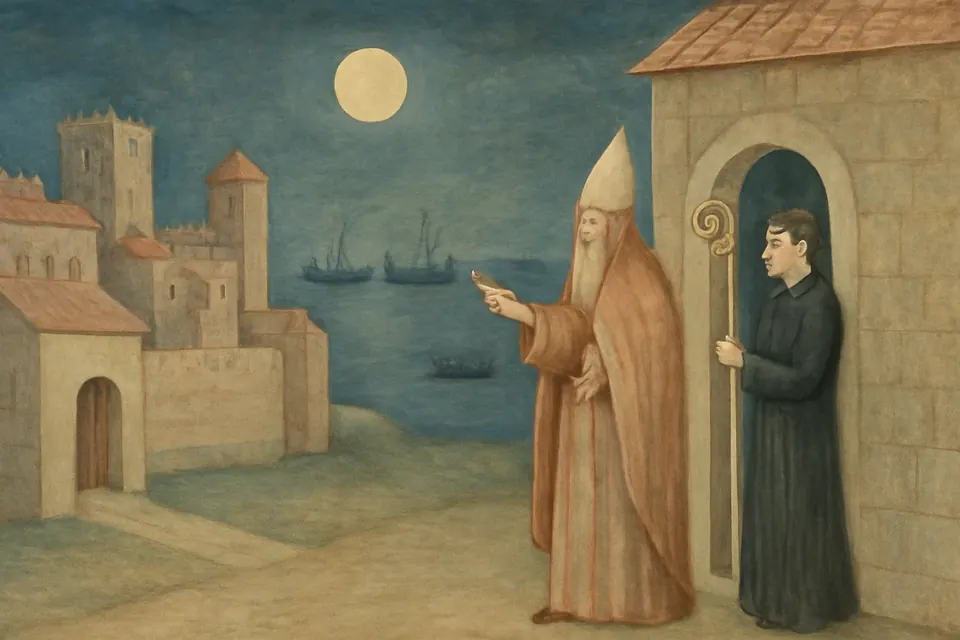
No city honors Blaise like Dubrovnik, on the Croatian coast, which as the Republic of Ragusa put his image on its flag, seal and coins until the Napoleonic era. Local tradition says that in 971 or 972, Venetian ships anchored off the city. Blaise appeared at night to a priest named Stojko, at the door of the Church of St. Stephen, and warned him of a coming attack. Stojko told the Senate, the city prepared its defense, and Blaise replaced Sts. Sergius and Bacchus as Dubrovnik's patron. The story is traditional.
The Baroque Church of St. Blaise on the main square was finished in 1715 by the Venetian architect Marino Gropelli, after fire destroyed the older church in 1706. A gilded silver statue of the saint from the 15th century, which survived the fire, stands on its high altar. The statue shows Blaise holding a model of the city as it looked before the earthquake of 1667. The cathedral treasury keeps his relics, including a head reliquary shaped like a Byzantine crown.


The festivity begins on February 2, Candlemas, when white doves are released and the saint's flag is raised in front of his church. On February 3, banner bearers from the surrounding parishes arrive in folk costume, the bishop leads a procession with the relics through the old town, and priests bless throats with crossed candles. UNESCO added the Festivity of Saint Blaise to its list of the Intangible Cultural Heritage of Humanity in 2009 and notes that the celebration goes back in some form to at least 1190.


Other places claim relics too, among them Maratea in southern Italy and the Black Forest abbey of St. Blasien, named for him.
Prayer to St. Blaise
The best-known prayer connected with St. Blaise is the formula of the blessing of throats, from the Catholic Book of Blessings (English edition, 1989). A priest or deacon says to each person:
Through the intercession of Saint Blase, bishop and martyr, may God deliver you from every disease of the throat and from every other illness: In the name of the Father, and of the Son, + and of the Holy Spirit.
Each person answers, "Amen." A lay minister says the same words but doesn't make the sign of the cross over the person.
Outside the liturgy, Catholics ask St. Blaise to pray for them in illnesses of the throat, and many light a candle in his honor. The Orthodox Church sings the troparion and kontakion of his feast on February 11.
Frequently asked questions
What is the blessing of throats on St. Blaise Day?
On February 3, a priest, deacon or lay minister holds two candles, crossed and usually tied with a ribbon, at each person's throat and says, "Through the intercession of Saint Blase, bishop and martyr, may God deliver you from every disease of the throat and from every other illness." The rite is in the Catholic Book of Blessings. The candles are usually ones blessed the day before, on Candlemas.
Why is St. Blaise the patron saint of throats?
His legend says a mother brought him her son, who was choking on a fish bone, and Blaise healed him. A Greek medical writer, Aëtius of Amida, was already advising people to call on Blaise for objects stuck in the throat around the year 500. The story is traditional, not a formally investigated miracle.
When is St. Blaise's feast day?
February 3 in the Catholic Church's General Roman Calendar, where it is an optional memorial. Eastern Orthodox and Greek Catholic churches remember him on February 11. Dubrovnik, Croatia, holds its great Festivity of St. Blaise on February 2 and 3.
Why are crossed candles used for the blessing?
The Golden Legend tells how a poor widow brought Blaise a candle in prison, and he asked her to offer a candle in his church every year. Candles became his emblem, and because his feast falls the day after Candlemas, the candles blessed that day came to be used for the blessing of throats.
Is St. Blaise one of the Fourteen Holy Helpers?
Yes. He is one of the fourteen saints, mostly martyrs, whom Christians in medieval Germany grouped together and called on in times of plague and sickness. Blaise is the helper for throat ailments.
Sources
- Catholic Encyclopedia (1907): St. Blaise
- Book of Blessings: Blessing of Throats on the Feast of Saint Blaise (Catholic Culture)
- The Golden Legend, Life of S. Blase (Caxton translation, 1483)
- Orthodox Church in America: Hieromartyr Blaise, Bishop of Sebaste
- UNESCO: Festivity of Saint Blaise, the patron of Dubrovnik
- Christian Iconography: St. Blaise in Art
- Catholic Culture: Fourteen Holy Helpers
- Butler's Lives of the Saints, February 3
- Roman Martyrology, February 3