St. Agnes of Rome
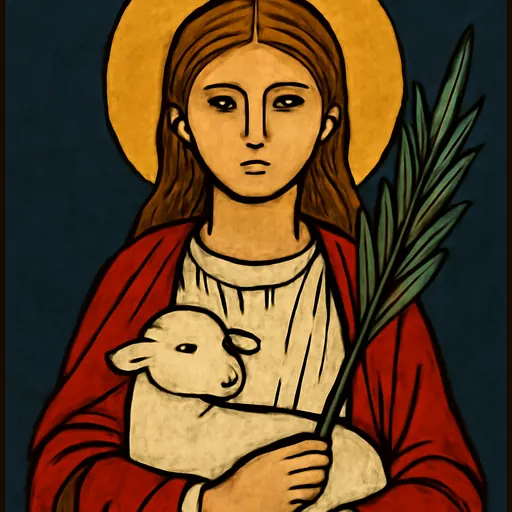
St. Agnes of Rome was a girl of 12 or 13 who was put to death for her Christian faith in Rome, most likely around 304 under the emperor Diocletian. St. Ambrose, Pope Damasus and the poet Prudentius all wrote about her within a century of her death. Her feast day is January 21, and she is the patron saint of girls, chastity and engaged couples. She is shown with a lamb because her name sounds like the Latin agnus.
Who was St. Agnes?
Agnes was a Roman girl of 12 or 13 who died for her Christian faith during one of the last great persecutions of the Church, most likely in the year 304 under the emperor Diocletian. She was buried in a family plot beside the Via Nomentana, just outside the walls of Rome, and her grave became one of the most visited shrines of the ancient city.
Very little about her life is certain. The Catholic Encyclopedia puts it plainly: by the end of the 4th century there was "no accurate and reliable narrative" of her martyrdom, and the early writers disagree on how she died. They agree on one thing, her youth. St. Ambrose says she was twelve, St. Augustine thirteen. Older reference books gave the year as 304; some historians now argue from Pope Damasus's epitaph that she died earlier, in one of the persecutions of the 3rd century.

What is certain is how quickly Christians came to honor her. The Roman calendar of martyrs' feasts compiled in 354 already lists her on January 21, with the name of the road where she was buried. Within a generation of that list, a bishop, a pope and a poet had each written about her. Her name is said in the Roman Canon, the oldest Eucharistic prayer of the Latin Mass, with St. Agatha, St. Lucy and St. Cecilia.
What the earliest sources say
Three witnesses wrote within about a century of Agnes's death. Each tells the story a little differently, and the later legend grew out of all three.
St. Ambrose: "a twofold martyrdom"
Ambrose, bishop of Milan, wrote his book On Virgins in 377 for his sister Marcellina, and he opened it on Agnes's feast day with her praise. He gives no names and few facts beyond her age and death by the sword, but his picture of a child facing soldiers shaped every later telling:
She was fearless under the cruel hands of the executioners, she was unmoved by the heavy weight of the creaking chains, offering her whole body to the sword of the raging soldier, as yet ignorant of death, but ready for it.
He gives her a short answer to her suitors, "He who chose me first for Himself shall receive me," and describes the end in a few words: "She stood, she prayed, she bent down her neck." His conclusion became the most quoted line ever written about her: "You have then in one victim a twofold martyrdom, of modesty and of religion. She both remained a virgin and she obtained martyrdom" (On Virgins I.2, in the Nicene and Post-Nicene Fathers translation).


Pope Damasus: the epitaph and the hair
Pope Damasus, who reigned from 366 to 384, honored the martyrs of Rome with verse inscriptions cut in marble. His poem for Agnes was set up at her tomb, lost, and found again in 1728, when it turned up in the basilica floor, used as a paving stone. It is still at her church, at the foot of the staircase that leads down to the tomb.
Damasus says the story had come down from Agnes's parents. In Fr. John Zuhlsdorf's translation, the poem says that "when the trumpet had sounded its sad tunes," the girl "suddenly left the lap of her nurse," faced the tyrant, and when he tried to burn her, "with her little forces she overcame immense fear and, gave her loosened hair to cover her naked limbs, lest mortal eye might see the temple of the Lord." In Damasus, then, Agnes dies by fire, and her own hair is her only covering.
Prudentius: the poet's version
The Spanish poet Prudentius wrote "The Passion of Agnes" around 400 as the fourteenth hymn of his Peristephanon, the Crowns of the Martyrs. He follows Ambrose on the sword but adds a scene. The judge threatens to send her to a brothel. Agnes is stripped and exposed in a public square, most of the crowd turns away, and one young man who stares at her is struck blind and falls as if dead. The poem opens at her tomb, in an English verse translation published by the New Liturgical Movement:
The native home of Romulus now enshrines
The tomb of Agnes, virgin and martyr blest.
Reposing there in sight of its lofty towers,
The maiden watches over the sons of Rome
The Catholic Encyclopedia thinks Prudentius "may have drawn at least the substance of this episode from a trustworthy popular legend," and that this threat may be what Ambrose meant when he spoke of her purity being in danger.
St. Jerome, writing in 414 to a young Roman noblewoman named Demetrias, could already say that Agnes "vanquished the temptations both of youth and of a despot and by her martyrdom hallowed the very name of chastity" (Letter 130).
The legend of St. Agnes
In the first half of the 5th century an unknown writer put together the Acts (or Passion) of St. Agnes, which survive in Latin and Greek. This is the version most people know, because the Golden Legend of Jacobus de Voragine retold it in the 13th century and painters followed it for the next five hundred years. Every scene below is traditional: it comes from the legend, not from the 4th-century witnesses.
The prefect's son
Agnes, the story goes, was a beautiful girl of a Christian family. When she was thirteen, the son of the prefect of Rome saw her coming home from school and fell in love with her. He offered her jewels and, when she refused, even richer ones. In William Caxton's 1483 English version of the Golden Legend, she sends him away: "Go from me thou fardel of sin, nourishing of evils and morsel of death," and says she is already promised to another lover, "much more noble of lineage than thou art." The young man fell sick with longing. When his father learned that the lover she meant was Christ, he had her brought to court.

The hair and the angel
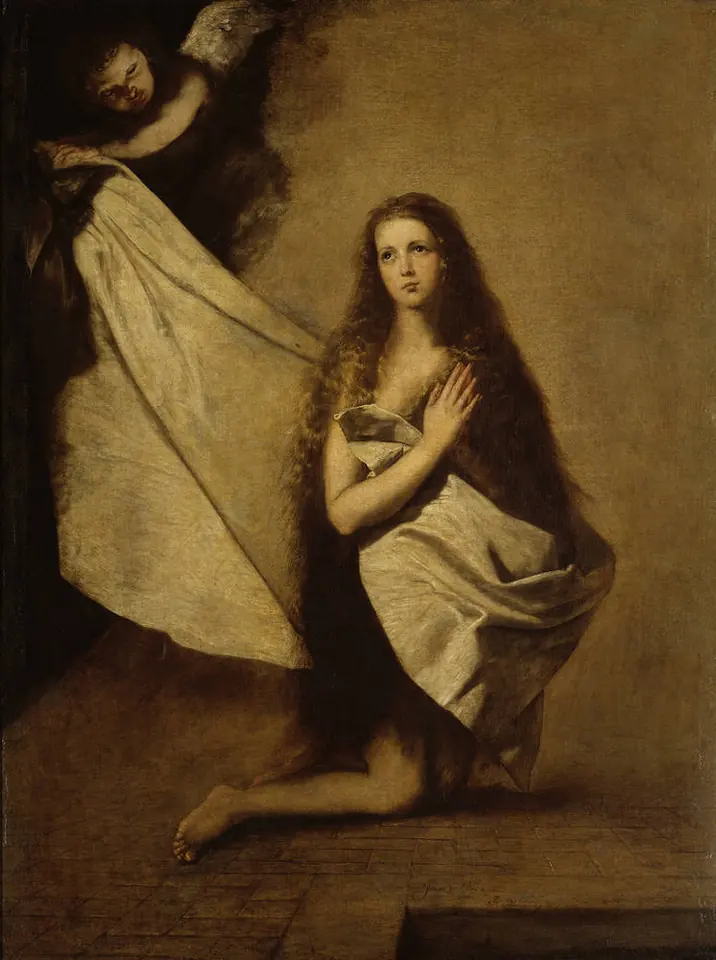
The prefect gave her a choice: offer sacrifice with the Vestal virgins or be sent to a brothel. Agnes answered that she had "his angel which is keeper of my body." She was stripped and led away, but, says the Golden Legend, "the hairs of her head became so long that they covered all her body to her feet." In the house an angel surrounded her with a light so bright that no one could look at her, and she found a white garment waiting for her. Men who came in left more devout than they arrived.
Damasus's loosened hair has become, in the legend, a miracle of growth. Painters loved the scene because it let them show the threat to Agnes and her protection in one picture.

The prefect's son raised
The prefect's son came anyway, mocked the others as cowards, and reached for her. The legend says a demon seized him by the throat and he fell dead. His grieving father accused Agnes of witchcraft and demanded she bring him back. She prayed, an angel raised the young man, and he ran out shouting that the God of the Christians was the true God. Prudentius tells a gentler form of this: the man who stared was blinded, and some said Agnes's prayer restored his sight.


The fire and the sword
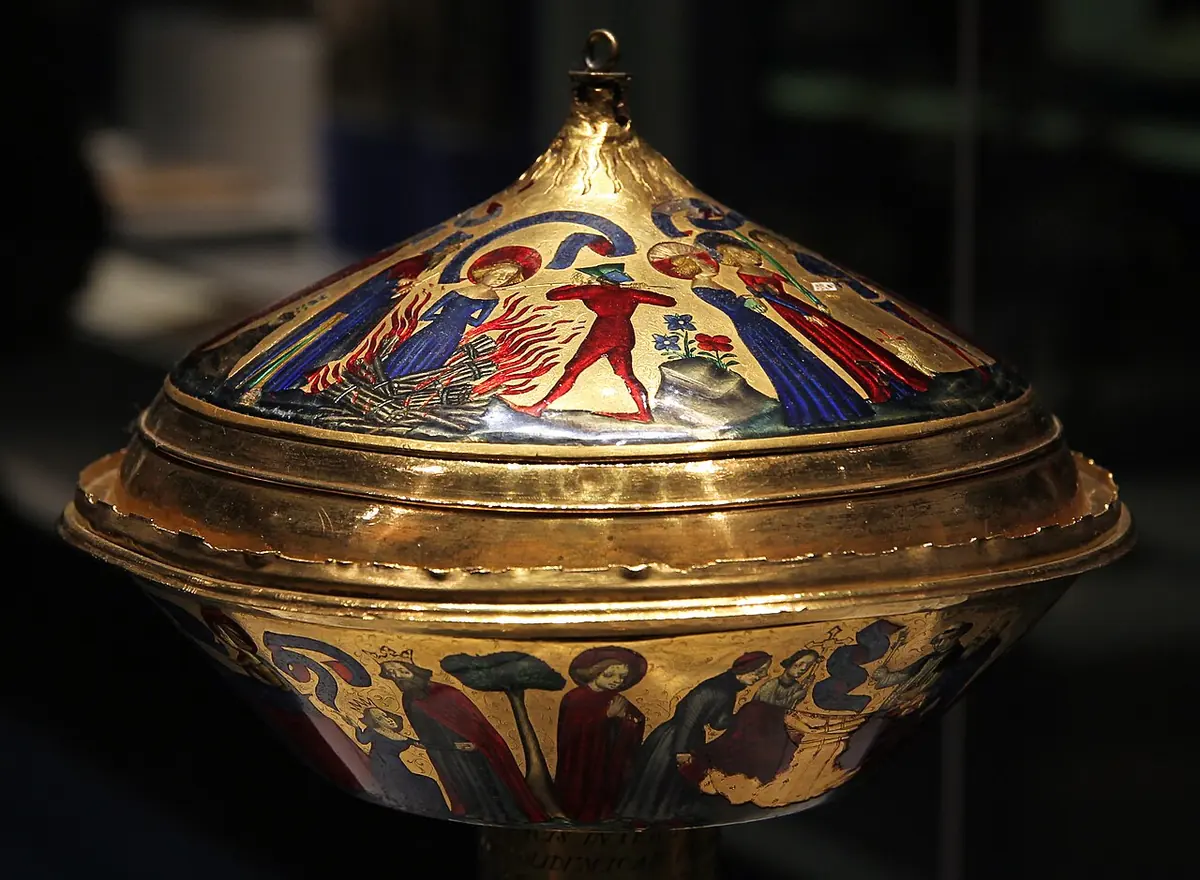
Pagan priests stirred up the crowd, and the prefect, afraid for his post, handed the case to a deputy named Aspasius. He had a great fire built and Agnes thrown into it. The flames divided, burned the people who had called for her death and left her untouched. When she finished her prayer of thanks, the fire went out. Aspasius then ordered a soldier to kill her with the sword. The legend thus combines Damasus's fire with Ambrose's sword.

Emerentiana
Agnes's parents and friends buried her on their land by the Via Nomentana. Among them, says the legend, was Emerentiana, her foster-sister and the daughter of her nurse, who was still preparing for baptism. She came to pray at the grave, rebuked the pagans for the killing, and was stoned to death. She was buried beside Agnes, and the Church honors her as a martyr, baptized, as the old phrase goes, in her own blood.
Miracles and legends of St. Agnes
Agnes lived long before the Church formally investigated miracles, so none of the stories told about her is approved in the modern sense. Sorted by the labels this encyclopedia uses:
- Her hair covering her body: traditional. Damasus, in the 4th century, describes her loosening her hair to cover herself. The Acts turn it into a miracle in which her hair grew to her feet.
- The young man struck blind (or dead) and restored: traditional, from Prudentius and the Acts.
- The fire that would not burn her: traditional, from the Acts and the Golden Legend. Damasus says only that she was condemned to the flames.
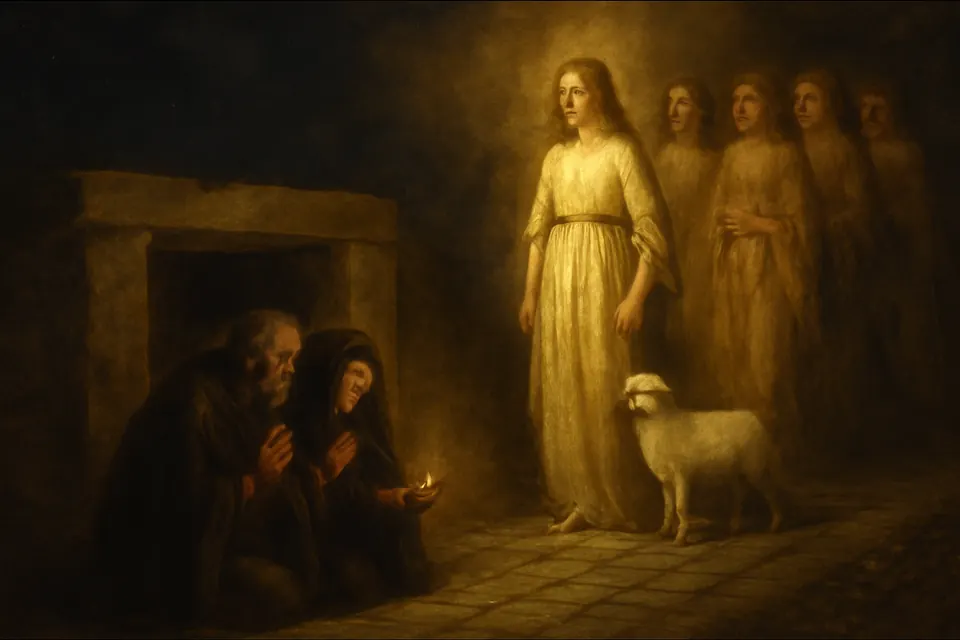
- Her appearance to her parents with a lamb: traditional. Eight days after her death, the legend says, her family keeping watch at the tomb saw her among a company of virgins dressed in gold, with "a lamb more white than snow" at her right side. She told them not to mourn her. This vision was the origin of the old second feast on January 28.
- The healing of Constantina: traditional. The Golden Legend says Constantina, daughter of the emperor Constantine, fell asleep praying at Agnes's tomb, saw her in a dream and woke cured of a skin disease. She was baptized and built a church over the grave.
- The ring of the priest Paulus: traditional. The Golden Legend tells of a priest of her church who, tormented by temptation, placed a ring on the finger of her statue, which closed its hand and kept it.
- Favors through her prayers: reported. Catholics have asked her intercession for centuries, especially girls and young women, but no modern miracle attributed to her has been examined by the Church.
Why St. Agnes is the patron saint of girls and chastity
Agnes is honored as a patron of girls and young women because she was one. Every early writer makes her age the center of the story. Ambrose marvels that a child who "could not, because of her age, dispose of herself" could bear witness to God. Schools, sodalities and Catholic girls' groups such as the old Children of Mary have taken her name ever since. Franciscan Media also lists her as patron of Girl Scouts.
She is the patron of chastity because the earliest sources praise her for keeping the vow she had made to Christ, and because Ambrose's "twofold martyrdom" joined her virginity to her death. She is also a patron of engaged couples, probably because of her answer that she was already betrothed to Christ, and of gardeners, a patronage whose origin is unclear.
Many Catholics also ask her prayers for survivors of rape and sexual abuse, because her legend centers on a threat of sexual violence. It is a tender patronage and needs care. The Church does not teach that a person who suffers violence loses anything. St. Augustine, writing after the sack of Rome in 410, when many Christian women had been assaulted, insisted that "while the sanctity of the soul remains even when the body is violated, the sanctity of the body is not lost" (City of God I.18). Devotion to Agnes in this sense is a prayer for protection, healing and dignity. See all patron saints by cause.
Symbols of St. Agnes in art
Agnes is one of the easiest saints to recognize. Look for a young girl, often with long fair hair, and these signs:
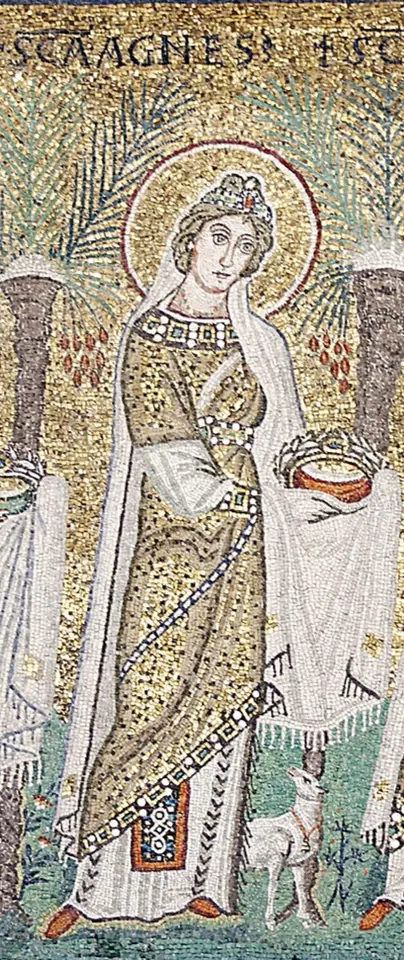
- A lamb: her main emblem, sometimes with its own halo. The Latin agnus, "lamb," sounds like her name, and the lamb points to Christ, the Lamb of God (John 1:29). In Greek, hagnē means "pure." The Ravenna mosaic near the top of this page already has a small lamb at her feet in the 6th century, and Stanzione and Zurbarán give her a lamb to hold.
- A palm branch: the sign of a martyr, carried by most virgin martyrs.
- A sword: the weapon of her death in Ambrose and the Acts. Some paintings show it at her throat.
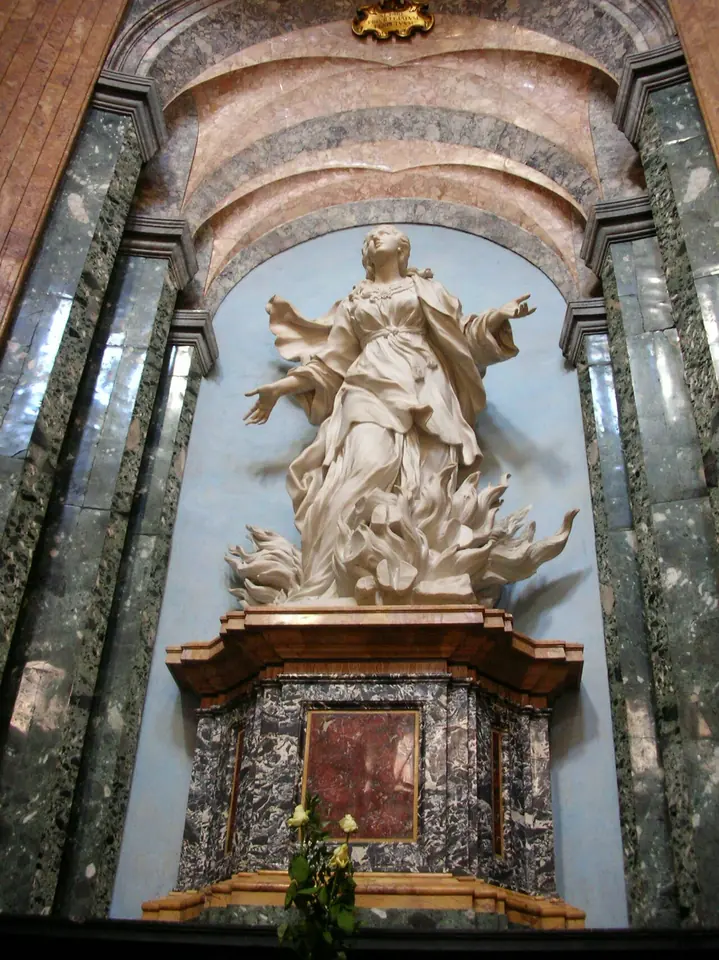
- Flames: she may stand on fire that does not touch her, as in Ercole Ferrata's statue in Rome and the 7th-century apse mosaic over her tomb.
- Long hair wrapped around her: from the brothel scene, as in Ribera's painting.
- A crown or wreath: the virgin's crown, which Prudentius calls her "twofold diadem."

Early images, like the mosaic procession at Sant'Apollinare Nuovo in Ravenna, show her as one of a line of richly dressed virgin martyrs carrying crowns. In the apse at Sant'Agnese fuori le Mura she wears the robes of a Byzantine empress. Eastern icons show her as a young martyr holding a cross, with her name written beside her. If you see two young martyrs side by side in a Roman church, one with a lamb and one with an organ or a wreath of roses, they are probably Agnes and Cecilia.


St. Agnes's feast day and the blessing of the lambs
The Catholic Church celebrates St. Agnes on January 21, an obligatory memorial in the General Roman Calendar. It is one of the oldest fixed saints' days in the Roman Church. Until the calendar reform of 1969 Rome also kept January 28, "St. Agnes the second time," for her appearance to her parents. Find her neighbors in the year on the feast day calendar.
The lambs and the pallium
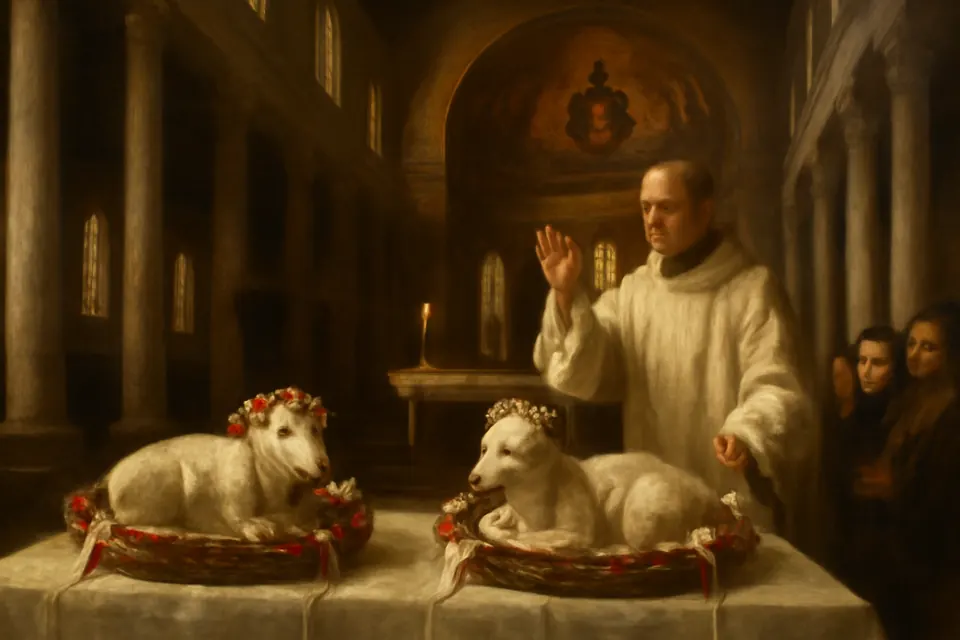
On her feast, two lambs are blessed and presented to the pope. Vatican News says the custom is first mentioned in the 6th century. For centuries the lambs were raised by the Trappist monks of Tre Fontane in Rome, and the canons of St. John Lateran presented them. In 2026, Vatican News reported, Pope Leo XIV received the two lambs in the Urban VIII Chapel at the Vatican, and they were blessed at the Basilica of St. Agnes outside the Walls.
The Benedictine nuns of St. Cecilia in Trastevere shear the lambs, and the wool goes into the pallium, a narrow band of white wool marked with six black silk crosses. The pope wears one, and he gives the pallium to new metropolitan archbishops on June 29, the feast of Sts. Peter and Paul. So every archbishop who wears the pallium carries, in a sense, a thread back to St. Agnes.
The collect of the Mass
The prayer of the day in the current English Roman Missal (2011) reads:
Almighty ever-living God, who choose what is weak in the world to confound the strong, mercifully grant, that we, who celebrate the heavenly birthday of your Martyr Saint Agnes, may follow her constancy in the faith.
"Heavenly birthday" translates the Latin natalicium: the early Church kept a martyr's day of death as the day of birth into eternal life. The first line echoes St. Paul (1 Corinthians 1:27).
Where St. Agnes is honored in Rome
Sant'Agnese fuori le Mura and the catacomb
Agnes was buried in a separate grave on the Via Nomentana, and a catacomb on three levels, from the 2nd to the 5th centuries, grew up around it. In the 4th century Constantina, the emperor Constantine's daughter, built a great basilica beside the grave. Pope Honorius I (625 to 638) replaced it with the smaller church that stands today, built down at the level of the tomb, so that visitors still descend a long staircase lined with ancient inscriptions to reach it.


The apse mosaic from Honorius's time shows Agnes in gold and purple, with Honorius holding a model of the church on one side and another pope on the other. The Catholic Encyclopedia describes her shown "amid flames, with a sword at her feet." Agnes's bones lie beneath the high altar. Parts of the catacomb can be visited with a guide.


Next door stands the round mausoleum built for Constantina, now the church of Santa Costanza, with its 4th-century mosaics of grapevines and harvest scenes.


Sant'Agnese in Agone, Piazza Navona
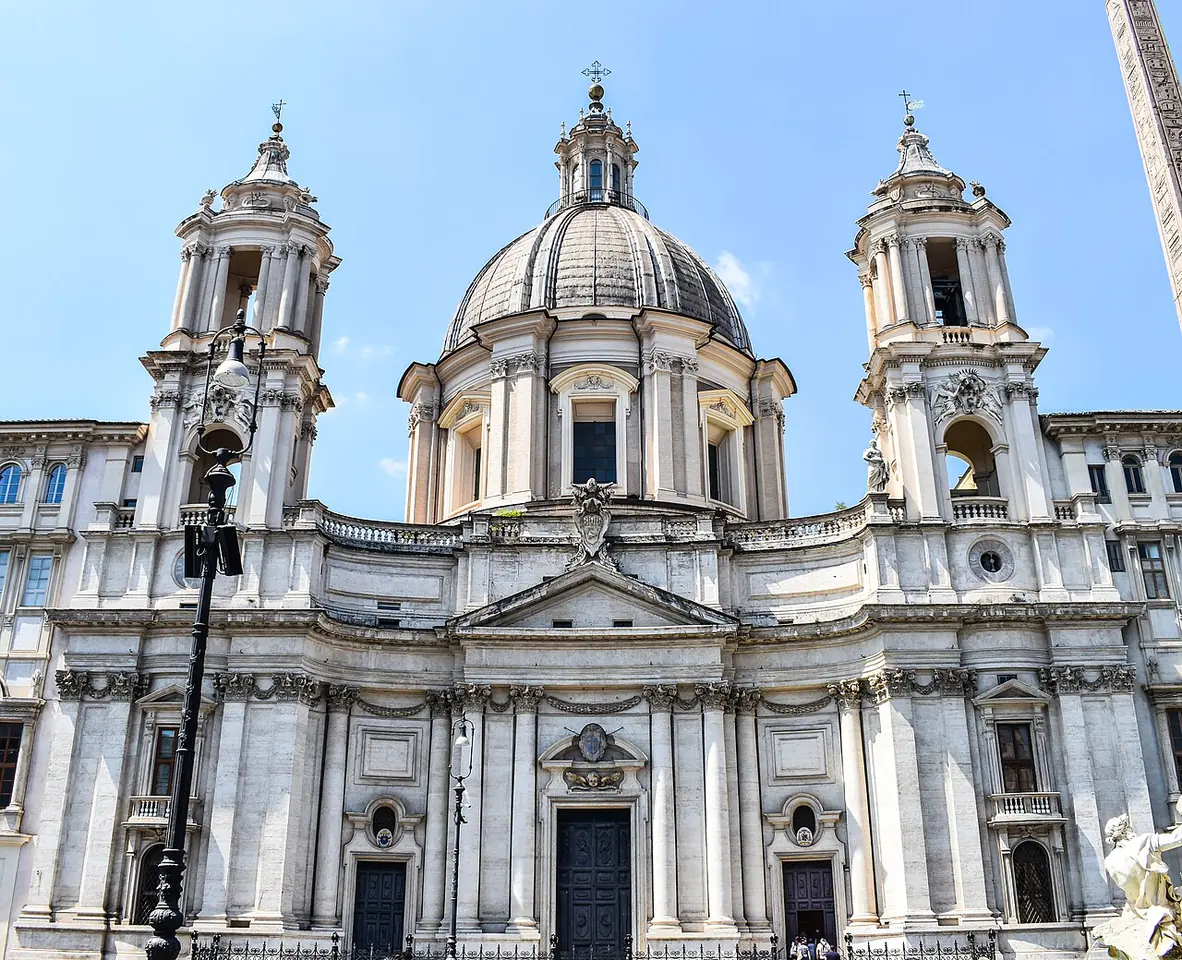
Piazza Navona sits on the track of the ancient Stadium of Domitian, and Roman tradition places Agnes's exposure and death in the arches of that stadium. A small church stood there by the 8th century. Pope Innocent X, whose family palace faced the square, rebuilt it from 1652 with the architects Girolamo and Carlo Rainaldi and Francesco Borromini. The crypt keeps an altar with Alessandro Algardi's marble relief of the miracle of her hair, and a chapel in the church holds the relic of her skull.

The Eve of St. Agnes
The night before her feast, January 20, gathered a body of English folk custom. A girl who went to bed without supper and followed certain rites, it was said, would see her future husband in a dream. John Keats built a long poem around the belief in 1819, "The Eve of St. Agnes," which opens on a freezing night:
St. Agnes' Eve--Ah, bitter chill it was!
The owl, for all his feathers, was a-cold
Its heroine, Madeline, has heard "how, upon St. Agnes' Eve, / Young virgins might have visions of delight." The poem has nothing to do with the martyr's life, but it made her name familiar to generations of English readers, and painters such as William Holman Hunt and John Everett Millais took scenes from it.
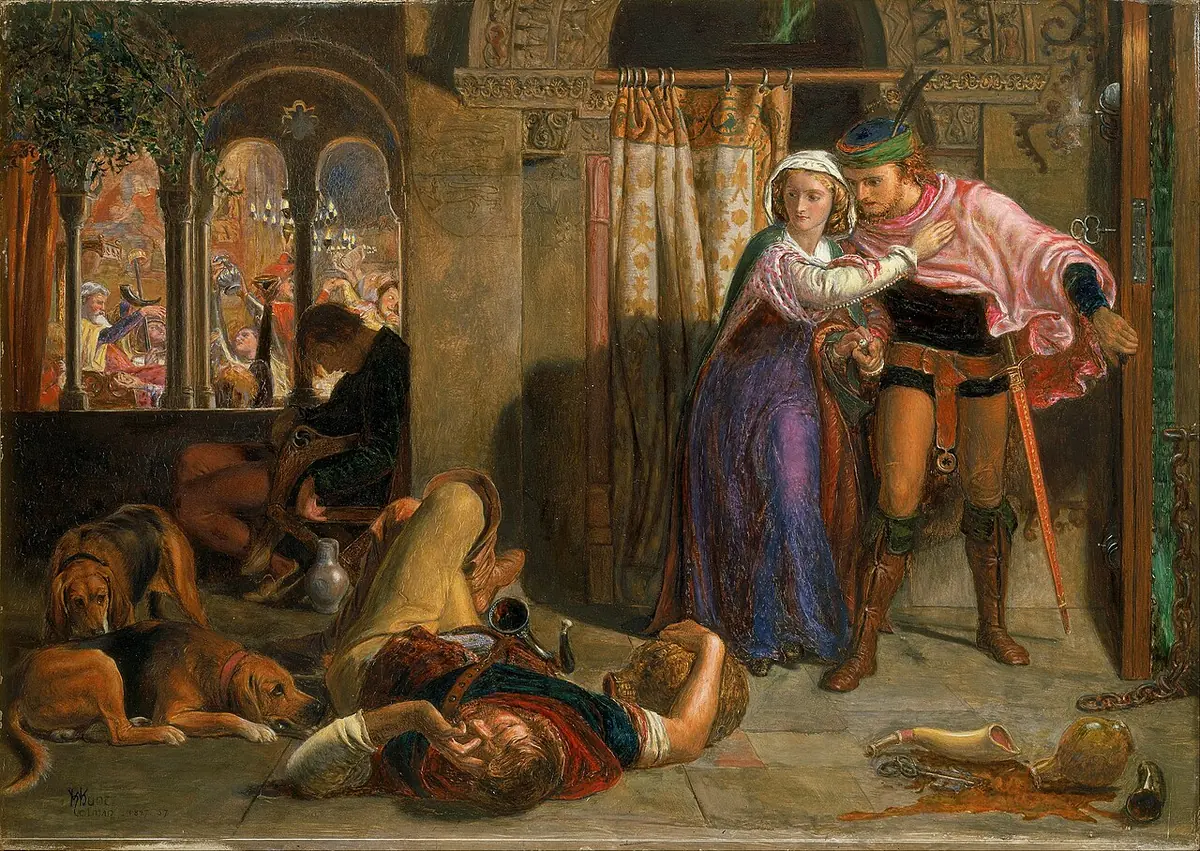

Prayer to St. Agnes
There is no prayer known to come from Agnes herself. The words given to her by Ambrose and the Acts belong to those writers. The prayers Catholics use come from the liturgy and old hymns:
- The collect of her feast, from the Roman Missal, quoted above.
- Her name in the Roman Canon, Eucharistic Prayer I, where the priest asks for fellowship with the martyrs Felicity, Perpetua, Agatha, Lucy, Agnes, Cecilia and Anastasia.
- The Latin hymn Agnes beatae virginis, once credited to St. Ambrose. The Catholic Encyclopedia says it was probably not his but was written soon after his time.
Outside the liturgy, Catholics simply ask, "St. Agnes, pray for us," especially for girls and young women, for engaged couples preparing for marriage, and for anyone who has suffered or fears violence. Prudentius ended his hymn with a request of his own, which many still make: "Deign now to turn thy face on our miseries."
Read about other young martyrs of the early Church: St. Lucy, St. Agatha, St. Cecilia and St. Philomena, and the 20th-century girl martyr often compared with Agnes, St. Maria Goretti.
Frequently asked questions
What is St. Agnes the patron saint of?
Girls, young women, chastity, engaged couples and gardeners. Catholic groups for girls and young women, such as the old sodalities of the Children of Mary, often took her as patron, and some Catholics ask her prayers for survivors of sexual assault because of the threat she faced in her legend.
When is the feast of St. Agnes?
January 21, an obligatory memorial in the Catholic Church's General Roman Calendar. The date goes back to the Roman list of martyrs' feasts compiled in 354. Until 1969 a second feast, on January 28, recalled her appearance to her parents eight days after her death.
Why is St. Agnes shown with a lamb?
Her name sounds like the Latin agnus, "lamb," and the lamb stands for innocence and for Christ, the Lamb of God. The Greek word hagnē means "pure," and medieval writers enjoyed both meanings. Her legend also says she appeared to her parents with a lamb whiter than snow at her side.
How old was St. Agnes when she died?
St. Ambrose says twelve and St. Augustine says thirteen. Every early source agrees she was a young girl, and the Catholic Encyclopedia sees no reason to doubt it.
How did St. Agnes die?
St. Ambrose, the earliest writer, says she bowed her neck to the sword. Pope Damasus's epitaph speaks of fire. The later legend combines the two, saying the flames divided and left her unharmed, and then a soldier killed her with a sword.
What is the blessing of the lambs on St. Agnes Day?
Each January 21 two lambs are presented to the pope and blessed, a custom first mentioned in the 6th century. Benedictine nuns at the monastery of St. Cecilia in Trastevere shear them, and their wool is used for the pallia, the white woolen bands that the pope gives to new metropolitan archbishops on June 29. In 2026 Pope Leo XIV received the lambs in the Urban VIII Chapel at the Vatican.
Where are the relics of St. Agnes?
Her body lies beneath the high altar of the Basilica of Sant'Agnese fuori le Mura on the Via Nomentana, above the catacomb where she was first buried. Her skull is kept in a chapel of Sant'Agnese in Agone on Piazza Navona.
What is the Eve of St. Agnes?
The night of January 20. An old folk custom held that a girl who went to bed without supper and followed certain rites would dream of her future husband. John Keats made the custom the subject of his 1819 poem "The Eve of St. Agnes."
Sources
- Catholic Encyclopedia (1907): St. Agnes of Rome
- Ambrose, Concerning Virgins, Book I (Nicene and Post-Nicene Fathers)
- Jerome, Letter 130, to Demetrias
- Augustine, City of God, Book I
- Prudentius, The Passion of Agnes (Peristephanon 14), English verse translation (New Liturgical Movement)
- Fr. John Zuhlsdorf: Agnes, "Shining with the fire of divine love" (Damasus's epitaph, Latin and English)
- Golden Legend: Life of Saint Agnes (Caxton translation)
- Christian Iconography: St. Agnes in Art
- Vatican News: Pope Leo XIV presented with lambs on feast of St. Agnes (2026)
- Franciscan Media: Saint Agnes
- Cathedral of Saint Peter, Scranton: Memorial of St. Agnes, virgin and martyr (collect)
- John Keats, Poems Published in 1820 (Project Gutenberg)
- Roman Missal, Eucharistic Prayer I (Roman Canon)
- Roman Martyrology, January 21